

You've just finished a demanding session. In one hand, there's a tub of whey. In the other, a bottle of BCAAs or essential amino acids. Both promise support for muscle, but they solve different nutritional problems.
The useful question isn't which product sounds more advanced. It's whether you still need to increase total daily protein, or whether a smaller, targeted amino acid dose fits a specific training situation. That distinction prevents a common mistake: treating free-form amino acids as an automatic upgrade over a complete protein.
| Decision point | Amino acid supplements | Protein powder |
|---|---|---|
| Main role | Targeted delivery of selected amino acids | Increase total daily protein |
| Muscle-building use | Rapid signaling, especially with EAA formulas | Complete substrate supply for muscle protein balance |
| Calories and volume | Usually low-volume and low-calorie | Provides protein in a broader nutritional matrix |
| Best fit | Fasted, low-appetite, or low-calorie situations | Regular meals, recovery, and muscle-building diets |
| Default choice | Specialized tool | Practical foundation |
For a broader explanation of amino acid functions and categories, this science-backed amino acid guide from VitzAi.com is a useful starting point. The central buying decision remains simple: protein powder usually supports the foundation, while amino acids serve narrower purposes layered on top.
Table of Contents
- Why the Amino Acid vs Protein Powder Question Matters
- What Amino Acid Supplements and Protein Powders Contain
- How They Work Side by Side
- What the Evidence Shows
- Timing, Dosing, and Daily Use
- Choosing the Right Option for Your Goal
- Practical Recommendation and Safety Notes
Why the Amino Acid vs Protein Powder Question Matters
The comparison matters because both products can influence muscle protein synthesis, but they don't deliver the same nutritional package. A protein powder supplies intact protein that digestion breaks into amino acids. An amino acid supplement delivers selected amino acids in free form, usually with less volume and without the broader substrate pool found in protein.
That difference changes the answer to three questions people commonly ask:
- Will replacing protein powder with aminos cost muscle? It can, if the swap lowers total daily protein or removes a meaningful protein serving from the diet.
- Are BCAAs worth buying when protein intake is already adequate? The case is weak, because a complete protein already supplies the branched-chain amino acids along with the other essential amino acids.
- When can targeted amino acids make more sense than a shake? During fasted training, low-appetite periods, or situations where a full serving of protein feels inconvenient.
Start with the daily protein calculation
Muscle growth and recovery depend on more than a short-lived post-training signal. Your body also needs enough amino acid material across the day to support ongoing protein turnover and tissue maintenance. A small bottle of aminos may stimulate a useful signal, but it doesn't automatically replace the role of a protein-rich meal or shake.
This is why the most defensible framework for amino acid supplements vs protein powder begins with total intake:
- Establish whether meals already provide enough protein.
- Use protein powder to close a genuine intake gap.
- Add amino acids only when their low-volume, targeted format solves a real problem.
- Judge the supplement by the situation, not by the label's promise of faster absorption.
The 2026 systematic review in the British Journal of Nutrition supports a balanced interpretation. It screened 8,702 citations and included 39 studies, finding small but statistically significant improvements in fat-free mass, strength, and physical function from protein and essential amino acid supplementation in older adults with acute or chronic conditions (British Journal of Nutrition systematic review). That finding shows that both approaches can work, not that one product universally replaces the other.
Practical rule: If an amino acid product displaces a protein serving you needed, it isn't a precision upgrade. It's a reduction in total protein.
What Amino Acid Supplements and Protein Powders Contain
A product's ingredient panel sets limits on what it can provide. Amino acid supplements are not one category. BCAAs contain leucine, isoleucine, and valine. EAAs contain all nine essential amino acids. A standalone leucine product supplies one amino acid associated with initiating muscle protein synthesis, yet it does not provide the full set of building blocks required to form new muscle protein.
Protein powders use intact protein as their starting material. Whey concentrate, whey isolate, hydrolysate, casein, and plant blends are digested into a broader amino acid mixture. Depending on the formulation, a powder can also contain carbohydrates, fats, minerals, flavoring agents, and other ingredients.
The label “protein” is therefore too broad for a useful comparison. A 2025 protein powder formulation analysis reported 36.14 g of essential amino acids per 100 g in yeast protein powder, while legume products ranged from 30.76 to 32.29 g per 100 g. In a Greek-market survey, animal-based powders supplied a median 11.0 g of essential amino acids per serving, compared with 8.4 g for plant-based powders. Animal-based products also contained 18.0 g of BCAAs per 100 g, versus 14.7 g in plant-based products. Source and processing can change the amino acid profile, so the nutrition panel matters more than the product category alone.
Composition and Cost Snapshot
| Product | Typical serving | Calories | Key contents | Cost / serving |
|---|---|---|---|---|
| BCAA supplement | Label-dependent amino acid serving | Product-dependent | Leucine, isoleucine, valine | Product-dependent |
| EAA supplement | Label-dependent amino acid serving | Product-dependent | All nine essential amino acids | Product-dependent |
| Whey or plant protein powder | Label-dependent protein serving | Product-dependent | Intact protein with a broader amino acid profile | Product-dependent |
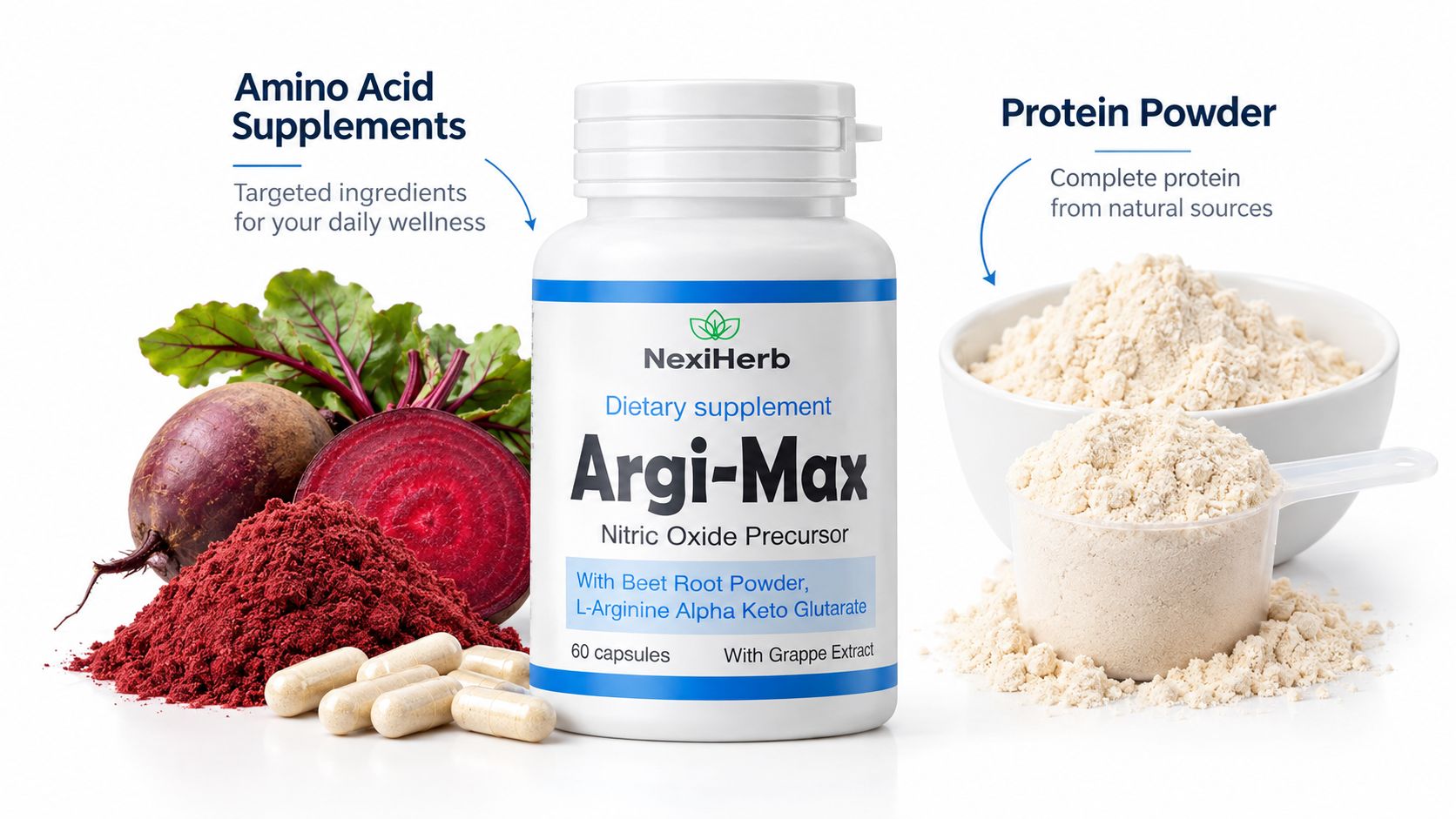
| Capsule amino acid formula | Two capsules in the Argi-Max formula | Product-dependent | L-arginine, L-citrulline-DL-malate, beet root powder | Product-dependent |
Amino acid products concentrate selected compounds. Protein powders deliver a wider protein matrix, although their composition still varies by source and processing. For practical ideas on combining protein, fluids, and other recovery nutrition, see this guide to best recovery drinks for athletes.
One example outside the BCAA and EAA categories is Argi-Max NexiHerb L-Arginine, L-Citrulline-DL-Malate, and beet root powder. Its listed serving is two capsules and includes L-Arginine HCL, L-Arginine Alpha Keto Glutarate, L-Citrulline-DL-Malate, and beet root powder. It is a capsule formula containing amino acids and a botanical ingredient, not a complete protein serving. NexiHerb's amino acid supplement overview provides further category context.
How They Work Side by Side
The most important difference is not only absorption speed. It's what reaches the muscle after absorption. Free-form EAAs can provide a rapid, defined signal, but a protein powder supplies a broader pool of amino acids that can support net protein balance after digestion.
A review from the International Society of Sports Nutrition notes that as little as 1.5 g of EAA can stimulate muscle protein synthesis at rest, while the maximal effective single dose is thought to be 15 to 18 g (International Society of Sports Nutrition review). The same review literature reports that oral EAAs can stimulate muscle protein synthesis more than an isonitrogenous protein isolate in some comparisons. Equal nitrogen therefore doesn't guarantee an equal anabolic response.
| Criterion | Amino acid supplements | Protein powder |
|---|---|---|
| Digestion | Free-form amino acids don't require intact protein digestion | Intact protein must be digested |
| Anabolic signaling | Defined EAA formulas can create a fast, targeted signal | Supplies EAAs plus a wider substrate pool |
| Satiety | Usually offers little food-like fullness | More likely to contribute to fullness because it provides protein in a broader serving |
| Convenience | Mixes quickly or comes in capsules | Requires a shaker or food preparation |
| Dietary flexibility | Useful when volume, appetite, or calories are constrained | Useful in shakes, oats, recipes, snacks, and meal gaps |
Signaling isn't the same as building
Leucine acts as an important trigger for muscle protein synthesis, but a trigger alone doesn't provide every material required for sustained protein accretion. That's why a BCAA product can look attractive on a label while remaining nutritionally incomplete.
Protein powder also offers more ways to use it. You can add it to a meal or drink when your schedule makes cooking difficult, rather than taking it only around training. An amino acid supplement wins on portability and low volume, not on completeness.
For readers comparing targeted supplement categories, this bioidentical ketone muscle recovery guide offers additional context on recovery-focused formulations. A product such as Tribulus Max NexiHerb Tribulus Terrestris Extract 40% Saponins belongs to a botanical supplement category, with Tribulus Terrestris extract listed per serving. It shouldn't be confused with either a complete protein powder or an EAA product. NexiHerb also provides a separate explanation of complete amino acid supplements.
What the Evidence Shows
The human evidence points to different jobs rather than one universal winner. Complete protein is the stronger tool for raising total daily protein intake. Free-form EAAs have a narrower role when a small, rapidly available dose is more practical than food or a full serving of protein powder.
Research in older adults provides a useful comparison. One review reported that 15 g of whey protein produced greater muscle protein balance than either 6.72 g of constituent EAAs or 7.57 g of non-essential amino acids in an acute setting (review of protein and amino acid metabolism in older adults). The result does not make EAAs irrelevant. It shows that a modest whey serving can outperform a smaller isolated amino acid formulation when the outcome is total muscle protein balance.
Formula composition also changes the result. In elderly subjects, a leucine-enriched EAA mixture reversed the lack of response observed with a whey-protein-based EAA mixture. The label “amino acids” therefore says little about whether a product supplies an effective essential amino acid pattern.
| Outcome | Amino acid supplements, EAA or BCAA | Whey or total protein powder |
|---|---|---|
| Muscle protein synthesis | EAA formulas can stimulate MPS with small doses; BCAA-only products are incomplete | Provides a broader amino acid supply and can support net muscle protein balance |
| Lean mass | Evidence is supportive in some older or clinical populations | Stronger fit for replacing missing daily protein |
| Recovery | Results depend on formula, dose, diet, and training context | Useful when recovery is limited by inadequate protein intake |
| Older-adult nutrition | Targeted EAA dosing may help when appetite or meal size is limited | Whey can provide a larger complete protein serving |
| Trained adults with adequate protein | Incremental benefit appears small or inconsistent | Main value is convenience, not automatic superiority |
Separate the signal from the substrate
BCAAs require particular caution. Leucine can initiate muscle protein synthesis signaling, while BCAAs alone do not supply all nine essential amino acids. The missing amino acids limit the complete material available for building new muscle protein.
A 2026 systematic review and meta-analysis in the British Journal of Nutrition found small effects across several outcomes in older adults, including a significant fat-free-mass effect of SMD 0.21, 95% CI 0.07 to 0.35, P<0.01 (systematic review and meta-analysis in the British Journal of Nutrition). The findings support supplementation in relevant populations. They do not show that BCAA-only products outperform diets that already provide adequate protein.
The buying conclusion is practical: assess total daily protein first, then consider amino acids for a specific rapid-signaling use case. A product such as All Night + Nitric-OX at -50% combines two dietary supplement formulas, one botanical formula with L-arginine and plant ingredients and another containing beet root extract, coenzyme Q10, and grape seed extract. It is neither an EAA formula nor a protein replacement, so it belongs in a separate decision category.
Timing, Dosing, and Daily Use
A protein shake after training can solve a missed meal. Free-form amino acids can suit a session where a full drink feels excessive. The useful choice depends first on total daily protein, then on whether the training window creates a practical reason to use a smaller supplement.
Build the day in this order:
- Set the protein foundation. The plan supplied for this guide uses 1.6 to 2.2 g of protein per kilogram of body weight daily as a starting range. Treat it as a planning guide, not a universal prescription.
- Use powder to fill a real gap. A shake can add protein to a low-protein meal or provide a convenient post-workout serving. It contributes to the daily total in a way an amino acid dose may not.
- Add EAAs selectively. The International Society of Sports Nutrition review reports EAA stimulation from as little as 1.5 g, with a proposed maximal effective single dose of 15 to 18 g. These figures describe a potential signaling use case, not a replacement for regular protein intake.
- Keep BCAAs subordinate. A BCAA serving may fit a training routine, but it does not provide the complete amino acid supply of a protein meal or full EAA formula.
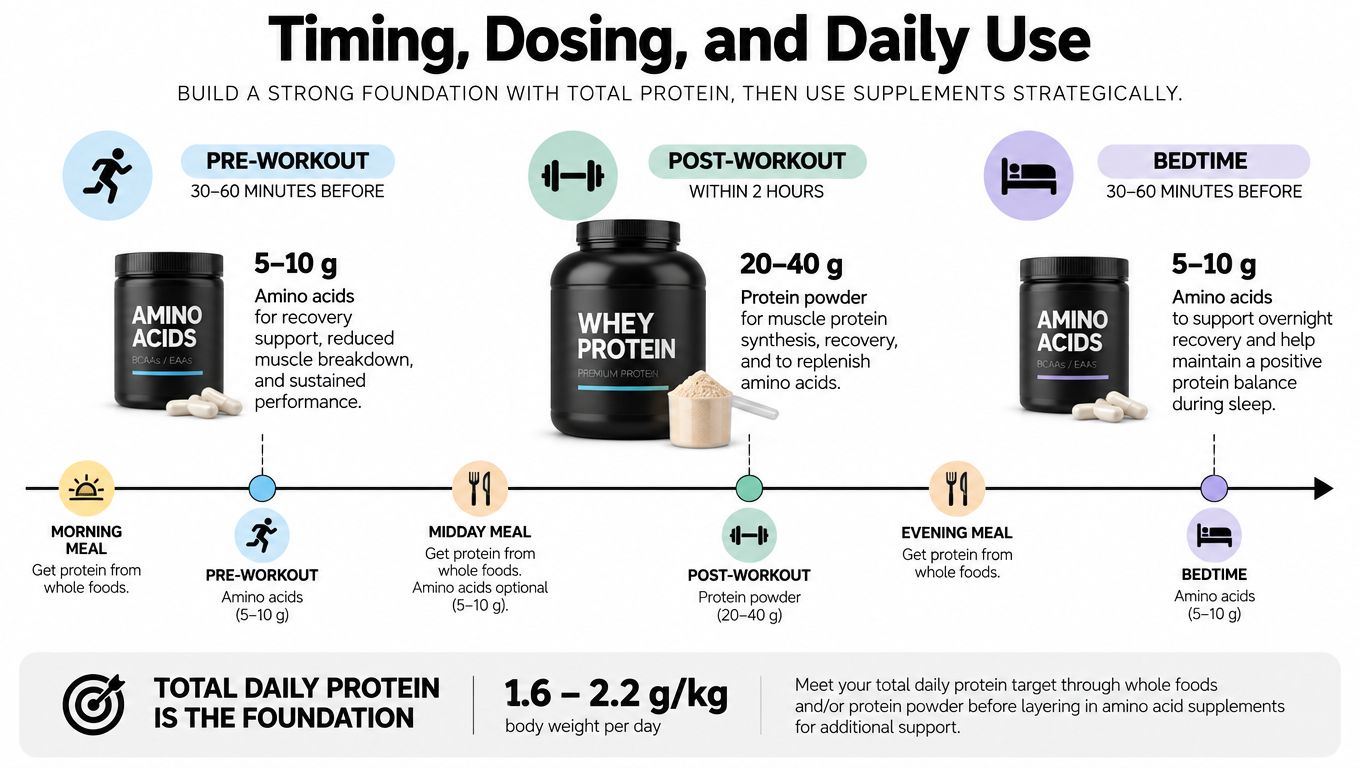
Match the format to the training day
Use a shake after training when you need meaningful protein and can tolerate the volume. Water keeps the serving lighter, while adding powder to a meal or smoothie makes it more substantial. Timing matters less than whether the serving helps you reach the day's protein target.
EAAs have a narrower role. A complete EAA formula may fit before or during a fasted session, a low-appetite morning, or a demanding training block when a full shake feels uncomfortable. A modest EAA dose alongside a later meal is more defensible than using amino acids alone as that meal.
The best time to take aminos depends on the training context, not a universal anabolic clock. After a protein-containing meal, the rationale for adding free-form amino acids becomes weaker.
Here's a practical visual aid for placing both options around exercise and sleep:
During a calorie deficit, prioritize protein powder when satiety and daily protein are the main constraints. At maintenance or in a surplus, powder can still improve convenience, while amino acids remain an optional precision tool. Neither should displace the varied diet that supplies energy, micronutrients, and other nutrients.
Choosing the Right Option for Your Goal
The right choice follows the constraint you're trying to solve. If the constraint is insufficient protein, choose protein powder. If the constraint is low appetite, low volume, or training without a recent meal, amino acids may fit better.
Goal-based choices
Muscle growth and strength: Start with a complete protein source. Whey or a suitable plant blend gives you a broader amino acid supply and helps raise total daily intake. Add EAAs only if a specific training window remains difficult to cover.
Fat loss: Protein powder generally offers more practical satiety than a small amino acid dose because it provides a meaningful protein serving. EAAs can fit before training when you want a low-volume option, but they don't replace the role of protein in a calorie-controlled diet.
Recovery: Choose based on what your diet is missing. When total protein is already matched, the incremental advantage of aminos appears small or inconsistent in trained adults, while a shake remains useful if it prevents an intake shortfall.
Travel and convenience: Amino acid sticks, capsules, or powders are easy to carry and prepare. Protein powder still works well when you have access to a shaker and want the nutritional value of a complete serving.
Fasted or endurance training: EAAs can be appropriate when a full shake creates digestive bulk before a long session. The decision is practical and context-dependent, not evidence that free-form amino acids are universally more anabolic.
Older adults or people with low appetite: A small EAA serving may help when a full meal is difficult. The 2026 review found benefits from both protein and amino acid supplementation in older adults with acute or chronic conditions, so the most suitable option depends on appetite, chewing, digestion, and the person's broader diet (British Journal of Nutrition review).
The narrow cases where amino acids can outperform protein powder are therefore clear: low-volume intake, fasted sessions, and targeted dosing when a full protein serving is impractical. In broader muscle-building situations, protein powder remains the more versatile default because it addresses the entire day rather than one signaling window.
Practical Recommendation and Safety Notes
For most strength trainees, choose protein powder first. It helps close a daily protein gap, supports meals that are short on protein, and provides a broader amino acid supply than a BCAA-only product.
For fasted training, very low-calorie days, endurance sessions, or older adults who struggle to eat enough at once, consider an EAA formula as a targeted supplement. The recommendation is not to abandon protein. It's to use a small, defined dose when digestion, appetite, or training logistics make a full serving inconvenient.
A practical decision sequence looks like this:
- Calculate your baseline: Use the supplied planning range of 1.6 to 2.2 g/kg of protein per day as a starting point, then account for your diet, training, body size, and professional guidance.
- Correct the largest gap: If meals fall short, add protein powder before buying BCAAs.
- Layer selectively: If recovery remains difficult during fasted or low-appetite sessions, consider an EAA serving within the verified effective range, rather than assuming more is better.
- Review the result: Track whether the product improves adherence to your nutrition plan. A supplement that sits unused or replaces a needed meal isn't solving the underlying problem.
Standard protein servings are generally well tolerated by healthy people, but individual medical conditions change the decision. Anyone with chronic kidney disease or maple syrup urine disease should consult a clinician before using protein or amino acid supplements. People taking medications, managing a diagnosed condition, or recovering from illness should also seek individualized advice rather than relying on a general supplement comparison.
The bottom line is straightforward. Protein powder is the default for total daily protein. EAAs are a precision option for specific constraints. BCAA-only products have the weakest rationale when protein intake is already adequate.
NexiHerb LLC offers amino acid formulas, botanical blends, nitric oxide support, and other dietary supplements intended to complement a balanced lifestyle and varied diet. Visit NexiHerb LLC to review clearly labeled options and choose a product that fits your protein strategy, training schedule, and everyday wellness routine.