

The most repeated chaga advice is simple: drink it every day and treat immune strength, calm inflammation, and extra energy as a done deal. That advice skips the part that decides whether a claim is real. Almost every popular benefit was measured in cells or animals, not in people who swallowed a cup of tea or a capsule.
Chaga mushroom benefits only make sense once you sort them by evidence level and put the oxalate kidney cases beside the marketing. A dark birch growth with a long folk history can still be a poor daily habit for the wrong person, at the wrong dose, in the wrong form.
Table of Contents
- Chaga Benefits Ranked by Strength of Evidence
- Why Chaga Is Studied and How It Might Work
- What Human Studies Have and Have Not Shown
- Safety Risks and Who Should Avoid Chaga
- Choosing a Chaga Product by Form and Label
- Confirm a Safe Chaga Routine Before You Start
Chaga Benefits Ranked by Strength of Evidence
| Benefit | Evidence level | Key finding | What it does not show |
|---|---|---|---|
| Antioxidant activity | Ex-vivo human cells and laboratory | Reduced hydrogen-peroxide DNA damage in lymphocytes from 40 participants | Does not show that tea or capsules raise antioxidant status throughout the body |
| Immune support | Traditional use and preclinical | Immune-related effects reported in cell and animal models | No robust human trials on immune outcomes |
| Inflammation markers | Preclinical | Anti-inflammatory compounds identified in laboratory studies | No human trials measuring inflammation markers |
| Blood sugar | Animal models | Reported reductions up to 31% in experimental models | Not an expected human outcome; relevant to people on glucose-lowering medicines |
| Tumor growth | Animal model | About 33% tumor growth inhibition in mice at 7 mg/mL aqueous extract | Does not show that chaga prevents or treats cancer in people |
| Energy, recovery, libido | No meaningful research | No relevant findings in reviewed studies | Not supported by current evidence |
Antioxidant activity sits at the top because human blood cells were tested, though the test happened outside the body. Immune support rests on folk use plus cell and animal work, which is a reason for curiosity, not a reason to expect fewer colds. Inflammation markers have named compounds behind them and no human trial that measured those markers after people took chaga.
Blood sugar figures, including reductions up to 31% in experimental models, belong to animals. They are not a result you should expect, and they matter if you already use a glucose-lowering medicine. The tumor growth row is a mouse result at a set extract concentration. It is not evidence that chaga prevents or treats cancer.
Energy, recovery, and libido have no meaningful research behind them. A major review found that, at the time of publication, no human experiments had been conducted on Inonotus obliquus, and a newer review found that no Inonotus obliquus clinical trials met its inclusion criteria, despite many cell and animal studies, according to a 2021 review in PMC.
Evidence rule: The higher the evidence level, the more confidence a claim deserves, and most chaga claims sit at the lowest levels.
If you want a wider map of what functional mushrooms can and cannot claim, our guide to functional mushroom benefits keeps the same standard: tradition and lab chemistry are not a clinical outcome.
Why Chaga Is Studied and How It Might Work
Inonotus obliquus earned its reputation long before modern labs existed. A 2024 review of chaga research describes centuries of traditional use across Russia, China, and other parts of East Asia for general health, digestive complaints, and skin disorders. In the 20th century, Soviet health authorities investigated folk reports, including claims involving tumors. That investigation is why chemists started pulling the fungus apart.
Think of tradition as the trailhead, laboratory work as the map, and human trials as the destination. The trail is old. The map is detailed. The destination is still ahead.
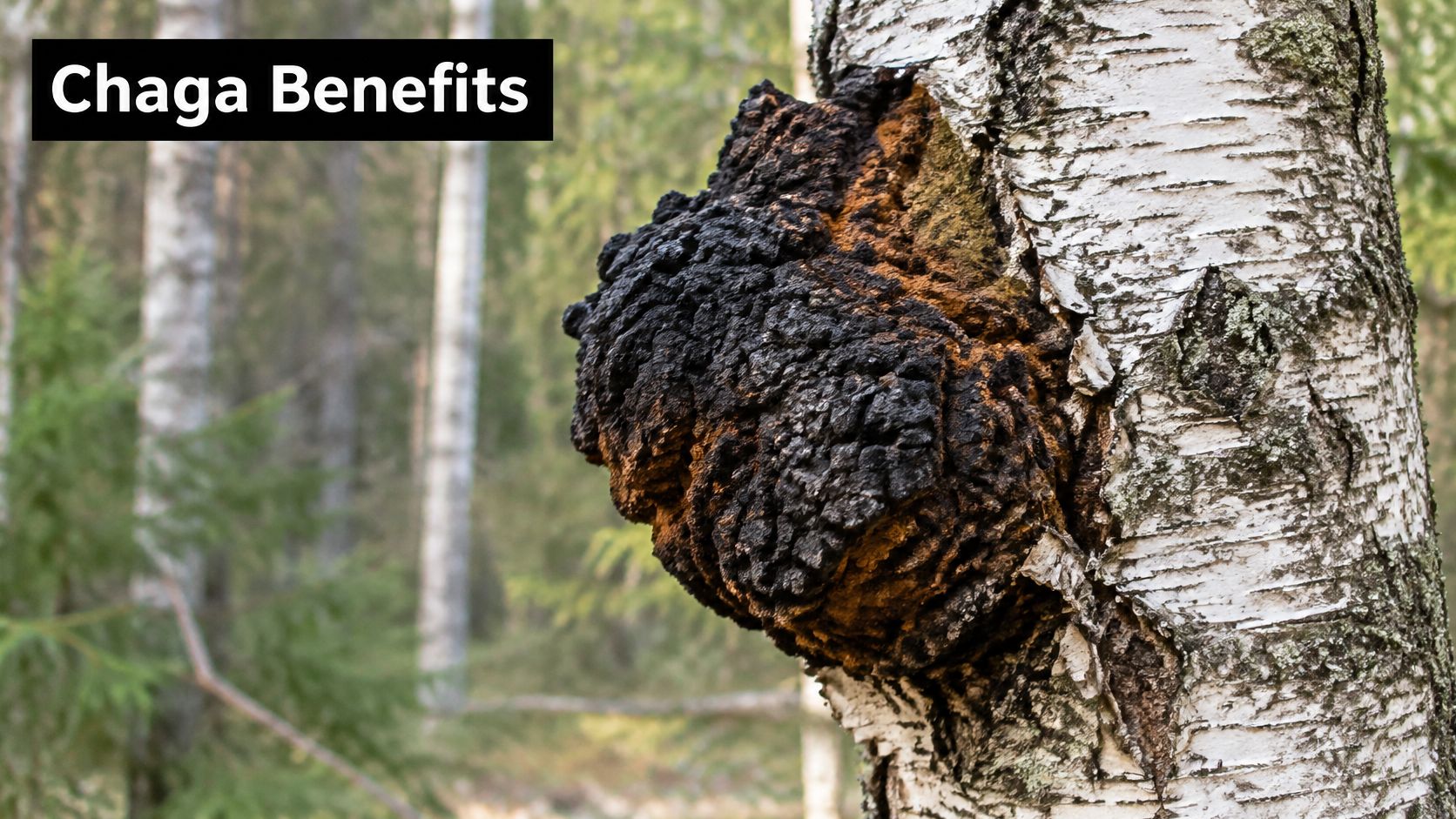
What the chemistry actually does
Laboratory and animal work has identified polysaccharides, polyphenols, triterpenoids, and melanin-related compounds with antioxidant, anti-inflammatory, antimicrobial, and metabolic activity. Reactive oxygen species nick cell structures the way rust eats metal. Antioxidant compounds are the cleanup crew, not a guarantee that your blood test will change.
A 2024 laboratory review reports that specific triterpenoids inhibited xanthine oxidase, an enzyme that generates reactive oxygen species. Phelligridin D reduced reactive oxygen species and malondialdehyde and increased superoxide dismutase and catalase. The proposed switch is the Nrf2–antioxidant response element pathway, which turns on cellular defense genes. That is a plausible mechanism in a dish. It does not make chaga a substitute for food-based antioxidants, and it does not treat oxidative-stress disease.
One animal experiment in that same research record used an aqueous extract at 7 mg/mL and reported about 33% inhibition of tumor growth in mice implanted with DLD-1 colorectal cancer cells over 36 days. That is a real biological measurement. It does not show that chaga prevents or treats cancer in people. Reviews from 2023 and 2024 still say immune, antioxidant, blood-sugar, and anti-inflammatory ideas need well-designed human trials.
For a plain-language look at how several fungi are discussed for immune interest, without treating any of them as medicine, the Yuve guide to immune mushrooms is a useful companion. Our own note on mushroom immune support stays in the same lane: optional wellness interest, not a treatment.
Compound levels swing with fungal strain, host tree, harvest conditions, and extraction solvent. A hot-water extract from one birch stand is not the tincture on a different shelf. Before you trust a claim, ask whether that source studied people, animals, or a dish of cells.
The short video below walks through what the growth looks like and how people have prepared it. Watch it as background, not as proof of a health effect.
What Human Studies Have and Have Not Shown
A laboratory change in human cells is not the same thing as a change in a person who drinks tea. Absorption, dose, and symptoms never enter an experiment that stops at a test tube.
The strongest human-relevant signal is a small oxidative-stress experiment described by the Cleveland Clinic. It involved 40 participants, 20 healthy and 20 with inflammatory bowel disease. Chaga extract at 10 mg/mL to 500 mg/mL reduced hydrogen-peroxide-induced DNA damage in peripheral blood lymphocytes, with significance at P < .001 in both groups. The cells were exposed outside the body. The result fits antioxidant activity in an ex-vivo model. It cannot tell you whether a mug of tea or a capsule does the same thing after digestion, what dose would matter, or whether any symptom would change.
Where chaga sits on an evidence ladder
Other often-quoted figures come from animals and labs. The same clinical summary describes blood-sugar reductions of up to 31% and tumor-size reductions of about 60% in experimental models. Those are not expected human outcomes.
Rank any future claim on this ladder:
- Laboratory. Compounds and cells only.
- Animal. A living body that is not yours, often at a fixed extract strength.
- Observational. People already using something, with no controlled comparison.
- Human clinical trial. A planned dose, a comparison group, and outcomes you can feel or measure.
Chaga currently sits on the first two rungs, plus one ex-vivo cell test. Controlled clinical evidence is extremely sparse. Toxicology has not been extensively studied, and randomized trials are still needed. The same summary ties daily use of about 4 to 5 teaspoons of powder for six months to oxalate nephropathy in a 72-year-old woman, and it flags possible interactions with anticoagulant, antiplatelet, and glucose-lowering medicines.
A healthy adult cannot bank on more energy, faster exercise recovery, or a change in libido. Any modest effect stays unproven until controlled trials exist.
Safety Risks and Who Should Avoid Chaga
Oxalate is the risk that benefit lists bury. Prolonged or high-dose chaga can expose susceptible people to a substantial oxalate load. Mushroom Atlas summarizes published case reports that link daily chaga powder with oxalate kidney injury, including a case that progressed to end-stage renal disease, and acute kidney injury after about 10 to 15 grams per day for three months alongside vitamin C.
Case reports cannot measure how often this happens in the general population, and they do not prove that an ordinary food-level serving harms everyone. They do make "natural" a useless safety standard. No validated safe dose exists. Tea and concentrated powder are not the same exposure, and a result from one aqueous extract does not transfer to every powder, tincture, or multi-mushroom formula.
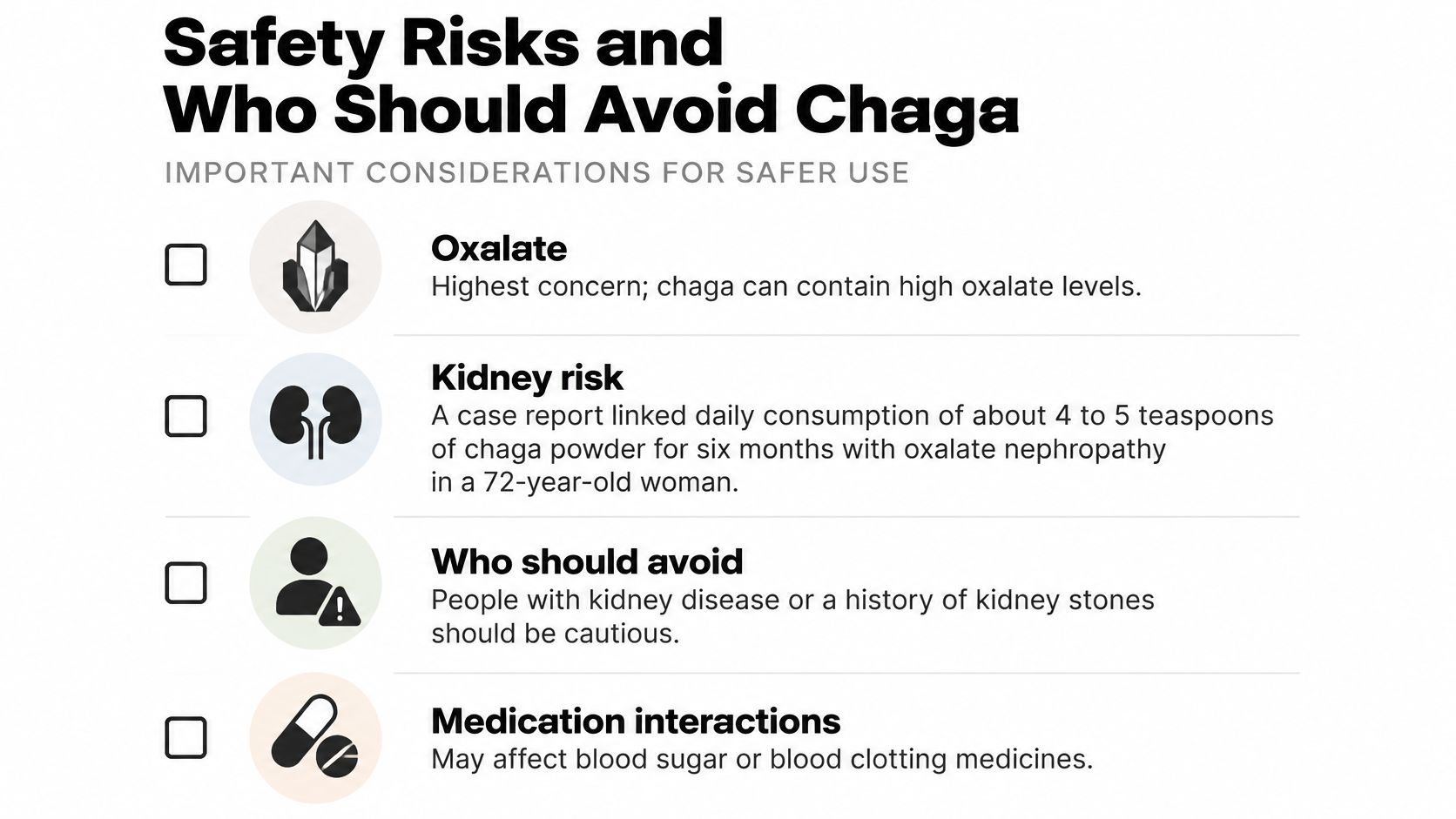
Who should pause before the first serving
| Situation | Main concern | Practical action |
|---|---|---|
| Kidney disease or prior calcium-oxalate stones | Oxalate load may worsen kidney injury | Avoid chaga or ask a nephrologist first |
| Daily high-dose powder (4 to 5 teaspoons) | Case report of oxalate nephropathy after six months | Do not use high-dose powder daily |
| Taking anticoagulant or antiplatelet medicines | Possible interaction and added bleeding risk | Ask a clinician before starting |
| Taking glucose-lowering medicines | Possible additive blood-sugar lowering | Clinician review and blood-sugar monitoring |
| Pregnancy or breastfeeding | Little safety data available | Avoid unless a clinician approves |
| Dehydration-prone training or restrictive diet | Oxalate handling depends on fluid balance | Hydrate well and keep to label amounts |
Active adults stack supplements, train while under-hydrated, and often add vitamin C. That combination is exactly where a casual powder habit gets less casual. A labeled serving that never states oxalate content leaves you guessing. Pregnancy, stone history, bleeding risk, and glucose medicines all belong in a clinician conversation before you start, not after a bad week.
Stop and get care promptly if you notice:
- Flank or back pain: Pain along the side or lower back that is new.
- Reduced urine: Less output than usual, or urine that looks off.
- Unusual fatigue: A drop in energy that doesn't match your training load.
- Bleeding or bruising: Nosebleeds, gum bleeding, or bruises you can't explain, especially on blood thinners.
- Dizziness with low blood sugar: Shakiness or lightheadedness if you use glucose-lowering medicine.
A small serving is not automatically risk-free. Hydration and a transparent label lower the chance of a surprise. They don't replace medical advice when your kidneys, medicines, or pregnancy status already raise the stakes.
Choosing a Chaga Product by Form and Label
| Form | How it is made | Typical use | Label check |
|---|---|---|---|
| Tea or decoction | Chunks simmered in water | Drink as a mild daily beverage | Species name and source listed |
| Powder | Dried and ground fungus | Mixed into drinks or food | Serving size and oxalate caution noted |
| Hot-water extract | Concentrated water extract | Measured dosing where stated | Extract ratio and batch testing listed |
| Tincture | Alcohol or alcohol-water extract | Measured drops | Alcohol content and extract ratio listed |
| Multi-mushroom capsule | Blend of several species | Convenience dosing | Confirm chaga is actually listed in the blend |
Tea or decoction is the old method: hard chunks simmered until the liquid darkens. You drink a mild beverage, and you still need the species name and where it was harvested. A jar that only says "wild mushroom tea" hasn't earned your trust.
Powder is the dried fungus ground fine. It disappears into coffee or oatmeal, which makes overuse easy. Look for a defined serving and any oxalate caution. Daily spoonfuls are the pattern behind the kidney case reports, so this form deserves the most restraint.
Hot-water extract concentrates water-soluble material and should state an extract ratio plus batch testing. That ratio tells you how much raw fungus went into the finished powder. A front panel that only shouts "chaga" doesn't.
Tincture uses alcohol or an alcohol-water mix. Drops are easier to measure than scoops, but you need the alcohol percentage and the extract ratio, especially if you avoid alcohol.
Multi-mushroom capsules win on convenience and lose on clarity. Chaga is in the blend only if the ingredient line names it. A bottle of "immune mushrooms" might be lion's mane and reishi with no Inonotus obliquus at all.
The label checklist at the shelf
- Species: Inonotus obliquus, not a nickname alone.
- Origin: Geographic source or host tree, when the brand knows it.
- Extract ratio: Stated for extracts and tinctures.
- Testing: Batch or third-party lab testing, not a slogan.
- Serving: A measured amount, not "brew to taste" with no limit.
- Claims: No promise to diagnose, treat, cure, or prevent disease.
Strain, tree, harvest, and solvent change the chemistry, so one published aqueous extract cannot stand in for every powder or blend. Powder used by the spoon carries the highest oxalate concern. A lower, measured amount of a verified product is the more cautious start, and a clinician should still sign off if you have kidney, bleeding, glucose, or pregnancy concerns.
If you compare powders more broadly, our notes on functional mushroom powder cover how serving size and species lists should read before you mix anything into a drink.
Confirm a Safe Chaga Routine Before You Start
Start with a clinician if you take medicines, have kidney or stone history, are pregnant or breastfeeding, or manage blood sugar or bleeding risk. Skip that step and the rest of the routine is guesswork.
- List every medicine and condition, including anticoagulants, antiplatelet drugs, and glucose-lowering drugs.
- Pick one form from the comparison above and don't stack a second chaga product on top.
- Read the label for Inonotus obliquus, the extract ratio, and a defined serving.
- Start at the label amount and don't climb past it because a friend uses more.
- Drink fluids through the day, especially if you train hard or follow a restrictive diet.
- Stop and seek care if flank pain, low urine, unusual fatigue, unexpected bleeding, or blood-sugar dizziness shows up.
- Review the routine with a clinician after four weeks and decide whether to continue.
A blend counts as chaga only when chaga is printed on its label. Our Triple Mushroom Complex contains Cordyceps, Reishi, and Lion's Mane. It isn't a chaga product. Like any supplement, it isn't intended to diagnose, treat, cure, or prevent any disease, and it's for adults used only as the label instructs.
Chaga is an optional wellness ingredient. It isn't a treatment, and skipping it is a reasonable choice when the evidence is thin and your kidneys or medicines raise the cost of being wrong.
NexiHerb LLC builds science-inspired supplements for everyday wellness, including functional mushroom formulas you can read label by label before you buy. If you want mushroom products framed as a complement to food and training, not as medicine, browse the catalog and the nutrition guides at NexiHerb LLC.