

Selenium 200 mcg is about 3.6 times the adult RDA of 55 mcg but half the U.S. adult upper limit of 400 mcg, so it's a high-dose supplemental amount, not automatically too much. It exceeds the upper limit for children under 9.
The more useful question is what happens after you add meals and other supplements. Europe's stricter adult benchmark leaves much less room for those sources, which means a capsule can look acceptable on its own while being a poor fit for your daily routine.
Table of Contents
- Is 200 mcg Too Much? Limits and Warning Signs
- What Selenium Does and What 200 mcg Adds
- Food Sources That Count Toward Your Daily Total
- Iodine and Other Interactions to Watch
- Confirm Your Total Intake Before You Start
- Deciding Whether a 200 mcg Supplement Fits
Is 200 mcg Too Much? Limits and Warning Signs
A recommended intake and an upper limit answer different questions. The recommended intake describes nutritional needs. The upper limit describes a safety boundary for total intake, not a target to approach.
The NIH Office of Dietary Supplements lists an adult RDA of 55 mcg daily and a U.S. adult upper limit of 400 mcg daily, making a 200 mcg serving approximately 3.6 times the RDA and half the upper limit. That comparison supports calling it a high-dose supplement, rather than a routine nutritional requirement.
The distinction is easier to see visually.
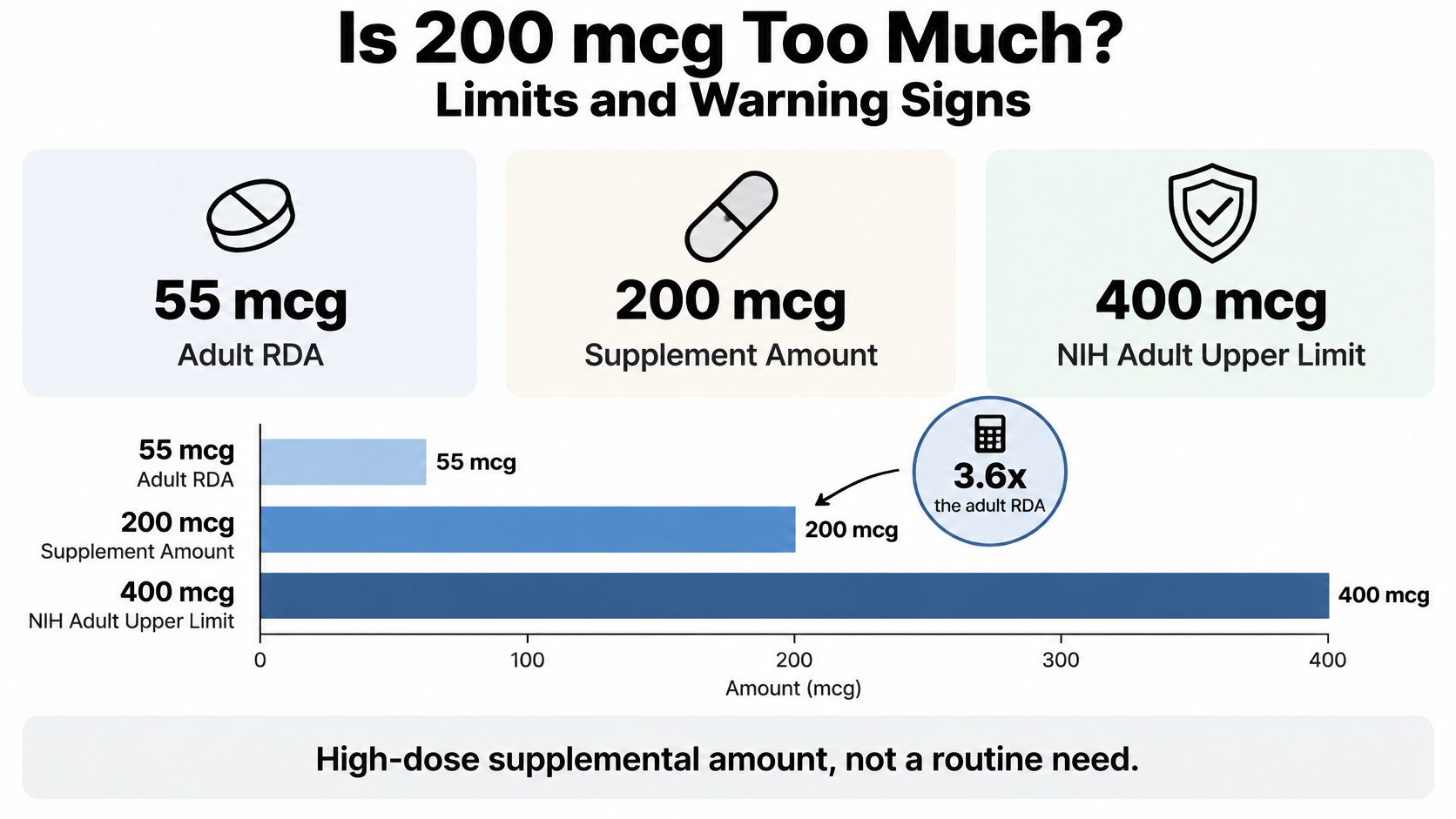
Compare the right age group first
The National Academies' dietary reference intake report establishes age-specific limits and sets the adult limit at 400 mcg daily, using a no-observed-adverse-effect level of 800 mcg daily and an uncertainty factor of 2. These are protective population benchmarks, not personalized predictions of when symptoms will begin.
Selenium 200 mcg Against Recommended and Upper Limits
| Group | Recommended intake | Upper limit | 200 mcg vs intake | 200 mcg vs upper limit |
|---|---|---|---|---|
| Infants 0-6 months | Age-specific adequate intake applies | 45 mcg | Not an infant nutritional dose | 155 mcg above limit |
| Infants 7-12 months | 20 mcg, adequate intake | 60 mcg | 10 times | 140 mcg above limit |
| Children 1-3 years | 20 mcg | 90 mcg | 10 times | 110 mcg above limit |
| Children 4-8 years | Age-specific childhood recommendation applies | 150 mcg | Not a routine childhood dose | 50 mcg above limit |
| Children 9-13 years | 40 mcg | 280 mcg | 5 times | 80 mcg below limit |
| Teens 14-18 years | 55 mcg | 400 mcg | About 3.6 times | 200 mcg below limit |
| Adults 19 and older | 55 mcg | 400 mcg | About 3.6 times | 200 mcg below limit |
| Pregnancy | 60 mcg | 400 mcg | About 3.3 times | 200 mcg below limit |
| Lactation | 70 mcg | 400 mcg | About 2.9 times | 200 mcg below limit |
| Adults, EFSA benchmark | 55 mcg, U.S. RDA for comparison | 255 mcg | About 3.6 times | 55 mcg below limit |
The European row uses the U.S. nutritional recommendation alongside the European safety benchmark. It shouldn't be read as a separate EFSA recommendation for nutritional intake.
Why the European benchmark changes the decision
The German Federal Institute for Risk Assessment's selenium assessment describes EFSA's revised adult upper limit of 255 mcg daily, leaving only 55 mcg after a 200 mcg supplement. EFSA used hair loss as an early observable adverse effect, deriving its limit from a lowest-observed-adverse-effect level of 330 mcg daily with an uncertainty factor of 1.3.
The difference between these benchmarks isn't permission to choose whichever makes a purchase look safer. It shows that authorities can evaluate uncertainty differently, and that the stricter benchmark deserves attention when considering long-term use.
Both comparisons concern total daily intake. A multivitamin, fortified drink, mineral capsule, and selenium-rich food all belong in the calculation.
Practical rule: Check the person's age before checking the capsule. Then assess the whole day, not just the supplement label.
Recognize warning signs without using them as a safety test
The NIH lists the following signs of excessive exposure in its fact sheet linked above. They aren't a reliable sequence that everyone experiences in order.
- Early sensory changes: Garlic-like breath odor or a metallic taste.
- Hair, nail, and skin changes: Hair loss, brittle or lost nails, and skin rash.
- Digestive and general symptoms: Nausea, diarrhea, fatigue, irritability, and nervous-system problems.
- Severe overdose effects: Breathing difficulty, tremors, kidney failure, heart attack, or heart failure.
Don't wait for symptoms to decide whether a dose fits. If you suspect excessive intake, stop adding nonprescribed selenium and seek medical advice; suspected overdose or severe symptoms require urgent medical attention.
What Selenium Does and What 200 mcg Adds
Selenium is part of selenoproteins, including enzymes involved in antioxidant protection and thyroid hormone metabolism. Those roles explain why adequate intake matters, but they don't establish that taking more improves health.
Think of selenium as a specialized tool in a repair crew. Missing equipment can prevent the crew from completing its work, but delivering extra tools doesn't necessarily make an already equipped crew work faster.
Higher blood levels aren't the same as better function
The NIH selenium fact sheet's thyroid evidence summary describes a randomized trial of 368 healthy adults aged 60-74 who received 100, 200, or 300 mcg daily as selenium yeast for six months. Plasma selenium increased, but researchers found no detectable improvement in thyroid-function measures.
That distinction matters when interpreting a supplement's effects. A higher selenium measurement demonstrates increased exposure. It doesn't, by itself, demonstrate a benefit that a person feels or a meaningful improvement in organ function.
The trial also has boundaries. It involved healthy older adults, so it doesn't settle every question about people with inadequate intake or a diagnosed condition. Nevertheless, it directly challenges the assumption that increasing selenium automatically improves thyroid function.
A nutrient's essential role explains why deficiency matters. It doesn't prove that an extra supplement helps someone who already has enough.
What a reasonable expectation looks like
The clearest rationale for supplementation is addressing inadequate intake under appropriate guidance. Even then, identifying a shortfall doesn't automatically establish that this particular capsule strength is necessary.
For someone whose intake is already adequate, the evidence presented here doesn't justify promises of better thyroid performance, general immune boosting, or cancer prevention. Nor should selenium replace prescribed thyroid treatment.
A useful decision starts with the outcome you're trying to achieve. If the answer is better wellness without an identified dietary gap, the case for a high-dose standalone product is weak.
Food Sources That Count Toward Your Daily Total
Food isn't background noise in a selenium calculation. It's part of the exposure you're evaluating, and a supplement adds to it rather than replacing it.
A useful food tally needs more than a food name. Match the food's preparation and portion to a reliable composition entry, then record how much you really ate. An entry for cooked fish, for example, shouldn't be substituted casually for a different species or serving.
Build a food log before assigning amounts
Approximate Selenium in Common Foods
| Food | Serving to record |
|---|---|
| Brazil nut | Individual nuts eaten |
| Yellowfin tuna, cooked | Actual cooked portion |
| Enriched spaghetti, cooked | Actual cooked portion |
| Beef, cooked | Actual cooked portion |
| Turkey, cooked | Actual cooked portion |
| Chicken breast, cooked | Actual cooked portion |
| Cottage cheese | Actual portion |
| Sunflower seeds | Actual portion |
| Brown rice, cooked | Actual cooked portion |
| Large egg | Eggs eaten |
This is a food-recording checklist, not a selenium-content table. Assigning precise selenium amounts or percentages without a matching composition entry would make the total look more certain than it is.
Brazil nuts deserve particular attention because they're selenium-rich. Don't use them as a precisely measured substitute for a capsule, or assume that a habitual serving is irrelevant when you're already taking supplemental selenium.
Use the tally to identify gaps, not create targets
Record an ordinary eating day rather than a deliberately ideal menu. Include foods eaten between meals, fortified products, and foods you consume repeatedly through the week.
The same approach helps when reviewing daily vitamins you should take: start with what your routine provides, then ask what's missing. Choosing supplements first and investigating food afterward reverses that logic.
Don't treat each meal as a separate opportunity to maximize selenium. The practical task is to estimate your overall intake well enough to decide whether an additional product has a purpose.
Iodine and Other Interactions to Watch
Selenium and iodine aren't interchangeable thyroid nutrients. Iodine provides material for thyroid hormone, while selenium-dependent enzymes participate in its metabolism.
The relationship resembles raw material and processing machinery. Supplying more machinery doesn't replace missing raw material, and adding raw material doesn't repair missing machinery. That analogy explains why guessing about either nutrient is a poor way to manage thyroid concerns.
Separate nutrient questions from medication questions
Taking selenium doesn't establish that your iodine intake is adequate. Likewise, buying an iodine product doesn't answer whether you need selenium.
Don't infer a deficiency from tiredness, a supplement advertisement, or a thyroid-support product name. A clinician can assess the relevant dietary and medical context rather than treating overlapping symptoms as a nutrient diagnosis.
If you take thyroid hormone replacement or antithyroid medication, bring the complete supplement list to your prescriber or pharmacist. Ask whether an added product is appropriate and whether its other ingredients affect how you should take your medication.
- Review combination products: A thyroid support complex needs an ingredient-by-ingredient review, not approval based on its category.
- Keep advice nutrient-specific: For a separate supplement question, vitamin C guidance from NZ Supps offers additional reading, but it shouldn't be used to infer selenium or iodine needs.
- Don't self-adjust treatment: Adding a nutrient isn't a reason to change prescribed thyroid medication.
The rule is straightforward: don't try to fix one thyroid nutrient by guessing about another. Ask a defined question about your intake or treatment before adding a product.
Confirm Your Total Intake Before You Start
Use a written tally rather than memory. Photographing labels makes it easier to review products together and prevents an ingredient in a combination formula from being overlooked.
This visual provides a starting workflow, but its U.S.-limit comparison shouldn't replace consideration of the stricter European benchmark.
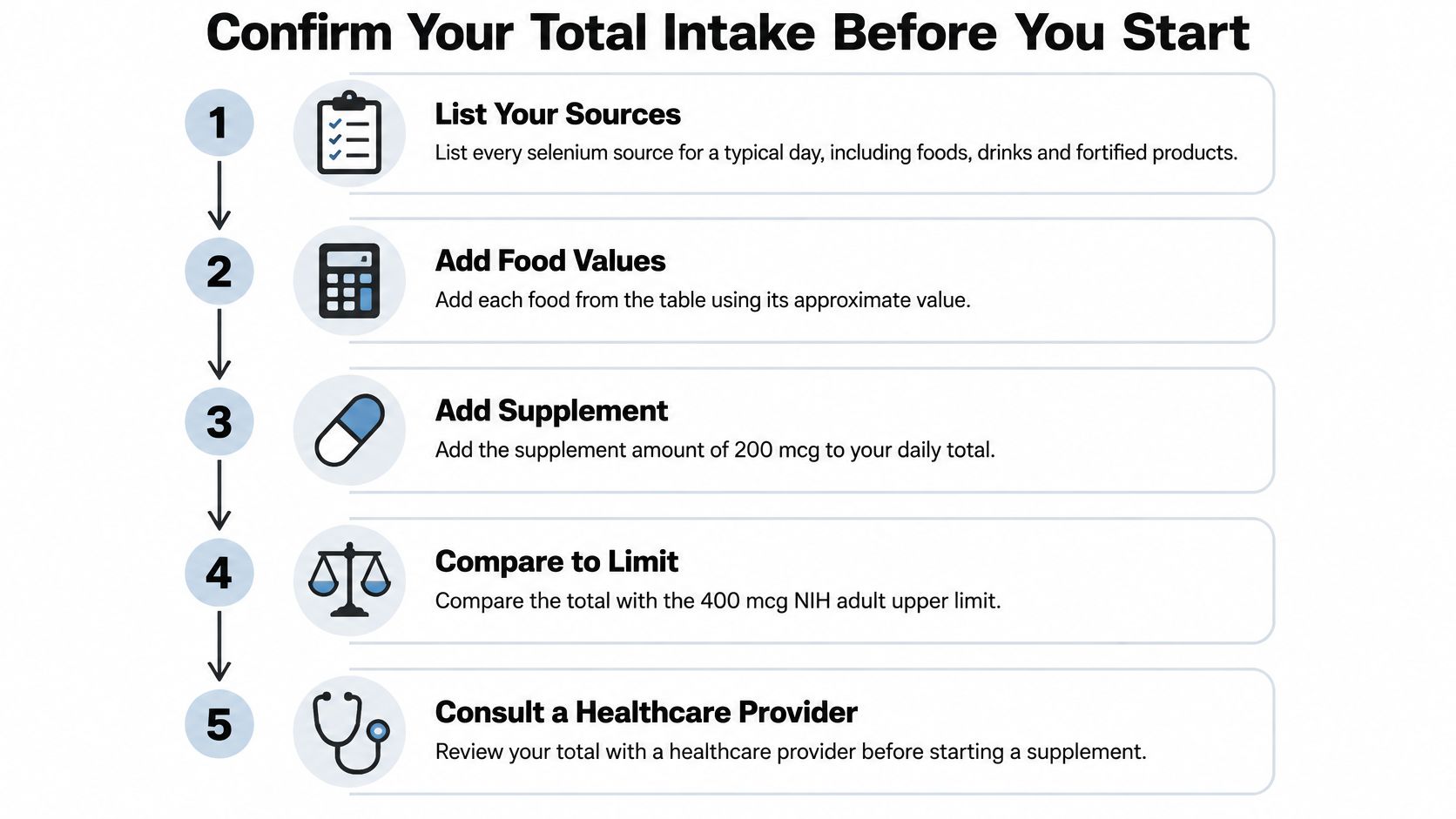
- Record your usual intake. Include meals, snacks, drinks, and fortified products.
- Match foods to composition entries. Mark uncertain estimates rather than treating them as exact.
- Read every supplement label. Use this guide on how to read supplement labels to distinguish serving size from amount per serving.
- Add selenium from all products, including the proposed capsule.
- Review the total against age-appropriate guidance. Don't interpret being below a ceiling as evidence that supplementation is useful.
- Ask a clinician whether testing would help before long-term use, particularly if you have symptoms or a suspected shortfall.
If you're comparing multivitamin options at Wallaby Wellness, apply the same label check to each candidate. A multivitamin belongs in the tally before a separate mineral supplement is considered.
For additional viewing, keep your labels and written tally alongside the video.
Before you add: If your proposed combination exceeds the conservative benchmark, reconsider the supplemental dose with a healthcare professional rather than cutting nutritious foods merely to make room for it.
Deciding Whether a 200 mcg Supplement Fits
| Situation | Recommended action | Reason |
|---|---|---|
| Documented low selenium or a restrictive diet | Ask a clinician whether this strength or a lower dose fits | A restrictive diet warrants assessment; it doesn't establish deficiency by itself |
| Healthy adult eating a varied diet | Usually skip a standalone high-dose product unless a gap is identified | Adequate intake isn't evidence of a need for extra supplementation |
| Adult already taking a multivitamin with selenium | Check the label and calculate the combined intake first | Overlapping products can leave little room for food |
| Pregnant or breastfeeding | Seek clinician guidance before adding a standalone product | Nutritional needs and the existing prenatal formula both matter |
| Children under nine | Don't use an adult-strength capsule unless specifically prescribed | The serving exceeds the relevant childhood safety limits |
| Taking thyroid medicine or an iodine product | Ask the prescriber or pharmacist first | The complete treatment and ingredient list need review |
| Men seeking prostate cancer prevention | Don't start on that rationale | The evidence presented here doesn't establish a prevention benefit |
Need matters more than capsule strength
A restrictive diet is a reason to investigate intake, not an automatic indication for supplementation. Someone avoiding several food groups may still obtain adequate selenium from the foods they eat, while someone with a seemingly varied diet may need a more individualized assessment.
Similarly, a label that appears compatible with a safety ceiling doesn't establish value. You still need a reason to take the product, a suitable dose, and a plan for reassessing whether it remains necessary.
The thyroid trial also makes a practical comparison possible: correcting a shortfall and trying to enhance normal function are different goals. A supplement can raise selenium exposure without improving the function a buyer hopes to change.
Price is secondary to an established purpose
A Target listing for Swanson selenium priced a 120-capsule product providing 200 mcg per capsule at $8.49 in 2026, approximately 7 cents per capsule. That's a price reference, not a recommendation or a guarantee of today's price.
Low cost doesn't resolve the nutritional question. An inexpensive product is still unnecessary if it adds no identified value, and a large bottle shouldn't become the reason to continue taking it.
Check combination formulas before buying separately
Vita Mix NexiHerb Multivitamin & Mineral Dietary Supplement is an adult multivitamin and mineral formula whose catalog ingredient list includes selenium. The catalog text doesn't specify its selenium amount, so check the current Supplement Facts panel before combining it with a separate product.
The package image is an identification aid, not a substitute for the quantitative label.
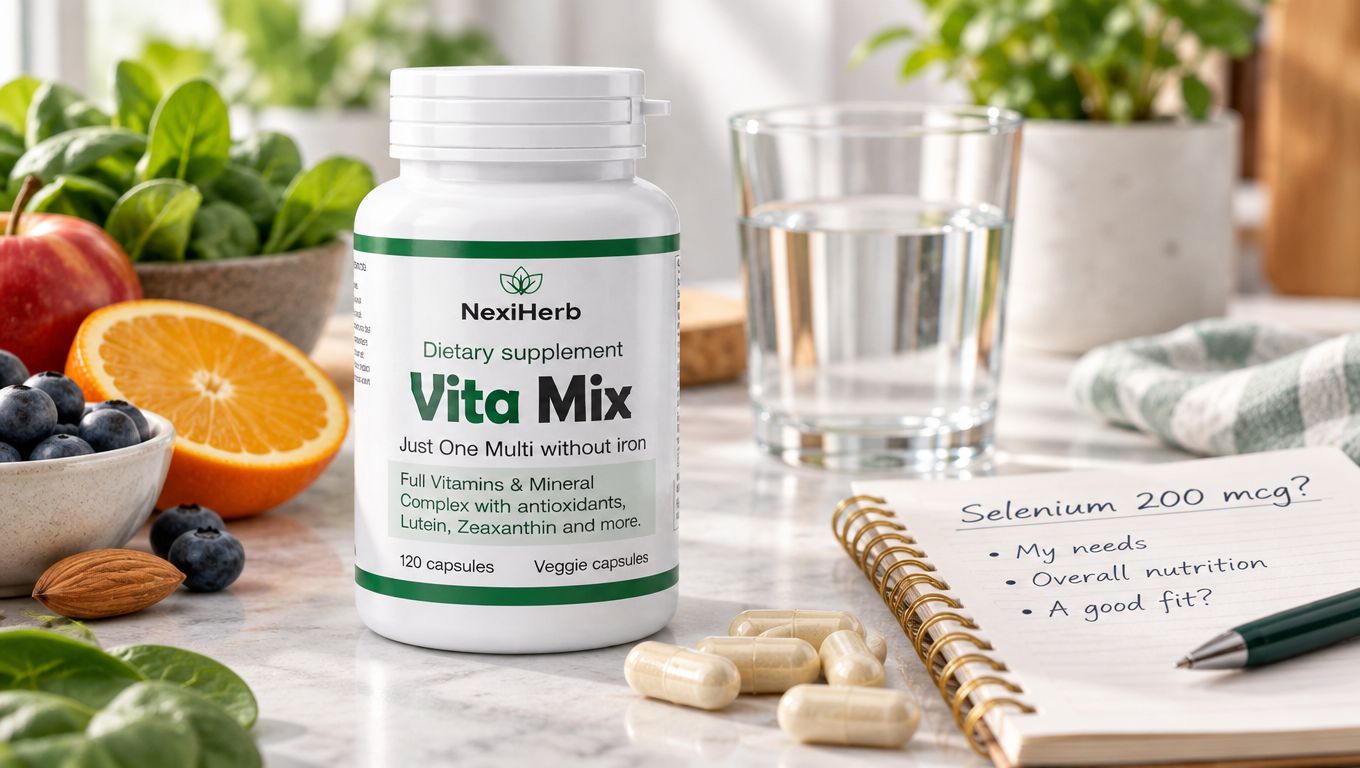
Don't enter an unknown amount as zero. If the label is unclear, ask the seller or manufacturer for the amount before making a stacking decision.
A selenium supplement is worth considering only after you know what it adds to your actual routine. If there's no demonstrated gap, no clinician-directed purpose, and no reliable total, postponing the purchase is the more defensible choice.
NexiHerb LLC offers dietary supplements and nutrition guides to help adults compare products with their everyday nutritional needs. Visit NexiHerb LLC to review multivitamin information, check labels, and identify any existing selenium before considering a separate supplement.