

The most popular advice about adaptogens is also the least reliable: take one, “balance your cortisol,” and expect stress to become easier. Adaptogens aren't magic pills, universal cortisol balancers, or replacements for medical care. They're a historically defined category of botanicals studied for their potential to support the body's response to changing physical and psychological demands.
So, what are adaptogens and how do they work? The useful answer requires more care than a list of trendy herbs. Their effects may involve several biological systems at once, and the outcome depends on the plant, plant part, extraction method, dose, preparation, and the person taking it. A transparent label and realistic expectations matter as much as the ingredient name.
Table of Contents
- Redefining Adaptogens Beyond the Buzzword
- The Multi-Target Mechanism of Stress Response
- Common Botanical Examples and Their Evidence
- Understanding Clinical Dosing and Standardization
- Navigating Safety Interactions and Quality Control
- Integrating Botanicals into a Daily Wellness Routine
- Building a Realistic Approach to Herbal Support
Redefining Adaptogens Beyond the Buzzword
The word adaptogen describes a classification concept, not a guaranteed result. It doesn't mean every product carrying the label has the same evidence, produces the same effect, or deserves the same level of trust.
The term was first proposed in 1940 by Soviet scientist N. V. Lazarev in connection with Schisandra chinensis. Soviet researchers Israel Brekhman and Igor Dardymov later developed a more formal herbal concept. By the 1990s, Hildebert Wagner, George Wikman, and Alexander Panossian described adaptogens as natural bioregulators that could support adaptation to environmental challenges and reduce stress-related damage. A commonly cited description characterizes phytoadaptogens as stress-response modifiers that nonspecifically increase resistance to physical, chemical, and biological stressors. You can read this historical development in the scientific review of adaptogens.
That history explains why adaptogens differ from conventional stimulants. Caffeine, for example, is commonly understood as producing a relatively direct increase in alertness. An adaptogen is generally proposed to support resilience and homeostasis, meaning the body's ability to adjust to changing conditions and return toward balance. That doesn't guarantee energy, calm, focus, or better performance.
A category, not a promise
Commonly discussed examples include:
- Panax ginseng, traditionally associated with stamina and vitality.
- Rhodiola rosea, often studied in relation to fatigue and cognitive performance under stress.
- Eleutherococcus senticosus, also known as eleuthero.
- Schisandra chinensis, a botanical connected to the early history of the adaptogen concept.
- Ashwagandha, frequently researched for stress-related outcomes.
These plants don't share one identical chemical profile. Their extracts may contain different active constituents, and manufacturers can use different plant parts, extraction techniques, and marker compounds. Treating them as interchangeable is like treating every fruit as nutritionally identical because they all grow on plants.
A useful definition: An adaptogen is a botanical studied for broad stress-response support, not a diagnosis, prescription, or assurance of a specific outcome.
The scientific literature remains preliminary, heterogeneous, or based on small studies in many areas. That makes responsible communication essential. A product can be described as supporting perceived stress, fatigue, or recovery when the evidence fits, but it shouldn't be promoted as treating anxiety, endocrine disease, burnout, or any other medical condition.
The practical shift is simple. Don't ask only, “Is this an adaptogen?” Ask, “Which botanical is this, what preparation does it contain, and what human evidence exists for that exact preparation?”
The Multi-Target Mechanism of Stress Response
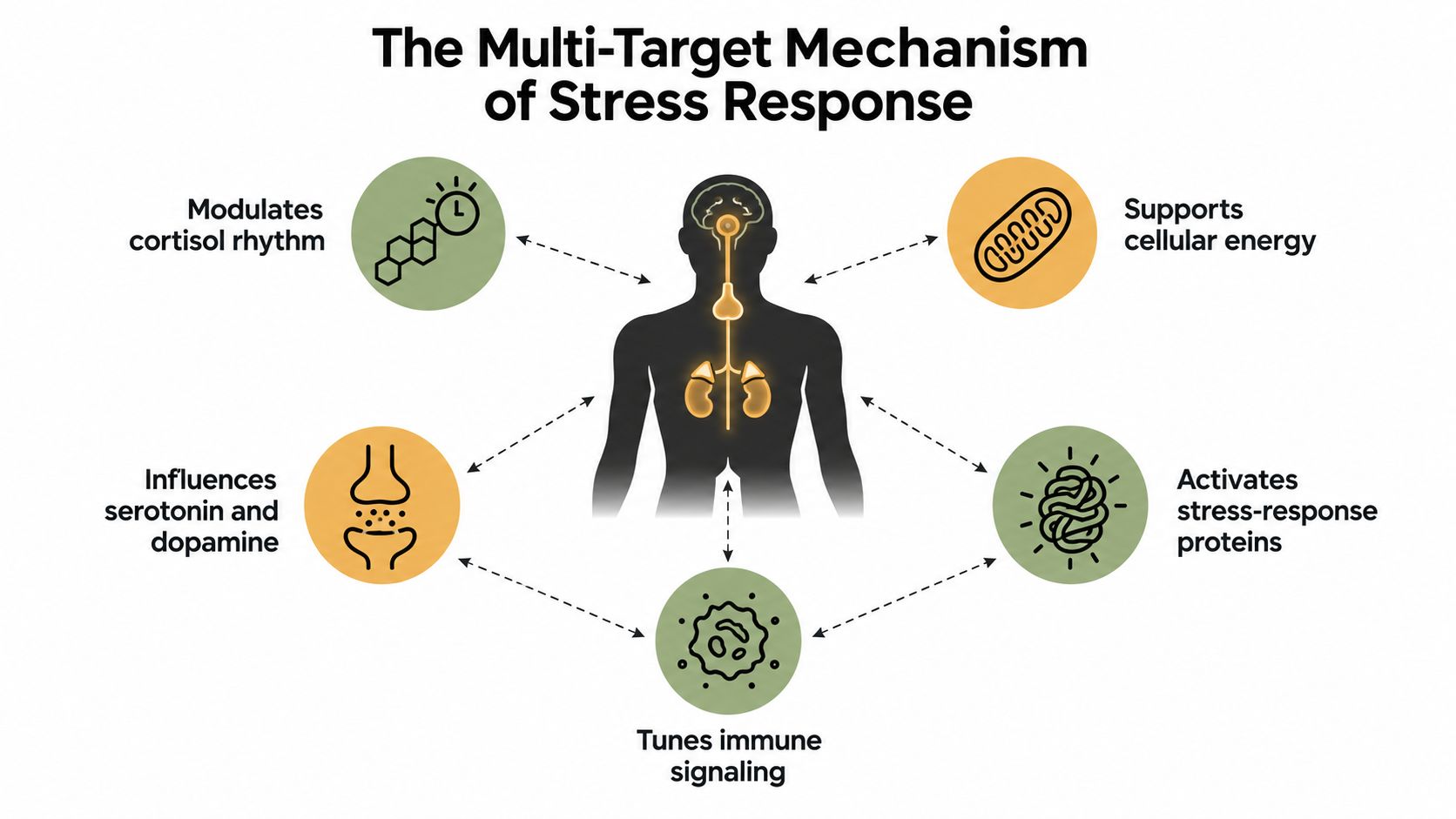
“Balances cortisol” is a tidy phrase, but it oversimplifies how stress works. Human stress biology behaves more like a thermostat network than a single switch. Multiple sensors, control centers, and feedback loops respond at once to sleep, perceived threat, physical exertion, inflammation, nutrition, and recovery.
Why the HPA axis isn't the whole story
The hypothalamic-pituitary-adrenal axis, or HPA axis, coordinates a major part of the stress response by linking brain signaling with hormonal activity in the adrenal glands. Cortisol matters within that system, but focusing on cortisol alone can make a network look like a single pathway.
Researchers also examine stress-response proteins, inflammatory signaling, antioxidant defenses, cellular energy regulation, and communication between the immune and nervous systems. In that broader model, the HPA axis, NF-κB and MAPK signaling, antioxidant defenses, and immune-neuroendocrine regulation are discussed as interacting systems rather than separate boxes. The recent evidence synthesis on adaptogen mechanisms and outcomes outlines why these pathways are often studied together, while also pointing out the need for larger and better-standardized clinical trials.
That distinction matters. A botanical may affect several points in this network without behaving like a simple sedative or stimulant. One part of the proposed action could relate to hormonal signaling, another to inflammation, and another to how cells respond to oxidative or metabolic strain. This is best understood as a working biological framework. It does not show that every extract sold under an adaptogen label produces the same result.
Why your result may differ from someone else's
Context shapes response. Someone who is under ongoing psychological pressure and sleeping poorly may have a very different experience from someone who is well rested and using an herb for occasional fatigue.
Baseline stress, overall health status, medication use, diet, and the exact extract can all influence what a person notices. Standardization and product quality matter here, too, because two formulas with the same plant name on the label may still differ in composition. Readers comparing blends can use this guide to stress support supplements for added context.
Herbs also work best as part of a broader support plan. Practical habits still matter, and these strategies to manage everyday stress focus on routines and coping skills that do not depend on a capsule alone.
A mushroom formula such as Triple Mushroom Complex Nexiherb, Cordyceps, Reishi, and Lion's Mane 90 caps includes mushroom-derived ingredients in capsule form for adult use. Its place in the adaptogen conversation does not, by itself, establish a specific clinical effect.
The main takeaway is straightforward. A broad proposed biology is not the same as broad clinical proof. Multi-target describes an interconnected stress model. Clinical confidence still depends on well-designed human studies using a clearly identified preparation.
Common Botanical Examples and Their Evidence
“Adaptogen” is a useful shortcut, but it can also blur real differences between herbs. Plants grouped under that label do not share one uniform effect, one active compound, or one level of evidence. A better way to read the category is to treat it as a set of botanicals that may influence stress-related systems through different chemical profiles, with research quality varying from one herb and extract to the next.
| Botanical Name | Primary Traditional Focus | Modern Research Outcomes |
|---|---|---|
| Panax ginseng | General vitality, stamina, and resilience | Human evidence varies by extract and outcome. It is commonly discussed in relation to energy and physical or mental fatigue. |
| Rhodiola rosea | Endurance and resistance to demanding conditions | Randomized studies have examined fatigue and cognitive performance during psychological or occupational stress. |
| Eleutherococcus senticosus | Broad resilience and physical capacity | Often discussed as a traditional adaptogenic botanical, though human findings depend on the preparation and measured outcome. |
| Schisandra chinensis | Endurance, concentration, and traditional stress support | Historically important to the adaptogen concept. Modern evidence remains dependent on preparation and study design. |
| Ashwagandha | Stress resilience and restorative support | Human trials have examined stress-related outcomes and cortisol measures using specific extracts. |
Read the botanical name and the extract
Common names can mislead. “Ginseng” on a label does not automatically mean Panax ginseng, and it does not tell you which plant part or extraction method was used. That matters because herbal research is tied to a named botanical and a defined preparation, not to a broad marketing category.
Rhodiola is a good example. Research has used extracts at approximately 200 to 680 mg per day, with reported findings involving fatigue and cognitive performance during psychological or occupational stress. Some double-blind studies observed salivary-cortisol reductions of roughly 14% to 30% after four weeks. Those results belong to specific extracts studied under specific conditions. The research focus on Canadian rhodiola for stress relief may help when comparing labels, but a product page does not stand in for the clinical trial behind the claim.
Ashwagandha shows the same pattern. Trials have used approximately 240 to 600 mg per day for 8 to 12 weeks, reporting changes in cortisol and stress-related outcomes. The key point is not the plant name alone. It is the exact extract, because withanolide standardization, manufacturing quality, and formulation can all shape how closely a product matches the research. For a closer look at two of the best-known examples, see the guide to ashwagandha and ginseng.
Tribulus helps illustrate the difference between a general herbal supplement and an herb with a clearer place in adaptogen discussions. Tribulus Max NexiHerb Tribulus Terrestris Extract 40% Saponins contains Tribulus terrestris extract standardized to 40% saponins, with a serving of 600 mg per capsule. That label detail is useful for product identification and comparison. It does not mean the product carries the same evidence base, historical use pattern, or classification as Rhodiola or ashwagandha.
The practical question stays the same. What outcome was measured, in which population, using which extract? That question cuts through the buzzword and keeps the focus on evidence rather than mythology.
Understanding Clinical Dosing and Standardization
Clinical dosing often sounds more precise than it really is. A label may show a neat milligram figure, but that number only makes sense once you know what was extracted, from which plant part, and how the finished product was standardized.
Milligrams alone work like counting cups of coffee without asking how strong the brew is. A 300 mg capsule made from a concentrated extract is not automatically equivalent to 300 mg of raw powdered root. A 3:1 extract and a 1:1 extract can both list the same daily serving, yet represent very different starting material and chemical profiles. That is why a trial dose cannot be copied blindly from one product to another.
Standardization helps translate the label into something more useful. If a product names the species, the plant part, the extract ratio, and marker compounds, you can at least compare like with like. For Rhodiola, labels may mention rosavins or related markers. For ashwagandha, they may list withanolide content. Those details do not prove that a formula will work the way a study did, but they reduce the guesswork.
A simple label review can prevent a common mistake. People see a bigger number and assume it means a stronger formula. In practice, the better question is whether the preparation resembles the one that was studied.
Use this quick screen before taking a dosing claim at face value:
- Botanical identity: Look for the full species name, not only a common name.
- Plant part: Root, leaf, berry, fruit, or a combination can change the preparation.
- Extraction details: Check whether the extract ratio or method is disclosed.
- Marker compounds: See whether relevant compounds are identified and standardized.
- Daily serving: Compare the serving to research on a similar preparation, not just the herb name.
- Trial duration: Ask whether the product's intended use matches the timeframe studied in humans.
Timing matters too. A useful guide on how long supplements take to work can help set expectations, but there is no universal countdown for adaptogens. Effects may be gradual, modest, or absent. That uncertainty is a reason to be careful, not a reason to keep increasing the dose.
Navigating Safety Interactions and Quality Control
A bottle can look polished and still tell you very little. With plant-based supplements, safety depends on what species was used, which part of the plant was processed, how the extract was made, and whether the finished product was checked for contamination. “Natural” does not answer those questions.
That matters because botanicals come from living raw materials, not identical lab-made inputs. Soil, water, storage, and manufacturing conditions can all affect what ends up in the capsule. Plants may also take up unwanted substances from their environment, including lead and nickel, so contamination screening belongs in the same conversation as ingredient choice and dose.
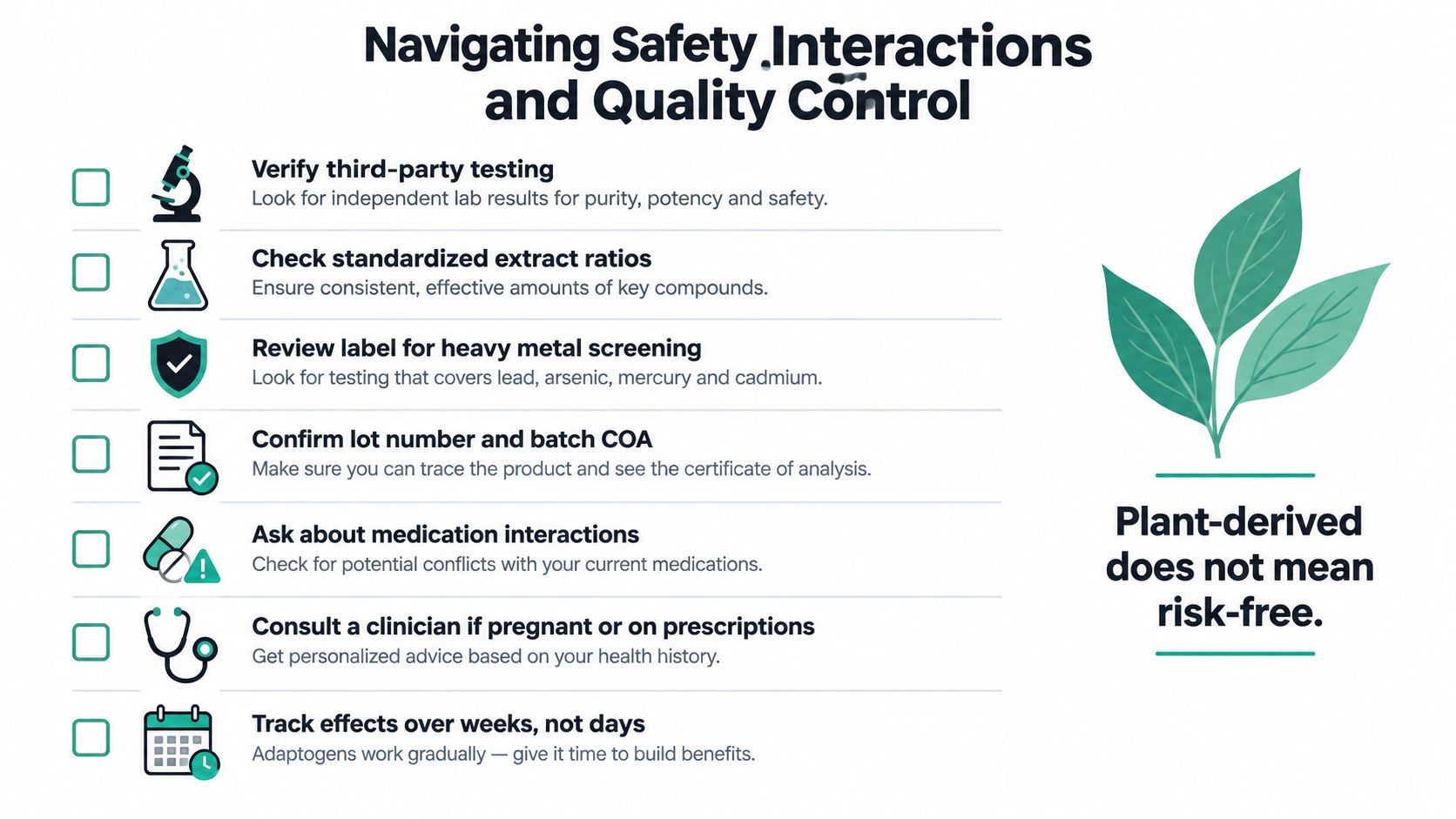
A practical way to judge a product is to read the label like a chain of custody record rather than a wellness promise. Start with identity. Does it name the exact species? Then check equivalence. Does it say whether the product uses root, leaf, berry, or another plant part? Those details help you tell whether two formulas are even in the same category.
Next, look for signs that the manufacturer can trace and test what it sells. Useful clues include listed marker compounds, a visible lot or batch number, and clear statements about testing for heavy metals or microbes. Medication and pregnancy warnings matter too. A product that hides those details asks you to assume more than you should.
Clinical trials on adaptogenic herbs often describe adverse events as mild and temporary, such as gastrointestinal discomfort, dry mouth, reduced appetite, or occasional upper-respiratory complaints. That is helpful, but it has limits. Short human trials can show what happened during the study period, not settle every question about long-term use, interactions, or product-to-product variation.
Use the same caution you would use with any active supplement. Stop if troubling symptoms appear. If you are pregnant, breastfeeding, living with a chronic condition, or taking prescription medication, ask a pharmacist or clinician before using an adaptogen. The goal is not fear. It is choosing a product you can identify, trace, and use more safely.
Integrating Botanicals into a Daily Wellness Routine
Daily use works best when a botanical supports a routine that already has basic structure. Regular meals, hydration, sleep, movement, and stress skills do more of the heavy lifting than any capsule. Herbs can fit into that system, but they should not be asked to carry it.
Start with a concrete reason for trying one. A person hoping to support perceived stress is asking a different question than a person focused on occasional fatigue or post-exercise recovery. That distinction matters because adaptogens are not one interchangeable group in practice. They are different plants, prepared in different ways, with different evidence behind them.
Keep the routine simple at first.
One new product is usually enough to learn from. If you add several botanicals at once, especially formulas with stimulating ingredients, you create a blurry test. It becomes harder to tell whether a change came from the herb, the dose, the timing, or something unrelated such as sleep disruption. Follow the label, stay within the recommended intake, and pay attention to timing if a formula feels activating later in the day.
A practical rhythm can look like this over the first stretch of use: choose one outcome to watch, use one product consistently, and write down changes in a few plain categories such as stress, energy, sleep, or recovery. The point is not perfect tracking. The point is separating a noticeable pattern from a hopeful guess.
That approach also keeps expectations realistic. Current evidence does not support routine adaptogen supplementation as a reliable way to improve athletic performance. A more accurate frame is possible support for perceived stress, fatigue, or recovery, depending on the botanical and preparation. “Natural” also does not guarantee a good fit with hard training, other supplements, or medication.
For non-supplement strategies that can sit alongside a simple routine, calming herbs for stress and anxiety offers broader ideas on coping practices and individualized support.
Building a Realistic Approach to Herbal Support
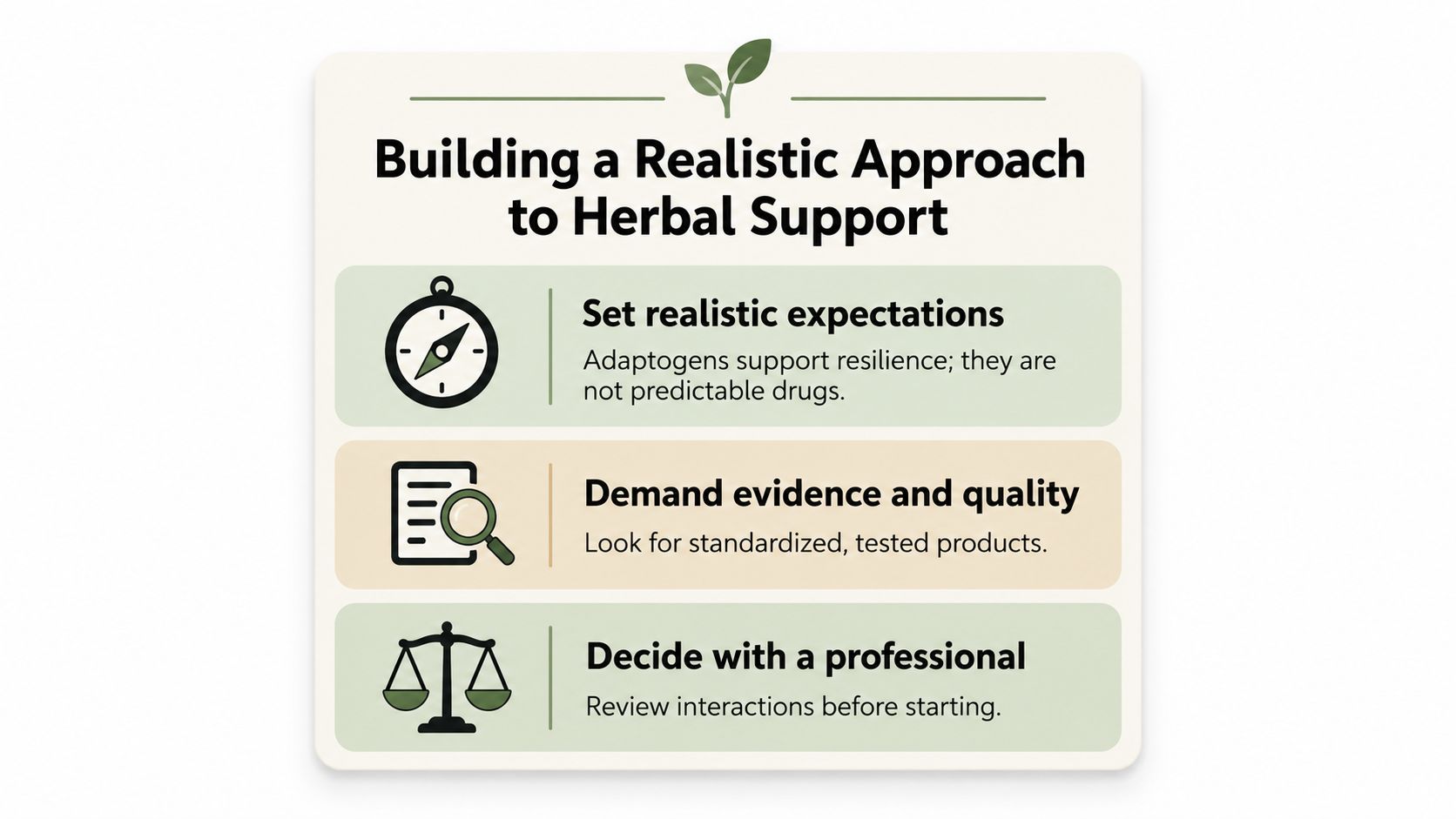
A sensible approach has three parts: define what you expect, inspect what you're buying, and involve a professional when the risk is meaningful.
Set realistic expectations
An adaptogen isn't a predictable natural stimulant. It may support resilience or a person's perception of stress, but the result depends on the individual and the preparation. It also isn't a substitute for treatment when anxiety, fatigue, sleep problems, or endocrine symptoms need clinical evaluation.
Demand evidence and quality
Evaluate each botanical separately. Prioritize human randomized trials over animal research or isolated laboratory mechanisms, then compare the trial preparation with the product label. Species, plant part, extract ratio, marker compounds, serving dose, manufacturing controls, and batch testing all shape the quality of the decision.
Decide with a professional
Medication interactions and individual contraindications deserve more attention than broad wellness claims. A pharmacist, physician, or qualified clinician can help assess whether a particular extract fits your health history, prescriptions, pregnancy status, and goals.
The answer to what are adaptogens and how do they work is therefore nuanced. They're historically defined botanicals proposed to influence several stress-related systems, but the category doesn't guarantee a particular result. Better choices come from matching a clearly identified extract to appropriate human evidence, using transparent products, and keeping supplementation in perspective.
NexiHerb LLC offers science-inspired dietary supplements across botanical blends, functional mushrooms, vitamins, amino acids, and other everyday wellness categories, with product information intended to support practical label-based decisions. If you're comparing options for a balanced routine, visit NexiHerb LLC and review each formula's ingredients, directions, and cautions before choosing.