

1,000 mg of vitamin C is below the 2,000 mg adult daily upper limit counting food, drinks, and supplements, but it's about 11 times the 90 mg male recommended dietary allowance. What matters most is how much you get altogether and how efficiently your body absorbs it, not merely whether the tablet falls below the limit.
A supplement label tells you what you swallow. It doesn't tell you how much reaches your bloodstream, how much you retain, or whether the extra amount improves your health.
Those distinctions matter when you're comparing a standalone tablet with a multivitamin, fortified drink, or more expensive formulation. They matter even more if you have a medical condition or take prescribed medication.
Table of Contents
- Where 1,000 mg Sits on the Vitamin C Scale
- Why Doubling the Dose Does Not Double the Benefit
- What the Evidence Supports at This Dose
- Ascorbic Acid, Buffered and Liposomal Compared
- Risks, Interactions and Who Should Check First
- How to Split and Time a 1,000 mg Dose
- Confirm the Dose Fits Before You Buy
Where 1,000 mg Sits on the Vitamin C Scale
A 1,000 mg serving is about 11 times the adult male recommended dietary allowance, according to the National Institutes of Health Office of Dietary Supplements fact sheet. The table compares that serving with adult daily requirements and the upper limit.
1,000 mg against adult benchmarks
| Adult group | Benchmark per day | How 1,000 mg compares |
|---|---|---|
| Women, RDA | 75 mg | About 13 times the benchmark |
| Men, RDA | 90 mg | About 11 times the benchmark |
| Women who smoke, RDA plus 35 mg | 110 mg | About 9 times the benchmark |
| Men who smoke, RDA plus 35 mg | 125 mg | About 8 times the benchmark |
| Adult tolerable upper intake level, all sources combined | 2,000 mg | Half the ceiling |
RDA means recommended dietary allowance. It is a daily intake benchmark for meeting nutritional requirements, not a supplement dose that everyone needs regardless of diet.
The tolerable upper intake level serves a different purpose. It marks a boundary for total daily intake from all sources, rather than a target for maximizing benefit. A 1,000 mg supplement is below that boundary, but the comparison alone does not show whether it suits your diet or circumstances.
Requirements and upper limits answer different questions
A person's usual intake and the upper limit measure different things. The RDA indicates a level intended to meet nutritional requirements; the upper limit marks a boundary for total intake. Staying below that boundary does not mean you need to use the remaining amount.
Practical rule: Count what's already in your routine before deciding what a supplement should add.
Check your multivitamin, drink powders, fortified beverages, and standalone supplements. Include your usual fruit and vegetable intake in the picture, too. Food is part of your total, not an insignificant extra.
The room below the upper limit is not a gap you need to fill. Your dietary intake may already meet your needs, or the amount you need to add may be much smaller than 1,000 mg. Assess the total rather than judging a tablet by its label alone.
Why Doubling the Dose Does Not Double the Benefit
In a controlled study, plasma vitamin C levels were already close to saturation at 400 mg daily. The researchers observed complete plasma saturation at approximately 1,000 mg daily, while bioavailability declined at single doses of 500 mg or more. The study tested seven daily intake levels, from 30 mg to 2,500 mg, with the sharpest plasma increase between 30 mg and 100 mg (controlled pharmacokinetic study of healthy volunteers).
These findings describe blood concentrations, not a point where the body suddenly stops absorbing vitamin C. As the dose increases, each additional amount tends to contribute less to circulating levels. The gut's transport capacity is one limit; the kidneys also remove absorbed excess.
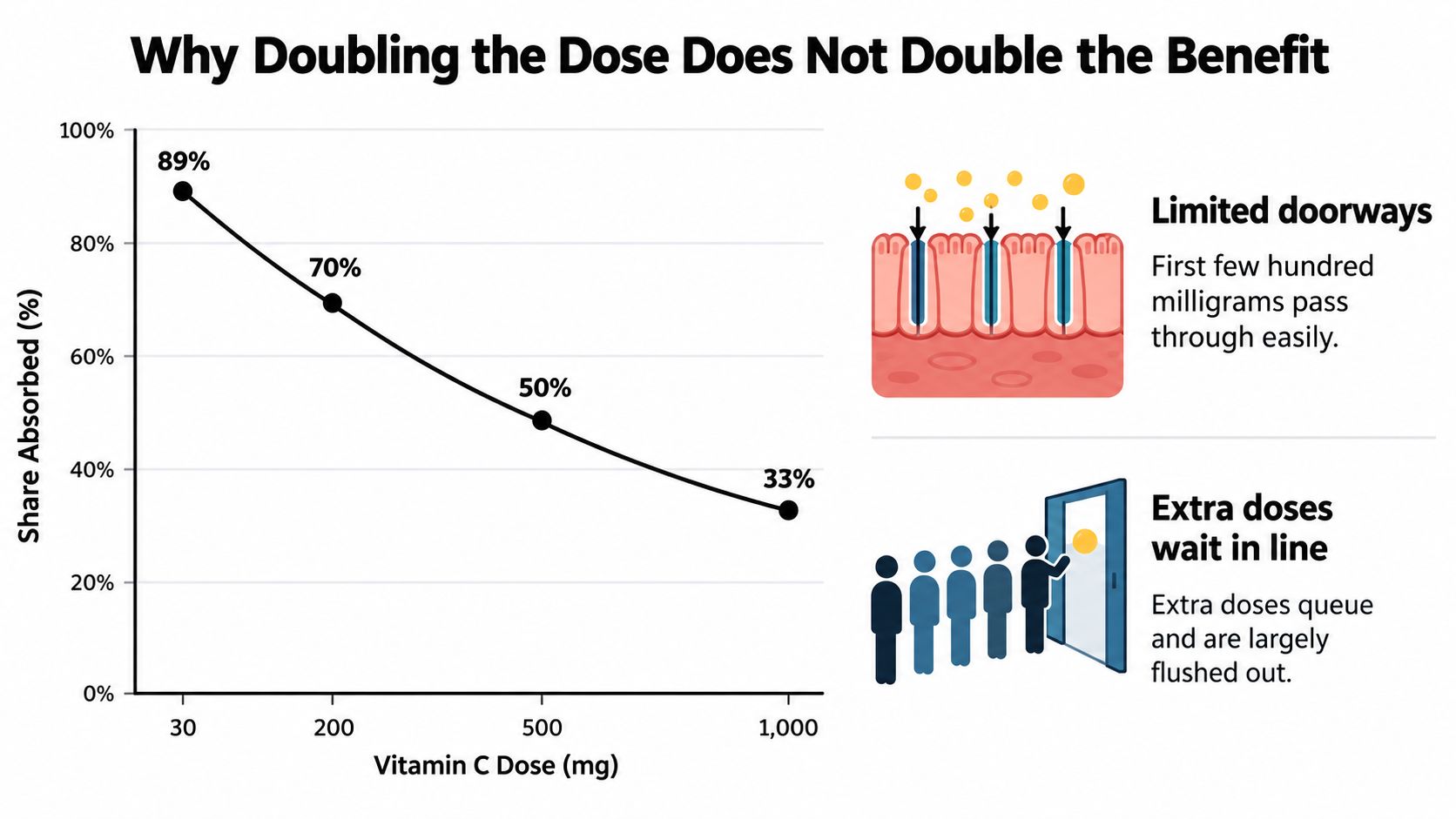
The chart shows this general pattern. Its plotted percentages are not precise predictions for any one person.
Absorption and blood concentration are different measurements
The distinction is like the difference between water entering a container and the level it reaches: how much is absorbed and how much remains circulating are related, but they are not the same measurement.
How absorption changes with daily intake
| Daily intake | Approximate absorption | What happens to the rest |
|---|---|---|
| Moderate dietary intake | A relatively high share is absorbed | Unabsorbed vitamin C remains in the digestive tract |
| Around the plasma-saturation range | Plasma saturation isn't an absorption percentage | Extra intake adds relatively little circulating vitamin C |
| Above the saturation range | Absorption becomes less efficient | Unabsorbed material leaves through the gut; absorbed excess can leave in urine |
That last distinction matters: unabsorbed vitamin C doesn't leave directly in urine, because it has not entered the bloodstream. Urinary excretion applies to vitamin C that has been absorbed.
For example, a larger tablet may deliver more absorbed vitamin C than a smaller one, but the increase is not necessarily proportional to the difference in dose. More absorption also does not, by itself, show that wellness improves measurably.
When assessing a supplement, keep three steps separate: the amount swallowed, the amount reaching the blood, and any health outcome. Read supplement claims against Herbswell's approach to supplement science, then check the product-specific evidence. A study of absorption does not establish a benefit for every product or user.
What the Evidence Supports at This Dose
The most defensible reason to supplement vitamin C is to address an intake problem or a clinician-identified need. That's different from assuming a large daily serving gives an already well-nourished person additional protection.
Vitamin C has established jobs in the body. It helps enzymes involved in collagen formation, supports absorption of iron from plant foods, and acts as an antioxidant, including helping regenerate other antioxidants. These are descriptions of nutrient function, not proof that increasing the dose continually improves those functions.
Nutrient support isn't a dose-specific promise
An immune-support claim can sound more specific than it really is. Supporting normal immune function doesn't establish that a particular tablet prevents infection, treats an illness, or speeds recovery in every user.
The same distinction applies to skin, connective tissue, and exercise-related marketing. A nutrient's involvement in a biological process doesn't prove that extra intake improves that process when nutritional needs are already met.
Meeting a need and adding a benefit are different outcomes. A supplement can do the former without demonstrating the latter.
For readers comparing immune-support supplements, the useful questions are practical:
- What outcome was tested? A change in blood concentration isn't the same as fewer illnesses or better recovery.
- Who took part? Findings in people with low intake may not apply to someone with an adequate diet.
- What was actually used? Evidence about vitamin C generally doesn't validate every formulation, combination, or serving size.
- What remains uncertain? A plausible mechanism is a reason to investigate a claim, not a reason to treat it as established.
People who eat very little produce have a clear reason to review their intake. Smokers should account for their different nutritional requirement, while people with malabsorption conditions need advice that considers the underlying condition rather than just choosing a larger tablet.
A varied diet also provides nutrients and food components that a vitamin C product doesn't replace. If your meals are consistently limited, use the supplement discussion to address that pattern, not to make it easier to ignore.
Choose a dose to solve an identifiable problem, not to match the largest number on the shelf.
Ascorbic Acid, Buffered and Liposomal Compared
The form affects how a product is made and may affect blood exposure. It doesn't, by itself, establish that the product produces better long-term health outcomes.
Vitamin C forms at a 1,000 mg dose
| Form | What it is | Evidence at this dose | Best fit |
|---|---|---|---|
| Ascorbic acid | Plain vitamin C, commonly available as tablets or powder | Reference form used for comparison; absorption becomes less efficient as intake rises | Adults who tolerate the plain form |
| Buffered sodium, calcium, or magnesium ascorbate | Vitamin C combined with a mineral, making the formulation less acidic | Calcium ascorbate hasn't shown a consistent plasma-concentration advantage over plain ascorbic acid | People who find plain ascorbic acid uncomfortable |
| Liposomal | Vitamin C encapsulated in lipids | A small single-dose trial found greater plasma exposure, not better long-term outcomes | People considering an alternative delivery form while accepting the evidence limits |
The appearance of a powder or liquid won't reliably identify its formulation. Read the ingredient list and Supplement Facts panel.
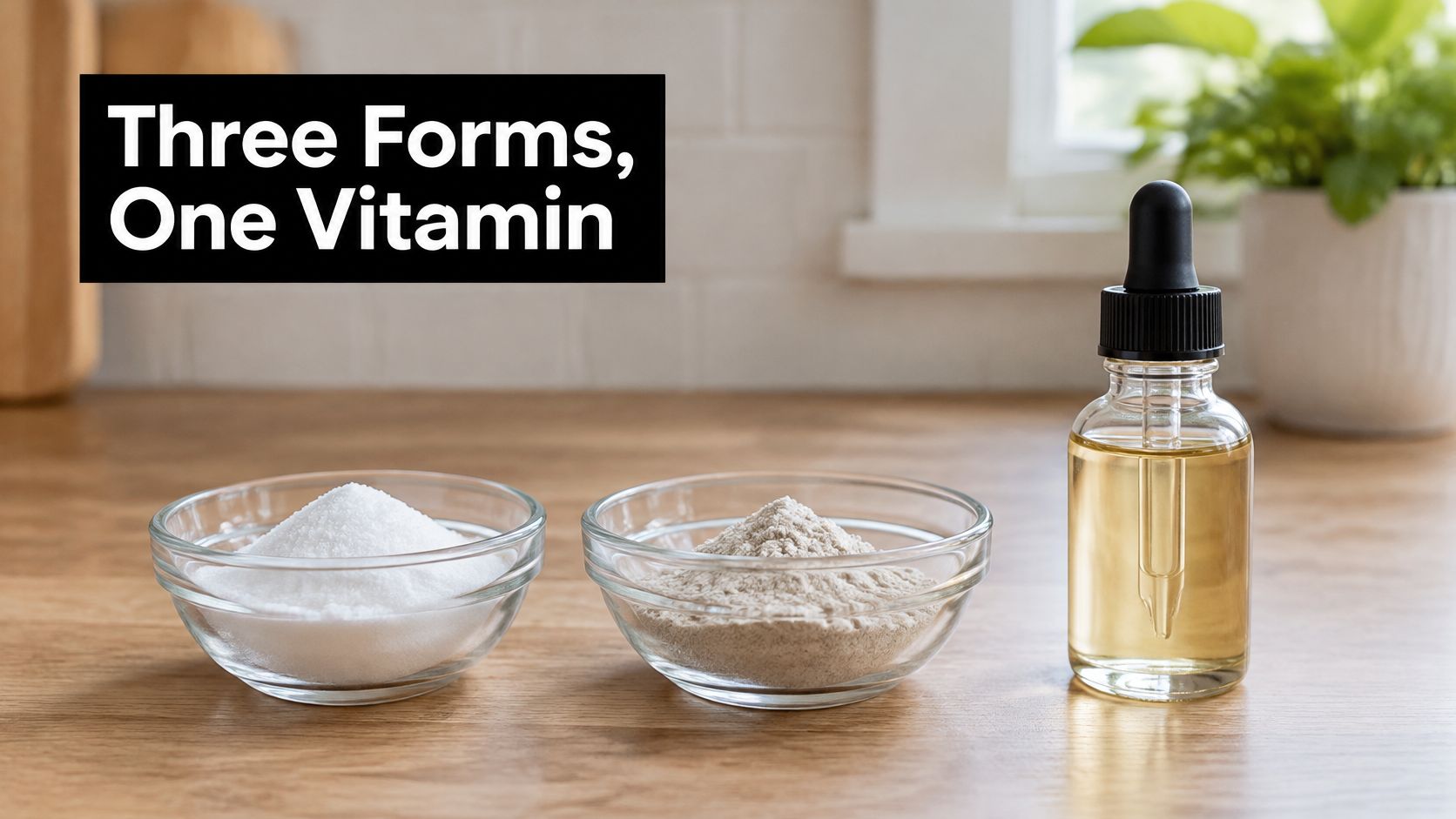
What the formulation trials actually measured
A randomized, double-blind crossover study published in Applied Sciences found approximately 30% higher plasma exposure after a single 1,000 mg liposomal dose in 10 healthy adults; its discussion also describes a 36-adult crossover trial that found no significant overall plasma-concentration difference between ascorbic acid and a calcium-ascorbate formulation.
Plasma exposure describes how much vitamin C appeared in blood over the measurement period. It doesn't tell us whether participants subsequently had better immune function, fewer symptoms, or improved long-term health.
Ascorbic acid is a straightforward reference option. If you tolerate it and have a reason to supplement, a more elaborate delivery system isn't automatically necessary. It suits someone who wants a simple formulation without paying for an unproven outcome advantage.
Buffered vitamin C may be worth considering when acidity makes the plain form unpleasant. Check which mineral accompanies it, particularly if you've been told to manage mineral intake. The plasma comparison doesn't establish better stomach comfort for everyone, so suitability remains individual.
Liposomal vitamin C is an optional delivery choice, not a demonstrated upgrade in health results. The small, single-dose study leaves questions about repeated use and clinical outcomes unanswered. It suits a buyer who understands that higher exposure and better health aren't interchangeable claims.
Before paying more, compare the amount of actual vitamin C per serving, the serving instructions, and any accompanying ingredients. Formulation is secondary to whether you need the dose in the first place.
Risks, Interactions and Who Should Check First
Water-soluble doesn't mean risk-free. Your ability to excrete excess vitamin C doesn't prevent digestive side effects or remove concerns related to medical conditions and treatment.
The NIH consumer guidance on vitamin C identifies diarrhea, nausea, and abdominal cramps as possible effects of excessive intake, warns about problems in people with hemochromatosis, and advises discussing potential interactions with cancer treatments. Kidney conditions and other relevant diagnoses also deserve an individualized review rather than reassurance based only on the adult ceiling.
Screening before a 1,000 mg dose
| Condition or situation | Why it matters | What to do |
|---|---|---|
| Kidney disease or past kidney stones | High supplemental intake can be a concern for susceptible people | Ask your clinician before starting a high-dose product |
| Iron overload, including hemochromatosis, thalassemia, or sideroblastic anemia | Vitamin C can increase iron absorption; the relevance depends on the diagnosis and treatment | Use only with clinician advice |
| G6PD deficiency | Advice about high-dose vitamin C depends on dose and route | Discuss the intended oral product with your prescriber |
| Ongoing cancer treatment | Supplements may interact with treatment | Get approval from the treating team |
| Sensitive digestion or previous supplement-related diarrhea | Large oral doses can cause gastrointestinal symptoms | Reduce or stop the product; consider a smaller divided intake if appropriate |
Make the review specific
For kidney disease or previous stones, tell your clinician what type of stone you had, if known, and bring the proposed product label. A general statement that vitamin C is excreted in urine isn't enough to assess your situation.
For iron-overload conditions, don't assume all forms of anemia mean you need more iron absorption. Your diagnosis and treatment history determine whether that effect is desirable or potentially harmful.
For G6PD deficiency, avoid treating evidence about intravenous vitamin C as though it directly describes an ordinary oral tablet. Ask your prescriber about the actual route and serving you intend to use.
For cancer treatment, ask about compatibility, not just timing. Separating a supplement from medication by a few hours doesn't necessarily prevent an interaction.
Before starting: Give your pharmacist the complete ingredient lists, including powders, multivitamins, and drinks, not just the names of your prescriptions.
Pregnancy and breastfeeding also call for personalized advice, especially when a prenatal supplement is already part of the routine. Don't apply adult guidance to children.
If digestive symptoms develop, don't treat them as proof that the product is working. Reduce or stop it, and seek medical advice for persistent or concerning symptoms. A condition-specific answer should come from your clinician, not from a population-level limit.
How to Split and Time a 1,000 mg Dose
Start with an intake inventory, not a timetable. A sports drink, multivitamin, and standalone tablet may overlap even when you think of them as serving different purposes.
The NIH professional guidance sets the adult upper limit at 2,000 mg daily from all sources and reports that absorption falls below 50% at doses above 1 gram daily. That supports a cautious approach to large servings, but it doesn't establish a universal split-dose schedule.
Use the visual as a reminder to tally and space intake, not as a prescription to reach its illustrated target.
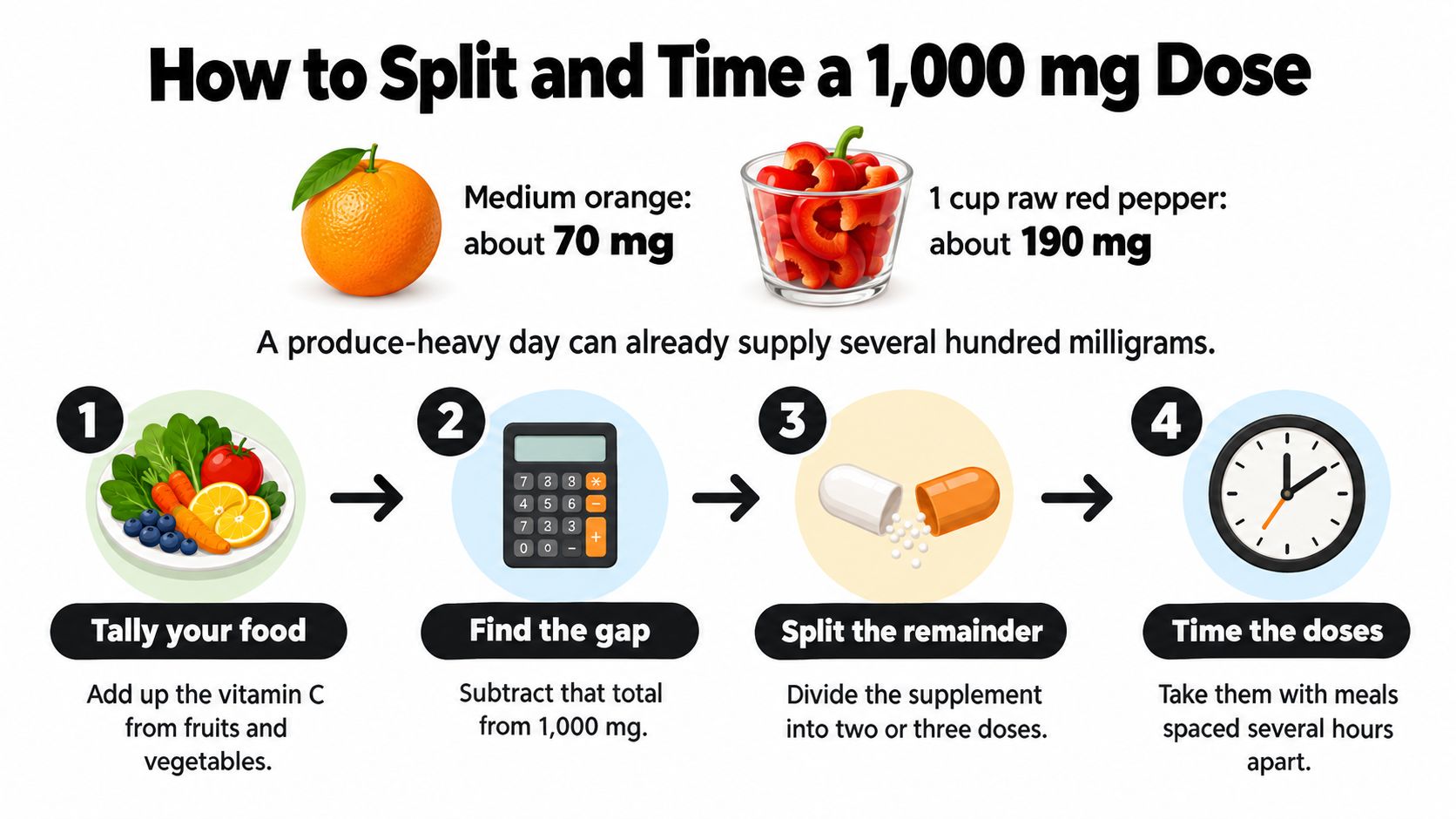
A repeatable routine
- Tally your usual intake. Record foods, fortified drinks, multivitamins, and standalone supplements. Use labels and a reliable food-composition reference rather than guessing food amounts from the illustration.
- Separate need from available room. Subtracting your intake from the adult ceiling identifies remaining room, not the dose you should take.
- Choose an appropriate serving. If supplementation is justified, a smaller divided intake may be easier to tolerate than a large serving at once. Don't split modified-release tablets or capsules unless the product instructions allow it.
- Build it around meals. Take the product with food and water if that improves comfort. Follow the product's preparation instructions for powders.
- Respond to symptoms. Reduce or stop it if nausea, diarrhea, or cramps occur. Don't wait through ongoing symptoms to complete a self-imposed trial.
- Recount when products change. Adding a fortified drink or replacing a multivitamin can change your total.
For an active adult, the practical issue may be an overlooked recovery powder rather than breakfast versus dinner. A guide to the best time to take vitamins can help organize the routine, but timing doesn't compensate for an unnecessary dose.
If you use video explanations alongside written instructions, keep your product label and medication advice beside you.
Confirm the Dose Fits Before You Buy
A search for 1000mg vitamin C can quickly become a comparison of tablet sizes, delivery systems, and marketing claims. Make the buying decision about your needs before comparing packaging.
Use these decision criteria rather than treating a large serving as the default:
- A clear reason. Identify the dietary gap or clinician recommendation you're addressing. Smoking or limited food choices justify reviewing intake, not automatically selecting a high-dose tablet.
- An appropriate safety review. If a medical condition or medication raises a question, resolve it before buying. A lower dose isn't a substitute for checking a potential interaction.
- A complete intake picture. Include every product that contributes vitamin C, then choose an amount that fits your circumstances.
For example, Vita Mix NexiHerb Multivitamin & Mineral Dietary Supplement includes vitamin C alongside other vitamins, minerals, and selected plant-derived compounds. Check its current label for the vitamin C amount before adding a standalone product; don't assume a multivitamin contribution is negligible.
Keep the Supplement Facts panel available while comparing products.
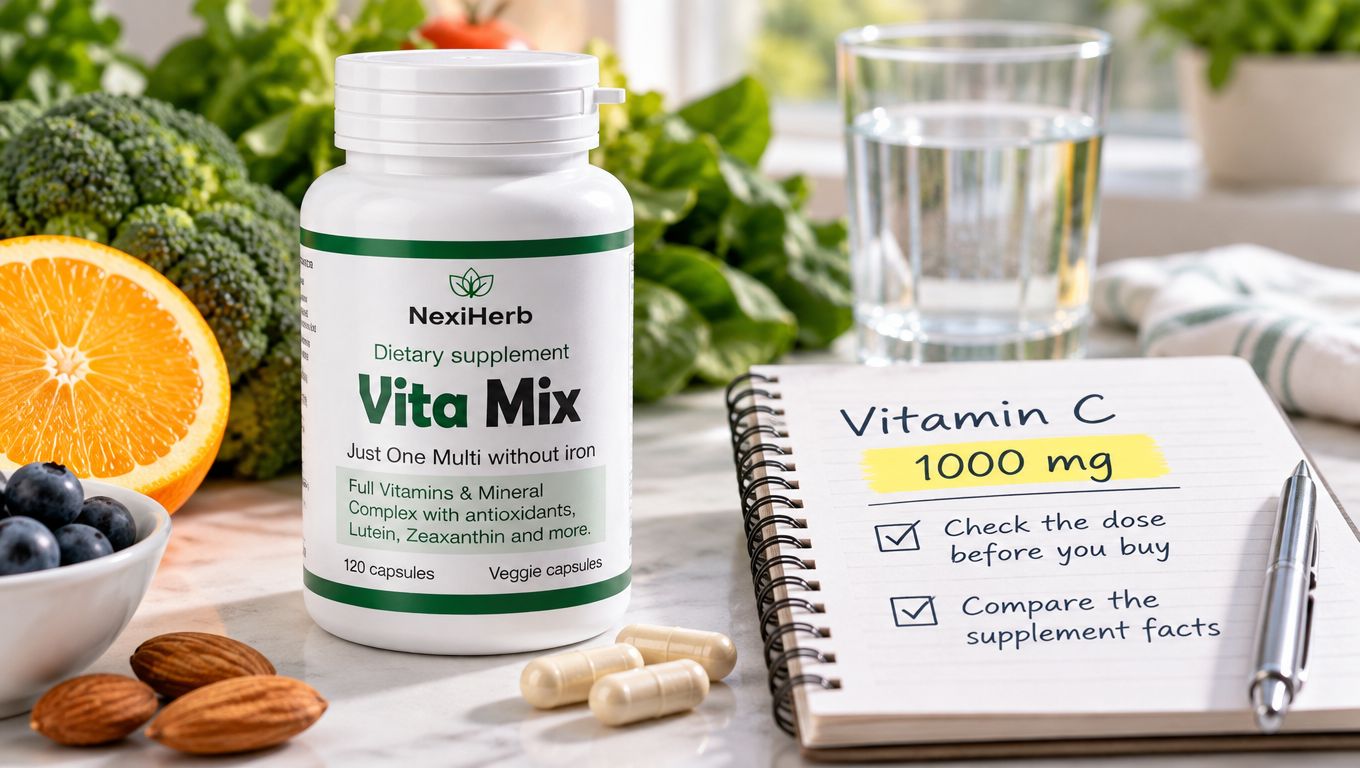
A practical guide to reading supplement labels can help you distinguish the serving size from the amount in each tablet or capsule. Check directions as well as the front-of-pack number.
Before your next appointment, write down the form, amount per serving, frequency, and estimated total intake, and bring the labels. Ask whether you need a standalone supplement at all and what would justify continuing it.
NexiHerb LLC offers multivitamins, targeted nutrients, and botanical supplements alongside practical nutrition guides. Visit NexiHerb LLC to compare product labels and build a supplement routine that complements your diet rather than adding vitamin C you may not need.