

Most wellness pages tell you to take alpha lipoic acid every day for nerves, blood sugar, weight, and energy, as if one antioxidant can cover all of that. That advice skips the part that decides whether a capsule is worth your money: how large the change was, how long it lasted, and who sat in the trial.
Alpha lipoic acid benefits look broad on a label. In the trials, they narrow fast. Short courses sometimes ease burning, pain, numbness, and tingling in diabetic neuropathy. Longer trials don't show a clear, lasting gain. Blood sugar markers shift in some analyses and barely agree across studies. Claims about energy, weight loss, and performance in healthy adults aren't established.
The useful question isn't "is ALA an antioxidant?" It is. The useful question is which outcome, at which dose, in which people, still looks real after the placebo group is counted.
Table of Contents
- Alpha Lipoic Acid Benefits by Evidence Strength
- How ALA Works and Why a Mechanism Is Not Proof
- Nerve Symptoms and the Neuropathy Trial Results
- Blood Sugar and Insulin Sensitivity Findings
- Safety Checks Before Taking ALA
- ALA Dosing and a Step-by-Step Start Plan
Alpha Lipoic Acid Benefits by Evidence Strength
Rank the claims before you buy a bottle. The table below is the short answer: five areas people ask about, graded by how far the human trials go.
| Benefit area | Evidence strength | What the trials show |
|---|---|---|
| Diabetic neuropathy symptoms | Mixed, short-term signals | 8 of 11 articles (73%) reported benefit; at 600 mg/day the total symptom score was 1.05 points lower than control |
| Fasting blood glucose | Limited, moderate confidence | Lower than control in a multi-trial analysis, with a moderate standardized difference |
| Insulin resistance (HOMA-IR) | Low confidence | Lower values in a small set of trials, with very high disagreement between studies |
| Antioxidant activity | Plausible mechanism, unproven outcome | Can regenerate other antioxidants in lab and small human work; no proven clinical endpoint |
| Energy, weight loss, performance in healthy adults | Not supported | Nothing establishes a performance, weight, or energy benefit in healthy adults |
A 2024 meta-analysis found that 8 of 11 articles (73%) reported a significant benefit of alpha-lipoic acid versus placebo, and at 600 mg/day the Total Symptom Score was 1.05 points lower than control (standardized mean difference −1.05, 95% CI −2.07 to −0.04). Mixed is the right label, because the other three articles didn't find that benefit. A one-point shift on a symptom score can matter to someone with burning feet, and it can also be too small to notice day to day.
Fasting glucose sits a step lower. Pooled trials point toward lower readings than control, yet the size of that shift isn't large enough to treat ALA as diabetes care.
Insulin resistance looks dramatic on paper and weak in practice. The studies don't agree with one another, so a big average can be one loud trial rather than a reliable effect.
Antioxidant activity is a real biochemical talent, not a clinical result. Regenerating other antioxidants in a lab doesn't tell you whether pain, glucose, or stamina will change.
Energy, weight loss, and gym performance in healthy adults have no supporting clinical endpoint. If a brand sells ALA for those goals, you're buying a story.
People stack plant antioxidants the same casual way. A practical read on how to use matcha safely shows the same habit: separate a pleasant daily drink from a medical claim.
Reading rule: strong enough to discuss for neuropathy symptoms, weak for blood sugar, and not proven for anything beyond symptom signals.
How ALA Works and Why a Mechanism Is Not Proof
ALA isn't a stimulant. It's a helper the mitochondria already use.

Think of a cell as a small workshop. Food arrives as raw material. Enzymes cut it into fragments. Those fragments have to move through the Krebs cycle so the cell can make usable energy. Alpha-lipoic acid (ALA) is a coenzyme in that handoff, not a spark plug you add for a buzz.
A plain analogy helps. ALA behaves like a rechargeable battery that can also top up other batteries. Its reduced form can hand electrons back to antioxidants that have already been used. That's why chemists call it unusual. It functions in both water and fat, and it exists in oxidized and reduced forms. A single compound that can cross those environments is rare. It is still not a treatment.
Why researchers tested nerves first
Nerves and small blood vessels in diabetes face oxidative stress and a sluggish fuel supply. Pain, burning, numbness, and tingling are the symptoms people report. That biology is a reason to run a trial. It isn't proof the trial will succeed.
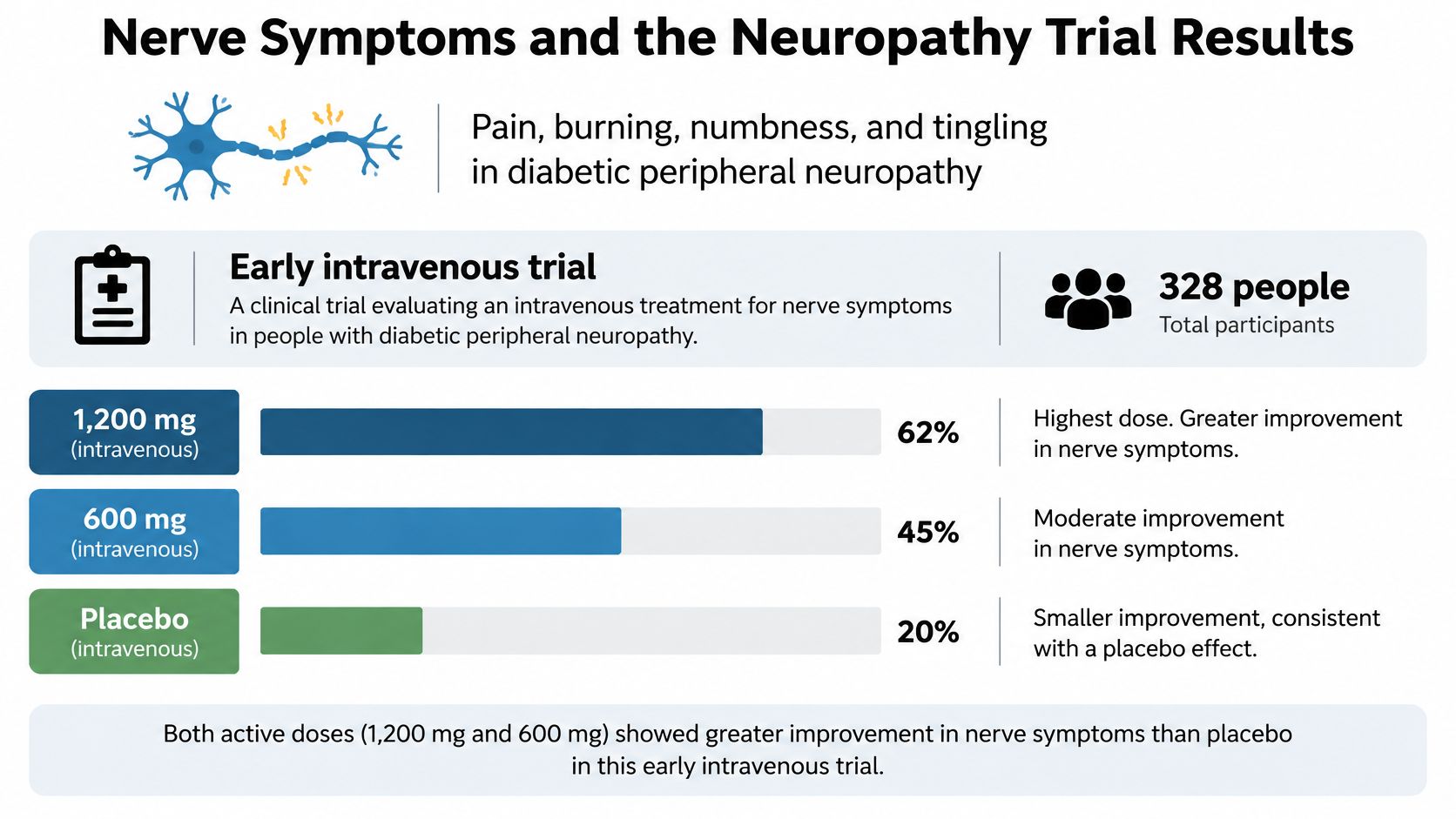
The history is older than the supplement aisle. As a review of ALA's biochemistry and early trials notes, researchers identified a growth-supporting factor in potato extract in 1937, and in 1951 the compound was isolated and tied to acyl-group transfer and the Krebs cycle. The same literature describes an early randomized study of 328 people with non-insulin-dependent diabetes and symptomatic peripheral neuropathy. They received intravenous ALA at 1,200 mg, 600 mg, or 100 mg, or placebo, for 3 weeks. By day 19, the 1,200 mg and 600 mg groups had significantly greater drops in total symptom scores than placebo, and all four individual symptoms were significantly lower with 600 mg than with placebo. A 2022 systematic review of eight studies and 1,500 diabetic patients shows how large the literature became, and how much results still swing with formulation, duration, and the outcome chosen.
If you want the chemistry of oxidation without the sales pitch, our guide to antioxidants and free radicals walks through what those words mean in a cell.
A short visual on the mitochondrial role makes the limit easier to see: a pathway explains where a compound acts, and a trial has to show that the action changes a symptom.
Three questions for any ALA claim
- Which outcome was measured? A lab marker, a symptom score, or something you can feel and function with?
- At what dose, and for how long? A three-week intravenous course is not a daily capsule.
- In which people, and by which route? Diabetes trials don't automatically apply to a healthy adult.
If a claim can't answer those three, the mechanism is doing the selling.
Nerve Symptoms and the Neuropathy Trial Results
ALA does not have evidence that it prevents diabetic neuropathy from getting worse. It has short-term symptom signals, and those signals fade once the trials run for many months.
The symptoms people care about are specific: pain, burning, numbness, and tingling in the feet and hands. Early intravenous courses, run over about three weeks, tracked larger symptom-score drops at the higher amounts than at placebo. That design is why 600 mg became a familiar research dose. It is also why bottle labels borrowed a hospital protocol.
What six months and two years actually show
A 2024 Cochrane review analyzed three randomized trials and 816 adults who received ALA or placebo for at least six months. After six months there was little or no improvement in diabetic peripheral-neuropathy symptoms: standardized mean difference −0.16 (95% CI −0.83 to 0.51), from one trial of 330 people. At 24 months the figure was −0.23 (95% CI −0.67 to 0.21), from one trial of 421 people. Both intervals cross zero, which means a true effect of "no difference" still fits the data. Functional impairment showed little or no clear difference at either time point.
Safety looked broadly similar to placebo at six months. The adverse-event risk ratio was 1.48, with a wide interval from 0.50 to 4.35, across three trials and 1,090 participants. A ratio like that doesn't prove extra harm, and it doesn't prove a clean safety record either. The same review notes why dose still matters: in the SYDNEY 2 trial summarized by the National Institutes of Health, 1,200 mg caused mainly nausea in 21% of participants, compared with 15% in one earlier study and 7% in another.
Three distinctions that change the decision
- Intravenous treatment versus an oral capsule. A vein infusion for three weeks is not the product on a pharmacy shelf.
- Short symptom relief versus disease modification. A lower score in week three doesn't show that nerve damage slowed over two years.
- Symptom scores versus outcomes you live with. A scale can move while walking, sleep, and foot care stay the same.
Current evidence does not establish that ALA prevents progression of diabetic neuropathy or produces a meaningful long-term improvement.
ALA can be a possible adjunct for selected symptoms, discussed with the clinician who already manages glucose and feet. It is not a substitute for either.
Blood Sugar and Insulin Sensitivity Findings
ALA may influence glucose metabolism through effects on oxidative stress and insulin-signaling pathways. That route is a hypothesis with some pooled data behind it, not a license to skip medication.
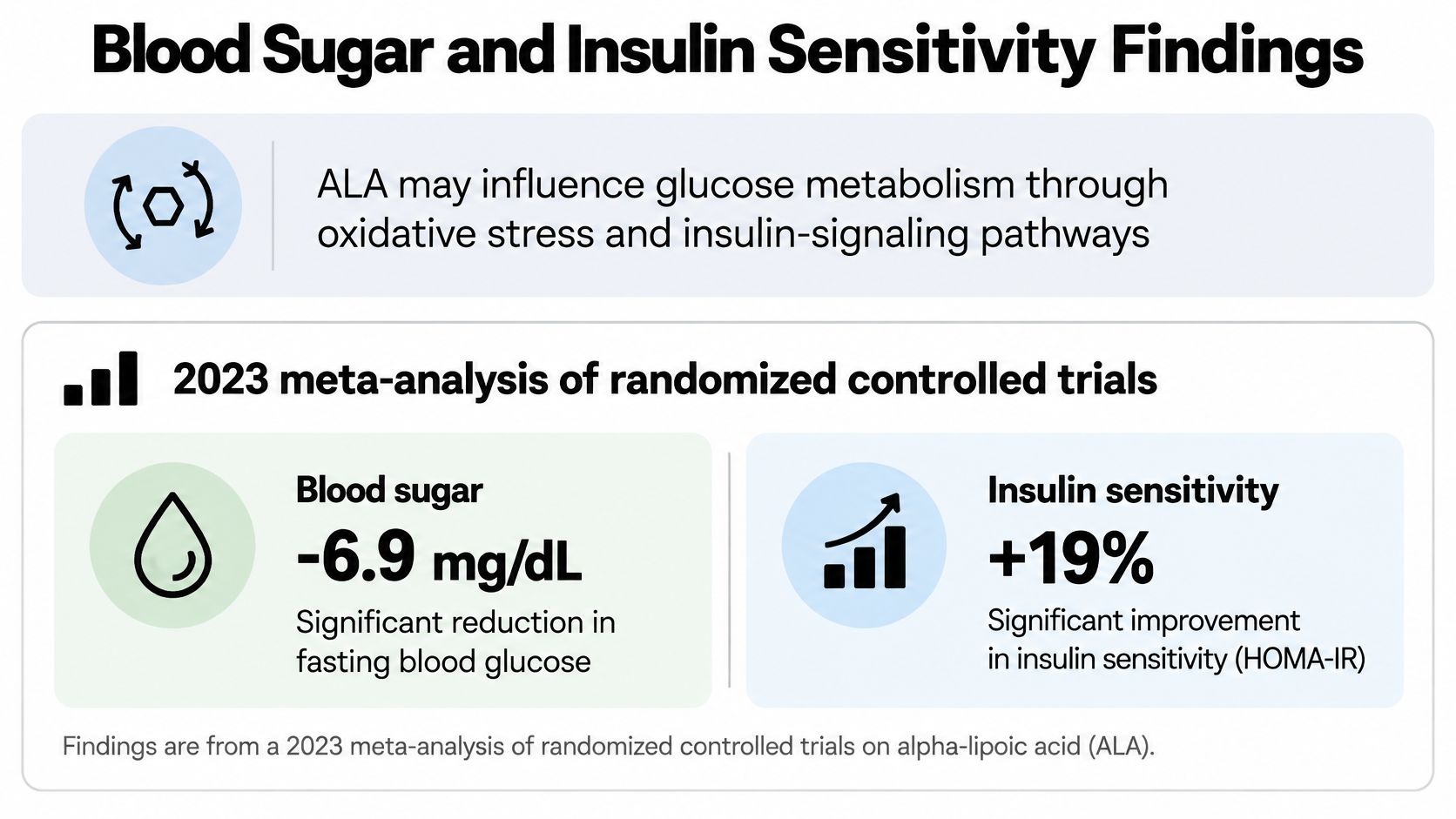
A 2023 meta-analysis of randomized trials reported lower fasting blood glucose versus control, with a standardized mean difference of −0.60 (95% CI −1.10 to −0.10, seven trials). In plain terms, the ALA groups sat lower than the comparison groups by a moderate amount on a common scale. The interval stays below zero, so the direction is more consistent than the neuropathy long-term results. It still doesn't tell you the change in mg/dL on your own meter.
Why the insulin number looks bigger than it is
The same analysis reported lower HOMA-IR, a surrogate for insulin resistance, with a standardized mean difference of −2.03 (95% CI −3.85 to −0.20, four trials). A difference that large would be exciting if the trials told the same story. They don't. Heterogeneity was I-squared 96.32%, which means almost all of the spread comes from differences between studies, not from a shared effect. Four trials and that much scatter is a low-confidence result. One study can pull the average.
What you can fairly say: ALA may modestly support metabolic markers in some adults. What you cannot say: that it prevents diabetes, treats diabetes, causes weight loss, or locks in a durable improvement in insulin sensitivity.
How to use a marker, not a promise
Treat ALA as an adjunct to meals, walking, and prescribed care. Our notes on blood sugar balance supplements put single ingredients next to the habits that move glucose further than any capsule.
If you already check glucose at home, write the readings down for a week before any change and for several weeks after. Bring that log to the visit. A supplement that can nudge glucose is also a supplement that can stack with diabetes drugs, and that interaction belongs in the safety check, not in a marketing line.
Safety Checks Before Taking ALA
Trial safety was generally favorable. That sentence applies to the people who were enrolled, at the doses and durations that were studied. It doesn't clear every adult who picks up a wellness bottle.
A systematic review of eight randomized trials in 1,500 adults with diabetes found inconsistent outcomes: three studies reported significant symptom improvement and five found no meaningful benefit. Doses ranged from 600 to 1,800 mg/day, and 600 mg/day was the most common regimen. The same review's practical point on safety is narrow and useful. People using glucose-lowering medication should watch for changes in glucose control and talk with a clinician before use.
| Situation | Risk to watch for | Action |
|---|---|---|
| Diabetes on glucose-lowering medication | Changes in glucose control | Consult a clinician before use and monitor readings |
| Diabetes, thyroid disease, or pregnancy | Unclear safety in these groups | Consult a clinician before use |
| Complex medication list | Interactions with other products | Review the full list with a clinician |
| Higher doses, or nausea, reflux, dizziness | Dose-related side effects | Lower the dose or stop and contact a clinician |
| Healthy adult on a daily wellness dose | Unproven benefit beyond symptom signals | Start at the lowest labeled amount and don't escalate |
Side effects you should actually recognize
Nausea, vomiting, dizziness, reflux, headache, and general stomach discomfort show up more often as the dose climbs. They aren't rare mysteries. If they start after you raise the capsule count, the dose is the first thing to question.
The glucose concern is separate from stomach upset. ALA can influence glucose metabolism, so a reading that drops when you haven't changed food or medicine deserves a call, not a second capsule.
Who should pause before the first dose
Anyone with diabetes, thyroid disease, pregnancy, or a long medication list should have that conversation first. A favorable average in neuropathy trials doesn't map onto pregnancy, a thyroid condition, or a healthy person chasing energy.
Stop rule: stop or lower the dose and contact a clinician if side effects show up, or if glucose readings change in a way you didn't expect.
Labels hide dose and extras in small type. Our walk-through on how to read supplement labels is the checklist to use before that clinician visit, so you can name the milligrams instead of the brand slogan.
ALA Dosing and a Step-by-Step Start Plan
More ALA is not more benefit. Older reviews found a tradeoff: doses above 600 mg daily didn't improve neuropathy symptom scores more than 600 mg, and they did increase nausea, vomiting, and dizziness.
| Dose | Where it appears | What the evidence shows | Tolerability notes |
|---|---|---|---|
| Intravenous 1,200 mg, 600 mg, or 100 mg | Early 3-week neuropathy studies | Greater short-term symptom reduction than placebo at the two higher amounts | Intravenous route, not an oral equivalent |
| 600 mg per day | Most common regimen in reviewed trials | The oral amount tied to symptom-score comparisons | Lower nausea burden than the higher oral amounts |
| 1,200 mg per day | Oral studies | No more symptom benefit than 600 mg in older reviews | Nausea in roughly 6% of participants; vomiting and vertigo rise as dose rises |
| 600 to 1,800 mg per day | Diabetes and neuropathy trials | Results vary by formulation, duration, and outcome | Higher amounts add stomach effects |
| 200 to 2,400 mg per day | Consumer safety summaries | A cited safety span, not a benefit range | Not a target for self-escalation |
A clinical review of oral ALA studies put nausea at roughly 6% of participants at 1,200 mg daily, with vomiting and vertigo climbing as doses rose. Higher amounts can also bring gastrointestinal discomfort, reflux, headache, or dizziness. A WebMD evidence summary states that clinical studies have used 600 to 1,800 mg per day for diabetes and neuropathy, while 200 to 2,400 mg per day is generally considered safe. Read that second span as a tolerability comment from consumer medical writing, not as a goal. The top of a safety range is not the dose that worked best.
Intravenous milligrams don't convert into oral capsules. Trial doses also shouldn't become an everyday wellness dose just because a paper used them.
A start plan that matches the evidence you actually have
1. Name the goal before you name the milligrams. Neuropathy symptom relief has mixed, mostly short-term evidence. General antioxidant support is a mechanism, not an outcome. Blood sugar support rests on modest marker changes with uneven insulin data. If you can't say which of those three you want, you can't judge whether anything changed.
2. Book the clinician visit with the bottle in hand. Bring the label, the dose per capsule, and the rest of your medicines. Don't combine ALA casually with glucose-lowering products. "Antioxidant" on the front panel doesn't cancel a pharmacologic effect.
3. If you get a yes, start at the lowest amount printed on that label. Don't step yourself up because week one felt quiet. The oral data say the step up buys side effects more reliably than it buys symptom scores.
4. Give it a real window, then decide. Several months is the honest trial, because a three-week signal doesn't promise a two-year one. Pick one tracker and keep it boring: a 0 to 10 note for pain or numbness a few nights a week, or the glucose log you already keep. Change one thing at a time so the note means something.
5. Use a stop rule you decided in advance. New nausea, reflux, dizziness, or a glucose pattern you didn't expect means lower the dose or stop, and contact the clinician. Don't "push through" a higher dose to chase a benefit the higher dose hasn't shown.
What a fair result looks like
Some people with diabetic nerve symptoms may get modest symptom support. Nobody should expect ALA to replace glucose control, foot checks, or prescribed neuropathy care. Nothing in the trials shows that ALA reverses nerve damage, and nothing shows that it improves performance in healthy adults.
If the goal was energy or a smaller waist, the evidence points you back to food, activity, and medical care, not to a higher capsule count.
NexiHerb LLC builds science-inspired supplements for everyday energy, circulation, and general wellness, and we treat them as a complement to diet and clinical care rather than a stand-in for either. If you want plant-derived and clinically familiar formulas with clear labels, start with the catalog at NexiHerb LLC and match a product to a routine you already keep, not to a disease claim.