

Is nitric oxide safe? That question only becomes answerable once you name the ingredient and the dose. "Nitric oxide supplement" is a category label, and the front of the bottle rarely tells you which member of the category you are holding. A powder built on L-arginine, a capsule built on beetroot nitrate, and a blend that adds L-citrulline each carry a different exposure and a different evidence base.
The phrase itself names a signal your body makes. It does not name the precursor, the milligram amount, or who was left out of the trial. Two products with near-identical front labels can differ substantially in how much precursor you swallow.
The toolbox comparison holds up: a wrench, a screwdriver, and a hex key all live in the same box, and none of them substitutes for the others.
L-arginine taken by mouth has a reasonable short-term record in healthy adults at moderate doses. As the dose climbs, gastrointestinal upset and a small dip in blood pressure grow more common, and whether daily use stays safe past a few months is largely untested. Anyone taking blood-pressure medicine, nitrate drugs, or erectile-dysfunction medication should get a clinician's approval first, since those combinations can push pressure lower than either would alone.
So the answer depends on which ingredient, at which dose, in which person.
Table of Contents
- Short Answer and Dose Ranges at a Glance
- How Nitric Oxide Supplements Work in the Body
- What the Research Says About Safety
- Common and Rare Side Effects to Watch For
- Drug and Condition Interactions That Raise Risk
- Who Should Avoid These Supplements
- Choose a Safe Product and Confirm It With a Clinician
Short Answer and Dose Ranges at a Glance
Is a nitric oxide supplement safe? The useful answer starts with the ingredient, not the bottle. The typical healthy adult handles one labeled serving of a single precursor without a short-term problem. The same words on a label can hide very different exposure when an arginine powder, a citrulline capsule, and a beetroot shot land in the same day.
Most formulas rest on L-arginine, L-citrulline, or nitrate from beetroot. Your exposure is set by the supplement facts panel: the precursor, the milligrams per serving, and the number of servings you swallow. Add every arginine source you take that day, including the tub you opened first and the capsule you forgot.
What studied doses showed
The range matters more than the label name. Published oral arginine trials describe a tolerability split around the studied doses, and the 2025 beetroot nitrate trial found a real pressure effect: about 7 mmHg lower systolic and 6 mmHg lower diastolic than placebo (2025 randomized trial of beetroot nitrate). That is large enough to matter for someone whose pressure already runs low or who takes a blood-pressure medicine.
| Precursor and dose | Typical label use | Tolerability signal | Practical check |
|---|---|---|---|
| L-arginine, up to 9 g per day | Single-product labeled serving | No major safety signals in short studies | Count all arginine sources |
| L-arginine, 9 to 30 g per day | High-dose or stacked product | Nausea and diarrhea more common; pressure may dip | Do not treat as a safer shortcut |
| High-dose daily use beyond about 3 months | Long-term use | Long-term data are limited | Reassess with a clinician |
| Beetroot nitrate | Food or standardized extract | Pressure lowering shown in a randomized trial | Dizziness or low pressure in some users |
Route matters too. The oral tolerability data do not transfer to intravenous arginine, where excessive L-arginine hydrochloride has been linked to electrolyte problems such as hyperkalemia and hyponatremia.
Practical rule: Read the serving size, total the milligrams from every nitric oxide product you use, and treat anything above the labeled serving as a clinical decision rather than a stronger version of the same product.
People with low blood pressure, kidney or liver disease, or those taking blood-pressure medicines, nitrates, or erectile-dysfunction medicines can face extra risk from additive pressure lowering. Get a clinician's review before use. A short trial in healthy adults does not prove safety for indefinite daily use.
How Nitric Oxide Supplements Work in the Body
Nitric oxide lasts seconds. The body makes it on demand, when a vessel wall needs to relax, and clears it almost as fast. Smooth muscle in the artery wall loosens, the vessel widens, and blood moves through with less resistance. That same widening is both the intended effect and the main safety question, because a wider vessel also means lower pressure.
Two routes into the same signal
The first route runs through an amino acid. L-arginine is the raw material, and enzymes called nitric oxide synthases perform the conversion. A supplement that supplies arginine is feeding the front of that line, though the enzyme step is the bottleneck that limits how much signal you get. Our guide to L-arginine walks through why the amino acid shows up on so many labels.
The second route starts with nitrate, usually from beetroot or leafy greens. Bacteria in the mouth convert nitrate to nitrite, and the body then reduces nitrite to nitric oxide. That first step depends on live oral bacteria, which is why a mouthwash right before a nitrate serving can blunt the response. Same end signal, different machinery, and different timing.
A concrete case makes the split easier to hold. A pre-workout scoop taken at 6 a.m. supplies arginine; a beet shot at lunch supplies nitrate. You opened two pathways rather than doubling one. A beet capsule and an arginine powder can both print "nitric oxide" on the front and still differ in dose, onset, and who should avoid them.
Food nitrate is not automatically safer once it is concentrated. A useful starting point is understanding beetroot's potential health benefits before you swap a serving of beets for an extract. The vegetable brings fiber and potassium along with its nitrate, while a standardized extract delivers the nitrate and little else.
Read two labels side by side the way a pharmacist reads a dose. One lists nitrate-standardized beetroot extract with a stated nitrate percentage per serving; the other lists L-arginine in grams per scoop. Those are different compounds, at different doses, feeding different pathways, so the safety questions for each are separate. Compare the ingredient and the gram amount before you compare brand names.
What the Research Says About Safety
Across 15 controlled trials in a 2023 systematic review and meta-analysis, 1,148 people received the intervention and 1,127 were controls, with an odds ratio for adverse events of 1.32 (95% CI 0.76 to 2.28; p=0.33); the same review's 16-trial analysis of serious adverse events, with 1,126 intervention participants and 1,100 controls, found an odds ratio of 0.83 (95% CI 0.60 to 1.16; p=0.27).
The first estimate sits above 1, which would mean more events, but its range crosses 1 and the p value misses the usual cutoff. That is an inconclusive result. The range includes both more and fewer events than control, so the review cannot settle whether these strategies change risk. The serious-event estimate leans below 1, but its range also includes 1. The review does not establish a protective effect.
Why one average hides the mix
The review also found high heterogeneity, meaning trials differed a lot by ingredient, population, dose, and design. Pooling arginine studies, beet juice studies, and mixed formulas into one average is like grading three different drugs on one label because they share a shelf. An average can hide a real problem in one of those piles. A two-week beet juice trial and a six-month arginine capsule trial answer different questions even when both sit under the same nitric oxide name. That is why the ingredient and the dose deserve separate checks.
A parallel from a different supplement category, Tecton Ketones™ on supplement safety, applies the same rule: separate the ingredient, the dose, and the person the trial enrolled.
Common and Rare Side Effects to Watch For
The first side effects to watch for are usually gut effects, and they follow the dose more closely than the label. Nausea, loose stools, and stomach upset appear more often as L-arginine intake climbs, particularly when you start with a large scoop on an empty stomach. Returning to the labeled serving often settles this within a day or two. Severe or persistent diarrhea needs medical advice, especially if you cannot keep fluids down. An L-arginine capsule, a citrulline blend, and a beetroot nitrate drink can produce different symptom patterns at different doses, so judge each product on its ingredient and serving size.
Less common effects call for a different response.
| Symptom | Likely cause | What to do |
|---|---|---|
| Nausea or diarrhea | High-dose L-arginine | Reduce the dose; stop if severe or persistent |
| Dizziness or faintness | Additive blood-pressure lowering | Sit down; call a clinician before the next dose; faintness needs urgent care |
| Palpitations | Blood-pressure or potassium shifts | Pause the product; have a clinician check rhythm and potassium |
| Wheezing | Possible worsening of asthma | Follow your asthma plan; seek urgent care if breathing worsens |
| Cold sore outbreak | Possible herpes reactivation | Contact a clinician promptly |
| Rash, swelling or breathing trouble | Allergic reaction | Call emergency services for lip or tongue swelling or trouble breathing |
Lightheadedness after standing up is the pressure effect showing up in daily life. It is a reason to check blood pressure and the dose before the next workout. Wheezing matters if you have asthma because these products can affect airways as well as vessels. A cold sore in someone who gets them can be herpes reactivation, so call a clinician rather than waiting it out. Lip or tongue swelling and trouble breathing need emergency care.
Oral capsules deliver arginine differently from an IV infusion. Electrolyte shifts remain possible, and a clinician can decide whether labs are needed before you start.
For the first 14 days, keep a short log with five fields: product name, ingredient and amount per serving, clock time, symptom severity from 0 to 10, and how long the symptom lasted. A beetroot nitrate drink and an arginine capsule produce different entries on that page, which is why a beet juice powder note belongs next to the amino acid note. Bring the log to a clinician. Times and doses give the conversation something concrete to work with.
Drug and Condition Interactions That Raise Risk
The risk that changes practice is additive vasodilation. You combine L-arginine, or a nitrate product, with a medicine that already relaxes vessels, and pressure can fall further than either one would manage alone. MedlinePlus flags antihypertensives, ACE inhibitors, and sildenafil for that combined drop. Mayo Clinic advises against unsupervised use after a heart attack, with kidney disease, or alongside nitrates, blood thinners, antihypertensives, or erectile-dysfunction medicines, and notes possible worsening of asthma or herpes reactivation.
Arginine can also increase potassium in some contexts. That matters if your kidneys don't clear potassium well, or if you already take a medicine that raises it.
| Medicine or condition | Risk | Required action |
|---|---|---|
| Antihypertensives | Excessive blood-pressure lowering | Clinician or pharmacist approval first |
| ACE inhibitors | Additive hypotension and potassium rise | Clinician approval and potassium check |
| Sildenafil or tadalafil | Additive vasodilation and hypotension | Avoid unless a clinician approves |
| Nitrates | Sharp blood-pressure drop | Avoid unless supervised |
| Blood thinners | Caution flagged by Mayo Clinic | Clinician approval first |
| Kidney disease | Potassium buildup | Avoid unsupervised use |
| Recent heart attack | Added cardiovascular strain | Avoid unsupervised use |
Stacking hides the dose
A morning capsule and an evening pre-workout can each look modest. If both list arginine, your total isn't the number on either label. Proprietary blends make this worse, because they hide how many milligrams of each amino acid you swallowed. Nitrate plus a blood-pressure pill is the same problem on a different route. The pathways overlap, so the drop can be larger than the trial average in people who were excluded from those trials.
If any medicine on that list is already in the cabinet, get clinician or pharmacist approval before the first dose, not after you feel faint.
If you do start while taking a blood-pressure medicine, check and log pressure at the same time each day for two weeks, seated, after a few quiet minutes, and bring the readings in. People with kidney disease, or those on potassium-raising drugs, should have potassium checked before the first serving and again after any dose change. Faintness, severe diarrhea, wheezing, palpitations, or an allergic reaction means stop and seek medical care.
Who Should Avoid These Supplements
Which ingredient and dose would you be taking? That question decides most of the avoid list, because "nitric oxide supplement" covers arginine, citrulline, and beetroot nitrate at very different milligrams. A product that is unremarkable for one person can be a poor fit for another based on blood pressure, pregnancy, age, or liver and kidney function.
Adults with normal blood pressure should not treat a further drop as a wellness goal. Lower pressure helps when the starting number is high; it is a liability when it is already normal. Pregnancy and breastfeeding have no solid safety file for these formulas, so the default is to avoid them. Children and teenagers are not a studied group, and NexiHerb's products are intended for adults only.
Groups that need clinician review
Skip these formulas unless a clinician approves the exact product and dose if you have low blood pressure, kidney disease, or a recent heart attack. The same applies to asthma and recurrent cold sores: wheezing and outbreak flares are possible enough that a clinician should supervise any trial. Those conditions change the risk calculation.
Liver disease is the gap. The trials that support blood-pressure effects from these ingredients do not provide a usable dose for people with significant liver disease, and the label serving is not a safety study. Ask a clinician to review liver function, your medicine list, and the exact milligrams of arginine, citrulline, or nitrate before you decide.
Do not use another person's good experience as your own safety data. Your prescription list and your history decide whether the ingredient fits. If the label hides the milligrams or the serving size, you cannot make that match, and the bottle stays closed.
Choose a Safe Product and Confirm It With a Clinician
Start with the panel, not the slogan. You want the milligrams of each active, the serving size, and how many servings are in the container. A proprietary blend that lists six names and one total weight doesn't let you add arginine across products, so it fails the first test.
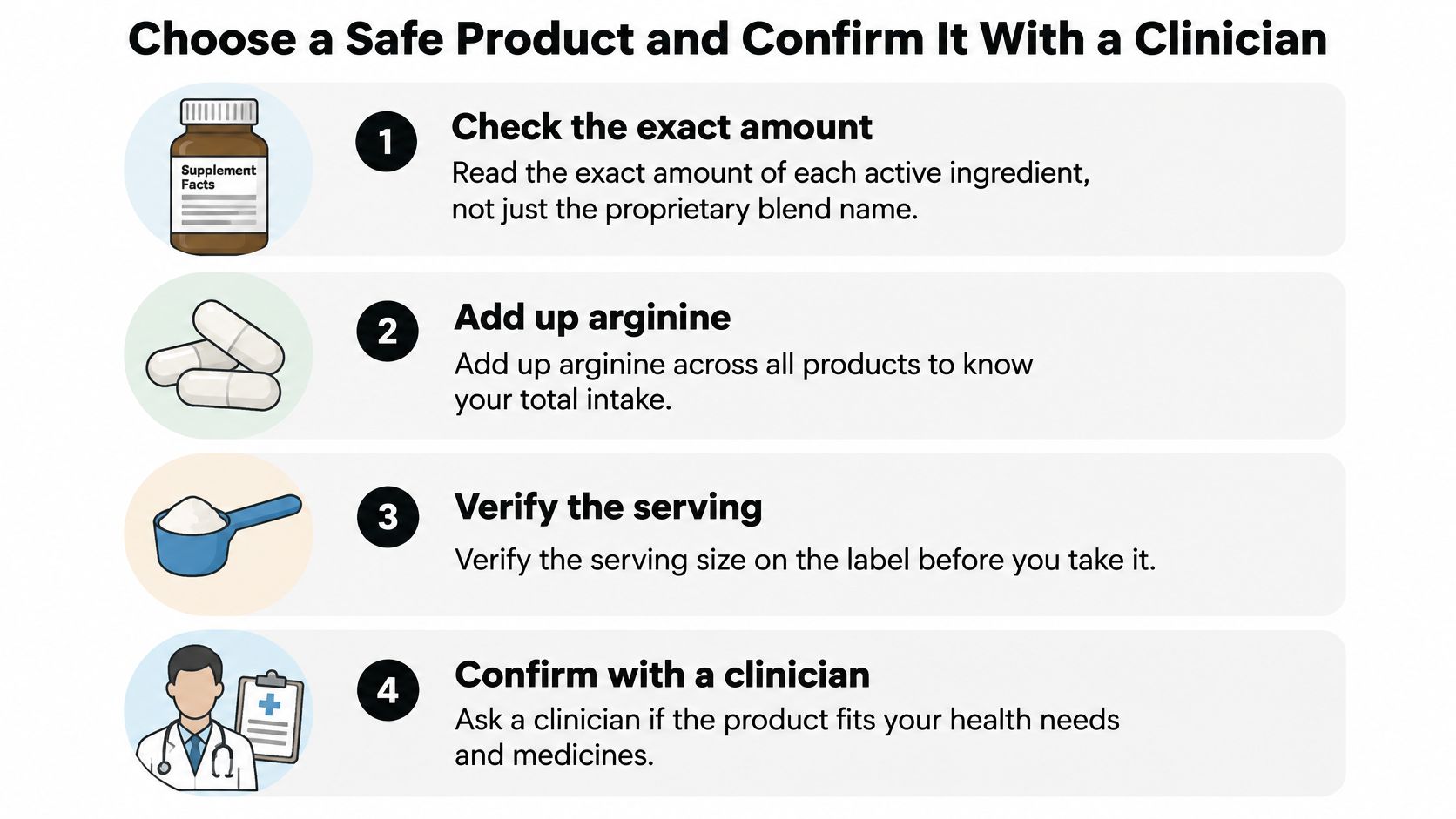
Check the exact amount: Read each active, not the blend name. If arginine appears in two products, add both before you decide the day is "moderate."
Verify the serving: Confirm servings per container so a "one scoop" habit doesn't turn into two servings without you noticing. Our walkthrough on how to read supplement labels shows where those numbers hide.
Look for quality signals: We aren't approved by the FDA, and our supplements are manufactured in facilities that follow quality standards. Prefer brands that publish third-party testing or batch checks you can read.
Scan allergens: Some of our formulas may contain soy, milk, gluten, or traces of nuts, depending on the formula and the plant. If you react to those, the other-ingredients line matters as much as the hero extract.
Confirm the audience: The label should say adults, and it should state that the product doesn't diagnose, treat, cure, or prevent disease. We urge you to consult a physician before use if you take medication, take other supplements, or have a medical condition. We don't guarantee results, because individual responses differ.
L-citrulline-only and nitrate-only products have a thinner safety record than the arginine doses studied for days to weeks. Don't assume a citrulline blend is gentler or equally tested. Give it the same ingredient-level check.
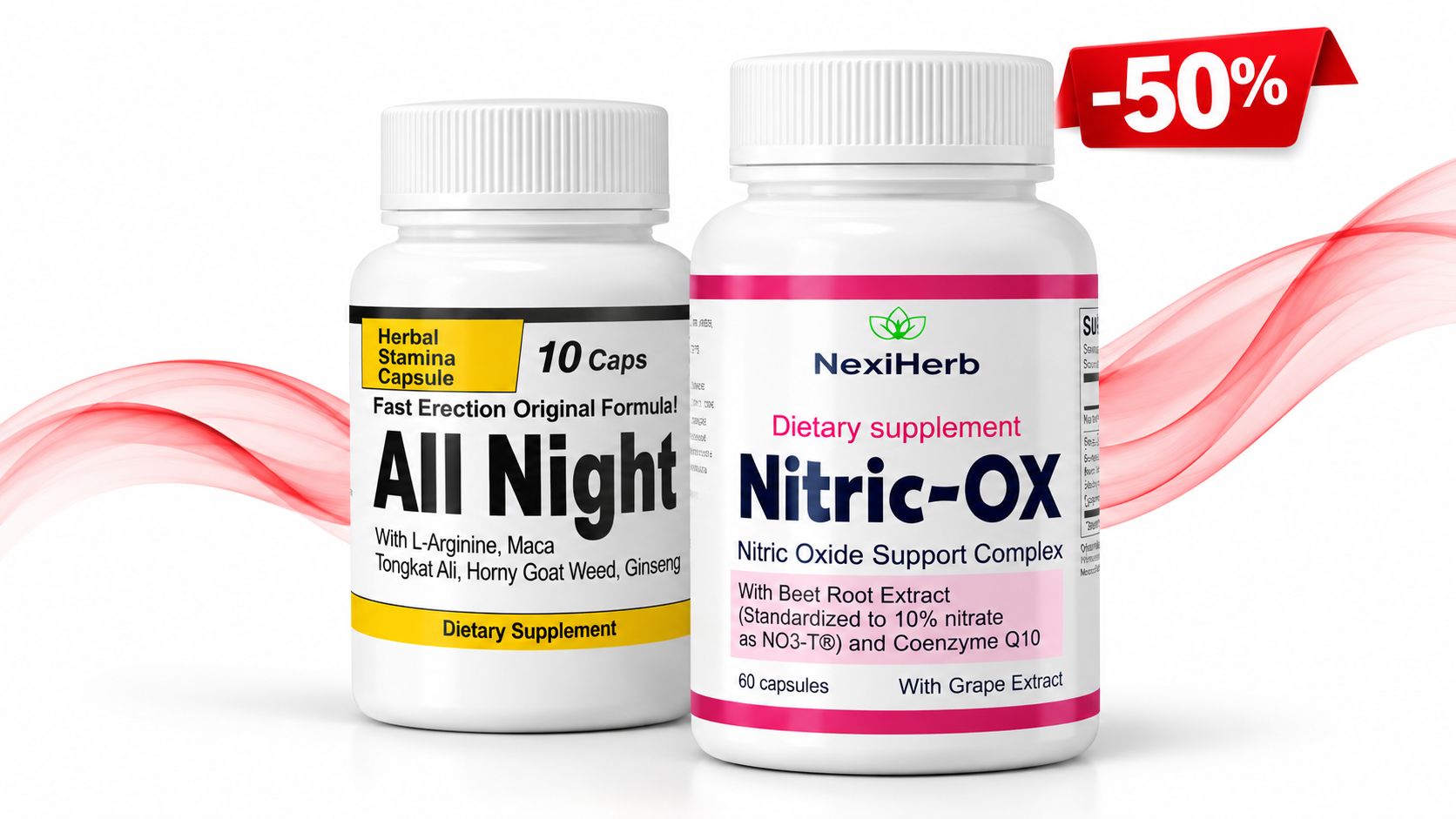
Nitric-Ox is one concrete example of reading a panel instead of a category name. It's a capsule for adults, with beet root extract, grape seed extract, and coenzyme Q10, a serving of 2 capsules, and 30 servings per container. Other ingredients include an HPMC capsule, silicon dioxide, magnesium stearate, and microcrystalline cellulose. Its statements haven't been evaluated by the Food and Drug Administration, and it isn't intended to diagnose, treat, cure, or prevent any disease. Use it only as the label directs, and don't exceed that intake.
Five steps before you stay on it
- List every medicine and supplement, including the pre-workout you only use on training days.
- Ask a clinician or pharmacist to walk the interaction list with that page in hand.
- Start at the lowest labeled serving, not a double "loading" day.
- Keep the two-week symptom and pressure log. If a watch flags a wild heart-rate spike while you're adjusting a cuff, learn what a motion artifact looks like so a shaky trace doesn't get mistaken for a rhythm problem, and still report real palpitations.
- Stop and seek care for faintness, wheezing, palpitations, severe diarrhea, or an allergic reaction.
A short explainer on how vessel signals relate to everyday circulation is worth a look before you treat a scoop as a training plan.
These products complement food and medical care. They don't replace either one. Before the first dose, match the ingredient and the serving to your medicines and your pressure, with a clinician if any item on the risk list applies.
NexiHerb LLC offers adult dietary supplements with plant-derived ingredients, including nitric oxide support formulas built on ingredients such as beet root extract, so you can match a label to the dose questions in this guide. We treat supplements as a complement to food and clinical care, not a substitute, and we don't promise a result. Visit NexiHerb LLC to read labels, check servings, and choose only after you've confirmed the formula fits your medicines.