

Could arginine 500 mg support circulation, or is that amount too small to matter? The honest answer sits between supplement-label optimism and outright dismissal. A 500 mg serving can be a practical building block, but it usually isn't equivalent to the multi-gram amounts used in research on specific outcomes.
The useful question isn't whether arginine “works.” It's what 500 mg can realistically contribute, how much reaches circulation, whether another nitric-oxide pathway would make more sense, and when medication or health conditions change the safety picture.
Table of Contents
- What Arginine 500 mg Actually Means on a Label
- How L-Arginine Connects to Nitric Oxide and Circulation
- What the Research Says About 500 mg Doses
- Practical Ways to Take Arginine 500 mg
- Why 500 mg Alone Is Often a Supporting Dose
- Safety, Side Effects, and Who Should Be Cautious
- How to Evaluate the Quality of an Arginine Supplement
- Fitting Arginine 500 mg Into a Daily Routine
What Arginine 500 mg Actually Means on a Label
L-arginine is an amino acid involved in protein metabolism and nitric oxide production. Its modern supplement relevance is closely tied to nitric oxide biology. Researchers identified nitric oxide as a signaling molecule in the late 1980s, and a 1999 review marked the 10-year anniversary of the discovery of arginine-dependent nitric oxide biosynthesis, a history outlined in this overview of arginine and nitric oxide biology.
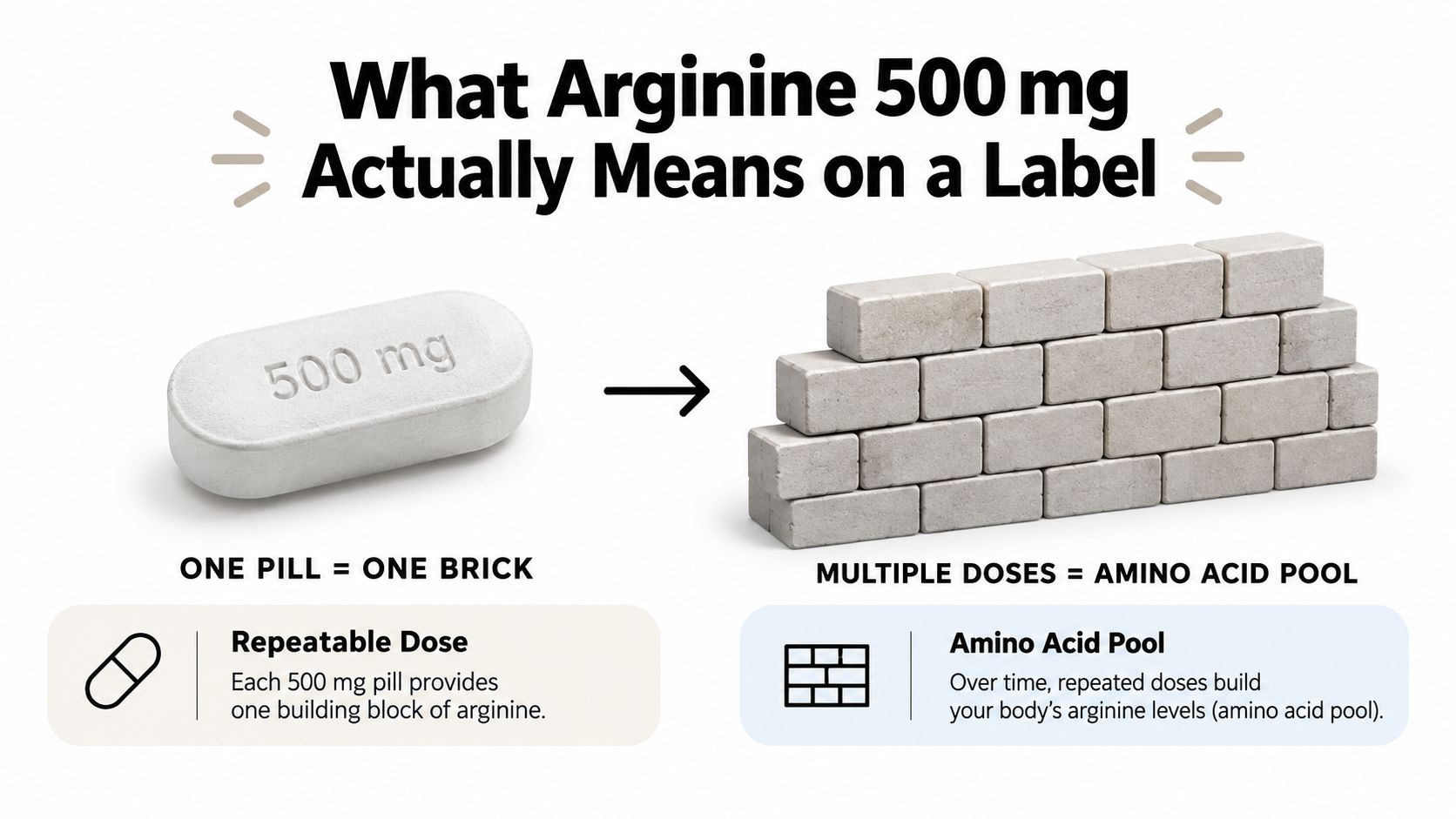
Think of arginine intake as bricks and nitric oxide support as a wall. One 500 mg serving is one brick, not an entire wall and not automatically a therapeutic dose. Repeating small servings can contribute to the body's amino acid pool, while the final effect depends on absorption, metabolism, baseline nutrition, the intended outcome, and the rest of the formula.
Read the form, not just the number
A label may list several forms:
- Free-form L-arginine is the amino acid in its direct form.
- Arginine base refers to the basic, uncombined form.
- Arginine HCl is L-arginine combined with hydrochloride.
- Arginine alpha-ketoglutarate, often abbreviated AAKG, combines arginine with alpha-ketoglutarate.
The amount beside the ingredient may describe the compound listed, not necessarily an identical amount of free arginine across every product. That's why the Supplement Facts panel matters more than the front label. Check whether the serving contains one capsule, two capsules, or a scoop, and identify the exact chemical form.
The arithmetic is simple but useful. Two capsules containing 250 mg each provide a 500 mg serving. One capsule labeled 500 mg provides the same stated amount, but the capsule count and form still matter when you compare products.
Clinical research has included amounts from 500 mg per day up to 30 g per day, with typical oral study dosing often falling into larger ranges depending on the indication, as summarized in this review of L-arginine supplementation. So 500 mg is best viewed as a repeatable supplemental unit, not a guarantee of a clinical-level intervention.
How L-Arginine Connects to Nitric Oxide and Circulation
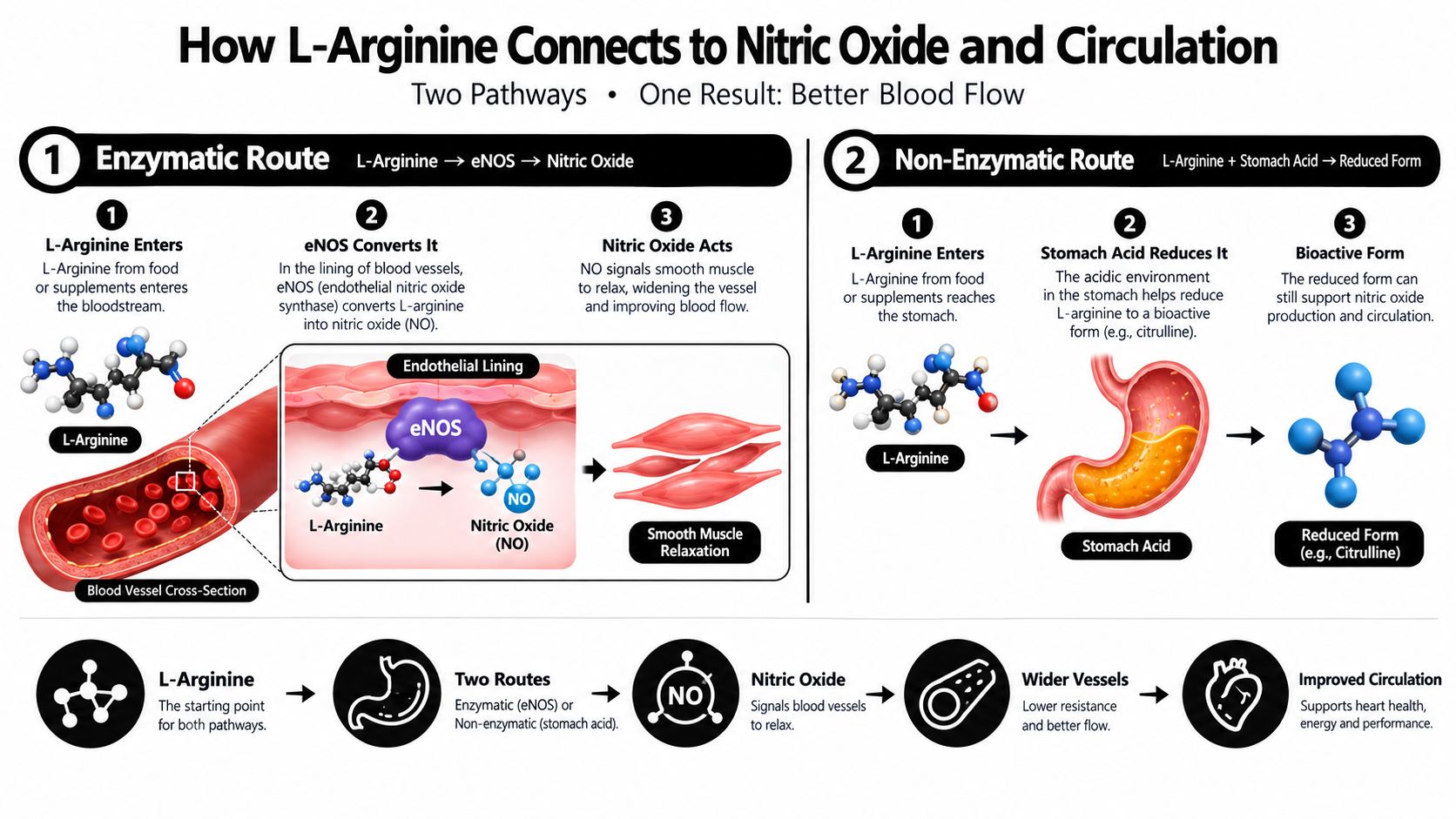
Nitric oxide is a signaling molecule that helps regulate blood-vessel tone. The basic enzymatic pathway works like this: endothelial nitric oxide synthase, or eNOS, uses L-arginine as a substrate and produces nitric oxide in the vessel lining. Nitric oxide then signals nearby smooth muscle to relax, which can support normal blood flow.
That description explains why shoppers associate arginine with circulation. It doesn't prove that every oral dose creates a large effect, however. The body has to absorb the amino acid, move it into circulation, and make it available where nitric oxide synthase can use it.
Two routes can support nitric oxide biology
The second route begins with dietary nitrate, found in foods such as beetroot and leafy greens. The body can convert nitrate through a separate pathway that doesn't require L-arginine as the direct substrate. L-citrulline offers another useful comparison because tissues can convert it into arginine, and expert reviews note that citrulline may sometimes be a better precursor because it bypasses hepatic first-pass metabolism before conversion in tissues, as described in this clinical review of arginine pharmacology.
Oral arginine faces a substantial first-pass limitation. About 40% is metabolized in the gastrointestinal epithelium and liver, and circulating arginine has an estimated half-life of about one hour, according to the same review. A 500 mg dose therefore may produce only modest systemic exposure unless intake is repeated or the formulation and accompanying ingredients improve the overall precursor strategy.
For readers interested in circulation-focused routines, nutrition is only one part of the picture. Movement, hydration, and comfortable support during activity matter too, so a guide on how to choose calf wraps for fitness can be a useful practical resource.
This guide to natural nitric oxide boosters can help you compare arginine with citrulline and nitrate-containing foods. A capsule formula such as Argi-Max NexiHerb L-Arginine, L-Citrulline-DL-Malate, and beet root powder combines those ingredient categories in a serving of two capsules, listed as L-Arginine HCl, L-Arginine Alpha Keto Glutarate, L-Citrulline-DL-Malate, and beet root powder.
What the Research Says About 500 mg Doses
The most important dose lesson is context. A study using 500 mg doesn't automatically show that one 500 mg capsule produces the same result. Researchers may use that amount repeatedly, combine it with other intake, administer it according to body weight, or study a particular patient group.
One clinical trial used three 500 mg capsules daily, totaling 1,500 mg per day, for 14 days. Blood arginine rose significantly for up to five hours after a single dose. Another randomized study used 500 mg per day for four months in groups of 25 patients and reported reduced pain frequency in the treatment group. These findings place 500 mg within a practical research unit, while also showing why the schedule and total intake matter. The details are reported in this clinical review of L-arginine studies.
A realistic comparison
| Outcome studied | Typical study dose | Evidence strength | What 500 mg likely does |
|---|---|---|---|
| Blood arginine response | 500 mg used within a repeated daily schedule | Direct clinical signal | May create a modest, temporary contribution to circulating arginine |
| Peripheral circulation support | Often larger oral regimens, depending on the indication | Mixed and context-dependent | More plausible as a supportive amount than a primary intervention |
| Erectile function | 1,500 to 5,000 mg in a 2019 meta-analysis | Benefit reported across that studied range | Usually below the dose range associated with measurable outcomes |
| Nitric-oxide-focused performance | Research has used multi-gram amounts, with findings varying by protocol | Mixed | Unlikely to replicate a high-dose pre-workout effect by itself |
| Blood pressure | Dose and duration vary across studies | Context-specific | May contribute to blood-pressure lowering, so medication review matters |
The erectile-function comparison deserves particular care. A 2019 meta-analysis found benefit when arginine doses ranged from 1,500 to 5,000 mg, while a later trial used 6 g per day for men with mild-to-moderate vasculogenic erectile dysfunction. Those figures come from the published meta-analysis on arginine and erectile dysfunction, and they shouldn't be used to promise that a smaller serving will produce the same result.
Dose reality: A 500 mg serving can be research-backed without being research-equivalent to a multi-gram regimen.
The most defensible interpretation is modest. Arginine 500 mg may fit a maintenance routine or a broader formula, but readers seeking a defined outcome shouldn't assume that a single capsule reproduces the protocols used in clinical trials.
Practical Ways to Take Arginine 500 mg
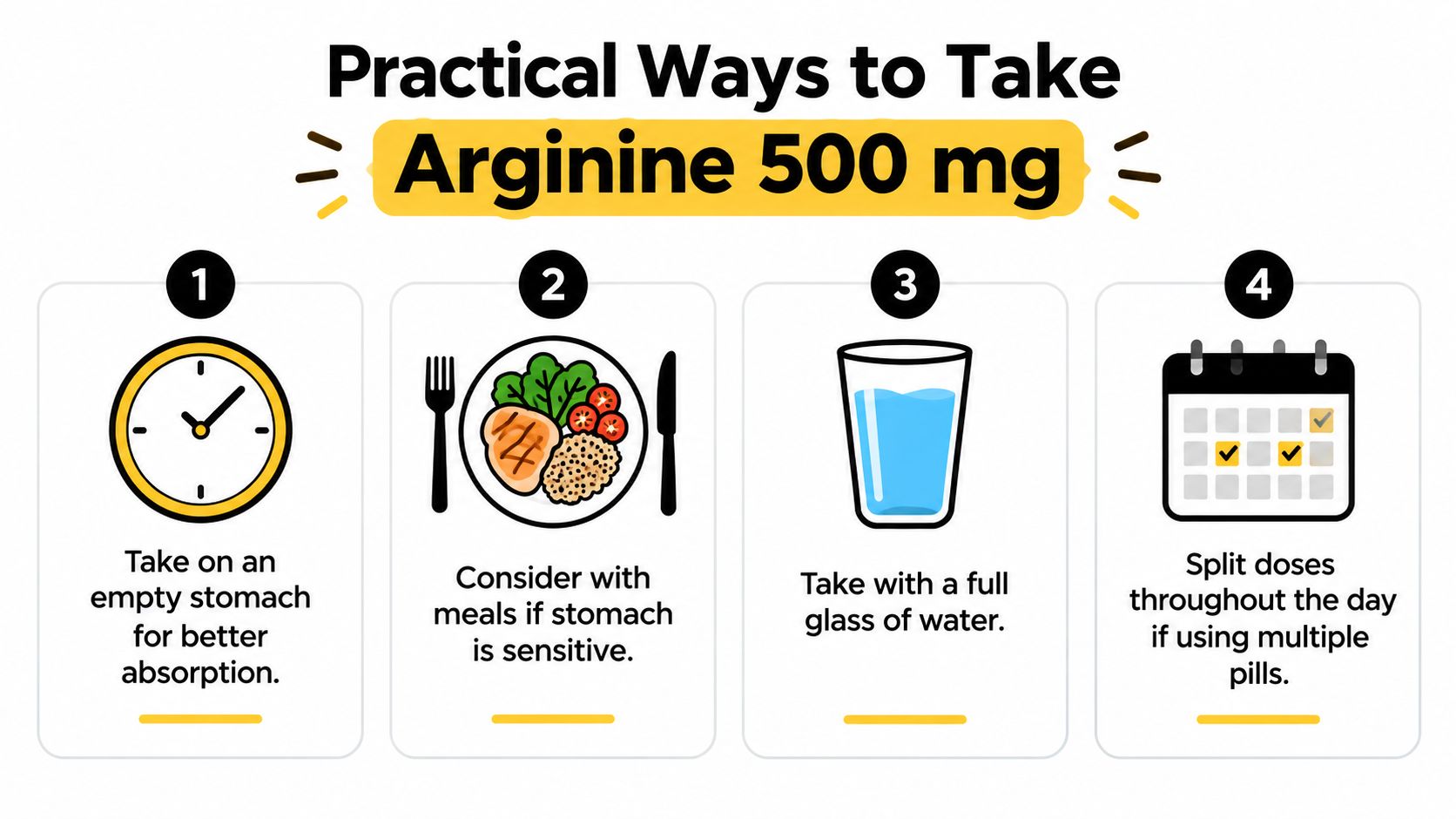
A 500 mg serving is easy to fit into a routine, but how you take it can affect comfort and consistency. Some people prefer an empty stomach because fewer competing nutrients may support absorption. Others experience stomach discomfort that improves when the capsule is taken with a meal.
Start with the product's directions, then adjust for tolerance rather than chasing a dramatic sensation. Take the capsule with water, and don't treat an uncomfortable stomach as evidence that the supplement is working.
Choose a routine you can repeat
If you use more than one capsule, splitting servings across the day may feel easier than taking them together. A morning serving, a pre-activity serving, or a dose alongside an established meal can all work as practical anchors. Consistency makes it easier to notice whether the product suits you.
Pairing is where a modest serving may become more strategically useful. L-citrulline can support the arginine precursor pool through tissue conversion, while beetroot supplies dietary nitrate through a different nitric-oxide route. Vitamin C, a small amount of carbohydrate, or an adaptogenic ingredient may appear in supplement routines, but those additions shouldn't be treated as proof of a specific outcome.
Capsules suit people who value convenience. Powders allow more flexible adjustment, though their taste and measurement can make adherence harder. For further reading on changing supplement research and formulation topics, explore MEDISTIK research updates, then compare any advice with the product label and your clinician's guidance.
Why 500 mg Alone Is Often a Supporting Dose
Could 500 mg be useful without producing a dramatic effect? Yes, but its role is usually foundational. The label states how much L-arginine is swallowed, while the body's response depends on the product's formulation, release pattern, and the person taking it. At this serving size, the practical result is more likely to be a modest contribution than a powerful standalone intervention.
That makes 500 mg a reasonable building block for a repeatable amino acid routine. It may complement L-citrulline or beetroot, or give someone a manageable way to assess tolerance before considering a larger serving. The goal matters: a foundational amount may suit general supplementation, while a specific circulation outcome may require a formula or dose closer to those examined in research.
Put the serving beside the research
| Dose range | Common use | Evidence strength |
|---|---|---|
| 500 mg | Small repeatable serving or formulation component | Direct physiological signals exist, but major outcome claims are limited |
| Up to 30 g per day | Reported in broader safety and research contexts | Not a general self-care recommendation |
The erectile-function figures discussed in the research section show why dose and outcome must be considered together. They describe studied interventions, not a promise that one 500 mg capsule will produce the same result.
Formulation can matter more at a modest dose. A powder permits finer adjustment, while a capsule offers a fixed serving and easier routine. Ingredients that pair L-arginine with L-citrulline may pursue a broader precursor strategy, whereas beetroot uses dietary nitrate through a different nitric-oxide route. This comparison of arginine and citrulline together explains why some formulas combine both ingredients instead of relying on arginine alone.
Safety, Side Effects, and Who Should Be Cautious
Arginine can cause gastrointestinal symptoms, including bloating, abdominal discomfort, diarrhea, and nausea. These effects may be more noticeable when someone takes a larger amount or uses the supplement on an empty stomach. A lower starting serving and food-based timing can make tolerance easier to assess, but they don't eliminate the need for caution.
Arginine can also lower blood pressure. Mayo Clinic notes that oral L-arginine may reduce blood pressure in people with hypertension, and recent evidence summarized in the supplied data reports an average reduction of about 4 mmHg in both 24-hour systolic and diastolic blood pressure in a 2026 meta-analysis, as discussed in this Mayo Clinic overview of L-arginine.
Medication combinations deserve attention
The main concern isn't that 500 mg is automatically dangerous. It's that even a modest vasodilatory effect may add to the effect of medicines or other supplements that already lower blood pressure.
- Nitrates: Combining arginine with nitrate medicines can increase the risk of blood pressure dropping too far.
- PDE5 inhibitors: People using erectile-dysfunction medicines should ask a clinician before adding arginine.
- Antihypertensives: Blood-pressure medicines may interact with arginine's vascular effects.
- Other vasodilators: A combined supplement routine can be difficult to evaluate if several products affect circulation.
People recovering from a heart attack, those with an active herpes outbreak, and anyone with asthma or liver or kidney impairment should consult a healthcare professional before using supplemental arginine. Pregnancy and pediatric use also require professional advice because safety data aren't established for those groups.
Safety first: If you take cardiovascular medication or an erectile-dysfunction medicine, ask your prescriber before adding arginine, even when the label serving looks small.
A cautious trial means starting with part of a serving, monitoring stomach comfort, dizziness, headache, and unusual weakness, and stopping if symptoms concern you. Seek medical guidance promptly if you're using arginine for a diagnosed condition rather than general nutrition.

How to Evaluate the Quality of an Arginine Supplement
A good label answers basic questions quickly. You should be able to identify the exact arginine form, the amount per serving, the serving size, other active ingredients, suggested use, and relevant warnings without decoding a proprietary blend.
Use four checkpoints
Third-party testing adds a layer of verification for identity, potency, and contaminant screening. Look for a recognizable certification seal, such as USP, NSF, or Informed Choice, and check whether the manufacturer can provide a current certificate of analysis. A seal alone isn't a substitute for reading the full product information.
Label transparency matters because “arginine complex” can conceal the amount of each form. A clear panel should distinguish free-form L-arginine from arginine HCl, alpha-ketoglutarate, or another bonded form.
Ingredient form affects how you compare products. Free-base L-arginine and arginine salts aren't interchangeable label descriptions, so compare the listed form and serving amount rather than assuming that every 500 mg entry represents the same material.
Complementary ingredients may make a formula more aligned with your goal. L-citrulline and beetroot represent different nitric-oxide precursor routes, while vitamin C may be included for broader nutritional support. Their presence still doesn't prove that a product will deliver a particular performance or medical result.
Make the decision practical
Use this short checklist before buying:
- Serving math: Compare the cost per active 500 mg serving, not merely the cost per capsule.
- Dosage clarity: Avoid products that hide active amounts inside a proprietary blend.
- Form factor: Choose capsules for convenience or powder when flexible measuring matters.
- Quality signals: Check manufacturing certifications, expiration dating, allergen disclosures, and testing documentation.
- Claim discipline: Be wary of promises that sound like treatment guarantees or instant vascular transformation.
For a plain-language refresher on serving sizes, ingredient order, and proprietary blends, use this guide to reading supplement labels. Five minutes of label checking can prevent an expensive comparison based on the wrong number.
Fitting Arginine 500 mg Into a Daily Routine
A useful routine begins with the person, not the capsule. Someone seeking general wellness may prefer one consistent serving attached to breakfast or another daily habit. An active adult may test timing before exercise, while an older adult focused on circulation should involve a clinician, especially if blood-pressure treatment is already part of the routine.
Keep expectations proportional to the serving. A 500 mg capsule can sit comfortably inside a broader nutrition plan, but it may need to be paired with L-citrulline, beetroot, or a different dietary strategy when the goal is sustained nitric-oxide precursor support. Stepping up to a larger amount should be a deliberate decision, not an automatic response to not feeling a “pump.”
Three routine examples
The maintenance user might take one serving with water at a consistent time and track tolerance, energy, and general comfort. The purpose is repeatability, not a dramatic immediate sensation.
The active exerciser could test the serving before a workout, provided the product directions and personal health context allow it. Tracking perceived endurance and recovery can be more useful than judging the supplement by an immediate tingling feeling.
The circulation-focused older adult should review the plan with a healthcare professional before use. Blood-pressure effects and medication interactions matter more than convenience.
Store the product as directed, keep the container closed, and follow its expiration date. If you use multiple servings, change only one variable at a time so you can identify what helps or causes discomfort. A weekly pattern might involve a consistent low serving on ordinary days, a carefully timed serving on planned activity days, and a review of tolerance before considering any increase.
A product such as All Night NexiHerb, Advanced Herbal Formula for Male Vitality & Daily Wellness is a separate adult-men's botanical formula that lists 20 mg of L-arginine per capsule alongside its other ingredients, so it shouldn't be confused with a standalone 500 mg arginine product.
The best fit for arginine 500 mg is usually the shopper who wants a modest, measurable starting point or a component within a wider formula. Choose a larger, clinically studied regimen only with a clear goal and appropriate professional input.
NexiHerb LLC offers science-inspired dietary supplements covering amino acids, nitric oxide support, herbal blends, and everyday wellness, with product information designed to help adults compare ingredients and serving sizes. Visit NexiHerb LLC to explore formulas that may fit your routine, then review each label and consult a healthcare professional when medications or health conditions are involved.