

Clinical evidence shows that maca root typically takes 8 to 12 weeks of consistent daily use to produce noticeable improvements in sexual desire and vitality, rather than working immediately. Some people may notice subjective changes sooner, but the clearest research-based evaluation window is measured in weeks, not hours or days.
You take maca in the morning, wait for the promised burst of energy or libido, and feel almost exactly the same. That experience is common, and it doesn't automatically mean the supplement has failed. Maca isn't generally evaluated like caffeine or a pre-workout product, where an acute sensation is expected soon after taking it. The more useful question is whether your response changes gradually with steady use.
Clinical trials provide a practical framework. Research has commonly assessed maca after 8 to 12 weeks, with some studies finding no clear benefit during the earliest checkpoints and more meaningful outcomes later in a systematic review of maca trials. Your product, dose, digestion, baseline health, and reason for taking maca can all affect what you notice, so the timeline should be treated as an evaluation plan rather than a promise.
Table of Contents
- Setting Realistic Expectations for Maca Root
- The Clinical Timeline for Libido and Sexual Function
- Tracking Energy, Mood, and Hormonal Markers
- Variables That Influence Your Personal Timeline
- Dosing Strategies and Titration for Best Results
- Safety Considerations and When to Reassess
Setting Realistic Expectations for Maca Root
You start maca on Monday and check for a change by Tuesday. Perhaps you expect more drive during a workout, stronger sexual interest, or a lift in mood. If nothing feels different, increasing the dose, changing products, or stopping may seem reasonable. That reaction is understandable, but it makes maca difficult to evaluate.
Maca is not generally assessed like an acute stimulant, where a noticeable sensation soon after use is part of the expectation. Its possible effects are better judged through consistent daily use over time. Human research on sexual desire points to an evaluation window that begins around the second month and continues into the third month, rather than a same-day response a summary of randomized clinical trial findings.
The practical benchmark
Use 8 weeks as the earliest serious checkpoint and 12 weeks as the fuller evaluation point. These milestones are evaluation points, not promises. People may respond differently, and some may not notice a useful effect at all. Stopping after a few days provides little information about whether maca fits your goal.
A systematic review found that some trials showed no benefit at 2 or 4 weeks, while positive effects appeared after at least 6 weeks across the broader evidence base an analysis of maca research on sexual function. Early impressions can therefore mislead. You may notice nothing at first, detect a gradual shift later, or complete the trial and conclude that maca is not useful for you.
Practical rule: Keep the dose and product stable long enough to evaluate them, unless side effects or professional advice require a change.
The meaning of “work” also depends on your target. For sexual desire, track interest, satisfaction, and sexual-function changes. For general vitality, record daily energy or mood, while recognizing that these subjective experiences are harder to measure and cannot be treated as interchangeable with clinical libido outcomes.
A better expectation than instant effects
Use milestones instead of waiting for a dramatic sensation. During the early weeks, focus on tolerance and keeping the routine consistent. Around the middle of the evaluation period, look for a pattern across several days rather than judging one unusually good or bad day. At the later checkpoint, compare your current experience with your starting point.
For more context on how long supplements take to work, the same principle applies: a supplement timeline is meaningful only when your routine is consistent enough to observe. A stable routine turns a vague expectation into a clearer personal test.
The Clinical Timeline for Libido and Sexual Function
If you start maca hoping to feel an immediate surge in desire, the clinical timeline points to a slower test. The strongest human evidence concerns sexual desire and sexual function, with benefits assessed across a 12-week randomized, double-blind, placebo-controlled trial of maca gelatinizada. An independent effect on sexual desire became clearest at 8 and 12 weeks, rather than during the first days in the published PubMed record.
The trial also helps prevent a common misunderstanding. Desire improved without a corresponding change in testosterone or estradiol during the study period. The result does not support treating maca as a fast testosterone booster. It suggests that a change in libido can occur without a measurable rise in those hormones.
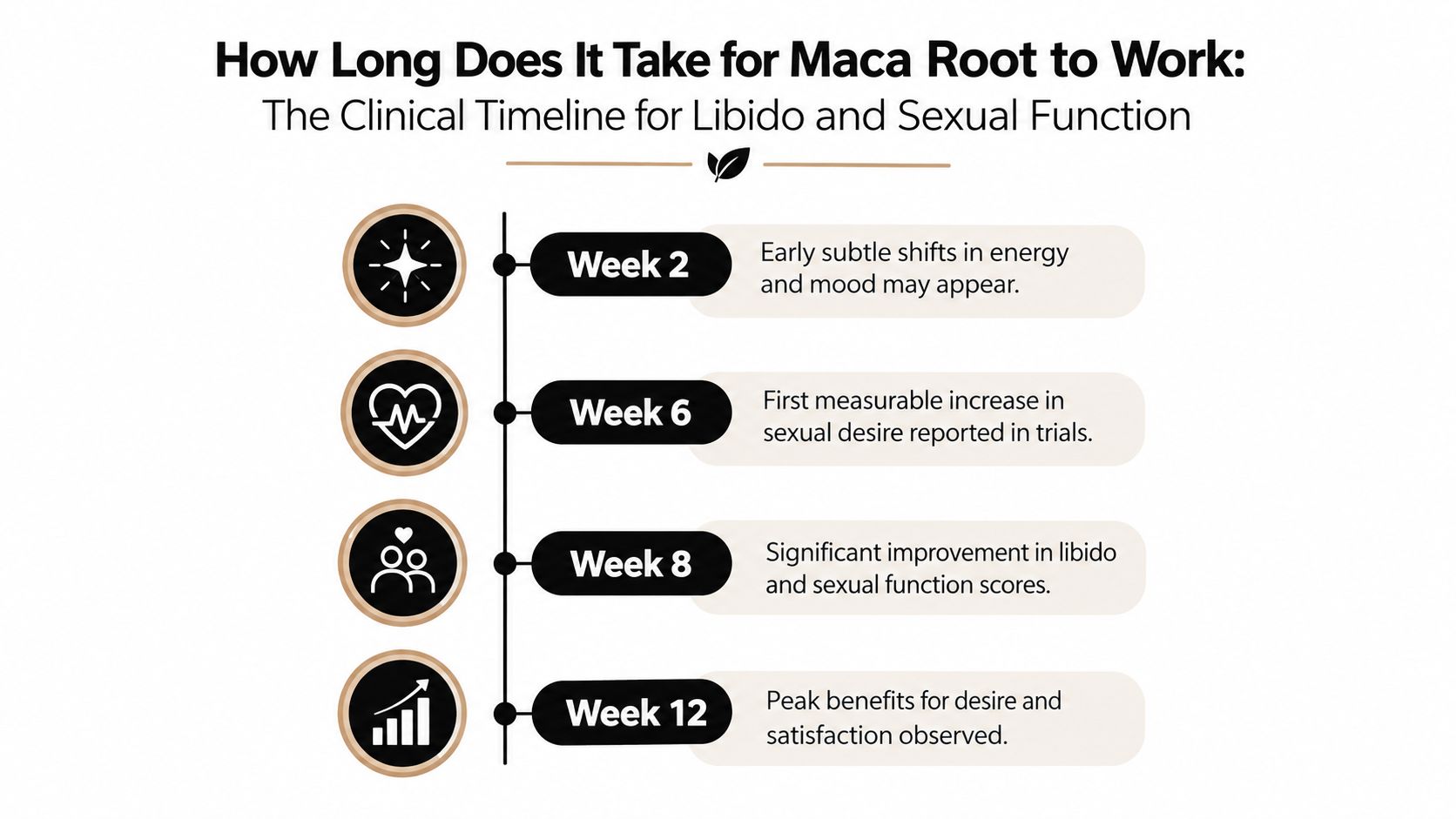
What the checkpoints mean
| Checkpoint | How to interpret it |
|---|---|
| Early use | Establish tolerance and note any immediate digestive or subjective responses. |
| Around 6 weeks | Look for a pattern across several days, while allowing for the possibility that an early benefit may not appear. |
| 8 weeks | Treat this as the first major evidence-based checkpoint for sexual desire. |
| 12 weeks | Compare your experience with baseline at the end of the trial period. |
The broader research summary describes a similar testing window. Clinical trials commonly lasted 12 weeks and often used approximately 2,400 mg per day. One study assigned 50 men with mild erectile dysfunction to maca tablets at that daily amount for 12 weeks. Another 12-week trial used the IIEF-5 and reported a statistically significant between-group improvement, with a mean difference of 1.10, a 95% confidence interval of 0.61 to 1.59, and P < 0.001 as summarized in the maca research review.
These results describe how researchers tested maca, not a guaranteed outcome for every adult. A short trial can miss a gradual response and can make a useful supplement seem ineffective. Before starting, record your baseline desire and sexual-function concerns. Keep the dose, product, and major lifestyle factors steady, then compare your notes at the later checkpoints.
Adults considering a blended botanical formula can review Maca Power+ NexiHerb Herbal Dietary Supplement, which contains maca root alongside selected botanical ingredients and black pepper in a vegetable capsule. Since the formula contains more than maca, a response cannot automatically be assigned to maca alone. Read the label and assess the product as a whole.
The practical conclusion is clear: maca's studied libido response is gradual and non-acute. The available trial data do not point to a testosterone or estradiol surge as the explanation. Use the weekly checkpoints to judge a pattern, rather than waiting for an overnight effect.
Tracking Energy, Mood, and Hormonal Markers
A week with better sleep can make maca seem effective, while a stressful week can make the same routine feel disappointing. Energy, mood, motivation, and vitality are personal outcomes, so judge them across repeated checkpoints rather than treating one unusually good or difficult day as proof.
Start with a simple evening journal. Rate energy, mood, sleep quality, stress, and sexual desire as low, moderate, or high. Add a brief note about exercise, alcohol, illness, unusually poor sleep, or major stress. These details act like labels on a test result, helping you see whether a change occurred alongside maca or alongside another factor.
Track patterns, not isolated sensations
Use weekly comparisons. For example, an entry might read: “Energy: moderate, mood: moderate, sleep: poor, stress: high, exercise: none.” A later entry could show higher energy and steadier mood after an ordinary night of sleep. Several similar entries across different days provide a more useful signal than a single burst of vitality.
Ask whether the change survives normal variation. Energy that improves only after excellent sleep may reflect sleep rather than maca. A steadier pattern across varied days is more informative, although a journal cannot prove that maca caused it.
The term adaptogenic is often applied to maca, but it does not establish a specific HPA-axis effect for every user. Because the earlier libido trial found no testosterone or estradiol shift, treat a perceived hormonal change as subjective unless testing confirms it. Maca should not be presented as hormone replacement or an automatic testosterone booster.
Journal prompt: “What changed repeatedly this week, and what else changed at the same time?”
Hormone testing requires a separate standard. If you have a medical reason to monitor hormones, ask a healthcare professional to order and interpret the appropriate tests. Libido, energy, and mood cannot confirm hormone status on their own. Feeling better does not prove a hormone change, and feeling no benefit does not prove that your hormones are abnormal.
Menopause-related concerns may lead you to compare supplements with clinical hormone care. For background on options and questions to raise with a qualified clinician, you can find BHRT relief with Athena Plastic Surgery. Use that information as general education, not as individualized medical advice.
If fatigue is the main outcome you are tracking, review this guide to the best supplements for fatigue. Persistent or worsening fatigue deserves medical evaluation, so a supplement trial does not postpone investigation of an underlying problem.
Variables That Influence Your Personal Timeline
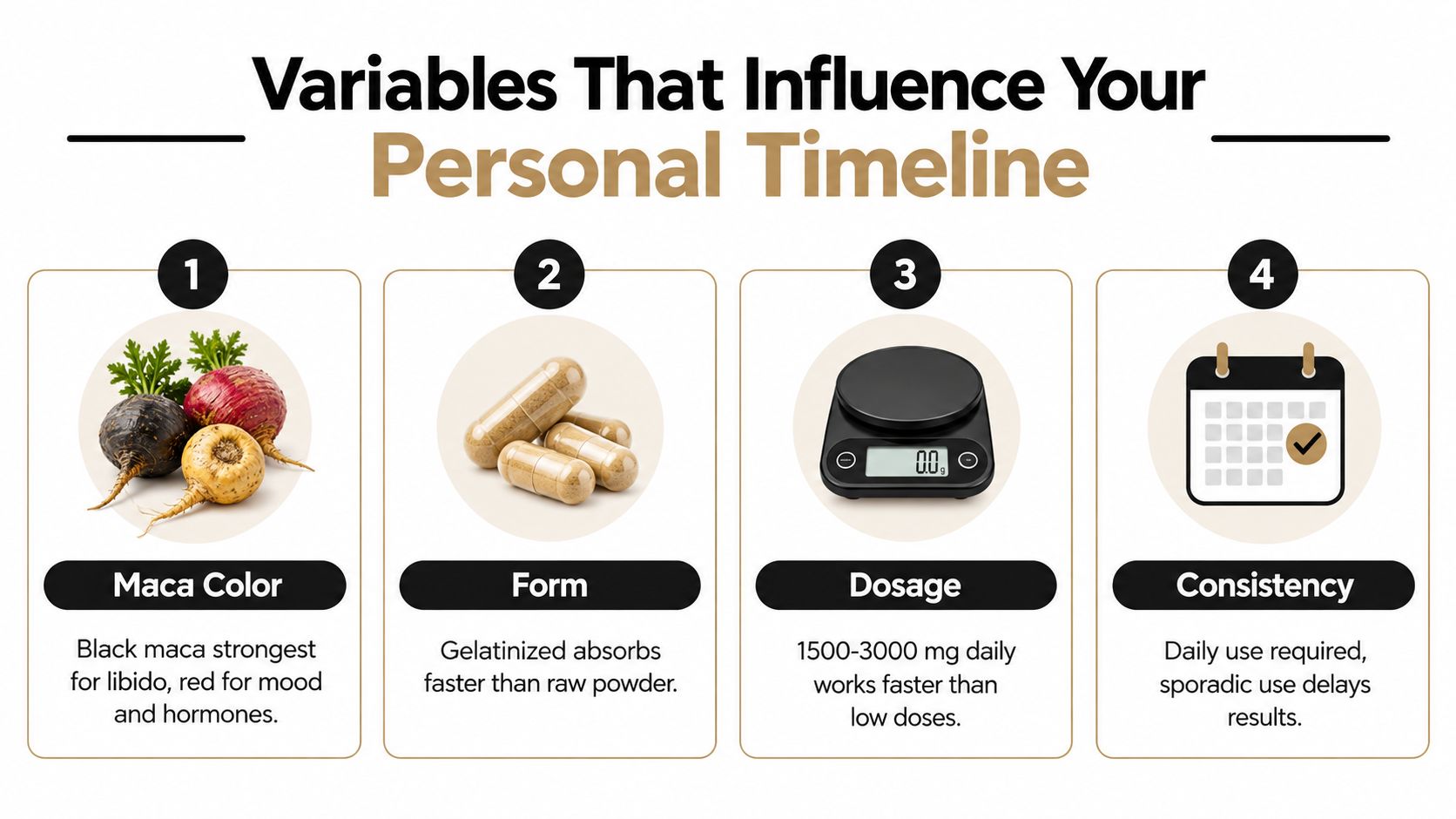
Two people can take maca consistently and still reach different conclusions. The form of maca, serving amount, digestion, nutrition, sleep, stress, and the outcome being measured can all affect the timeline. These factors do not prove that maca works faster for one person. They explain why your results may not match a trial exactly.
Form and digestion
Raw maca powder retains much of its natural starch. Gelatinized maca has been processed to remove much of that starch, which may make it easier for some people to tolerate. The trial discussed earlier used gelatinized maca, so its findings apply most directly to that form.
Easier digestion is not the same as faster effects. A product that causes less stomach discomfort may make daily use more consistent, but it does not show that libido will improve sooner. Compare products by their labeling, serving size, form, tolerance, and quality rather than by an absorption claim alone.
Color and personal goals
Maca is commonly sold in yellow, red, and black varieties. Traditional use and early research discussions connect these colors with different goals, yet the evidence does not establish that one color will reliably work best for a particular person. Select a clearly labeled product and define the outcome you want to track before starting.
The infographic summarizes four practical variables that may shape an individual timeline. Use it as a planning aid, not as a clinical promise.
Lifestyle and baseline differences
Sleep loss, restrictive eating, high stress, and demanding training can affect energy and libido before maca enters the picture. A shift worker, for example, may compare a week-six journal entry from several night shifts with an earlier week of regular sleep. That comparison mixes maca exposure with sleep disruption, making the timeline difficult to judge.
Keep major conditions visible in your journal. Record sleep pattern, stress, training load, and the same outcome measures each week. Stable routines make a week-to-week comparison more useful, while sharp changes add noise.
Hormone-related symptoms also require context. If you are comparing maca with medical hormone options or preparing questions about a treatment timeline, the Pause Medical HRT timeline may provide general background for a discussion with a healthcare professional. Maca and hormone therapy are not interchangeable, so do not use one to judge the effects or safety of the other.
Dosing Strategies and Titration for Best Results
A label can make a research dose look deceptively simple. One capsule may contain a defined amount of maca, while another product may list a proprietary blend whose total combines several botanicals. The 1,500 to 3,000 mg range covered earlier describes study protocols, not a universal prescription.
Read the Supplement Facts panel before choosing a routine. Check the maca amount per serving, the number of capsules in that serving, and whether the product uses raw or gelatinized root. If the label gives only the blend's total weight, you cannot assume it provides the maca quantity used in a trial. Record the product name and label details so later changes remain interpretable.
A cautious routine
Begin at the lower end of the labeled direction, particularly if your digestion is sensitive. Follow the product instructions or a clinician's advice before adjusting the amount. Taking maca with food may make it easier to tolerate. Morning or early afternoon may suit you better if taking a stimulating-feeling product late in the day interferes with sleep.
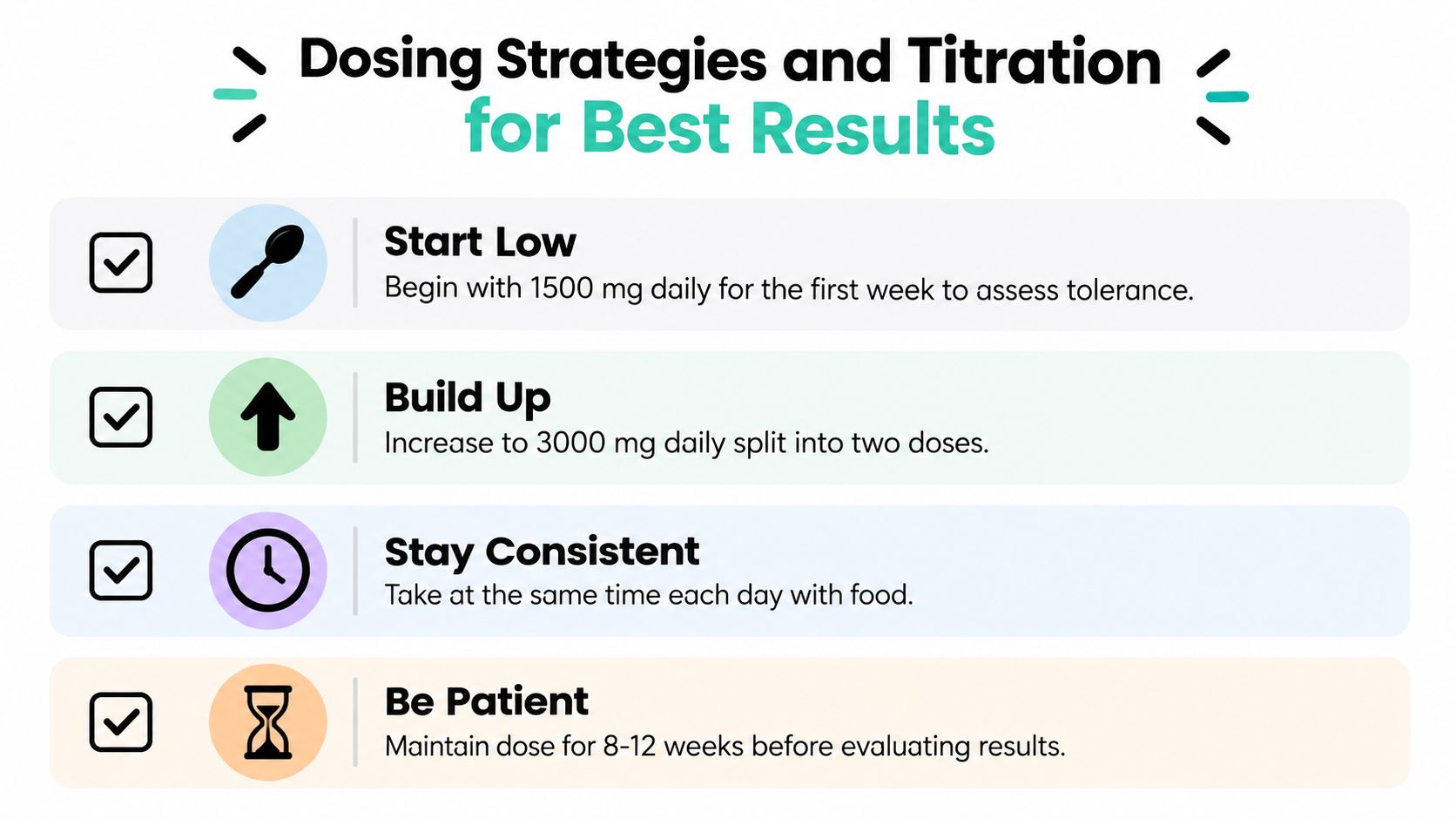
Change one variable at a time. Starting maca alongside several new supplements makes it difficult to identify which product affected digestion, sleep, mood, or libido. Hold the routine steady long enough to compare weekly observations rather than reacting to a single day.
Use a 12-week tracking sheet
Record these details at regular intervals:
- Starting point: Note baseline libido, energy, mood, sleep, and relevant symptoms before the first dose.
- Routine: Mark each day you take maca, including the form and amount shown on the label.
- Tolerance: Record stomach upset, headaches, sleep disruption, unusual mood changes, or other concerns.
- Milestones: Review entries around week 6, week 8, and week 12. Look for a consistent pattern, not one unusually good or difficult day.
- Decision: At week 12, continue only when the perceived benefit is meaningful and the routine remains well tolerated.
This approach gives you a clearer comparison than repeatedly raising the dose. For context about maca and male vitality goals, read maca root for men. People reviewing options during perimenopause can also consult this perimenopause supplement guide before discussing supplement questions with a healthcare professional.
Safety Considerations and When to Reassess
A supplement routine can seem promising during one good day, then feel different after poor sleep or added stress. Judge maca by a steady pattern across the planned tracking period, while treating new or persistent symptoms as a reason to pause.
Maca is generally described as well tolerated in studied adults, but “natural” does not mean risk-free. Digestive discomfort, headaches, sleep disruption, or unusual mood changes can occur. Stop use and seek medical guidance if symptoms are concerning or persistent.
Who should ask a clinician first
Speak with a healthcare professional before using maca if you have a thyroid condition, a hormone-sensitive condition, are pregnant or breastfeeding, or take hormonal therapies or thyroid medication. Maca contains glucosinolate compounds, and available safety information is not sufficient to assume that self-directed use suits every population.
Ask for advice if you are using maca for fertility, persistent sexual dysfunction, severe fatigue, menstrual changes, or a suspected hormone disorder. These concerns may require evaluation, and a supplement should not delay diagnosis or replace treatment.
The 12-week decision
At the final checkpoint, review three questions:
- Did the target outcome improve consistently?
- Did the product remain comfortable and practical to use?
- Could sleep, stress, medication, illness, or another change explain the difference?
Continue only when the benefit is clear enough to justify the routine and your healthcare professional agrees it is appropriate. If nothing meaningful has changed after a consistent evaluation, discontinuing maca is reasonable. Reconsider the goal, product, and underlying health factors instead of assuming a higher dose will solve the problem.
For context about maca and male vitality goals, read maca root for men. People reviewing options during perimenopause can consult this perimenopause supplement guide before discussing supplement questions with a healthcare professional.
NexiHerb LLC offers science-inspired dietary supplements, including plant-based formulas for everyday wellness, energy, and vitality, with practical nutrition guides for informed routines. Visit NexiHerb LLC to review the catalog and compare products with your health goals, label preferences, and tracking plan.