

The popular advice to choose sunflower lecithin because it's soy-free misses the most useful question: what's in the powder? Sunflower tells you the starting plant, and powder tells you the physical form. Neither tells you how much phosphatidylcholine you'll get, how well it'll mix into a recipe, or how fresh the lot is.
For kitchen use, you need an ingredient that disperses well and performs consistently. For supplement decisions, you need a clearly stated composition, not just a large scoop size. Those are different jobs, and the same jar won't necessarily be equally suited to both.
Table of Contents
- What Sunflower Lecithin Powder Really Contains
- How Phospholipids Work in Food and the Body
- Powder Specs Worth Reading on a COA
- Functional Benefits and Where They Stop
- Kitchen and Supplement Ways to Use It
- Sunflower Lecithin Versus Soy Lecithin
- Dosage and Safety Limits
- Choose a Lot and Use It Safely
What Sunflower Lecithin Powder Really Contains
Sunflower lecithin powder is a mixture recovered during sunflower-oil processing. The powder's composition depends on how it is finished, including how much oil and other material remains with its phospholipids. “Sunflower” identifies the source, and “powder” describes the form; neither specifies a fixed phosphatidylcholine (PC) dose.
A study of sunflower-oil phosphatide concentrate reported about 50–60% phospholipids in this principal raw material, identified 10 individual phospholipids, and measured the fatty-acid ranges below. These figures describe particular materials, not every retail powder.
What a typical sunflower lecithin powder can contain
| Component | Reported figure | Why it matters |
|---|---|---|
| Phospholipids in phosphatide concentrate | About 50–60% | Principal raw material before finishing |
| Ranked phospholipid classes | PC, then PE, PI, PS, and PA | The mix includes several classes, not only PC |
| Individual phospholipids identified | 10 | Shows that the ingredient contains multiple molecules |
| Example total phospholipids | 43.1% in one formulation starting material | The rest included oil and other compounds |
| Example class split of those phospholipids | PC 36.7%, PI 35.3%, PE 15.0%, PA 5.1%, other 7.9% | These percentages describe the phospholipid fraction, not the whole material |
| Oil in that material | 33.4% | Oil lowers the phospholipid share per gram |
| Other compounds | 23.5%, including glycolipids and complex carbohydrates | These are outside the measured phospholipid fraction |
| Linoleic acid | About 59.17–60.15% in reported samples | A major polyunsaturated fatty acid |
| Oleic acid | 0.58% to 10.34% | The amount differed across materials and processing conditions |
| Palmitic acid in phospholipid fraction | Up to 19.0%, versus no more than 7.2% in the cited unrefined oil | The extracted fraction can differ from the starting oil |
The study's formulation-material example shows why the denominator matters: a percentage of the phospholipid fraction is not necessarily the same percentage of the whole ingredient. Two bottles labeled sunflower lecithin powder may therefore report different PC figures, even when both contain the same type of ingredient.
Learn the names without confusing the fractions
Phosphatidylcholine (PC) is the choline-containing phospholipid often highlighted on product labels. Phosphatidylethanolamine (PE) and phosphatidylinositol (PI) are other major classes. Phosphatidylserine (PS) and phosphatidic acid (PA) may also be present, but their presence alone does not establish a standardized dose of either.
Label-reading rule: Compare total phospholipids, PC, moisture, and residual oil. The word “lecithin” alone does not show that two products have equivalent compositions.
How Phospholipids Work in Food and the Body
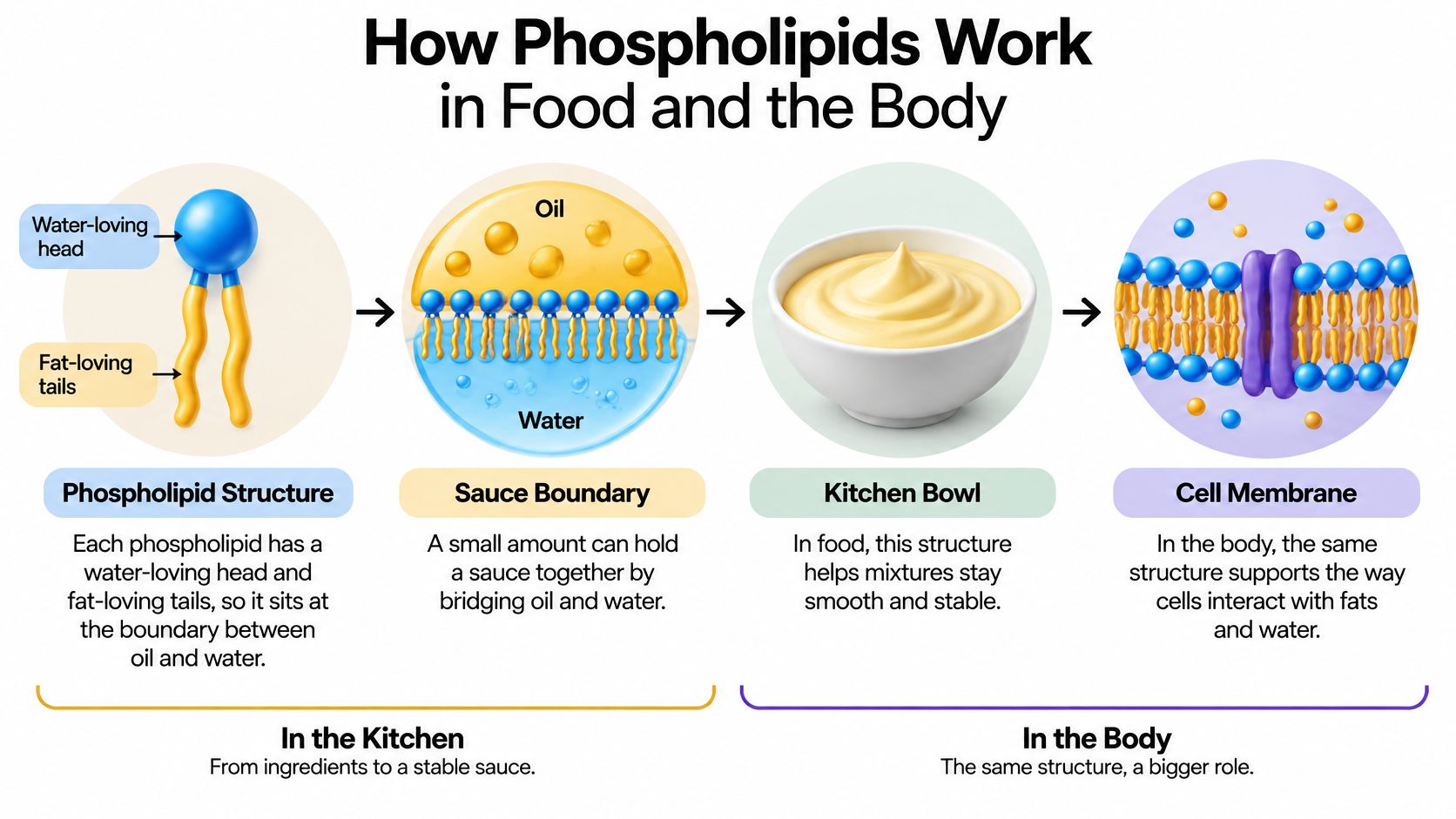
A vinaigrette often separates within minutes because oil and water do not readily stay mixed. Add a little lecithin, then whisk: its phospholipids can help keep small oil droplets dispersed. Each molecule has a water-loving head and fat-loving tails, so it can sit where the two phases meet.
Kitchen function starts at the interface
The effect depends on the recipe. Oil-to-water balance, temperature, mixing method, and other ingredients all influence whether a sauce or beverage stays evenly dispersed.
The same molecular structure also appears in cell membranes, where phospholipids form part of the membrane's boundary.
Different phospholipids have different head groups. PE and PI therefore don't function identically to PC in a formulation, and a mixed lecithin ingredient isn't the same as a supplement with a precisely stated dose of one phospholipid.
Processing also affects how lecithin behaves:
- Standard lecithin retains a mixture of phospholipids, neutral oil, and other compounds.
- De-oiled lecithin has much of its neutral oil removed, concentrating the remaining fraction.
- Hydrolyzed lecithin has been enzymatically modified, changing its phospholipid structure and dispersing behavior.
Nutritional structure and what a label can tell you
PC contains choline, but the weight of PC and the weight of choline are different measurements. A label that states only the lecithin amount cannot establish a specific choline dose.
Phospholipids are also part of cell membranes. That role alone doesn't show that taking extra lecithin treats disease or changes a particular blood test.
Lipid form matters in other ingredients, too. The comparison of omega-3 fish oil and krill oil discusses how products can differ even when both are sources of omega-3. Similar lipid terminology doesn't guarantee matching nutrient amounts or outcomes.
Sunflower origin identifies the source, and powder describes the form. Neither specifies a standardized PC dose: two sunflower lecithin powders can differ in phospholipid mix, residual oil, and freshness. A product name alone can't settle those differences.
Powder Specs Worth Reading on a COA
The word “powder” does not specify a phosphatidylcholine dose. Sunflower origin describes the source, while powder describes the form; products with those same labels can still differ in phospholipid mix, oil content, and freshness. A certificate of analysis, or COA, connects test results to a specific lot.
Read concentration and identity separately
An FDA-reviewed sunflower lecithin specification lists 18–24% phosphatidylcholine (PC) and above 97% acetone-insoluble matter, alongside limits for oxidation, moisture, insoluble material, and contaminants. These benchmarks apply to the ingredient described in that specification.
Additional FDA documentation on sunflower lecithin gives a de-oiled benchmark of at least 96% acetone-insoluble matter and describes a powder characterization reporting 30.49% phospholipids and 70.14% acetone-insoluble phosphatides. One characterization reported 19% PC and 30.49% phospholipids on different measurement bases. Those figures describe different things, like two measurements of the same mixture rather than two versions of the same result.
Specification targets for sunflower lecithin powder
| Test | Benchmark | What it measures |
|---|---|---|
| Acetone-insoluble matter | Above 97% for the powder or granule specification; at least 96% in the de-oiled notice | Proxy for total phosphatides |
| Phosphatidylcholine | 18–24% in the powder or granule specification | One phospholipid class, not total lecithin |
| Phospholipids in a powder characterization | 30.49% | Reported phospholipid measurement, not acetone-insolubles |
| Acetone-insoluble phosphatides in that characterization | 70.14% | A separate analytical result from the phospholipid figure |
| Peroxide value | Below 5 milliequivalents of oxygen per kilogram | Early oxidation |
| Moisture | Below 1.5% | Water content relevant to flow and storage |
| Hexane- and toluene-insolubles | Below 0.3% | Material insoluble under those test conditions |
| Lead, arsenic, cadmium, mercury | 0.1 mg/kg or less each | Individual heavy-metal limits in the specification |
The concentration results above come from the FDA sunflower lecithin specification and FDA documentation on sunflower lecithin. Acetone-insoluble matter can indicate the proportion of phosphatides, but it does not directly measure PC. For a consistent PC amount, look for an explicit PC result and check whether it is reported as a percentage of the whole powder.
Check freshness and contaminants next
Peroxide value helps assess early oxidation. A low result at manufacture gives information about the tested lot at that point; storage conditions still matter because exposure to heat and air can affect freshness.
Moisture affects handling. Powder that absorbs moisture may clump, which can make even mixing and repeatable spoon measurements harder.
- Separate insolubles from residual solvents. A hexane-insoluble test measures material that does not dissolve in hexane; it does not measure residual hexane. Request residual-solvent results separately.
- Check acid value when available. It provides information about free fatty acids and ingredient condition. Compare it with the supplier's specification and test method.
- Look for lot-specific results. A list of permitted limits gives targets; measured results show how the particular lot compares with them.
The guide to reading supplement labels can help distinguish total ingredient weight from declared constituent amounts. Use the label to see what the seller promises, then check the COA for results tied to the lot.
Functional Benefits and Where They Stop
Sunflower lecithin's strongest practical case is ingredient performance, not a list of medical promises. It can help disperse ingredients, support texture, and influence stability, but each benefit depends on the formulation.
This visual separates those functional advantages from claims they don't establish.
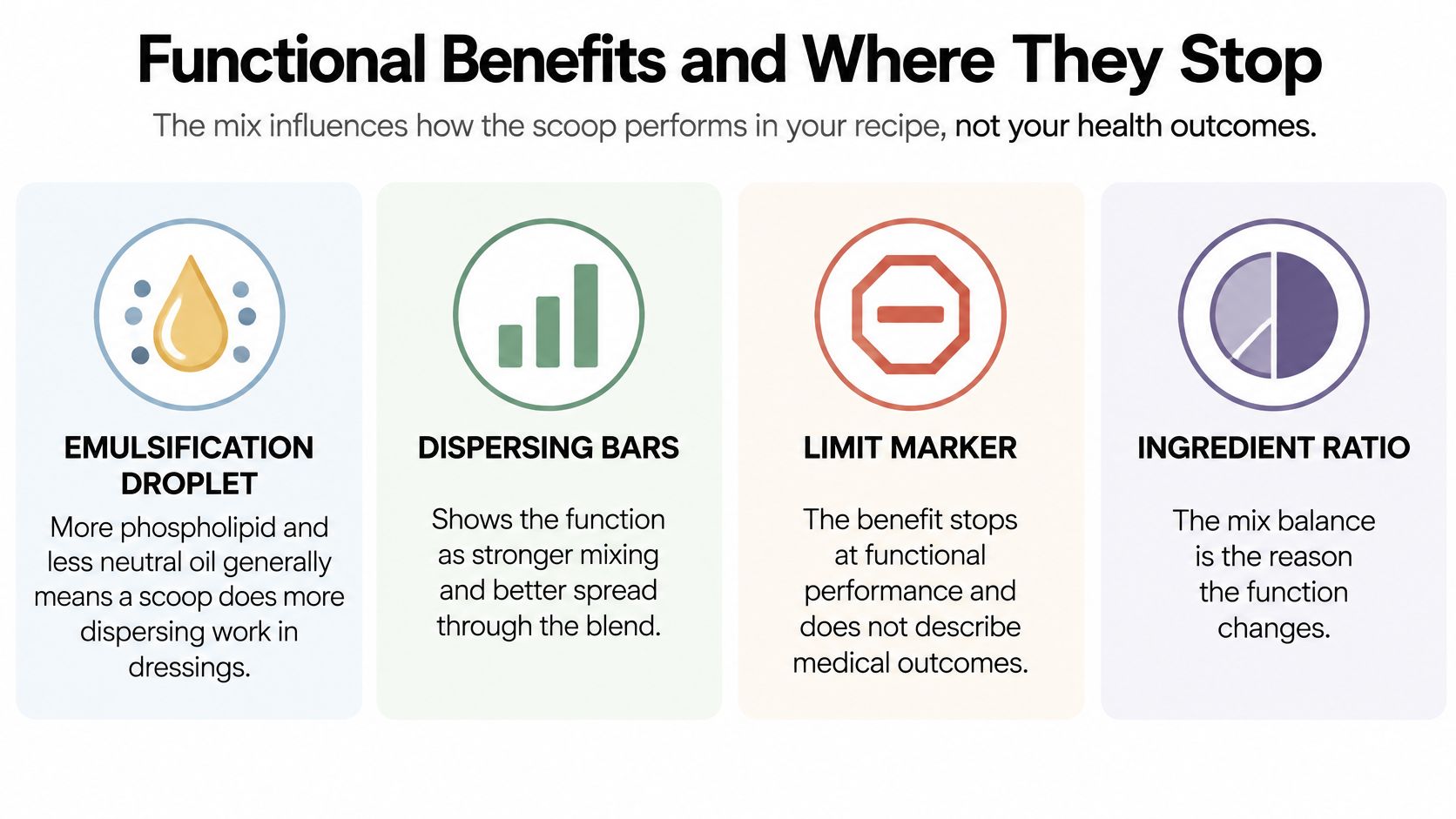
Match the benefit to the job
In dressings and plant-based beverages, the useful outcome is more even dispersion. In chocolate, lecithin is also used to adjust flow and handling, which isn't the same task as stabilizing an oil-in-water dressing.
A more concentrated phospholipid ingredient may do more work per gram, but adding extra isn't automatically better. Judge the finished texture, flavor, and separation rather than assuming the largest addition will perform best.
Ingredient choice also depends on the structure you need. For recipes involving whipped protein foams, the guide to powdered whites at IFM Gourmet Food Store offers a useful contrast: foam formation and lecithin-assisted dispersion are different jobs.
Sunflower origin is not a potency or a health guarantee.
Better stability still has limits
Comparative findings described in the FDA GRAS materials for sunflower lecithin reported a peroxide value of 1.5 milliequivalents of oxygen per kilogram of oil for a sunflower sample, versus 3.6 for a peanut-lecithin comparator. The same comparison associated the sunflower sample's greater stability with a lower proportion of oxidation-prone polyunsaturated fatty acids.
Those findings apply to the tested materials. They don't establish that every sunflower powder will outlast every other lecithin.
The peanut-butter work also found that protection declined with longer storage. Treat lecithin as one part of a stability plan, not as a preservative that makes a homemade spread shelf-stable.
- At home, close the jar promptly and protect it from heat, light, and moisture.
- In manufacturing, validate the finished packaging and check oxidation over shelf life rather than relying only on the incoming ingredient report.
The accompanying video provides additional context for the ingredient's uses.
None of these functional findings establishes treatment of heart, liver, brain, or fertility conditions. For everyday nutrition, lecithin remains an optional ingredient alongside a varied diet.
Kitchen and Supplement Ways to Use It
Sunflower origin and powder form tell you where the lecithin comes from and how it is handled. They don't specify a standard phosphatidylcholine dose, so use the product's directions for supplement servings and make small, controlled adjustments in recipes.
Kitchen techniques that avoid wasted batches
Start with a small test batch. Measure the amount, record it, and change one variable at a time so you can tell whether the powder improved the texture.
- For vinaigrette, disperse a small pinch in the aqueous ingredients, then whisk or blend while adding oil gradually. Check the texture right away and again after the dressing rests.
- For smoothies, blend the powder with the liquid before adding nut butter and frozen ingredients. This makes dry pockets easier to spot and correct.
- For warm plant milk, whisk in a little powder before frothing, then compare it with an untreated batch. Lecithin cannot compensate for every difference in protein or fat content.
- For chocolate, choose a food-grade product suited to fat-based applications and follow the recipe's addition method. Keep water out while dispersing the powder.
- For nut butter, blend thoroughly and observe oil separation during storage. Less separation describes a texture change; it does not establish how long the finished food can be stored safely.
For repeatable results, add 1/4 teaspoon, whisk for 30 seconds, and record the result. Increase the amount only if the texture still needs adjustment. A larger addition can change mouthfeel or flavor without solving the original problem.
Keep supplement servings separate from recipe adjustments
A teaspoon measures volume, not a precise amount of any one phospholipid. Powder density, packing, and granule size affect how much ingredient fits in the spoon.
For supplement use, follow the product's serving instructions rather than borrowing a cooking amount. A capsule serving and a spoonful of powder may provide different amounts and mixtures of constituents.
If the powder clumps, make a smooth slurry with a little warm recipe liquid before adding the rest. Follow supplier guidance on whether to disperse it in the water or fat phase, since processed forms can behave differently.
For general routine advice, see this guide to taking herbal powders. Lecithin still requires handling suited to the product and recipe.
Storage check: Use a dry spoon, reseal the container promptly, and keep it cool and dark. Discard the powder if it develops an unexpected paint-like, fishy, or otherwise rancid odor.
These steps help with preparation and routine use, not treatment.
Sunflower Lecithin Versus Soy Lecithin
Sunflower and soy lecithin can share a similar phosphatidylcholine (PC) figure while differing in other phospholipids. In dried crude samples, the published lecithin formulation material reports about 25% PC for each, with different proportions of phosphatidylinositol (PI) and phosphatidylethanolamine (PE).
| Point of comparison | Sunflower lecithin | Soy lecithin |
|---|---|---|
| Phosphatidylcholine in dried crude samples | About 25% | About 25% |
| Phosphatidylinositol in dried crude samples | About 24% | About 15% |
| Phosphatidylethanolamine in dried crude samples | About 14% | About 24%, roughly 1.7 times sunflower |
| Starting crop | Sunflower | Soybean |
| Major-allergen source status in US foods | Not soy-derived | Soy is a major food-allergen source |
| Common buyer reason | Non-soy formulation | Cost, supply, and familiar function |
| Forms that change function | Standard, de-oiled, hydrolyzed | Standard, de-oiled, hydrolyzed |
| What the plant name does not prove | PC dose, freshness, or an allergen-free facility | PC dose, freshness, or non-GMO status |
These figures describe dried crude samples, not every finished powder. The chart also shows why neither crop automatically supplies more PC.
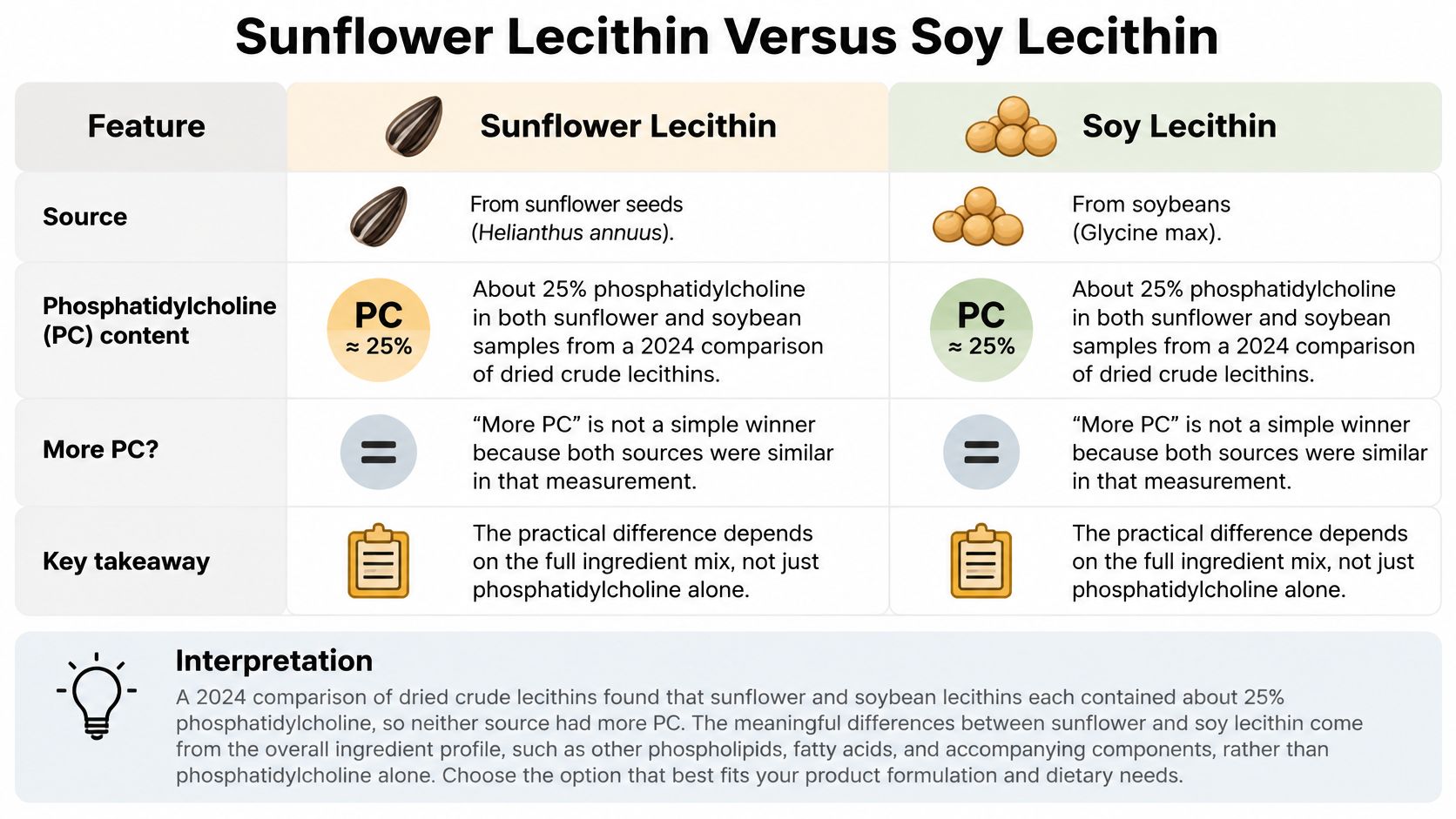
Processing can matter more than the crop
Two lots could show the same PC figure but different PE levels. In a recipe, that difference may affect how the lecithin performs, so a matching PC number alone does not guarantee a direct substitute. Sunflower origin identifies the crop; powder describes the form. Neither promises a standardized phosphatidylcholine dose or an identical phospholipid mix.
De-oiling changes concentration, while hydrolysis changes phospholipid structure. Check the processing form and product specifications before switching ingredients, especially when you rely on consistent recipe behavior.
For a plant-based recipe, assess the full formulation rather than assuming dietary suitability from one ingredient. If you're browsing options such as Saporia's dairy-free cheese with a chilli kick, check its own ingredient and allergen information. Dairy-free and soy-free describe different things.
Choose by situation, not by a winner's label
- Choose sunflower when you need a non-soy source and the supplier documents the composition and handling characteristics you want.
- Consider soy when soy is acceptable and the ingredient meets your recipe, sourcing, and budget requirements.
- Pause before buying if the seller can't explain the processing form or provide useful concentration and freshness information.
Non-GMO and organic claims need their own documentation. Choosing sunflower alone does not establish either claim or guarantee a particular emulsifying performance.
For a recipe you make repeatedly, record the brand, processing form, lot, and amount used. When changing suppliers, run a small trial rather than assuming the new powder will behave the same at the same amount.
Dosage and Safety Limits
Sunflower lecithin powder has no single daily supplement dose established by the ingredient studies cited in this article. Sunflower origin and powder form identify the source and format, not a standardized phosphatidylcholine dose. Products with the same name can differ in their phospholipid mix and oil content.
For a product that lists PC, calculate the amount in a serving from its powder weight and PC percentage. For example, 500 mg of powder at 20% PC provides 100 mg of PC. PC weight and choline weight aren't interchangeable, as section 2 explains, and the calculation doesn't determine whether the serving suits you.
Use the label as a boundary
- Check the serving basis. Confirm whether the label refers to powder weight, lecithin weight, PC, or choline.
- Avoid unplanned stacking. Review other supplements and foods containing lecithin before adding another product.
- Respond to intolerance. If use brings bloating, loose stools, or other digestive discomfort, reduce the amount or stop. Seek advice if symptoms persist.
- Get individual guidance. Ask a clinician before supplement use during pregnancy, for children, with a medical diet, or if you have a diagnosed food allergy.
A large kitchen scoop is a poor shortcut to a nutritional target. Volume can work for a familiar recipe, but it does not show how much powder or PC a serving contains.
A product's ability to emulsify food doesn't establish an appropriate daily intake.
Lecithin shouldn't replace choline-containing foods such as eggs, fish, or legumes. Choose supplement amounts with attention to your diet, the product's serving instructions, and your personal circumstances.
Choose a Lot and Use It Safely
Buy the powder whose documentation matches your purpose. A clear ingredient identity and a current lot report are more useful than a front label crowded with wellness claims.
Make the final checks before buying
- Read the entire ingredient panel. Look for carriers, flavors, and anti-caking ingredients as well as sunflower lecithin.
- Confirm the processing form. Ask whether it's standard, de-oiled, or hydrolyzed, and whether the supplier recommends it for your intended application.
- Request the lot-specific COA. Look for concentration, PC, moisture, peroxide value, residual solvents, and heavy-metal results.
- Verify allergy controls. Check the allergen declaration and ask about shared equipment, cleaning, and testing where relevant.
The FDA's food-allergy guidance explains major-allergen labeling and addresses inadvertent cross-contact during manufacturing and packaging. Sunflower-derived doesn't mean allergen-free: avoiding soy as the starting material doesn't establish what happens elsewhere in the facility.
Ask questions the label can't answer
If a seller calls a product soy-free, ask what supports that claim when allergy safety matters. An absent precautionary statement isn't a substitute for a manufacturer's explanation of its controls, and people with diagnosed allergies should follow clinician advice.
Keep organic, non-GMO, soy-free, and allergen-free claims separate. Labeling requirements also differ between markets, so don't treat US terminology as a worldwide guarantee.
Once you receive the jar, check the seal, lot identification, storage directions, and condition. Choose a stated phospholipid target for the job, test the powder cautiously, and use the smallest amount that achieves the intended result within the product's directions.
NexiHerb LLC offers dietary supplements and practical nutrition guides to help adults compare ingredients and build everyday wellness routines. Visit NexiHerb LLC to explore its catalog and label-reading resources, and bring the same focus on declared ingredients and serving instructions to your next supplement purchase.