

The most popular advice about a thyroid support complex is also the least useful: take a “thyroid booster” and expect more energy, easier weight management, or a faster metabolism. Thyroid biology doesn't work like a dimmer switch. Hormone production depends on specific nutrients, enzymes, feedback signals, medication status, and the underlying condition.
A better question is narrower and more practical: Which nutrient is missing, what dose is appropriate, and does the person taking it need monitoring? That shift matters because a complex may help address a genuine nutritional gap, but it can't automatically correct autoimmune disease, replace prescribed thyroid hormone, or explain every episode of fatigue.
Table of Contents
- Redefining the Thyroid Support Complex
- Core Ingredients and Their Biological Roles
- Evaluating the Evidence and Target Audience
- Navigating Safety Risks and Nutrient Interactions
- How to Choose a High-Quality Supplement
- Lifestyle Habits That Support Thyroid Function
- Building Your Personalized Wellness Strategy
Redefining the Thyroid Support Complex
A thyroid support complex is better understood as a targeted nutritional toolkit than as a universal stimulant. Thyroid hormone production follows several biological steps. Iodine contributes the raw material for hormone structure, while other nutrients help enzymes involved in production, protection, and conversion. Correcting a genuine deficiency may support normal physiology. Taking more without a deficiency may add little and increase avoidable risk.
The evidence also extends beyond any single “thyroid herb.” A 2024 NIH-linked review discusses iodine, selenium, iron, zinc, copper, magnesium, vitamin A, and vitamin B12 as nutrients that influence thyroid hormone synthesis and regulation throughout life. Related discussion places particular attention on the iodine-selenium relationship, because these nutrients support different parts of thyroid biology and should be considered together rather than treated as interchangeable. The NIH-linked review of thyroid nutrition provides the biological context.
Practical rule: A supplement can correct a nutrient shortfall. It can't diagnose why your thyroid is underperforming.
“Thyroid support” can describe several different aims: maintaining adequate iodine intake, supporting antioxidant defenses, filling a dietary gap, or including botanicals associated with stress management. These outcomes are not interchangeable. Someone with low nutrient intake has a different question from someone with Hashimoto's disease, thyroid nodules, hyperthyroidism, or a prescription for levothyroxine.
The same distinction limits unrealistic expectations. Fatigue, hair changes, constipation, mood shifts, and weight changes can result from many conditions. Persistent or worsening symptoms, palpitations, unexplained weight change, or neck swelling warrant clinical evaluation rather than self-treatment with a complex.
The category has also grown into a sizable supplement market. One estimate valued thyroid support supplements at USD 1.87 billion in 2024 and projected the segment to reach USD 4.08 billion by 2033, with a projected 9.29% CAGR from 2025 to 2033. Vitamins and minerals represented 47.75% of 2024 revenue in that estimate. The figures describe commercial projections, not proof that finished products improve thyroid outcomes. Grand View Research's thyroid support supplements market estimate supplies that market context.
Core Ingredients and Their Biological Roles
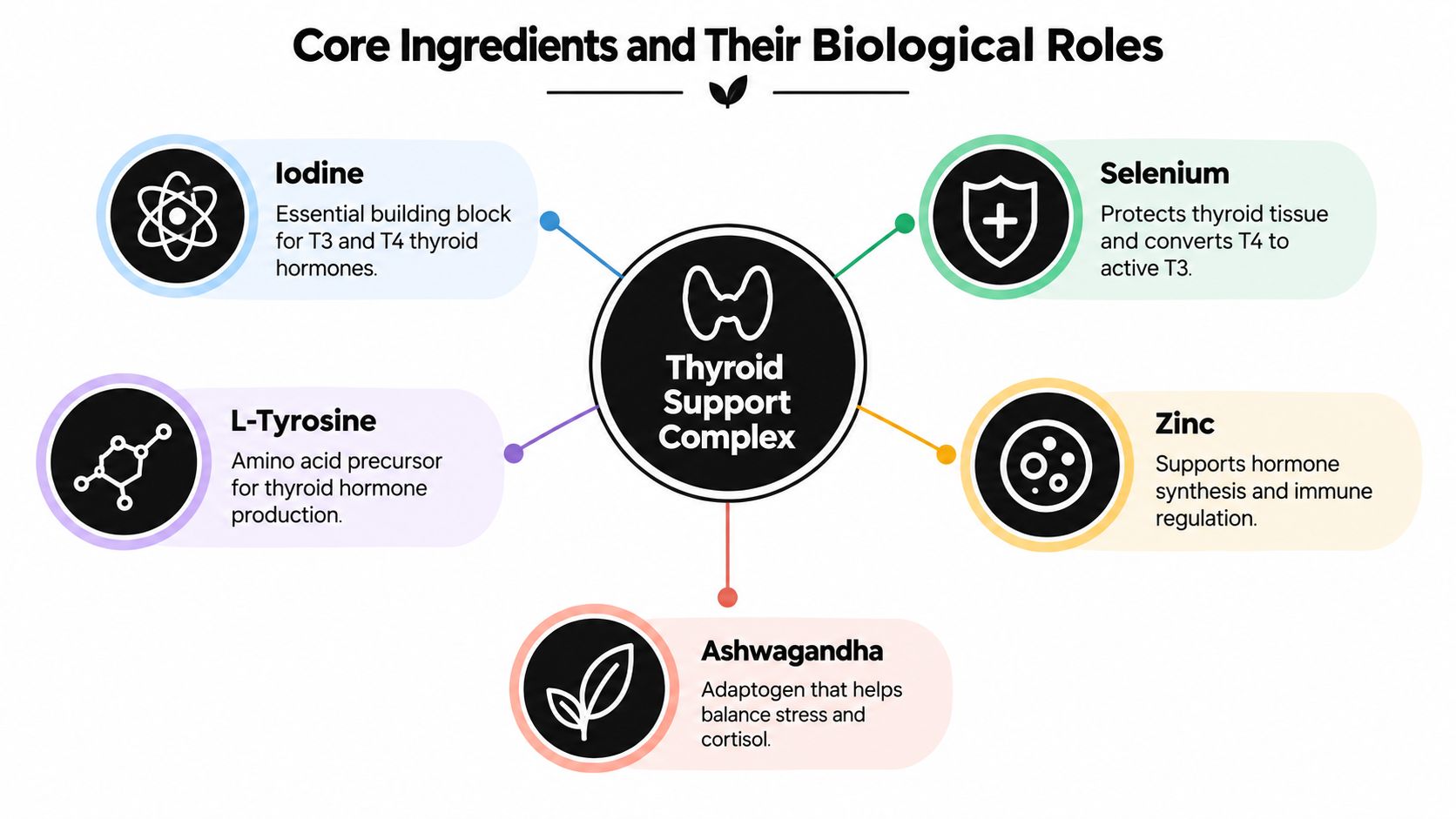
A label becomes easier to judge when you understand the jobs each ingredient performs. Think of iodine as a structural building material and selenium as part of the protective and conversion machinery. Zinc, iron, vitamin A, and B vitamins support additional steps, but the presence of an ingredient doesn't prove that its dose or form suits your needs.
Iodine supplies the hormone structure
Iodine is an essential component of thyroxine, or T4, and triiodothyronine, or T3. Without adequate iodine, the thyroid has less of the raw material required to build these hormones. Insufficient intake can reduce thyroid output and may lead to compensatory rises in thyroid-stimulating hormone, or TSH. The NIH Office of Dietary Supplements iodine fact sheet explains why iodine-containing supplements are common and why the nutrient remains central to hormone production.
Iodine isn't automatically safer at a higher dose. The practical formulation challenge is a narrow window: too little can impair hormone synthesis, while excess can destabilize thyroid function in susceptible people. For that reason, “high iodine” isn't a synonym for “high quality.”
Selenium protects and assists conversion
The thyroid contains relatively high selenium concentrations. Selenium-dependent enzymes help manage oxidative stress within thyroid tissue and participate in thyroid hormone metabolism, including processes involved in converting T4 into the active hormone T3. Evidence summaries from the NIH indicate that selenium deficiency can worsen iodine deficiency and increase thyroid-disease risk, but supplementation hasn't produced a consistent universal benefit across populations.
That makes selenium more defensible when a formula addresses low intake or a defined subgroup, rather than promising broad treatment for every thyroid complaint. The adult upper limit is 400 mcg per day, according to the NIH selenium fact sheet. Expert discussions may recommend considerably lower routine supplemental amounts, so the label should be evaluated alongside food intake and other supplements.
Supporting nutrients fill different roles
Iron supports biological systems involved in thyroid hormone production, while zinc participates in hormone synthesis and immune regulation. Vitamin A can influence thyroid signaling, and vitamin B12 is among the nutrients identified as relevant to thyroid regulation. B-complex vitamins may also help cover general nutritional gaps, but a broad vitamin blend shouldn't be treated as a thyroid-specific therapy.
L-tyrosine is an amino acid used in thyroid hormone production, while botanicals such as ashwagandha are marketed for stress-related support. Their inclusion changes the formula's purpose, and their presence doesn't establish that the finished product improves thyroid disease. Read the nutrient amounts, forms, and warnings rather than judging a complex by the number of ingredients.
For general nutritional coverage, Vita Mix NexiHerb Multivitamin & Mineral Dietary Supplement is described as a once-daily multivitamin and mineral supplement for adults as part of a balanced lifestyle. Its listed ingredients include vitamins A, C, D, and E, B-complex vitamins, folate, zinc, selenium, and other compounds. It is intended for general wellness, not to diagnose, treat, cure, or prevent disease.
A short visual explanation can help connect the ingredients to their roles:
For broader everyday micronutrient guidance, see this practical overview of daily vitamins you should take. The key is to avoid stacking several products that repeat iodine, selenium, zinc, or vitamin A without checking the combined intake.
Evaluating the Evidence and Target Audience
The honest answer to “Will a thyroid support complex help my fatigue?” is sometimes, but not as a blanket rule. Benefit is most plausible when a person has a relevant deficiency, inadequate dietary intake, or a clinical subgroup in which a particular nutrient has been studied. A formula can't be evaluated as one indivisible object because each ingredient has its own evidence, dose range, mechanism, and safety profile.
Recent independent coverage and reviews identify the strongest human evidence around selenium, particularly in settings such as Hashimoto's disease or subclinical hypothyroidism. Even there, the evidence doesn't justify treating every person with the same product. A 2026 research protocol reflects that the field still lacks settled evidence on clinical and cost-effectiveness outcomes for iodine and selenium in subclinical hypothyroidism. The protocol is a sign that important questions remain open, not evidence that a supplement works. The PROSPERO record for the iodine and selenium review protocol outlines that unresolved research need.
Who should be cautious about expectations
A generally healthy adult with no known deficiency may not experience a noticeable change from adding a complex. Fatigue could instead relate to sleep, iron status, mood, medication effects, infection, training load, or another medical issue. Taking a supplement before identifying the cause can delay the evaluation that would help.
Someone with documented low nutrient intake has a more rational reason to discuss targeted supplementation. The same applies to a person whose clinician has identified a relevant nutritional issue while evaluating thyroid symptoms. In these cases, the supplement serves a defined purpose, and follow-up can determine whether that purpose was met.
People with Hashimoto's disease, nodules, a history of hyperthyroidism, pregnancy, or thyroid medication need a more individualized approach. Iodine and selenium may be relevant, but the appropriate choice depends on the person's total intake, diagnosis, treatment plan, and laboratory findings.
What the evidence doesn't support
The evidence doesn't support a blanket promise that a multi-ingredient blend will improve weight, energy, or “thyroid function” in all adults. It also doesn't support treating a supplement label as proof that the product can replace prescribed hormone therapy.
A better decision question is:
- Nutrient: Which ingredient is intended to address a known or suspected gap?
- Dose: Is the amount visible and appropriate for the person's total intake?
- Population: Has that nutrient been studied in a comparable health context?
- Monitoring: What symptoms or laboratory findings would show benefit or harm?
This framework is more useful than asking whether thyroid support “works” as a category. It turns a broad marketing claim into a testable nutritional question.
Navigating Safety Risks and Nutrient Interactions
Nutrients involved in thyroid biology are not automatically safe at higher doses. More isn't better, particularly for iodine and selenium. Review the complete label, add overlapping ingredients across products, and seek professional guidance if thyroid disease or medication is part of the picture.
Treat iodine as essential, not harmless
Iodine has a U-shaped risk profile. Too little can restrict thyroid hormone production, while excess may trigger or worsen thyroid dysfunction, including autoimmune activity in susceptible people. A concentrated iodine product is therefore a poor default for fatigue when thyroid testing is normal.
Iodine may already come from a multivitamin, thyroid formula, seaweed product, or fortified supplement. Add these sources before deciding that another product is appropriate. People with Hashimoto's disease, nodules, hyperthyroidism, or changing thyroid laboratory results should avoid self-prescribing high-dose iodine.
Iodine and selenium also need to be considered together. They participate in different parts of thyroid hormone biology, so increasing one nutrient does not correct an unsuitable overall intake. A formula should address a documented or plausible gap, not just promote a larger dose.
Respect selenium's toxicity margin
Selenium supports antioxidant defenses and hormone metabolism, but the space between useful intake and excess is limited. The adult upper limit is 400 mcg per day, according to the NIH Office of Dietary Supplements selenium guidance. This includes food, multivitamins, standalone selenium, and thyroid blends, so the combined daily amount matters.
Gastrointestinal upset, unusual hair or nail changes, a metallic taste, or garlic-like breath can follow excessive selenium exposure and warrant medical attention. Do not wait for symptoms after discovering overlapping products. Ask a clinician or pharmacist to review the complete regimen.
Avoid hidden hormone exposure
“Natural thyroid support” does not guarantee a formula contains only vitamins, minerals, or herbs. Some tested dietary thyroid supplements have contained clinically significant amounts of thyroid hormones. Unrecognized exposure may contribute to hyperthyroid symptoms, arrhythmias, and bone loss.
Choose products with complete ingredient disclosure. Be cautious with formulas suggesting glandular or hormone content without clearly identifying the substances and amounts. Racing or irregular heartbeat, tremor, heat intolerance, worsening anxiety, or unexplained weight loss after starting a supplement calls for prompt medical advice, not a higher dose.
Safety checkpoint: Baseline evaluation matters more than a dramatic ingredient list. A clinician can determine whether thyroid testing, medication review, or nutrient assessment is appropriate.
How to Choose a High-Quality Supplement
A high-quality thyroid support complex should make evaluation easy. The label should identify each active ingredient and its amount, rather than placing several nutrients inside a proprietary blend. Transparent dosing lets you compare the formula with your diet, other supplements, and any upper limits that apply.
Compare labels by function
A product centered on iodine and selenium has a different rationale from a general multivitamin or an herbal stress formula. Look for forms and quantities that are clearly disclosed, then ask whether each ingredient has a reason to be present for your situation. A large ingredient count can create overlap without improving usefulness.
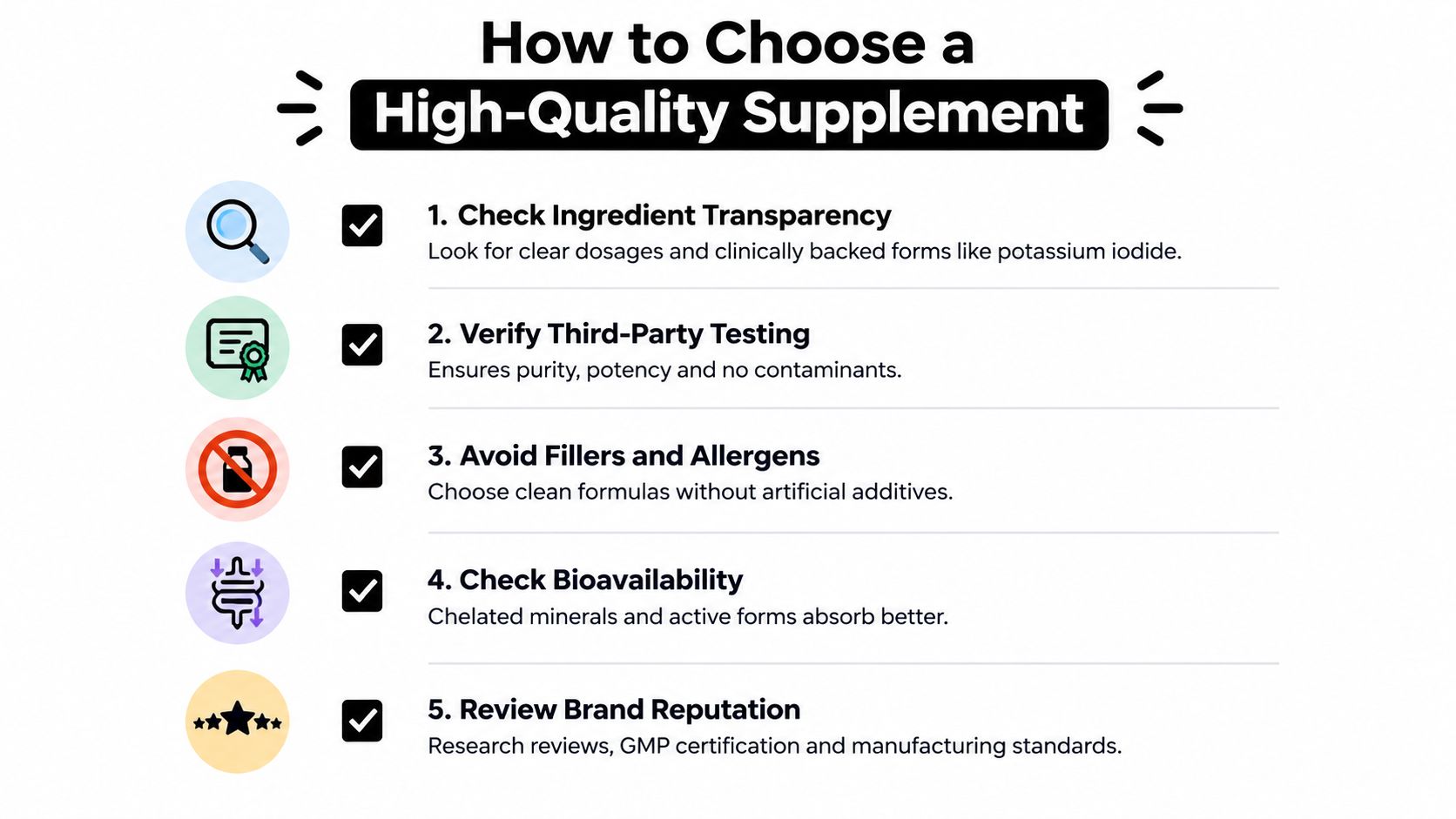
A label review should cover five points:
- Ingredient transparency: Confirm that iodine, selenium, zinc, iron, and botanicals are listed with exact amounts. Be wary of proprietary blends that conceal individual doses.
- Form and suitability: Consider whether the nutrient form fits your dietary needs and whether the product includes ingredients you need to avoid. “Active” or “chelated” language should not replace clear dosing and quality documentation.
- Testing evidence: Look for credible third-party testing or manufacturing quality information that addresses identity, purity, and contaminants. This is particularly important for products marketed around thyroid or glandular support.
- Hormone disclosure: Avoid products that could contain thyroid hormones without unambiguous labeling. A supplement shouldn't leave you guessing about hormonal exposure.
- Total intake: Compare the product with every other supplement you take. One formula may look moderate by itself but become excessive when combined with a multivitamin and an iodine-containing product.
The Axelrad Clinic thyroid guide can provide another perspective when you're comparing common thyroid-related supplement categories. Use any guide as a starting point, not as a substitute for diagnosis or individualized advice.
For a practical primer on reading serving sizes, ingredient panels, and warnings, review how to read supplement labels. Pay attention to serving size, not just the amount printed in large type on the front of the bottle. Also check whether the serving requires multiple capsules, because that changes the actual daily exposure.
Lifestyle Habits That Support Thyroid Function
A supplement works within a person's broader routine. Consider an adult who feels depleted after irregular sleep, skipped meals, sustained stress, and a diet with limited variety. Adding a thyroid support complex may be less useful than first creating consistent conditions for recovery and then addressing a confirmed nutrient gap.
Sleep deserves attention because the body regulates endocrine signals within a wider network, not in isolation. Keep a regular sleep schedule, reduce stimulating activity before bed, and address persistent snoring or insomnia with a healthcare professional. Better sleep won't cure thyroid disease, but it can make it easier to distinguish thyroid-related symptoms from sleep-related fatigue.
Stress management also needs to be concrete. A short walk, paced breathing, resistance training adjusted to recovery, time outdoors, or a regular meal schedule may be more sustainable than an elaborate wellness protocol. If stress remains severe, counseling or medical support can be more appropriate than adding another capsule.
Build meals around nutrient density
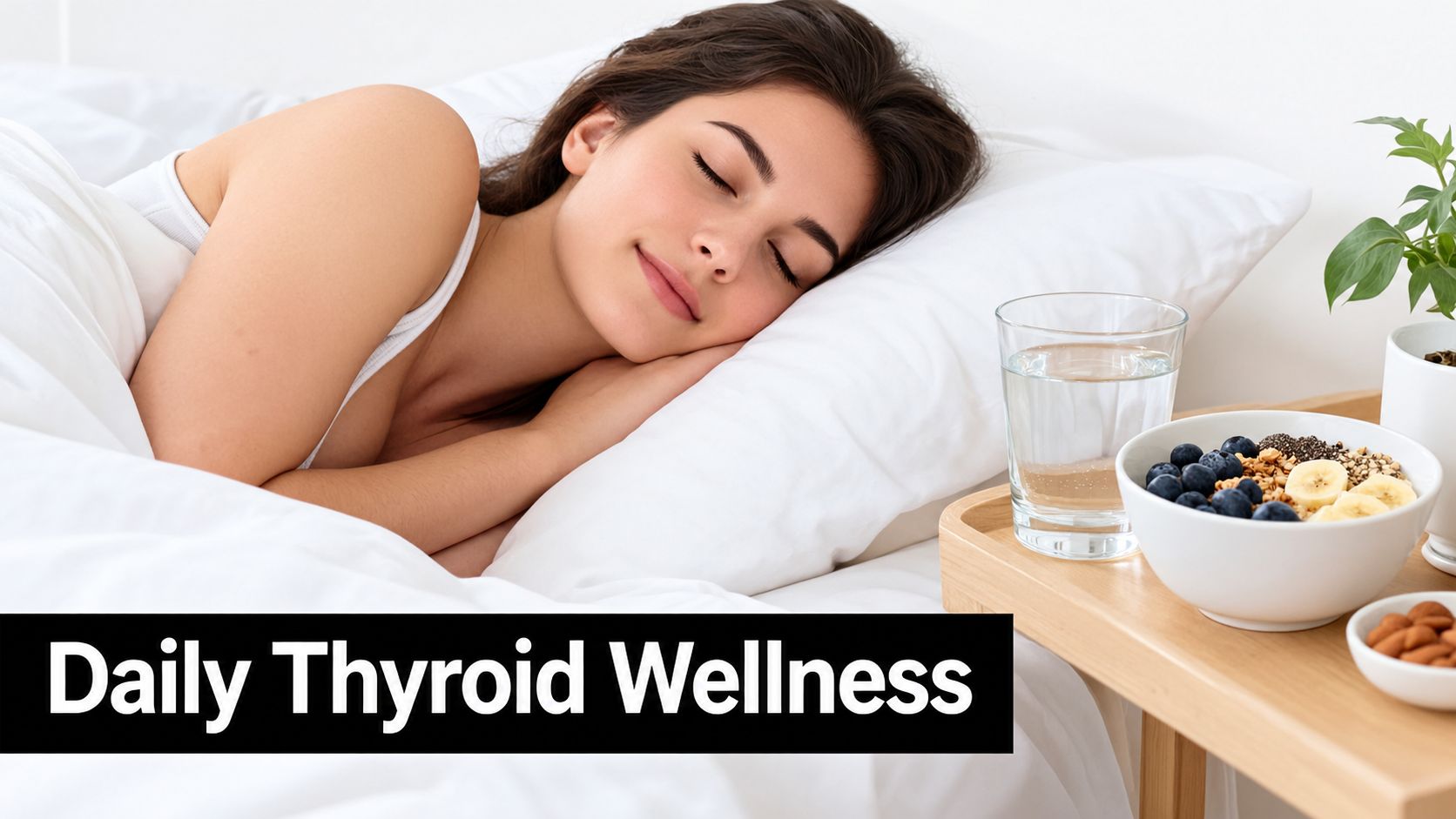
A varied diet can supply many of the nutrients involved in thyroid biology. Include protein sources, vegetables, fruits, legumes, whole grains, and other foods that fit your health needs and cultural preferences. Avoid turning one food into a “thyroid cure,” and don't remove major food groups without a clear reason.
People often fear that ordinary vegetables automatically harm thyroid function. The more useful approach is dietary balance, adequate nutrient intake, and individualized advice when someone has a diagnosed condition. A restrictive diet can create nutritional gaps that a supplement later tries to patch.
Medication timing matters too. If you're taking thyroid hormone, follow the prescribing instructions and ask a pharmacist about separation from minerals or other supplements. Don't change medication or use a supplement to adjust lab results without the clinician managing your care.
A broader thyroid energy guide may help you organize daily habits around energy and routine. Use it as wellness education, while treating persistent symptoms as a reason to seek proper assessment.
Building Your Personalized Wellness Strategy
A safe plan starts with a reason, not a product. Before buying a thyroid support complex, write down your symptoms, current medications, dietary restrictions, and every supplement you already use. Bring that list to a healthcare professional and ask whether testing or a medication review should come first.
Use this decision sequence:
- Clarify the concern: Separate a diagnosed thyroid condition from nonspecific fatigue or weight concerns.
- Identify the target: Decide whether the purpose is general nutritional coverage or correction of a documented nutrient gap.
- Review the formula: Check iodine, selenium, zinc, iron, vitamin A, botanicals, and possible hormone exposure.
- Set a monitoring plan: Know which symptoms require stopping and when your clinician wants follow-up.
- Support the basics: Maintain regular meals, restorative sleep, manageable activity, and appropriate medical treatment.
If you want to explore broader options alongside clinical guidance, you can find wellness treatments at ProMD Health Bel. The central principle remains simple: choose the smallest, clearest intervention that matches your actual need, then reassess rather than adding more products automatically.
NexiHerb LLC offers science-inspired dietary supplements for everyday wellness, including multivitamins, amino acids, herbal blends, omega-3s, antioxidants, and functional mushrooms. Visit NexiHerb LLC to review clearly labeled options and choose products that complement a varied diet and consistent health routine.