

A supplement stack is a planned combination of two or more dietary supplements taken together for a specific goal, and it's a usage strategy rather than a distinct legal product category. In the United States, 38.7% of adults used two or more supplements during August 2021–August 2023, according to CDC data on dietary supplement use.
You may already have the beginnings of one. A multivitamin sits beside your coffee, an amino acid formula goes into your gym bag, and an herbal product appears in the evening drawer. You take each item for a reasonable purpose, but you're not always sure whether the ingredients overlap, whether the timing makes sense, or which product is responsible when something feels different.
That uncertainty is the central issue. A sensible stack isn't a larger pile of capsules. It's a planned daily routine with a clear purpose, transparent labels, and a cumulative safety review.
Table of Contents
- From Random Pills to a Real Routine
- What Is a Supplement Stack Actually
- Common Supplement Stack Types by Goal
- Core Principles Behind Effective Stacking
- How to Evaluate Stack Quality and Safety
- Building a Supplement Stack That Fits Your Routine
- Simple Stacking Habits for Long-Term Wellness
From Random Pills to a Real Routine
At 7 a.m., Jordan takes a multivitamin with breakfast, adds a separate mineral capsule because a fitness video recommended it, and swallows an energy formula before leaving for work. After training, Jordan uses a recovery powder and takes another product remembered from a previous routine. None of these decisions is necessarily unreasonable on its own. The problem is that no one has written down the full daily intake.
By lunchtime, the routine has several unanswered questions. Does the multivitamin already contain the mineral in the second capsule? Does the energy product include a stimulant-like ingredient also found in the pre-workout? Is the recovery formula being used because it serves a defined need, or because it's available?

A random supplement drawer creates three practical problems:
- Duplicate ingredients: Two products may provide the same vitamin, mineral, botanical, or stimulant-like compound.
- Unclear timing: You may take products at inconvenient points in the day, making the routine harder to follow or assess.
- Unclear outcomes: If you change several products simultaneously, you can't easily tell what helped or caused an unwanted response.
A structured stack starts with a short inventory. Write down each product, serving size, ingredient amount, time of use, and reason for taking it. Then compare the labels instead of relying on product names. The FDA's consumer guidance on dietary supplements explains why this matters: supplements add to the diet, and separate products can contain overlapping ingredients.
Practical rule: If you can't explain what each item contributes to the routine, the stack probably needs simplifying.
The aim isn't to make the routine look impressive. It's to make it purposeful, traceable, and easy to review.
What Is a Supplement Stack Actually
A supplement stack is a planned combination of two or more dietary supplements taken together to support one or more personal goals. Those goals might include filling nutritional gaps, complementing exercise, or supporting general wellness. A stack can combine vitamins, minerals, herbs or botanicals, amino acids, enzymes, probiotics, extracts, or products that already contain several ingredients.
The word stack describes how products are used. It doesn't identify a separate legal product class. In the United States, the legal foundation is the Dietary Supplement Health and Education Act of 1994, which defines a dietary supplement as a product intended to supplement the diet and containing at least one recognized dietary ingredient. The product must also be labeled as a dietary supplement or an equivalent term.
That distinction changes how you evaluate a routine. A stack isn't automatically safer or more effective because several products are involved. Since supplements are intended to add to food rather than replace it, you need to consider the total intake from meals, fortified foods, and every product in the plan.
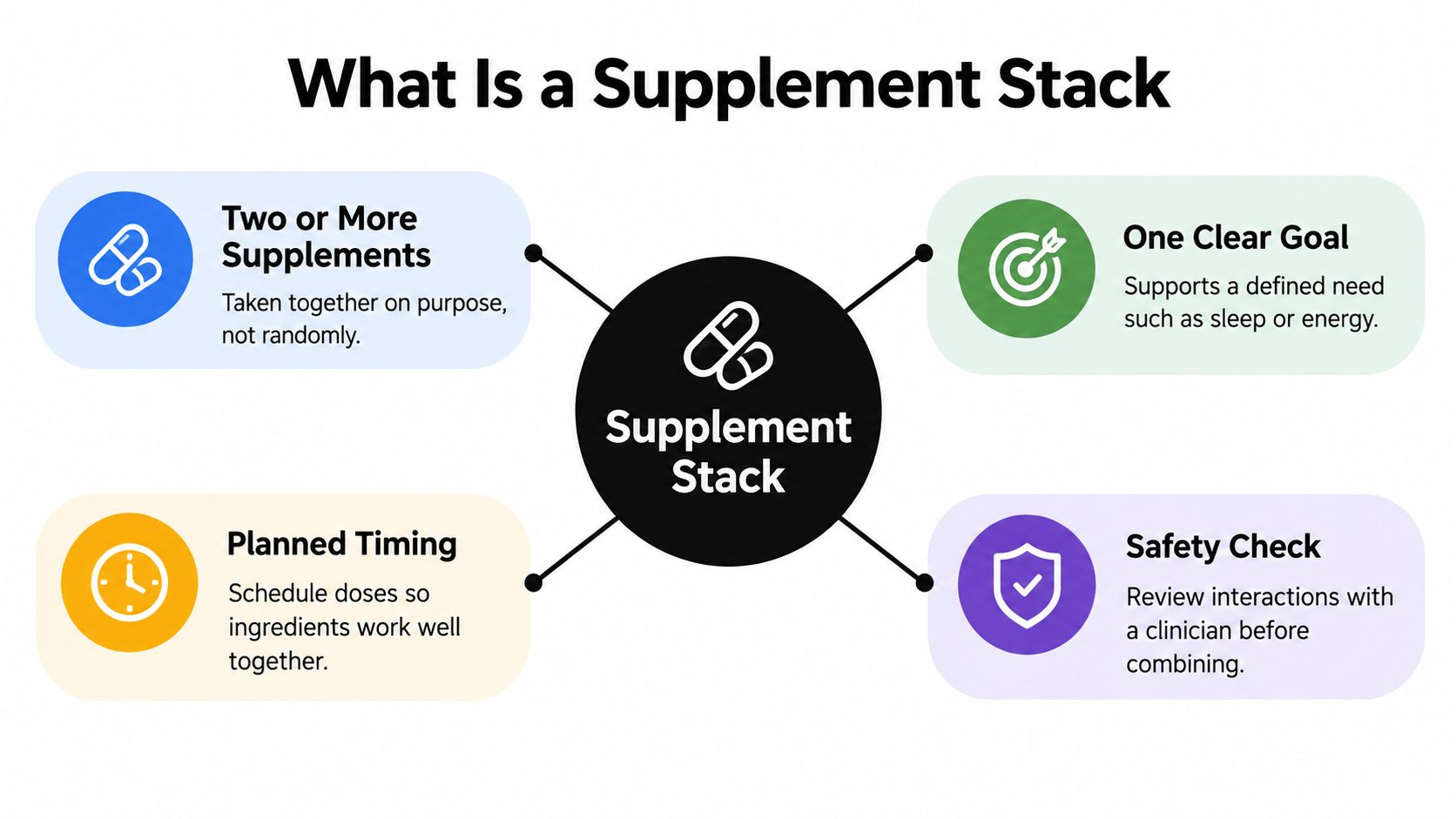
A useful definition has four parts:
- Two or more supplements: Separate products count, as does a formula that combines multiple ingredients.
- A defined purpose: The routine should connect to a nutritional gap, activity pattern, or wellness objective.
- An organized schedule: You should know when each product is taken and whether food is recommended.
- A safety review: You should check serving sizes, amounts, duplicate ingredients, and possible interactions.
For example, Vita Mix NexiHerb Multivitamin & Mineral Dietary Supplement is described as a once-daily adult multivitamin and mineral supplement with vitamins, minerals, and selected plant-derived compounds including lutein and zeaxanthin. If someone adds another multivitamin or a separate mineral product, the relevant question isn't whether the brand names differ. It's whether the combined labels create unnecessary overlap.
Timing can also be part of a sensible routine, especially when sleep and daily alertness matter. Readers interested in how biological rhythms influence performance can explore circadian timing for high performers as broader context, while remembering that timing advice doesn't replace an ingredient-by-ingredient review.
Common Supplement Stack Types by Goal
A supplement stack usually starts with a goal, but goals can blur judgment. Someone wants better daily coverage, better training support, or better recovery, and the easy mistake is to treat each new concern as a reason to add another bottle. A safer way to sort stack types is to ask what problem the routine is trying to solve, then check whether each product adds a distinct role or just increases total exposure.
That matters because supplement use is common well beyond gym-focused routines. CDC dietary supplement data reported 57.6% of adults used a dietary supplement in the previous 30 days in 2017 to 2018, including 63.8% of women and 50.8% of men. A later CDC update reported 60.2% of U.S. adults aged 20 and older used at least one dietary supplement during August 2021 to August 2023. The practical point is simple. Stack literacy is an everyday consumer skill, not a niche sports topic.
| Stack Type | Typical Focus | Common Ingredient Families |
|---|---|---|
| Daily wellness | Complementing overall nutritional intake | Vitamins, minerals, omega-3s, botanicals |
| Training support | Organizing products around exercise | Amino acids, hydration ingredients, functional compounds |
| Recovery routine | Supporting post-exercise habits | Protein-based products, electrolytes, selected nutrients |
| Vitality routine | Building a consistent adult wellness plan | Vitamins, minerals, botanical blends |
These categories describe patterns, not instructions. A daily wellness stack is often the simplest because it can begin and end with one foundational product. Training support stacks are often more layered, but they also create more chances for overlap when pre-workout, hydration, and amino acid products share similar ingredients. Recovery routines can look sensible on paper while still becoming crowded if a person adds powders, capsules, and drink mixes without totaling the label amounts.
For circulation-oriented routines, Argi-Max NexiHerb L-Arginine, L-Citrulline-DL-Malate, and beet root powder gives a concrete example of a formula built around amino acids and a plant ingredient. Its listed serving is two capsules, with L-arginine forms, L-citrulline-DL-malate, and beet root powder. That tells you what is in the product. It does not answer whether another amino acid formula should be added on top of it.
Training still sets the ceiling. Someone building a bodyweight program may get more from better exercise progression than from a larger stack, and the discussion of progressive push-ups study results can help frame that choice. Readers comparing nitric-oxide-style formulas can also review how arginine and citrulline work together, then compare labels carefully before combining products with similar roles.
Core Principles Behind Effective Stacking
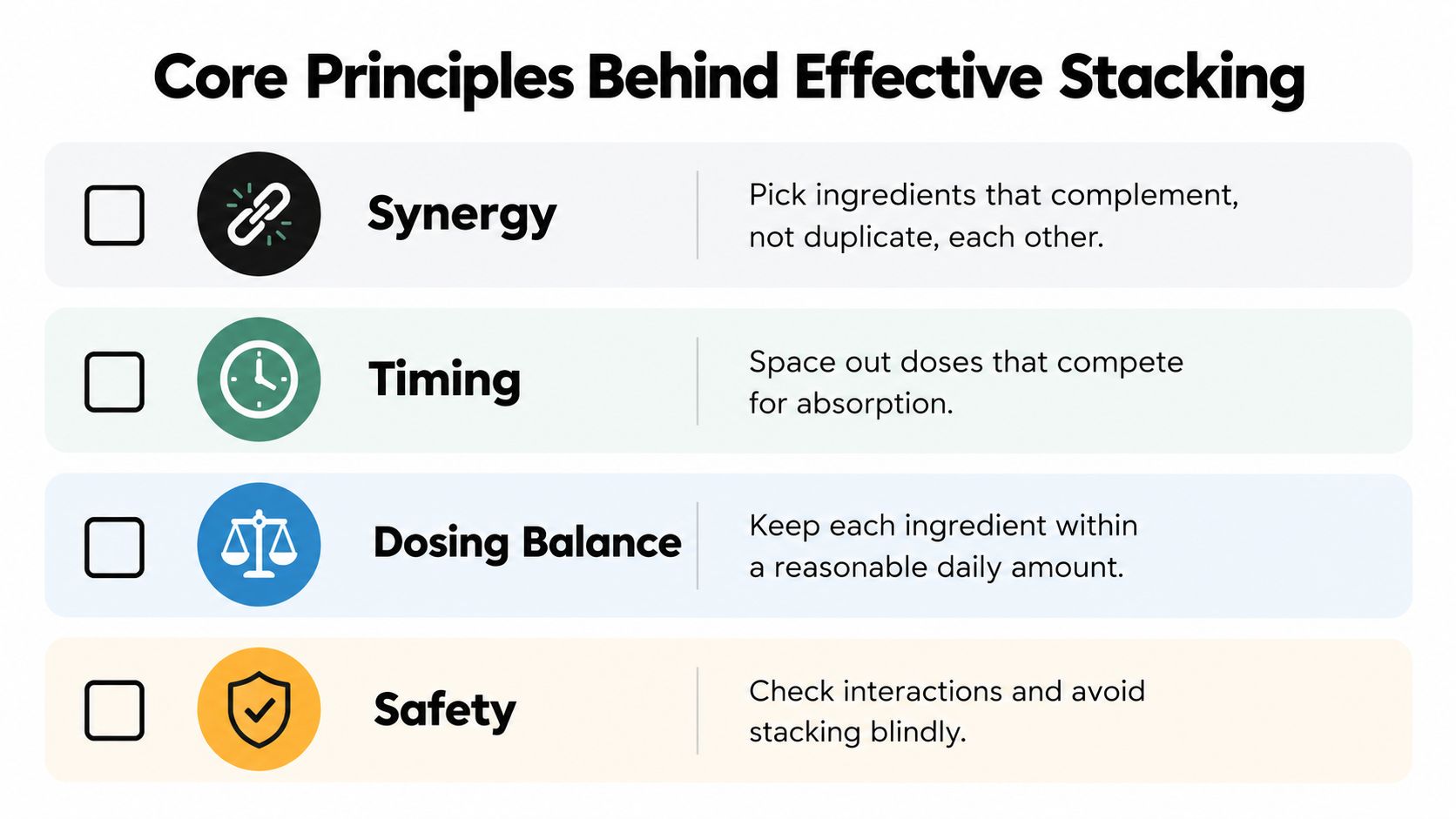
A stack works as a routine only when its components have distinct jobs. The most useful comparison is between a coherent combination and an ingredient-heavy combination. The first makes it clear what each product contributes. The second may contain attractive ingredients but leaves you unable to calculate total exposure or explain why every item is present.
Synergy means complementary roles
Synergy is often used loosely in supplement marketing. A more practical meaning is that products serve different, compatible purposes without unnecessary duplication. For example, a foundational nutrient product and a separate exercise-focused formula have more clearly defined roles than two broad formulas that both contain the same vitamins and botanicals.
Timing creates structure
Timing should make the routine easier to follow and should respect the instructions on each label. Some products are recommended with food, while others may be intended for a particular point in the day. The goal isn't to create an elaborate schedule. It's to avoid taking everything at once just because the bottles are nearby.
Dosing balance requires arithmetic
Read the serving size first, then record the amount per serving for every overlapping ingredient. A proprietary blend can make this difficult because the total blend may be shown without disclosing the amount of each component. Without those amounts, you can't reliably calculate cumulative exposure.
Safety outranks novelty
A product can be legal and clearly labeled without being appropriate for every person. The FDA labeling guide for dietary supplements explains that a Supplement Facts panel should include serving size, servings per container, each dietary ingredient, and, except in certain proprietary blends, the amount per serving.
The strongest stack is usually the one you can audit without guesswork.
Quality review also has limits. NSF certification to NSF/ANSI 173 includes label-claim review, formulation toxicology review, contaminant assessment, and laboratory testing to check whether contents match the label. NSF states that certification doesn't establish efficacy, so separate identity, quantity, and benefit when evaluating a product.
How to Evaluate Stack Quality and Safety
Start with the label, not the front of the bottle. The front may emphasize a goal or a large ingredient count, but the Supplement Facts panel tells you the serving size, ingredient names, and declared amounts. The separate ingredient list identifies non-active materials such as binders, fillers, preservatives, sweeteners, and flavorings.
A short label audit can prevent a long period of confusion:
- List each ingredient: Record the exact name, form, serving size, and amount.
- Compare overlapping products: Look for repeated vitamins, minerals, botanicals, amino acids, and stimulant-like ingredients.
- Question proprietary blends: If individual quantities aren't disclosed, dose accounting becomes difficult.
- Check manufacturer information: A clear responsible company and accessible product details improve traceability.
- Separate quality from efficacy: Testing can support identity and manufacturing confidence, but it doesn't prove the stack will produce a particular outcome.
The NIH Office of Dietary Supplements frequently asked questions explains an important regulatory distinction: U.S. dietary supplements don't undergo FDA premarket approval for safety or efficacy in the same way medicines do. The FDA establishes current Good Manufacturing Practices, and independent quality seals can offer evidence about manufacturing, label matching, and contaminants. Those checks still don't prove that the entire combination delivers a meaningful health benefit.
A large stack can also make personal experimentation worse. If you add five products at once and develop an unwanted response, you may have to stop several items just to identify the likely cause. A simpler method is to make one change at a time, keep a basic record, and avoid expanding the routine until the existing products are understood.
You can use how to read supplement labels as a practical reference when comparing panels. If you're helping others understand these decisions, the same label-focused approach can support marketing a nutrition workshop without turning education into a product-counting exercise.
Building a Supplement Stack That Fits Your Routine
Begin with the reason, not the shopping cart. Write one sentence describing the goal, such as complementing general nutrition or organizing products around training. Then identify what your diet, schedule, and activity already provide before choosing anything additional.

A manageable building process looks like this:
- Create a complete inventory: Include supplements, fortified foods, prescription medicines, and over-the-counter products.
- Choose a small foundation: Start with products that have distinct purposes and fully disclosed amounts.
- Make the schedule realistic: Attach doses to meals or existing habits only when the label instructions allow it.
- Record your response: Note unwanted effects, missed doses, and meaningful changes without assuming that every change came from a supplement.
- Review before adding more: Recalculate overlapping ingredients each time the routine changes.
Interaction review deserves special attention. A recent study reported potential drug-supplement interactions in 40.1% of participants taking both supplements and prescribed medicines, while 10.3% had at least one supplement-supplement interaction. It classified 12% of identified interactions as severe (Frontiers study on supplement interactions). Most identified interactions were moderate, so these figures don't mean that every stack is dangerous. They do mean that a medication review is sensible.
A pharmacist or clinician should review the full list when you use anticoagulants, thyroid medication, diabetes medicines, or multiple prescriptions, or when you're older or managing an existing condition. The safest way to simplify a stack is not to stop medically necessary treatment. Instead, record each ingredient and dose, remove clear duplicates, identify higher-risk combinations, and ask a qualified professional to review the remaining routine.
For broader routine ideas, daily wellness supplements can provide additional context, but your final plan should still be based on your own labels, diet, medicines, and professional guidance.
Simple Stacking Habits for Long-Term Wellness
A durable stack should be easy to understand, easy to maintain, and easy to revise. If the routine requires constant calculations, several unexplained blends, and a different schedule every day, complexity may be working against you.
Keep one current list in a phone note or paper folder. Include product names, serving sizes, ingredients, amounts, timing, and the date you started each item. Bring that list to a pharmacist or clinician instead of trying to recall every capsule during an appointment.
Use a few practical safeguards:
- Review duplicates regularly: A new multivitamin, mineral formula, or training product can change the total intake.
- Change one component at a time: This makes unwanted responses easier to trace.
- Respect label directions: Don't exceed the stated daily intake without professional advice.
- Keep food central: Supplements are designed to complement the diet, not replace meals, sleep, exercise, or medical care.
- Prefer clarity over novelty: A transparent formula with defined amounts is easier to evaluate than a fashionable blend with hidden quantities.
The right question isn't “How many products can I fit into this routine?” It's “Can I explain why each product is there, what it adds, and how I'll review it?” That standard keeps supplement use grounded in practical decision-making rather than accumulation.
NexiHerb LLC offers dietary supplements covering multivitamins, amino acids, herbal blends, omega-3s, antioxidants, joint care, and functional mushrooms, with product information intended to help adults match formulas to everyday wellness routines. Visit NexiHerb LLC to compare clearly described options, then review any combination with the same attention to ingredients, serving sizes, and interactions.