

Taking a high-dose B12 supplement for more energy isn't automatically good advice. Before choosing B12 1000 mcg methylcobalamin, the useful question isn't how impressive the dose looks, but whether you need it and how much your digestive system can absorb.
The label tells you what you're swallowing, not what reaches your bloodstream. Understanding that distinction helps separate a sensible nutrition routine from self-treatment that could delay a diagnosis.
Table of Contents
- What 1,000 mcg Methylcobalamin Means for Daily Needs
- How B12 Reaches Your Bloodstream and Why a High Dose Works
- Who May Benefit and What the Evidence Shows
- Test Your B12 Status Before Taking 1,000 mcg
- Dosing, Side Effects and Drug Interactions
- Methylcobalamin Versus Cyanocobalamin and Other Forms
- Choosing a Product and Timing Your Dose
-
Frequently Asked Questions
- Is a high-dose B12 supplement safe for most adults?
- Will it boost my energy?
- Is methylcobalamin better absorbed than cyanocobalamin?
- Can I take it with metformin or a proton pump inhibitor?
- Should I retest after starting?
- Can children take an adult high-dose product?
- What should I bring to an appointment?
What 1,000 mcg Methylcobalamin Means for Daily Needs
A 1,000 mcg tablet provides about 417 times the adult Recommended Dietary Allowance of 2.4 mcg, according to the NIH Office of Dietary Supplements. The same guidance sets the daily requirement at 2.6 mcg during pregnancy and 2.8 mcg during breastfeeding.
Those figures describe different things. The Recommended Dietary Allowance, or RDA, is a nutritional intake benchmark intended to meet the needs of healthy people. A supplement's labeled dose describes how much vitamin the manufacturer puts in a serving.
Think of the label as the size of a delivery truck, not the amount unloaded into the warehouse. Your digestive system doesn't accept every microgram that arrives.
Daily requirements in context
The following comparison uses those NIH intake values; the multiples are calculated by dividing the labeled amount by each daily requirement.
1,000 mcg B12 compared with daily requirements by group
| Group | Daily RDA | Times the RDA in 1,000 mcg | Upper intake level |
|---|---|---|---|
| Adults (19 and older) | 2.4 mcg | About 417x | None established |
| Adults over 50 | 2.4 mcg | About 417x | None established; food-bound B12 absorption may be reduced |
| Pregnancy | 2.6 mcg | About 385x | None established |
| Breastfeeding | 2.8 mcg | About 357x | None established |
An older adult doesn't automatically need a larger RDA. The concern is often access to the vitamin in food, rather than a higher baseline requirement. The NIH guidance notes that 10% to 30% of older adults may have difficulty absorbing naturally occurring food-bound B12.
Methylcobalamin is an active form of vitamin B12, but the daily requirements apply to B12 overall. They aren't a recommendation to choose this particular form or take a high-dose tablet.
Practical distinction: A large delivery dose can compensate for incomplete absorption. It doesn't mean your body requires, absorbs, or uses the entire labeled amount.
If a clinician recommends an injectable route, ProMD Health Easton's information on vitamin B12 injection options offers context for discussing that service. Choosing between oral and injectable treatment should follow an assessment of the cause and severity of a deficiency, not a comparison of label amounts.
How B12 Reaches Your Bloodstream and Why a High Dose Works
Say you eat a B12-containing meal and later swallow a supplement. Both supply the vitamin, but the supplement doesn't need the same initial release from food protein.
The digestive route helps explain the difference:
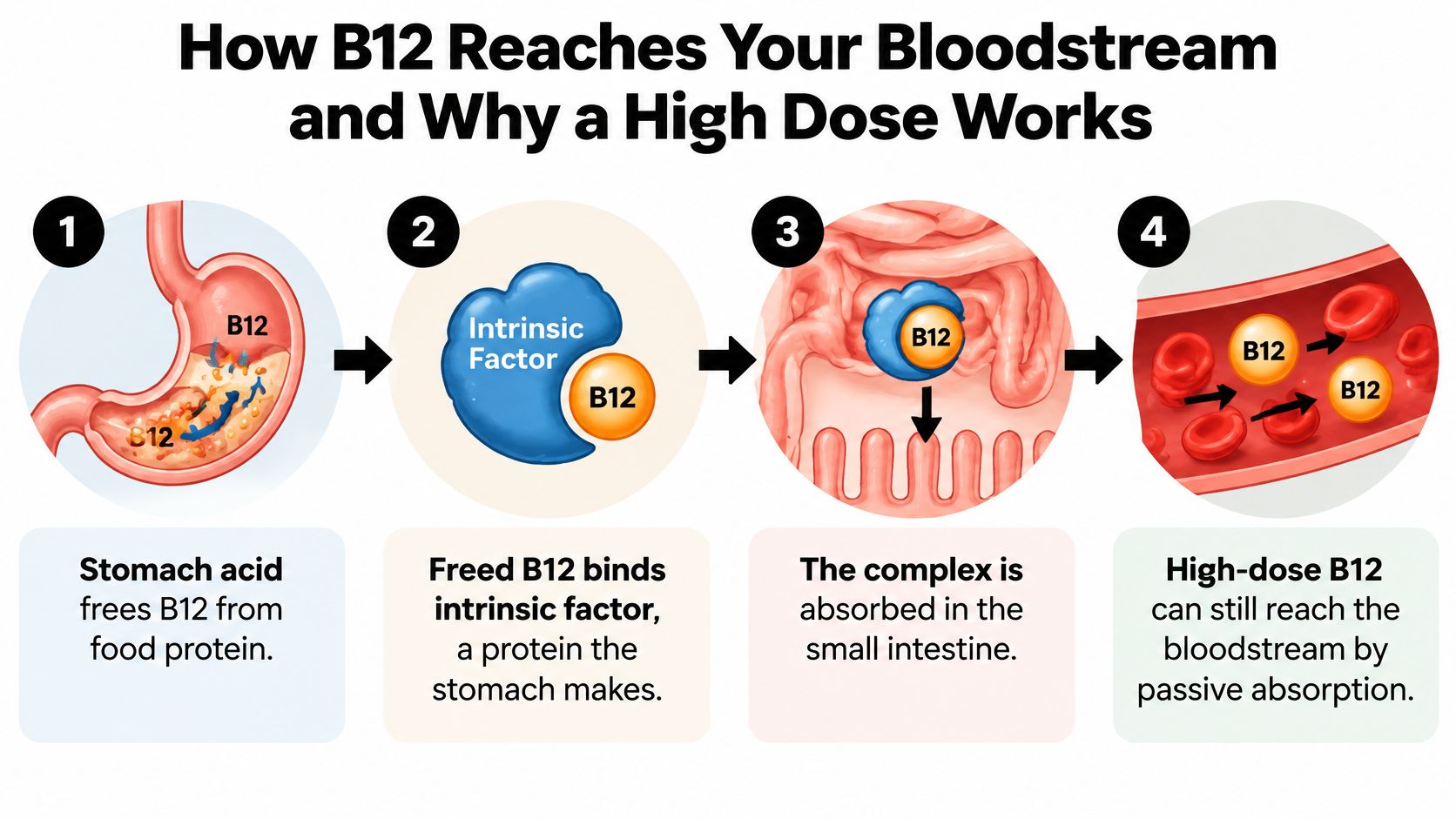
- Stomach acid frees food-bound B12. The vitamin must first separate from the proteins carrying it.
- B12 binds intrinsic factor. This stomach-produced protein supports efficient intestinal uptake.
- The complex reaches the terminal ileum. This final part of the small intestine is where the intrinsic-factor-bound vitamin is absorbed.
- Some B12 crosses by passive absorption. This alternative route doesn't require intrinsic factor.
Intrinsic factor works a little like a ticket for a turnstile. The normal route is efficient, but it has limited capacity. Sending more passengers doesn't make the gates expand.
A worked absorption example
The NIH consumer fact sheet on vitamin B12 describes absorption of about 50% at doses below approximately 1 to 2 mcg, falling to about 1.3% at a 1,000 mcg dose, equivalent to roughly 13 mcg absorbed.
That estimated total includes passive and intrinsic-factor-mediated uptake. It shouldn't be described as entirely passive absorption, and it isn't a prediction of your personal response.
The high-dose strategy supplies enough vitamin for a small fraction to matter even when the usual route is restricted. This explains its usefulness in selected absorption problems without implying that every gastrointestinal condition responds equally well.
For a visual introduction to B12, the following video provides another learning format:
A tablet that dissolves under the tongue is a delivery format, not proof that it bypasses every absorption problem. NexiHerb's guide to sublingual B vitamins can help you understand the terminology before comparing labels.
Pernicious anemia needs medical assessment, because impaired intrinsic-factor function changes the treatment decision. Don't use the absorption calculation to design your own treatment.
Who May Benefit and What the Evidence Shows
People consider B12 supplements for different reasons. Some lack reliable dietary sources; others eat enough B12 but have trouble absorbing it. These aren't interchangeable problems.
Groups worth discussing with a clinician include:
- Older adults with reduced stomach acid. Releasing B12 from food can become less reliable.
- People taking metformin or acid-suppressing medicines. Medication history can help identify a reason to investigate B12 status.
- People following vegan or strict plant-based diets. Their main concern may be dependable intake rather than damaged absorption.
- People after Roux-en-Y gastric bypass. Surgery can change how nutrients are handled.
- People with gastrointestinal disease. The location and severity of the condition influence the treatment plan.
Being in one of these groups doesn't establish a deficiency. It does give you a concrete reason to review your diet, symptoms, medication list, and any previous test results.
What oral treatment trials actually show
The NIH professional fact sheet summarizes trials in which 1,000 to 2,000 mcg daily of oral B12 normalized serum B12 comparably to intramuscular treatment, although the evidence was rated low quality. It also reports that 1,000 mcg daily of oral methylcobalamin appeared as effective as hydroxocobalamin injections for normalizing B12 values after Roux-en-Y gastric bypass.
These findings support oral treatment as a reasonable option in selected situations. They don't establish that tablets and injections are interchangeable for every patient.
The measured outcome also matters. Normalizing a blood concentration isn't the same as proving improved stamina, exercise performance, or energy in a person who isn't deficient. Severe malabsorption, advanced deficiency, or neurological involvement may call for clinician-directed injections and follow-up.
Treatment evidence answers whether a regimen can correct a deficiency marker. It doesn't turn the same regimen into a universal wellness recommendation.
The NIH also reports no established tolerable upper intake level, because B12 hasn't demonstrated harm at high doses. That isn't a reason to assume the dose suits everyone or to ignore medicines and medical conditions.
For a healthy adult with a varied diet and no identified absorption problem, there's no established need to choose this high-dose format. The sensible goal is adequate B12, not the largest number on the shelf.
Test Your B12 Status Before Taking 1,000 mcg
An apparently normal serum B12 result doesn't always settle the question of functional deficiency. Starting supplements before testing can also complicate interpretation, so tell your clinician what you've already taken.
The Blue Cross NC guidance on vitamin B12 and methylmalonic acid testing discusses methylmalonic acid, or MMA, when B12 results are borderline or symptoms persist despite an apparently acceptable level. It also describes total or active B12 as initial tests, with MMA or homocysteine considered in selected circumstances.
Use the following checklist to prepare for an appointment:
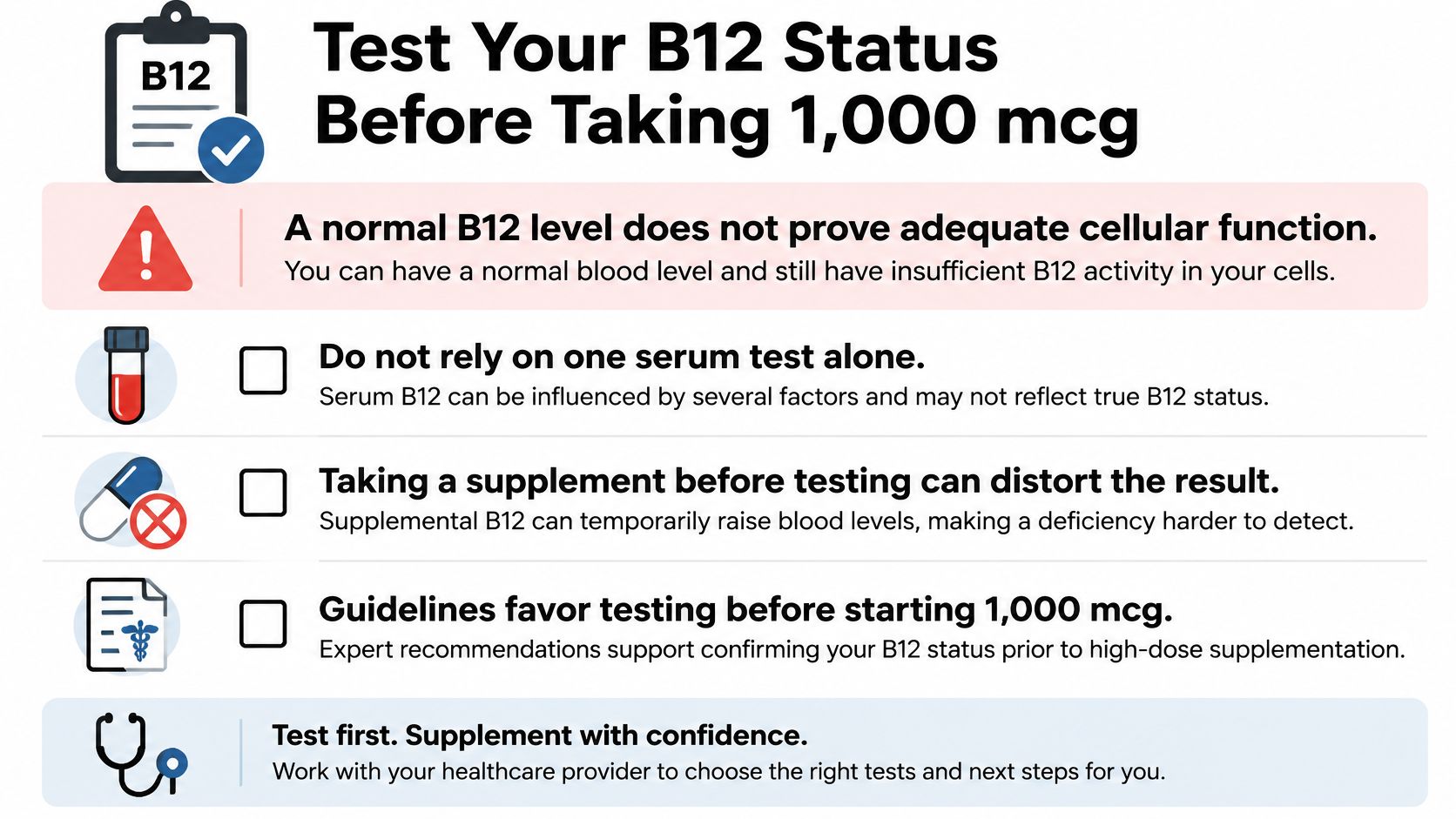
A practical decision path
- Identify symptoms and risks. Mention numbness, tingling, balance difficulties, unusual fatigue, anemia, or memory and mood changes. These symptoms aren't specific to B12 deficiency.
- Ask about appropriate testing. A clinician may request total or active B12, then MMA if indicated. Anemia may also warrant a full blood count; neurological symptoms deserve prompt assessment.
- Follow the diagnosis, not the bottle. Confirmed deficiency needs a plan that addresses its cause, with the route of treatment and follow-up testing chosen accordingly.
- Separate wellness from treatment. If testing doesn't support deficiency, reconsider what problem you're trying to solve before adding a high-dose product.
Don't postpone care for new or worsening neurological symptoms while trying supplements. Likewise, don't stop prescribed B12 to arrange your own baseline test; ask the treating clinician how to proceed.
If you're considering several nutrients because you feel tired, NexiHerb's guide to vitamin D and B vitamins provides broader nutrition context. It doesn't replace investigating persistent symptoms.
High-dose oral B12 is a tool for an identified nutritional or absorption problem, not a shortcut around medical evaluation.
Dosing, Side Effects and Drug Interactions
Start with the serving size, not the front-label claim. A serving might be a tablet, a capsule, or a specified amount of liquid, and those directions aren't interchangeable.
If your chosen product directs daily use and a clinician agrees it's appropriate, use the stated serving rather than increasing it because you haven't noticed an immediate effect. A prescribed deficiency regimen may differ from retail directions.
Check your whole supplement routine
Before adding a standalone product:
- Read your multivitamin label. It may already contain B12.
- Check B-complex products and fortified foods. Include them when reviewing your intake.
- Record the actual serving. Photograph the Supplement Facts panel and bring it to your appointment.
- Avoid improvised catch-up doses. Ask a pharmacist how to handle missed doses within your particular plan.
Don't assume that every symptom appearing after a dose is caused by B12. Conversely, don't keep taking a new supplement through itching, rash, or an acne-like eruption without asking a clinician or pharmacist to assess it. Stop the new product while seeking advice if you suspect a reaction; breathing difficulty or swelling needs urgent care.
Medicines and conditions that change the decision
Medicines and conditions that change B12 needs or absorption
| Medicine or condition | Why it matters | Practical step |
|---|---|---|
| Metformin | Can lower B12 levels with long-term use | Ask a prescriber about periodic B12 testing |
| Proton pump inhibitors or H2 blockers | Reduce the acid needed to release food-bound B12 | Discuss supplementation; supplemental crystalline B12 doesn't need release from food protein |
| Colchicine | May affect B12 absorption in some users | Ask a pharmacist whether monitoring is appropriate |
| Nitrous oxide exposure | Can impair B12 function | Seek clinical evaluation rather than self-dosing |
| Pernicious anemia or intrinsic-factor problems | Oral treatment requires careful selection and monitoring | Clinician-directed injections may be required |
| Pregnancy or breastfeeding | Nutritional requirements and the broader supplement plan need review | Confirm the plan with a midwife, obstetrician, or doctor |
Timing alone doesn't necessarily solve these problems. Taking B12 at a different hour from metformin, for example, isn't a substitute for reviewing your B12 status.
Don't stop a prescribed medicine because it appears in the table. A prescriber can weigh the medicine's benefit against the need for testing or supplementation.
Bring the labels: Your pharmacist can give more useful advice from the actual ingredient panels than from a list saying “vitamins.”
A supplement should fit around your treatment plan. It shouldn't replace it.
Methylcobalamin Versus Cyanocobalamin and Other Forms
Methylcobalamin hasn't been shown to be automatically better absorbed than cyanocobalamin. “Active form” describes its biochemical role, not a guaranteed advantage for the person buying it.
The NIH professional vitamin B12 overview states that available evidence doesn't show supplement absorption rates differing by B12 form. That's a useful check against marketing that treats the word methyl as proof of superior results.
The comparison below separates the names from the claims:
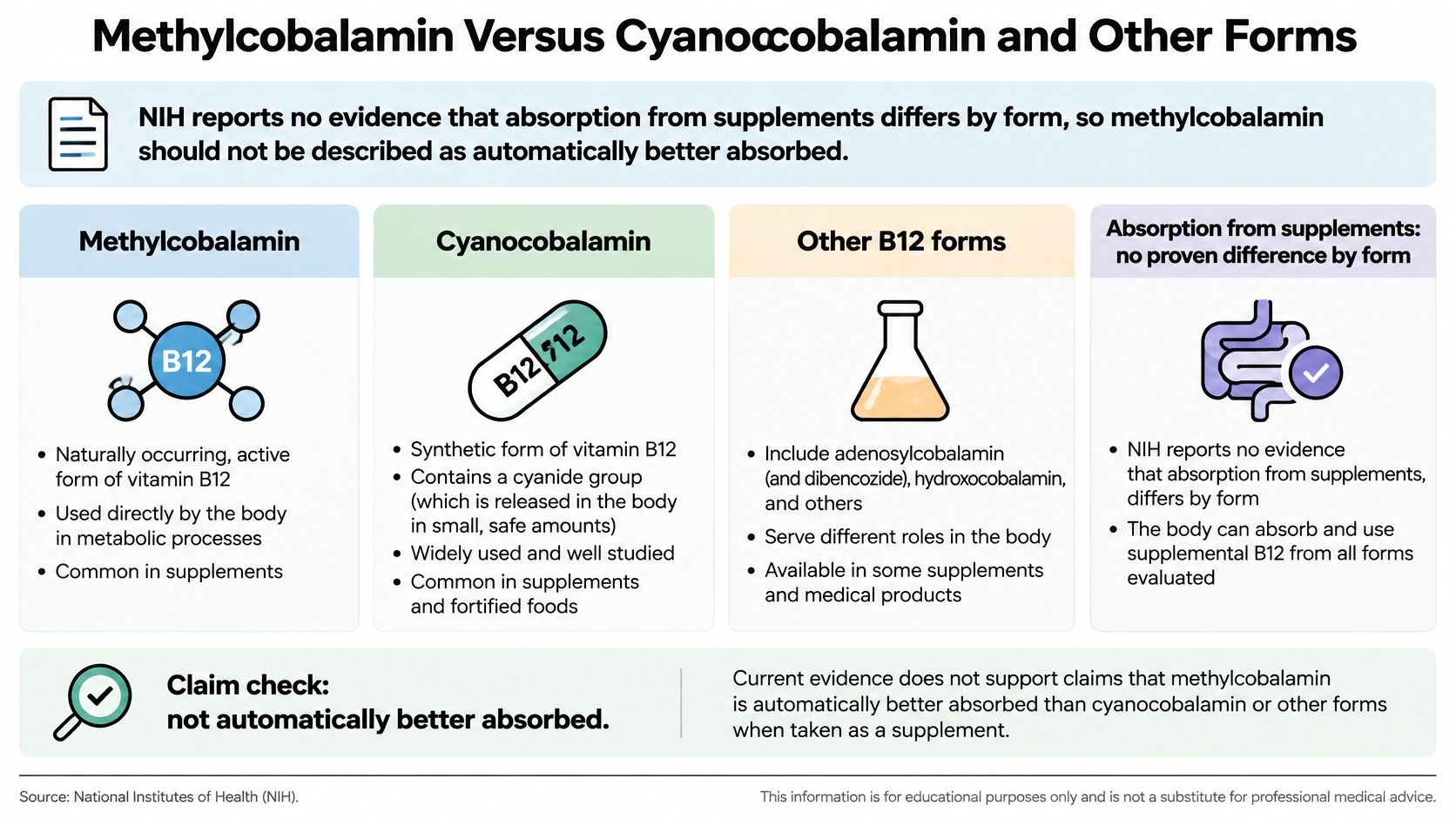
Common B12 forms compared
| Form | Role | Practical point |
|---|---|---|
| Methylcobalamin | Active coenzyme form, often marketed as metabolically active | Absorption hasn't been shown to be better than other supplemental forms |
| Cyanocobalamin | Synthetic form that the body converts into active forms | A conventional option in supplements and fortified foods |
| Hydroxocobalamin | Form used in injectable treatment | Selection belongs within a clinician's treatment plan |
| Adenosylcobalamin | Coenzyme form found in some combination products | Its presence doesn't establish that a combination works better |
The body can process a precursor into a usable form. Consequently, a label saying that a vitamin requires conversion doesn't, by itself, establish that the product is ineffective or inferior.
Nor does including several B12 forms prove that a formula corrects deficiency more effectively. You need evidence about the actual clinical outcome, not a longer ingredient list.
Choose for the situation
Methylcobalamin is a reasonable choice when the serving is appropriate, the label is clear, and the price fits your budget. There's no need to pay extra solely because a package implies that other forms can't be used.
Cyanocobalamin is also a reasonable option for ordinary supplementation. Compare the actual products rather than assuming either form will always be cheaper.
Injectable treatment is a separate decision. The reason for choosing it is the clinical situation, not a shopper's ranking of chemical names.
NexiHerb's explanation of coenzyme B-complex formulas offers context for understanding active-form terminology across B vitamins. When comparing a B-complex with standalone B12, consider the other ingredients too; you may not need an entire combination.
The practical verdict is simple: the right indication, dose, delivery route, and follow-up matter more than choosing a fashionable form.
Choosing a Product and Timing Your Dose
A useful label lets you answer basic questions without guessing. Check these details before comparing bottle prices:
- Amount per serving. Confirm that the advertised amount matches the Supplement Facts panel.
- Named B12 form. Look for methylcobalamin or cyanocobalamin rather than an unclear blend description.
- Serving count. Compare servings, not just capsule count.
- Independent verification. If USP or NSF testing is claimed, verify the specific certification.
- Inactive ingredients. Check sweeteners, flavorings, capsule materials, and ingredients you avoid.
Compare historical listings carefully
These are listing snapshots, not guaranteed current prices. The calculations divide the listed bottle price by its tablet count.
Listed 1,000 mcg methylcobalamin products and cost per tablet
| Product | Count and format | Listed price |
|---|---|---|
| Natural Factors methylcobalamin, Walmart listing from 2025 | 180 chewable tablets, 1,000 mcg | $17.47, about $0.10 per tablet |
| Piping Rock methylcobalamin, Target listing from 2026 | 120 fast-dissolve tablets, 1,000 mcg | $13.49, about $0.11 per tablet |
| Nutricost methylcobalamin, Target listing from 2026 | 240 capsules, 240 servings, 1,000 mcg | Check the current listing; price wasn't recorded |
Choose a time you can remember, using the product's directions for food and administration. A meal can be a convenient routine cue; a fast-dissolve format may suit someone who struggles to swallow capsules.
Keep different vitamin products distinct. D3+K2 NexiHerb 10,000 IU of vitamin D3 + 120 mcg of Vitamin K2 is a separate vitamin D and K supplement, not a B12 product or substitute.
The product image below illustrates that distinction:
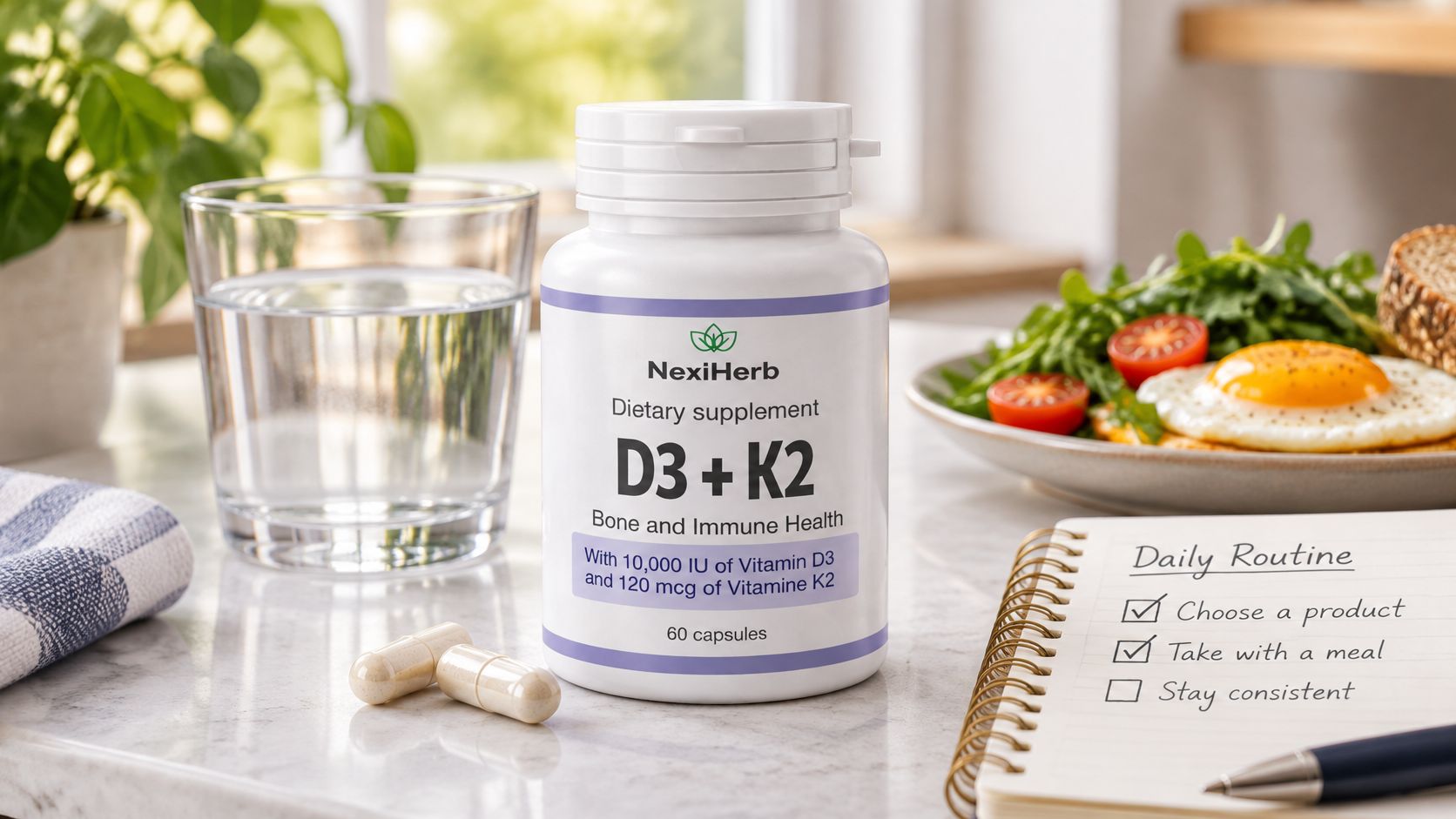
Don't transfer B12 safety assumptions to other vitamins. Review each product independently, then check the combined routine for unnecessary overlap.
Frequently Asked Questions
Is a high-dose B12 supplement safe for most adults?
B12 generally has a wide safety margin, but that doesn't establish that you need a high-dose product. Ask a clinician or pharmacist if you take medicines, have a medical condition, are pregnant, or are breastfeeding.
Will it boost my energy?
Correcting a deficiency is different from enhancing energy in someone with adequate B12. Persistent fatigue deserves an assessment rather than an automatic supplement purchase.
Is methylcobalamin better absorbed than cyanocobalamin?
The available evidence doesn't establish an absorption advantage. Choose an appropriate product and regimen rather than relying on active-form marketing.
Can I take it with metformin or a proton pump inhibitor?
Discuss your B12 status with the prescriber. The important issue is whether you need testing or supplementation, not whether you can separate the doses.
Should I retest after starting?
Agree on follow-up with your clinician, particularly when treating confirmed deficiency. Tell them the product, serving, start date, and any symptom changes so they can interpret the results.
Can children take an adult high-dose product?
Don't apply an adult supplementation plan to a child. Ask a pediatrician to assess the need and choose an age-appropriate product and dose.
What should I bring to an appointment?
Bring your medication list, supplement labels, previous laboratory results, and a brief symptom timeline. Include any dietary restrictions or gastrointestinal surgery, because the cause of a B12 problem influences treatment.
NexiHerb LLC offers dietary supplements and practical nutrition guides to help adults build informed wellness routines. Visit NexiHerb LLC to review ingredient labels and educational resources, then discuss any high-dose B12 plan with your clinician before adding it to your routine.