

If a multivitamin gummy tastes good and lists plenty of vitamins, does that mean it covers your nutritional needs? Not necessarily. The useful questions are less obvious: what does the full daily serving contain, how does your body use those nutrients, and what evidence supports the label?
A daily multivitamin gummy can be a practical supplement, especially if swallowing pills is difficult. But convenience isn't the same as nutritional completeness. Choose it by the formula, serving instructions, and quality evidence, not by flavor alone.
Table of Contents
- Gummy, Tablet or Capsule Compared at a Glance
- Who a Daily Gummy Suits and Who Should Choose Differently
- What a Gummy Can and Cannot Cover in Nutrients
- Why Labelled Doses Can Overstate What Your Body Absorbs
- Sugar, Sweeteners and Serving Size Traps
- How to Judge Quality on a Gummy Label
- Gummy or Capsule Cost per Daily Serving and Your Next Step
Gummy, Tablet or Capsule Compared at a Glance
A daily multivitamin gummy is a chewable, gelled supplement containing a combination of vitamins and sometimes minerals. The daily serving may include several pieces, so the word gummy doesn't tell you the dose.
Gummy, tablet and capsule compared
| Feature | Gummy | Tablet | Capsule |
|---|---|---|---|
| Ease of swallowing | Chewed rather than swallowed whole; generally no water needed | Can be difficult for people who struggle with pills | Swallowed with water; size matters |
| Sugar or sweeteners | Usually present | Usually absent | Usually absent |
| Pieces per daily serving | Often multiple pieces; check serving instructions | May be a single tablet or several | May be a single capsule or several |
| Heat and humidity sensitivity | Can soften, melt, or stick together | Usually less vulnerable to texture changes | Shells can soften under unsuitable conditions |
| Nutrient load per piece | Often limited, particularly for bulky minerals | Can accommodate a concentrated formula | Capacity is limited by capsule size and formulation |
| Shelf life | Check the product's expiry and storage requirements closely | Use the labeled expiry, not a format-based assumption | Use the labeled expiry, not a format-based assumption |
These are shopping tendencies, not guarantees about every product. A large capsule can be harder to swallow than a small tablet, and a gummy isn't automatically nutritionally weaker than every pill.
The category is commercially substantial: Mordor Intelligence estimated the global multivitamin gummies market at USD 15.51 billion in 2025. Popularity, however, doesn't establish whether a particular formula suits you.
Compare daily portions rather than individual pieces
Say a gummy's directions require several pieces while a capsule's directions require a single capsule. Put the products side by side and compare the nutrients delivered by each complete daily portion. Don't assume the easier-to-read front label describes an individual piece.
Also consider what you're willing to do consistently. Chewing several gummies may suit someone who avoids pills, while someone who travels frequently may prefer a compact capsule container.
Format decides how the product feels to take. The formula decides what it delivers.
Who a Daily Gummy Suits and Who Should Choose Differently
Would a daily gummy help you take a supplement consistently, or would another format fit your needs better? A gummy may suit someone who has a reason to supplement and dislikes swallowing pills. The format is only one part of the decision: the full daily serving and its label still need to match your needs.
Routine multivitamin use is more common among older adults. The NIH Office of Dietary Supplements professional overview reports that, in the 2017–2018 National Health and Nutrition Examination Survey, past-month multivitamin-mineral use reached 39.4% among adults aged 60 and older, compared with 24.0% among adults aged 20–39. Those figures describe multivitamin-mineral products, not gummies specifically.
Match the formula to the person
- Adults with limited food variety: Identify which food groups or nutrients are missing. A broad supplement may suit several gaps, while a targeted product may fit a specific need more closely.
- People who are pregnant or planning pregnancy: Ask a clinician about a prenatal formula rather than assuming a general adult gummy is appropriate.
- People taking prescription medicines: Ask a pharmacist to review the complete ingredient panel before starting, including your other supplements.
- Children: Follow age-appropriate guidance rather than using an adult product. Store supplements securely out of reach, especially products containing iron.
- Vegetarians and vegans: Check the gelling agent and nutrient sources. Gelatin and a vegetarian-friendly label are not interchangeable.
Use our guide to choosing a multivitamin to organize your needs before comparing products.
The pictured product is a capsule alternative, not a gummy.
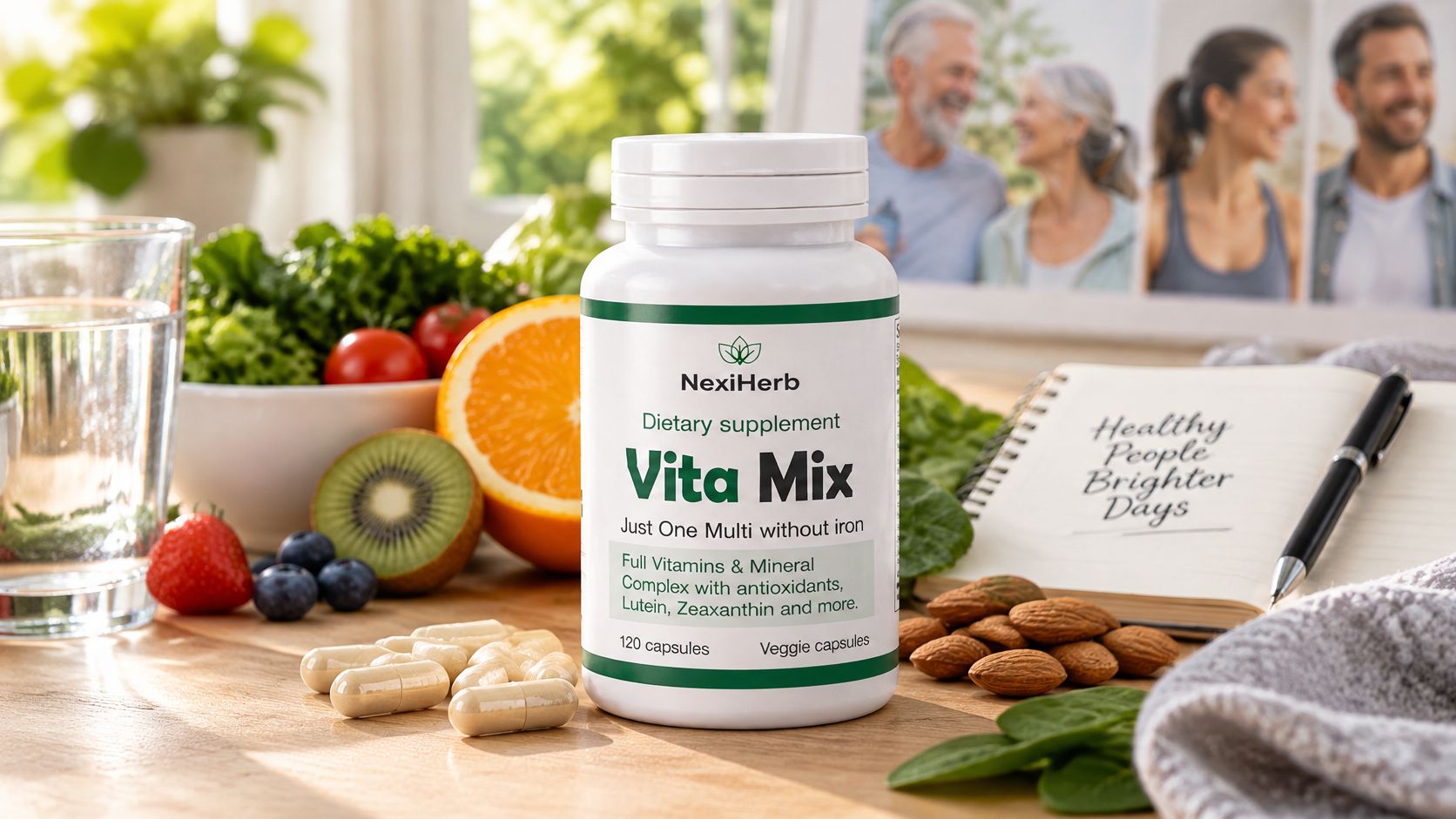
For adults considering capsules, Vita Mix NexiHerb Multivitamin & Mineral Dietary Supplement combines carefully selected vitamins and minerals.
Before buying, ask: Have I identified a nutritional gap? Can I follow the product directions consistently? Does the label show the nutrients I need? A pleasant format cannot make an unsuitable formula the right choice.
What a Gummy Can and Cannot Cover in Nutrients
Which nutrients does a daily gummy provide, and how much does its full serving contribute? Multivitamin-mineral supplements can add nutrients when food falls short, but they don't replace a varied diet. The NIH Office of Dietary Supplements consumer guide notes that calcium, magnesium, and potassium are often present in relatively small amounts in multivitamin-mineral supplements.
Adult reference values for common label nutrients
| Nutrient | Adult men | Adult women | Gummy label check |
|---|---|---|---|
| Vitamin D | RDA: 15 mcg (600 IU) through age 70; 20 mcg (800 IU) after 70 | RDA: 15 mcg (600 IU) through age 70; 20 mcg (800 IU) after 70 | Check whether the dose is shown in mcg or IU. 1 mcg equals 40 IU. |
| Vitamin C | RDA: 90 mg | RDA: 75 mg | Compare the amount per full serving with the relevant RDA. |
| Vitamin B12 | RDA: 2.4 mcg | RDA: 2.4 mcg; pregnancy: 2.6 mcg; lactation: 2.8 mcg | Check the amount per serving, not just whether B12 appears on the label. |
| Folate | RDA: 400 mcg DFE | RDA: 400 mcg DFE; pregnancy: 600 mcg DFE; lactation: 500 mcg DFE | Check the folate form and whether the amount is listed in mcg DFE. |
| Calcium | RDA: 1,000 mg through age 70; 1,200 mg after 70 | RDA: 1,000 mg through age 50; 1,200 mg after 50 | Check the calcium amount; a multivitamin may provide only a small share of the daily target. |
| Magnesium | RDA: 400–420 mg | RDA: 310–320 mg | Check the amount of magnesium itself, not just the compound name. |
| Potassium | AI: 3,400 mg | AI: 2,600 mg | Look for a listed amount and compare it with the AI. |
| Iron | RDA: 8 mg | RDA: 18 mg through age 50; 8 mg after 50 | Confirm whether iron is included and account for life stage and individual guidance. |
| Zinc | RDA: 11 mg | RDA: 8 mg | Add zinc from other supplements when reviewing the total. |
An RDA, or Recommended Dietary Allowance, is a reference intake for healthy people in a defined group. An AI, or Adequate Intake, is used when evidence isn't sufficient to establish an RDA. Age and life stage affect which reference applies, so check the relevant row rather than treating one adult target as universal.
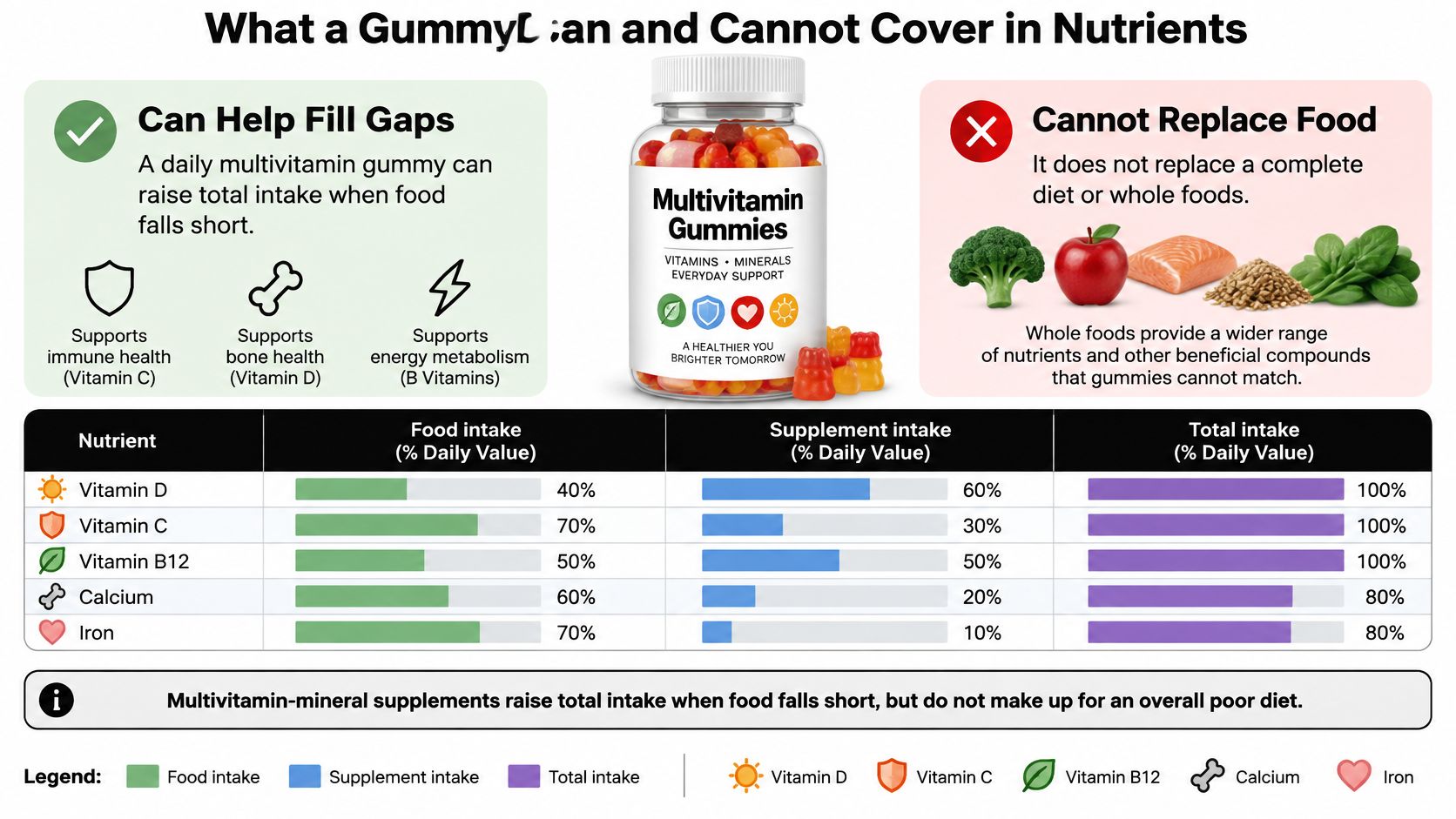
Read the serving without double-counting
Suppose a label defines one serving as two gummies. If the nutrient amounts are listed per serving, the pair provides the listed amounts. Counting each gummy as a full serving would double the total by mistake.
Percentage Daily Value is a label reference, not a personal assessment. A high percentage doesn't establish that you need more of a nutrient, while a low percentage doesn't account for what you get from meals. For broader context on supplements and whole-person health, see this resource on nutraceuticals for whole-person health.
The video below illustrates the difference between filling nutrient gaps and replacing a varied diet.
Record each nutrient's amount, unit, form, and serving count. Include fortified foods and other supplements when reviewing your total intake with a dietitian, particularly if you're addressing a documented deficiency.
Why Labelled Doses Can Overstate What Your Body Absorbs
A label shows the amount in a serving, not the amount your body will absorb and use. Bioavailability describes how readily a nutrient is absorbed and used. The National Academies' nutrient reference material identifies chemical form, competing substances, food constituents such as phytates, intestinal transit time, and enzyme activity as factors that affect micronutrient bioavailability. Chewing a supplement does not remove those influences.
Nutrient forms and what affects absorption
| Nutrient form | Absorption note | Label check |
|---|---|---|
| Calcium carbonate | Absorbed best when taken with food | Check meal instructions |
| Calcium citrate | Can be absorbed with or without food and may suit people with low stomach acid | Check the amount of elemental calcium |
| Vitamin D3 (cholecalciferol) | Evaluate the form alongside the dose and meal instructions | Confirm the unit and complete-serving amount |
| Vitamin D2 (ergocalciferol) | The vitamin name alone does not establish how much is absorbed | Record the form when comparing products |
| Magnesium oxide | Chemical form matters; labeled weight alone does not establish absorption | Check elemental magnesium rather than compound weight |
The calcium examples show why the form and directions both matter. Taking calcium carbonate without food may not follow its meal instructions, while calcium citrate allows more flexibility around meals. For either form, check the elemental calcium amount rather than comparing compound weights alone.
Improve the conditions, not the dose
Start with the Supplement Facts panel and ingredient list. A front-label phrase such as “mineral complex” does not identify which mineral compounds the product contains.
For fat-soluble vitamins, follow the product's meal instructions. Taking them with a meal that includes some dietary fat may suit the directions; extra gummies are not a substitute for understanding the form or timing. The guide to improving nutrient absorption explains how meal timing and formulation choices can affect absorption.
Recommended intake values are reference points for planning nutrient intake, not a guarantee of how much an individual absorbs from a particular product. Don't increase a serving to compensate for uncertainty or add another supplement because a mineral form is unclear. If absorption is a medical concern, seek professional assessment.
Sugar, Sweeteners and Serving Size Traps
A gummy's nutrition label covers more than its vitamins and minerals. Sweeteners and other ingredients affect how the full daily serving fits your eating plan and how well you tolerate it.
Check whether sugar is listed per gummy or per serving. If the label gives an amount per piece, multiply it by the number of gummies in the daily serving. If it gives the total for the full serving, use that figure as written.
A repeatable sugar check
- Find the serving size. Read the Supplement Facts panel alongside the directions.
- Check the sugar basis. Calculate the daily total only if the amount is listed per gummy.
- Compare with your eating plan. Use your personal sugar allowance or the target agreed with your clinician.
- Read the other ingredients. Note sugar alcohols, other sweeteners, and colors you prefer to avoid.
“Sugar-free” does not mean “sweetener-free.” Sugar alcohols such as sorbitol and xylitol may cause digestive discomfort, especially when they appear in several products you consume. If you monitor carbohydrates, check total carbohydrate on the label rather than relying on a front-label claim.
Consider tolerability and dental care
Sugar alcohols in gummies, gum, and sweetened protein snacks can add up. If bloating or loose stools occur, review the ingredient lists across those products rather than assuming the vitamins are responsible.
Sticky gummies may leave residue on teeth. Keep taking care of your teeth as usual, and avoid grazing on gummies throughout the day.
Practical rule: If the sweeteners or sugar make the full daily serving a poor fit for your eating plan, compare a tablet or capsule that provides the nutrients you need.
A gummy's texture and sweeteners can affect tolerability as well as taste. Choose a format you can take consistently without ingredients that repeatedly upset your stomach or conflict with your dietary goals.
How to Judge Quality on a Gummy Label
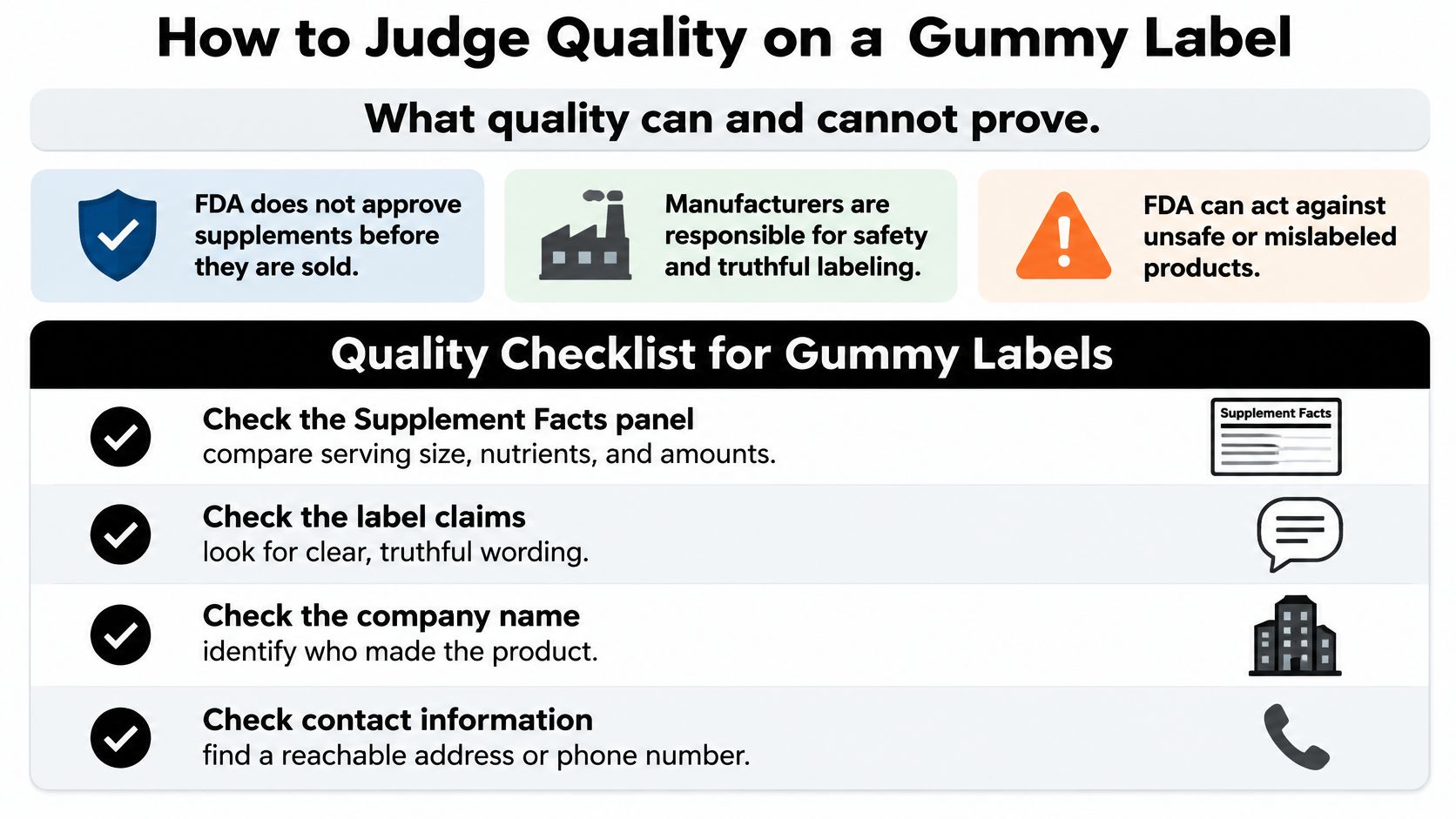
Quality evidence can help establish what a product contains and how it was manufactured. It can't prove that the product will improve your health.
The FDA's dietary supplement guidance states that supplements aren't approved before marketing and that manufacturers are responsible for safety and lawful labeling. FDA oversight doesn't mean every bottle has been tested by the agency before sale.
Use a shelf-side quality checklist
- Find the responsible company and batch details. Look for a reachable manufacturer or distributor, a lot or batch number, and an expiration date. These details help identify the product if you need to report a problem or investigate a recall.
- Check dietary compatibility. Read allergen statements, sweetener disclosures, and gelling ingredients. Pectin and gelatin aren't equivalent choices for someone avoiding animal-derived ingredients.
- Verify independent testing claims. Identify the testing organization and confirm what its program covers. A decorative badge without a named standard tells you little.
- Read storage instructions before purchase. Consider whether your delivery location, kitchen shelf, or travel bag can meet them. During hot weather, ask the retailer how it handles heat-sensitive shipments.
- Inspect the product when it arrives. Check the seal and compare the gummies' appearance with the manufacturer's description. Don't use visibly damaged or substantially altered gummies until the manufacturer has clarified whether they're suitable.
The visual checklist keeps the regulatory distinction visible while you shop.
Understand what a seal does not prove
Independent quality programs may assess manufacturing practices, whether ingredients match the label, and contaminant limits. A quality seal doesn't guarantee safety for every person or establish clinical effectiveness. It doesn't tell you whether your medicines interact with an ingredient or whether you need the formula.
Our guide to reading supplement labels helps distinguish ingredient information from marketing language. For the food-label side of your comparison, Rip Van's nutrition label guide offers useful context when reviewing the packaged foods you eat alongside supplements.
Keep gummies away from a hot car, direct sunlight, and a steamy bathroom cabinet. Melting, unusual clumping, or a pronounced change in texture deserves attention, even when the expiration date hasn't passed.
A good label is evidence of care, not proof of results.
Gummy or Capsule Cost per Daily Serving and Your Next Step
Price is the final filter, not the starting point. Global Market Insights reported that the average retail price of a standard gummy-supplement pack was USD 17.31 in 2025, but that broad market figure doesn't establish the value of an individual multivitamin.
A bottle price can look attractive while hiding a short supply. The useful comparison is cost per complete daily serving, paired with the nutrients that serving provides.
Put both formats on the same basis
| Comparison step | What to use |
|---|---|
| Establish the daily portion | The labeled serving and directions |
| Find the usable supply | Servings per container, not simply pieces per bottle |
| Calculate daily cost | Purchase price divided by daily servings |
| Check nutritional equivalence | Amounts of the nutrients relevant to your needs |
| Account for practicality | Whether you can comfortably follow the routine |
A hypothetical gummy bottle with many pieces may contain fewer daily servings than a smaller-looking capsule bottle. Don't divide by the gummy count unless an individual gummy is the complete daily serving.
Likewise, a cheaper formula isn't better value if it omits the nutrient you're buying it for. Compare the relevant amounts first, then decide whether the gummy's convenience justifies any additional cost.
Choose a routine you can maintain
If you can swallow capsules comfortably and the capsule provides the appropriate formula at a lower daily cost, there's little reason to pay extra for chewability. If pills are a genuine obstacle and the gummy meets your dietary and formulation needs, the convenience may be worthwhile.
Before starting or switching, arrange professional guidance if you're pregnant, take prescription medicines, have an absorption disorder, or are treating a diagnosed deficiency. For routine use, anchor the labeled serving to an existing habit, such as breakfast, when its instructions allow.
Choose the format that fits your life, then follow the directions consistently. Don't turn missed servings into an excuse to take extra later.
NexiHerb LLC offers dietary supplements and practical nutrition guides to help adults compare formulas and build everyday wellness routines. Visit NexiHerb LLC to review multivitamin options and their ingredient information, then choose a formula that complements your diet and suits your preferred format.