

Libido support means lifestyle and wellness strategies that help adults maintain or improve sexual desire, interest, and receptivity, rather than erectile function, lubrication, or treatment of a disorder.
If a product helps blood flow, does that necessarily mean you'll want sex more? That question exposes a common misunderstanding: wanting intimacy and having a physical sexual response aren't the same thing. Understanding the difference helps you choose habits, evaluate supplements, and recognize when a medical conversation would be more useful than another bottle.
Table of Contents
- What Libido Support Means for Everyday Wellness
- How Often Low Desire Shows Up
- Causes of Low Desire and the Lifestyle Base First
- Familiar Ingredients and How They Are Used
- Unsafe Products and When to See a Clinician
- Build a Practical Libido Support Plan
What Libido Support Means for Everyday Wellness
Libido support is broader than taking a supplement. It means considering the circumstances that make sexual interest possible, comfortable, and welcome.
Think of desire as deciding you'd like to take a trip, while arousal is the engine responding once you start. The analogy isn't perfect, because desire and arousal can influence each other, but it explains why improving a physical response doesn't automatically create motivation.
Say you've had a demanding stretch at work. You still care about your partner, but you're distracted, tired, and rarely thinking about sex. A product marketed for sexual performance might not address what's affecting your interest.
The different parts of desire
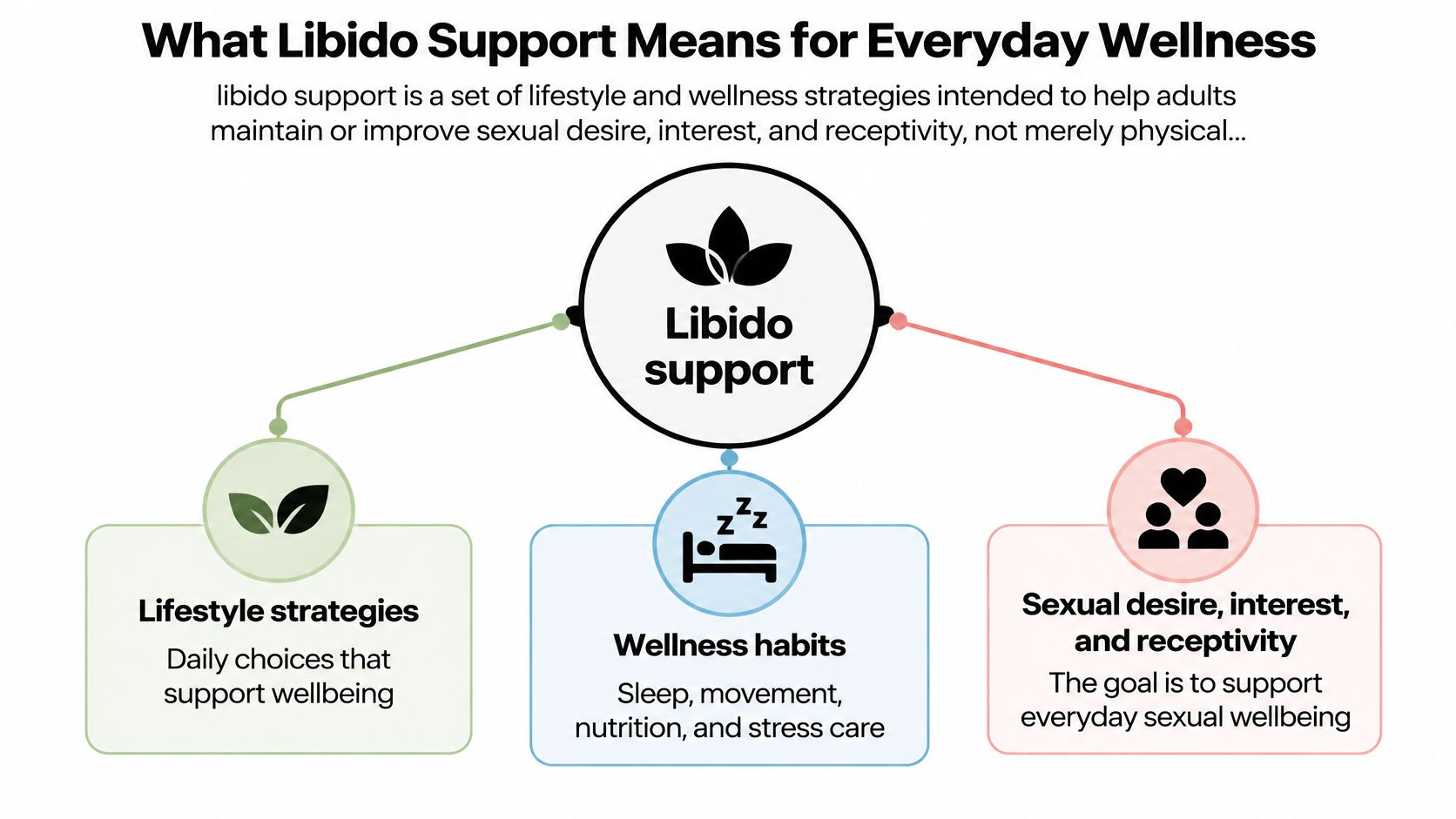
Sexual desire can include thoughts, fantasies, motivation, and receptivity. Emotional connection and physical comfort also shape whether intimacy feels appealing.
Receptivity deserves particular attention. You might not think about sex while doing chores, yet feel interested when there's time, privacy, affection, and no pressure. Conversely, you might have sexual thoughts but not want partnered intimacy in a particular situation.
This concept map brings those dimensions together.
A change isn't automatically a disorder
A temporary dip can accompany stress, relationship difficulties, disrupted sleep, medication use, or a hormonal transition. Clinical assessment considers whether low desire is persistent or recurrent, causes significant personal distress or interpersonal difficulty, and has another explanation.
The 2013 DSM-5 combined previously separate female desire and arousal diagnoses into Female Sexual Interest/Arousal Disorder, while the FDA's clinical description emphasizes persistently or recurrently deficient or absent sexual fantasies and desire, as discussed in Sexual Medicine Reviews. These clinical terms aren't interchangeable with an everyday statement such as feeling less interested during a stressful period.
A useful distinction: Wanting help with your sexual wellbeing doesn't mean you have a sexual disorder.
If hormonal changes are part of your questions, ProMD Health Bethesda's resource can help you compare hormone optimization and traditional HRT before discussing the terminology with a clinician. Learning what those services mean isn't the same as establishing that you need them.
So, what is libido support in everyday life? It's general wellness support organized around your experience of desire, not a diagnosis, a promise of more frequent sex, or a guarantee of any particular sexual outcome.
How Often Low Desire Shows Up
How often low desire is reported
The estimates below come from the NCBI Bookshelf clinical review of sexual interest and arousal disorders. They summarize different populations and measures, so each rate belongs to its stated group and definition.
| Group or study | What was measured | Reported rate |
|---|---|---|
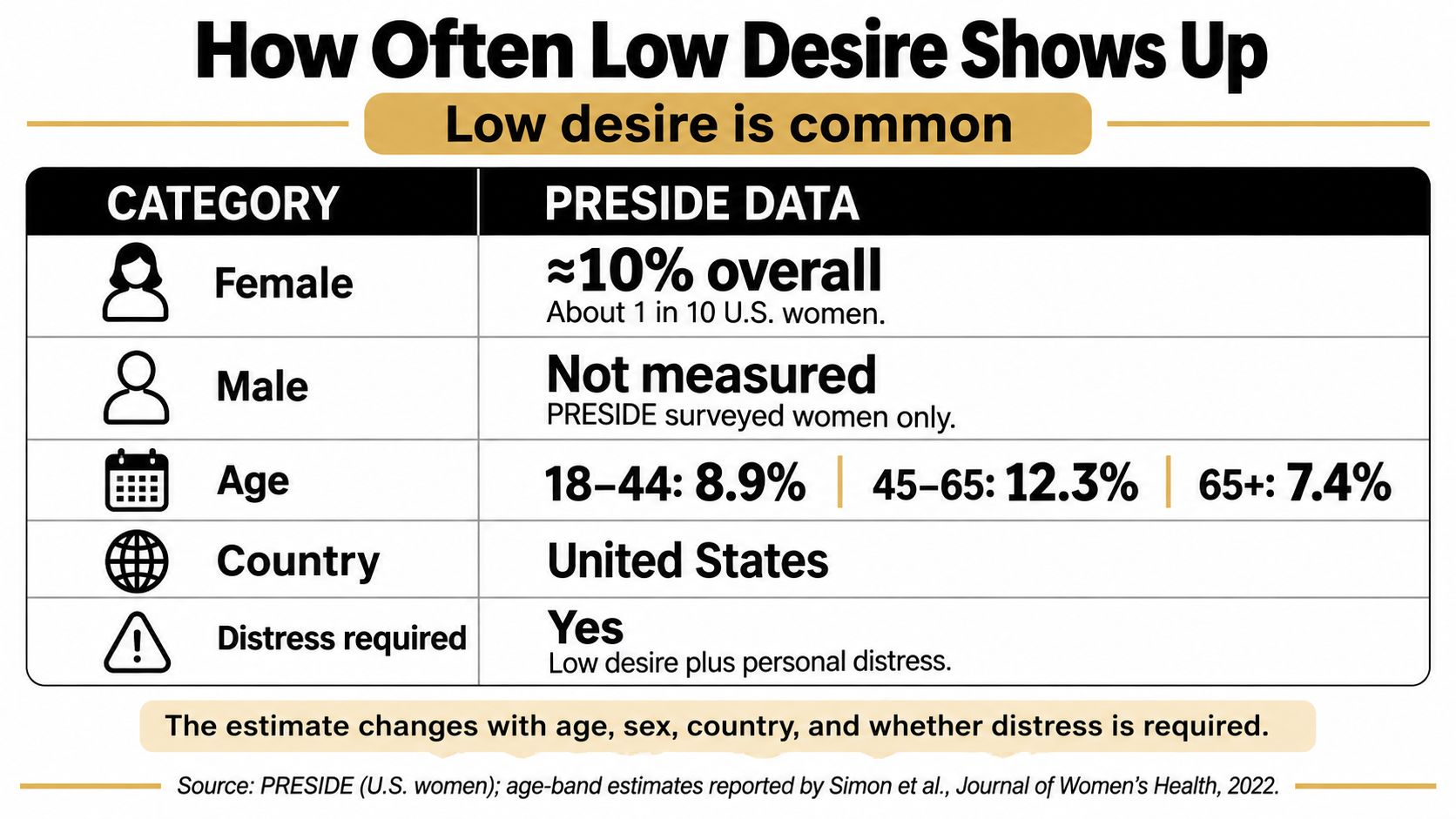
| Women 18–44, PRESIDE | Female Sexual Interest/Arousal Disorder | 8.9% |
| Women 45–64, PRESIDE | Female Sexual Interest/Arousal Disorder | 12.3% |
| Women 65 and older, PRESIDE | Female Sexual Interest/Arousal Disorder | 7.4% |
| Women, PRESIDE cumulative | Sexual-desire problems with or without distress | 38.7% |
| Women in Europe, WISHeS | FSIAD estimate | 6%–16% |
| Women in North America, WISHeS | FSIAD estimate | 9%–26% |
| Men, U.S. study in a review | Self-reported desire problem | 4.8% |
| Men, U.K. study in a review | Self-reported desire problem | 17% |
| Men in Portugal, Croatia, and Norway | Distressing lack of desire for at least two months | 14.4% |
The age-group comparison for women is also shown in this chart of low sexual desire prevalence among U.S. women. It provides context, not a personal target or a measure of what any individual should experience.
Why the distress requirement matters
The most important distinction is between reporting a desire problem and meeting a clinical definition that requires distress. A survey may count a person's concern about reduced interest whether or not it causes distress, while a clinical measure may set distress as a condition. Those approaches answer different questions and can produce different estimates.
For example, someone may notice less interest during a demanding life stage and feel comfortable with the change. Someone else may experience a similar level of interest but feel upset, disconnected, or unlike themselves. A questionnaire that includes both experiences will report a different rate from one that counts only distressing concerns.
The table combines studies rather than one test applied identically across settings. Differences between countries therefore do not show that living in one place causes low desire. Likewise, estimates for men and women use differing definitions and study methods, so they should not be read as a direct ranking.
For another perspective on the topic, you can watch this video.
What the numbers mean for you
Prevalence isn't a prescription. The estimates show that questions about desire arise in different populations, but they cannot identify which kind of support suits an individual.
A more useful personal check is to consider what has changed, how you feel about it, and whether it affects your wellbeing. Sexual frequency alone does not answer those questions. Having less interest than a partner also does not establish that either person has a disorder.
These figures are one small part of a wider picture of desire. They do not measure whether someone feels connected, satisfied, or comfortable with their own level of interest. Nor do they show that a particular product or intervention will change that experience. Libido support is therefore not one standardized approach: what feels helpful depends on the person and the concern they want to address.
If reduced desire remains distressing, a professional evaluation can help clarify what may be contributing and what options are appropriate. Comparing yourself with a population average cannot provide that individual context.
Causes of Low Desire and the Lifestyle Base First
| Contributor | Examples | Pathway involved |
|---|---|---|
| Medication | SSRIs; some antihypertensives | Can suppress desire through drug-specific pathways |
| Mood | Depression; anxiety | Motivation, reward, and interest |
| Physical health | Cardiovascular disease; erectile dysfunction | Performance difficulties can also affect interest |
| Hormones | Suspected testosterone deficiency in men | Assessment requires symptoms and appropriate testing |
| Relationship context | Conflict; mismatched interest; poor communication | Receptivity and emotional context |
| Sleep and stress load | Short sleep; ongoing stress | Energy, mood, and motivation |
| Pain or discomfort | Pain with sex or pelvic discomfort | Discomfort can make intimacy less appealing |
Low desire isn't just a blood-flow problem. Desire involves motivation, reward, mood, hormones, relationship context, and pleasurable experience. Erection and lubrication involve vascular, neurologic, and local physical responses, so a performance-focused approach may miss the main contributor.
Relationship differences also deserve attention without assigning blame. A 2024 Beducated survey of 1,885 people reported that one in four couples experienced mismatched libidos. A mismatch is a reason to discuss needs and expectations, not evidence that the less-interested partner needs a supplement.
What a clinician needs to know
Bring a description of when the change began, whether it was sudden or gradual, and how it affects you. Mention arousal, orgasm, pain, erectile function, mood, chronic conditions, and every prescription, over-the-counter medicine, and supplement you use.
The European Association of Urology guidance on low sexual desire recommends assessing these contributors and using laboratory testing to investigate endocrine disorders when appropriate. Its testosterone recommendation concerns low desire accompanied by signs and symptoms of testosterone deficiency, not low interest alone.
Establish a workable foundation
- Protect your sleep window. Choose a bedtime and waking time you can maintain, with enough opportunity to wake restored. Notice whether fatigue changes your interest.
- Keep movement manageable. Continue activity you already tolerate, such as walking, cycling, or familiar strength exercises. Don't turn wellness into another source of exhaustion.
- Eat adequately. Use regular meals and varied foods to address obvious gaps rather than assuming a specialized blend will compensate for inadequate intake.
- Reduce a concrete stressor. Delegate a task, protect downtime, or address a recurring conflict. If you're exploring stress-support supplements, keep that separate from assessing persistent anxiety or depression.
- Talk about timing and pressure. Explain which circumstances feel inviting and which make intimacy feel like an obligation.
- Arrange a medication review. Ask a prescriber or pharmacist about possible sexual side effects. Don't stop prescribed treatment on your own.
- Investigate medical concerns. Discuss pain, suspected endocrine changes, and other symptoms before considering hormone treatment.
Why hormone therapy needs individual assessment
A Mayo Clinic Proceedings review30596-1/fulltext) discusses a meta-analysis of 20 randomized, placebo-controlled trials associating testosterone treatment in men with improvements in desire and other sexual-response outcomes. That finding doesn't justify universal use: baseline deficiency, symptoms, formulation, dose, contraindications, and monitoring matter.
For women considering a hormone consultation, ProMD Health Washington, DC offers background to understand hormone treatment benefits and risks. Use it to prepare questions, not to self-select a treatment.
Familiar Ingredients and How They Are Used
| Ingredient | Commonly used for | Mechanism in plain language | Evidence limit |
|---|---|---|---|
| Maca root | Everyday vitality | Traditional food plant used in energy and stamina routines | Not a hormone or an established desire treatment |
| Tribulus terrestris | Male wellness formulas | Extract often standardized to saponins | Mixed evidence; not a testosterone prescription |
| Ginseng root | Stamina and vitality traditions | Botanical with a long history of wellness use | Species and product quality differ |
| Muira puama | Traditional vitality blends | Botanical traditionally included in wellness practices | Clinical desire evidence is limited |
| Ginger root | General wellness formulas | Culinary botanical included in some blends | Not specific to sexual desire |
| L-arginine or L-citrulline | Circulation support | Amino acids involved in nitric-oxide pathways | Blood flow isn't motivation |
| Beet root | Nitric-oxide support | Dietary nitrates can contribute to nitric-oxide production | Not a desire drug |
Ingredients complement the foundation of libido support rather than replacing it. The table describes common wellness uses and basic distinctions, not proof that an ingredient or finished blend will improve sexual interest.
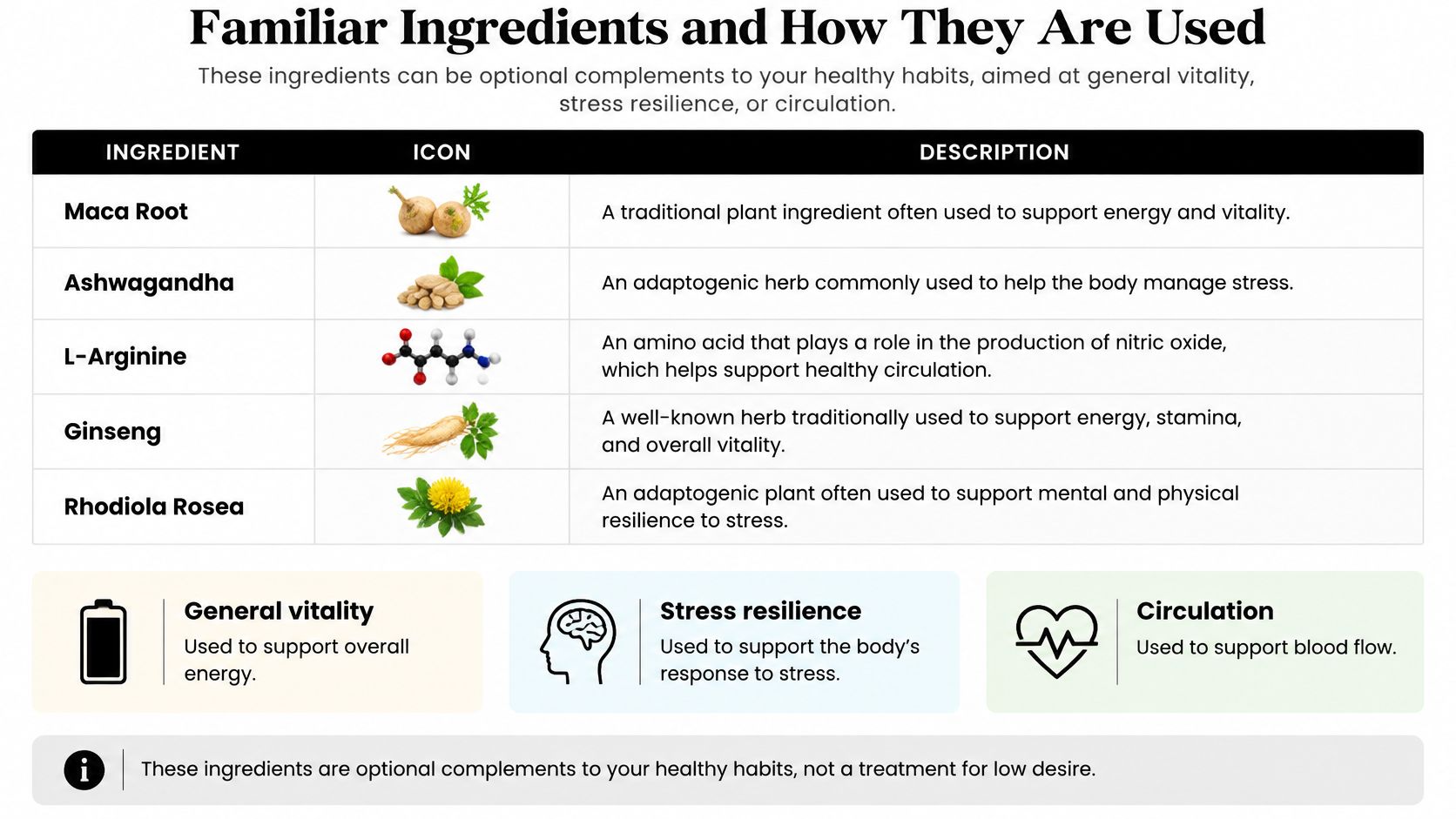
Circulation ingredients support blood flow, not desire
L-arginine, L-citrulline, and nitrate-rich beet root are associated with the nitric-oxide conversation. Nitric oxide is involved in blood-vessel relaxation, which helps explain why these ingredients are discussed in relation to circulation.
That pathway does not establish an effect on fantasies, emotional connection, or willingness to have sex. A plausible biological mechanism also does not prove that every product containing an ingredient delivers a meaningful benefit.
Match the ingredient to the question you have. A circulation formula cannot explain why intimacy has started to feel stressful.
Traditional botanicals need realistic expectations
Maca, tribulus, ginseng, muira puama, ginger, and cnidium appear in vitality-oriented products. Traditional use helps explain why manufacturers include them, but it does not amount to strong clinical evidence for improved desire.
Species, plant parts, preparation, and extract quality can vary. A label that names an herb without explaining the amount per serving gives you less information than a transparent ingredient panel.
The guide to maca root for men offers context for considering this familiar botanical. Keep everyday vitality positioning distinct from a demonstrated sexual outcome.
For a catalog example, Maca Power+ NexiHerb Herbal Dietary Supplement is listed as a maca supplement. Its product category does not establish that it treats low desire or produces a particular sexual outcome.
Nutritional adequacy is a different task
Sometimes the useful question is whether you are eating enough and getting a varied diet, rather than which sexual-wellness blend to buy. Addressing an identified nutritional problem is different from adding botanicals without a clear reason.
For example, suppose you routinely sleep too little and notice a change after starting an SSRI. Trying maca alone will not show which factor matters. Keep track of the timing and discuss the medication change with your prescriber.
Before choosing a formula, read the ingredient identity, extract description where applicable, and amount per serving. Those details help you understand what the product contains, but they cannot guarantee a result or tell you when an effect will occur.
Unsafe Products and When to See a Clinician
Some sexual-enhancement products contain undeclared drug ingredients. A natural-looking package does not show whether the contents match the label or are safe. The National Center for Complementary and Integrative Health's sexual-enhancement safety guidance describes FDA warnings about hidden drug ingredients, including ingredients associated with prescription erectile-dysfunction medicines. It also identifies promises of effects within 30–40 minutes as a concerning marketing signal.
That risk matters as much as the advertised herbs. If an active drug is missing from the label, you cannot reliably assess interactions by reading the ingredient panel alone.
A practical product-screening checklist
- Identify the promise. Does the product describe everyday wellness, or promise an immediate erection, dramatic performance, or a guaranteed sexual response? These claims suggest different expectations and deserve different scrutiny.
- Reject prescription-replacement language. A supplement should not be presented as an equivalent substitute for prescribed treatment.
- Examine the sales channel. Spam promotion, single-serving sexual-enhancement packaging, and dramatic urgency are reasons for caution.
- Check label readability. You need to understand the ingredients and warnings. A label mainly in a language you cannot read makes informed choices harder.
- Look for transparency. Prefer clearly identified ingredients and independent quality testing where available. Testing may address quality questions, but it does not prove a libido benefit.
- Review interactions first. Adults taking nitrates, blood-pressure medicines, antidepressants, or several chronic medications should ask a clinician or pharmacist for individualized advice.
When reviewing guidance on the best male enhancement pills, apply these checks before weighing rankings or testimonials. A persuasive review does not verify what a product contains.
Safety rule: A dramatic promised effect is not evidence that a supplement is potent, well tested, or appropriate for you.
When self-care isn't enough
Arrange a clinical appointment for persistent distress, a sudden unexplained change, pain, suspected hormone deficiency, or symptoms that began after a new prescription. Concerning changes in erectile function or arousal also merit assessment rather than repeated product trials.
You can ask for help before a problem becomes severe. Describe what bothers you and what you want to understand; you do not need to arrive with a diagnosis.
There is no universal supplement timeline for restoring desire. Waiting for an advertised result should not delay an evaluation, and a wellness product should not be presented as diagnosing or treating hypoactive sexual desire disorder.
Build a Practical Libido Support Plan
Use a four-week planning framework to organize observations and decisions, not as a treatment schedule or a deadline for improvement. If you have concerning symptoms, skip the self-care experiment and arrange professional assessment.
Choose outcomes that reflect your own goals. You might want less pressure around intimacy, better understanding of a medication effect, or more energy for connection. A partner's preferred frequency shouldn't be your only measure of progress.
Week one establishes your starting point
Use a notebook or phone note to record sleep quality, stress, relationship pressure, medicines, and whether the change feels distressing. Brief observations are enough; don't turn intimacy into a daily performance test.
Write down the sequence of events. For example, did interest change after a prescription, during a conflict, or alongside discomfort? Pause Medical's overview of the causes of declining sexual desire can help you organize questions for an appointment without assuming a single explanation.
Week two makes the routine easier to sustain
Choose changes you can realistically repeat. Set aside a workable sleep window, keep suitable movement in your schedule, and make regular meals easier to prepare.
If medication seems relevant, contact the prescriber with your notes. Explain when the change began and what else you've noticed, rather than stopping the medicine or trying to counteract it with a blend.
- For relationship pressure, agree that affection doesn't have to lead to sex.
- For overloaded evenings, discuss another time for connection.
- For persistent discomfort, make the appointment instead of trying to work around pain.
Week three is an optional decision point
Consider a botanical vitality formula only if there are no red flags and you've addressed interaction questions. Choosing not to add anything is also a reasonable decision.
If you do proceed, choose a clearly labeled product and change only one thing at a time so your observations remain interpretable. Check the extract name where applicable, serving information, and warnings; don't buy on the strength of fast or guaranteed results.
Week four reviews what actually changed
Revisit your notes for interest, energy, comfort, relationship pressure, and possible side effects. If distress remains, book a clinician rather than automatically increasing a serving or switching to a stronger-sounding product.
The useful decision is specific: continue a manageable habit, request a medication review, seek help for discomfort, or discuss unresolved symptoms. You don't need to prove that you tried every supplement before asking for care.
Disclosure: NexiHerb publishes this guide. Its supplements are intended to complement a healthy lifestyle and varied, balanced diet, and its male vitality collection is presented without medical or therapeutic claims.
NexiHerb LLC offers dietary supplements, including vitamins, minerals, amino acids, and botanical blends for everyday wellness. Visit NexiHerb LLC to review ingredient labels and wellness guides, and choose optional support that fits your routine without replacing appropriate medical care.