

The most repeated advice about Boswellia is to choose the supplement with the biggest absorption claim. That can be misleading: higher blood levels of one compound don't automatically mean better joint comfort or easier movement. A more useful starting point is to check what the extract contains, whether that exact type has been studied in people, and what outcomes the trials measured.
Boswellia serrata extract comes from frankincense-tree resin, but products can differ in their chemical composition and in how they're prepared. The label's extract weight alone can't tell you how much of a particular boswellic acid a capsule provides. Understanding the difference makes it easier to compare products without treating a supplement as a proven treatment for a disease.
Table of Contents
- Boswellia Serrata Extract in Plain Numbers
- From Frankincense Resin to the 5-LOX Pathway
- What Joint Trials Measured in People
- Studied Doses Safety Limits and Cautions
- When Higher Absorption Does Not Mean More Benefit
- How to Choose a Standardized Extract
- Build a Four-Week Wellness Check
Boswellia Serrata Extract in Plain Numbers
Boswellia serrata extract is a concentrated preparation of gum resin from the Boswellia tree, standardized extracts supply named boswellic acids in stated proportions.
| Boswellia serrata extract forms and research figures | Marker to look for | Figure seen in research |
|---|---|---|
| Raw gum-resin extract | Total boswellic acids, often unspecified | Label weight doesn't equal AKBA delivered |
| Chemically standardized extract | AKBA, sometimes with defined β-boswellic acids | About 20–30% AKBA in extracts used in human studies |
| Joint-trial daily amount | Boswellia extract, not the whole resin lump | Commonly 100–250 mg per day |
| When outcomes were checked | Continuous daily use | Generally after about four weeks |
The first row is a reminder that milligrams of extract aren't milligrams of AKBA. A capsule could list the weight of the resin extract without stating how much of its key compounds it contains. If the label doesn't identify total boswellic acids or a specific marker, the extract weight alone can't tell you its chemical profile.
A chemically standardized product gives you more to compare. AKBA, short for 3-O-acetyl-11-keto-β-boswellic acid, is one marker used to describe extract composition. Human studies have included extracts with about 20–30% AKBA, sometimes alongside stated levels of β-boswellic acids. That percentage is more informative than a front-label number that says only “extract,” though it still doesn't make two products identical. A review of Boswellia extract composition and clinical evidence emphasizes that study results depend on the preparation and trial design.
How to read the research figures
The daily amount in the table is the amount of Boswellia extract, not a lump of raw resin. Joint-focused randomized trials commonly used 100–250 mg per day, with outcomes generally assessed after about four weeks of continuous use. Those figures describe amounts and timing in human research, not a universal recommendation or a promise of benefit.
For a simple label check, look for the plant species, whether the ingredient is gum-resin extract, the stated extract ratio, and the marker percentage. Then compare the serving amount with the kinds of extracts and amounts used in human studies. If you're also comparing broader approaches to supporting joints, joint nutrition tips from Thermo Recovery Wear can offer useful context, but it shouldn't replace careful label reading or advice from a healthcare professional.
Practical rule: A clear marker percentage and serving size give you a better basis for comparison than a large extract-weight number on its own.
From Frankincense Resin to the 5-LOX Pathway
Start with the tree, not the capsule. Boswellia serrata is a frankincense species, and its bark is tapped to collect oleogum resin. That sticky resin is the traditional material. A supplement extract is made by concentrating selected constituents, rather than putting whole frankincense into a capsule.
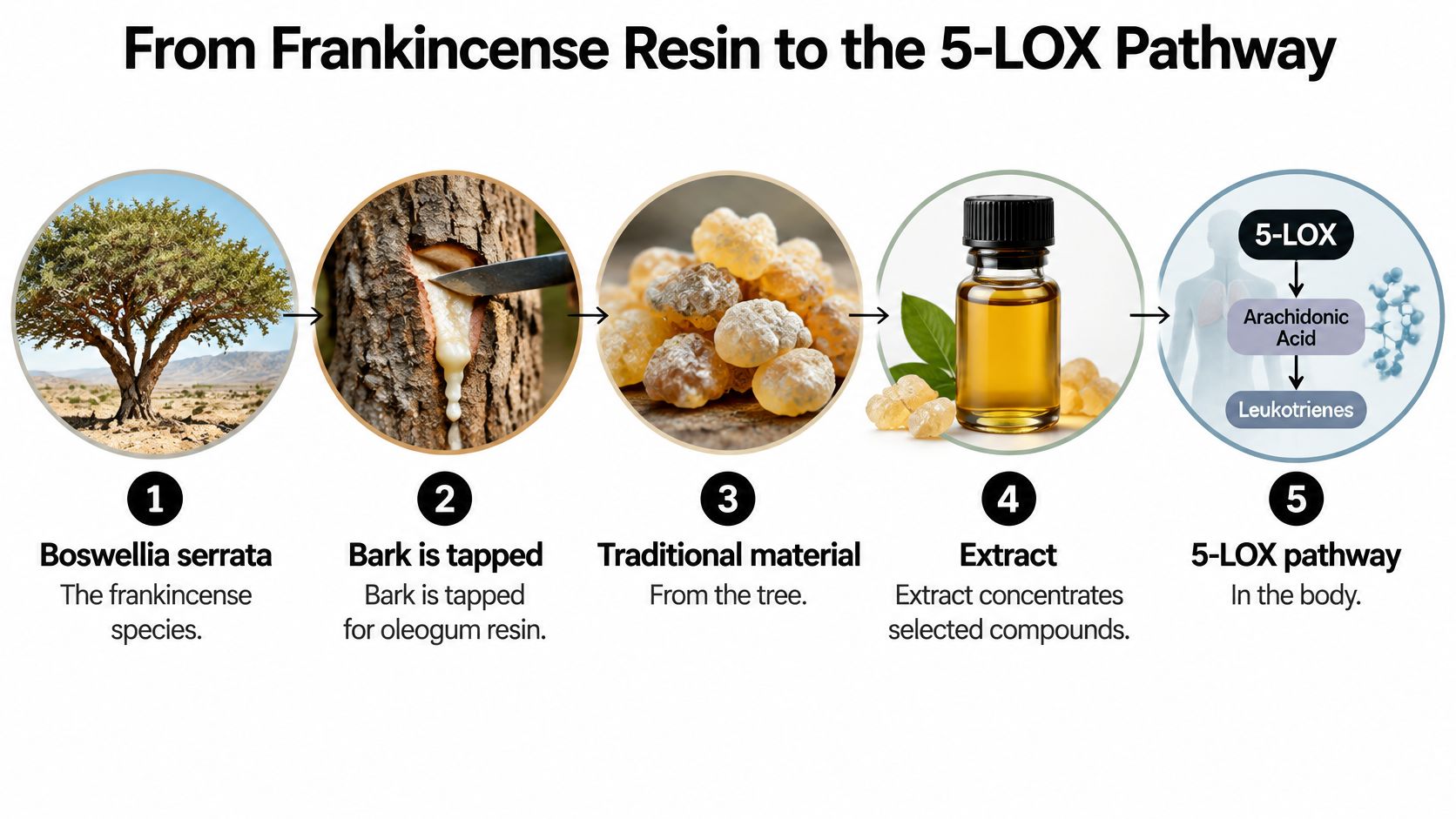
Boswellic acids are a family of plant compounds called pentacyclic triterpenes. They include several related acids, so an extract can contain a mix rather than one single active ingredient. AKBA is a particular boswellic acid often discussed because it's associated with 5-lipoxygenase, or 5-LOX, an enzyme involved in making leukotrienes.
Think of 5-LOX as helping to build traffic on one route in a larger signaling network. AKBA is studied for its ability to slow that enzyme, like easing one on-ramp, not shutting down the whole road. In everyday terms, researchers are interested in whether this pathway activity might relate to inflammatory signaling and support comfort or function. A biochemical mechanism, however, can't establish that a supplement treats a disease.
Why extracts can differ
Two capsules can have the same stated extract weight but different mixtures of boswellic acids. One may state a percentage of AKBA, while another may list only Boswellia serrata extract. Some preparations also define the amount of β-boswellic acids alongside AKBA, giving a fuller description of the extract.
The practical implication is that “frankincense” and “Boswellia serrata extract” don't identify a uniform formula. Plant material, extraction, and standardization shape what ends up in a product. This matters when interpreting research: a result for one defined extract shouldn't automatically be treated as proof that every product with a similar name has the same effect.
Researchers have explored Boswellia in different areas, including joint comfort and respiratory wellness. That interest doesn't turn a proposed pathway into evidence that an extract treats asthma, arthritis, or another condition. Human trials measuring what happened to participants provide a more useful guide to what a particular preparation may support.
What Joint Trials Measured in People
The clearest numerical picture comes from a 2020 systematic review and meta-analysis of Boswellia or Boswellia extracts for osteoarthritis. It pooled 7 randomized controlled trials involving 545 participants, comparing outcomes in treatment and control groups. Lower scores on the scales below indicate less reported pain, stiffness, or difficulty with movement in those trials.
| Pooled osteoarthritis outcomes for Boswellia extracts | Pooled difference vs control | How to read it |
|---|---|---|
| Visual analogue pain | −8.33 points (95% CI −11.19 to −5.46); P<0.00001 | Lower score means less reported pain in the pooled trials |
| WOMAC pain | −14.22 points | Less pain on this osteoarthritis questionnaire |
| WOMAC stiffness | −10.04 points | Less reported stiffness |
| WOMAC physical function | −10.75 points; P<0.00001 | Easier reported daily function |
| Lequesne index | −2.27 points; P<0.00001 | Lower severity and function score |
| Evidence base | 7 RCTs, 545 participants | Different extracts, doses, and scales were combined |
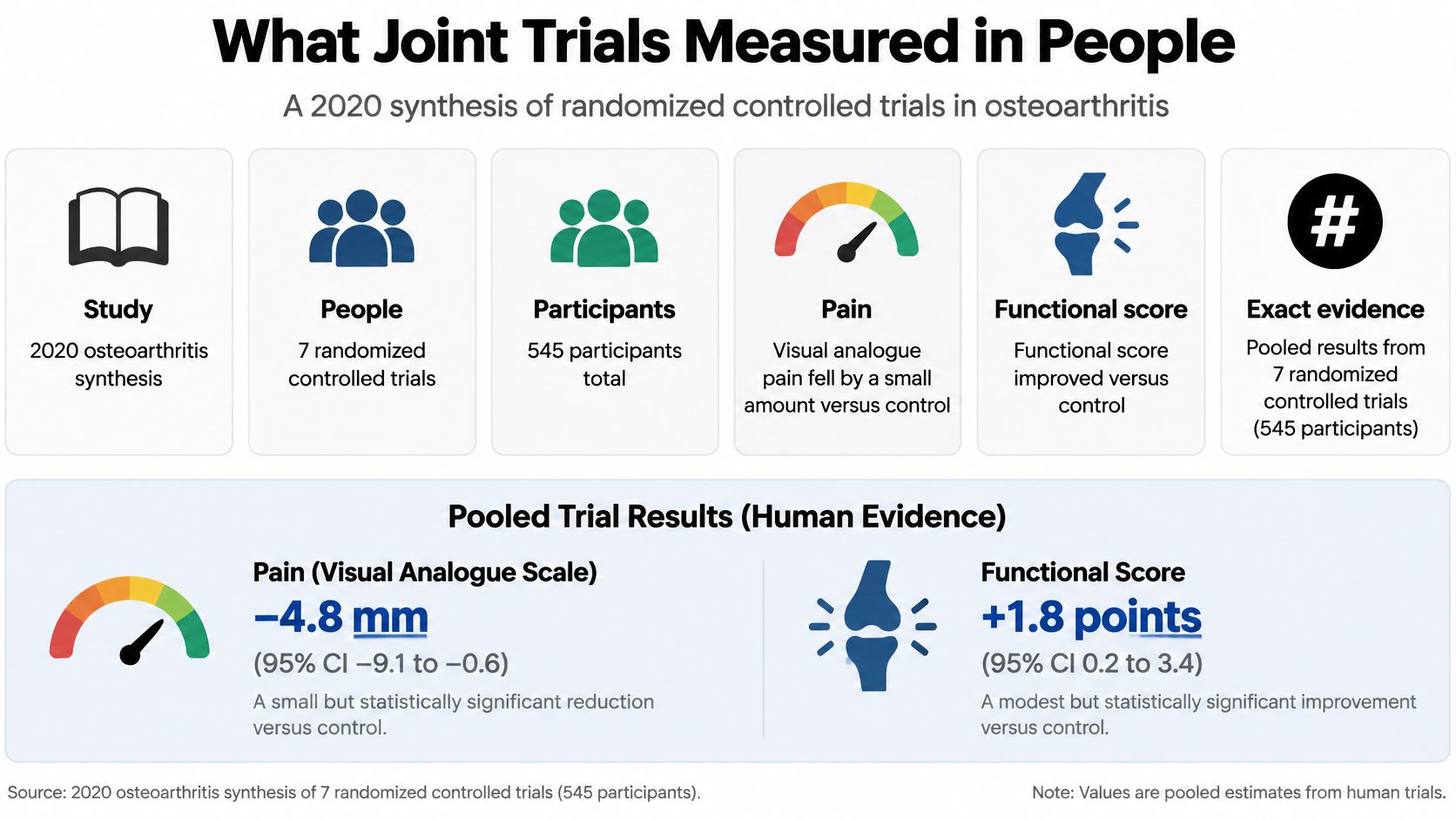
The visual analogue scale records participants' reported pain, while WOMAC measures osteoarthritis-related pain, stiffness, and physical function. The Lequesne index is another measure of osteoarthritis severity and function. In the pooled results, each score favored Boswellia compared with control, but score changes describe group averages, not what any one person will experience. The 2020 meta-analysis also notes that the trials used different extracts, doses, and scales.
What the wider evidence can and can't say
A broader review gives important context. The 2008 review in the British Medical Journal screened 47 potentially relevant studies, but only 7 met its inclusion criteria. Those included 5 placebo-controlled trials and 2 active-comparator trials examining asthma, rheumatoid arthritis, Crohn's disease, osteoarthritis, and collagenous colitis. All 7 reported clinical effectiveness, but only 3 were judged to have good methodological quality.
Findings are formulation- and outcome-specific. An outcome measured with one extract shouldn't be treated as a guaranteed result from every Boswellia product.
The osteoarthritis results don't provide pooled numbers for asthma or gut conditions such as Crohn's disease and collagenous colitis. Readers shouldn't assume joint-study results transfer to breathing or digestive outcomes. A newer short trial adds a recent data point, not a final verdict: a 2025 randomized, double-blind, placebo-controlled study recruited 105 participants, with 94 completing 28 days of treatment at 400 mg per day (study record).
Studied Doses Safety Limits and Cautions
A dose used in a trial is studied exposure, not automatically the right dose for you. The U.S. National Center for Complementary and Integrative Health reports that Boswellia serrata extract doses up to 1,000 mg per day were used safely in several clinical trials lasting as long as six months. It also reports that 2,400 mg per day appeared safe for up to one month. These figures describe what has been studied, not targets to chase. The NCCIH Boswellia safety overview supports a cautious, standardized approach rather than dose escalation.
Joint-focused trials have commonly tested lower amounts, such as 100–250 mg per day of standardized extract, with outcomes generally assessed after at least four weeks. One 90-day trial using an extract standardized to 30% AKBA and 50–55% β-boswellic acids reported no serious adverse events. That's a tolerability finding for one specified extract, not a guarantee that every preparation will be tolerated in the same way.
What to watch for
Reported side effects are usually mild gastrointestinal symptoms. These can include nausea, diarrhea, constipation, heartburn, or abdominal discomfort. If symptoms persist, stop taking the supplement and seek medical advice rather than trying to push through them or increasing the dose.
Talk with a healthcare professional before starting if you're pregnant, take medication, or have a sensitive stomach. This is especially important if you already receive care for a persistent joint or breathing concern. The available information doesn't justify guessing at a specific interaction list, so a clinician or pharmacist can help assess your circumstances and other products you use.
A useful product label should identify the extract ratio, boswellic-acid standardization, serving size, and intended duration. If those details are missing, it's harder to compare the product with the forms used in research or to understand how much of a stated marker the serving supplies.
When Higher Absorption Does Not Mean More Benefit
A supplement label that promises multiplied absorption can sound like a promise of multiplied comfort. Those are different claims. Bioavailability describes how much of a compound reaches the bloodstream; comfort and function describe what changes for a person.
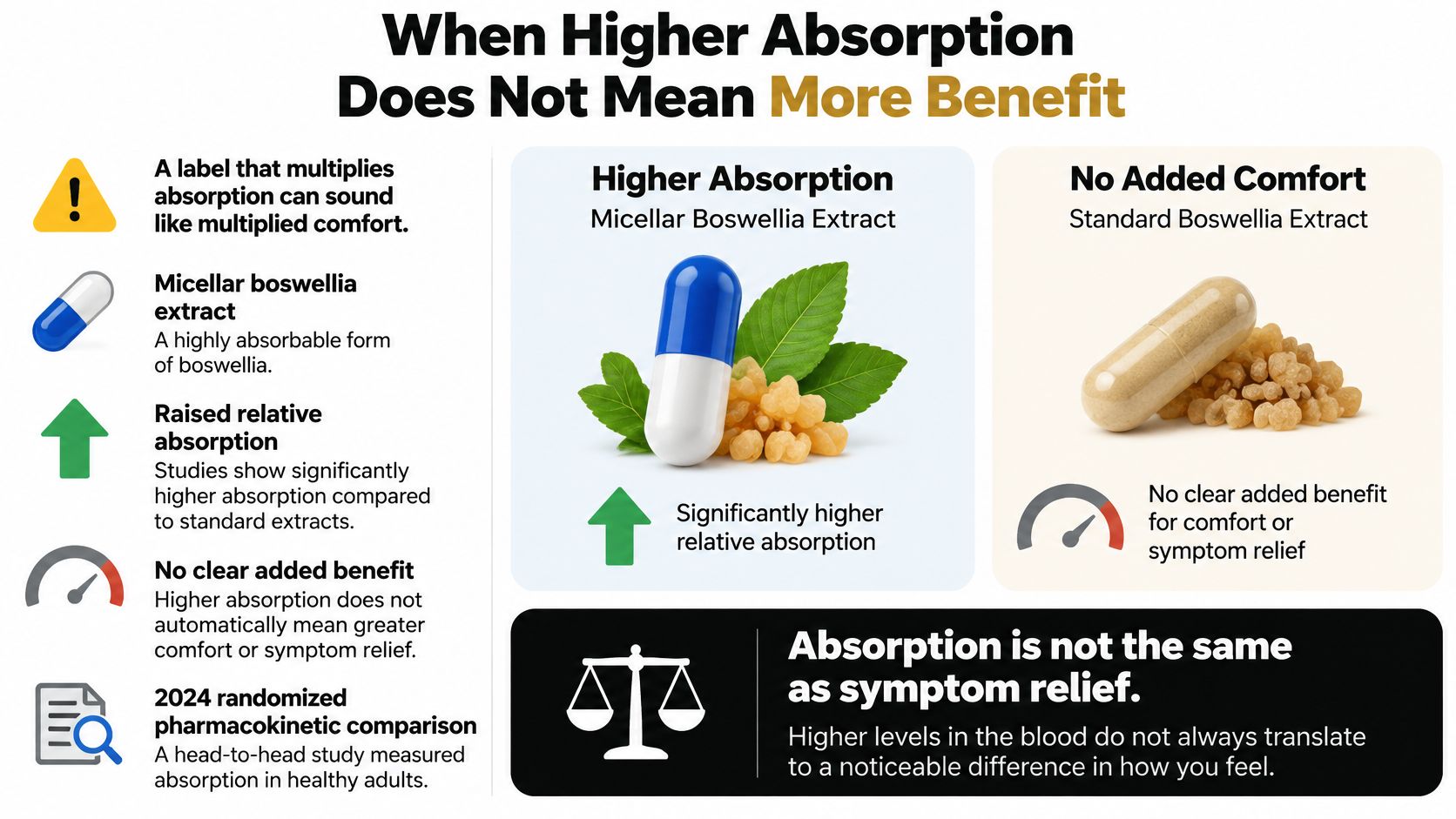
A 2024 randomized pharmacokinetic comparison found that a micellar Boswellia extract increased relative bioavailability by approximately 1,720%–4,291% compared with a native extract, with the largest difference for AKBA. Yet the higher plasma concentrations didn't produce greater anti-inflammatory activity in the accompanying ex-vivo model. That distinction matters: a larger blood-level measurement doesn't prove a person will feel more comfortable or move more easily. The 2024 comparison illustrates why absorption claims shouldn't stand in for human outcome evidence.
Questions to ask before buying
When you compare conventional, micellar, or other enhanced formulas, ask:
- Was this exact form tested in people? Look for a human trial that measured comfort or function, not only blood levels.
- Does the label state a marker? Check for a visible AKBA or total boswellic-acid percentage.
- Does the serving have a research basis? A very small amount shouldn't seem equivalent to a studied serving just because the label uses an absorption multiplier.
An independent evidence summary also describes a hybrid-hydrogel formula that increased solubility 58-fold, while its clinical meaning remains less certain. Solubility is a formulation property, not a report of better daily movement. The same distinction appears in supplement discussions beyond Boswellia, including turmeric with piperine, where a delivery approach shouldn't be confused with proof of an improved outcome.
Put human evidence, clear standardization, tolerability, and cost per studied dose ahead of marketing terminology. A product can have striking pharmacokinetic figures and still leave the most relevant shopping question unanswered: whether that formulation helped people feel or function better.
How to Choose a Standardized Extract
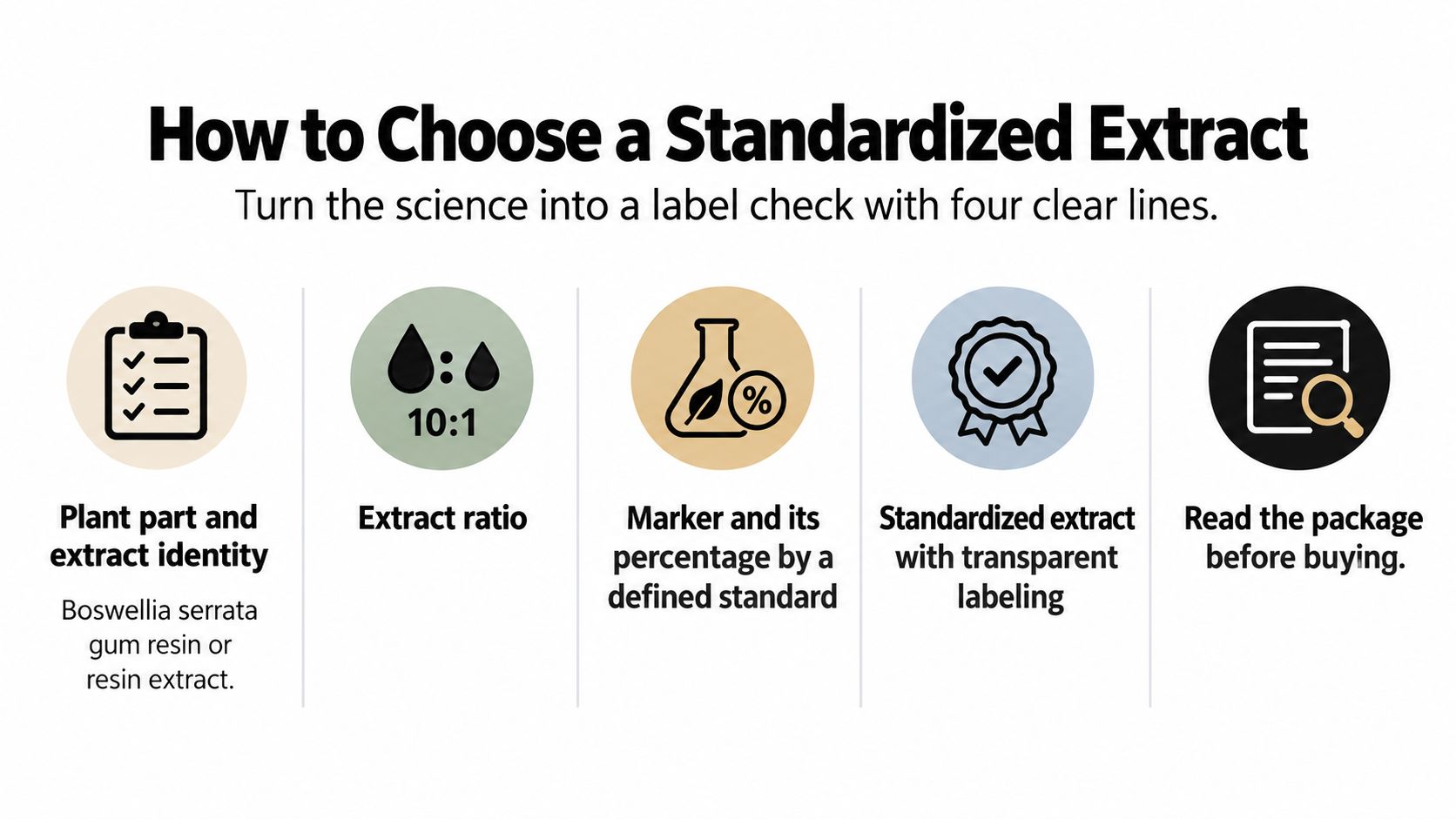
Use the label as a short audit, not a contest in headline numbers. First, confirm the plant species and plant part. Then look for the extract ratio, the marker compound and its percentage, and milligrams per serving. For a broader guide to evaluating package information, see how to read supplement labels.
| Extract style | Label should show | Evidence to trust | Shopper caution |
|---|---|---|---|
| Conventional resin extract | Species, plant part, extract ratio, total acids if known | Traditional use plus variable modern trials | Weight alone hides AKBA dose |
| AKBA-standardized | Percent AKBA, ideally about 20–30%, and mg per serving | Closest match to many human study specs | One brand's result doesn't transfer automatically |
| Full-spectrum boswellic acids | Which acids and their percentages | The named mix, not the phrase “full-spectrum” | Broader isn't proven better |
| Micellar or other enhanced | Exact technology and mg of native-equivalent extract | Blood-level data only unless that form has outcome trials | Higher absorption doesn't prove more activity |
Full-spectrum is a description, not evidence that a wider mix works better. Likewise, an enhanced formula should be judged by human comfort or function results for that same form, not by its delivery technology alone.
The same label-reading habit applies to supplements in other categories. For example, Maxi Berberine+ NexiHerb Berberine Extract Ceylon cinnamon and Milk Thistle is described as a dietary supplement combining berberine extract with Ceylon cinnamon and other plant extracts. That description doesn't make it a Boswellia product or evidence for joint outcomes. Keep the comparison focused on the ingredient and intended use you're evaluating.
Before buying a Boswellia product, check that it names Boswellia serrata, shows the AKBA percentage, lists the serving amount, and gives enough information to compare its extract with human research. If you plan to try one, discuss suitability with a healthcare professional and reassess after a consistent trial rather than switching based on an absorption headline.
Build a Four-Week Wellness Check
Keep the trial practical and easy to review. Take the labeled serving with a meal and water, unless the label or a healthcare professional advises otherwise. Use the same product consistently so you can judge that formula rather than mixing up several changes.
Track three things in a simple daily note: morning stiffness, a 0–10 comfort score during a familiar activity such as stairs or a walk, and any stomach upset. Record the activity alongside the score, since a rest day and a longer walk aren't directly comparable. Regular movement, sleep, and a varied diet can remain part of your routine; a supplement is a complement, not a substitute for medical care. For additional context on everyday habits and mobility, explore this guide to joint care.
At the end of the four-week check, review the notes for a consistent, meaningful change. If you've noticed no improvement, don't automatically move to a higher-absorption product or increase the amount. Recheck the extract identity and marker information, and ask a healthcare professional whether another approach makes sense. Pause use and seek advice if stomach symptoms persist, and consult a clinician before starting if you're pregnant, take medication, or are already receiving care for a joint or breathing condition.
NexiHerb LLC offers science-inspired dietary supplements and practical nutrition guides designed to complement everyday wellness routines. If you're comparing botanicals and want straightforward information to support your choices, visit NexiHerb LLC.