

The advice to “take glucosamine for your joints” skips the questions that matter: which joint, which symptom, and whether you have osteoarthritis at all. A supplement that's studied for knee pain isn't automatically useful for post-workout stiffness, and feeling better isn't evidence that cartilage has regrown. The most useful answer isn't a blanket yes or no. It's a decision based on the person, ingredient, and outcome studied.
Table of Contents
- Do Joint Support Supplements Work for You
- What These Ingredients Are Supposed to Do
- What the Largest Knee Trials Found
- Why Supplements Do Not Rebuild Cartilage
- How Curcumin and Collagen Compare
- How to Read a Joint Formula Label
- Building a Practical Joint Care Plan
Do Joint Support Supplements Work for You
You finish training, notice a stiff knee, and compare bottles promising comfort, flexibility, and cartilage support. Those promises sound related, but they describe different outcomes. Before choosing an ingredient, ask whether the people in its trials resemble you.
Joint support supplements may offer modest symptom benefits in some circumstances, but that doesn't establish a general benefit for everyone. Much of the relevant research concerns diagnosed osteoarthritis, not otherwise healthy adults hoping to prevent problems or recover faster from exercise.
Match the research population to your situation
A systematic review published in 2017 found statistically significant short-term improvements in osteoarthritis pain with several supplements, but the clinical importance was unclear, and medium- and long-term follow-up showed no clinically important effects on pain or function. That distinction matters: researchers can detect a difference that a person wouldn't necessarily notice when walking, climbing stairs, or getting dressed.
For someone with diagnosed osteoarthritis, this evidence can inform a discussion about optional symptom support. For someone with an undiagnosed stiff knee, it doesn't establish what's causing the discomfort or whether the same intervention would help.
Consider the difference between these goals:
- Pain relief with diagnosed osteoarthritis: This resembles the context of much of the research.
- Less soreness after training: Osteoarthritis findings don't establish an athletic-recovery benefit.
- Preventing future joint damage: A symptom trial can't answer a prevention question.
- Easier everyday movement: This is worth defining concretely rather than treating “mobility” as a single measurable result.
Make the question narrower
The practical question is therefore not just “do joint support supplements work?” Ask whether a particular formulation has evidence for the problem you're trying to address. Benefits, when present, shouldn't be assumed to transfer across diagnoses, products, or uses.
For another consumer-facing discussion, Pure Paw Labs on joint supplements can be a starting point for questions to investigate. Keep the distinction between general educational content and controlled human research clear.
Practical rule: A favorable result only answers the question researchers actually tested. It doesn't validate every promise printed beside the ingredient's name.
What These Ingredients Are Supposed to Do
Think of a joint as a hinge, but don't take the analogy too far. Cushioning, smooth movement, and discomfort are different concerns. A label that groups them under "joint support" hasn't shown that its contents address them equally.
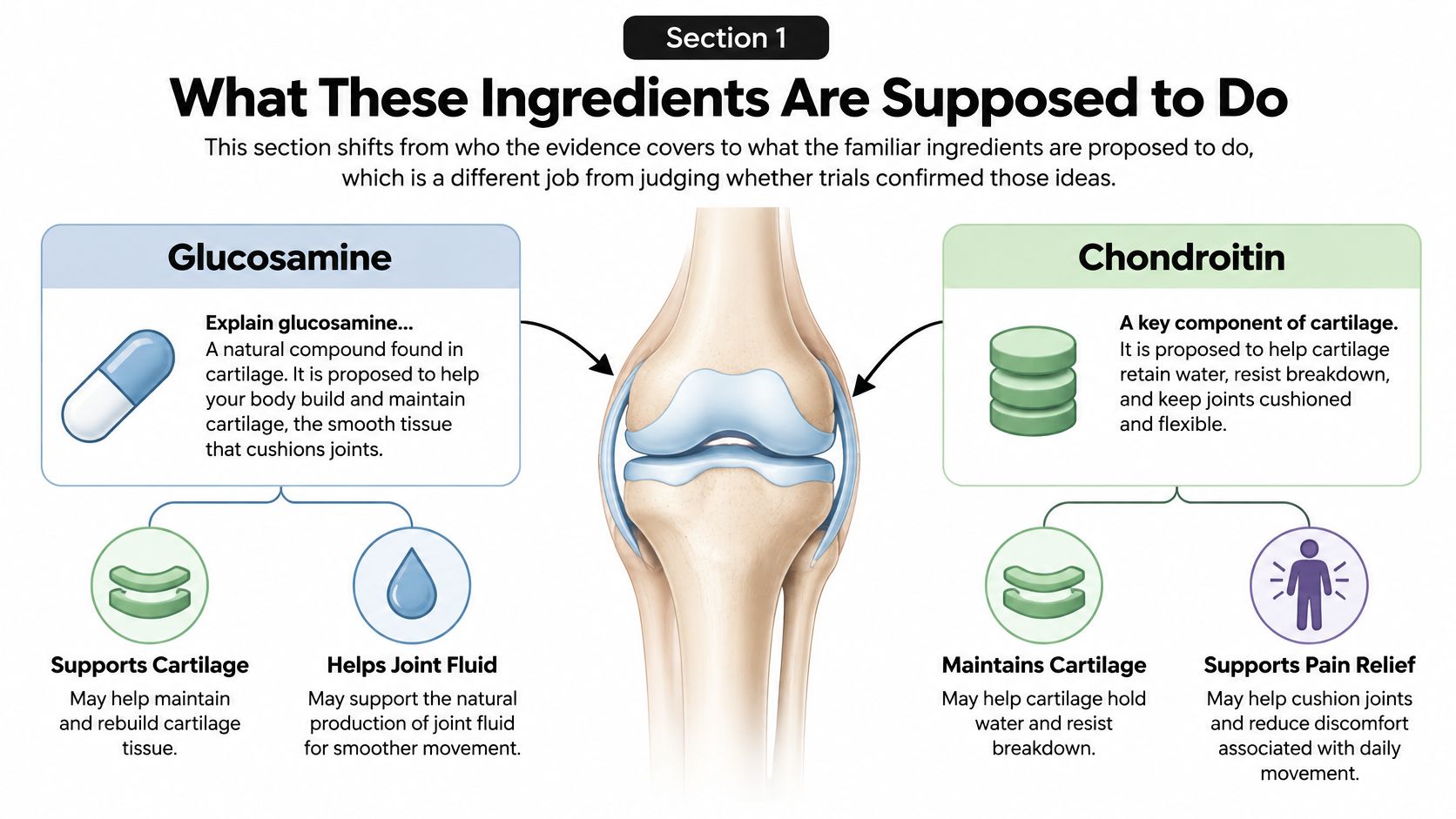
The ingredient map below illustrates proposed roles, not confirmed treatment effects.
Read mechanisms as proposals
Glucosamine and chondroitin are commonly presented through a cartilage-building-block explanation. The marketing logic is straightforward: provide compounds associated with cartilage, then expect better cushioning. But supplying an ingredient orally and demonstrating a useful change in a joint are different propositions.
MSM often appears alongside those ingredients in combination products. Its presence shouldn't be read as proof that a blend works better, and a familiar ingredient name doesn't tell you whether the finished formula has been tested.
NexiHerb's guide to glucosamine, hyaluronic acid, chondroitin, and MSM provides additional ingredient context. Use explanations of proposed roles to understand the vocabulary, then look separately for clinical outcomes.
Keep different ingredient categories separate
Other familiar ingredients arrive with different proposed purposes:
- Collagen: Evaluate claims about pain and function separately from suggestions that consuming it repairs cartilage.
- Omega-3s: Discussion about inflammatory balance isn't, by itself, proof of improved joint symptoms.
- Turmeric and curcumin: The relevant clinical question concerns a defined preparation and symptom outcome, not whether turmeric sounds broadly beneficial.
These distinctions also help avoid a common mistake: treating every wellness concern as a reason to add another supplement. If a clinician recommends investigating vitamin D status, Vitals Healthcare Doctor On Call offers information to help you find affordable vitamin D tests. That's a separate clinical question, not evidence that everyone with stiffness needs testing or vitamin D supplementation.
A credible mechanism can justify research. It can't replace research. When a bottle combines cartilage-oriented ingredients, botanicals, and other compounds, judge the evidence behind the actual formulation rather than counting how many proposed mechanisms appear on the label.
What the Largest Knee Trials Found
The Glucosamine/Chondroitin Arthritis Intervention Trial, known as GAIT, is a useful test of the familiar claim that these ingredients reliably relieve knee osteoarthritis symptoms. Its overall result and its subgroup result need to be read separately.
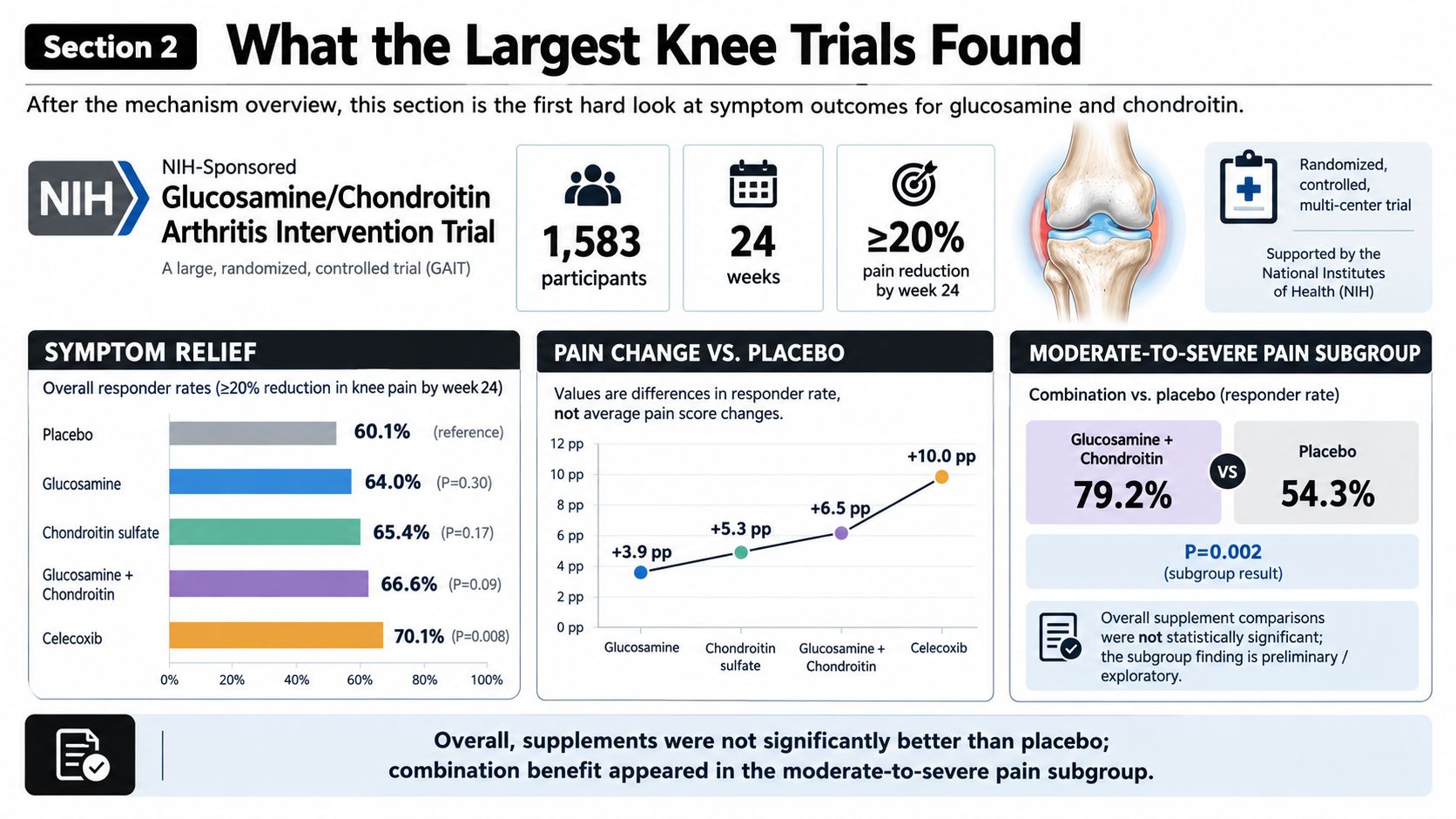
This visual summarizes the trial comparison.
The overall result wasn't a clear supplement benefit
The NIH-sponsored GAIT trial, published in 2006, screened 3,238 people, randomly assigned 1,583 adults with knee osteoarthritis to glucosamine, chondroitin sulfate, their combination, placebo, or celecoxib for 24 weeks, and found nonsignificant response-rate advantages over placebo of 3.9 percentage points, 5.3 points, and 6.5 points for the respective supplement groups; within the prespecified moderate-to-severe-pain subgroup, approximately 79% receiving the combination achieved at least a 20% pain reduction, compared with 54% receiving placebo.
The overall finding is the starting point. Neither individual supplement nor the combination produced a statistically significant improvement in the predefined responder outcome compared with placebo. Participants with mild pain also didn't show a statistically significant benefit.
That doesn't prove that nobody responds. It means the study didn't establish reliable superiority for the overall population studied.
The subgroup is a clue, not a universal result
The moderate-to-severe-pain finding deserves attention because researchers specified that subgroup in advance. Still, it answers a narrower question than the overall trial.
A promising result in people with more pronounced pain isn't permission to advertise the same benefit to everyone with a stiff knee.
The supplied video provides another format for exploring the topic.
A careful reading also separates improvement during a trial from improvement caused by the supplement. The placebo comparison matters because people in that group improved too. A testimonial describing less pain after starting a bottle can't reproduce that comparison.
For consumers, GAIT supports a restrained conclusion: these ingredients aren't dependable symptom relievers for everyone with knee osteoarthritis, although some people with more pronounced pain may respond. It doesn't establish who will respond before treatment, and it doesn't justify choosing a product solely because its label lists both ingredients.
Why Supplements Do Not Rebuild Cartilage
The heading needs an important qualification: the evidence doesn't establish these supplements as cartilage rebuilders. That's different from proving that no conceivable formulation could ever affect cartilage. The defensible conclusion concerns what researchers have demonstrated, not every theoretical possibility.
Pain relief and structural preservation require different evidence. A person might report greater comfort without a corresponding change in joint structure. Conversely, a structural measurement isn't interchangeable with how easily that person manages daily activities.
Test the structural claim directly
A NCCIH evidence summary on glucosamine and chondroitin describes a 24-month GAIT follow-up involving 572 participants, with Kellgren-Lawrence grades 2 or 3 and at least 2 millimeters of baseline joint space, in which placebo-group joint-space loss averaged 0.16 millimeters and no supplement group differed significantly; it also reports a Cochrane review of more than 2,500 people, with an overall pain difference of about 13 points on a 0-to-100 scale but approximately placebo-equivalent improvement in high-quality trials, a 2018 analysis of 29 studies involving 6,120 people, and the 2019 American College of Rheumatology/Arthritis Foundation guideline recommending strongly against glucosamine alone or with chondroitin for knee or hip osteoarthritis while conditionally allowing chondroitin for hand osteoarthritis.
The structural follow-up didn't establish that glucosamine, chondroitin, or their combination slowed deterioration. It therefore doesn't support selling them as proven cartilage-preserving treatments, much less as products that regrow lost cartilage.
Read positive pain findings in context
The broader review findings help explain why people encounter contradictory conclusions. In the pooled analysis described above, glucosamine and chondroitin separately reduced global pain significantly, while their combination didn't. In the Cochrane evidence, the apparent overall advantage became less persuasive when attention narrowed to high-quality trials.
These are different questions with different practical implications:
- Symptom change: Did people report less pain?
- Functional change: Could they do activities more comfortably?
- Structural change: Did researchers demonstrate a difference in joint deterioration?
A positive answer to the first question doesn't answer the last. Likewise, the hand-osteoarthritis recommendation shouldn't be generalized to the knee or hip.
The useful buying distinction is between optional, condition-specific symptom support and proven disease modification. The evidence leaves room for the former in selected circumstances, but it doesn't justify describing these ingredients as established cartilage restorers.
How Curcumin and Collagen Compare
Curcumin and collagen deserve separate consideration rather than being judged by the glucosamine results. They also shouldn't be grouped together just because both appear in the joint-supplement aisle.
A systematic review and related evidence on curcuminoids included 15 randomized trials involving 1,670 patients, with a weighted mean pain difference of −1.77 and total WOMAC difference of −7.06 points versus placebo, while related analyses reported no meaningful difference in pain relief or adverse events below versus above 1,000 mg daily; the collagen evidence described alongside this research included 11 randomized trials involving 870 participants, with improvements in pain and function but substantial statistical heterogeneity.
Favorable results still need interpretation
The curcuminoid findings are encouraging for symptomatic knee osteoarthritis, but formulations, doses, and trial quality varied. A pooled improvement doesn't establish that every turmeric capsule produces the same result.
The evidence also described curcuminoids as less effective for pain relief than ibuprofen. That limits the claim: possible adjunctive symptom support isn't equivalent to established anti-inflammatory treatment.
For collagen, heterogeneity means the trial results differed substantially. That makes it harder to predict the benefit a particular buyer should expect from a particular product.
What the Supplied Evidence Supports
| Ingredient focus | Evidence snapshot | Practical reading |
|---|---|---|
| Glucosamine and chondroitin | Mixed symptom findings and an unconvincing overall GAIT result | Don't assume the familiar combination is a dependable default |
| Curcuminoids | Favorable pain and WOMAC findings in knee osteoarthritis, with variable preparations | Consider the studied preparation and symptom context |
| Collagen | Improvements in pain and function, alongside substantial heterogeneity | Promising doesn't mean predictable across products |
| Omega-3s and MSM | No comparable outcome findings established in the evidence discussed here | Don't assign them a clinical ranking without relevant trials |
Don't confuse formulation claims with outcome evidence
NexiHerb's turmeric with piperine guide offers context for a common formulation pairing. However, an absorption explanation isn't a head-to-head clinical comparison showing superior comfort or function.
Buying insight: A product can sound more sophisticated without having better evidence for the outcome you care about.
The dose comparison also challenges the assumption that increasing intake must improve results. It doesn't establish a universal ideal dose or justify self-escalation.
Rather than selecting a winner across unrelated studies, ask which outcome matters most. Pain, stiffness, function, and quality of life aren't interchangeable, and differences between trial populations and formulations prevent a simple shelf-wide ranking.
How to Read a Joint Formula Label
Start with your intended outcome, then inspect the ingredient panel. The front label may promise broad “support,” but the back label tells you what you would take.
A network meta-analysis of knee-osteoarthritis supplements published in 2025 identified different products as strongest for stiffness, pain, and function. That finding argues against assuming a single ingredient or formula is uniformly best.
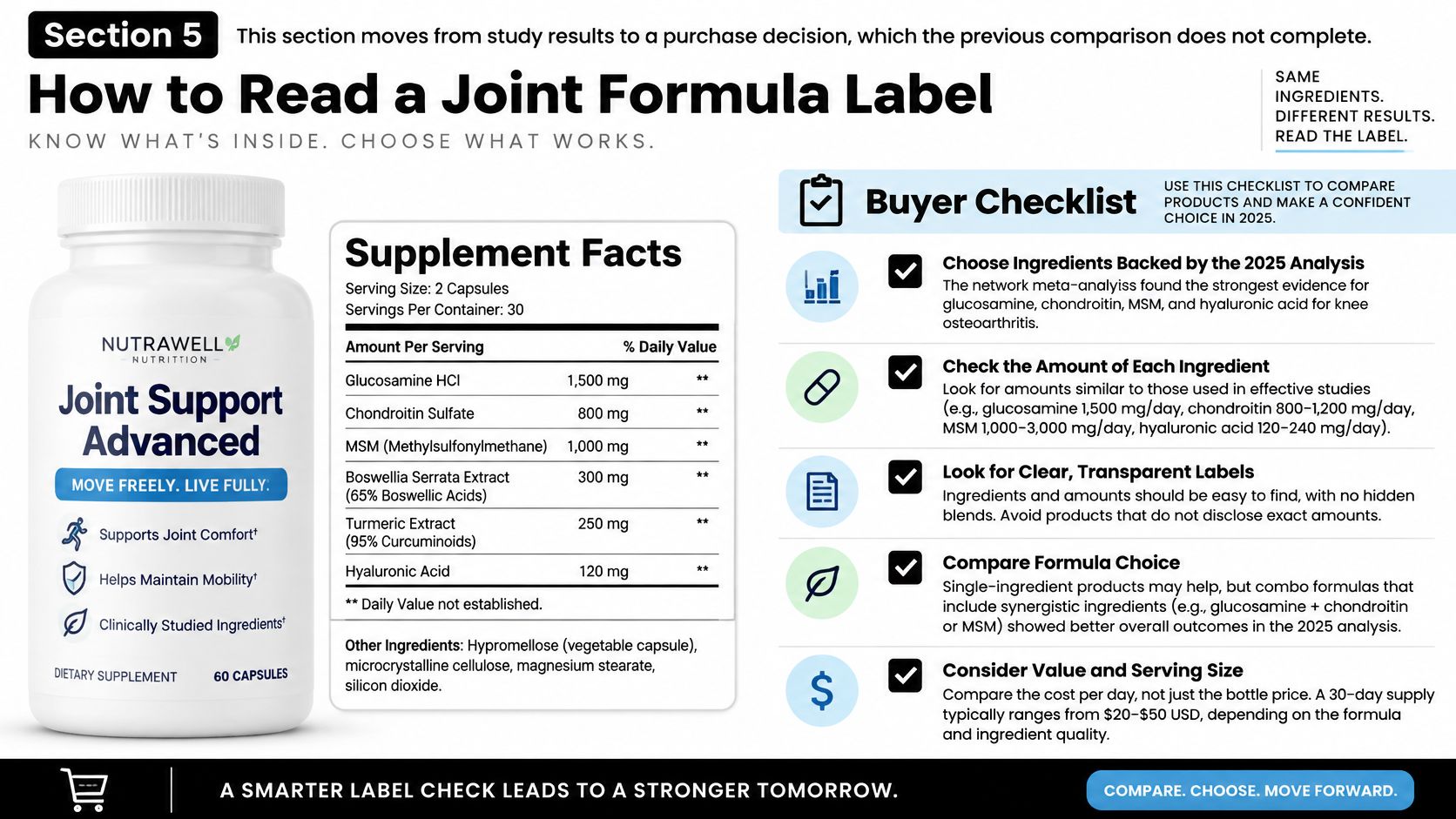
Use this label checklist to organize the purchase decision.
Apply the same questions to any blend
As a concrete example, the Joint Care Complex NexiHerb Glucosamine & Chondroitin Complex label lists, per 3-capsule serving, shellfish-free glucosamine sulfate potassium at 1,500 mg, boswellia extract at 200 mg, chondroitin sulfate and turmeric extract at 150 mg each, and quercetin, L-methionine, MSM, and bromelain at 25 mg each, with 30 servings per container.
It's an adult dietary supplement with a gelatin capsule and rice extract blend among its other ingredients. Those details describe the formula; they don't demonstrate that the finished product reproduces a clinical-trial result.
A useful label review asks:
- Ingredient identity: Is the listed compound or extract comparable to what researchers studied?
- Serving size: Are the amounts stated per capsule or per full serving?
- Evidence fit: Does the research concern your diagnosis and desired outcome?
- Missing details: Does a generic extract name leave important formulation questions unanswered?
Put safety ahead of stacking
NIH guidance warns that supplement risks can increase with high doses, replacement of prescribed medicines, or combining multiple supplements. Some products can increase bleeding risk or interact with medicines and anesthesia, so people taking anticoagulants, preparing for surgery, or already using several wellness products should ask a clinician or pharmacist before starting.
The example product's label states that its claims haven't been evaluated by the Food and Drug Administration and that it isn't intended to diagnose, treat, cure, or prevent disease. Adults should follow its directions, avoid exceeding the recommended intake, and keep it out of children's reach.
A clearly listed formula is easier to evaluate, but label transparency isn't proof of efficacy. Don't let the number of ingredients substitute for evidence about the blend.
Building a Practical Joint Care Plan
A useful plan begins with a problem you can describe, not a bottle you've already decided to buy. “My knee is uncomfortable when I climb stairs” gives you something more concrete to discuss and reassess than “I need healthier joints.”
Keep movement, a varied diet, appropriate weight management, and clinical evaluation in the plan rather than replacing them with supplements. If pain limits daily life, don't postpone assessment while waiting for a product to help.
Make any personal trial interpretable
NexiHerb's overview of what joint care involves offers a broader framework for thinking beyond individual ingredients. If you and your clinician decide a supplement trial is reasonable, agree on what would count as a useful result and when you'll review it.
- Confirm the goal: Record the activity or symptom you want to improve.
- Check medicines: Bring a complete list of prescriptions, over-the-counter products, and supplements.
- Choose a single formula: Avoid changing several products together if you want to understand your response.
- Keep intake consistent: Follow the label rather than increasing the dose when progress feels slow.
- Set a review point: Reconsider continued use if there's no meaningful improvement in comfort or function.
There isn't a universal time-to-benefit established for every ingredient, formulation, and complaint discussed here. Choose the review period with a healthcare professional rather than borrowing a deadline from a different product's trial.
Keep the location and diagnosis in view
Knee research shouldn't become a template for every painful joint. For example, someone whose concern is jaw discomfort can explore non-surgical TMD treatments through the Pain and Sleep Therapy Center as a condition-specific starting point, rather than extrapolating from knee-supplement studies.
Likewise, an active adult without diagnosed osteoarthritis shouldn't interpret these trials as evidence of prevention or faster athletic recovery. That's an unanswered application, not an established benefit.
The strongest personal decision may be to try a supplement cautiously, decline it, or stop one that isn't helping. Judge the choice by meaningful daily comfort and function, not by how broad the marketing sounds.
NexiHerb LLC offers adult dietary supplements and nutrition guides for everyday wellness, including joint-care options intended to complement a balanced lifestyle. Visit NexiHerb LLC to review ingredient panels and directions, then bring your preferred formula to a clinician or pharmacist for a safety check before starting.