

It's mid afternoon, your focus is slipping, and you still have a workout, family time, or a long drive ahead. Reaching for something labeled for energy feels reasonable. The harder question is what you want that product to change. Feeling more alert for an hour, feeling less worn down over a week, finishing a ride stronger, recovering by tomorrow, and feeling more vital in intimate life aren't the same goal, and an herb that fits one may do little for another.
Table of Contents
- Why Herb Choices Depend on Your Energy Goal
- Understanding Stamina Energy and Recovery
- Comparing the Best Researched Herbal Options
- How Panax Ginseng Supports Daily Vitality
- How Beetroot and Nitrate Support Exercise Stamina
- Matching Herbs to Real Wellness Routines
- Choosing and Using Herbal Energy Supplements Safely
Why Herb Choices Depend on Your Energy Goal
You finish lunch, sit back at your desk, and your eyelids feel heavy even though you slept. Or you lace up for training after work and your legs feel flat from the first warm up set. In both moments you'd probably say you need energy, but your body is asking for different things.
That distinction matters because stamina isn't one measurable outcome. A product studied for how tired people say they feel hasn't automatically been shown to help you run farther. An ingredient that supports blood flow during exercise hasn't been shown to fix an afternoon slump. When labels bundle all of this under herbs for stamina and energy, it's easy to buy the wrong tool for the job you have in mind.
Five Goals People Bundle Together
It helps to name your goal before you look at any bottle. These five show up most often, and they overlap less than marketing suggests.
- Perceived alertness: You want to feel sharper and less foggy right now, during work or study.
- Everyday fatigue: You're not chasing a workout result. You just feel worn down across normal days.
- Exercise endurance: You want to sustain output longer, whether that's reps, pace, or time.
- Recovery: You want to feel ready again sooner after hard effort or a demanding week.
- Sexual vitality: You're interested in libido, confidence, and intimate wellness, which is a different conversation from athletic stamina.
Once you've picked your priority, the next questions get easier. Was this herb studied for that outcome, in people like you, at the dose and extract type on this label. If the answer is unclear, the product may still interest you, but you should hold your expectations loosely.
Many readers also confuse adaptogens with stimulants, so it's worth reviewing what adaptogens are and how they're described in traditional and modern use before comparing specific ingredients. By the end of this guide, you'll be able to define your goal, read a claim against the evidence behind it, check product quality and safety, and decide whether an herb belongs in your routine at all.
Understanding Stamina Energy and Recovery
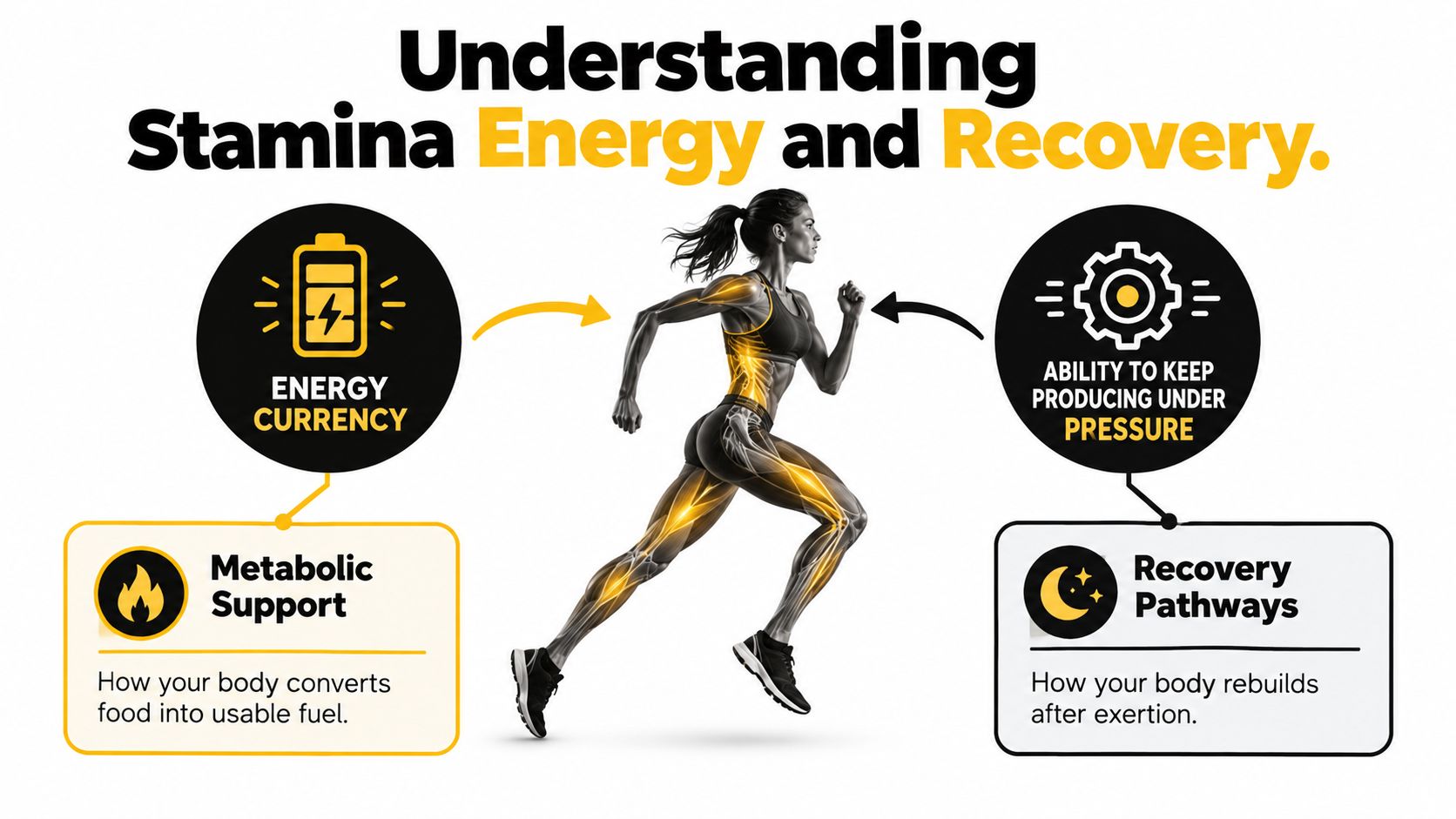
Think of your body like a workshop rather than a battery. A battery model suggests you charge up and drain down. Real life is messier. You can have fuel available and still struggle to keep producing under pressure, the way a workshop can have power but slow down when tools overheat, materials run low, or workers need a break.
That gives you two useful ideas. Energy currency is the fuel side, how your body converts food into usable energy for muscles and brain. Ability to keep producing under pressure is the stamina side, how well you sustain effort, tolerate stress, and then rebuild afterward through sleep, nutrition, and rest.
Pathways Herbs Are Said to Influence
Different ingredients are linked to different pathways, and plain language helps here. Metabolic support refers to processes involved in turning nutrients into fuel. Stimulant signaling affects alertness and the feeling of being switched on. Nitric oxide availability relates to blood vessel function and circulation, which influences how oxygen reaches working muscles. Adaptogenic responses describe how the body handles physical or mental stress over time.
None of these pathways guarantees a result you can feel. An active compound in a plant doesn't translate into an identical effect in every product. Dose matters. Extraction method matters. Standardization, which means controlling how much of a marker compound is in each serving, matters too. Two capsules with the same herb name on the front can be quite different inside.
Feeling Energized Versus Performing Better
Readers get tripped up most here. A fatigue questionnaire asks how tired you feel. A treadmill test, time trial, or set of reps to failure measures what you did. Both are legitimate, but they answer different questions, so a good result on one shouldn't be sold as proof of the other.
Feeling less tired and performing measurably better are related experiences, but they're not interchangeable evidence.
Training itself still does the heavy lifting for endurance, and if you want the conditioning side explained in practical terms, you can build endurance with Vanta Sports alongside any nutrition changes you test. Herbs, at best, sit on top of that foundation. They don't replace sleep, carbohydrate for hard sessions, hydration, or progressive training.
Population matters as much as pathway. Results in young trained athletes may not transfer to older adults, sedentary people, or anyone with persistent unexplained fatigue. Keep that lens on as you read the ingredient comparisons that follow.
Comparing the Best Researched Herbal Options
A useful comparison holds every candidate to the same questions. What's the proposed action, what human evidence exists, what product profile was studied, which outcome does it support, and where does the evidence run thin. Applied evenly, those questions make some popular herbs look more modest and others more interesting.
Rhodiola Rosea and Fatigue
Rhodiola rosea is the classic adaptogen in this space, investigated mainly for physical and mental fatigue rather than measured athletic output. The results are mixed. A 2012 systematic review of Rhodiola rosea for physical and mental fatigue screened 206 potentially relevant articles and included 11 studies, finding that among six physical fatigue trials in healthy participants, two reported benefit, while three of five mental fatigue trials reported favorable effects, and every included study had a high risk of bias or reporting weaknesses.
In plain terms, roughly a third of the physical fatigue trials and a majority of the mental fatigue trials were positive, but weak study quality means you shouldn't treat that as settled proof. Rhodiola has a real human research history. It just doesn't support guaranteed energy claims.
Ginseng, Maca, and Beetroot at a Glance
Panax ginseng has broader fatigue research, though the picture is still modest and uneven, which is why it gets its own detailed look later in this guide. Maca is traditionally framed around vitality, but vitality interest isn't the same as demonstrated fatigue relief. A clinical trials summary discussed in a 2025 Frontiers in Medicine protocol on fatigue trial design notes that maca at 2,000 mg daily for two weeks did not significantly improve fatigue or physical performance in well trained basketball players. Beetroot sits in a different category entirely because its nitrate content is measurable and its research targets exercise performance directly.
| Herb or ingredient | Main research angle | Potential role | Key limitation |
|---|---|---|---|
| Panax ginseng | Fatigue scores in clinical and general populations | Everyday perceived fatigue support | Modest, heterogeneous results, extract dependent |
| Rhodiola rosea | Physical and mental fatigue in healthy participants | Perceived fatigue under stress | Mixed findings and high risk of bias |
| Maca | Vitality and general wellness tradition | Daily wellness and vitality routines | No clear fatigue or performance benefit shown in trained athletes |
| Beetroot | Dietary nitrate and exercise performance | Exercise endurance support | Inconsistent results that vary by activity |
Reading Products Against This Evidence
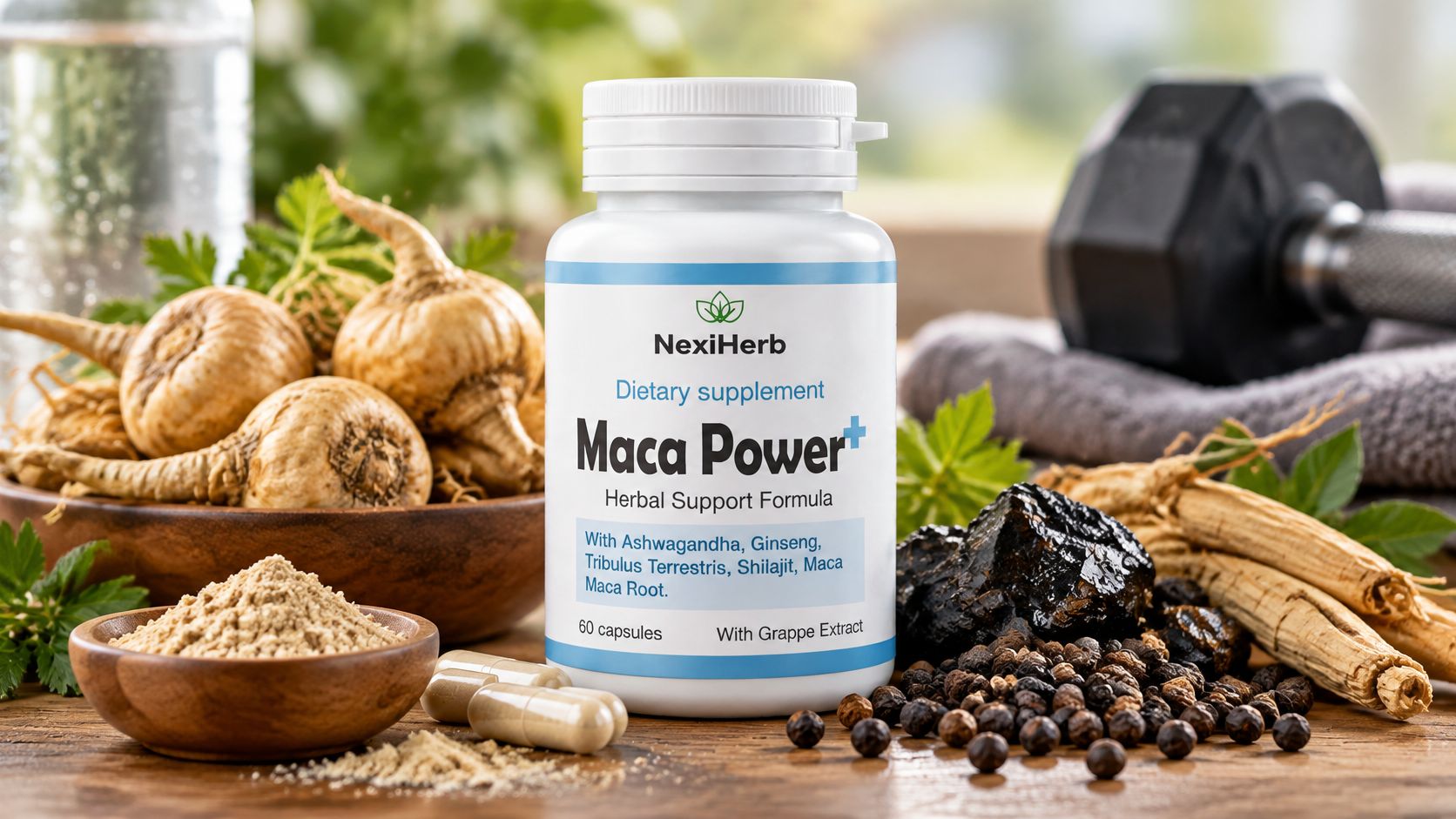
Suppose you're comparing formulas and one lists several of these ingredients together. Maca Power+ NexiHerb Herbal Dietary Supplement is one catalog example, a plant based capsule combining 300 mg maca root with smaller amounts of ashwagandha, ginseng, tribulus, shilajit, shatavari, and black pepper, taken once daily with a meal. That's a general wellness format. Its per ingredient amounts differ from the single ingredient doses used in the trials above, so you shouldn't assume study results transfer directly to it.
This transfer problem shows up across sports nutrition generally, not just botanicals. The creatine HCl vs Kre-Alkalyn comparison from Evermost LLC makes a similar point in another category, that ingredient form and studied dose shape what conclusions you can draw. Readers curious about mushroom based options often explore cordyceps and its traditional role in endurance routines as well, which deserves the same extract and dose scrutiny.
The honest summary is unglamorous. Evidence here is ingredient specific, population specific, and outcome specific. Anyone ranking a single best herb for every kind of energy is skipping the parts that matter most.
How Panax Ginseng Supports Daily Vitality
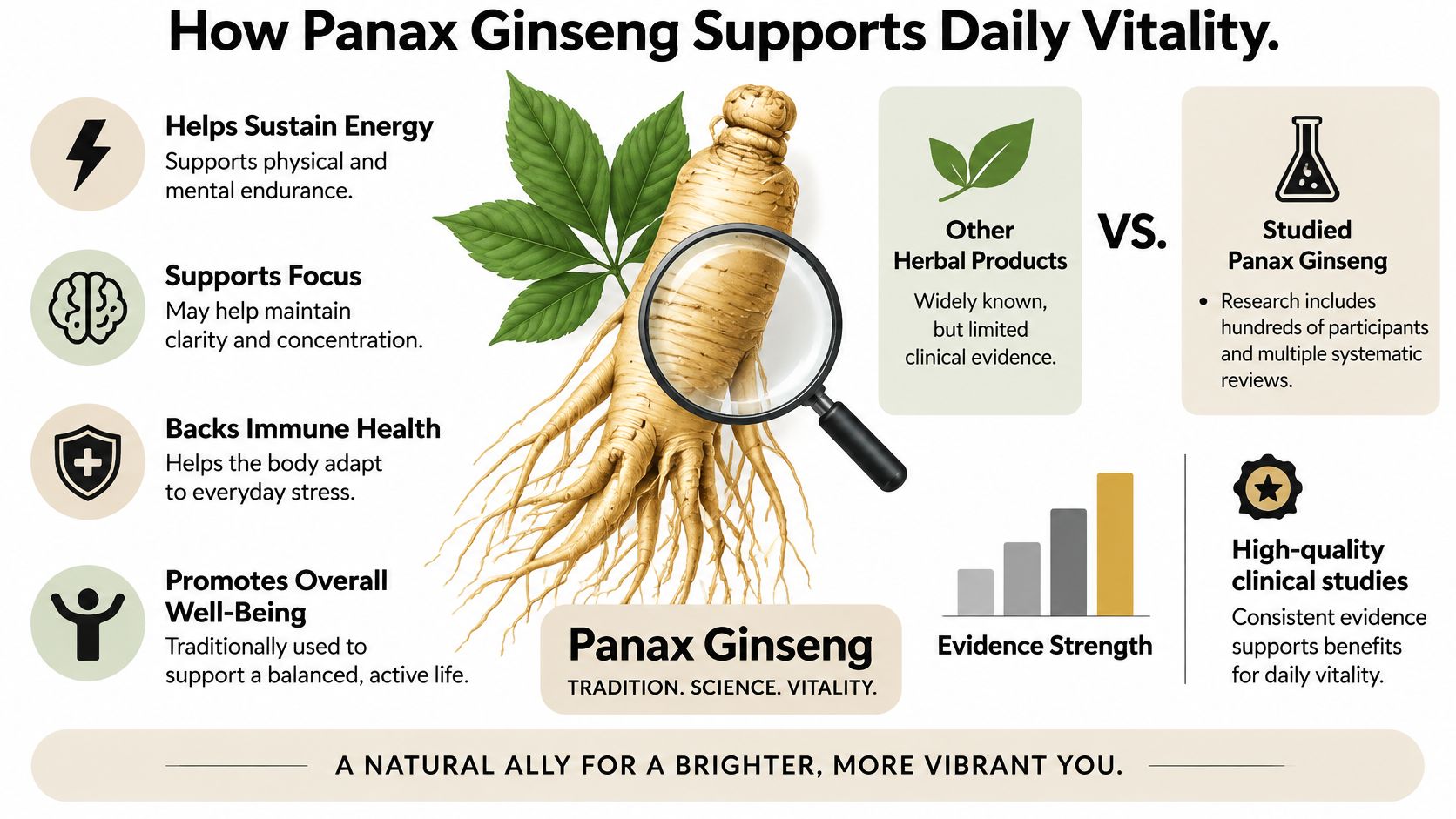
Ginseng is the clearest example of why a familiar herb name can't stand in for a studied product. Panax ginseng is among the most extensively studied traditional herbs for fatigue related outcomes, with research spanning hundreds of participants and multiple systematic reviews. Even so, outcomes vary enough that the details of each study matter.
What the Strongest Data Actually Shows
The most cited recent analysis comes from a specific clinical setting, and that context shouldn't be stripped away. A 2023 network meta-analysis of ginseng for cancer related fatigue included five randomized controlled studies involving 750 patients, and ginseng produced a pooled standardized mean difference of 0.32 versus placebo, with a 95% confidence interval of 0.17 to 0.46 and P<0.0001, although only three of the five trials found statistically significant improvement.
A standardized mean difference of 0.32 is a small to moderate effect on fatigue scores. That's meaningful in a clinical trial, but it's not a dramatic transformation, and it was measured in people dealing with cancer related fatigue, not healthy adults wanting a better Tuesday. One of the five trials showed only a favorable trend, and one small trial found no significant effect.
Other syntheses land in a similar place. A systematic review and meta-analysis of ginseng for fatigue related outcomes identified eight randomized trials with 678 participants and estimated a small to moderate fatigue benefit, while concluding that evidence remained insufficient to establish improved physical performance. Feeling less fatigued and performing better physically remain separate claims.
Turning That Into a Selection Process
Because results hinge on the preparation, use a short checklist before buying any ginseng product.
- Check the species and extract: Confirm it's Panax ginseng and note whether the label describes an extract or plain root powder.
- Look for ginsenoside content: One reviewed American ginseng preparation containing more than 5% ginsenosides at 2,000 mg per day for up to eight weeks significantly reduced cancer related fatigue, which shows how specific studied products can be.
- Compare dose and duration: A capsule with a small amount of ginseng inside a blend isn't equivalent to a studied standalone regimen.
- Set the right expectation: The realistic target is possible support for perceived energy and everyday fatigue, not a stimulant effect.
Practical rule: Judge a ginseng product against the extract, dose, and duration that were actually studied, not against the word ginseng on the front of the bottle.
A cautionary data point keeps this grounded. In one four week randomized trial, a 20% ethanol extract at 1 or 2 grams per day didn't significantly outperform placebo on the primary fatigue score. Ginseng may suit someone focused on daily vitality who accepts uncertain, modest effects. It isn't a guaranteed stamina formula.
How Beetroot and Nitrate Support Exercise Stamina
Beetroot answers a narrower question than the adaptogens above. It isn't about daily vitality or stress resilience. It's about whether a measurable compound, dietary nitrate, can support how efficiently you exercise.
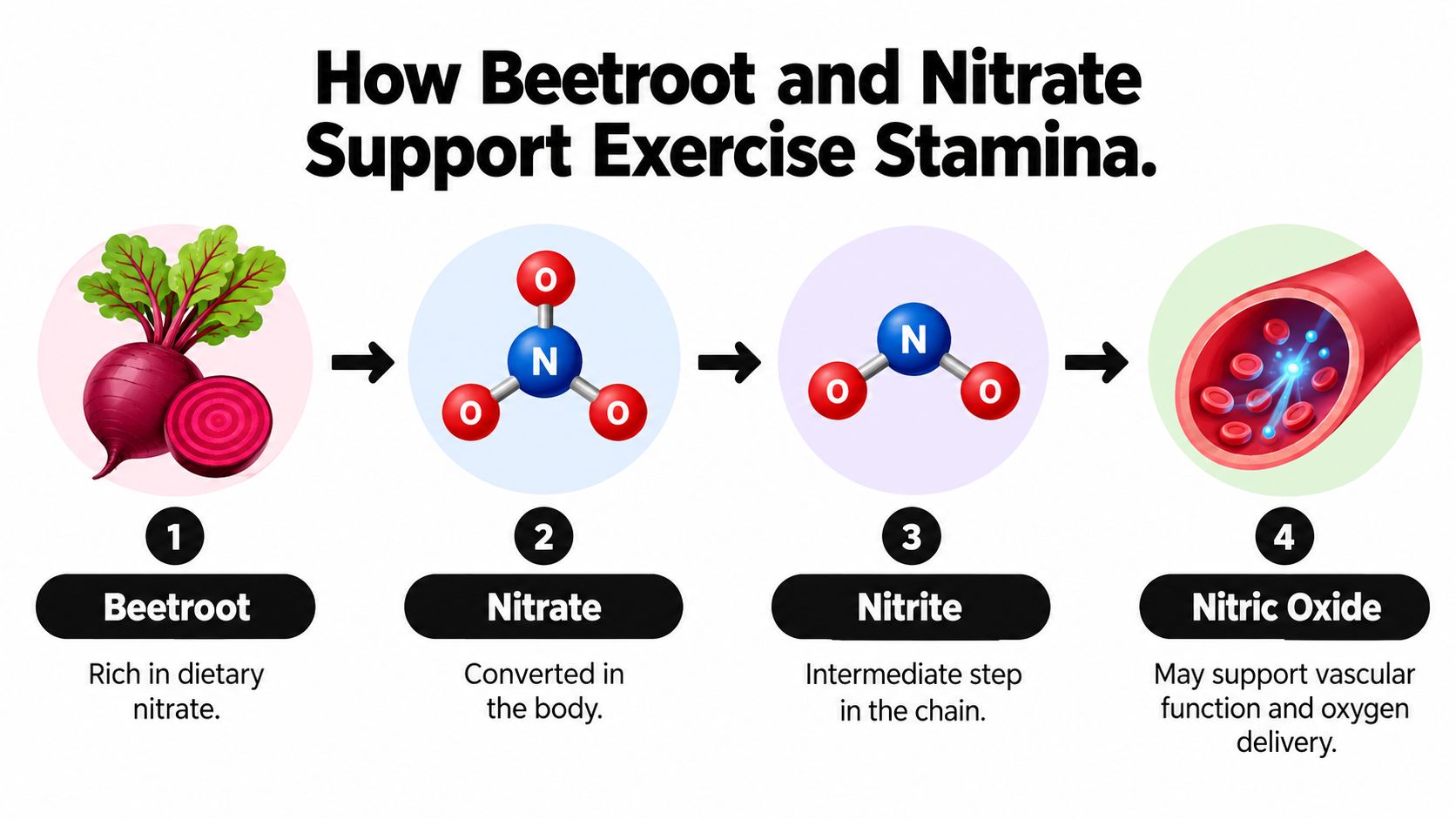
The pathway works like a delivery chain. You consume nitrate from beetroot, your body converts it to nitrite, and nitrite can then increase nitric oxide availability. Nitric oxide supports blood vessel function, which may improve how muscles receive and use oxygen during demanding work. Each link has to function for the chain to matter.
Why Results Depend on the Activity
The evidence supports cautious interest, not a blanket performance promise. The NIH Office of Dietary Supplements fact sheet on exercise and athletic performance reports that beetroot has improved endurance or time trial performance in some runners, swimmers, rowers, and cyclists, but findings are inconsistent, and in one controlled study, juice providing 6.5 mmol nitrate improved back squat muscular endurance at 65% of one repetition maximum, while the benefit was not observed during bench presses.
That contrast between squats and bench presses is the lesson. Larger muscle mass and higher oxygen demand in the squat may give the nitrate pathway more to work with. An ingredient can plausibly help one movement pattern and do nothing noticeable for another, which is very different from acting as a general performance enhancer.
If you want a visual walkthrough of how this pathway is usually explained to athletes, the video below covers the basics before you test anything yourself.
How to Evaluate It Honestly
- Ask for nitrate quantity: Beetroot powder weight alone tells you little, since nitrate concentration varies.
- Test with a repeatable protocol: Use the same workout, load, and rest periods so you can compare sessions fairly.
- Keep foundations first: Conditioning, carbohydrate availability, and hydration drive performance far more than any single ingredient.
Position beetroot as potential exercise support nutrition. Persistent exhaustion during training deserves medical evaluation, not a stronger pre workout stack.
Matching Herbs to Real Wellness Routines
The word energy hides at least five separate goals: perceived alertness, everyday fatigue, exercise endurance, recovery between sessions, and sexual vitality. A product studied for one rarely speaks to the others. That is why the useful question is not which herb is best, but which outcome you are trying to change. Three everyday situations show how that question reshuffles the same shelf of products.
Three Common Scenarios
The desk worker with everyday fatigue. She sleeps reasonably well but feels drained by mid afternoon and wants steadier perceived energy. For her, ginseng research on fatigue scores is at least aimed at the right outcome, provided she compares extract and dose carefully and treats any benefit as modest and uncertain. Beetroot nitrate research, built around exercise output, answers a question she is not asking.
The recreational lifter or runner. He trains consistently and wants to know whether nutrition can support endurance. Beetroot fits his question because its studies measure performance directly, even though results vary by activity. A repeatable test session tells him more than testimonials. If his real complaint is lingering soreness rather than output during the session, that is a different goal again, and neither fatigue questionnaires nor nitrate trials answer it cleanly.
The man focused on vitality. He cares less about workout metrics and more about overall vigor and intimate wellness. Multi ingredient men's formulas enter the conversation here, and label transparency matters most because blends can hide how much of each herb you are getting.
One goal, one product, one honest trial. That sequence beats stacking several hopes at once.
Single Ingredients Versus Blends
A researched single ingredient works like a recipe with one variable. You know the dose, you can match it against a published study, and if it disagrees with you the culprit is obvious. Blends trade that clarity for convenience and tradition based combinations, so per ingredient disclosure becomes the minimum standard to accept.
Two formats from the same catalog make the contrast concrete. A single ingredient product such as the Maca Power+ capsule compared earlier keeps the arithmetic simple: one botanical, one serving size, a label you can check against standalone research. Maxi Vir NexiHerb Herbal Dietary Supplement – Botanical Blend for Male Wellness & Vitality Support uses a different botanical extract combination and a different label schedule, so compare the two formats on disclosed amounts rather than assumed equivalence.
Labels like these let you do one more check. When a blend lists its components, ask whether each appears in an amount anywhere near what was studied on its own. A fraction of a researched dose inside a blend does not inherit the single ingredient trial results. Both formats are supplements intended to sit within a balanced diet and healthy lifestyle.
Convenience is a fair reason to choose a blend. Evidence for individual ingredients is not evidence for the finished formula.
Whichever scenario sounds closest to you, lifestyle remains the load bearing layer. Sleep, total food intake, hydration, and training load explain most day to day energy swings, so pick one defined outcome, give the chosen product a fair trial window, and track whether anything changed.
Choosing and Using Herbal Energy Supplements Safely
The most common assumption in this category is that natural means harmless. That assumption doesn't survive contact with concentrated extracts, prescription medicines, or multi ingredient energy stacks. Treating safety as part of the purchase decision, rather than a footnote, protects both your health and your wallet.
The regulatory context explains why. The U.S. National Center for Complementary and Integrative Health guidance on herb and drug interactions states that herbal supplements may cause drug interactions, direct toxicity, or contamination with active pharmaceutical ingredients, manufacturers generally do not have to prove safety or effectiveness before marketing a dietary supplement, and for most herbs evidence is insufficient to determine whether interactions are harmful or clinically insignificant.
That last point cuts both ways. Insufficient evidence isn't proof every herb is dangerous. It also isn't reassurance. It means you should screen your own situation instead of assuming.
A Decision Checklist Before You Buy
- Define one outcome: Alertness, everyday fatigue, endurance, recovery, or vitality. Reject products promising all five equally.
- Match the study to the bottle: Same ingredient form, similar dose, similar duration, similar population.
- Demand clear amounts: Prefer labels that disclose per ingredient quantities over vague proprietary totals.
- Respect the directions: Don't exceed label use, and don't stack several energy formulas at once.
- Screen for risk: Seek professional advice first if you take prescription medicines, are pregnant, face surgery, or have liver or kidney problems.
Disclose supplements during medication reviews, the same way you'd list any medicine. Ordinary culinary use of a plant is a very different exposure from a concentrated extract taken daily. If you're using powdered formats, the practical guidance on how to take herbal powders consistently and correctly can help you follow label directions accurately.
Brand level details like clear labeling, bundle options, secure payment, and shipping terms are reasonable shopping considerations. They say nothing about whether an herb will change your energy. Keep those categories separate in your head.
Finally, draw a firm line around persistent fatigue. If tiredness is new, worsening, or unexplained, get it evaluated rather than layering on a more complex stack. Supplements support routines. They don't diagnose why you're exhausted, and the most responsible use of any product in this category starts with knowing when the answer isn't a supplement at all.
If you're ready to put this outcome based approach into practice, browse the herbal blends, nitric oxide support formulas, and daily wellness staples at NexiHerb LLC, where clear labels help you match ingredients and amounts to the goal you've defined. Choose one priority, start with a product that fits it, and give your sleep, nutrition, and training the credit they deserve alongside it.