

Most buying advice on glucosamine resolves in one line. Sulfate works, hydrochloride doesn't, so read the front label and put the other bottle back. The pooled evidence does lean that way, and the numbers below show it. As a purchase rule, though, it's incomplete, and it walks you past the four variables that separate two products sitting inches apart on the same shelf.
The salt name is real. It changes molecular weight, glucosamine density, absorption behavior and the trial literature attached to it. What it doesn't do is travel alone. Dose, exposure across the day, product identity and label standardization explain much of the gap that gets credited to the word "sulfate."
That reframing changes what you look for. A shopper who buys by salt name chooses between two bottles. A shopper who buys by salt plus elemental glucosamine plus daily schedule plus quality documentation chooses the right one, and often at a lower cost per milligram of actual glucosamine.
Table of Contents
- Sulfate and Hydrochloride Side by Side
- How Absorption and Dosing Differ Between the Forms
- What the Clinical Trials Actually Show
- Why Direct Comparisons and Pooled Reviews Disagree
- How to Read a Glucosamine Label Correctly
- Choosing a Form by Your Situation
- Confirm the Form Before You Buy
Sulfate and Hydrochloride Side by Side
Glucosamine sulfate has the stronger, more consistent clinical record for knee osteoarthritis symptoms. Glucosamine hydrochloride has weaker support in pooled analyses of pain outcomes. That's the direct answer, and most articles stop there, which is a shame, because the same evidence base says the salt name alone won't tell you whether a specific bottle is worth its price.
The comparison below reflects both salts as they were studied, which is a narrower thing than the full range of products sold under each name.
| Feature | Glucosamine sulfate | Glucosamine hydrochloride |
|---|---|---|
| Salt form | Crystalline sulfate salt, commonly stabilized with sodium or potassium chloride | Hydrochloride salt; stabilizer content not stated in research |
| Glucosamine by weight | About 74% in the stabilized sulfate form | About 99% |
| Molecular weight | About 277.25 g/mol | About 215.63 g/mol |
| Most-studied daily dose | 1,500 mg once daily (prescription formulation) | 500 mg three times daily |
| Pooled evidence for pain | Standardized effect 0.58 (95% CI 0.30 to 0.87) | Effect -0.02 (95% CI -0.15 to 0.11), not significant |
| Direct comparison | Not significantly different from hydrochloride in a 2005 trial | Not significantly different from sulfate in a 2005 trial |
The two rows that change shopping behavior are the weight and molecular-weight rows. A label printing 1,500 mg of glucosamine sulfate is describing the weight of the salt, not the glucosamine inside it. At roughly 74 percent glucosamine by weight, that bottle carries about 1,110 mg of glucosamine. The same 1,500 mg printed for hydrochloride, at roughly 99 percent, carries close to the full figure. Sulfate is also the heavier molecule overall, which is why equal milligrams of the two salts were never equal amounts of the active compound.
Rule for the aisle: compare cost per gram of glucosamine, not cost per gram of salt. The two numbers can differ by a quarter of the label weight.
One caveat before the trial data. The sulfate column describes a stabilized crystalline material dosed once daily, the form used in most of the positive research. A generic sulfate powder with no assay or stabilizer statement is a different product wearing the same word. Do three things with any bottle: find the salt name next to the milligrams, convert that number to glucosamine content, then compare prices on the converted figure.
How Absorption and Dosing Differ Between the Forms
The two salts don't just differ on paper. They produce different concentration curves in the blood, and those curves explain why the research on each form settled into a different dosing rhythm.
A chart of what once-daily and three-times-daily dosing produce makes the point faster than a paragraph.
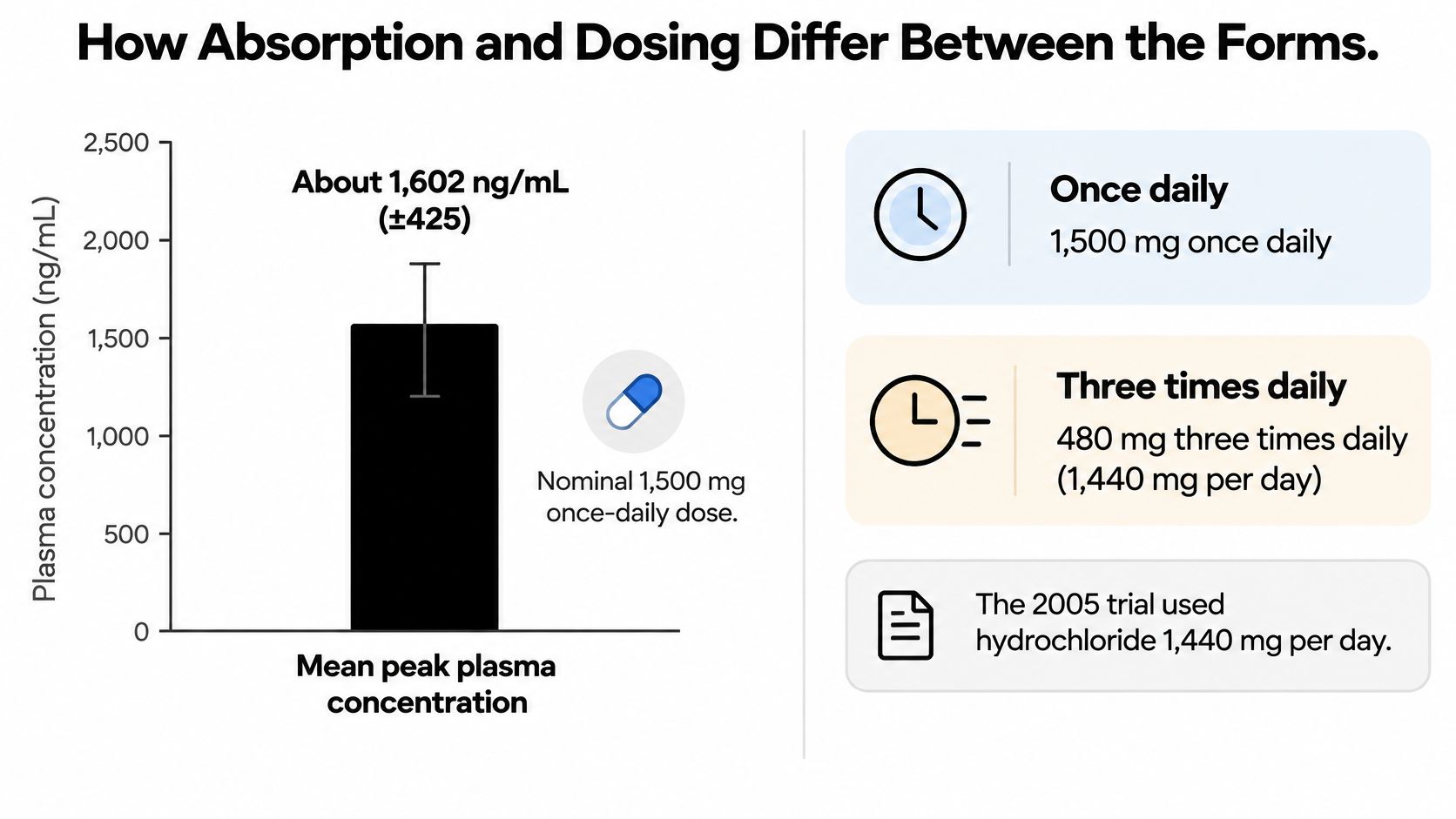
At a nominal 1,500 mg once-daily administration, a comparative technical table reports mean peak plasma concentrations of 1,602 ± 425 ng/mL for glucosamine sulfate against 492 ± 161 ng/mL for glucosamine hydrochloride, with reported half-lives of about 15 hours and 2.51 ± 1.84 hours respectively, as set out in the International Journal of Molecular Sciences salt comparison. Same nominal milligram figure, very different exposure.
What a 15-hour half-life does to a dosing schedule
A compound with a half-life near 15 hours still has meaningful amounts in circulation the following morning. One daily dose can hold a plateau without the concentration crashing between servings, which is why the sulfate trials were built around a single 1,500 mg dose.
A 2.5-hour half-life behaves differently. The curve rises and falls within a few hours, so a single large dose leaves long stretches of the day with little circulating. That's the logic behind dividing hydrochloride into three smaller servings, and it's why hydrochloride studies used that pattern rather than copying the once-daily sulfate design.
Why equal daily totals can produce unequal exposure
Set a 1,500 mg daily sulfate dose against the same span of milligrams split across three hydrochloride servings. On paper the daily totals look comparable. Under the curve they aren't, because peak height and time spent above a threshold are separate measures, and a schedule with three short peaks can deliver less total exposure than one sustained one.
A higher peak doesn't automatically translate into better joint outcomes, and no trial has been designed to prove that it does. What the pharmacokinetic figures do show is that the two dosing patterns are not interchangeable, so a null result from one can't be transferred to the other.
Benchmark, not specification: these figures come from specific formulations and study designs. Use them to compare products and to sanity-check a dose, not as a guarantee of what any bottle will do in your body.
What the Clinical Trials Actually Show
Start with the strongest summary. A 2012 peer-reviewed review pooled the randomized evidence and reported a standardized effect size for pain reduction of 0.58 for glucosamine sulfate, with a 95% confidence interval of 0.30 to 0.87. The same review put glucosamine hydrochloride at -0.02, with a 95% confidence interval of -0.15 to 0.11, which is statistically indistinguishable from no effect, and concluded that hydrochloride could not be recommended on the evidence available then, as documented in the 2012 review of the glucosamine trial literature.
Then look at the trial that anchors the sulfate case. In a 2007 randomized, double-blind study, 318 people with knee osteoarthritis were assigned to prescription glucosamine sulfate at 1,500 mg once daily, acetaminophen at 3,000 mg daily, or placebo for 6 months. The sulfate group's Lequesne index fell 3.1 points against 1.9 points for placebo, a between-group difference of -1.2 points (95% CI -2.3 to -0.8, P=0.032), per the same review.
| Study | Form and dose | Duration | Key result |
|---|---|---|---|
| 2012 systematic review of 19 RCTs | Sulfate and hydrochloride, various doses | Pooled across trials | Sulfate pain effect 0.58; hydrochloride -0.02, not significant |
| 2005 multicenter RCT, 142 patients | Hydrochloride 1,440 mg/day vs sulfate 1,500 mg/day | 4 weeks plus 2-week assessment | No significant difference in Lequesne score or safety |
| 2007 randomized double-blind trial, 318 patients | Prescription sulfate 1,500 mg once daily vs acetaminophen 3,000 mg vs placebo | 6 months | Lequesne index fell 3.1 points vs 1.9 for placebo (difference -1.2, P=0.032) |
| Large U.S. trial of hydrochloride | Hydrochloride 500 mg three times daily | Two years | No significant difference in joint-space width vs placebo |
What each row can and cannot prove
Each row belongs to one product at one dose over one time frame. The 2007 trial tested a prescription crystalline sulfate, so its result is evidence about that material rather than about every capsule carrying the word sulfate. The hydrochloride rows tested specific regimens too, and the two-year imaging study measured joint-space width, not how a knee feels on a Tuesday morning.
What the rows cannot do is settle your individual case. A small average benefit across hundreds of people is compatible with you noticing nothing, and a null average is compatible with someone else responding. The honest reading is that formulation-level evidence is stronger for one salt and that individual response remains unpredictable either way.
If daily comfort is the goal while you work out which formulation suits you, practical guidance on relief for stiff, achy joints is a sensible companion to the trial data rather than a replacement for it. It also helps to know whether joint support supplements work in the first place, because expectation management is half of reading this literature.
Why Direct Comparisons and Pooled Reviews Disagree
Clinical review is mostly a desk activity, and the disagreement between the two literatures shows why the desk needs the clinic.

The head-to-head evidence reads differently from the pooled evidence. A 2005 multicenter randomized trial enrolled 142 patients with knee osteoarthritis and compared the two salts directly, giving hydrochloride at 1,440 mg per day as 480 mg three times daily or sulfate at 1,500 mg per day as 500 mg three times daily for 4 weeks, followed by a two-week assessment. The investigators found no statistically significant difference in Lequesne score reduction between groups (P greater than 0.05) and no significant safety difference, concluding the two were similarly effective over that short follow-up, according to the published 2005 head-to-head trial.
That sits awkwardly against a pooled review favoring one salt. Both can be right.
Three reasons a null result and a positive review can coexist
Dose and formulation quality. A head-to-head comparison tests the specific products in the bottles, stabilizers and all. If one arm uses a well-standardized crystalline material and the other a differently manufactured powder, the trial is measuring manufacturing as much as chemistry.
Treatment length. Four weeks is a short window for a joint. The sulfate trial that produced a placebo-adjusted benefit ran six months with more than twice the participants. Slow, modest effects need time to separate from noise.
Study size and outcome measure. A 142-patient trial has limited power to detect a small difference, and it can only detect what its chosen score captures. A pooled analysis of 19 trials aggregates thousands of people across many instruments, which raises sensitivity and also mixes products together.
A null trial is not proof of equivalence, and a positive pooled review is not proof that every sulfate product works. Both statements survive the data.
For labeling, the defensible line is narrower than "sulfate wins." Sulfate, particularly the studied 1,500 mg once-daily prescription formulation, has stronger and more consistent clinical support. Hydrochloride has some positive direct-comparison data and weaker overall evidence. That's a ranking of evidence quality, not a guarantee attached to a word on a bottle.
How to Read a Glucosamine Label Correctly
Labels are where chemistry turns into marketing, and the corrections are mechanical once you know the order to do them in.
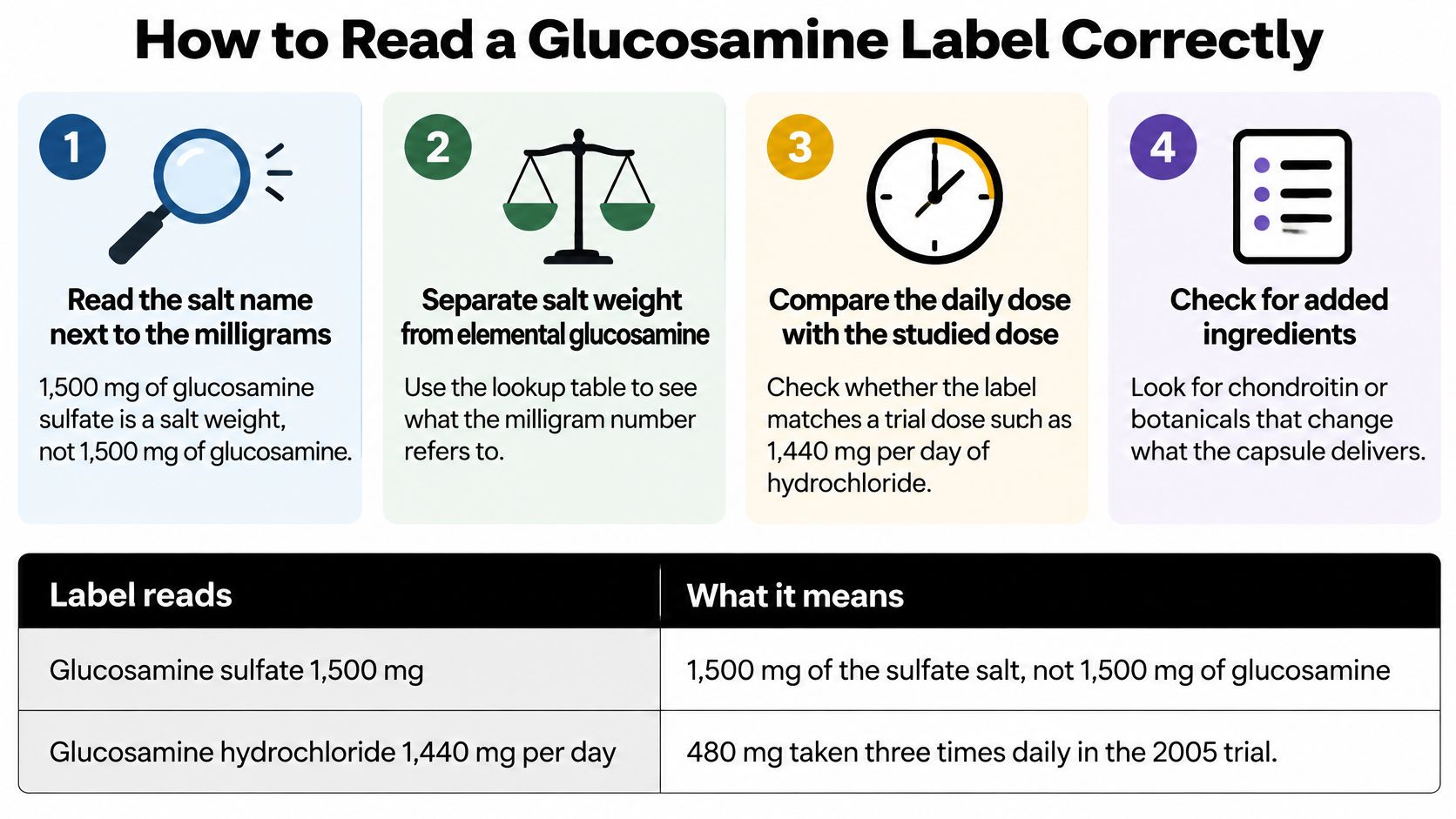
Four checks, in order
- Read the salt name next to the milligrams. A label saying 1,500 mg of glucosamine sulfate is describing a salt weight. Without knowing the elemental content, you don't know the dose. This single habit corrects most of the confusion in this category.
- Multiply out the serving size. Three capsules per serving means the printed milligram figure applies to three capsules, not one. The doses that mattered in research are daily amounts, so compare your total daily intake to 1,500 mg once daily or 1,440 mg per day, not to a single capsule.
- Check what else is in the capsule. Chondroitin, MSM and botanical extracts turn a single-ingredient product into a combination with its own literature and its own dilution of the glucosamine dose. Neither approach is wrong. They answer different questions.
- Look for stabilizer and quality statements. Stabilized sulfate is a mixture, so the stabilizer belongs on the label. An assay figure or a stated quality standard tells you the manufacturer is measuring something. Our own NexiHerb dietary supplements are not approved by the FDA, but they are manufactured in facilities that follow quality standards, which is the kind of statement worth looking for in any brand.
| Label line | What it usually means | What to verify |
|---|---|---|
| Glucosamine sulfate 1,500 mg | Salt weight, not elemental glucosamine | Glucosamine content or the elemental equivalent |
| Glucosamine HCl 1,500 mg | Salt weight; hydrochloride contains more glucosamine per milligram | Whether the dose matches the studied 500 mg three-times-daily regimen |
| Serving size, e.g. 3 capsules | Daily amount depends on how many servings are taken | Total daily milligrams of the named salt |
| Chondroitin or MSM added | Combination product with its own evidence | Whether the glucosamine dose alone matches a studied dose |
| Potassium or sulfate potassium named | Stabilized salt form | Whether a stabilizer or assay is stated |
| Shellfish-free or gelatin statement | Ingredient source, not a benefit claim | Allergy status and capsule ingredients |
The unresolved question deserves naming. Much of the favorable pooled signal comes from trials of a prescription-grade crystalline sulfate, while sulfate trials overall were heterogeneous and hydrochloride trials were more consistent. Differences in crystalline stabilization, dose, trial sponsorship and formulation may all contribute to the observed gap, which is why the practical benchmark for any label is to specify the exact salt and the standardized daily amount rather than describing the product as plain "glucosamine," as the systematic review of 19 randomized trials notes. If you want a broader method for parsing supplement panels, this guide to how to read supplement labels walks through the rest of the panel.
Choosing a Form by Your Situation
Five reader profiles cover most of the decisions, and none of them is settled by the salt name alone.
You want the most-studied form. Look for a crystalline sulfate with a stated daily amount and some proof of identity. One detail rarely mentioned in the sulfate versus hydrochloride debate is that the best-known pharmacokinetic comparison used crystalline sulfate at 1,500 mg once daily against hydrochloride at 500 mg three times daily, and the hydrochloride regimen produced about 75% lower overall bioavailability and 50% lower peak plasma concentrations, which makes the salt hard to separate from formulation, timing and standardization, as the pharmacokinetic comparison indexed in PubMed sets out. Whether an ordinary sulfate powder matches the studied crystalline material is still unanswered.
You take warfarin. Have the medication reviewed before you buy anything. The reported interaction concern matters more than which salt you pick, and it belongs in a conversation with the clinician managing your anticoagulation.
You have a shellfish allergy. Check the source statement and the capsule ingredients. A shellfish-free claim describes where the glucosamine came from, not what it will do for you.
You have chronic liver disease. Get clinical advice first. Caution is advised in that group, and no label can make that decision for you.
You're shopping on price. Compare cost per milligram of actual glucosamine after converting the salt weight. A cheaper bottle of a heavier salt can cost more per milligram of the compound you're after.
The differentiator: choosing sulfate over hydrochloride is not the whole decision. Matching product identity, daily dose and your own health profile is.
If you're stacking ingredients, it's worth understanding how glucosamine, hyaluronic acid, chondroitin and MSM are combined before paying for a multi-ingredient formula. Readers managing long-term joint stiffness, or supporting an older parent, may also find osteopathic guidance for older adults' arthritis useful for the movement side of the equation.
Confirm the Form Before You Buy
The decision that matters isn't which salt wins. It's whether either form helps you enough to justify the shelf space, and how you'll know.
A large U.S. trial found that glucosamine hydrochloride at 500 mg three times daily did not significantly reduce knee pain in the overall symptomatic osteoarthritis population, while reviews describe the broader evidence as inconclusive or low quality, as summarized in the Merck Manual's professional entry on glucosamine. A negative hydrochloride trial shouldn't be generalized to every sulfate formulation, since exposure differs. What it should do is lower your confidence in a quick fix.
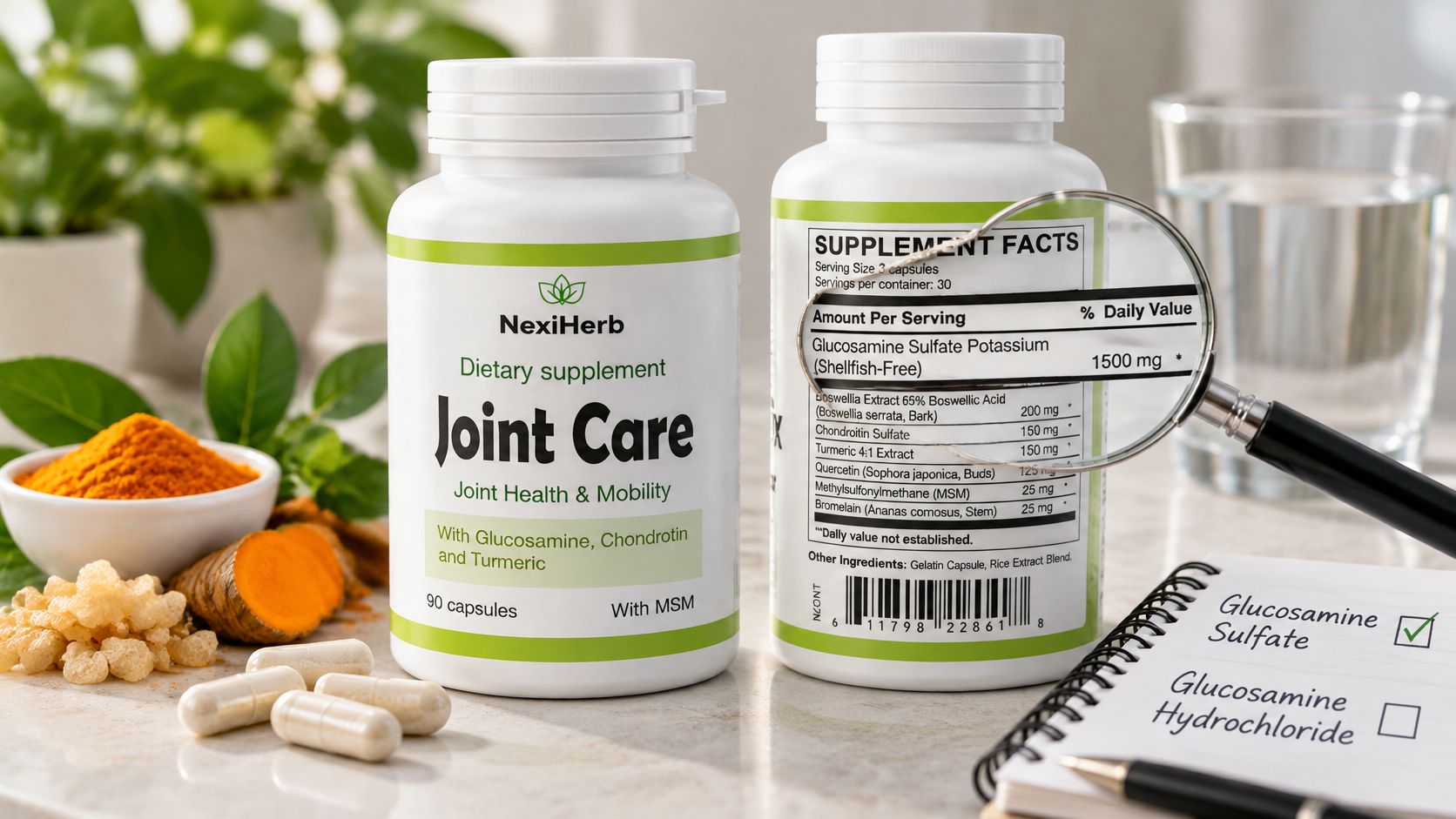
Four checks before you commit.
- Confirm the salt and the daily total: name the salt, then multiply the serving size out to a full day.
- Convert to glucosamine: do the content arithmetic so you're comparing like with like across brands.
- Review medications and conditions: warfarin, liver disease, shellfish allergy and pregnancy all change the conversation.
- Set a review date: decide in advance how long you'll try it and what would count as a reason to stop. Some people notice nothing even with a well-chosen product, and a planned stopping point makes that a decision rather than a slow drift.
Our Joint Care Complex is a glucosamine and chondroitin complex that lists glucosamine sulfate potassium at 1,500 mg per three-capsule serving alongside chondroitin sulfate, MSM, boswellia, turmeric, quercetin, L-methionine and bromelain, priced at $24.99. Run it through the checklist above, including the three-capsule serving arithmetic, and judge it on the same terms as everything else on the shelf.
NexiHerb LLC builds dietary supplements around plainly labeled ingredients and doses you can check against published research, and this joint formula is a good example of how we approach it. If you want to compare the salt, the daily amount and the supporting ingredients for yourself, the full panel and product details are on our site. Visit NexiHerb LLC to see the joint care range and the rest of the catalog, including free U.S. shipping on orders over $49.