

Drink spearmint tea twice daily to balance hormones and reduce facial hair. That popular advice skips the most important distinction: changing a hormone measurement isn't the same as improving a visible symptom. It also turns a short research protocol into a daily prescription that hasn't been validated for everyone.
The health benefits of spearmint tea deserve a narrower, more useful explanation. There's a preliminary human signal for androgen-related hormone changes, laboratory evidence of antioxidant activity, and much less certainty behind claims about digestion, concentration, blood sugar, or weight. Your reason for drinking it should determine how much those findings matter.
Table of Contents
- Spearmint Tea Benefits Ranked by Evidence Strength
- What the 30-Day Hormone Trial Measured and Found
- Antioxidant Compounds in Spearmint Tea
- Digestive Comfort and Everyday Use Cases
- How to Brew and Drink Spearmint Tea
- Side Effects, Interactions and Who Should Check First
- Decide Whether Spearmint Tea Fits Your Routine
Spearmint Tea Benefits Ranked by Evidence Strength
Spearmint tea is a caffeine-free, low-calorie beverage with a narrow, mostly preliminary evidence base. Its strongest clinical finding concerns hormone measurements in a specific population, which is a much smaller claim than broad health improvement.
Each evidence category answers a different question. A randomized trial can test whether drinking the tea changes an outcome compared with a control. A laboratory assay can show that compounds in the infusion react with free radicals, while falling short of proving that drinking it prevents illness.
Evidence strength by spearmint tea benefit area
| Benefit area | Evidence level | Study type behind it | Main gap |
|---|---|---|---|
| Androgen-related hormone effects | Preliminary | A short randomized trial in women with hirsutism | Hair-growth score didn't change significantly during the trial |
| Antioxidant activity | Laboratory only | Infusion chemistry and in-vitro radical-scavenging assays | No proof of lower oxidative stress or disease risk in people |
| Digestive comfort | Traditional use | Traditional use and broader mint research | Few trials on spearmint tea itself |
What the ranking means for your decision
The hormone finding deserves attention because investigators tested the beverage people drink, rather than an isolated extract. Even so, a measured endocrine effect in one selected group over a short period is a narrow result, and describing spearmint as a general hormone-balancing remedy overstates what that design can show.
Antioxidant activity answers a different question: what can the infusion do under laboratory conditions? That chemistry is real and measurable, yet it sits several steps removed from a patient-relevant outcome like lower disease risk.
Digestive comfort sits in the weakest tier of the three. The support comes from traditional use and broader mint research, and product form matters here: mint aroma, essential oil, concentrated extract, and brewed spearmint tea are different interventions, so a positive result for one does not establish a benefit for another.
Treat spearmint tea as a modest addition to your routine. Match each claimed benefit to the outcome investigators actually measured.
What the 30-Day Hormone Trial Measured and Found
The most relevant human evidence comes from a two-center randomized controlled trial involving 42 women with hirsutism, comparing spearmint tea twice daily for 30 days with a placebo herbal tea; free and total testosterone fell, LH and FSH rose, with p < 0.05, while the objective hair-growth score showed no significant between-group difference, p = 0.12.
Hirsutism refers to excess hair growth in an androgen-associated pattern. That participant selection shapes what the results can claim: the trial measured women with a defined symptom, so its findings apply most directly to people in that situation.
The study's design and outcomes are summarized visually below.
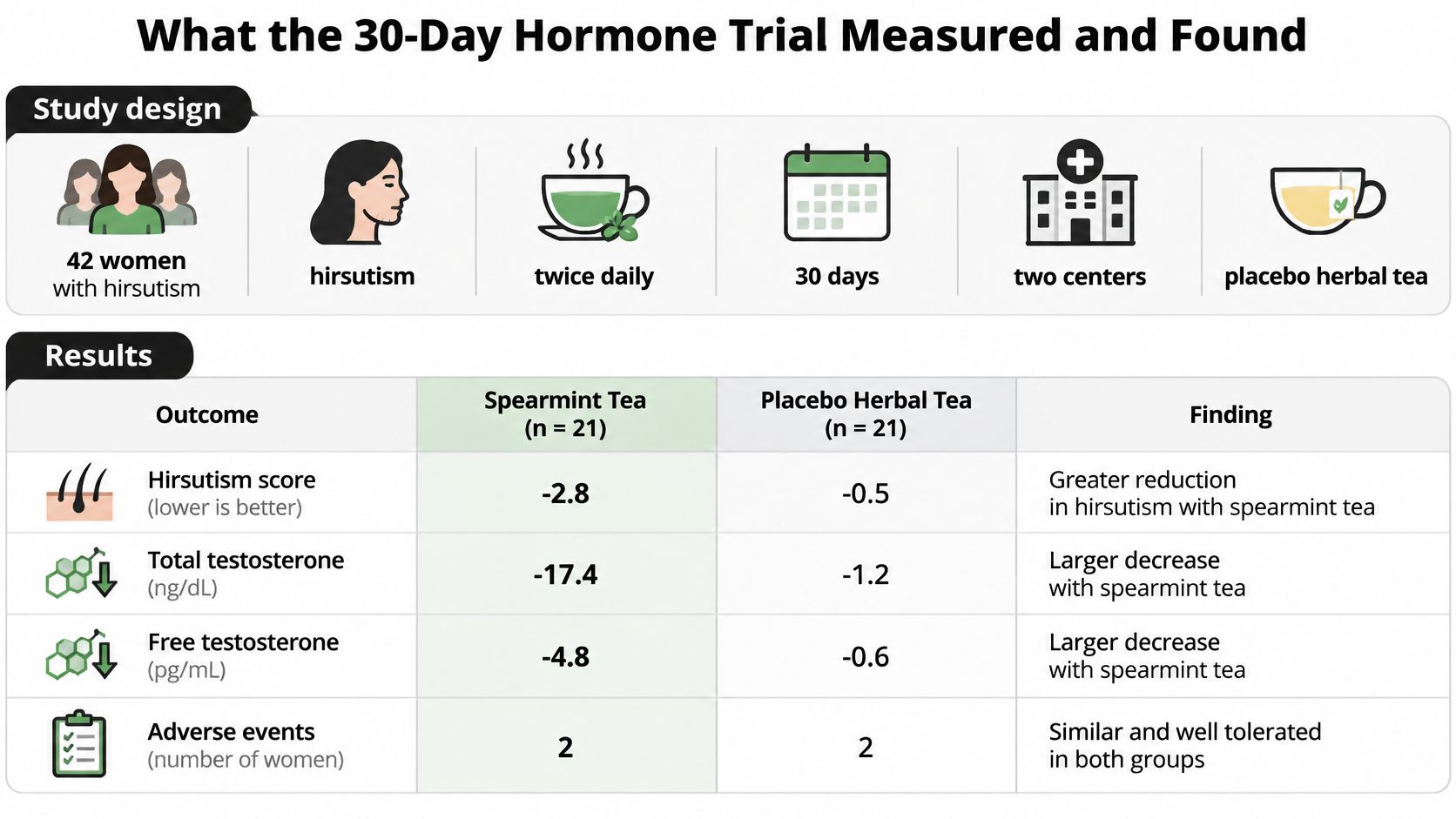
Hormone measurements versus hair growth
| Outcome | Finding | What it supports |
|---|---|---|
| Free testosterone | Significantly reduced | A short-term effect on circulating hormone measurements |
| Total testosterone | Significantly reduced | An endocrine signal beyond free testosterone alone |
| Luteinizing hormone, or LH | Significantly increased | A measurable rise in a signaling hormone, with ovulation left unmeasured |
| Follicle-stimulating hormone, or FSH | Significantly increased | A measurable rise in a signaling hormone, with fertility outcomes untested |
| Objective Ferriman–Gallwey hirsutism score | No significant difference between groups | No demonstrated visible hair-growth benefit during the study |
A p-value reports reliability, not size or visibility of the change. The trial also leaves open whether the effect persists after someone stops drinking the tea.
Hair follicles grow and turn over relatively slowly, so hormonal changes could precede visible changes. Thirty days may be too short a window for a hair-growth score to register an endocrine shift. That explanation is a reason to run longer trials before claiming any visible benefit.
What the trial doesn't establish
The findings fall short of treatment-level efficacy for polycystic ovary syndrome, or PCOS, or hirsutism. Rising LH or FSH carries no automatic benefit either: a hormone's clinical meaning depends on the person's symptoms and medical context.
If you're comparing drinks while managing PCOS, DietOwl's guide to tea choices for PCOS offers additional context for beverage decisions. Keep those decisions separate from evaluating or treating the condition itself.
Likewise, a discussion of pituitary gland supplements gives no reason to turn changes in LH and FSH into self-prescribed hormone targeting. A laboratory result calls for interpretation by a clinician who knows your history.
Verdict: spearmint tea may be an adjunct worth discussing with a clinician for androgen-related symptoms. Diagnosis, prescribed treatment, and an objective assessment of whether symptoms improve still belong to medical care.
Antioxidant Compounds in Spearmint Tea
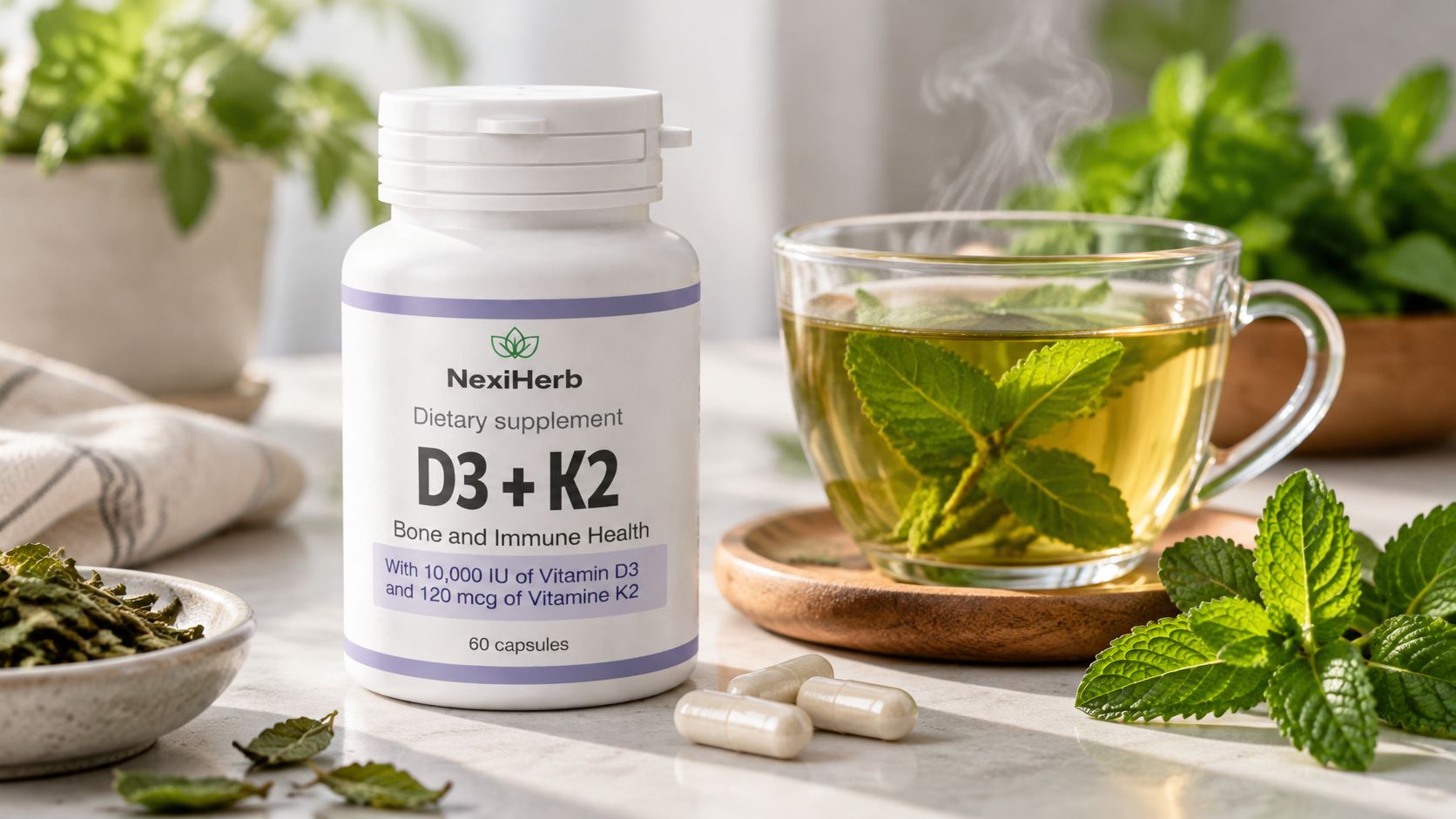
Two measurements set the boundary for this topic. An infusion analysis indexed by FAO AGRIS reported rosmarinic-acid concentrations of approximately 101–169 micrograms per milliliter and radical-scavenging EC50 values of 152–336 micrograms per milliliter, with antioxidant capacity differing by harvest lot and phenolic content.
Spearmint contains phenolic compounds, plant chemicals that can donate electrons and neutralize free radicals in laboratory tests. Rosmarinic acid was the predominant phenolic constituent in the analyzed infusions, which makes it the marker to watch when comparing one lot or brew with another.
What the assay measured
EC50 is the concentration needed to reach half-maximal activity in that assay. It describes potency in a test system, not a drinking dose and not protection inside your body.
A cup therefore offers a measured amount of antioxidant chemistry. Human benefit would require studies that track oxidative-stress biomarkers or clinical outcomes in people drinking the tea.
For background on that distinction, our explanation of antioxidants and free radicals separates the underlying chemistry from broader health claims.
Why every cup isn't chemically identical
- Cultivar and harvest conditions: Different raw materials needn't have the same composition.
- Drying and storage: Processing affects the material you eventually brew.
- Steeping time and serving strength: Different preparations don't necessarily deliver comparable concentrations.
Those variables explain why the same tea can perform well in one assay and weaker in another. The strongest reading is narrow: spearmint infusions can contain measurable phenolic antioxidant activity, while claims about lower disease risk remain unsupported without human outcome data.
Digestive Comfort and Everyday Use Cases
No controlled trial has tested brewed spearmint tea as a treatment for bloating or indigestion. Centuries of traditional use explain why people reach for mint after a meal, and the habit is reasonable enough. What tradition cannot measure is how reliably the infusion changes a specific symptom.
Some drinkers describe spearmint as gentler on the stomach than peppermint, an observation drawn from personal reports rather than a comparative trial.
Everyday situations worth distinguishing
| Situation | A practical approach | What not to conclude |
|---|---|---|
| After a heavy meal | Sip a warm, rather than scalding, cup if you enjoy it | Feeling comfortable afterward doesn't prove a specific digestive action |
| An evening coffee habit | Choose plain, unsweetened spearmint if you want a caffeine-free alternative | A caffeine-free drink isn't automatically a sleep treatment |
| An occasional bloating spell | Record what you ate, when symptoms started, and how you felt after drinking it | Improvement alone can't identify what caused the bloating |
A diary tells you more than changing teas, meals, and supplements at the same time. Record the circumstances alongside the symptom. Otherwise you may credit the drink for an improvement caused by something you ate, or by the bloating passing on its own.
Mint can worsen heartburn for some people with acid reflux. If your symptoms get worse after drinking it, a label describing digestive support is not a reason to continue.
Keep broader wellness claims separate
The cognitive and mood entries in the evidence ranking rest on small, short studies of mint aroma. Smelling mint is a different exposure from drinking spearmint tea, so those results do not transfer to the cup.
A package that describes digestive support is reporting a marketing position, not a measured trial outcome. Readers weighing the tea against capsules or botanical blends can find wider context in our guide to plant-based supplements for gut health; what another mint preparation or herbal formula claims on its label does not establish what this beverage does.
Practical rule: judge the tea first as a drink you enjoy and tolerate. Temporary comfort is not evidence of treatment, and persistent digestive symptoms deserve evaluation rather than another cup.
The defensible benefits here are modest: a pleasant, caffeine-free, low-calorie habit when served unsweetened. Any digestive effect beyond that remains unproven.
How to Brew and Drink Spearmint Tea
| Tea form | Amount per cup | Steep time | Notes |
|---|---|---|---|
| Dried cut leaves | A measured spoonful, adjusted for taste | Follow the product's brewing guidance | Easier to prepare consistently |
| Fresh leaves | A small handful, gently bruised | Taste during brewing and strain when pleasantly minty | Leaf size makes strength harder to reproduce |
| Tea bag | A bag intended for an individual cup | Use the package's stated infusion time | Check that the ingredient list names spearmint |
| Amount used in the research | A twice-daily drinking pattern | Short study protocols, not indefinite use | Not a validated universal dose |
Brewing strength is a flavor decision, not an established therapeutic dose. The same cup size can contain different amounts of plant material, and longer steeping doesn't establish greater clinical benefit.
This visual guide outlines the brewing process.
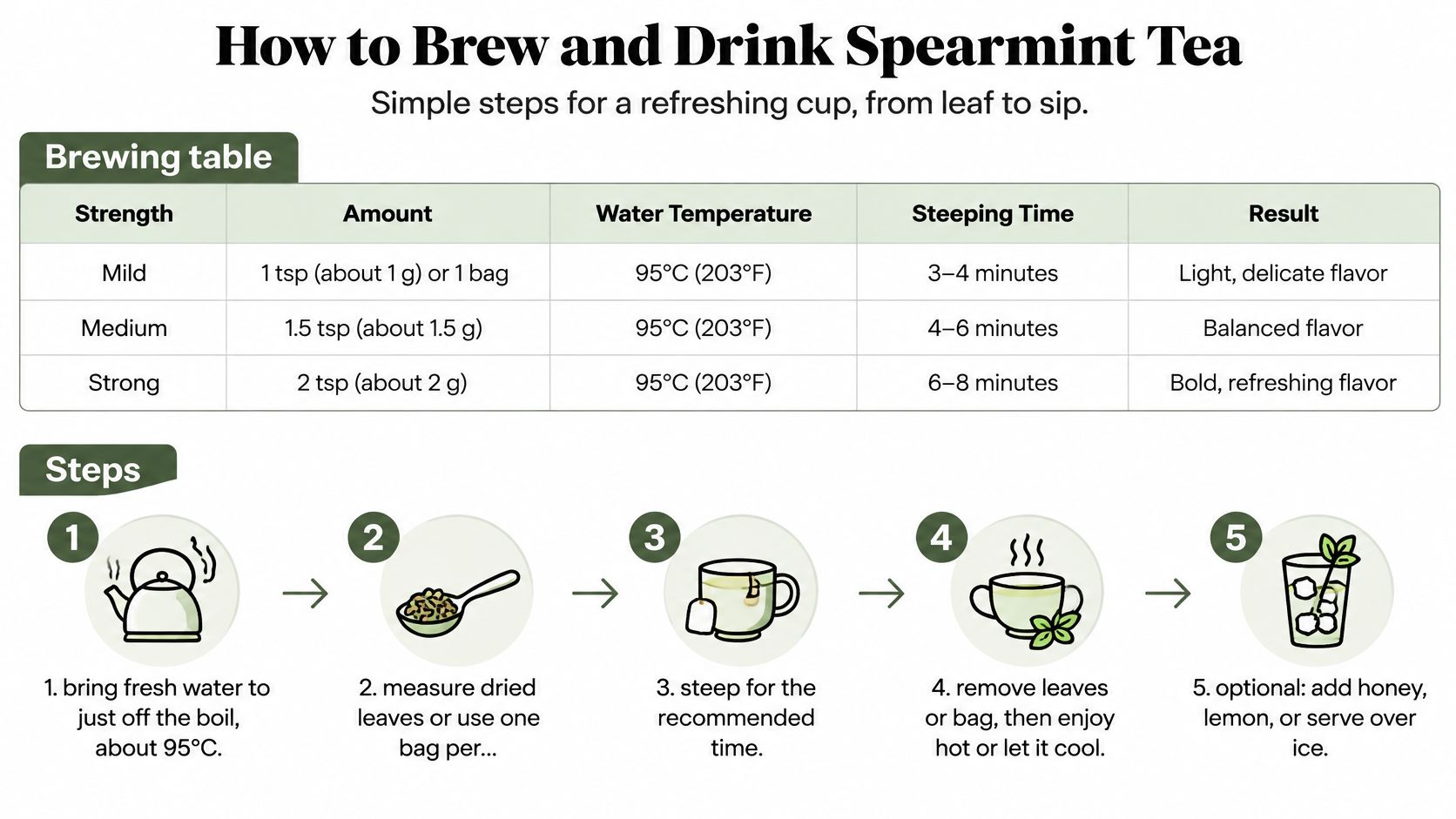
A repeatable brewing method
- Heat fresh water. Bring it just off the boil, then pour carefully into a heat-safe cup or teapot.
- Measure the leaves. Use the same spoon and cup each time if you want a consistent preparation.
- Cover the infusion. A lid helps retain the mint's aromatic character while the leaves steep.
- Taste before strengthening. Let the tea infuse according to its package guidance, then adjust future cups for flavor rather than presumed medicinal potency.
- Strain and cool slightly. Drink it comfortably warm, or allow it to cool before chilling.
Dried leaves are easier to measure consistently. Fresh leaves can offer a fuller mint flavor, but a handful isn't a standardized weight, and tightly packed leaves produce a different preparation from loosely gathered ones.
Make consistency the default
Start with an occasional modest cup rather than immediately adopting a research schedule. If you decide to drink it regularly, assess tolerability and check the safety considerations before increasing the amount.
Don't increase strength because a symptom hasn't improved. Without an established dose-response relationship, stronger tea is a different exposure, not a proven better treatment.
For a brewing demonstration, the video below offers a visual reference.
Check that the ingredient list names spearmint or Mentha spicata, particularly when buying mixed-mint products. Skip sugar if your aim is an unsweetened everyday drink, and keep dried leaves tightly sealed away from light and moisture.
Side Effects, Interactions and Who Should Check First
The review discussing spearmint's endocrine studies reports no adverse effects during the short observation periods and describes an earlier study in which twice-daily consumption for five days reduced free testosterone by about 30%, without significant changes in total testosterone or DHEA-S.
Those findings provide limited reassurance about short-term tolerability, not proof of safety during prolonged or high-dose use. The earlier study was also too short to meaningfully assess hair-growth outcomes.
Natural doesn't mean pharmacologically inactive. A beverage associated with measurable endocrine changes deserves a more careful review when someone is pregnant, receiving fertility treatment, or taking hormone-sensitive medication.
Who should talk to a clinician first
| Situation | Why it matters | Suggested action |
|---|---|---|
| PCOS symptoms or unexplained excess hair | The main human findings concern hormone measurements | Obtain clinician review before regular use |
| Pregnancy or breastfeeding | Safety and hormonal effects haven't been established in these groups | Ask a clinician before use |
| Contraceptives, fertility medication, or anti-androgen drugs | Potential relevance to hormone-sensitive treatment needs assessment | Request a medication review before daily use |
| Menstrual changes | Symptoms may need evaluation rather than self-treatment | Arrange clinician review first |
| Healthy adult with none of the above | Short studies can't establish safety for every individual | Use modest beverage amounts and monitor tolerance |
Potential interactions aren't confirmed interactions
The reason to review contraceptives, fertility medications, and anti-androgen drugs is caution, not evidence that spearmint tea has a proven interaction with each medicine. Uncertainty should prompt assessment, not an invented interaction warning or a blanket assurance of safety.
Tell your clinician or pharmacist the product name, whether it's pure spearmint or a blend, how strongly you brew it, and how often you drink it. Include herbal capsules and other supplements in that conversation rather than treating beverages as irrelevant to the medication list.
Several practical questions remain unresolved: whether preparation strength changes endocrine effects, whether continuous use is appropriate, and how those effects behave during pregnancy or breastfeeding. The studies don't establish a universal safe upper intake.
A short trial without reported adverse effects can't establish long-term safety for populations the trial didn't adequately study.
If you have unexplained excess hair or menstrual changes, seek evaluation rather than using tea to test whether you have a hormone disorder. If unusual symptoms begin after starting it, stop and seek advice; don't increase the amount in pursuit of a stronger effect.
Decide Whether Spearmint Tea Fits Your Routine
Spearmint tea works best as a deliberate choice. Enjoyment, an unsweetened option, and a caffeine-free evening drink are straightforward goals. A persistent hormone-related symptom calls for a different decision.
Three different things get blurred in most coverage of this tea: a lab value that shifted in a small trial, a symptom you can see or feel, and the result a product page promises. This checklist separates a beverage choice from a medical question.
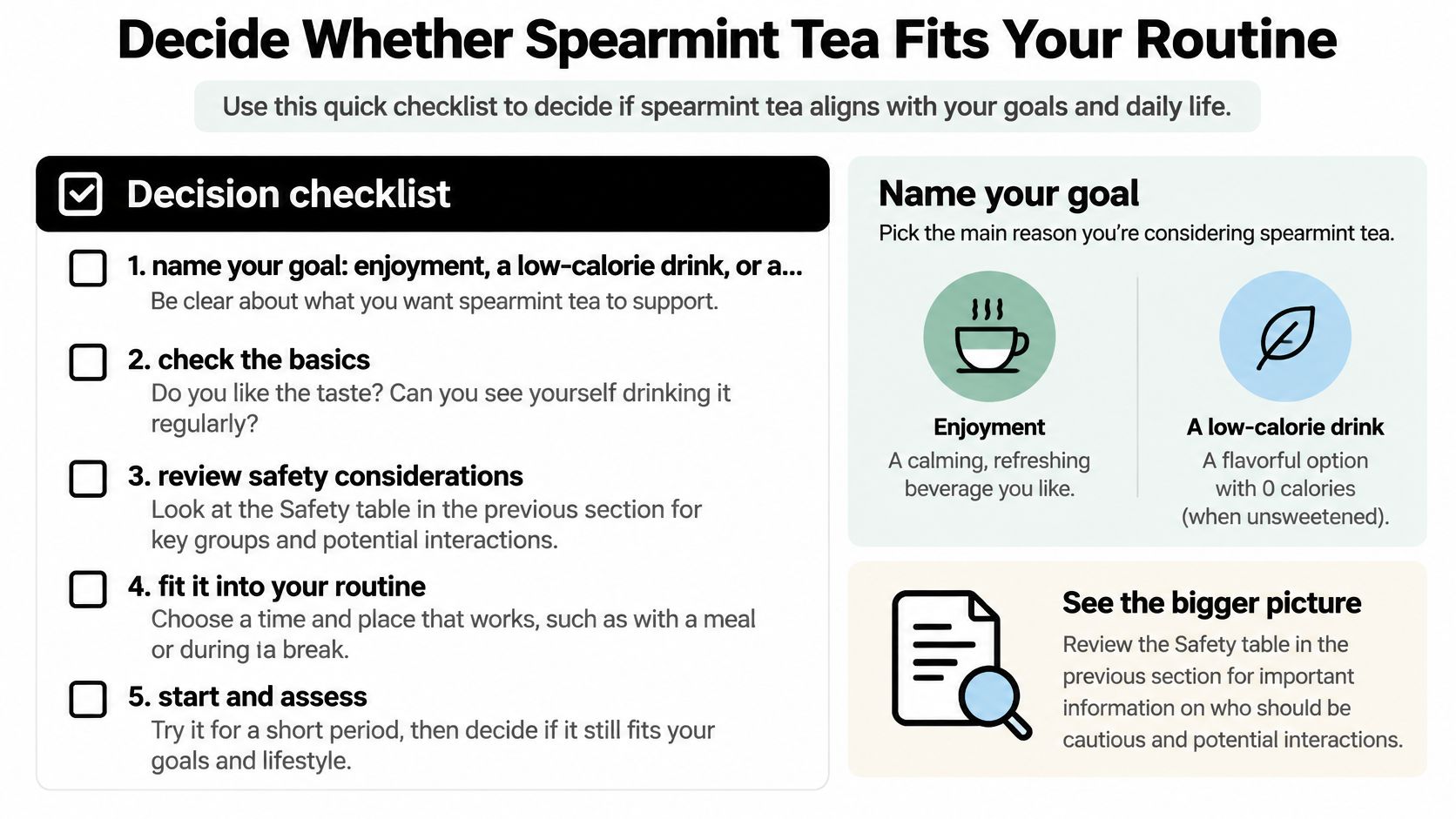
A practical decision checklist
- Name your goal. Decide whether you want flavor, an unsweetened drink, or help with a symptom.
- Check the safety table. Seek clinician review if a caution applies, especially with hormone-sensitive treatment.
- Pick a trial window. Brew the same strength for a set stretch, such as a few weeks, so any change you notice has a steady baseline for comparison.
- Keep a simple log. Note preparation, digestion, and sleep each night, plus any new symptoms. A one-line nightly entry records patterns without diagnosing anything.
- Set the clinician line. Persistent hormone-related symptoms deserve assessment, whether or not you enjoy the tea.
Consider someone with irregular cycles and facial hair: the appropriate first step is a clinical review, and brewing a stronger infusion changes nothing about that. Someone without those concerns who wants a caffeine-free after-dinner drink can decide on taste and tolerance alone.
The verdict is modest: spearmint tea earns a place in your routine when you enjoy it and tolerate it well.
NexiHerb LLC offers dietary supplements and practical nutrition guides intended to complement a varied diet and healthy lifestyle. Visit NexiHerb LLC to explore clearly labeled options and educational resources, and discuss any supplement you're considering with a healthcare professional if you take medication or have a medical condition.