

If a packet says red maca, what does the colour tell you about what's inside? Less than many shoppers assume. It identifies a variety, but it doesn't tell you how the crop was dried, whether the powder matches its label, or whether anyone tested the finished batch.
If you've searched for maca root powder red, you're probably looking for a practical answer about benefits, dosage, and safety. The useful starting point isn't a colour ranking. It's learning to distinguish a food powder from an extract, a promising human finding from a product promise, and a meaningful laboratory report from attractive packaging.
Table of Contents
- Red Maca Root Powder and Its Active Compounds
- What the Human Evidence Shows
- Dosage and Timing for Red Maca Powder
- Side Effects, Interactions and Who Should Avoid It
- How to Choose High-Quality Red Maca Powder
- Simple Ways to Use Red Maca Powder
- Store Red Maca Powder and Start a Safe Routine
- Frequently Asked Questions About Red Maca Powder
Red Maca Root Powder and Its Active Compounds
Red maca is a colour variety of Lepidium meyenii, not a separate species. Ordinary red maca root powder is the dried, ground edible root structure, rather than an isolated active ingredient.
The review of maca's ethnobiology and ethnopharmacology describes a Peruvian highland crop cultivated for more than 2,000 years, growing primarily in the central Andes at approximately 4,000 to 4,500 metres. Intense sunlight, cold conditions, and the high-altitude agricultural environment are part of its background. They aren't, by themselves, proof that a particular retail powder is potent or well made.
Red, yellow and black maca compared
The comparison below separates what's known about the varieties from what remains unestablished. Trial inclusion means a variety was tested, not that every product carrying that colour has demonstrated benefits.
| Feature | Red maca | Yellow maca | Black maca |
|---|---|---|---|
| Growing area | Central Peruvian Andes | Central Peruvian Andes | Central Peruvian Andes |
| Included in the human trial discussed below | Yes, as a spray-dried extract | No, not among the listed study groups | Yes, as a spray-dried extract |
| Main outcomes reported | Subjective mood and energy, plus altitude-related symptom scores | Unknown for this trial | Colour-specific outcomes aren't detailed in the available trial summary |
Unknown doesn't mean ineffective. It means there isn't enough information in this comparison to assign an outcome. A table that fills those gaps with a confident ranking would make the evidence look more complete than it is.
What active compounds really means
Maca contains several groups of plant compounds, including glucosinolates, macamides, and macaenes. These names are useful when you examine a product specification, but they shouldn't be treated as a list of proven benefits.
A marker compound helps a laboratory characterise a material or check its identity. Finding that marker doesn't establish that the product will improve your energy, and a larger marker measurement doesn't automatically mean a better personal result.
Think of maca like a spice blend whose strength depends on where the herbs grew and how they were dried. The name gives you a starting identity, while growing conditions and processing help determine the finished composition.
Most of the powder is still food material, including carbohydrate, fibre, and protein. A small serving shouldn't be mistaken for a substitute for a balanced meal or a nutritionally complete supplement.
Practical rule: Use colour to identify the intended variety. Use documentation to judge the actual powder.
The strongest buying question is therefore not whether red is better than black or yellow. It's whether the manufacturer can describe and verify the material you're about to consume.
What the Human Evidence Shows
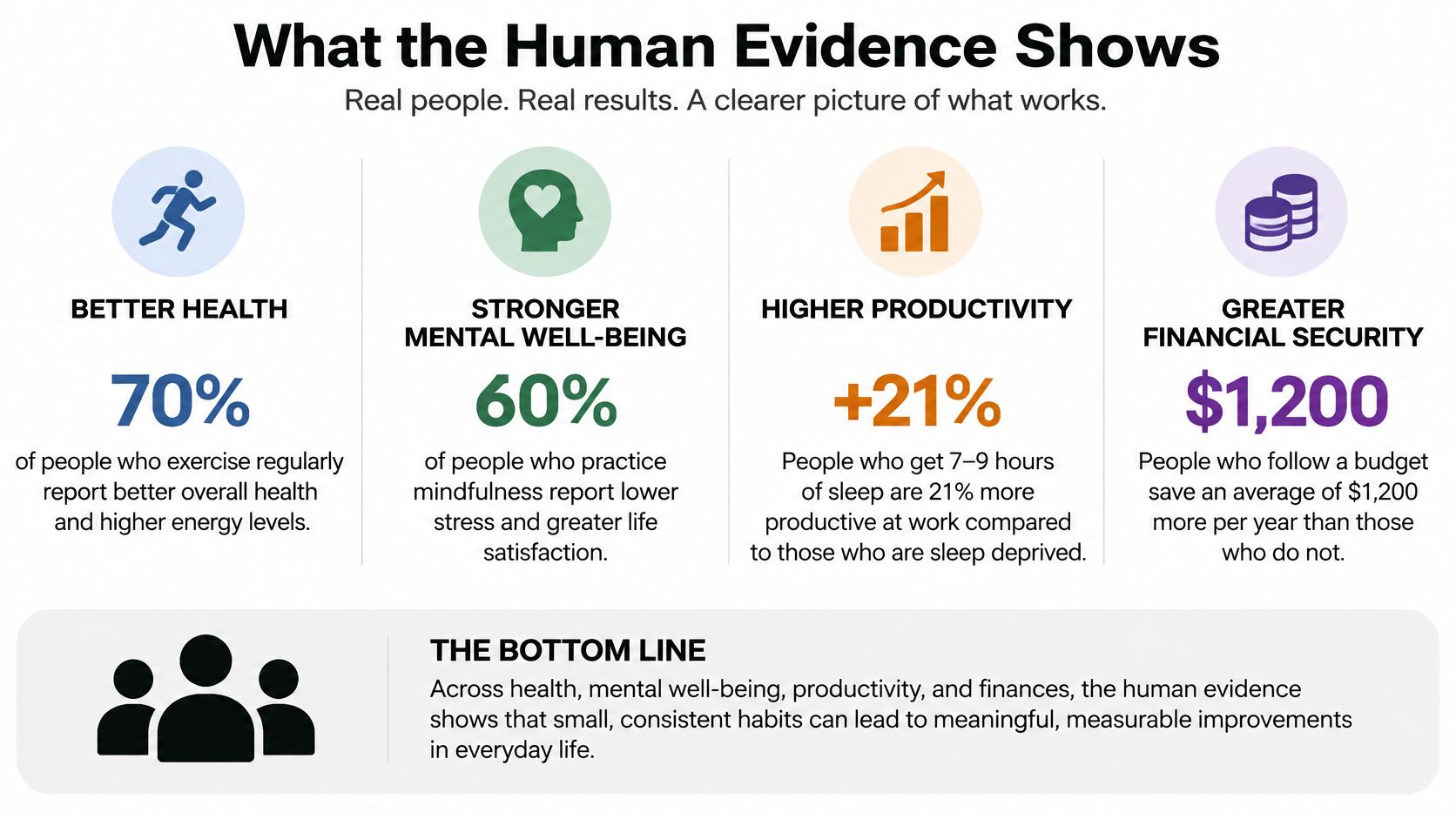
What did the red maca trial measure, and how closely does its preparation match a powder sold for everyday use?
A human-trial summary published in Nutrients describes a 12-week randomised, double-blind, placebo-controlled study involving 175 adults. Participants received 3 grams daily of spray-dried red maca extract, black maca extract, or placebo. They lived in Lima or Cerro de Pasco, so the study included people at different altitudes. The tested extract is not automatically equivalent to an unspecified culinary powder.
The study measured participants' reports of mood, energy, and sexual desire, along with chronic mountain sickness symptom scores. The red-maca group reported improvements in mood and energy and changes in sexual desire. The mountain-sickness finding relates to the study's altitude context and does not establish maca as a treatment.
The report describes 175 participants across three groups, but the summary cited here does not give the number in each group. Results based on participants' reports describe their experiences; they do not establish an improvement in athletic performance or predict how any individual will respond.
The related video is an optional introduction to maca. It does not replace the study details or clarify whether a particular powder matches the trial extract.
How to apply the findings
Check three things before applying a study to a product: the preparation tested, the outcomes measured, and the limits of the participant group. The trial used spray-dried extract and included people living at different altitudes, so its findings do not establish the effects of every red maca powder.
For shopping context, see Vitamin Planet's UK guide to choosing maca supplements. Audience-specific information such as maca root for men can also be read with the same care: a product's intended audience does not establish that it has a stronger effect.
Overall, this trial offers preliminary evidence about reported mood, energy, and desire. Its extract, participant group, and measured outcomes limit how broadly those findings can be applied.
Dosage and Timing for Red Maca Powder
Red maca powder amounts by use case
| Use case | Daily amount | Timing | Basis |
|---|---|---|---|
| Clinical trial using spray-dried extract | Study-specific amount, not a powder equivalent | Daily throughout the study | A research protocol, not a universal serving recommendation |
| Typical starting powder | 1 teaspoon, weighed to confirm its gram amount, or a smaller portion of the labelled serving | With a meal, at a convenient time | A cautious introduction, not an established clinical dose |
| Typical maintenance powder | The labelled serving, without automatic escalation | At a consistent, convenient time | Product-specific directions and individual tolerability |
| Pregnancy, breastfeeding or medication use | Ask a clinician before starting | Before use | Individual safety assessment comes first |
A teaspoon measures volume, while a label may give the serving in grams. To convert, weigh a level teaspoon of the actual powder on a kitchen scale, then use that measured weight to portion it. For example, if a level teaspoon weighs 3 grams and the label serving is 6 grams, two level teaspoons make one labelled serving. Powder density varies, so this example is a measuring method, not a universal teaspoon-to-gram conversion.
A systematic review in the Journal of Men's Health identified only two eligible randomised trials addressing erectile outcomes, an evidence base too small for firm conclusions. Avoid increasing your serving to chase a stronger or faster result.
Choose the amount by formulation
Extraction changes which constituents are retained and how concentrated the material becomes. A study dose for spray-dried extract therefore cannot be used as a powder serving.
Check whether the label describes whole-root powder, processed powder, or extract, and whether its serving amount refers to maca alone or to a blend. If the preparation or serving size is unclear, choose a product with clearer directions.
Build a routine you can evaluate
Taking maca with breakfast can make it easier to remember and to notice whether it agrees with your digestion. Choose a time that fits your routine; the information here does not establish a best time of day.
- Measure deliberately. Follow the label and use a suitable scale if the serving is listed by weight.
- Change one thing at a time. Avoid starting several new supplements together.
- Record relevant changes. Note energy, sleep, digestion, and anything else unusual.
- Review before increasing. If you notice no change, a larger serving is not the automatic next step.
If you divide a serving between meals, keep the total within the label directions. Moving part of your usual amount does not call for an extra portion.
A useful supplement routine should be easy to stop, assess, and explain to a clinician.
Decide what you hope to observe before starting. For example, you could track whether your afternoon routine feels more comfortable while watching for changes in sleep or digestion. This gives you specific points to review rather than relying on a vague promise of vitality.
Side Effects, Interactions and Who Should Avoid It
If you take thyroid medication, check with your clinician or pharmacist before adding maca. Bring the product label so they can review the serving size, whether it is powder or extract, and any other ingredients in a blend.
A review of maca safety and analytical evidence reports acceptable tolerability and no serious adverse effects in a short-term human extract trial. That finding applies to the conditions studied. It does not establish long-term safety or show that all maca preparations are equally well tolerated.
When professional advice comes first
Seek advice before use if you are pregnant or breastfeeding, have a hormone-sensitive condition, take medication for thyroid function, blood pressure, or blood sugar, or have planned surgery. These are reasons to review the specific product and your circumstances, not proof that maca interacts with each condition or medication.
A clinician or pharmacist can check the total serving and the full ingredient list. They may also look for stimulant-containing ingredients in a blend, since those can affect how the product fits with your medicines and health needs. Don't assess a combination by its maca content alone.
Symptoms shouldn't be ignored
After starting a product, watch for digestive discomfort, loose stools, or changes in sleep. If symptoms appear, consider the full routine, including coffee and other additions. For understanding calories in unsweetened coffee, separate the coffee itself from what you add; that guide is about calories, not supplement safety.
Stop use and seek advice if you develop persistent stomach pain, a rash, or unusual heart symptoms. Get urgent help for breathing difficulty, significant swelling, chest pain, or fainting.
How to Choose High-Quality Red Maca Powder
Quality checks for red maca powder
| Check | What it confirms | Red flag |
|---|---|---|
| Botanical identification | Lepidium meyenii with a red ecotype | Only the word maca, without species or colour detail |
| Marker testing | Measured glucosinolates or validated maca markers using chromatography | No method, results, or marker levels |
| Moisture and microbial testing | Evidence relevant to storage stability and microbial quality | No batch certificate of analysis |
| Heavy-metal screening | Measured contaminant levels | Screening report missing or unavailable |
| Drying and processing | Documented processing and heat control | Drying method not disclosed |
A review of maca composition and quality control identifies glucotropaeolin as the principal glucosinolate generally found in root powder and describes macamides, macaenes, and glucosinolates as potential identity and quality markers. The same review explains that cultivar, geography, drying, and extraction affect composition, so a colour claim alone can't establish consistency.
The checklist below highlights the identity questions that should come before benefit claims.
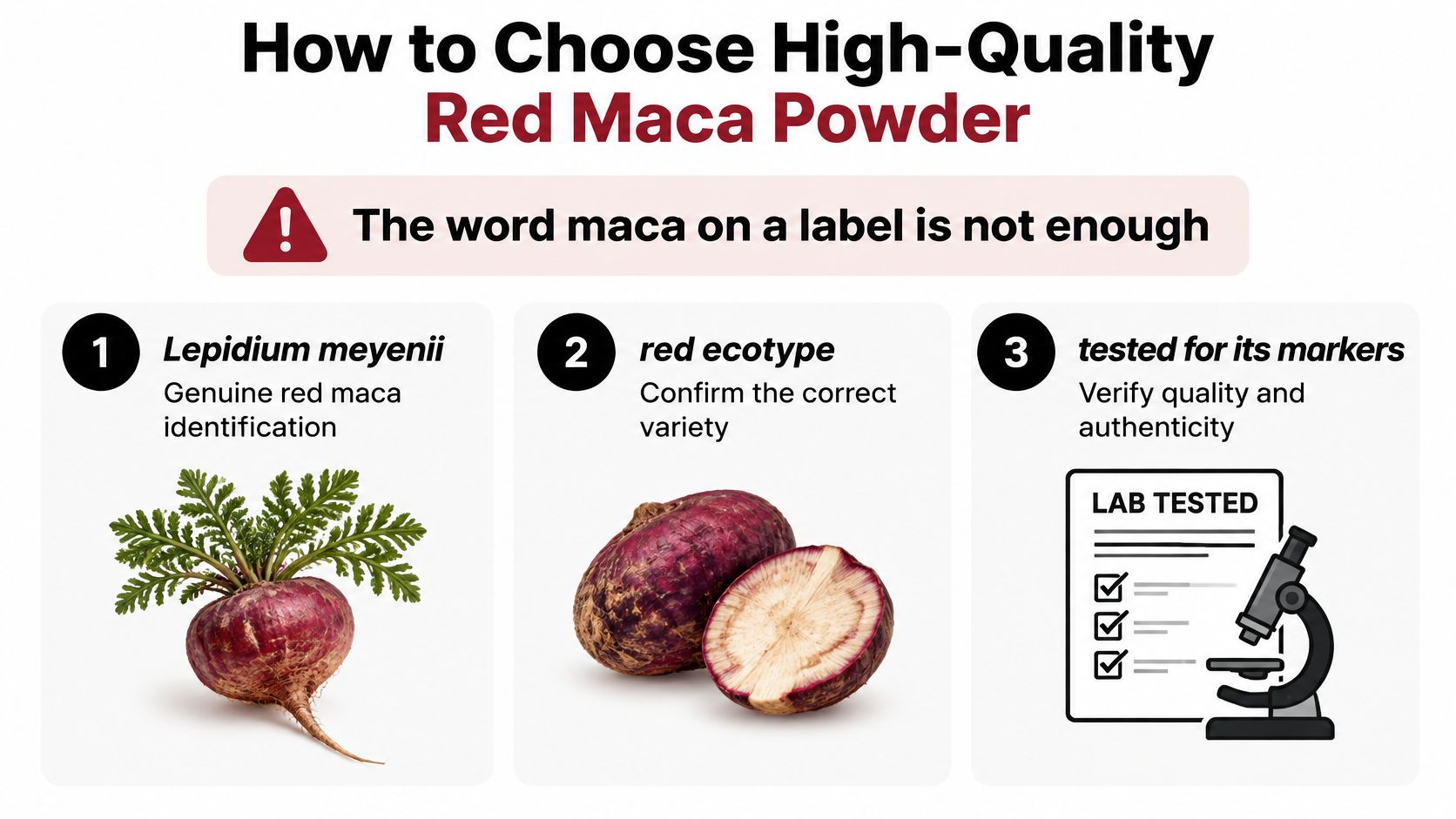
Read the report, not just the badge
A certificate of analysis, often shortened to COA, should identify the batch and show what was tested. Look for the laboratory's name, test methods, result units, and the limits used to interpret contaminant results.
A third-party logo isn't enough if you can't tell what the laboratory assessed. Testing identity doesn't automatically establish microbial quality, and testing contaminants doesn't demonstrate a clinical benefit.
Chromatography is a laboratory technique that separates compounds so they can be identified or measured. For a shopper, the useful question is whether the report gives actual marker measurements rather than an unexplained pass.
Questions to use before buying
- Request the batch report. Match its lot identifier to the product you'll receive.
- Ask about drying. Look for a described method and heat controls, not just natural-processing language.
- Confirm origin and variety. A named growing region and red ecotype make the specification more informative.
- Check document dates. Establish that the tests apply to the production batch, rather than an unrelated sample.
The review also notes that fresh roots contain more total glucosinolates than dried roots. That doesn't make every heated product inferior, but it does make processing relevant and undermines the idea that all red powders are equivalent.
Use a guide to reading supplement labels to distinguish ingredient identity, serving size, and blend composition. A polished label or higher price can't replace missing documentation.
Buying standard: Prefer a clearly described, batch-tested material over an impressive colour claim with no supporting report.
Simple Ways to Use Red Maca Powder
Choose a recipe you already enjoy rather than building a complicated new ritual. Measure the portion according to your product's directions, then add it to a food that makes consistent use easy.
Maca's earthy, malty flavour can work with banana, cocoa, nut butter, and cinnamon. Taste a small prepared portion before adding it to an entire batch of food.
A smoothie, soft breakfast or warm drink
For a morning smoothie, blend banana, milk or plant milk, and nut butter, then add the measured powder. Blending helps disperse it, while the stronger flavours make the earthy note less prominent.
For oats or yoghurt, stir the powder into a small spoonful first to form a smooth paste, then mix that through the bowl. This is easier than tipping dry powder onto the finished breakfast and trying to break up pockets afterward.
For a warm drink, make a paste with a little warm milk before whisking in the rest. Cinnamon and a little honey can adjust the flavour; there's no need to boil the mixture merely to dissolve the powder.
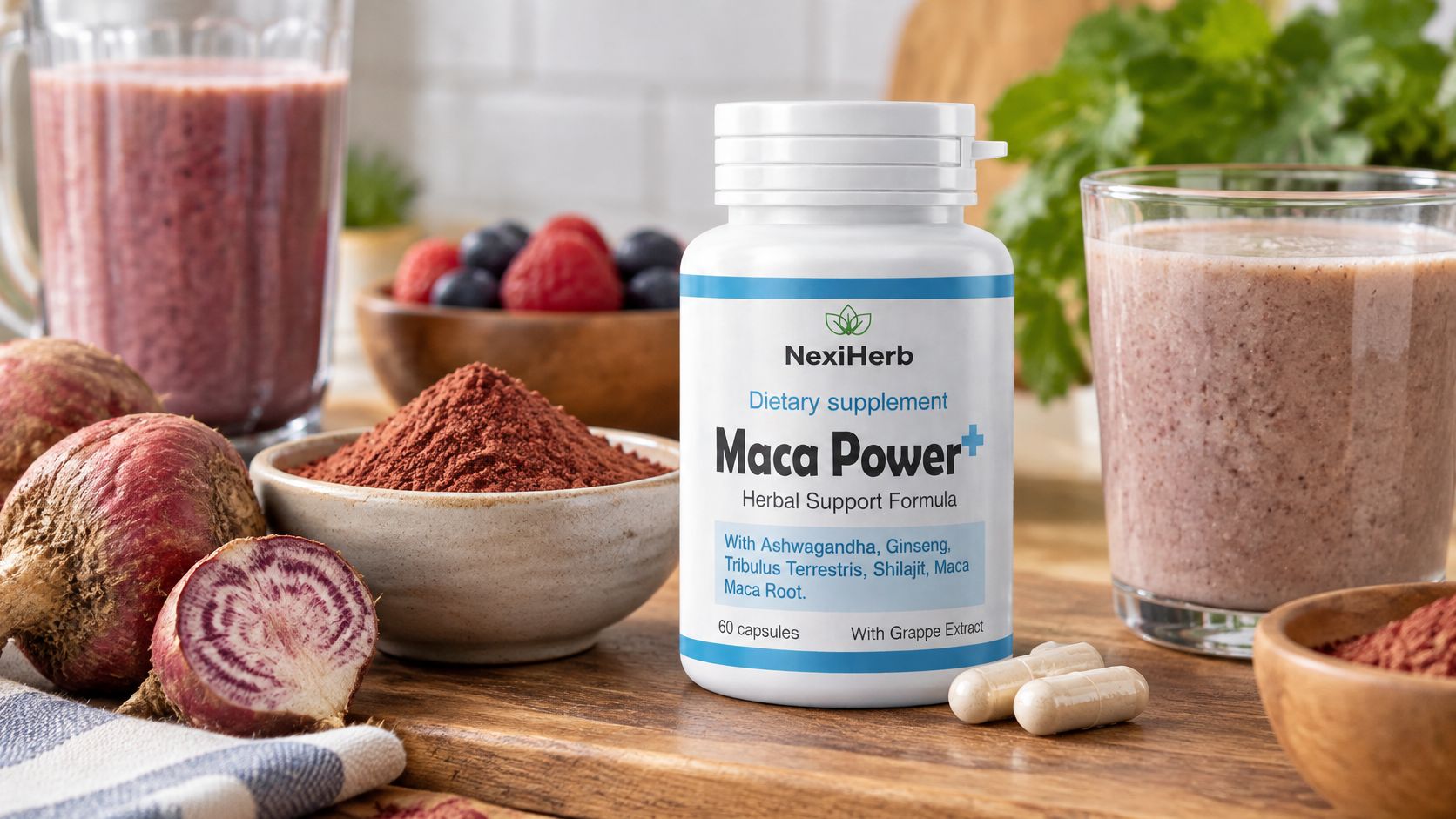
The pictured item is a capsule supplement, not a loose powder for these recipes.
A repeatable mixing method
- Measure the powder. Don't assume a heaped kitchen spoon matches the label's serving.
- Make a paste. Add a little liquid or soft food and stir out dry pockets.
- Combine thoroughly. Whisk, blend, or fold into the remaining portion.
- Serve promptly. Store any prepared food according to the requirements of its other ingredients.
Plain water may leave a texture you don't enjoy. A smoothie or yoghurt offers more texture to carry the powder, but mixing doesn't turn maca into a fully soluble ingredient.
For more preparation techniques, use the guide to taking herbal powders. Keep recipes separate from dosing decisions: a drink that tastes good isn't a reason to add extra servings.
Store Red Maca Powder and Start a Safe Routine
A cool, dry cupboard helps protect red maca powder from moisture and heat. Keep it in a tightly closed container, away from the cooker, direct sunlight, and steam. The original packaging is suitable if it reseals securely and protects the contents.
Use a clean, dry scoop. Keep the open packet away from steaming food, and don't return a damp spoon to the container.
Make the container easy to track
Write the opening date on the packet and keep the lot number readable. If you transfer the powder, retain the original label, storage directions, and printed date. Follow the product's storage instructions, since powders may have different requirements. Don't refrigerate automatically: opening a cold container in humid air can introduce moisture.
- Inspect before use. Check for unexpected dampness, visible mould, damaged packaging, or an unusual smell.
- Keep documents together. Store the batch report with your purchase information.
- Discard suspect powder. Don't taste it to decide whether it has spoiled.
Keep storage separate from your routine
Storage protects the powder; it doesn't establish whether you'll notice a benefit. Keep the label and batch report with the container, follow the product directions, and note any changes that matter to you. If problems appear, stop using it and seek appropriate advice rather than repeatedly adjusting the serving.
Apply the same care to any brand, including NexiHerb. A standalone red maca powder and a botanical blend are different formats, so their labels don't describe the same ingredients or exposure.
For example, Maca Power+ NexiHerb Herbal Dietary Supplement is a capsule supplement that contains maca root extract along with other botanical ingredients. It is not loose red maca powder, and the product description doesn't establish that it is equivalent to a standalone powder or a clinical extract.
Choose a format you can identify and use consistently. You don't need to continue taking a supplement just because you bought it.
Frequently Asked Questions About Red Maca Powder
Is darker red maca stronger?
Colour alone cannot answer that. The earlier buying guidance covers the checks that help assess a powder's identity and quality.
How long before effects show?
Human research assessed outcomes over a sustained study period. Individual experiences vary, so a drink or a single good day cannot predict what you will notice.
Can I take it every day?
Follow the directions for the specific product. If you have a health condition, take medication, or are unsure whether regular use suits you, ask a clinician.
Does red maca raise testosterone?
The human evidence discussed above does not establish that red maca raises testosterone. A change in energy or desire is not proof of a hormone change.
Can I cook with it?
For a culinary powder, try mixing it into a finished warm or cool dish, while following the package instructions. Cooking does not make powder equivalent to a tested extract.
Choose a product you can identify, follow its directions, and decide whether it fits your routine. NexiHerb LLC offers dietary supplements and nutrition guides for adults building everyday wellness routines. Visit NexiHerb LLC to explore its botanical options.