

If a bottle says chelated, does that mean your body will absorb more of the mineral, or does it just tell you how the ingredient was made? That distinction matters when you're choosing between supplements that appear similar but use different chemical forms.
A chelated mineral supplement can be a reasonable choice, but the label word alone isn't enough. A useful comparison starts with the exact compound, the amount of actual mineral in each serving, and human evidence that matches the product's claims.
Table of Contents
- What Chelated Minerals Are and Which Forms Matter
- How Chelation Changes Absorption and Bioavailability
- Chelated and Standard Minerals Compared Side by Side
- Elemental Doses and Upper Limits to Respect
- Medicines and Minerals That Need Spacing
- How to Choose a Quality Chelated Supplement
What Chelated Minerals Are and Which Forms Matter
What does chelated tell you about a mineral? It describes how the mineral is chemically bound to another molecule, often an amino acid such as glycine, a peptide, or an organic acid. The mineral and carrier form a defined compound.
The carrier is part of the compound's structure. That structure may affect how the ingredient behaves during digestion, but the word chelated alone cannot predict how much mineral the body absorbs. Chelation names a chemical structure. Whether one form performs better than another depends on human data comparing those specific compounds.
Recognizing the names on a label
The first word in a compound name usually identifies the mineral; the following word identifies its form. In zinc bisglycinate, zinc is the mineral, and bisglycinate describes its association with glycine.
Common chelated and non-chelated mineral forms
| Form | Mineral | Carrier molecule | Human evidence |
|---|---|---|---|
| Bisglycinate | Zinc, iron | Glycine, an amino acid | Look for human trials comparing the same mineral as bisglycinate and as a conventional salt. |
| Glycinate | Magnesium, calcium | Glycine, an amino acid | Check human studies comparing magnesium glycinate or calcium glycinate with another form of that same mineral. |
| Picolinate | Chromium, zinc | Picolinic acid | Look for human studies testing the same mineral as picolinate against another form, with the measured outcome specified. |
| Citrate | Zinc, magnesium | Citric acid, an organic acid | For zinc, look for a human comparison of zinc citrate with zinc gluconate and check the reported absorption measure. |
| Gluconate | Zinc | Gluconic acid, an organic acid | Human studies may use zinc gluconate as the comparison form; check which form it is being compared with. |
| Oxide | Zinc, magnesium | No organic carrier; inorganic and not chelated | For zinc, compare zinc oxide with another zinc form in a human study, using the same outcome and dose conditions. |
A useful place to look is a review in a medical or nutrition database, followed by the human study it cites. Check whether the study compares the same mineral forms and reports a relevant measure, such as absorption. A result for zinc citrate does not establish how magnesium citrate compares with magnesium glycinate.
Organic doesn't automatically mean chelated
An organic acid name alone does not establish the same coordination structure as an amino-acid chelate. Citrates and gluconates are distinct forms, so their names should not be treated as interchangeable evidence about performance.
The label wording also sets the level of detail. Magnesium chelate is broad, while magnesium bisglycinate names a more specific form. If a label gives only a general amino-acid-complex description, the compound is harder to identify.
Label-reading habit: Find the exact mineral form in the Supplement Facts panel or ingredient information. “Chelated zinc” identifies less than a name such as zinc bisglycinate, and it does not establish an absorption advantage.
How Chelation Changes Absorption and Bioavailability
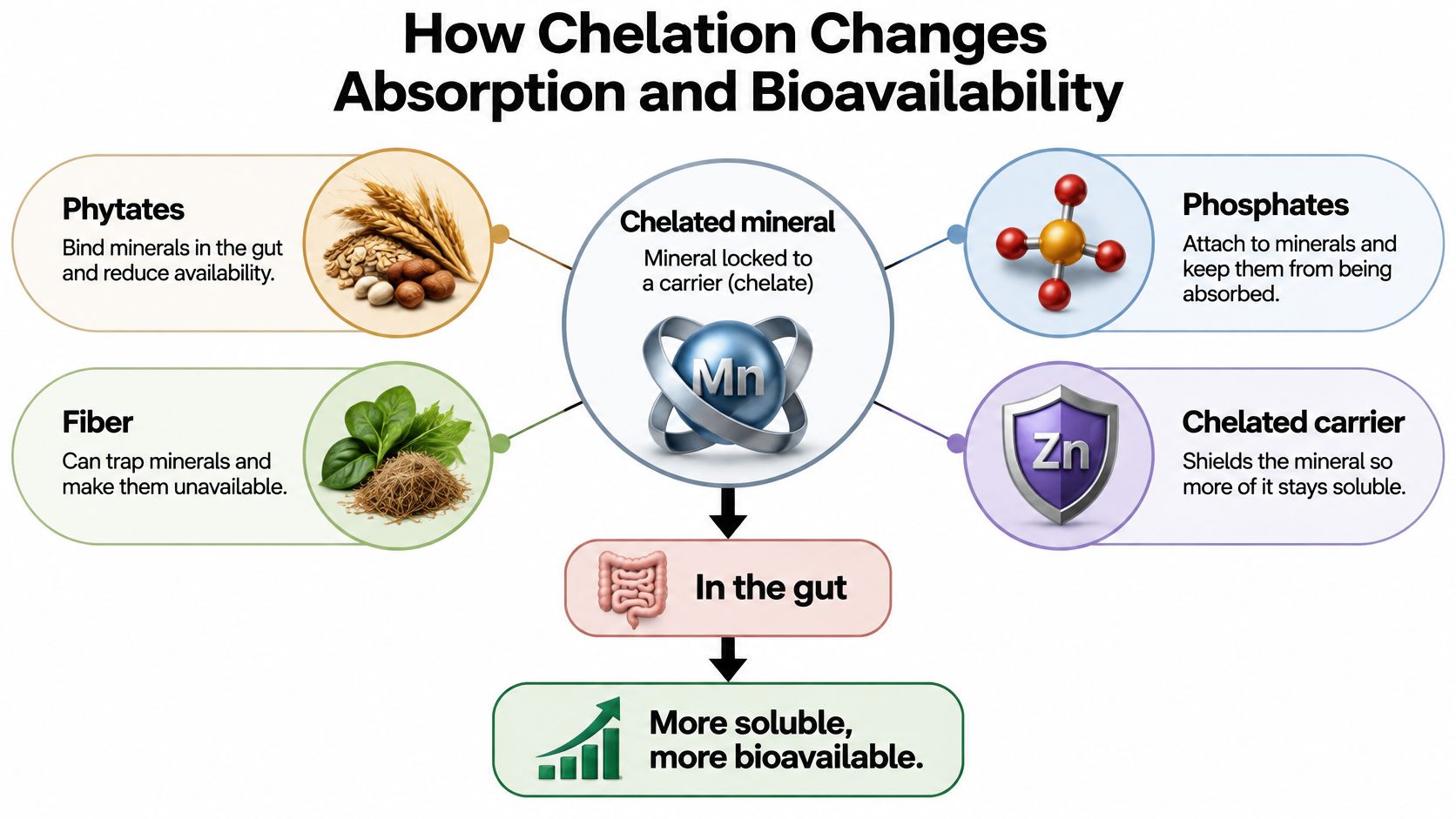
Why might a mineral stay available for absorption in one formulation but become harder to absorb in another? In the gut, phytates, phosphates, and components of fiber can bind minerals, leaving less available for intestinal cells to take up.
A suitable carrier may limit some of these interactions and help a mineral remain soluble, meaning dissolved and accessible for absorption. Chelation can protect a mineral during digestion, but it does not override the body's normal absorption controls. The diagram shows the idea; it does not guarantee the same result for every mineral or formulation.
What bioavailability actually measures
Bioavailability describes how much of an ingested substance becomes available to the body after absorption. A tablet breaking apart is only an early step. The mineral must remain available in the gut and cross the intestinal lining before it can contribute to the body's mineral supply.
In an adult crossover study summarized in an iron amino-acid chelate review, participants received 18 mg of elemental iron daily as either ferrous sulfate or an iron amino-acid chelate. Mean absorption was reported as 59% higher with the chelate. This is a relative increase under the study's conditions, not a prediction that every person absorbs that much of a dose or that all iron chelates work alike.
The review also discusses ferrous bisglycinate and ferric trisglycinate in relation to non-heme iron absorption. The practical point is to distinguish a proposed mechanism from a demonstrated outcome: a carrier may reduce unwanted binding in the gastrointestinal tract, but the word “chelated” alone does not establish an absorption advantage.
Where the evidence stops
Iron status, dose, meal composition, formulation, and the people enrolled can all affect an absorption result. A controlled comparison does not establish that a supplement will correct fatigue or another symptom in someone who does not need extra iron.
Use three questions to assess an absorption claim:
- Compared with what? A named comparator is more informative than a general claim of enhanced absorption.
- At what elemental dose? Equal compound weights do not necessarily provide equal amounts of mineral.
- In whom? Human comparisons are more relevant to shoppers than animal feeding experiments.
For context on how meals and supplement routines may affect nutrient uptake, read NexiHerb's guide to improving nutrient absorption. If pregnancy is why you are considering magnesium, compare magnesium forms for pregnancy and use that information to prepare questions for your prenatal clinician.
Chelated and Standard Minerals Compared Side by Side
Does the word chelated tell you a mineral will be absorbed better? Not by itself. A randomized, two-way crossover study of 12 healthy women compared a single 15 mg elemental-zinc dose as zinc bisglycinate with zinc gluconate. It reported 43.4% greater oral bioavailability with bisglycinate, according to the human zinc study record.
The researchers measured serum exposure, including peak concentration and the area under the concentration-time curve. These measures show how much zinc appeared in the blood over time. They do not show whether participants experienced better long-term health.
The comparison was with gluconate, not oxide. A result for one pair of forms cannot establish that one chelate outperforms every standard salt.
Compare the features you can verify
Chelated versus standard mineral forms by criterion
| Criterion | Chelated form, such as bisglycinate | Standard salt, such as oxide or sulfate |
|---|---|---|
| Human absorption data | Look for a direct human comparison of the named chelate | Check evidence for the exact salt; don't group all salts together |
| Sensitivity to food inhibitors | Check whether the product is taken with meals and look for human data on that exact compound | Consider meal composition and the particular mineral |
| Stomach tolerance | Check the directions and assess your response at the intended dose | A conventional form may suit you if you tolerate it at the intended dose |
| Cost per elemental mg | Calculate from the actual price and mineral content | Use the same calculation rather than assuming better value |
| Label clarity | Check that the label names the form and elemental amount | Require the same information; clear labeling isn't exclusive to chelates |
Neither form guarantees better tolerance or lower cost. Compare your actual options by dose, serving size, added ingredients, and price instead of relying on the label term.
If digestive comfort is a concern, how magnesium chelation affects digestion explains terminology you can discuss with a pharmacist. Comfort alone does not demonstrate greater absorption.
Applying the comparison to a combination product
A multivitamin calls for a whole-formula check. Consider the mineral forms listed, the amounts provided, and whether other products create overlap. The word chelated cannot answer those questions on its own.
For example, Vita Mix NexiHerb Multivitamin & Mineral Dietary Supplement is a multivitamin and mineral dietary supplement. Its product description alone does not establish that its minerals are chelated or demonstrate comparative absorption.
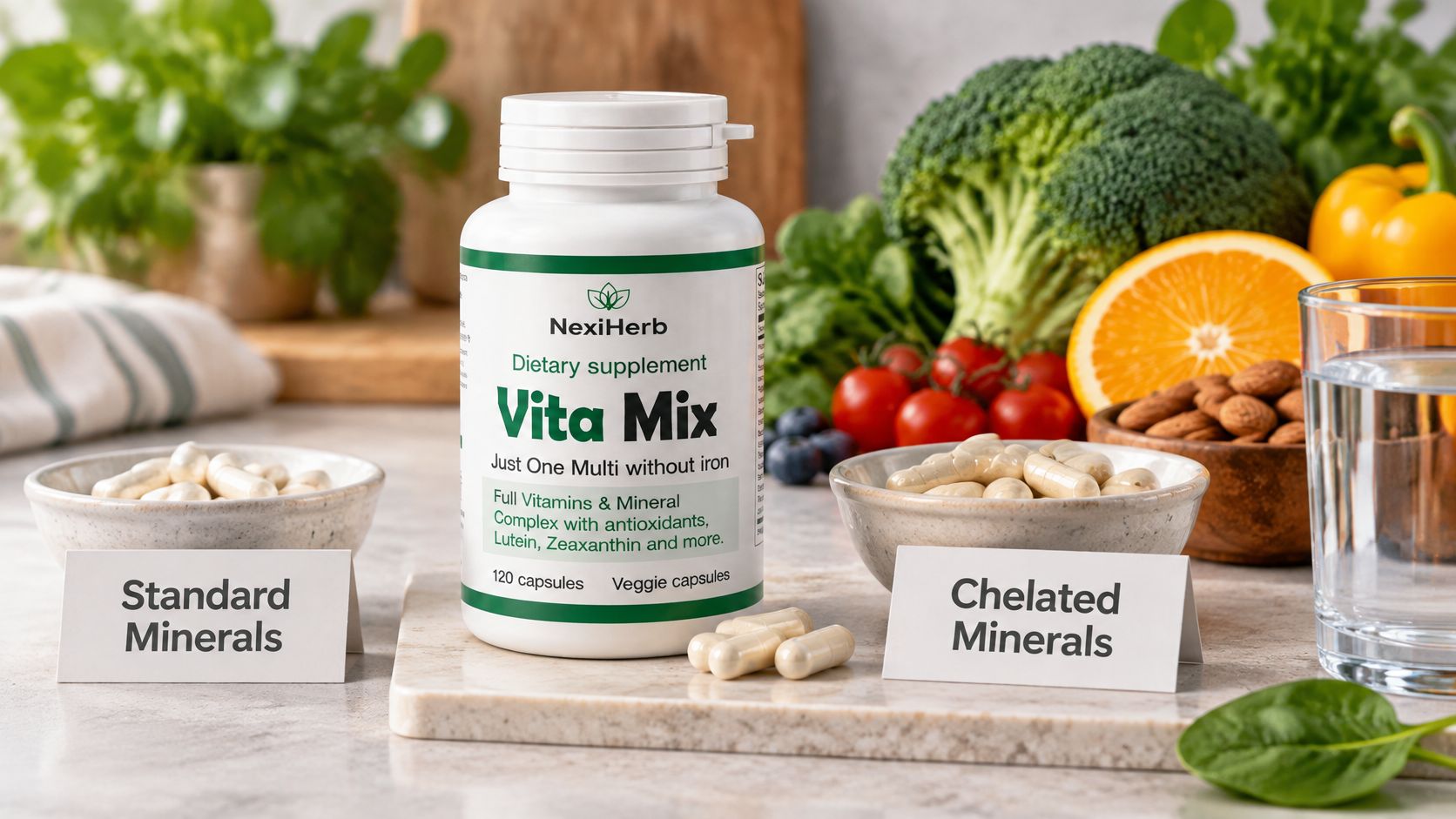
A chelate is a reasonable choice when its specific form has relevant human evidence or suits your routine. A standard form can also be reasonable when it meets your needs. In either case, judge the compound, elemental amount, and evidence, not the word chelated alone.
Elemental Doses and Upper Limits to Respect
A label's wording can make a mineral dose harder to read. A chelate's label weight includes its carrier, so the elemental amount is the figure to track. Check the nutrient amount on the Supplement Facts panel alongside the listed mineral form.
For example, if a label lists magnesium and identifies magnesium bisglycinate in parentheses, use the stated magnesium amount when adding up your intake. The form name tells you what compound supplies it; the elemental amount tells you how much magnesium the serving provides. If a label gives only the weight of a proprietary mineral complex, its elemental amount cannot be determined from that figure alone.
Treat upper limits as a separate safety check
A tolerable upper intake level is a safety boundary, not a daily target. The appropriate reference can vary with age, source of intake, and clinical circumstances. Because this section does not provide sourced numerical limits, use the table as a checklist of which mineral-specific questions to raise, not as a dose guide.
Adult upper intake levels for common minerals
| Mineral | Check before choosing a dose |
|---|---|
| Iron | Ask whether iron supplementation is appropriate, including whether iron-status testing should be discussed. |
| Zinc | Count zinc from all supplements, including combination products. |
| Magnesium | Distinguish supplemental magnesium from magnesium in food. |
| Calcium | Account for both dietary and supplemental sources. |
| Selenium | Check for overlap between single-mineral and multivitamin products. |
| Manganese | Include every supplement that supplies manganese. |
| Chromium | An absent established upper limit does not establish that any dose is safe. Review the intended use with a health professional. |
Build an intake inventory
Gather your multivitamin, single-mineral supplements, and other nutrition products. Record the elemental amount per serving and how often you take each one. This makes it easier to spot overlap: two products with different names may both contribute the same mineral.
Ask a pharmacist or clinician to review the combined intake against appropriate reference values. Bring the product labels, since names alone do not show the amount or form in each serving.
Practical rule: Use a supplement to address an identified need, rather than adding another mineral automatically.
If copper is part of your plan, the guide to copper supplement dosage can help you frame questions about the label and dose. Avoid adding another mineral to compensate for an unnecessarily high dose of the first. Supplements are intended to fit within a varied diet and healthy lifestyle, not replace a balanced diet.
Medicines and Minerals That Need Spacing
Could a chelated mineral still affect your medication? Yes. Minerals may bind to some medicines in the digestive tract or interfere with absorption, so changing the mineral's chemical form does not automatically prevent an interaction.
A review of magnesium interactions describes reduced absorption of tetracycline antibiotics when taken with magnesium, as well as interactions involving minerals and medicines such as levothyroxine. The practical step is to ask whether the two products can be taken together, and which schedule keeps the medicine's effect intact.
Timing belongs to the medicine's instructions
Medicines that need spacing from mineral supplements
| Medicine class | Minerals to separate or review | Question to ask a pharmacist |
|---|---|---|
| Tetracycline antibiotics | Magnesium, calcium, iron | For this specific antibiotic, how many hours should separate each mineral, and should I pause a nonessential supplement during treatment? |
| Levothyroxine, a thyroid medicine | Iron, calcium, magnesium | How should I time this medicine and each mineral around meals to keep my schedule consistent? |
| Fluoroquinolone antibiotics | Zinc, magnesium, iron | What separation interval does this specific antibiotic's label recommend for each mineral? |
| Bisphosphonates for osteoporosis | Calcium, magnesium | When can I take minerals after this medicine, given its instructions about water, food, and posture? |
There is no single timing interval that suits every medicine in a class. The specific medicine and its prescription instructions determine the schedule. A pharmacist can help fit it around your usual meals and other medicines.
During a short antibiotic course, ask whether it would be simpler to pause a nonessential mineral supplement. Don't stop prescribed treatment or change its timing without professional guidance.
Prepare a medication review
- List everything you take. Include prescriptions, nonprescription medicines, antacids, multivitamins, and single-mineral products.
- Highlight mineral sources. Mark products containing iron, calcium, magnesium, or zinc.
- Record the schedule. Note meal times, medicine times, and any instructions to take a medicine on an empty stomach.
- Review new additions. Ask a pharmacist to check a supplement before starting it, so its timing can be considered alongside your current medicines.
Supplements aren't chelation therapy
Ordinary oral mineral supplementation is different from medical chelation therapy. Chelation therapy uses agents to bind particular metals for removal under medical supervision. A supplement containing a chelated mineral supplies that nutrient; it is not a home detoxification treatment.
Avoid products marketed for home use that promise to remove toxic metals or treat unrelated illnesses. Keep the distinction clear: a mineral's chelated form describes its chemical structure, not a proven ability to detoxify the body.
How to Choose a Quality Chelated Supplement
What does “chelated” tell you when you are choosing a supplement? It describes a chemical form, not a guaranteed absorption advantage. Start with the Supplement Facts panel and look for the actual mineral form, the amount provided, and the directions for use. A persuasive front-label claim cannot replace those details.
The FDA's dietary supplement guidance explains that supplements are regulated as foods under DSHEA. Most are not approved for safety or effectiveness before marketing, and manufacturers are responsible for avoiding adulteration and misbranding. Keep that regulatory context in mind when weighing claims about absorption: legal sale does not mean the FDA has confirmed a product's performance.
Read the panel before judging the promise
Use this visual guide to identify the label fields that matter most.
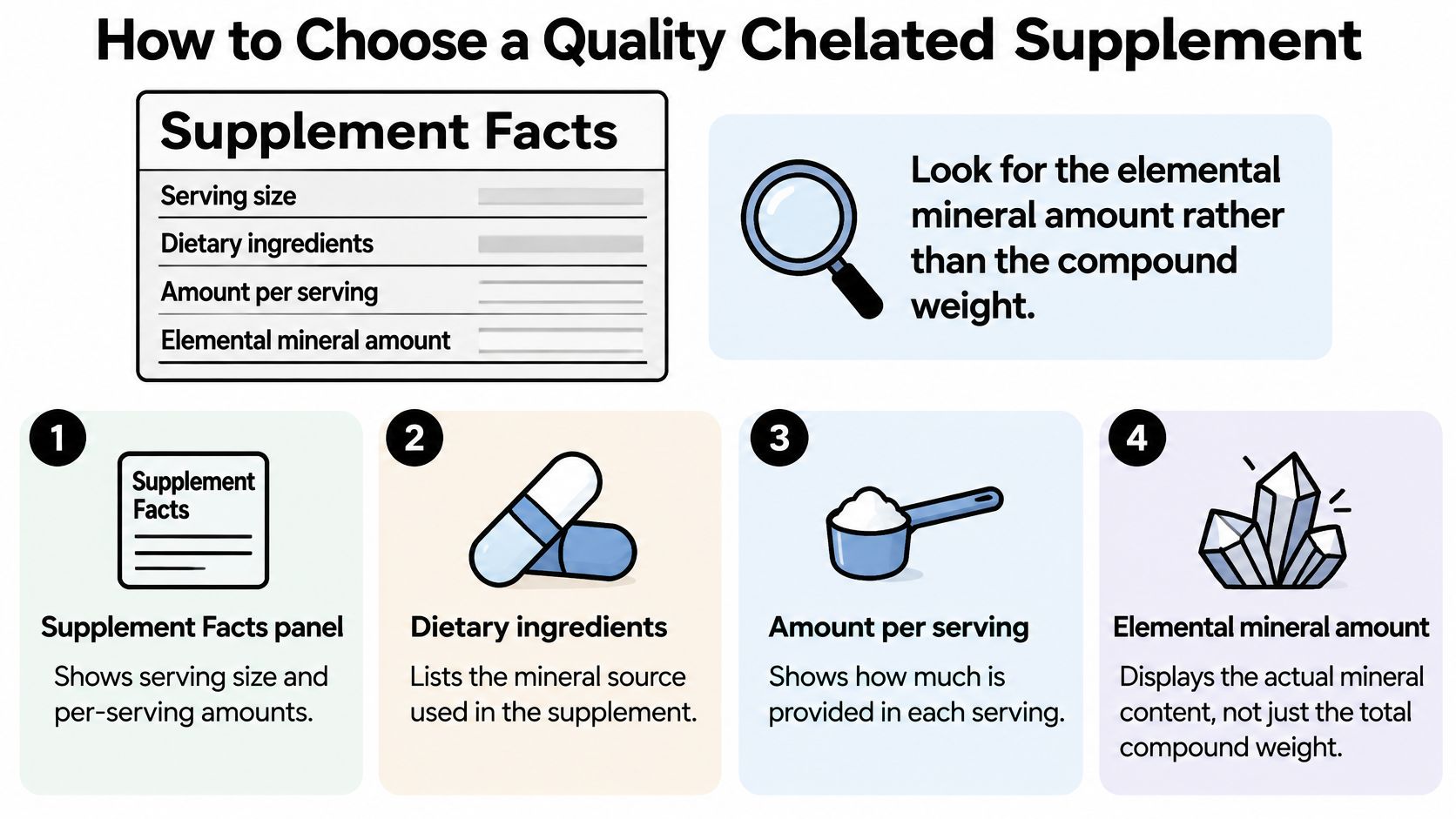
A compound name may be unfamiliar without being a problem. The practical question is whether the label identifies the form clearly enough for you to assess what you are buying. A generic phrase such as “chelated minerals” gives less detail than a specific compound name.
For help identifying label details, consult this guide to reading supplement labels alongside the packaging you are considering. Then use the checklist below to decide whether the product fits your needs.
A purchase checklist that leads to a decision
- Confirm the exact form. Look for a specific name, such as zinc bisglycinate, rather than “chelated zinc” alone. If the label lists a blend, don't assume every mineral comes in the form featured most prominently on the front.
- Use the dose check from earlier. Compare the declared elemental amount per serving with your intended intake, rather than relying on the weight of the whole compound.
- Check serving size and dosage form. Establish how many capsules or tablets make up a serving and whether the directions fit your routine. A format is only convenient if you can follow its instructions.
- Look for independent testing. Check what was tested, who performed the testing, and whether the documentation applies to the finished product. Identity, potency, and contaminant testing address different questions from evidence about absorption.
- Match evidence to the claim. Use the earlier discussion of comparative data to judge whether the evidence applies to this product and the people taking it.
- Compare cost per elemental amount. Divide the purchase price by the total declared elemental mineral in the container. For combination products, consider whether you need the other ingredients before assigning the entire cost to one nutrient.
- Follow the directions and reassess appropriately. Use the label and any clinician-directed plan. Don't raise the dose because you notice no immediate effect, and don't treat a subjective change as proof that a deficiency has been corrected.
Match the checks to your circumstances
If you eat a plant-based diet, assess your overall intake before assuming you need extra iron or zinc. Iron merits consideration of symptoms and medical history, including whether testing is appropriate, rather than an automatic purchase based on diet alone.
Hard training or heavy sweating does not by itself establish a need for a larger mineral dose. Review your food intake, existing supplements, and likely needs with an appropriately qualified professional.
For older adults taking several medicines, a workable schedule may matter more than a small difference in absorption evidence. During pregnancy or when planning pregnancy, ask your prenatal clinician to review your full supplement routine before adding a separate mineral.
A technically impressive ingredient may still be a poor fit if the dose is unnecessary, the medication schedule is difficult to follow, or the evidence does not apply to you.
Know when the conventional form is enough
A review of organic trace-mineral formulations discusses differences among formulations, including research involving livestock and aquaculture. Those findings do not establish equivalent benefits in humans.
A well-tolerated conventional mineral may be a sensible purchase when a chelated alternative lacks relevant human comparisons. Choose according to a clear nutritional need, an appropriate dose, suitable directions, and evidence that fits the claim. The word “chelated” alone cannot make that decision.
NexiHerb LLC offers dietary supplements including vitamins, minerals, amino acids, omega-3s, and antioxidants, along with practical nutrition guides. Explore NexiHerb LLC and compare ingredient forms, serving sizes, and mineral amounts with the needs you have reviewed with your pharmacist or clinician.