

The usual advice is to grab any nitric oxide booster powder, chase a bigger pump, and treat that feeling as proof the formula works. That advice collapses once you separate the gas from the tub. Nitric oxide is a signal your blood vessels make. It is not an ingredient you can scoop in useful amounts. What the tub sells is a precursor, and precursors do not share one track record.
The front label is marketing. The Supplement Facts panel is the product. One formula can list an amino acid far below amounts used in trials, another can list beet powder with no nitrate number, and a third can lean on a botanical that is not a nitric oxide precursor at all. A tingle, flushed skin, or a fuller muscle does not tell you which of those you bought.
Match the claim on the bottle to a named ingredient, then to a printed amount, then to an outcome a trial measured. Those three checks, not the category name, decide whether a powder belongs in training or in a daily routine.
Table of Contents
- Ingredients in a Nitric Oxide Booster Powder at a Glance
- How Nitric Oxide Forms From Powder Ingredients
- Beetroot Nitrate and the Best-Supported Route
- Where the L-Citrulline and L-Arginine Evidence Stops
- How to Read a Label Before You Buy
- Safety, Side Effects and Dosing Limits
- Use Cases for Athletes and Daily Wellness Routines
- Decide Whether a Nitric Oxide Booster Powder Fits Your Routine
Ingredients in a Nitric Oxide Booster Powder at a Glance
Nitric oxide is short-lived; powders supply precursors such as arginine, citrulline, and nitrate. Those ingredients enter different pathways, and their performance evidence is not interchangeable. The NIH Office of Dietary Supplements consumer fact sheet describes evidence for arginine in strength, aerobic performance, and recovery as limited, and research on citrulline as inconsistent. Studies have used 3–6 g of L-arginine per day and 6–8 g of L-citrulline or citrulline malate. For dietary nitrate from beetroot, a studied protocol used about 6 mmol, roughly 372 mg nitrate, daily for more than three days. These are study amounts, not a guarantee of benefit or a recommendation for every product.
| Ingredient | Role in the body | Performance evidence |
|---|---|---|
| L-arginine | Substrate for nitric oxide synthase enzymes | Limited for strength, aerobic performance, and recovery |
| L-citrulline or citrulline malate | Converted to L-arginine; may raise nitric oxide-related markers | Inconsistent, with exercise benefits not strongly supported |
| Dietary nitrate from beetroot | Reduced to nitrite, then converted to nitric oxide | Evidence is strongest for time to exhaustion |
| Coenzyme Q10 and botanical extracts | Not direct nitric oxide precursors | No established dose for nitric oxide production |
Use the Supplement Facts panel to assess a formula. Match its listed ingredients to the product's claims, then check whether the amount appears in milligrams or grams. A label that says only “beet root powder” does not show how much nitrate a serving provides. Likewise, a blend name does not reveal the amount of each ingredient.
Blends that are not nitric oxide
Multi-ingredient powders may include caffeine or other stimulants alongside ingredients linked to nitric oxide production. Stimulants can affect alertness and perceived effort independently, so a “wired” feeling cannot establish that a precursor changed nitric oxide or improved performance. The measured outcome matters: a change in a nitric oxide-related marker is not itself proof of a better workout.
Practical rule: If the panel hides ingredient amounts inside a proprietary blend, you cannot compare the serving with the study amounts above.
A formula centered on nitrate or citrulline has a different evidence profile from one centered on grape seed, coenzyme Q10, or a long list of botanicals. The marketing name cannot show which ingredients are present in meaningful amounts. Read the panel first, then judge what the product's specific ingredients and printed amounts can reasonably support.
How Nitric Oxide Forms From Powder Ingredients
Think of nitric oxide as a spoken message that lasts seconds. The powder does not deliver the message. It delivers words your body may use to say it. The endothelium, the inner lining of a blood vessel, releases that message to nearby smooth muscle so the vessel can widen. The 1998 Nobel Prize in Physiology or Medicine, shared by Ferid Murad, Robert Furchgott, and Louis Ignarro, recognized nitric oxide as that cardiovascular signal. A tub marketed as nitric oxide support usually does not contain large amounts of stable nitric oxide. It supplies substrates or pathways tied to production. The prize explains the biology. It does not prove a commercial powder improves a workout.
Two routes feed the same short-lived signal.
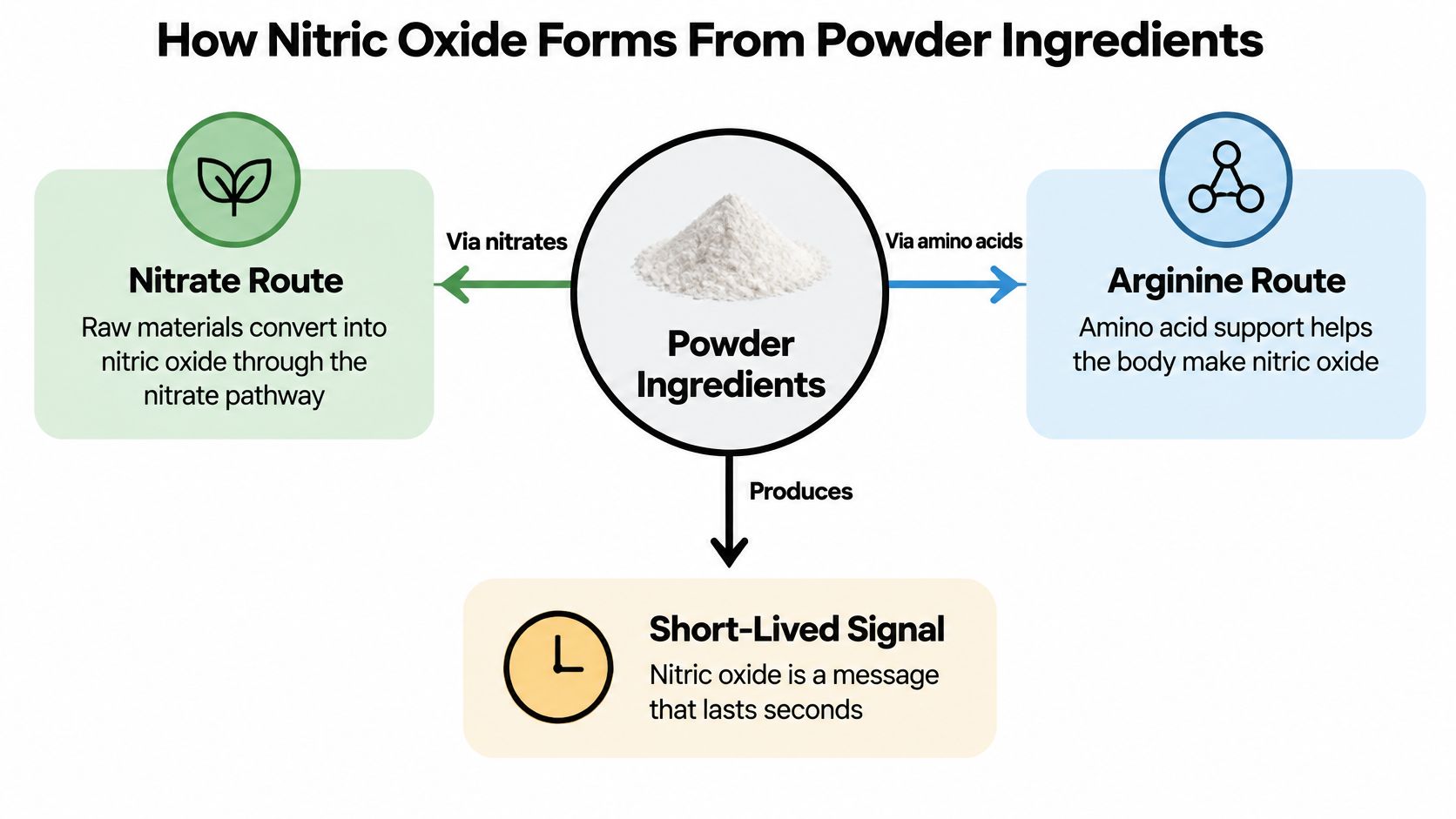
Arginine route. L-arginine is a substrate for nitric oxide synthase enzymes, especially the endothelial form. The enzyme still needs its cofactors and a tolerable oxidative balance. Extra arginine on a label does not force the enzyme to run faster if those conditions are already met. L-citrulline joins this route indirectly, because the body converts it to L-arginine.
Nitrate route. Dietary nitrate follows a separate path. Bacteria in the mouth reduce nitrate to nitrite. The body can then convert nitrite to nitric oxide, most readily when oxygen is lower and conditions are more acidic, which is closer to hard exercise than to rest. Antibacterial mouthwash can interfere with the oral step, so a "cleaner mouth" habit can work against the pathway you are trying to feed.
Vessel relaxation and oxygen delivery sit downstream of both routes. That map shows how an ingredient could act. It does not show that any single nitric oxide booster powder improves performance. Each ingredient still has to be judged by the outcome a trial measured, at a dose you can find on the label.
Beetroot Nitrate and the Best-Supported Route
Nitrate is the ingredient with the clearest performance record, and the record is narrower than marketing implies. An umbrella review of 20 systematic reviews found that nitrate supplementation improved time-to-exhaustion performance with a standardized mean difference of 0.33 (95% CI, 0.19–0.47). The gain was more pronounced when protocols supplied at least 6 mmol of nitrate daily, about 372 mg, for more than three days.
The same review also reported improvements in total distance, muscular endurance, peak power output, and time to peak power. The benefit was not uniform across every performance outcome. Read that as a specific pattern, not a blanket upgrade to fitness.
Why beet weight is the wrong number
A line that says "beetroot powder, 500 mg" tells you almost nothing. Nitrate content swings with the raw material, the extract, and the batch. You need milligrams of nitrate, not milligrams of beet.
Say a label states 372 mg of nitrate per serving. Taking that serving every day for four to six days before a test session matches the pattern above: a quantified dose, continued for more than three days. A single scoop on race morning, or a beet capsule whose nitrate is unstated, does not.
Expect better exercise tolerance and efficiency. Do not expect a guaranteed rise in maximal oxygen uptake or in strength. Nitrate-rich powders should also show serving-to-serving reproducibility, not a beet story on the front and a blank nitrate line on the back. Our guide to beet juice powder walks through how concentration on a label differs from a produce-aisle beet.
People who care about blood pressure should keep food first. DASH eating for blood pressure control is a diet pattern with a job of its own. A nitrate powder does not replace it, and it is not a treatment for hypertension.
Where the L-Citrulline and L-Arginine Evidence Stops
A change in blood markers does not establish a change in exercise performance. L-citrulline can raise nitric oxide-related metabolites because the body converts it to L-arginine. The NIH Office of Dietary Supplements notes that this biochemical change has not been directly and consistently linked to better athletic performance. Current evidence does not strongly support citrulline or citrulline malate for exercise. A higher plasma marker alone cannot show whether a session felt easier or lasted longer.
The form listed on a label matters. Pure L-citrulline and citrulline malate are different compounds, and the total weight of citrulline malate does not equal its active citrulline content. Compare the form and amount with the protocol being considered. Arginine also appears in different forms, so adding their listed weights does not establish that any one form matches a research serving.
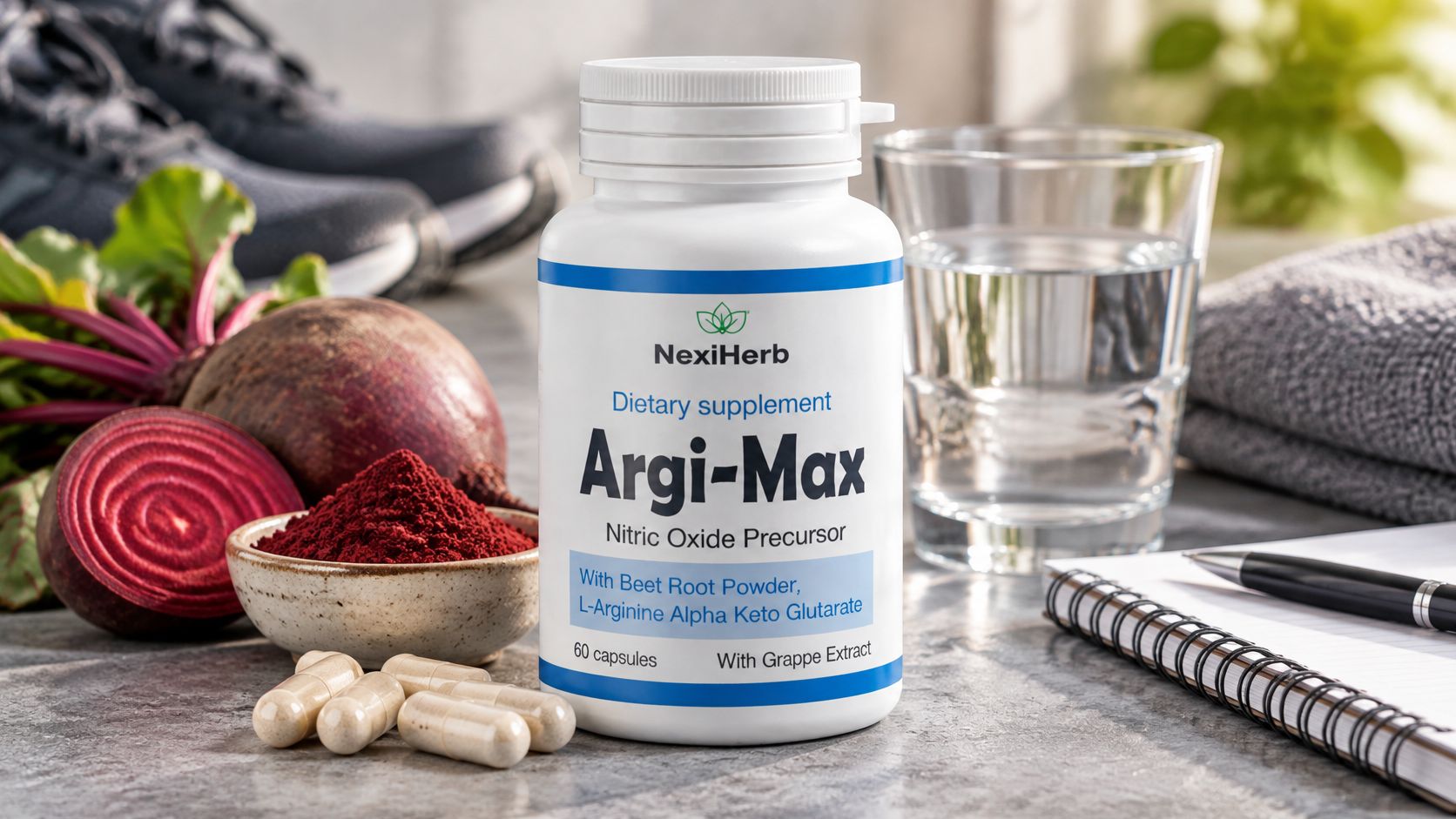
Argi-Max shows why the Supplement Facts panel matters more than a product's category name. A serving of two capsules contains 400 mg L-arginine HCL, 400 mg L-arginine alpha-ketoglutarate, 400 mg L-citrulline-DL-malate, and 100 mg beet root powder. These are the disclosed ingredient amounts; they do not establish a performance effect. The citrulline malate amount is not the same as an equal amount of pure citrulline, and beet root powder weight does not specify nitrate content.
Match the claim to something you can time
Choose an endpoint before judging an amino acid product. Otherwise, a general claim about “performance” has no clear outcome to test.
- Perceived exertion: Record whether the same pace feels easier.
- Time to exhaustion: Compare repeated efforts to failure under similar conditions.
- Muscular endurance: Count repetitions at a fixed load across comparable sessions.
- Circulation or vitality: A powder label cannot establish these as measured outcomes.
Keep the product's proposed biological pathway separate from the result you can measure. Judge an amino acid product by its disclosed ingredients and the outcome studied. Claims about disease treatment belong to clinical care, not to a supplement's nitric oxide rationale. Supplements sit alongside diet and training, not in place of medical care.
How to Read a Label Before You Buy
A product's marketing name cannot show how much of each ingredient a serving provides. The Supplement Facts panel does. Start with the serving size, then check servings per container and the form and amount of each active ingredient. A serving of two capsules calls for different arithmetic from one scoop, even if both packages use the same category name.
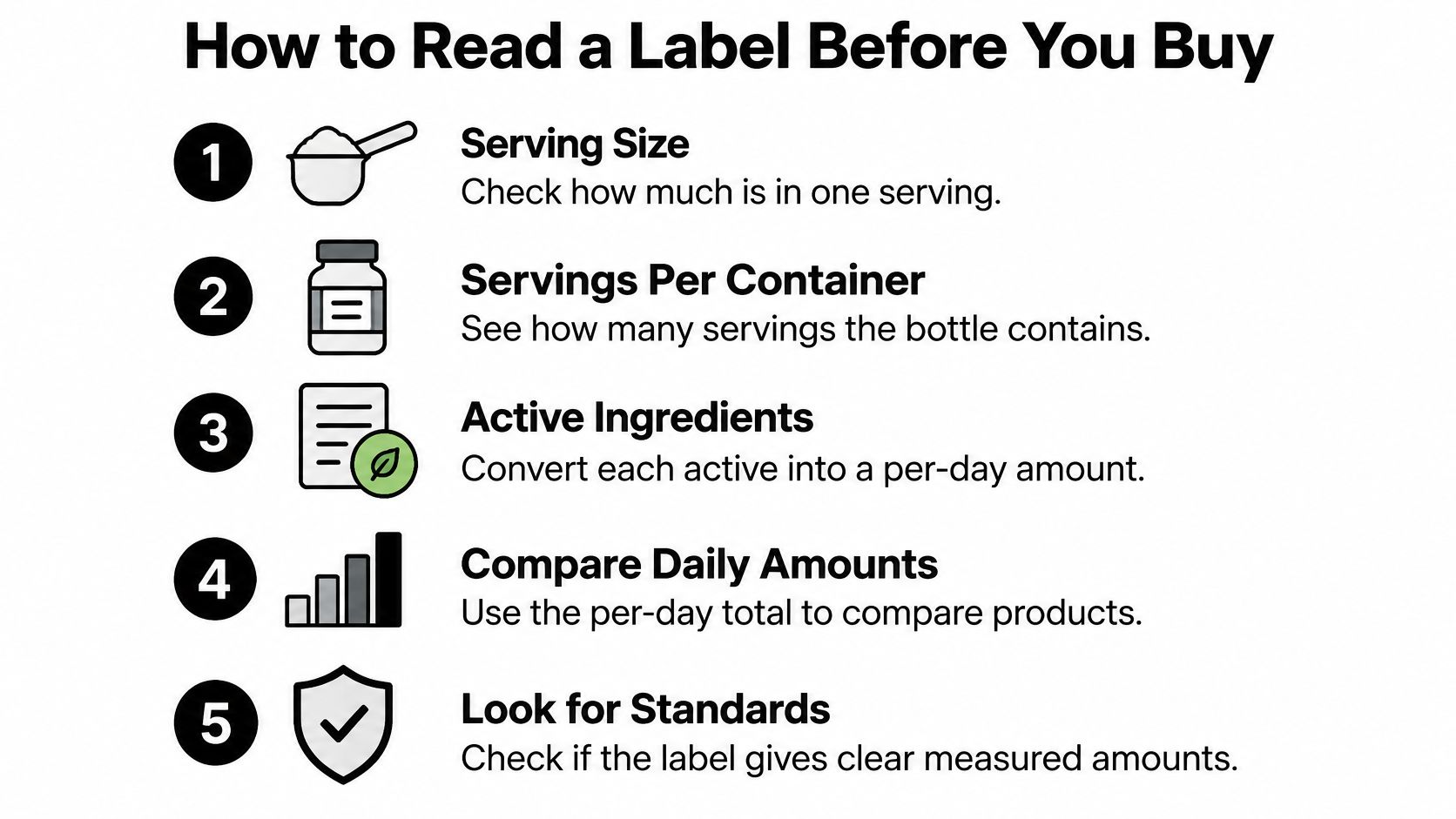
- Serving size. Check how many capsules or grams make one serving. Use that amount as the starting point for every comparison.
- Servings per container. Check how many servings the package holds, then calculate the total if your planned intake differs from one serving. Compare that daily amount with the protocol you are considering.
- Form and milligrams. Arginine hydrochloride, citrulline malate, and pure citrulline are not interchangeable label entries. For beetroot, distinguish the weight of the powder or extract from a stated nitrate amount.
- Amounts disclosed. Read the listed milligrams for each active ingredient. If the panel gives only a combined amount for a proprietary blend, it does not show how much of each ingredient a serving contains.
- Other ingredients. Check for caffeine, other stimulants, and botanicals. These can affect how a product feels and may matter when assessing the whole formula.
Quality marks can answer a separate question from ingredient amounts. NSF Certified for Sport, USP Verified, and Informed Choice marks relate to product contents and screening; check that the relevant mark appears on the package itself.
A label's disclaimer sets out the product's stated regulatory limits; it does not establish a performance effect. Nitric-Ox combines nitrate-standardized beet root extract and Coenzyme Q10. Its serving size is 2 capsules, with 30 servings per container. The product's statements have not been evaluated by the Food and Drug Administration, and it is not intended to diagnose, treat, cure, or prevent any disease. Check the batch or lot number and expiry date as well. This guide to how to read supplement labels applies the same label-reading approach across products.
Safety, Side Effects and Dosing Limits
A nitric oxide pathway can affect blood pressure, but the likely risk depends on the ingredients and medicines used together. Arginine can cause gastrointestinal discomfort and may slightly lower blood pressure at higher intakes, as described in WebMD's citrulline overview. Evidence on citrulline's longer-term safety is limited. “Plant-based” does not mean interaction-free: beet, grape seed, and amino acids may still add to the effects of blood-pressure medicines.
Citrulline may interact with erectile-dysfunction drugs such as sildenafil and tadalafil, prescription nitrates used for heart disease, and blood-pressure medicines. Combining agents that lower blood pressure could cause an unsafe drop. Stimulants in a pre-workout add a separate concern, unrelated to nitric oxide production.
| Situation | Ingredient concern | Action before use |
|---|---|---|
| Sildenafil or tadalafil | Citrulline may add to blood-pressure lowering | Ask a prescriber before combining |
| Prescription nitrates for heart disease | Possible unsafe drop in blood pressure | Get professional review first |
| Blood-pressure medicines | Additive lowering of blood pressure | Check with a clinician before starting |
| Low blood pressure or cardiovascular disease | Arginine and citrulline may lower pressure further | Seek professional advice |
| Pregnancy or breastfeeding | Limited safety data at these amino acid doses | Avoid unless a clinician approves |
| Pre-workout or stimulant products | Stacked stimulants unrelated to nitric oxide | Add up total intake and review the full label |
A single-ingredient nitrate product presents a different set of considerations from a multi-ingredient blend. Before the first serving, total every source of arginine, citrulline, nitrate, and stimulants in supplements and over-the-counter products. Include minerals in that review: whole food magnesium supplements are a separate dosing decision, and combining supplements without checking their effects can add to blood-pressure concerns.
Use a specific rule: add up every arginine, citrulline, and nitrate source per day before the first serving, then follow the product label. These products are intended for adults and should be used only as the label instructs. For a broader review of whether nitric oxide supplements are safe, consider the ingredients and your medicines together, and ask a prescriber who knows your health history before combining products.
Use Cases for Athletes and Daily Wellness Routines
A powder's use case depends on its disclosed ingredients and the outcome you can track. A nitrate routine aimed at endurance differs from taking an amino acid before strength training, while a daily wellness routine may have no training outcome to measure.
| Routine | Main ingredient | Timing | Time before judging |
|---|---|---|---|
| Endurance or interval training | Dietary nitrate with a stated dose | Use a practical trial window before sessions; keep intake consistent during loading | At least 3-4 days of consistent intake |
| Strength or sprint training | L-citrulline or L-arginine in labelled grams | Trial a consistent schedule around sessions | No validated window |
| Daily wellness without structured training | Nitrate or amino acid per label | With a meal, once daily | No validated window |
Endurance or intervals. Consider nitrate only when the label states the nitrate dose. A pre-session window can be tested as a practical routine, but the timing is not a validated guarantee of performance. Keep the stated daily amount consistent through a loading period of at least three to four days, then track tolerance and efficiency rather than expecting a new personal best.
Strength or sprints. An amino acid serving is worth considering only when the label discloses the amount in grams. Choose a consistent schedule around training and record one outcome. Performance evidence is weak, so treat the routine as a trial rather than a proven strength aid.
Days without training. Take the labelled serving with a meal if that suits the product directions. There is no validated window for expecting a wellness change. If no measurable outcome changes, reconsider whether the powder has a useful role in the routine.

For a Sunday race, a practical test would be to take the stated nitrate dose consistently from Wednesday through Saturday, including before key sessions, then follow the label on race day. Avoid adding an extra scoop “just in case.” On a rest day, keep to the normal amount rather than doubling up. Log one measure, such as time at a set pace or session RPE, so the routine has a defined outcome.
Recovery products follow a separate schedule. The guide to muscle recovery supplement dosing and timing can help distinguish a post-workout formula from a pre-session nitrate dose and prompt a check of total intake. Separate the intended roles of each product, then judge each by its own measurable purpose.
Decide Whether a Nitric Oxide Booster Powder Fits Your Routine
A useful trial answers a practical question: does the product improve an outcome you care about, enough to justify continuing it?
First, choose one goal. For endurance, nitrate may be relevant; for general wellness, prioritize a product you can use consistently with a meal. The goal narrows which ingredient and outcome matter.
Next, decide what result would count as a benefit. For training, track one measure, such as time at a set pace or perceived exertion during a comparable session. Keep the routine steady so changes are easier to interpret.
Use the five-point label check above, then review whether any medicines or blood-pressure concerns call for advice from a clinician before taking the product.
Set a stopping rule before you begin: assess the same outcome after three to four weeks, and stop if it has not meaningfully changed. A simple log can record the date, serving, session or routine, and the chosen outcome. A noticeable sensation alone is not evidence of improved performance.
NexiHerb LLC offers dietary supplements, including amino acids and nitric oxide support formulas. Compare the label and intended use before choosing a powder or capsule option. Visit NexiHerb LLC to compare products and select a routine you can assess.