

The most popular advice on tiredness is simple. Buy vitamin B12, and your energy will come back. That shortcut skips the only question that matters: whether your level is low.
Vitamin B12 for energy is a real biological link, not a universal boost. The vitamin supports the chemistry that lets cells use food. Taking more of it doesn't lift energy when your status is already adequate. A normal result is where most of those marketing claims fall apart.
What follows is a plain walk through the jobs B12 does, how to read a borderline lab value, and which other problems deserve a look before you spend money on another bottle.
Table of Contents
- Does Vitamin B12 Really Boost Energy?
- Low B12 Signs and the Groups Most at Risk
- Reading Your B12 Blood Test Correctly
- Identifying Other Causes of Fatigue
- How Oral and Injectable B12 Reach Your Blood
- Which B12 Form and Dose to Consider
- Confirm Your B12 Status Before You Supplement
Does Vitamin B12 Really Boost Energy?
The energy claim has a clear limit: B12 can help when deficiency is the problem. It is not a general-purpose stimulant. In cells, B12 works like a specialized worker on a factory line. When too few workers are available, production slows; adding more to a fully staffed line does not speed it up.
Two jobs that actually affect how you feel
B12 supports red blood cell formation, which helps carry oxygen to muscles and the brain. It also helps enzymes process fats and amino acids in cells and nerves. When deficiency is real, it can contribute to megaloblastic anemia, fatigue, palpitations, and neurological changes, according to the NIH Office of Dietary Supplements fact sheet.

Correcting deficiency may ease tiredness related to that deficiency over time. Supplementation has not been shown to improve energy, athletic performance, or endurance in people whose B12 status is adequate.
A small 2025 randomized, placebo-controlled study of healthy male amateur cyclists reported a 4.1% increase in maximum physical power and a 6.4% decrease in fatigue after three days of 1 mg methylcobalamin, according to Nutritional Outlook's report on the trial. The short duration and specific group limit what the results can establish. They do not show that people with normal B12 will feel more energetic in everyday life.
Low B12 Signs and the Groups Most at Risk
A 64-year-old retired teacher, vegetarian, fading by mid-afternoon, walks in with two risk factors at once. Age lowers stomach acid, so B12 stays bound to food protein instead of being freed for absorption. A diet without animal foods or fortified products removes the usual source. A serum B12 test, plus a blood count if she is short of breath or pale, tells you more than a wellness shot chosen from an ad.
Fatigue that hangs on for weeks can come with other clues. Breathlessness on exertion, pale skin, and palpitations sit alongside tiredness. So do numbness or tingling in the hands and feet, balance trouble, low mood, memory fog, and a sore or red tongue.
None of those signs belongs to B12 alone. Iron deficiency, thyroid disease, poor sleep, and medication effects can look the same. The list is a reason to test, not a reason to diagnose yourself from a symptom checker. A result that later reads clearly normal is where most energy claims fall apart. Check other causes of fatigue before you buy a supplement.
Who should consider B12 testing
| Group | Main reason for risk | Suggested check |
|---|---|---|
| Adults aged 60 and older | Lower stomach acid reduces B12 release from food | Serum B12, with a blood count if symptomatic |
| Strict vegetarians and vegans | No animal foods or fortified foods in the diet | Serum B12 and supplement guidance from a clinician |
| People taking metformin or long-term acid reducers | Medication can reduce absorption over time | Periodic testing discussed with the prescriber |
| People after stomach or intestinal surgery, or with celiac or Crohn's disease | Impaired absorption in the gut | Clinician-guided testing and treatment plan |
| Pregnant people | Higher demand during pregnancy | Ask about B12 status in prenatal care |
People sometimes ask whether an injection is the faster fix. A clear look at B12 injection benefits and limitations helps separate medical replacement from a same-day energy promise. Food patterns matter too, including how vitamin D and B vitamins fit a diet that may already be thin on animal foods.
Ask for testing sooner if you have neurological symptoms, anemia on a blood count, or fatigue that persists despite decent sleep. Those aren't wait-and-see problems.
Reading Your B12 Blood Test Correctly
One serum number is a starting point, not a full picture of whether B12 is reaching your cells.
Many laboratories treat serum B12 below about 200–250 pg/mL (148–185 pmol/L) as subnormal, and assay cutoffs vary. An intermediate band of roughly 150–399 pg/mL is the awkward middle: low enough to raise concern, high enough that the report may not say "deficient." Serum methylmalonic acid (MMA) helps sort that band. The NIH Office of Dietary Supplements cites an MMA concentration above 0.271 micromol/L as suggestive of deficiency. Kidney impairment and some other conditions can raise MMA, so a clinician reads that number against kidney function, not on its own. MMA, and sometimes homocysteine, are the follow-up tests used when the serum result is hard to call. Tiredness by itself does not point to one cause.
What each band suggests
| Result | What it suggests | Next step |
|---|---|---|
| Above 350 pg/mL (258 pmol/L) | Generally adequate | No supplement for energy alone; investigate persistent fatigue |
| MMA above 0.271 µmol/L | Suggestive of deficiency | Clinician review; kidney function can confound the result |
A result above that upper line is where most energy claims fall apart. Serum B12 works like a traffic light with a long yellow band. A clearly adequate result is green: the vitamin is not the missing fuel, so another capsule should not be expected to raise energy or endurance. The yellow band is those intermediate serum values, where the sensible move is a confirming test rather than a bottle chosen the same day.
Holotranscobalamin, sometimes called active B12, is getting more attention as an early marker. Labs don't all offer it, and interpretation isn't uniform. A vitamin B12 level assessment that lists which markers a lab runs is more useful than assuming every panel is the same.
A 52-year-old comes in with a serum B12 of 240 pg/mL and ongoing fatigue. That value sits where many labs hesitate. The next step is an MMA test before any supplement. A confirmed deficiency can reasonably be expected to improve B12-related fatigue over time. A normal status should not be expected to deliver a measurable energy or endurance benefit from taking more.
Bring three questions to the visit.
- Which tests were run: Serum B12 alone, or MMA, homocysteine, or holotranscobalamin as well.
- What reference range the lab printed: Cutoffs aren't identical from one assay to the next.
- Whether MMA was checked: Especially if the serum result sits in an intermediate band.
Testing belongs with a healthcare professional when symptoms are significant, nerves are involved, anemia is suspected, or absorption problems are possible. Oral or injectable replacement follows the cause the tests support.
Identifying Other Causes of Fatigue
A normal B12 result is where most energy claims fall apart. The number looks fine, and the exhaustion is still there. B12 works like a spark plug: it matters if that part is missing, and it does nothing if the problem is sleep, iron, or training load.
A 2025 clinical review in American Family Physician identifies serum B12 below 180 pg/mL as diagnostic for deficiency, while borderline values of 180–350 pg/mL may warrant methylmalonic acid testing. It also advises weighing risk factors and symptoms rather than screening everyone. A result clearly above that deficient and borderline zone means B12 is not the explanation, and the search moves on.
Checks worth doing before another bottle
- Sleep: Log hours and quality for two weeks, including shift work and possible apnea.
- Iron: Full blood count, ferritin, and iron studies. Low iron tires people whose B12 is fine.
- Thyroid: A TSH test, because thyroid disease can look like plain exhaustion.
- Glucose: Daily patterns, and control if you live with diabetes.
- Medications: Review sedating antihistamines, beta-blockers, and some antidepressants with the prescriber.
- Alcohol: Count a typical week, not your best one.
- Mood: Low mood, anxiety, and ongoing stress often show up as tiredness.
A 35-year-old runner's training log shows rising mileage, two short nights, and heavy legs after easy runs. Serum B12 is normal, and a high-dose tablet is already in the cart. A blood count, iron studies, and an honest look at training load and sleep are the better next moves. Overtraining or low iron would explain the slump. More B12 would not. Broader options people consider are covered in this guide to supplements for fatigue, and they still sit behind a clinical workup.
Supplementation makes sense when deficiency is confirmed. A normal result leaves the cause of the fatigue open. Fatigue that lasts several weeks deserves a clinician visit.
How Oral and Injectable B12 Reach Your Blood
Food B12 must pass through several steps before it reaches the bloodstream. Stomach acid releases it from protein, then it binds to intrinsic factor, a protein made in the stomach. The B12–intrinsic factor pair is absorbed in the lower small intestine.
Intrinsic factor is the key; the gut wall is the lock. When this process is impaired, eating B12-rich foods may not provide enough.
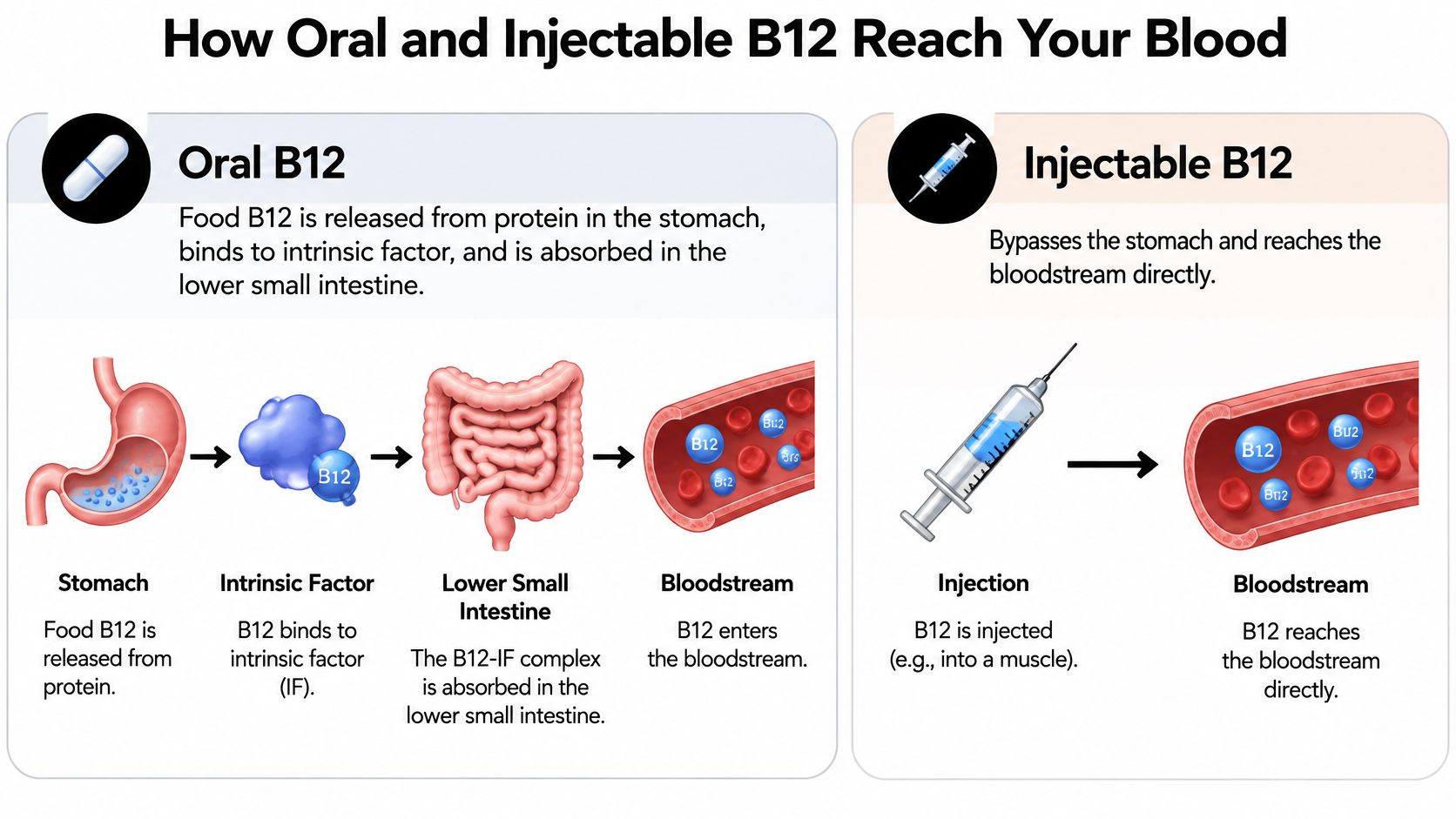
Oral tablets and injections side by side
| Route | Who it usually suits | How absorption works | Who sets the regimen |
|---|---|---|---|
| Oral supplement at everyday doses | Adults with normal absorption and mild or borderline status | Small amounts absorb mainly with intrinsic factor | Self-selected or clinician-advised |
| Oral high dose (1,000 µg or more) | Some people with malabsorption, under medical guidance | About 1% can be absorbed passively without intrinsic factor (NIH Office of Dietary Supplements) | Clinician |
| Intramuscular injection | Confirmed deficiency, pernicious anemia, neurological symptoms | Bypasses the gut absorption step | Clinician only |
Clinicians may favor injections when deficiency is confirmed alongside neurological symptoms, when levels are very low, or when pernicious anemia or surgery makes absorption unreliable. They set the initial schedule and maintenance plan according to the cause and clinical picture.
People comparing clinic options can read how B12 injections at Luxe Aesthetic Surgery are offered, then ask their own clinician whether an injection fits their situation. A swallowed tablet and a melt-under-the-tongue product use different formats; this guide to sublingual B vitamins explains the distinction.
A short explainer on the absorption path can help make the route comparison clearer.
The route depends on what is disrupting B12 absorption. With normal absorption, an oral product can use the usual pathway; when that pathway is impaired, a clinician can choose an appropriate plan.
Which B12 Form and Dose to Consider
For someone with a normal B12 result, the form on a supplement label is unlikely to explain persistent fatigue. The first question is whether a supplement fills a dietary gap or addresses a deficiency identified by a clinician.
Forms you'll see on a label
- Cyanocobalamin: A stable form used in many fortified foods and tablets. The body converts it to active forms.
- Methylcobalamin: One of B12's active coenzyme forms, often highlighted on supplement labels.
- Adenosylcobalamin: The other active coenzyme form, usually found in combination products.
- Hydroxocobalamin: A form used for injections in some clinical settings.
The label form is only one part of the choice. Whether you need B12, and the amount appropriate for your situation, matter more.
Oral supplement labels commonly list amounts from a few hundred micrograms to about a milligram per serving. A clinician should determine the dose when deficiency has been diagnosed. A high amount on a label does not explain fatigue on its own.
A three-part label check
- Find the form. Cyanocobalamin and methylcobalamin are two forms you may see in general-use supplements.
- Read the micrograms per serving. A serving of two capsules in a B-complex product may differ from one capsule of a single-ingredient product.
- Check the percent Daily Value. This shows how the serving compares with the reference intake printed on the label.
Clams, beef liver, fish, eggs, dairy, fortified cereal, and nutritional yeast can supply B12. If these foods are regularly part of your diet, consider whether a separate high-dose product meets a specific need before adding one.
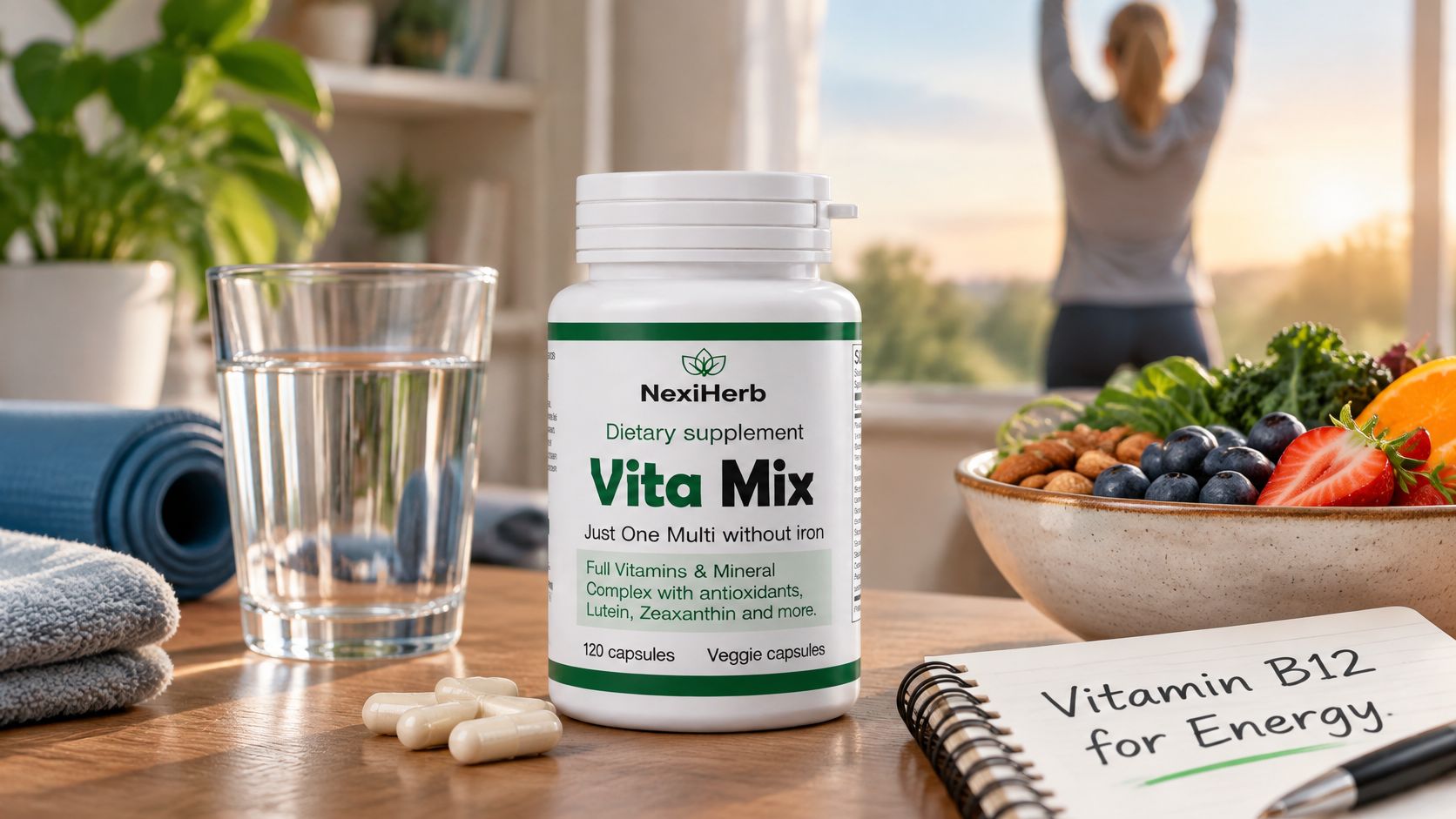
Some adults prefer one product combining several nutrients rather than separate single-vitamin supplements. Vita Mix NexiHerb Multivitamin & Mineral Dietary Supplement combines carefully selected vitamins and minerals. Use a multivitamin to help cover everyday dietary gaps, and discuss a diagnosed deficiency with a clinician.
If you take metformin, long-term acid reducers, or other regular medicines, ask a clinician whether they affect your B12 needs. Persistent tiredness deserves a proper assessment, not an unexplained high-dose supplement.
Confirm Your B12 Status Before You Supplement
Let the lab result guide whether you supplement and what to ask next.
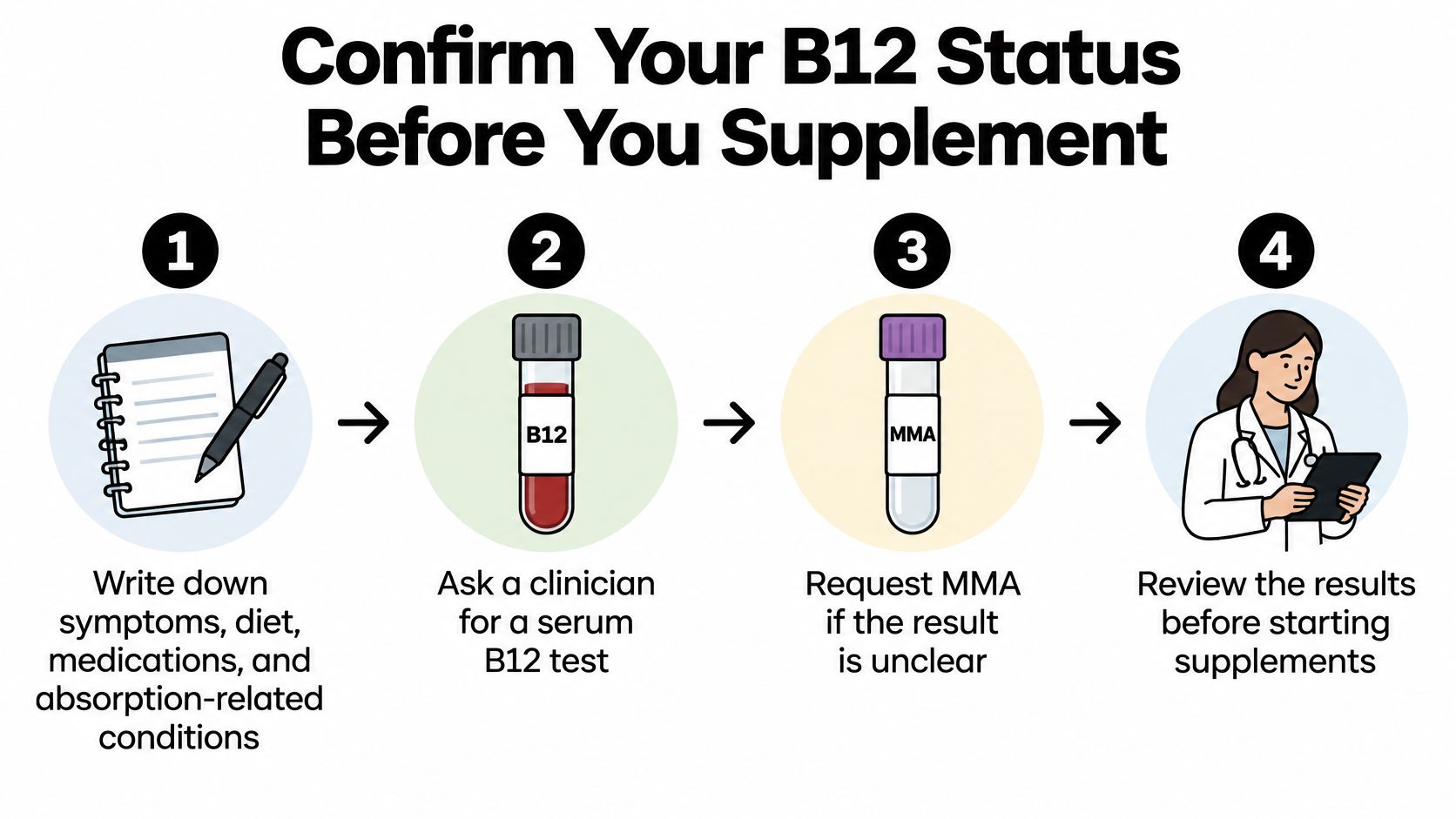
- Write it down. Note your symptoms, usual diet, medicines, and any condition that may affect absorption.
- Ask for serum B12. If the result is borderline, ask your clinician whether methylmalonic acid (MMA) testing would help clarify it.
- If deficiency is confirmed, follow the oral or injectable plan your clinician recommends and arrange the advised follow-up test.
- If B12 is normal, ask what else could explain fatigue, including whether iron studies, thyroid testing, or a review of sleep is appropriate.
- If your diet leaves a gap, choose a form and labeled dose you can take consistently, without exceeding the product's directions.
A diet gap can develop when someone avoids animal foods and fortified foods over time. Pernicious anemia and absorption problems after surgery involve different causes and may need a clinician's assessment to guide treatment.
Supplements are meant to complement a varied diet and healthy lifestyle, not replace a balanced diet.
Bring the lab printout to your next visit, along with a record of your symptoms.
Keep the result, test date, and symptom notes together. That gives you and your clinician a clearer starting point for discussing what to check or do next.
NexiHerb LLC offers science-inspired dietary supplements, including multivitamins with B-complex vitamins, for adults seeking everyday nutrition support alongside a varied diet. If you're considering a formula to fit your routine, visit NexiHerb LLC to browse its catalog and nutrition guides.