

Stop chasing soreness. Most popular recovery advice tells you to foam roll harder, buy compression gear, and rate how wrecked you feel in the morning, as if pain proves the workout worked. In real training logs, the lifters and runners who progress longest are rarely the sorest. They're the ones who can repeat quality work, week after week. That's the reframe for learning how to improve workout recovery. Recovery isn't a reward after training. It's a measurable training variable, judged by performance, not vibes.
Table of Contents
- Why Recovery Is Where the Real Training Happens
- Sleep as a Performance Lever You Can Actually Extend
- Post-Workout Fueling That Beats the Anabolic Window Myth
- Mobility Work and Active Recovery That Earn Their Place
- Load Management and Periodization to Prevent Breakdown
- Supplements That Actually Complement a Solid Routine
- Building Your Weekly Recovery Plan and Tracking What Matters
Why Recovery Is Where the Real Training Happens
A workout creates the stimulus. It doesn't create the adaptation. During hard training you deplete glycogen, damage muscle proteins, and stress your nervous system. Between sessions, your body replaces fuel, turns over muscle protein, and restores coordination and force output. Shortchange that window and the next session starts with borrowed capacity, no matter how disciplined the program looks on paper.

Soreness is a weak scoreboard. You can be sore and still perform well, and you can feel fine while strength, sprint output, or endurance drops. Novices get especially misled here because unfamiliar movements produce soreness easily. Familiar, productive training often produces less of it. If soreness is your main metric, you'll chase novelty instead of progression and mistake discomfort for effectiveness.
What adaptation actually requires
Think of recovery as several jobs running in parallel. Muscle needs energy and amino acids to rebuild. Glycogen stores need carbohydrate and time to refill. Your nervous system needs sleep and lower stress to restore reaction time, accuracy, and motivation to train. None of these jobs cares about your motivation playlist. They respond to sleep, fuel, fluids, movement, and load, applied consistently.
If you can't describe what improved, you don't know whether recovery worked. You only know how you felt.
That distinction matters because feelings fluctuate for reasons that have nothing to do with tissue readiness. Work stress, a poor night's sleep, dehydration, or an unusually hard day can all color perceived recovery. Performance clues are harder to fake. Can you hit your planned weights with normal bar speed? Can you complete intervals at your usual pace without perceived exertion spiking? Can you finish the session you planned, rather than cutting it short again?
Seven levers, one system
The levers that move those answers aren't exotic. They are sleep duration, post workout fueling, hydration, low load movement, intelligent programming, selective supplementation, and honest tracking. The mistake is treating them as separate hacks. A supplement can't outrun chronic sleep restriction. Perfect nutrition can't repair a calendar with no easy days. Mobility work can't compensate for training hard every time you feel guilty.
Build recovery like you build training. Choose a lever, set a benchmark, run it long enough to see a trend, and keep what moves performance. Drop rituals that only consume time and money. That approach fits a recreational lifter with a job and a family just as well as it fits an endurance athlete, because it starts with what's measurable in your actual life.
Sleep as a Performance Lever You Can Actually Extend
Sleep advice usually stops at hygiene tips. Dark room, cool bedroom, no late caffeine. Those habits can help you fall asleep, but they don't guarantee you get enough sleep. The narrative review on athlete sleep and performance reported elite athletes averaged approximately 6.5 hours per night with actigraphy, 39.1% self reported fewer than 7 hours, and athletes reported insufficient sleep on 3.8 nights per week. That gap is the problem to fix.
Adequate sleep in that literature was associated with better reaction time, accuracy, endurance, cognitive function, and psychological resilience. You don't need to be elite for the same trade off to show up in your log. When sleep drops, warm ups feel heavier, pacing gets sloppy, and you start negotiating with yourself mid session. That's not a character flaw. That's under recovery.
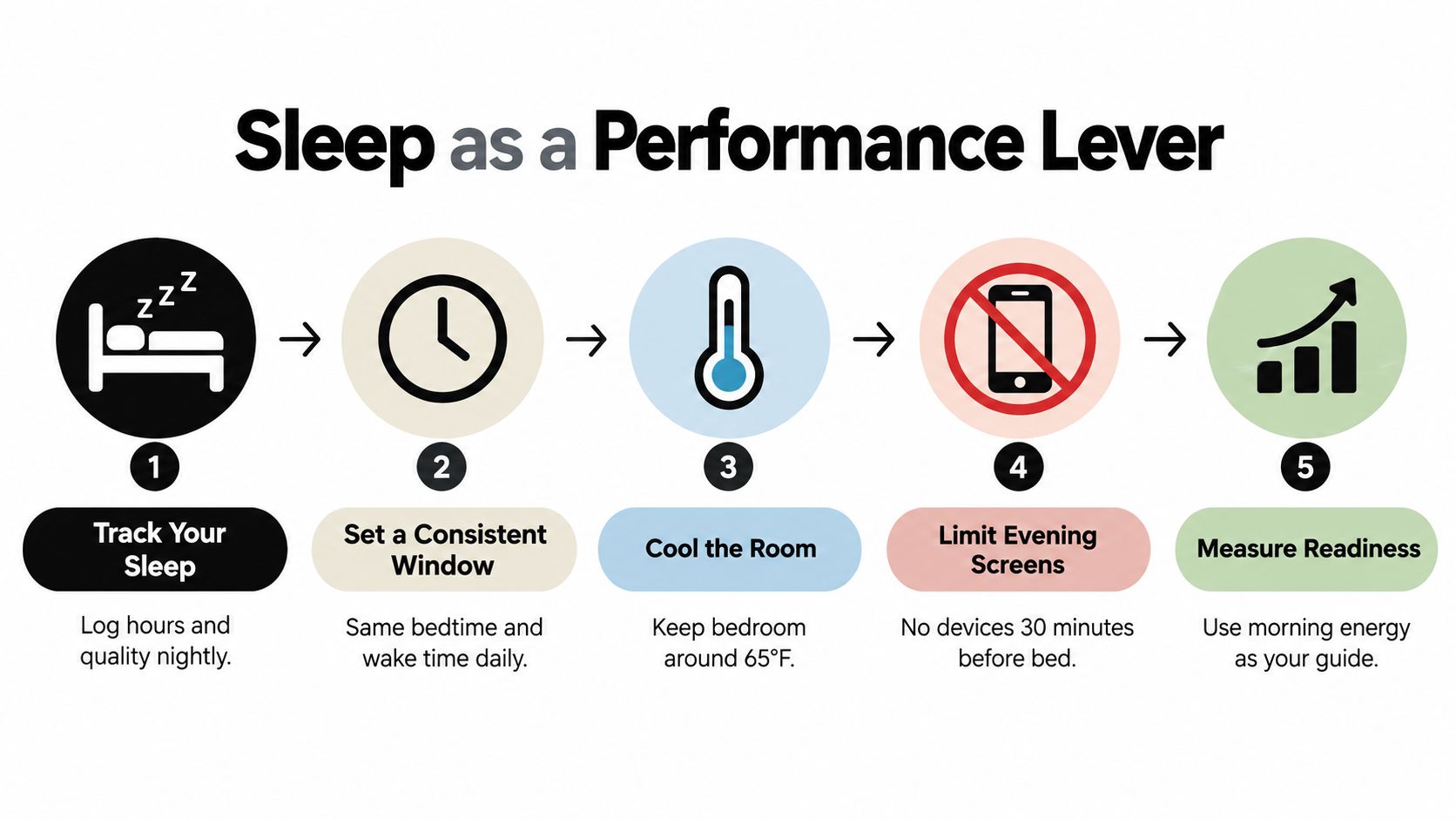
Run a sleep extension block
Use this protocol instead of guessing:
- Baseline for 7 days: Record total sleep time, sleep latency, awakenings, training load, and next day performance in a diary or with a validated wearable, as described in the systematic review of sleep extension in young athletes.
- Add 30 to 60 minutes in bed: Keep that extension nightly for 2 to 4 weeks and hold wake time consistent.
- Nap if nights are capped: Use a strategically timed daytime nap when work or family schedules block longer nights.
- Judge by performance: Pick one benchmark in advance, such as reaction time, repeated sprint output, session completion, or perceived exertion.
That review covered 10 studies involving 218 young athletes and found sleep extension produced the most consistently favorable effects on subsequent performance. A newer review of 25 studies identified sleep extension and napping as the most promising interventions. It reported no clear effect of sleep hygiene alone on performance recovery, creatine kinase, C reactive protein, or cognition.
Wake time consistency matters because it's the anchor you can control. Bedtime perfection fails on travel days and late practices. A stable wake time makes the extra time in bed real instead of borrowed from tomorrow. For broader context on building an environment that supports that routine, this guide to restful nights connects exercise timing and bedroom setup in a practical way. If you're also evaluating nighttime nutrients, read the overview of ZMA for sleep support before adding anything, and don't change supplements and sleep duration in the same week.
Practical rule: Extend sleep opportunity first. Optimize the bedroom second.
Don't judge the block by soreness or by one great morning. Judge it by whether hard sessions get completed at planned quality more often. That's a return you can see in the log.
Post-Workout Fueling That Beats the Anabolic Window Myth
The frantic sprint to a shake within minutes is mostly marketing theater for recreational athletes. What matters is whether another demanding session is coming soon, and whether your total day covers energy, carbohydrate, protein, and fluids. A normal protein containing meal after training, plus enough food across the day, beats a perfectly timed product inside an under fueled diet.

Timing does get serious when recovery time is short. The review on carbohydrate intake for glycogen resynthesis concluded people with 8 hours or less between exercise bouts should prioritize carbohydrate to accelerate muscle glycogen resynthesis. In one summarized protocol, 0.8 grams per kilogram per hour of carbohydrate plus 0.4 grams per kilogram per hour of protein during the first 2 hours of an 18 hour recovery period produced about 14 additional minutes of subsequent exercise capacity compared with carbohydrate alone at 1.2 grams per kilogram per hour.
Translate the math into food
You don't need to weigh every meal forever. Use those numbers to understand scale. After a long ride or a double session day, a small shake and good intentions won't refill the tank. You need a substantial meal with rice, potatoes, oats, pasta, or bread plus chicken, fish, eggs, dairy, or another protein source, then another normal meal later. Endurance athletes planning during ride fuel can compare that post ride thinking with Rider 18's MTB fueling advice, which focuses on energy intake for mountain biking contexts.
Combined carbohydrate and protein intake was also associated with approximately 1.6% higher mean cycling time trial power and 0.6% better competitive running performance in the summarized endurance evidence. Those are small margins, but small margins decide whether the last interval holds together. For a once daily lifter with a full day before the next session, total daily adequacy usually matters more than minute by minute precision.
Watch how practical fueling choices look when a coach breaks them down on video:
Hydration and the decision tree
For fluids, the American College of Sports Medicine recommendation cited in the review is 1.25 to 1.5 liters for each kilogram of body mass lost during exercise. Weighing before and after matters most after long, hot, or heavily sweated sessions. For a short indoor workout where weight barely changes, drinking to thirst with meals is usually a saner use of attention.
Keep the decision simple:
- Another hard session within a day: Prioritize carbohydrate early, include protein, and replace fluid losses deliberately.
- A full recovery day ahead: Eat a normal protein containing meal and hit your daily totals without panic.
- Appetite is low: Use a shake or liquid meal as a bridge, not as a replacement for food later.
If amino acid timing is part of your routine, the guide to the best time to take aminos helps place that decision inside total intake rather than treating it as magic. Benchmark success by next session strength, training volume completed, and repeatability, not by whether soreness vanished.
Mobility Work and Active Recovery That Earn Their Place
Mobility work earns its place when it helps you train well tomorrow. It doesn't earn its place because a routine looks impressive online. The useful version is low load movement that increases blood flow, restores comfortable range of motion, and leaves you feeling looser without adding fatigue. The wasteful version is aggressive stretching of already irritated tissue or a recovery workout that's secretly another workout.

Start by asking what tomorrow requires. A lifter squatting again needs hips, ankles, and thoracic spine moving comfortably. A runner needs calves, hips, and feet tolerating normal stride mechanics. A field sport athlete needs change of direction positions available without guarding. Choose movements that serve that demand, not a generic full body ritual copied from someone else's sport.
Build a short menu you will repeat
Controlled articular rotations, easy bodyweight patterns through comfortable ranges, light sled or bike work, and brisk walking all fit the same purpose. They move joints, raise temperature slightly, and give you feedback about stiffness or sharp pain. Foam rolling can be part of that menu if it helps you relax and move better afterward. If it only bruises you and eats time, drop it without guilt.
For exercises organized by joint and goal, use this practical guide to improving mobility to select a small set rather than collecting dozens. Pick a few movements for your limiting areas, practice them with control, and retest the position you care about. Better squat depth with stable feet is feedback. More time spent rolling is not.
- Easy spin or walk: Best when legs feel heavy but joints feel sound and you want circulation without impact.
- Light mobility circuit: Best when range of motion is the limiter for tomorrow's lifts or drills.
- Full rest: Best when you're exhausted, ill, sleeping poorly, or dealing with pain that changes how you move.
Active recovery should end with you feeling better than when you started. If it doesn't, it wasn't recovery.
Same day mobility works well after training while you're warm, provided intensity stays low. Dedicated recovery day work works when the session itself was so demanding that adding anything afterward would be counterproductive. Skip it entirely when sleep or food is the missing input. An extra hour in bed or a real meal will do more than another circuit performed while depleted. Keep the dose modest, repeat what helps, and let next session quality decide whether the work stays.
Load Management and Periodization to Prevent Breakdown
No recovery tool fixes a program that asks for peak effort too often. Most breakdowns I see in recreational athletes aren't caused by one bad workout. They build when hard days stack, easy days drift upward, and life stress gets ignored because it's not written in the training plan. Sleep loss, work deadlines, travel, and illness all draw from the same recovery budget as training.
Periodization sounds academic, but the practical version is simple. Separate hard, moderate, and easy days on purpose. Hard days create the main stimulus and deserve the best sleep and fueling around them. Moderate days build volume and skill without chasing exhaustion. Easy days protect the hard days. When every session becomes moderate to hard, you get tired without getting much better, which is the worst trade in training.
Track load without overcomplicating it
Session rating of perceived exertion multiplied by duration gives you a usable load number without wearable subscriptions. Write it down with the session notes. One spike doesn't tell you much. A rising trend alongside falling performance, disturbed sleep, persistent heaviness, or recurring small aches tells you load is outpacing recovery. React to trends, not to a single ugly Tuesday.
Watch for these warning patterns:
- Performance slides first: Planned weights, paces, or intervals repeatedly miss despite normal effort.
- Warm ups stop working: You never quite loosen up or find rhythm, even after a thorough preparation.
- Motivation and sleep erode together: You dread sessions you normally enjoy and wake unrefreshed.
- Minor issues rotate: A knee complains one week, a shoulder the next, then a hamstring joins in.
Deload before you're forced to
A planned deload is a reduction in volume or intensity while keeping movement familiar. You keep the groove, lose fatigue, and return ready to progress. Waiting for injury or burnout to impose rest costs more time and usually costs fitness too. Treat deloads as part of progression, not as an admission of weakness.
Adjust inputs when life load rises. During a brutal work stretch, keep hard days hard but trim accessory volume, protect sleep opportunity, and make easy days easy. During calmer weeks, you can push volume with more confidence. That's how to improve workout recovery at the calendar level. You match demand to capacity before your body negotiates for you, usually less politely.
The honest test is repeatability. A well managed week lets you show up for the next hard session ready to work. A poorly managed week looks heroic in a screenshot and disappointing in the results column.
Supplements That Actually Complement a Solid Routine
Supplements sit at the top of the recovery pyramid, not the base. If sleep is short, meals are inconsistent, and training load is reckless, a capsule won't reorganize your physiology. Once those foundations are stable, a short and intentional list can fill specific gaps. The goal is complementing food and sleep, not building a cabinet of hope.

Sort products by job. Protein and amino acid products are mainly convenience tools for hitting intake when meals fall short. Omega 3s and antioxidants are usually considered for general nutritional support within a varied diet. Joint focused nutrients such as glucosamine or collagen appeal to athletes thinking about connective tissue comfort over time. Adaptogens and botanical blends are typically positioned around stress and vitality. Those roles differ, so stacking everything at once teaches you nothing about what helped.
| Category | Recovery Role | What to Look For |
|---|---|---|
| Protein and amino acids | Helps cover daily protein needs when food is impractical | Clear dose per serving and a flavor or format you'll actually use |
| Omega 3s and antioxidants | Nutritional support alongside a varied, food first diet | Transparent labeling without exaggerated disease claims |
| Joint support nutrients | Long term support category for active adults | Ingredients you recognize and realistic expectations about timeline |
| Nitric oxide and botanical blends | Complement to daily wellness and training routines | Simple formulas that don't duplicate other products you're taking |
How to evaluate a formula without hype
Read the Supplement Facts panel before the marketing copy. Check serving size, active ingredients, and whether the same compounds appear in your pre workout, multivitamin, or recovery drink. Doubling up is the most common way people overspend. Introduce one product at a time, keep training and sleep stable, and judge it against your existing benchmarks over a fair trial period.
As one example of a clearly labeled amino acid and botanical formula, Argi-Max NexiHerb L-Arginine, L-Citrulline-DL-Malate, and beet root powder is a dietary supplement formulated with amino acids and plant based ingredients to complement a balanced daily wellness routine. Its label lists L-Arginine HCl 400 mg, L-Arginine Alpha Keto Glutarate 400 mg, L-Citrulline-DL-Malate 400 mg, and beet root powder 100 mg per 2 capsule serving, with 30 servings per container. Suggested use is 2 capsules daily with water, preferably with a meal, or as directed by a healthcare professional.
That kind of factual label reading is the standard to apply everywhere. Who is it for, what gap does it fill, what does it duplicate, and how will you know whether it earns its cost? If you can't answer those questions, keep your money and fix food, sleep, or programming first. Supplements that survive that filter tend to be few, boring, and consistently used, which is exactly the profile that fits a solid routine.
Building Your Weekly Recovery Plan and Tracking What Matters
A recovery plan works when it fits the training week you live. Start by marking your hard and moderate sessions, then place recovery inputs where they protect those days. The night before a hard session gets the strongest sleep protection. The hours after it get the most deliberate fueling. Easy days get movement only if it helps, and at least one day stays light or off.
Here's a simple template built around four training days. Adapt the sports and lifts to your own program, but keep the logic intact:
- Monday, hard: Main strength or interval session, substantial post session meal, early time in bed.
- Tuesday, easy: Walk or light mobility circuit, normal meals, no extra intensity to prove discipline.
- Wednesday, moderate: Technique, aerobic volume, or accessory work, protein distributed across the day.
- Thursday, rest or active recovery: Choose based on sleep, soreness that alters movement, and Friday's demand.
- Friday, hard: Second key session, carbohydrate emphasis if Saturday training follows quickly.
- Saturday, moderate: Longer easy aerobic work or lighter lifting, deliberate fluid replacement if sweat losses were high.
- Sunday, rest: Sleep extension opportunity, meal preparation, and a brief review of the week's log.
Build your recovery scoreboard
Soreness belongs on the scoreboard, but at the bottom. The systematic review and meta analysis of peri exercise protein in young males found protein reduced maximal strength decrements and lowered post exercise creatine kinase, but did not reliably reduce soreness, and effects weren't clearly altered by protein type, timing, frequency, or dose. That finding reinforces why next session strength and performance volume are better recovery signals than soreness alone.
Track a small set of measures you'll review:
- Session completion: Did you finish planned work at planned quality?
- Repeat performance: Are key lifts, sprints, or intervals holding or improving?
- Perceived exertion at fixed work: Does the same warm up or pace feel normal again?
- Sleep duration: Are you getting the opportunity you planned, not just intending it?
- Resting trends: Use resting heart rate, grip strength, or morning energy as supporting context, never as a single verdict.
Run experiments like a coach, not a gambler. Change one variable, such as sleep extension or post session carbohydrate, and hold the rest steady for 2 to 4 weeks. Compare against your baseline weeks. If session completion and repeat performance improve, keep it. If only soreness changes while performance stays flat, be skeptical about paying time or money for it.
Coach's check: Recovery is working when hard training becomes repeatable, not when every morning feels perfect.
Troubleshoot in order. Persistent fatigue points first to sleep duration, total energy intake, and weekly load. Plateaued performance with good energy may point to programming, where hard and easy days have blurred together. Recurring minor injuries point to load spikes, inadequate preparation for the positions your sport demands, or returning to full intensity before tissue capacity is restored. Pull the biggest lever first instead of adding five small ones.
That's the durable answer to how to improve workout recovery. Plan it, measure it against performance, and keep only what survives contact with your training log.
If you're building a recovery routine around better sleep, consistent fueling, and smarter load management, NexiHerb LLC offers science inspired dietary supplements across amino acids, omega 3s, antioxidants, joint care, and daily wellness formulas to complement that foundation. Browse the catalog, read the labels carefully, and choose only the products that fill a clear gap in the system you're already running.