

Pre-workout marketing on product pages usually points in one direction: take a bigger scoop and chase the pump. That gets the safety question backwards. The pump is only a sensation inside the vessel wall, and it says nothing about what the same capsules are doing to your gut an hour later or to your pressure when a prescription is already in the mix.
The dose picture is already uneven: the NIH Office of Dietary Supplements summary of L-arginine describes up to 9 grams a day as generally tolerated in short-term studies, while 9 to 30 grams a day more often brought nausea and diarrhea with a slight pressure drop. From there, risk shifts with the ingredient on the label, grams per serving, weeks of use, starting blood pressure, and any nitrates, blood-pressure medicines, or other vasodilators stacked alongside it. By itself, a stronger nitric-oxide marker remains a signal; the safety story sits in dose and context.
Table of Contents
- Nitric Oxide Supplement Side Effects at a Glance
- Why the Same Signal Affects Gut and Pressure
- How Arginine Citrulline and Beet Differ
- What Clinical Trials Actually Reported
- Medicine Stacks and Stop Signals
- Choose a Lower-Risk Formula and Ask First
Nitric Oxide Supplement Side Effects at a Glance
Find your bottle's row before you read anything else. The table compresses four things into one line per ingredient: the dose used in research, the complaint that shows up most, the blood-pressure signal, and how long the evidence covers. That is more than most product pages will tell you.
| Ingredient | Dose band in research | Effects reported most | Blood-pressure signal | Duration limit |
|---|---|---|---|---|
| L-arginine | Up to 9 g/day for days to weeks | Generally tolerated | Slight drop possible | High-dose safety past about 3 months unknown |
| L-arginine, high dose | 9 to 30 g/day | Nausea and diarrhea most often | Slightly reduced pressure; dizziness if stacked | Long-term use untested at this band |
| L-citrulline | At least 6 g/day in pooled trials | Bloating, cramping, diarrhea | Small average drop across pooled trials | Mostly short, small studies; responses vary |
| Beet root or dietary nitrate | Label or food-extract amounts, not arginine grams | GI upset possible; pink or red urine from beet pigments | Can lower pressure through the nitrite route | Do not copy arginine study doses |
| Multi-ingredient NO support | Whatever the panel lists | Depends on the whole formula | Additive if several vasodilators are combined | Cannot generalize from one ingredient |
L-arginine holds the longest evidence trail, which is why every other row gets compared to it. The NIH Office of Dietary Supplements' athletic-performance summary reports doses up to 9 grams per day as generally safe and well tolerated in studies lasting several days to weeks, and states that the safety of high-dose arginine beyond roughly three months remains unknown. Read that gap as an open question. An untested duration is no evidence of safety.
Move up a band and the complaints stop being subtle. At 9 to 30 grams a day, nausea and diarrhea lead the list, and blood pressure drifts down slightly. Notice what happened inside a single ingredient: the same amino acid is uneventful at one gram count and symptomatic at another. That jump is the first lesson of the table. Side effects are dose behavior before they are ingredient identity.
The rows that behave differently
L-citrulline gets sold as arginine's gentler cousin because the body has to convert it into arginine before it can be used, so nothing hits the pathway all at once. Pooled trials still show a small average pressure change, wide variation between individuals, and the same digestive complaints. "Gentler" describes the marketing more than the physiology.
Beet root or dietary nitrate doesn't use amino acid grams at all. It runs the nitrate to nitrite to nitric oxide route, which is why a beet capsule and a 9 gram arginine dose can't be judged by the same rules or blamed for the same symptoms. Pink or red urine afterward is beet pigment leaving the body, a harmless color change that surprises anyone who wasn't warned.
The last row hides in plain sight. A formula labeled "pump" or "NO support" may stack arginine, citrulline, beet, and three botanicals into one scoop, and the side-effect profile then belongs to the combination. Two products can share the words "nitric oxide" on the front and sit in different rows once the milligrams are counted.
Why the panel beats the front label
Front-of-bottle language is written to sell a feeling. The Supplement Facts panel is written to disclose quantities, and quantity is where every call the table makes lives.
Do this now: circle every ingredient on the panel that widens blood vessels, write the milligram amount beside each one, and match the total to a single row above. If the product combines three of them, you're reading the last row, not the first.
Why the Same Signal Affects Gut and Pressure
Two capsules with water, and half an hour later there's warmth across the face and a faint queasiness in the stomach. Different organs, one molecule behind both.
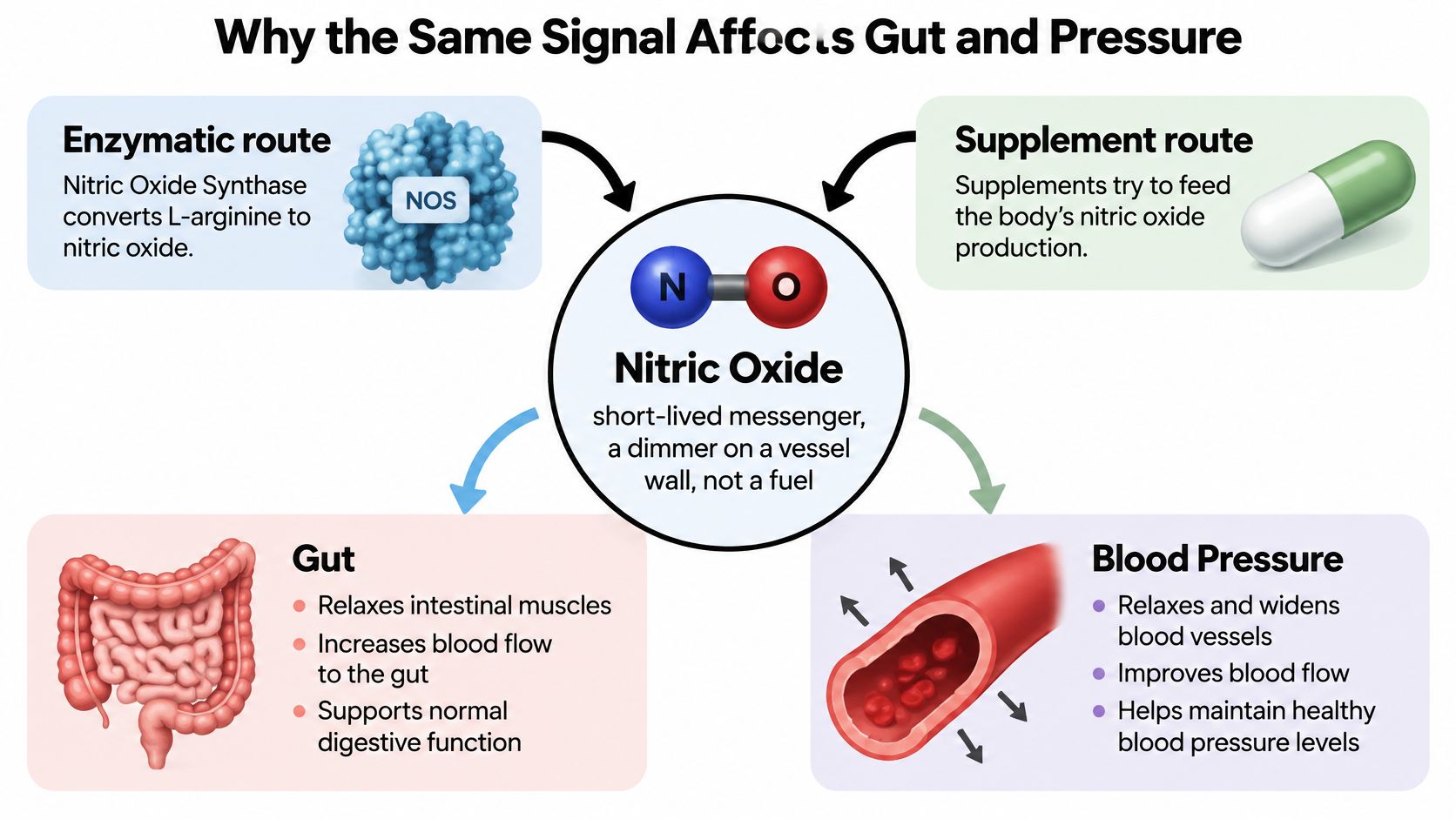
Nitric oxide is a gas the body makes on demand, uses locally, and breaks down within seconds. No supplement pours it into you. What arginine, citrulline, and beet products do is feed the two production routes your body already runs.
The route through the enzyme
The main route runs through an enzyme called nitric oxide synthase, and the endothelial version of that enzyme lines your blood vessels. It takes L-arginine and converts it into nitric oxide. L-citrulline joins the same route indirectly: the body turns it back into arginine first, which is why a citrulline product still ends up feeding an arginine-dependent pathway.
The second route is the food one. Nitrate from beet root and leafy greens gets partly converted to nitrite by bacteria living in the mouth, then to nitric oxide further downstream. A review of L-arginine's adverse effects describes both mechanisms and ties them to the same two outcomes.
Where the stomach upset comes from
Not all of a gram-scale amino acid dose gets absorbed. What stays behind in the intestine pulls water with it, raising what's called the osmotic load, and that's the direct line to nausea, diarrhea, and indigestion. A bitter taste and a heavy stomach belong to the same story.
The vascular side is separate but simultaneous. Nitric oxide that does form relaxes the smooth muscle in vessel walls, and relaxed walls mean lower pressure. A mechanism that drops pressure predicts exactly the symptoms people report: headache, palpitations, numbness, and the light-headedness some describe as feeling their heartbeat in their ears. How noticeable the drop feels depends on the dose, how long you've been taking it, and where your pressure started.
The valve analogy is the honest one: pressure in a closed system falls when more taps open. Open two at once and it falls further than either tap would manage alone.
One caution about lab values. A higher nitric oxide marker on a test strip is a measurement of a metabolite, not a certificate of performance or safety. Pooled reviews of citrulline and arginine trials report limited or conflicting athletic benefit overall, so a number that moved upward shows the supplement was absorbed, nothing more.
If you're deliberately pairing arginine with a second botanical, the useful question is what that pairing does to the same pressure pathway, and combining L-arginine with Pycnogenol safely walks through the interaction points worth raising with a pharmacist.
How Arginine Citrulline and Beet Differ
Read the label as three separate products wearing similar names. Each ingredient reaches nitric oxide by a different road, and each carries its own dose logic.
One panel, three different questions
Arginine is the direct raw material for the enzyme, and it appears as L-arginine HCl, L-arginine alpha-ketoglutarate, or a blend of both, usually in gram amounts in research. Read the panel carefully, because a capsule product listing 400 mg per serving is nowhere near the 9 gram band where the tolerability data sits. You can't apply a 9 gram finding to a 400 mg dose, and you can't claim the 400 mg dose is proven either.
Citrulline, often sold as citrulline malate, converts to arginine after you swallow it. A meta-analysis of citrulline trials found that doses of at least 6 g/day were associated with a statistically significant diastolic reduction of about 2.75 mmHg and a pooled systolic fall of about 4.10 mmHg, with substantial heterogeneity between studies. Translation: the average effect is small and uneven, and the same review notes that longer-term supplemental safety hasn't been adequately assessed, since most trials are short and enroll healthy people.
Beet root supplies nitrate rather than amino acids. Some extracts state a nitrate figure; many list only milligrams of beet powder with no nitrate number at all, which makes two beet products impossible to compare from the front label. If you want to understand how a powdered beet product is standardized and dosed, this explanation of beet juice powder covers what a useful spec looks like.
You'll also see grape seed extract and coenzyme Q10 riding beside beet in the same capsule as antioxidant or cellular-energy companions. They aren't stand-ins for a gram-scale arginine dose, and they shouldn't be credited or blamed for arginine trial results.
A concrete example of an honest panel: Argi-Max lists 400 mg L-Arginine HCL, 400 mg L-Arginine Alpha Keto Glutarate, 400 mg L-Citrulline-DL-Malate, and 100 mg beet root powder per two-capsule serving. Add the two arginine forms and you have 800 mg of arginine, roughly a twelfth of the lowest research band. That math is the whole skill. Capsules are convenient; they're not research doses, and nobody should pretend otherwise.
If beet is the route you want, a product that states its nitrate content is easier to evaluate than one that doesn't, and organic beet root capsules for energy is an example of the category worth comparing on that spec.
Label check: count grams, not ingredients. One clearly identified active at a stated milligram amount is easier to trial and easier to abandon than a four-part blend with no individual quantities.
Start at the lowest labeled adult dose and hold everything else steady for a week. Intolerance is far easier to spot against an unchanged routine than against a week where you also changed your training, your coffee, and your sleep.
What Clinical Trials Actually Reported
Trial numbers are where the guessing ends, provided you keep two very different populations apart.
The mild case
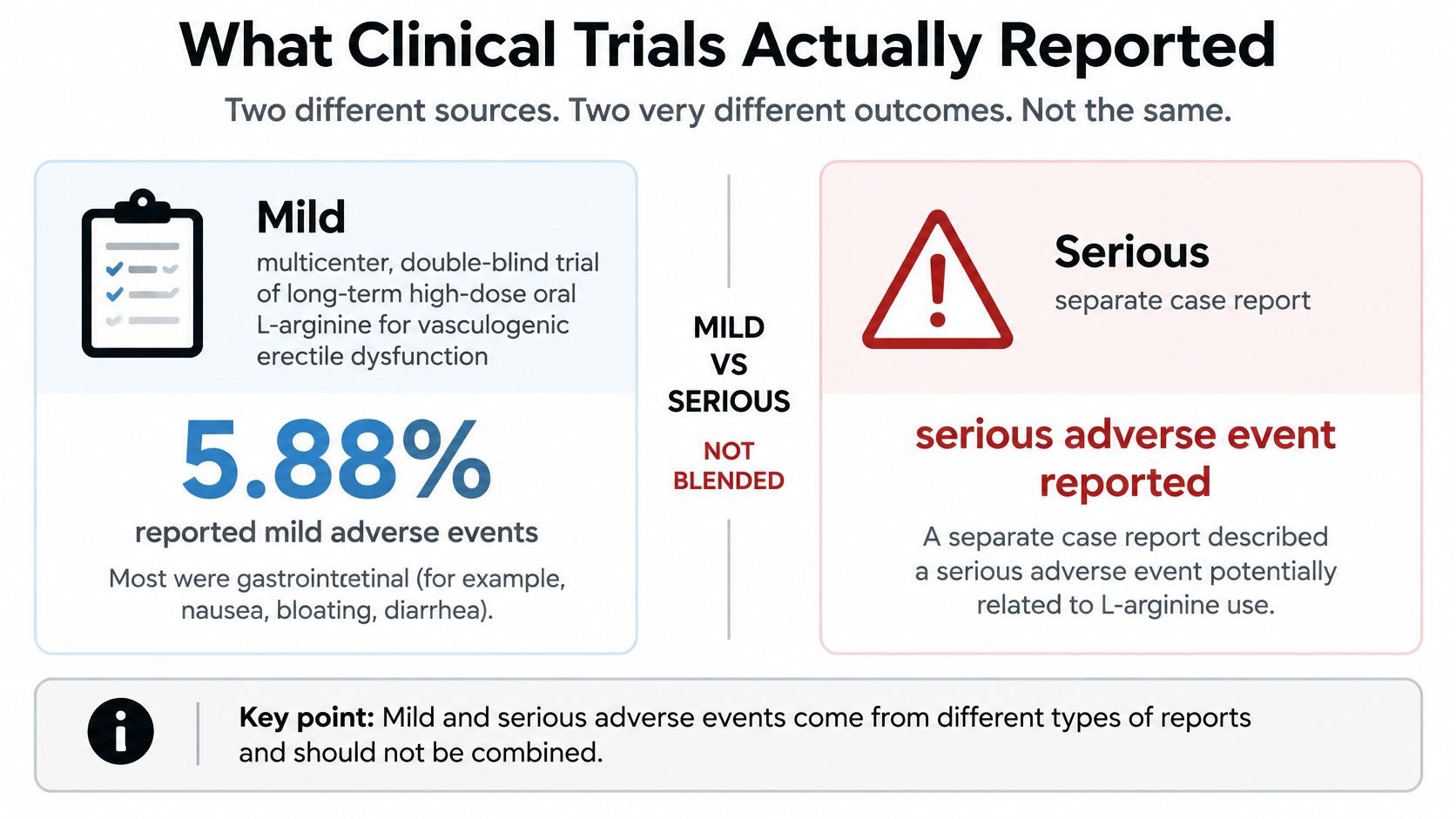
A multicenter, double-blind, randomized trial of long-term, high-dose oral L-arginine for vasculogenic erectile dysfunction reported adverse events in 5.88% of participants receiving L-arginine versus 4.26% on placebo. The events in the arginine group included gastric burning, an urticarial reaction, and scrotal itching. None was judged clinically significant, and nobody stopped treatment because of them.
Sit with that comparison for a second. The supplement group barely separated from the placebo group. A rash or a burning stomach can happen on either. That's the everyday picture most healthy users should expect, and it's a useful corrective to the idea that arginine reliably announces itself with dramatic symptoms.
The serious case
Now the other population. A trial in people who had just survived a heart attack gave them a high daily arginine dose for months, and deaths clustered in the arginine group while the control group stayed clear. Investigators stopped the study early.
Two things follow. First, that signal belongs to a specific, medically fragile group. It says nothing direct about a healthy adult taking a labeled beet capsule or a modest amino acid product, and it doesn't prove ordinary consumer doses cause the same outcome. Second, it destroys the assumption that more arginine is automatically better. Dose multiplied by duration multiplied by the state of the person's vessels is the equation, and a post-heart-attack patient sits in a very different part of it than a healthy gym-goer.
The lesson sits in three variables: who was studied, at what dose, and for how long. Change any one of them and the risk changes with it. A nuisance effect and a reason to stay away are not the same finding, and blending them into one scary list helps nobody.
If you want the plain-language background on what this amino acid does before you read another panel, this primer on L-arginine covers the basics without the pump language.
Medicine Stacks and Stop Signals
A pharmacist asks one question that settles most of this: what else are you taking? Most preventable trouble in the category begins with a reasonable ingredient meeting a medicine that acts on the same vessel wall. The FDA's consumer guidance on dietary supplements flags three recurring setups: mixing medicines and supplements, taking excessive amounts, and using a supplement instead of medical treatment. A nitric oxide product sitting next to a blood-pressure prescription can hit all three at once.
Counting every vasodilator on the panel
Write down each ingredient that widens vessels: arginine, citrulline, dietary nitrate, and botanicals such as grape seed. Write the milligrams beside each. Then write your medicines with their doses and the time of day you take them. Two lists side by side tell a pharmacist more in thirty seconds than a paragraph of description.
| Situation | Why the stack matters | Practical step |
|---|---|---|
| Blood-pressure medicine | Both can lower pressure, raising dizziness or fainting risk | Share the full panel, dose, and timing before combining |
| Nitrate medicine | Nitrates and nitric oxide donors both relax vessels | Do not add a supplement without the prescriber |
| PDE-5 inhibitor | Additive vasodilation can cause symptomatic low pressure | Avoid combining on your own |
| Several NO ingredients at once | Arginine plus citrulline plus nitrate adds up to more than one gentle dose | Count every vasodilator on the label |
| Recent heart attack or significant heart disease | High-dose arginine has a serious historical safety signal | Do not self-start grams of arginine |
The distinction that matters: a healthy adult taking one ingredient alone faces a small risk, while someone on an antihypertensive, a nitrate, or a PDE-5 inhibitor faces a different one, because the pressure-lowering effects add together rather than cancel out.
Same day versus this week
Two clocks run after a dose, and mixing them up is how people end up in an emergency room for something they could have handled by phone, or the reverse.
Get emergency care the same day for fainting, chest pain, severe shortness of breath, one-sided weakness, trouble speaking, or a sudden severe headache. The FDA's supplement safety guidance describes adverse events ranging from gastrointestinal upset to severe reactions such as chest pain or stroke, which is exactly why the escalation list exists rather than being softened into "ask a doctor."
Call a clinician promptly for new dizziness, blurred vision, unusual weakness, a pounding heartbeat, a widespread rash, or diarrhea that doesn't settle after you hold the dose for a day or two. Holding the dose means stopping it, not halving it indefinitely.
What the pharmacist needs from you
Four items make the conversation useful instead of vague.
- The complete Supplement Facts panel, including the amounts per serving and the number of servings you take.
- Your medication list, with doses and timing, including anything over the counter.
- The dose you're using and how long you've used it, because duration changes the question.
- Your symptom timeline, with the first day you noticed it.
Practical rule: keep taking prescribed blood-pressure medicine while you evaluate any pump product. Swapping a prescription for a supplement is the one mistake with consequences well beyond a stomach ache.
A few details still get skipped. Adult label doses are built for adults: Nitric-Ox, like the other NexiHerb products discussed here, is intended for adults and should be used only as the product label instructs, so nothing in a trial of grown men transfers to children. The other-ingredients line deserves a read if you avoid soy, milk, gluten, or nut traces, since some NexiHerb supplements may contain common allergens depending on the formula and manufacturing environment. Baseline pressure that already runs low is treated as a pause case in the checklist that follows, because a small extra drop lands harder there.
For a wider view of which supplements compete with each other, this guide to supplements that shouldn't be taken together is a sensible second read before you combine anything.
Choose a Lower-Risk Formula and Ask First
Here's the decision, and it takes about a minute.
- Pause entirely if your blood pressure already runs low, if you take a nitrate or PDE-5 medicine, or if you've had a heart attack or significant heart disease. Those circumstances call for a clinician conversation before any product, not after.
- Trial one ingredient at the labeled adult dose for a week or two if none of that applies, rather than stacking scoops toward the 9 to 30 gram arginine range.
- Stop at the first red-flag symptom and write down what you took, how much, and when.
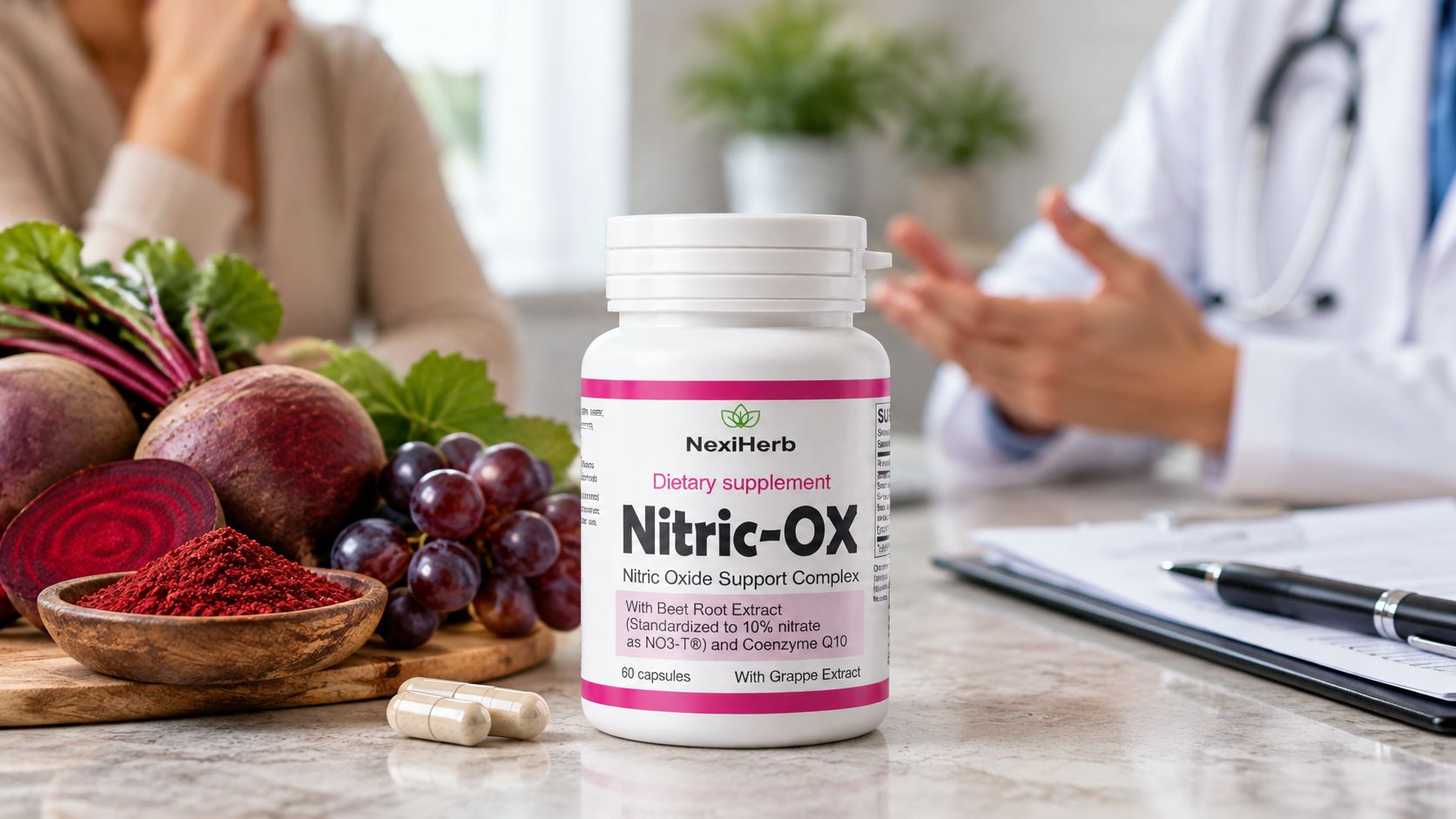
A beet-based formula opens a different conversation because it never uses gram-scale arginine doses in the first place. As one example, Nitric-Ox is an adult capsule supplement containing beet root extract, grape seed extract, and coenzyme Q10, with a serving of 2 capsules and 30 servings per container. It's a dietary supplement, not a treatment. NexiHerb LLC urges customers to consult a physician or other medical practitioner before using its products, especially when taking medication or other supplements or managing a medical condition, and results aren't guaranteed because individual experiences vary. These statements have not been evaluated by the FDA, and the product is not intended to diagnose, treat, cure, or prevent any disease.
Skepticism should follow you to the checkout page, too. Unregulated powders sold with no documentation deserve the same scrutiny described in these checks before ordering research chemicals, where purity paperwork matters more than a convincing product page.
The most useful thing you can do today isn't picking a bottle. It's the label check and the medication review, done once with the actual panel in front of you.
NexiHerb LLC builds its catalog around exactly this kind of careful, label-first supplement use, from amino acids and nitric oxide support to everyday multivitamins and herbal blends, all formulated with plant-derived, clinically familiar ingredients and clear dosing. If you want to see how a beet-based capsule fits alongside the dose and stacking questions above, browse the nitric oxide range at NexiHerb LLC and read the full Supplement Facts panel before you buy. Bring that panel to your next pharmacist visit, and let the conversation start from facts rather than a feeling.