

A certificate of analysis is a lot-specific quality document showing whether a product meets its specifications, with the measured results. It documents what a manufacturer tested on one production run, the limits those results were judged against, and the numbers that came back.
The bottle is on your kitchen counter, and somewhere on the brand's website there's a PDF you were told to trust. You open it and find a grid of test names, abbreviations and figures, plus a lot code you've never noticed before. Nothing on the page tells you which numbers are healthy, which are borderline, or whether the report belongs to the bottle in front of you at all.
That's the gap this walkthrough closes. A certificate of analysis, usually shortened to COA, isn't a badge and it isn't a review score. Read it in the right order and it tells you a great deal about a single batch. Scan for the word "pass", and it tells you almost nothing.
Table of Contents
- What a Certificate of Analysis Is and What It Contains
- Key Terms Behind Every COA Line
- How a COA Compares Results Against Specifications
- Real Examples of Reading a COA Line by Line
- What a COA Does and Does Not Prove
- Spotting a Weak COA and Checking Your Lot
What a Certificate of Analysis Is and What It Contains
A manufacturer's quality-assurance team issues the certificate, and its job is to confirm whether a specific product or batch meets the specifications set for it. The FDA's quality systems guidance frames these documents as records that commonly report the actual results of quality-control testing for an individual batch or product, rather than merely stating that testing occurred. That distinction decides everything else. A page saying "tested and approved" is a claim. A page saying a lot measured a specific number against a named limit is evidence.
| Field | What It Shows | Why It Matters |
|---|---|---|
| Product name | Exact product and form | Confirms the document matches the bottle |
| Lot or batch number | The production run that was tested | Ties the results to the package you bought |
| Test or release date | When testing was done | Shows whether the result is current |
| Test methods | How each property was measured | Lets an auditor repeat or compare the test |
| Acceptance limits | The allowed range for each test | Defines what pass means |
| Actual results | The measured number for each test | Shows where the lot falls within the limit |
| Measurement uncertainty | Confidence in each reported value | Shows how precise the number is |
| Laboratory identity | Who performed the testing | Lets you ask the lab to confirm the report |
| Authorized signature | Approval by quality staff | Shows an accountable person released the lot |
A workable certificate connects the tested material to an identity, a batch number, a specification, an analytical method, a limit and a measured result. Where measurement uncertainty appears, it tells you how much confidence to place in a value, which matters most when a result lands close to its limit. The signature matters for a different reason: it names the function that released the lot, so the document has an owner rather than an anonymous author.
Why the lot number is the first thing to check
A COA is evidence about one production lot. It never promises that every lot from the same supplier has identical composition, and treating one report as a permanent verdict on a brand is the most common mistake shoppers make.
Find the lot code on your package first. It's usually stamped or ink-jetted near the expiry date, on the base of the bottle, or along the side of the label, sometimes as a short string of letters and digits. Then look for that exact string on the report. If the two don't match, the numbers describe a different run of product, and nothing else on the page will help you.
If you want a second walkthrough built around a pharmacy dispensing label rather than a supplement, this guide to reading a medicine COA covers the same fields from the healthcare side.
Key Terms Behind Every COA Line
Eight terms carry almost every certificate. Learn them once and the rest of the page reads quickly.
- Specification. The full set of limits a product must meet, covering identity, potency, purity and contamination. It's the standard the whole document is judged against.
- Lot or batch number. The production run that was tested. It appears on the package and again on the report, and it's the only thing linking the two.
- Acceptance limit. The allowed range for a single test. This is the line a result is measured against, whether it's a maximum, a minimum or a band.
- Actual result. The measured number with its unit. A result written as a figure is the only form you can compare; a result written as a word can't be checked.
- Measurement uncertainty. The plus-or-minus margin around a reported value, showing how precise the number is.
- Detection limit. The lowest level a method can reliably detect. It gives meaning to a "not detected" entry; without it, that phrase could mean the test was too coarse to find anything.
- Test date, release date and retest date. When testing happened, when the lot was approved for sale, and when the result should be reconfirmed.
- Accreditation scope. The defined list of tests covered by a laboratory's ISO/IEC 17025 accreditation, which can be narrower than the laboratory's full workload.
Practical rule: if a term on the report isn't defined anywhere on the page, ask. A certificate that leaves you guessing about its own units can't be audited.
The same discipline applies to the front of the package, and our guide to how to read supplement labels covers what the label itself must state so you can compare it with the results.
How a COA Compares Results Against Specifications
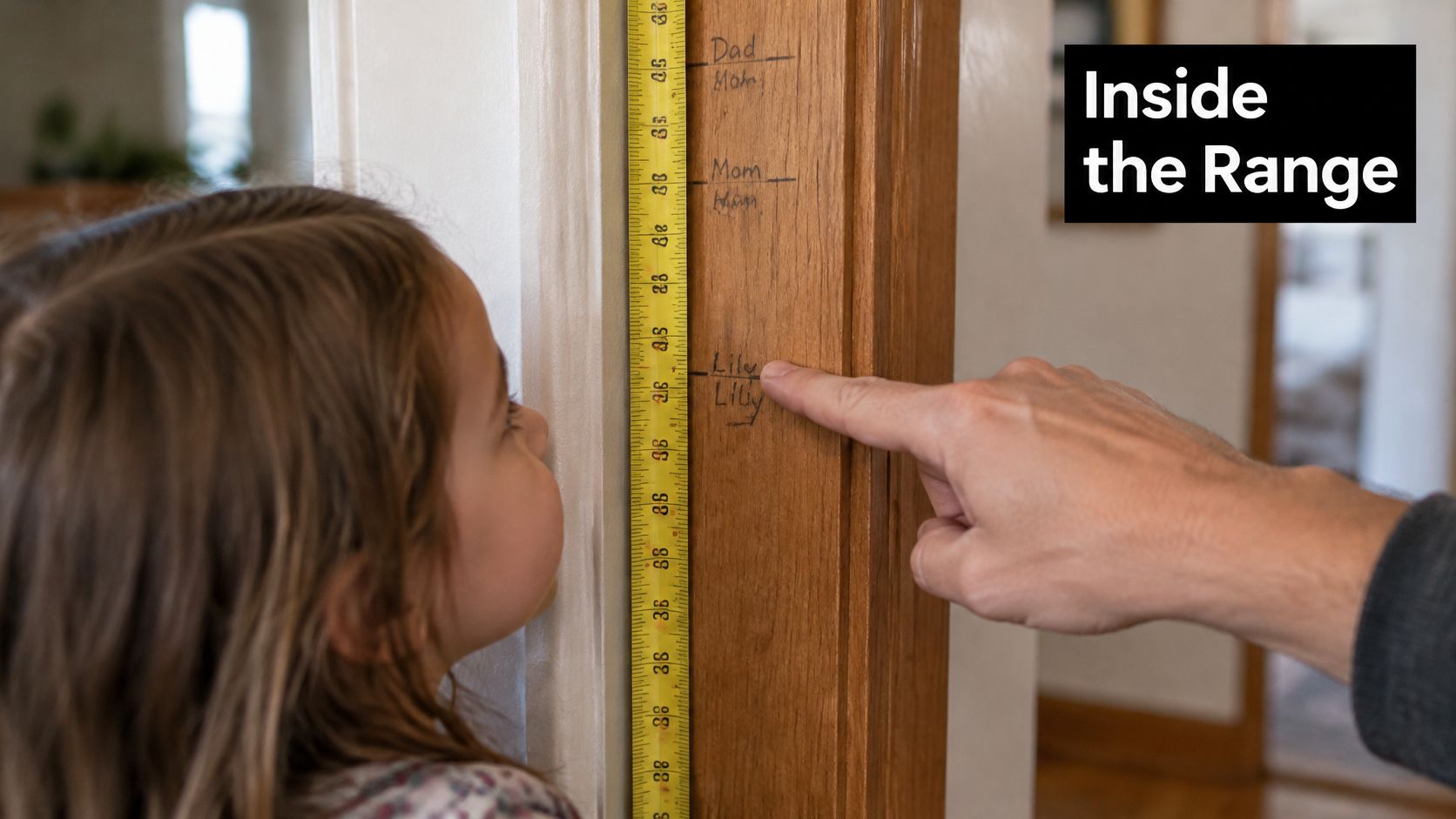
Think about the pencil marks a family keeps on a doorframe. Someone draws two lines a few inches apart, marking the range a child is expected to fall in this year. The measurement is where the top of the head lands. The verdict is whether that mark sits between the lines.
A certificate works the same way, and the chart is useless if you drop either half. A report that says "compliant" with no numbers is a doorframe with no marks on it. You can't tell whether the result sat comfortably inside the band or scraped the edge.
Structured batch records follow a recognisable pattern. FDA's ICH Q7A guidance states that authentic certificates should be issued for each batch on request, and that the document should identify the material and, where relevant, its grade, batch number and release date. It should carry an expiry or retest date where one applies. It must list every test performed under compendial or customer requirements with the corresponding acceptance limits, and give numerical results where the tests are quantitative.
The supply-chain side is part of the same requirement. The certificate must be dated and signed by authorized quality personnel and must identify the original manufacturer with contact details, so that even when a repacker or reprocessor issues a replacement document, the laboratory and the original producer stay traceable. In practice that means a supplement buyer can follow a tested lot back to its source instead of stopping at whoever printed the PDF.
Q7A is written for active pharmaceutical ingredients, so treat it as a model for judging a supplement certificate rather than a binding rule for finished dietary supplements. The logic transfers cleanly.
Once you have a report open, the video below is a reasonable companion to this section.
The check you can run on any report: every test row should carry a limit and a number beside it, and the verdict should follow from comparing the two. If a row has a verdict but no visible number, you're reading a doorframe chart with the marks rubbed out.
Real Examples of Reading a COA Line by Line
Four short scenes, using illustrative figures rather than any published standard, show how the same comparison plays out across test types.
Identity. The label says maca root powder. The report lists an identity test with the method named (macroscopic and chromatographic comparison against a reference), a specification reading "conforms", and a result reading "conforms". Verdict: pass, and the method column tells you what kind of evidence was produced.
Potency. Say the specification reads 90 to 110 percent of label claim. A result of 97 percent sits inside the band, so the lot passes. A result of 84 percent fails, even though the report is neatly formatted, signed and dated. The document looks identical in both cases; only the number next to the limit separates them.
Microbial count. A report shows a total aerobic count with a limit of not more than 1,000 CFU per gram and an actual result well under it, which is a pass. Now imagine the row instead reads "not detected" with no detection limit stated. You cannot tell whether the method could have found a meaningful level or only gross contamination, so the entry proves less than it appears to.
Heavy metals. A lead row with a stated maximum and a measured result below it is a genuine pass for that test. If the report contains no contaminant testing at all, the absence is not a pass. It's a blank, and a blank tells you nothing about whether the product is free of those risks.
Reading order: lot number, then limit, then result, then verdict. Everything else, including the claims on the front of the bottle, gets checked after that.
For a second pass over the same fields from the laboratory side, Herbilabs Labware's certificate of analysis guide covers how a report is laid out and why the method column sits where it does.
What a COA Does and Does Not Prove
Here's the assumption worth testing: that a certificate vouches for a brand's whole product line. It doesn't. It vouches for one lot, tested on one date, against one set of limits. Everything the document supports sits inside those boundaries.
U.S. dietary-supplement rules treat the certificate as one part of a wider release system. The FDA's small entity compliance guide allows a manufacturer to rely on a supplier's COA only after qualifying the supplier, documenting the basis for trust, periodically reconfirming the supplier's results, and obtaining quality-unit review and approval. The same guidance expects the certificate to identify test methods, acceptance limits and actual analytical results rather than declaring a product compliant.
That's why the lot number has to match what arrived in your hand. A generic or undated certificate cannot reliably establish that the tested sample represents the material being received, however official the letterhead looks.
What the document leaves out
A batch can pass its potency assay while allergens, microbes, heavy metals or adulterants were never tested and never appear on the report. The pass is real. It's also narrow. The scope of the testing, not the verdict, tells you how much of the product's risk profile was examined.
Third-party testing language on a label is a starting point, and what third-party testing actually covers pairs well with the certificate when you're deciding how much weight to give it. Manufacturing conditions sit alongside the results too; what cGMP certification means explains the rules that testing is meant to support.
A COA proves what it lists, for the lot it names. Nothing beyond that line survives scrutiny, and nothing less should satisfy you.
Spotting a Weak COA and Checking Your Lot
Weak certificates fail in recognisable ways, and each failure has a question attached that gets you a better document.
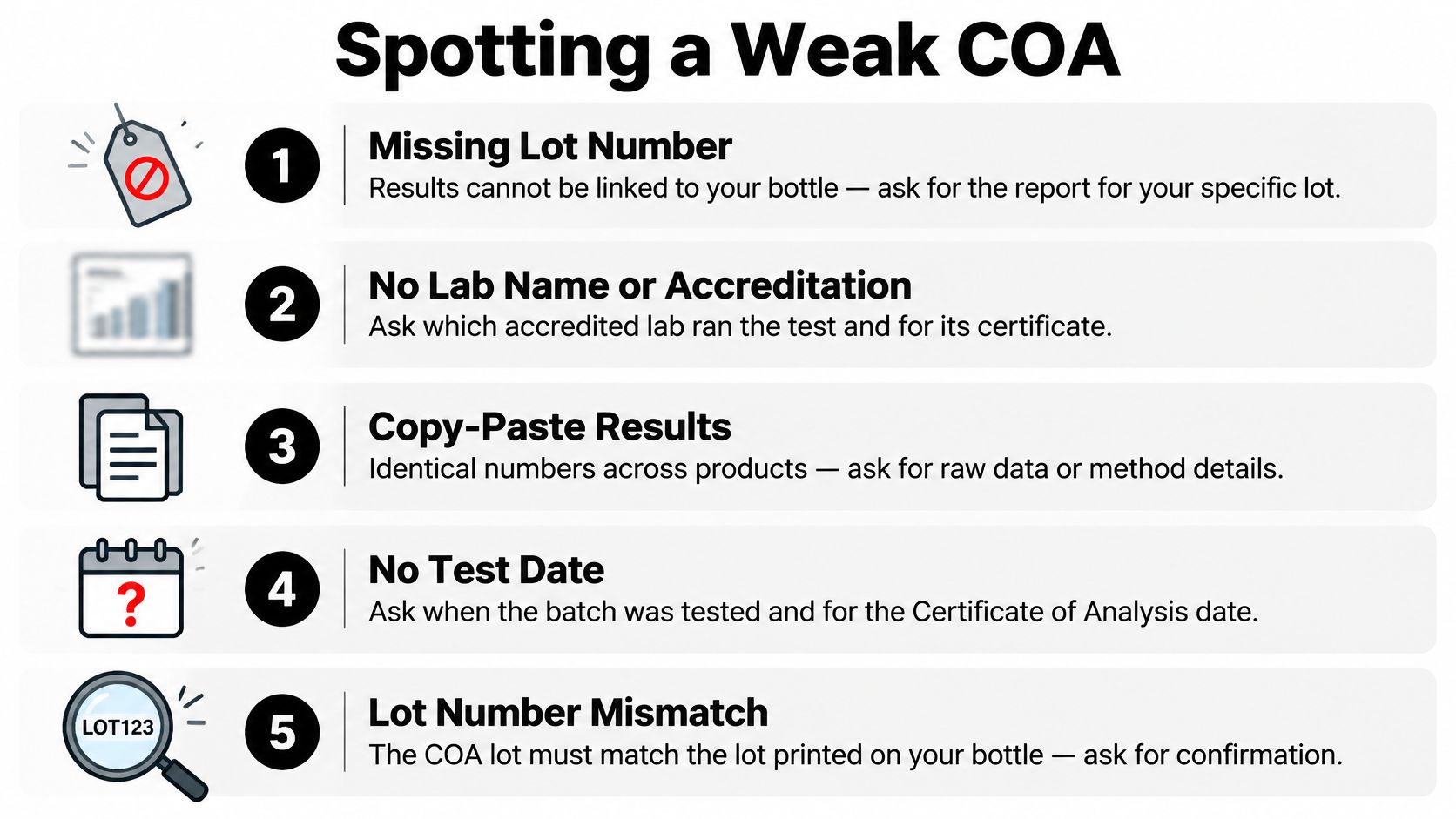
| Red Flag | What It Suggests | What to Ask For |
|---|---|---|
| No lot number | Results cannot be linked to your bottle | A lot-specific report matching the package |
| Only the words pass or compliant | No numbers to compare against limits | Actual results with units and acceptance limits |
| Undated or old report | May not represent current production | A report with a clear test date |
| Generic supplier-wide certificate | Not specific to one batch | The report for your lot |
| Accreditation logo with no scope | Accreditation may not cover these tests | Confirmation of which tests the lab is accredited for |
| Summary only, no laboratory name | The source cannot be verified | The original laboratory report |
| Only one test shown | Other risks were not addressed | A list of every test performed |
The accreditation row deserves extra attention. Lab Manager's questions to ask before accepting a supplier certificate points out that an ISO/IEC 17025 claim applies to a laboratory's defined scope of tests rather than automatically validating every test it performs. A logo alone proves the laboratory was assessed; it doesn't prove this particular assay was inside that assessment.
Seven steps to run before you buy
- Find the lot code on the package. It's the only physical link between your bottle and the report.
- Locate the certificate for that lot. If the brand publishes none, request it; a published report for a different batch doesn't help.
- Match the product name and lot number. Both must agree with the package in your hand.
- Check the test date against the product's shelf life. Old results describe old production.
- Read method, limit and result for each row. Three pieces, in that order, per test.
- Confirm the risks you care about were tested. Contaminants, microbes and identity are separate rows, not automatic inclusions.
- Ask the brand or the laboratory to confirm anything unclear. A laboratory will often verify whether a report under its name is genuine.
Ask first: which accredited laboratory ran these tests, for which lot, on what date, and against which limits? A supplier who answers in specifics is telling you something useful about their quality system.
For some specific products, NexiHerb can provide additional quality information or certificates on request, if available. It's also worth seeing how these questions land in a heavily tested category, and this piece on choosing reishi mushroom supplements shows where identity and contaminant testing usually come up.
Buy when the lot, the dates, the limits and the results all line up. Pause when a key field is missing, because a missing field is not a small cosmetic problem.
NexiHerb LLC builds its catalog around carefully selected, plant-derived ingredients and clear labeling, and we think you should be able to ask the same quality questions of us that this guide teaches you to ask of any brand. If a product you're considering carries additional quality information or certificates, our team can confirm whether those are available on request. Visit NexiHerb LLC to browse the lineup and see which formulas fit your routine.