

Why does one bottle of omega 3 fish oil supplements promise heart support, another emphasizes brain health, and a third lists a completely different dose? The gap in most shopping advice is simple: omega-3 isn't one ingredient with one universal effect. Your diet, baseline risk, target outcome, EPA-to-DHA preference, product quality, and measurable response all influence whether a supplement makes sense.
The useful question isn't “Which fish oil is best?” It's “Which omega-3 form, dose, and quality standard fit my situation, and how will I know whether it's helping?” Once you ask that, the supplement aisle becomes easier to manage.
Table of Contents
- What Omega 3 Fish Oil Supplements Actually Are
- EPA, DHA, and ALA Explained
- What the Evidence Really Shows
- How to Read an Omega 3 Supplement Label
- Forms, Concentration, and What to Choose
- Quality, Freshness, and Sourcing Signals
- Safety, Interactions, and Smart Dosing
- Personalizing Omega 3s for Your Routine
What Omega 3 Fish Oil Supplements Actually Are
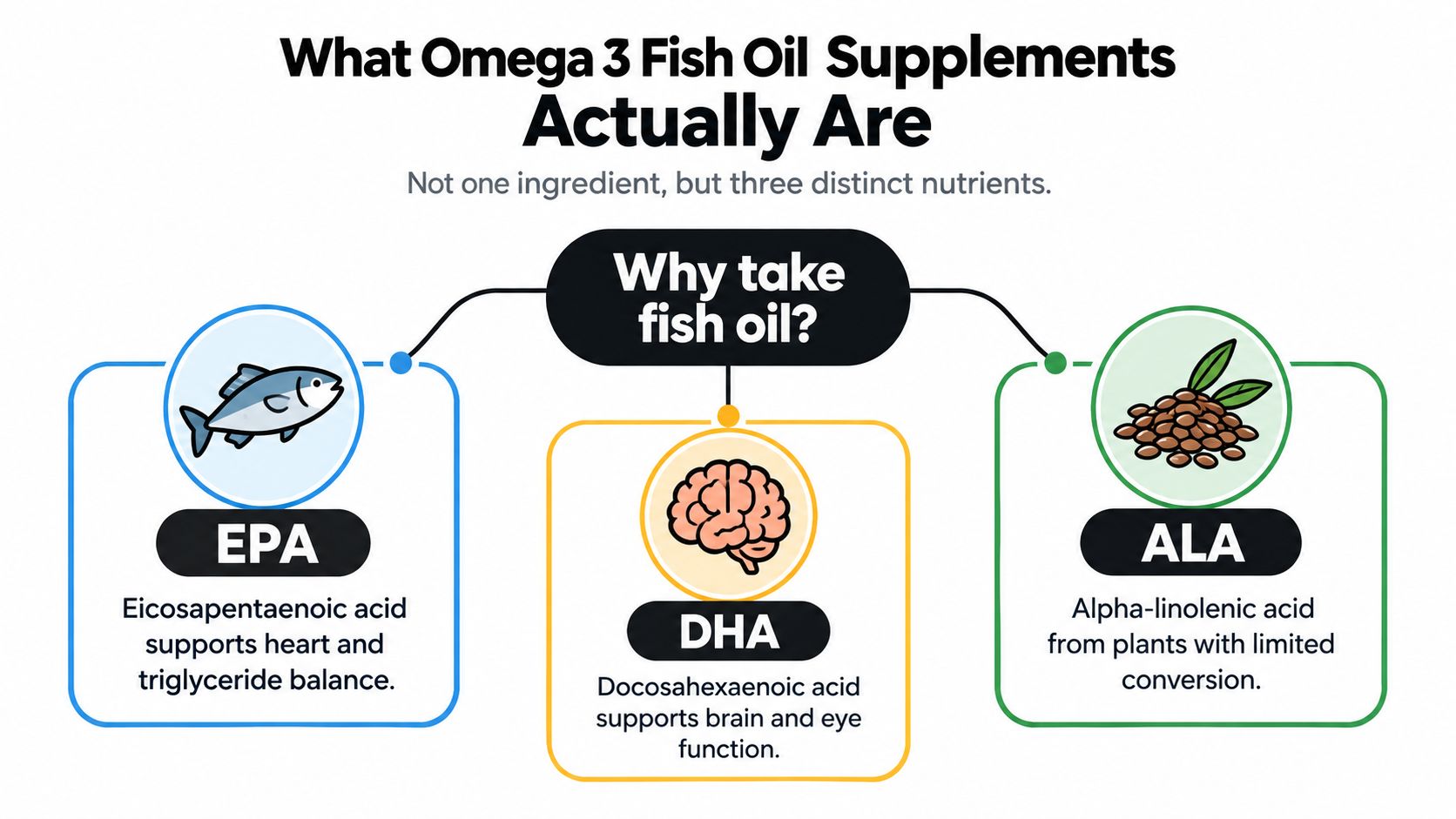
What does a fish oil capsule deliver? Omega-3 is a family of fats, not one universal ingredient. The three names shoppers encounter are EPA, DHA, and ALA, and each comes from different foods and serves different functions. Treating them as separate tools makes a label easier to understand.
Fish oil mainly supplies eicosapentaenoic acid, or EPA, and docosahexaenoic acid, or DHA. Plant foods and oils generally supply alpha-linolenic acid, or ALA. ALA belongs in a balanced diet, yet the body converts only a limited amount into EPA and DHA. As a result, an ALA number on a food or capsule does not show how much EPA or DHA you are getting.
The delivery vehicle matters
A softgel marked “fish oil” can contain much less EPA and DHA than its total oil weight suggests. The remaining oil may consist of other fatty acids, depending on the product's formulation and concentration. Comparing total oil alone can therefore make a lower-potency product look stronger than it is.
The NIH Office of Dietary Supplements fact sheet on omega-3 fatty acids reports that data from the 2012 National Health Interview Survey found supplements containing fish oil, omega-3s, and/or DHA or EPA were used by 7.8% of U.S. adults and 1.1% of U.S. children. The same source reports that supplements added about 100 mg of ALA, 10 mg of DHA, and 20 mg of EPA to mean daily adult intake. Those amounts show that routine supplement use did not necessarily resemble the larger intakes examined in clinical research.
Practical rule: Read the EPA and DHA lines before judging a bottle by “fish oil” or total oil weight.
Your choice should then reflect the outcome you are tracking. Compare EPA and DHA per serving, serving size, oil form, freshness indicators, oxidation testing, and the dose suited to your purpose. A general wellness routine differs from a clinician-managed triglyceride plan, and a personal response measure, such as an Omega-3 Index when appropriate, can help show whether the chosen approach is producing the result you want.
EPA, DHA, and ALA Explained
Think of the three omega-3s as building materials. EPA and DHA are more like pre-cut pieces, while ALA is a raw material that the body can convert only to a limited extent. ALA still belongs in a balanced diet, but it shouldn't be treated as an equivalent substitute for the EPA and DHA listed in fish-oil research.
EPA is commonly associated with lipid and inflammatory signaling. DHA is a major structural fat in the brain and retina, which helps explain why it receives particular attention during early development and in eye-related nutrition. ALA comes mainly from flaxseed, chia seeds, walnuts, soybeans, and some plant oils, while EPA and DHA are concentrated in fatty fish and seafood.
The three fats on one label
| Fatty Acid | Main Roles | Top Food Sources | Conversion Notes |
|---|---|---|---|
| EPA | Supports lipid balance and inflammatory signaling | Fatty fish and seafood | Can be supplied directly through fish or supplements |
| DHA | Supports structural tissues such as the brain and retina | Fatty fish, seafood, fish oil, algal oil | Can be supplied directly through fish, fish oil, or algae |
| ALA | Essential plant-based omega-3 for dietary balance | Flax, chia, walnuts, soybeans, plant oils | Conversion into EPA and DHA is limited |
The commonly cited ALA-to-EPA conversion estimate of 5% to 10% appears in nutrition discussions, but that quantitative claim isn't included in the verified data for this article. The practical conclusion is still clear without assigning a precise conversion rate: conversion is inefficient enough that someone avoiding fish should look for a direct EPA or DHA source when that is the intended nutrient.
Vegetarians and vegans often choose algae oil, because algae can provide DHA directly without fish. Some algae products also provide EPA, but the exact profile varies, so the supplement facts panel remains more useful than the front label.
If you're comparing plant oils, remember that a product can contain a small amount of omega-3 without being a meaningful EPA or DHA supplement. A guide to real olive oil omega 3 content can help clarify why the presence of omega-3 on a food label doesn't automatically make that food comparable to fish oil.
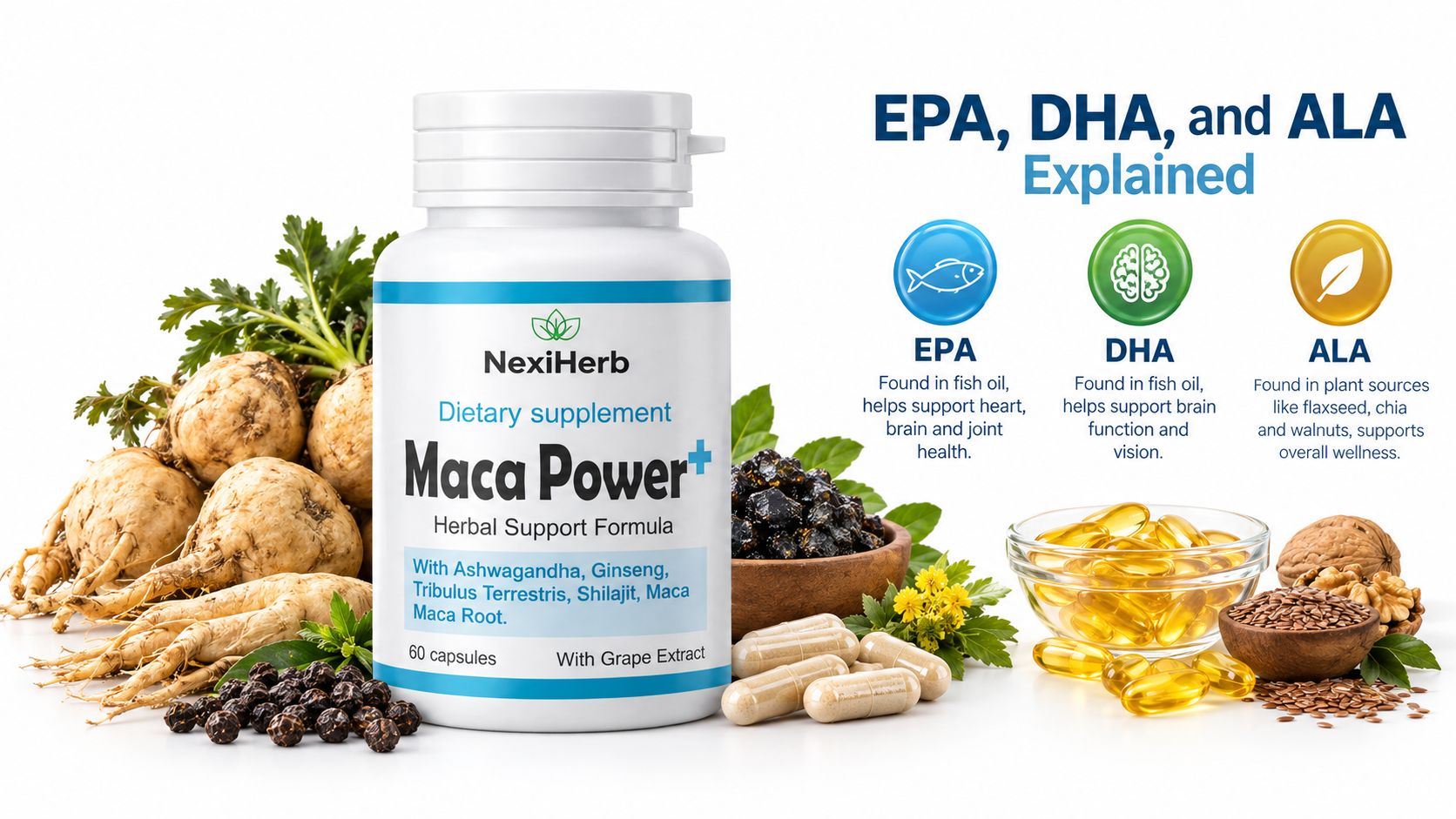
A separate botanical product, Maca Power+ NexiHerb Herbal Dietary Supplement, is a plant-based supplement containing maca root, herbal extracts, black pepper, and a vegetable capsule. It isn't an omega-3 source, so it shouldn't be used as a substitute for EPA, DHA, or ALA.
The label habit is straightforward: ignore the total omega-3 headline until you've identified the individual EPA and DHA amounts. Those figures tell you what kind of omega-3 you're buying.
What the Evidence Really Shows
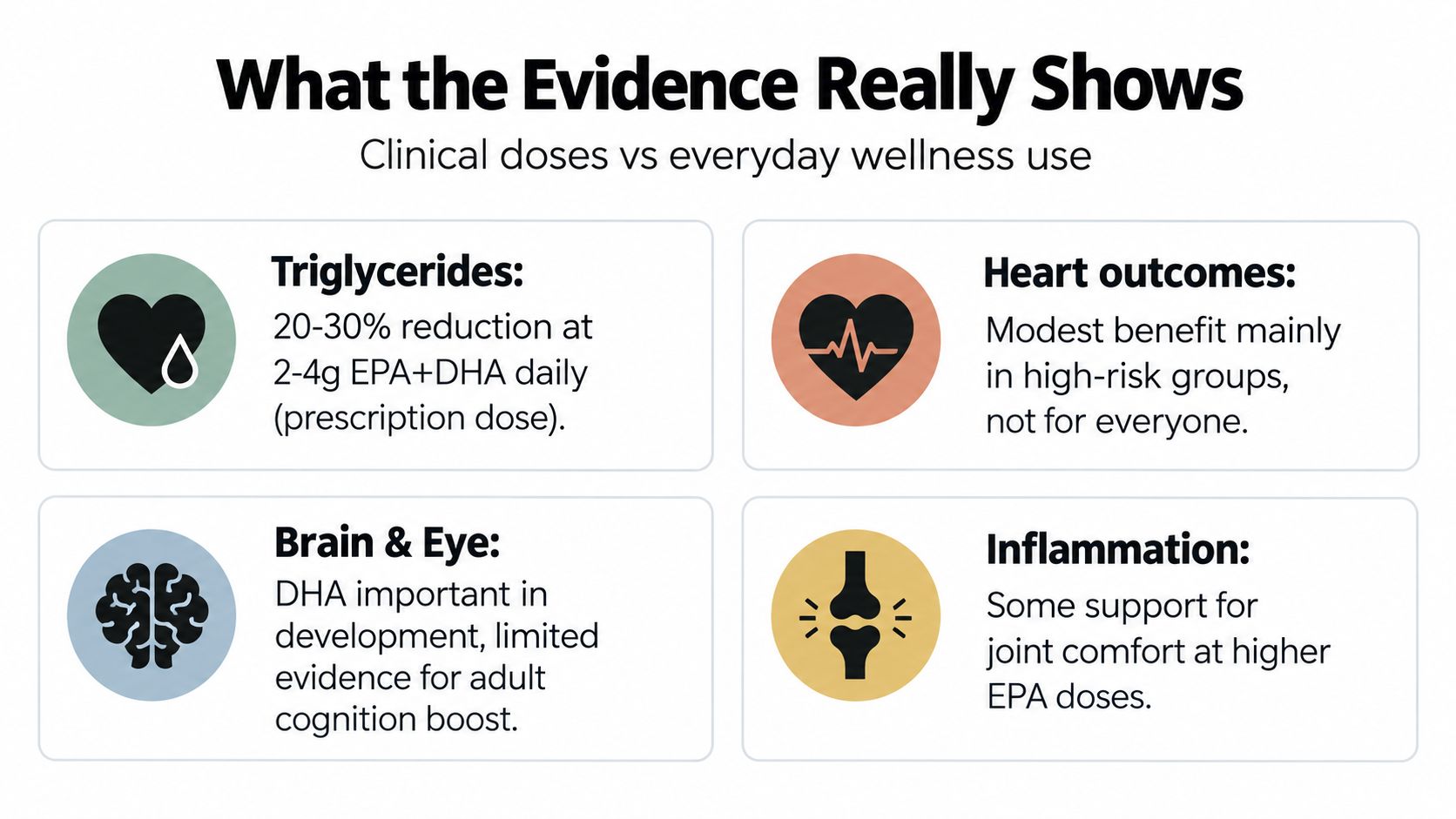
Could the same omega-3 bottle help one person and add little value for another? Yes. Research becomes easier to interpret when you separate ordinary nutritional use from the clinical doses tested in trials. A modest daily softgel should not be expected to produce the same outcome as a much larger, medically supervised intake.
The useful questions are who was studied, what was their baseline risk, which formulation was used, and what dose did they receive? Evidence summaries often describe combined EPA and DHA doses above 1,000 mg per day as more biologically active than lower amounts, while major analyses have examined doses from 376 mg per day to 2,550 mg per day. The NIH professional omega-3 evidence summary puts those ranges in context. “One capsule” says almost nothing about the intensity of the intervention.
Why outcomes differ
Triglyceride support is one area where higher EPA and DHA intake has been studied directly. That evidence does not make fish oil a general treatment for everyone. Cardiovascular findings have also varied. A 2018 meta-analysis covering 47,803 participants across 10 trials found no statistically significant effect of EPA and DHA on coronary heart disease events, coronary heart disease deaths, non-fatal myocardial infarction, or major vascular events, as summarized in the NIH evidence review.
The result means context matters. A 2026 randomized trial in dialysis patients associated 4 g per day of fish oil with a 43% lower rate of major cardiovascular events, but the investigators cautioned that the finding should not be generalized to healthy people or other patient groups, according to coverage of the dialysis trial.
The same capsule can be sensible for one person, unnecessary for another, and inappropriate at a high dose without clinical guidance.
For everyday decisions, measurable targets are more useful than broad “heart health” promises. Depending on your situation, those targets could include an Omega-3 Index, triglycerides, usual fish intake, or a defined nutrition goal such as obtaining DHA during pregnancy. An preventive cardiology ApoB test can add another lipid measurement to a prevention discussion with a clinician, although ApoB does not measure omega-3 status.
A 2025 study reported strong but short-lived EPA increases after fish oil, alongside meaningful differences in lipid profiles between individuals. Another 2025 trial found that EPA-rich and DHA-rich supplementation for six weeks raised the Omega-3 Index from below 6% to above 8% and improved submaximal exercise physiology in trained men, as summarized in the fish oil supplement research overview. These findings support choosing an EPA or DHA goal based on personal needs, baseline measurements, and follow-up results, rather than assuming every user will experience the same effect.
How to Read an Omega 3 Supplement Label
Which number on an omega 3 bottle matters? Start with the back panel, because the front often highlights total fish oil rather than the EPA and DHA you may be trying to obtain.
For example, a softgel may contain 1000 mg of fish oil, but only 180 mg EPA and 120 mg DHA. Your usable EPA plus DHA total is therefore 300 mg per capsule, not 1000 mg. The remaining oil is not automatically useless, but it should not be counted as EPA or DHA.
Five figures to locate
- Total fish oil: The weight of the complete oil mixture.
- EPA: Record the amount per softgel and for the stated serving.
- DHA: Assess it separately, especially if your goal is DHA rather than EPA.
- Other omega-3s: Extra information, not a substitute for clearly listed EPA and DHA.
- Softgels per serving: The label may calculate its amounts across several capsules.
Check whether the serving size is one softgel or several. A product can look potent or inexpensive until you see that its listed EPA and DHA require multiple capsules. Capsule count also affects whether the product fits your routine.
Treat “omega-3 complex” as a description that needs verification. It may refer to a legitimate blend, yet the label should still state individual EPA and DHA amounts. Clear numbers make it easier to connect a product with a specific EPA or DHA goal, or with a follow-up measure such as an Omega-3 Index.
A quick shelf-side checklist
- Compare usable content: Add EPA and DHA, then compare the combined amount across products.
- Check the form: Look for triglyceride, re-esterified triglyceride, or ethyl ester wording.
- Look for testing: Prefer brands that identify independent testing or provide certificates of analysis.
- Inspect the date: The expiration date should be clearly printed, not hidden behind a sticker.
- Review the source: Species, fishing area, and sustainability information provide useful context.
For a broader method that applies to vitamins, minerals, and botanical products, use this guide to reading supplement labels. If your interest is connected to blood flow and ageing, the same careful label reading helps separate a measurable nutrient choice from a general health promise.
For a visual explanation of common label traps, watch the video below.
Finally, consider tolerability. If reaching your intended daily amount means swallowing several large softgels, a more concentrated product may suit your routine better, even if the bottle price is higher.
Forms, Concentration, and What to Choose
The oil's chemical form affects how manufacturers concentrate it, how much EPA and DHA fits in a capsule, and how the product fits your budget. The main forms shoppers encounter are triglyceride, ethyl ester, and re-esterified triglyceride.
Natural triglyceride oils keep the fatty acids attached to a glycerol backbone. Ethyl ester oils use a different structure that can make concentration and production more economical. Re-esterified triglyceride products convert concentrated fatty acids back into a triglyceride structure.
The exact absorption difference depends on the product and meal context, so don't treat form as a standalone quality verdict. A high-quality, well-tested product with a clear dose may be more useful than a poorly stored oil marketed with a premium-sounding form.
Compare the options
| Form | Typical EPA+DHA Concentration | Absorption Notes | Cost Positioning | Best For |
|---|---|---|---|---|
| Triglyceride | Varies by product | Familiar natural structure; take with food | Often mid-range | Shoppers prioritizing a conventional form |
| Ethyl Ester | Varies by product | Absorption can depend more strongly on meal fat and formulation | Often lower-cost | Buyers focused on affordability and clear testing |
| Re-esterified Triglyceride | Often concentrated | Keeps a triglyceride structure after concentration | Often higher-cost | People seeking more EPA and DHA per softgel |
A useful comparison is the percentage of total oil represented by EPA plus DHA. Products below 50%, between 50% and 70%, and at 70% or higher can be viewed as lower, mid-range, and concentrated categories for shopping purposes. Those thresholds are a practical framework, not a guarantee of freshness, purity, or effectiveness.
Match the form to the routine: A smaller capsule you'll take consistently may serve you better than a theoretically ideal form you avoid.
Krill oil is another option shoppers often compare with fish oil. The discussion of krill oil and astaxanthin can help separate the source and accompanying compounds from the more important question of how much EPA and DHA the product supplies.
Choose based on your priority. If you want a straightforward daily supplement, focus first on transparent EPA and DHA amounts, freshness, and tolerability. If you need a higher clinical dose, work with a healthcare professional rather than trying to reach that dose by guesswork.
Quality, Freshness, and Sourcing Signals
A good omega-3 product needs to pass three separate tests: freshness, analytical quality, and responsible sourcing. A sustainability logo can't prove that an oil is fresh, and a low oxidation result can't tell you how responsibly the fish were harvested.
Oxidation testing gives you a more objective starting point. Peroxide value, or PV, measures primary oxidation products. p-anisidine value, or p-AV, captures secondary oxidation products. TOTOX combines those measurements into a broader view of oxidation.
Common voluntary limits cited for EPA and DHA oils are PV below 5 meq O₂/kg, p-AV below 20, and TOTOX below 26, according to the independent analysis published in research on fish-oil oxidation quality. Some independent testing has found that many products meet these thresholds, while other samples exceed them. That makes oxidation control a real procurement and storage issue.
What you can verify at home
A strong fishy odor, paint-like smell, or unpleasant repeat burps can signal that a product isn't tolerating storage well. Taste isn't a laboratory test, but it can alert you to a problem. Dark or opaque packaging, nitrogen flushing, added vitamin E, and a clearly printed expiration date are sensible freshness signals, although none replaces batch testing.
Look for sourcing information as a separate decision. MSC, Friends of the Sea, and GOED can provide useful information about fisheries, supply-chain practices, or industry standards, but certification scope varies. A logo doesn't prove every quality attribute of the finished capsule.
Use this three-question sniff test before buying:
- Freshness: Does the bottle have a clear expiration date and sensible storage instructions?
- Testing: Can the brand provide batch-level certificates of analysis, including oxidation results?
- Sourcing: Does the label explain the fish species, origin, and certification rather than relying on a vague marine-oil claim?
Information about Norwegian fish oils can add context when you're comparing origin claims, but country language alone isn't a substitute for product-specific testing.
Safety, Interactions, and Smart Dosing
Omega-3 supplements are widely used, but higher intake changes the conversation. A clinician may guide combined EPA and DHA intake up to 3 g per day, while the appropriate amount for you depends on diet, medications, health status, and the reason you're taking it.
People using anticoagulants or antiplatelet medicines, including warfarin, aspirin, or clopidogrel, should speak with a healthcare professional before starting or increasing omega-3. Anyone preparing for surgery, managing a bleeding condition, pregnant and balancing DHA with mercury avoidance, living with a fish allergy, or dealing with an immune condition also needs individualized advice.
Possible unwanted effects include gastrointestinal discomfort, loose stools, reflux, and fishy burps. Bruising or nosebleeds deserve attention, especially if they appear after a dose increase or alongside blood-thinning medication.
Make the routine easier to tolerate
Take capsules with a meal rather than on an empty stomach. Splitting the daily amount between meals can reduce reflux, and storing softgels according to the product instructions helps protect the oil from heat and light. Some people freeze softgels to reduce fishy burps, but check the manufacturer's guidance first.
Blood pressure and LDL cholesterol can shift modestly in some users, so people taking omega-3 for a defined health purpose should discuss appropriate monitoring with their clinician. Don't treat a high-dose product as a stronger version of a casual wellness supplement.
Personalizing Omega 3s for Your Routine
Start with your baseline, not a marketing promise. Track how often you eat oily fish, decide whether your priority is EPA-led, DHA-led, or general nutritional coverage, and check whether an Omega-3 Index test is appropriate for your situation.
Choose a dose and timing that fit a normal week. Taking capsules with breakfast may improve consistency and reduce reflux, while a pill organizer can turn an occasional intention into a repeatable habit. If fishy burps are a problem, freezing softgels may help some people.
Reassess after a consistent trial period rather than judging the product after a single dose. Compare your routine, tolerance, dietary intake, and any relevant biomarker with the goal you set at the beginning.
The best omega-3 plan isn't the bottle with the largest front-label number. It's the one with transparent EPA and DHA content, credible quality controls, an appropriate safety profile, and a routine you'll maintain.
NexiHerb LLC offers science-inspired dietary supplements across omega-3s, vitamins, amino acids, herbal blends, and other everyday wellness categories, with clear product information designed to support practical routine building. Visit NexiHerb LLC to compare options and choose supplements that complement your diet and personal wellness goals.