

Your morning might look like this. Coffee in one hand, phone in the other, maybe a quick glance at the gym bag, lunch, or the growing list of things you meant to start doing “for your health.” That's where a once-daily supplement often enters the picture. It feels manageable. One pill, one moment, done.
That simplicity helps explain why the once a day for men idea has stuck around for so long. Multivitamin and mineral products first became commercially available in the United States in the early 1940s, and by the time the NIH Office of Dietary Supplements summarized the category, about one-third of all U.S. adults were estimated to take a multivitamin/mineral supplement according to the NIH Office of Dietary Supplements. What began as a niche format became a normal part of many people's routines.
Still, the label can be misunderstood. “Once a day” doesn't automatically mean stronger, more advanced, or right for every person. In practice, it usually points to a design choice: make the formula simple enough to use consistently, balanced enough for general daily support, and practical enough to fit real life.
That's the useful lens. If you're trying to make sense of men's supplements, start with routine first, then ingredients, then fit. A product only helps if you take it, and it only makes sense if its formula matches your needs rather than just sounding impressive on the front of the bottle.
For everyday context on how supplements can fit into a realistic routine, NexiHerb's guide to daily wellness supplements is a helpful companion read.
Table of Contents
- Introduction to Once a Day for Men Supplements
- What Once a Day Really Means for Mens Formulas
- Key Ingredients and Dosages to Look For in a Daily Men's Supplement
- How to Time Your Once a Day Dose and Build a Consistent Routine
- How to Choose the Right Once a Day Supplement for Your Needs
- Safety Interactions and Realistic Expectations for Daily Use
- Putting It All Together and Next Steps for Your Daily Routine
Introduction to Once a Day for Men Supplements
A lot of men don't want a supplement routine that feels like a second job. They want something they can keep beside the coffee maker, take with breakfast, and move on with the day. That's why once-daily formulas have such staying power. They fit the way people live.
The phrase also carries a sense of familiarity. For decades, “one-a-day” style multivitamins have been positioned as a simple habit, not a complicated protocol. That matters because routine is often the hardest part of wellness. A smart plan that never becomes automatic usually fades out after a week or two.
Why simplicity matters more than hype
A once-daily supplement can work like laying out tomorrow's clothes the night before. It reduces friction. You don't need to remember a midday dose, pack multiple tablets, or wonder whether you already took the second capsule.
That doesn't make every once-daily product equal. Some are broad multivitamins. Some are men's formulas that remove iron. Others add plant compounds or emphasize certain nutrient forms. The label tells you the schedule, but it doesn't tell you whether the formula is thoughtful.
Practical rule: Treat “once a day” as a convenience clue first. Then inspect the ingredient panel to see what kind of convenience you're actually buying.
What men often expect, and what a multivitamin actually does
Many people buy a daily men's multivitamin with big hopes attached to it. More energy. Better performance. Fewer wellness gaps. A sense of having things covered. Some of that thinking is understandable, but it helps to stay grounded.
A daily supplement is usually best seen as nutritional support, not a replacement for meals, sleep, movement, or medical care. It can help make a routine more complete, especially when eating patterns are inconsistent. But it doesn't cancel out a rushed lunch, a string of short nights, or an all-or-nothing approach to health.
That's why the most useful questions aren't “Is this the strongest men's formula?” They're closer to these:
- Can I take this consistently? If the schedule is annoying, it probably won't last.
- Does it match common gaps? A practical formula should focus on needs that show up often in real diets.
- Does the label make sense? Serving size, timing, and ingredient balance matter more than flashy claims.
What Once a Day Really Means for Mens Formulas
A man grabs a multivitamin before work, sees “once a day” on the front, and assumes the message is about strength. One pill. One day. Problem solved. In practice, that phrase usually says more about dosing design than about how impressive the formula is.
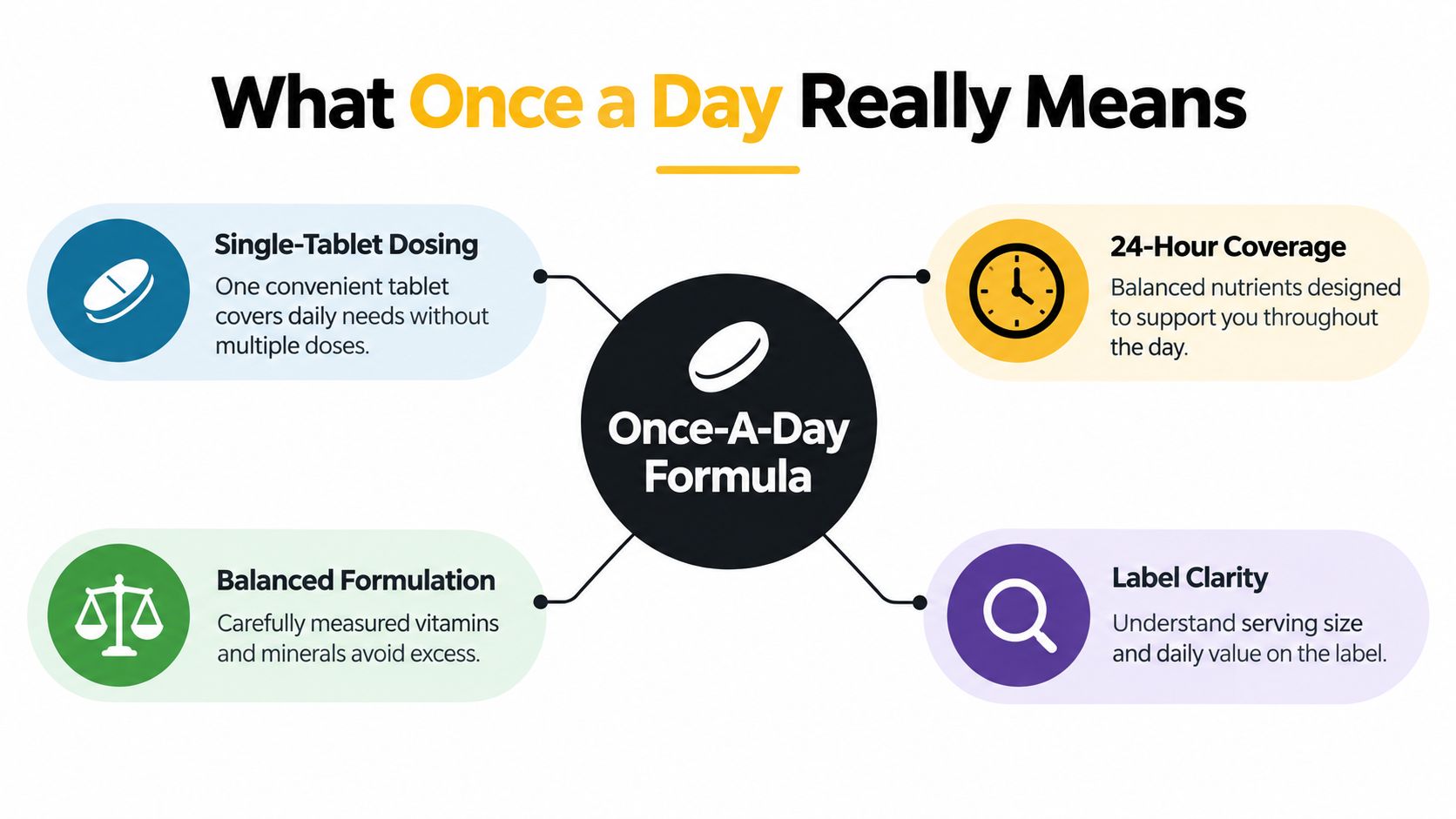
“Once a day for men” usually means the maker wants the full daily serving taken at one time, often with a meal. Sometimes that is one tablet or capsule. Sometimes the label still uses daily language while the serving size is two pills. The front of the bottle gets attention, but the serving size line is the part that answers the question.
The history of the one-a-day format helps explain why the phrase feels familiar, as noted earlier in the article. But for modern men's formulas, the more useful question is simpler. Why was this product built to fit into one daily dose?
Once a day works like a routine tool, not a performance claim
A well-designed once-daily formula often aims to make regular use easier. That matters because a supplement only helps fill nutritional gaps if someone takes it.
The design usually balances a few practical goals:
- Compliance: one daily moment is easier to remember than a split schedule
- Absorption planning: directions often pair the dose with food, which can help certain nutrients fit better into a normal eating routine
- Formula tradeoffs: men's products are often iron-free, which changes how much space the formula needs and what it prioritizes
- Gap coverage: the goal is often to cover common shortfalls reasonably well, not to pack every nutrient into the highest possible amount
That iron-free point can confuse shoppers, so it helps to slow down there. Many men's multis leave iron out on purpose. That choice is not automatically better for every person, but it often reflects a design decision about who the formula is for and how much room is available in a single daily serving. If a brand removes one mineral, it has more flexibility to include or adjust others without turning the product into a larger or multi-pill routine.
Pill count matters less than the dosing logic
A one-pill formula is convenient, but convenience alone does not make it the smarter option. Some nutrients are bulky. Some formulas split the serving into two pills because the brand wants more room for minerals or plant compounds. Others keep it to one capsule because a simpler routine tends to be easier to repeat.
The better question is whether the format supports steady use and sensible meal timing. A once-daily men's supplement is often built for breakfast or lunch, when food can act like a cushion and a carrier. In that sense, “once a day” is closer to packaging a day's support into one repeatable habit than making a claim that one pill does everything equally well.
One example is Vita Mix NexiHerb Multivitamin & Mineral Dietary Supplement, a one-capsule vegetarian multivitamin and mineral supplement that includes a range of vitamins, minerals, and selected plant-derived compounds such as lutein and zeaxanthin. That does not make it the right fit for everyone. It shows what this format often looks like in the world: one serving, meal-friendly instructions, and a formula built around practical daily use.
“Once a day” usually reflects a compliance and formulation choice first. The smarter read is not “How few pills is this?” but “What gaps is this trying to cover, and why was it built to be taken this way?”
Key Ingredients and Dosages to Look For in a Daily Men's Supplement
A label can look strong and still tell you very little.
Many once-daily men's formulas list dozens of nutrients, plant compounds, and technical ingredient names. The useful question is simpler. Does the formula cover common gaps in a way that fits one daily dose, or is it mostly trying to look busy on the bottle? That compliance-and-design lens matters here. A once-a-day product has limited space, so every inclusion reflects a choice about what to prioritize, what to leave out, and how practical the serving will be with real-life use.
Nutrients that often deserve a closer look
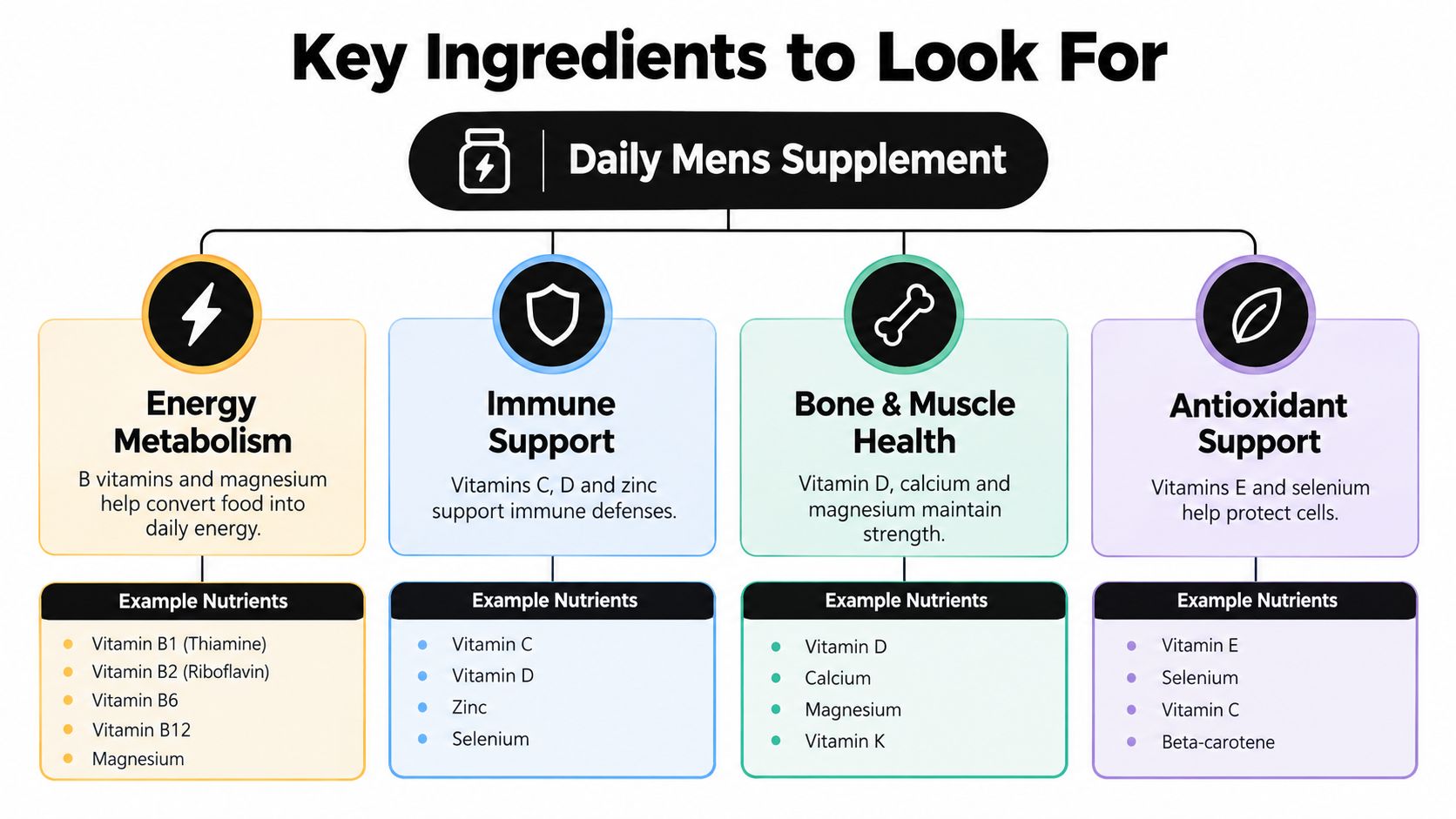
A solid men's multivitamin usually reads like a gap-filler, not a greatest-hits album. The basics often matter more than a long list of extras.
- Vitamin D: Commonly checked because food intake and indoor routines may leave this area light.
- Vitamin B12: Often relevant for men with lower animal-food intake or inconsistent meal patterns.
- Zinc: Frequently included as part of broad mineral coverage in men's formulas.
- Magnesium: Worth extra scrutiny because meaningful amounts take up space, so some once-daily products include very little or leave it out.
That last point causes confusion. If a label includes magnesium but only in a token amount, it may be there for label appeal more than meaningful coverage. One-capsule formulas often make tradeoffs like this because minerals are bulky.
Why some men's formulas are iron-free
This is one of the most practical clues on the label.
Many men's daily supplements leave out iron unless there is a specific reason to include it. That is not a shortcut. It is often a design choice that creates more room for other nutrients and keeps the formula aligned with general men's multivitamin conventions. In plain terms, the capsule works like a carry-on bag. If one bulky item goes in, something else may need to stay out.
That is why pill count can be misleading. A one-a-day formula is not automatically “better packed.” It may be choosing broader basic coverage over heavier mineral loading.
Read the label by function
A cleaner way to compare products is to group ingredients by job instead of reacting to marketing language or long chemical names.
| Nutrient group | What to notice on the label | Why it matters |
|---|---|---|
| B vitamins | Whether several B vitamins appear together | They are often grouped for basic daily nutritional coverage |
| Fat-soluble vitamins | Vitamins A, D, E, and serving guidance | These are commonly paired with meals in daily-use formulas |
| Minerals | Zinc, selenium, magnesium, chromium, and amounts | Mineral choices show where the formula put its limited space |
| Added compounds | Lutein, zeaxanthin, tocopherols, bioflavonoids | These may be useful extras, but they should not distract from the basics |
This method lowers label noise. You stop asking, “How long is the ingredient list?” and start asking, “What jobs is this product trying to do in one serving?”
Active forms matter, but only after the basics
Some labels use ingredient forms that sound more advanced. Folate may appear as L-5-MTHF. Vitamin E may include mixed tocopherols. A formula may also add lutein or zeaxanthin.
Those details can be helpful. They just belong in the second round of evaluation, not the first. A daily men's supplement still needs a sensible foundation before the extras mean much.
A good men's multivitamin panel should read like a well-packed lunch. Core items first, useful additions second, no need to stuff in everything at once.
Dosage questions that keep you grounded
“Dosage” sounds precise, but for a multivitamin it often means balance more than force. Higher numbers across the label do not automatically make the formula smarter. A once-daily product has to fit into one serving, work with regular use, and focus on likely gaps rather than trying to cover every possible need in maximum amounts.
The same practical mindset shows up in other supplement categories. If you want an example of dosage guidance built around fit instead of hype, HempWell USA's resource on correct CBD dosage for sleep shows how product instructions can be framed around context and individual use.
A few label questions help:
- Does it cover the nutrients I am most likely to miss?
- Are key minerals included in meaningful amounts, or just listed?
- Is the formula iron-free by design, and does that choice make sense for a general men's product?
- Do the added compounds support the formula, or mainly decorate the label?
- Does one daily serving reflect a realistic balance of coverage, absorption, and routine?
How to Time Your Once a Day Dose and Build a Consistent Routine
You get out the door, remember your keys, answer two messages, and realize the vitamin bottle is still on the counter. That is the problem a once-a-day formula is trying to solve. The point is not just one pill. The point is one repeatable moment.
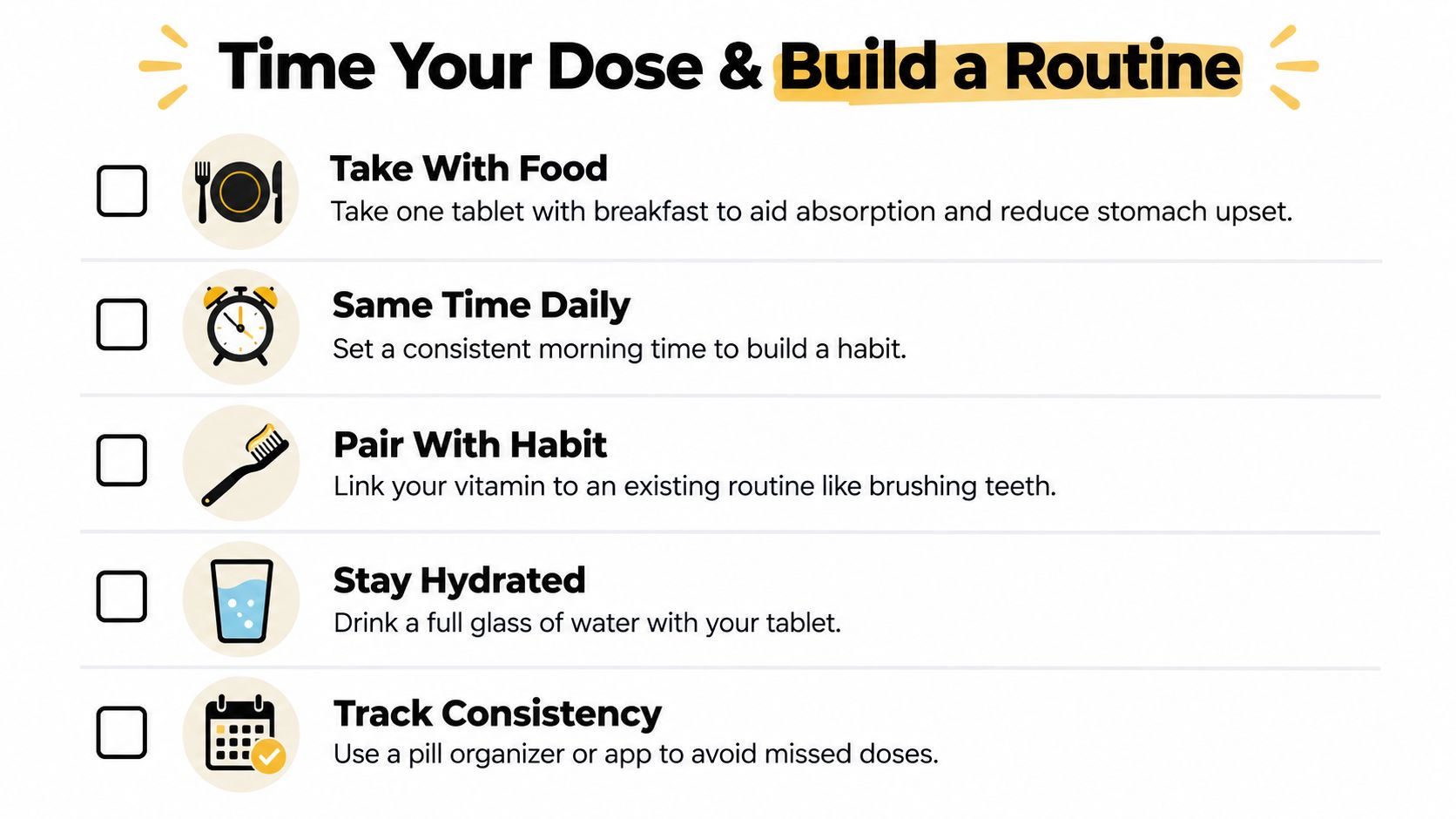
For men's formulas, timing is usually a design question more than a marketing claim. Many are made to be taken with food because that fits how the formula is built. Fat-soluble vitamins such as A, D, E, and K are commonly paired with a meal for practical absorption reasons, and an iron-free formula can make that single daily dose easier to place into an ordinary routine. Food also gives the habit a setting. A supplement taken in the middle of chaos is easy to miss. A supplement tied to a meal has a home.
Pick a moment that already exists
A good routine works like hanging your keys on the same hook every day. You are not relying on motivation. You are using placement and repetition.
Choose the meal or daily event that happens most reliably:
- Breakfast anchor: Keep the bottle near the coffee mugs or breakfast bowl.
- Lunch backup: Helpful if mornings are inconsistent but midday is steady.
- Dinner routine: Useful if work hours are hectic and evenings are calmer.
- Travel version: Keep a small organizer in your work bag or toiletry kit.
If the label says to take it with food, the best meal is usually the one you skip least often. “Best” on paper matters less than “easy to repeat” in real life.
For a practical walkthrough of meal pairing and scheduling, see NexiHerb's guide on the best time to take vitamins.
Match the habit to your real schedule
A clock-based plan sounds tidy, but many men do better with an event-based plan. Tie the dose to the first solid meal after waking, the meal after training, or the dinner that happens almost every night. That approach usually holds up better on weekends, travel days, and shift changes.
Here is a simple way to set it up:
| Daily pattern | Routine that often works |
|---|---|
| Early riser | Take it with breakfast or a post-workout meal |
| Shift worker | Tie it to your first main meal after waking, not the clock |
| Frequent traveler | Pack a week's worth in a labeled case and keep it with toiletries |
| Busy parent | Put it where the morning chaos happens, not where you hope to remember it |
The larger idea is simple. Once a day works best when the formula fits a meal, and the meal fits your life.
If you want ideas for making that kind of consistency stick beyond supplements, Full Circle Function & Fitness shares practical advice on building strong nutrition habits for longevity.
This quick video can also help reinforce the routine mindset before you choose your timing.
If you miss a day
A missed day is a routine problem, not a character flaw. Take the next scheduled serving as directed on the label, then fix the part of the routine that broke.
Keep the habit boring. Boring habits survive busy weeks.
A few small adjustments can help:
- Use visual placement: Put the bottle where your hand already goes at mealtime.
- Use a full glass of water: That turns the dose into a clear start-and-finish action.
- Avoid pile-ons: Adding several new supplements at once makes the routine harder to keep.
- Read the label again: Once-daily products can differ on food timing, serving form, and instructions.
Consistency usually comes from fewer decisions, not more. That is why “once a day” works best as a compliance and absorption strategy, not just a pill count promise.
How to Choose the Right Once a Day Supplement for Your Needs
Choosing a men's once-daily supplement gets easier when you stop asking which bottle looks strongest and start asking which one fits your diet, schedule, and label preferences. The right choice usually feels clear on the back panel long before it feels exciting on the front panel.
One area that confuses shoppers is the meaning of iron-free. Many men's formulas are designed that way, and for many adult men that can make sense. Still, iron-free isn't automatically “better” for every person. It's a formulation decision that may or may not match your situation.
Choosing a Once a Day Mens Formula at a Glance
| Label Cue | What It Means | Who It May Suit |
|---|---|---|
| Iron-free | The formula leaves out iron | Many adult men who don't need added iron from a daily multivitamin |
| One tablet or capsule | The full daily serving is in one piece | Men who value simplicity and travel-friendly use |
| Multiple tablets per day | The formula spreads the serving across more than one pill | Men comfortable with a more involved routine |
| Active-form nutrients | The label uses specific nutrient forms such as L-5-MTHF | Shoppers who like more detail in their formulas |
| Botanical additions | The formula includes plant-derived compounds beyond standard vitamins and minerals | Men who want broader wellness-oriented blends |
| Vegetarian capsule or allergen-aware details | The dosage form or ingredient base may fit personal preferences | Men who care about capsule type or ingredient transparency |
Questions that make comparison easier
When you're standing in front of several options, use a short filter:
- What does my diet already cover well? If you eat broadly and consistently, you may want a simpler support formula.
- Do I want pure basics or basics plus extras? Some men want a straightforward multivitamin. Others prefer added carotenoids or plant compounds.
- Will I take this every day? A perfect label on paper can still be a poor choice if the routine feels annoying.
- Does the serving instruction fit my meals? If the bottle says take with food, your daily rhythm needs to support that.
For a deeper checklist on comparing labels, forms, and personal fit, NexiHerb's guide on how to choose a multivitamin is a practical next step.
A calm way to decide
If you feel stuck, choose the formula that solves the most obvious problem with the least friction. That may mean a basic once-daily multivitamin with transparent labeling. It may mean an iron-free men's formula. It may mean skipping flashy extras and picking the product you'll consistently take with breakfast.
The goal isn't to win at supplement shopping. The goal is to build a realistic daily support habit.
Safety Interactions and Realistic Expectations for Daily Use
Daily multivitamins are easy to treat as harmless background items, but they still deserve attention. “Daily” doesn't mean “thought-free.” You still need to check the label, consider what else you take, and keep expectations realistic.
One of the clearest long-term datasets in men comes from the Physicians' Health Study II. In that randomized trial, 1,732 men experienced major cardiovascular events during a median 11.2 years of follow-up, with event rates of 11.0 per 1,000 person-years in the multivitamin group versus 10.8 per 1,000 person-years in the placebo group, and the study reported 2,757 deaths overall, or 18.8% of participants. The trial found no significant reduction in major cardiovascular events, myocardial infarction, stroke, or cardiovascular death from taking a daily multivitamin in the JAMA publication of the study.

What that means in everyday language
That result doesn't mean multivitamins are pointless. It means they should be understood correctly. A once-daily men's multivitamin is better viewed as a nutritional support habit than as a substitute for sleep, activity, food quality, or medical care.
Another study adds useful nuance. In a 6-month randomized, double-blind study of healthy older men, one-tablet-per-day multivitamin and multimineral supplementation improved several blood vitamin biomarkers, including pyridoxal phosphate, calcifediol, alpha-tocopherol, and beta-carotene, while the placebo group generally declined. The supplement group also avoided the drop in cellular oxygen consumption seen in placebo in this open-access study on healthy older men. That's a practical reminder that a daily formula may help maintain micronutrient status, especially when diet falls short, without needing to carry unrealistic promises.
Basic safety checks worth doing
Before you start or switch a product, pause on a few points:
- Check for overlap: If you also use separate vitamin D, zinc, magnesium, or energy blends, you may be stacking duplicate nutrients.
- Review medications: Some vitamins, minerals, and botanicals can matter when medications are in the picture. A pharmacist or clinician can help check compatibility.
- Watch tolerance: If a product bothers your stomach, the issue may be timing, taking it without food, or the formula itself.
- Use the label as the rulebook: Serving size, meal instructions, and cautions matter.
If you take prescription medication or use multiple supplements at once, bring the full list to a healthcare professional instead of guessing.
Putting It All Together and Next Steps for Your Daily Routine
The most helpful way to think about once a day for men is simple. It isn't mainly a marketing phrase about power. It's a design choice about consistency, practical absorption, and label clarity.
A strong choice usually has three traits. It fits your actual schedule, it focuses on common nutrient gaps rather than endless extras, and its serving instructions are easy to follow with food. That matters more than pill count alone.
Use this quick checklist before you buy or restart a routine:
- Look at your meals first: Where are your obvious gaps or inconsistencies?
- Read the serving size line: Is it once daily?
- Check the formula type: Iron-free or not, basic or broader, simple or multi-pill
- Plan the anchor habit: Breakfast, lunch, dinner, or first meal after waking
- Avoid unrealistic expectations: Support habit, not miracle shortcut
- Check for overlap with other supplements: Especially if you already take single nutrients
If your current bottle has been sitting untouched for weeks, don't start by chasing a fancier product. Start by making the routine easier. The best daily supplement is often the one that fits your life well enough to become automatic.
NexiHerb LLC offers science-inspired supplements and practical wellness education for adults who want routines they can maintain. If you're comparing daily multivitamins, men's wellness options, or straightforward nutrition guidance, visit NexiHerb LLC to explore products and blog resources built around balanced, everyday use.