

Most advice on the best joint supplements for men starts with a ranking. That's the wrong starting point.
A supplement that makes sense for a man with diagnosed knee osteoarthritis may be a poor choice for a lifter whose only issue is stiff knees after heavy squats. A formula that helps an older adult with clear cartilage wear may do very little for a healthy runner who just needs better recovery habits and a smarter training week. That mismatch is why so many men buy a “top-rated” joint product, take it for a few weeks, and conclude that all joint supplements are useless.
The more useful question is simpler. What problem are you trying to solve? Morning stiffness, training-related irritation, known osteoarthritis, swelling after impact work, or a joint that just feels unreliable under load are not the same problem. They shouldn't get the same answer.
Table of Contents
- Why the Best Joint Supplement Depends on the Man Asking
- The Three Ways Supplements Actually Support Your Joints
- The Big Eight Ingredients and What the Research Shows
- Active Men vs Diagnosed Joint Wear How Your Starting Point Changes the Answer
- How to Choose a Joint Supplement That Is Worth the Money
- Safety Interactions and Who Should Check With a Doctor First
- Setting Expectations and Measuring Real Results Over Time
- Putting It All Together A Practical Daily Framework for Joint Health
Why the Best Joint Supplement Depends on the Man Asking
The joint-supplement market exists for a reason. A global analysis published in 2023 estimated that 595 million people had osteoarthritis in 2020, equal to 7.6% of the world population, and the total number of cases had risen 132.2% since 1990. That same analysis reported higher age-standardized prevalence in females than males, but male burden was still substantial, and a later global burden analysis found male osteoarthritis cases in working-age adults rose from 8,093,701 in 1990 to 13,815,145 in 2021 (global osteoarthritis analysis in The Lancet Rheumatology00163-7/fulltext)). So yes, this category matters. But it doesn't follow that one bottle is “best” for every man.
A better way to think about it is that ingredients are tools, not trophies. The right tool depends on the pattern.
Three men, three different answers
Take a 38-year-old recreational lifter. He feels stiff the day after lower-body training, but he warms up and moves well once he gets going. He may care more about ingredients aimed at irritation and recovery than slow-acting cartilage support.
Now consider the weekend athlete with a known cartilage defect or a diagnosed wear issue from old injuries. His question is different. He's not just chasing less soreness after training. He's looking for support that at least tries to match structural joint stress over a longer timeline.
Then there's the middle-aged desk worker whose main complaint is morning stiffness. He may not need the same stack as either athlete. His biggest wins might come from movement, body composition, and an ingredient choice matched to persistent stiffness rather than post-exercise discomfort.
Practical rule: Stop asking “What's the best joint supplement for men?” Start asking “What is my actual pattern of pain, stiffness, and load?”
This is also why broad supplement rankings often feel unsatisfying. They flatten very different situations into one shopping list. If you want a good primer on debunking supplement myths, that piece does a nice job showing why context matters more than marketing.
What your decision should be based on
Before you buy anything, sort yourself by four filters:
- Your baseline joint status: Healthy but creaky is not the same as diagnosed osteoarthritis.
- Your training load: Heavy lifting, running volume, and impact sports stress joints differently.
- Your symptom pattern: Morning stiffness, pain under load, swelling, and rest pain point in different directions.
- Your timeline: Some ingredients are “support over time” options, not fast pain relievers.
That's how you find your fit. Not by memorizing someone else's top 10 list.
The Three Ways Supplements Actually Support Your Joints
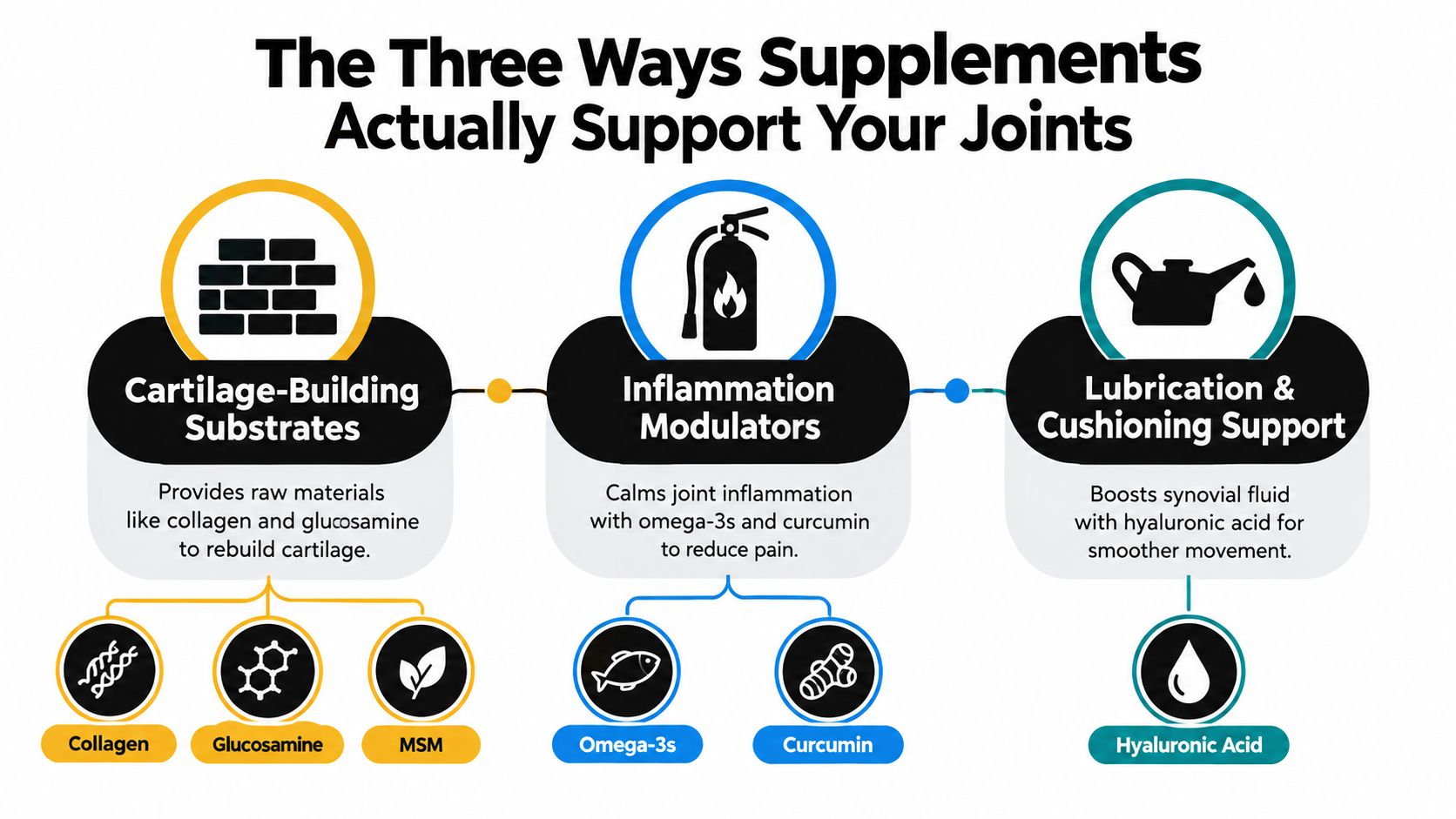
Most men get lost because ingredient lists look random. They're not random. Almost every joint supplement is trying to do one of three jobs.
Cartilage-building substrates
Think of these as raw materials. This group includes glucosamine, chondroitin, and collagen. They're used in formulas built around cartilage support, connective tissue support, or longer-term joint comfort.
These aren't painkillers. When they help, they usually help slowly. That matters because many men judge them like they'd judge ibuprofen. Wrong test.
A product example helps here. Joint Care Complex NexiHerb Glucosamine & Chondroitin Complex contains glucosamine sulfate potassium, chondroitin sulfate, MSM, boswellia extract, and turmeric extract in capsule form for adult use. That's a mixed formula. Part of it aims at structural support, and part aims at inflammatory modulation.
Inflammation modulators
This bucket is the fire extinguisher. Ingredients here include omega-3s, curcumin, and boswellia. Their role is less about rebuilding tissue and more about calming the chemical environment around an irritated joint.
That makes them especially relevant for men whose symptoms rise with training load, repetitive impact, or flare-prone stiffness. If your joints feel worse after hard sessions and better with recovery, this category often makes more intuitive sense than a cartilage-first formula.
A short video can help make the framework stick:
Movement-support nutrients
This third group is the support crew. Think of it as the team keeping the door swinging smoothly. Ingredients such as vitamin D, magnesium, and MSM often matter because joints never work alone. Muscles, tendons, loading tolerance, and recovery all influence how a joint feels.
If a man is low in movement quality, slow to recover, cramp-prone, or generally under-recovered, this category can matter even when the bottle doesn't say “joint” in huge letters.
A simple map for the big ingredients
- Glucosamine: mostly cartilage-building
- Chondroitin: mostly cartilage-building
- Collagen: cartilage and connective tissue support
- Omega-3s: inflammation modulation
- Curcumin: inflammation modulation
- Boswellia: inflammation modulation
- MSM: movement support, with some overlap into inflammation support
- Vitamin D and magnesium: movement and musculoskeletal support
Once you know the job each ingredient is trying to do, label reading gets much easier.
The Big Eight Ingredients and What the Research Shows
The evidence for joint supplements is not evenly distributed. Some ingredients have a decent logic and at least some supportive human data. Some have mixed outcomes. Some are mainly useful in very specific people.
The quick comparison
| Ingredient | Evidence Verdict | Typical Daily Dose | Best For |
|---|---|---|---|
| Glucosamine | Mixed | 1500 mg | Men with osteoarthritis-like joint wear who can commit to a longer trial |
| Chondroitin | Mixed | 1200 mg | Often paired with glucosamine for longer-term support |
| MSM | Weak to mixed | Label-dependent | Men focused on stiffness and recovery support |
| Collagen | Mixed to promising | Label-dependent | Men with symptomatic joint discomfort, especially when baseline joint issues are present |
| Omega-3s | Mixed but practical | Label-dependent | Training-related irritation and general inflammatory load |
| Curcumin | Mixed but practical | Label-dependent | Flare-prone joint irritation, if using a well-formulated product |
| Boswellia | Mixed but practical | Label-dependent | Men seeking non-structural support for discomfort and stiffness |
| Vitamin D | Conditional | Based on personal status | Men with low status or broader musculoskeletal support needs |
| Magnesium | Conditional | Form matters | Men with recovery, muscle tension, or cramp-related overlap |
Glucosamine and chondroitin
These are the legacy ingredients in this category, and they're still the benchmark for comparison.
A network meta-analysis of 10 large, patient-blind randomized trials involving 3,803 people with knee or hip osteoarthritis concluded that glucosamine, chondroitin, and their combination did not produce a clinically relevant reduction in joint pain or meaningful change in joint-space narrowing versus placebo (patient-blind trial meta-analysis). That's the skeptical side of the story, and it matters.
The more forgiving read is that results depend on formula, study design, and population. A later review noted that oral daily doses of 1500 mg glucosamine and 1200 mg chondroitin are the standardized practical doses most often discussed, usually split into two or three doses, while also noting inconsistent results and that the American College of Rheumatology has recommended against routine use for knee osteoarthritis because the best data don't show important benefits (human safety and efficacy review).
Don't buy glucosamine expecting quick pain relief. If it helps, it tends to be slow and modest.
A useful nuance is formulation. Men often lump all glucosamine products together, but that's not how labels work in the real world. If you want a plain-language primer on ingredient pairings, this overview of glucosamine, hyaluronic acid, chondroitin, and MSM is a decent practical read.
MSM
MSM shows up in many formulas, but the evidence base is less standardized than glucosamine and chondroitin. I'd put it in the weak to mixed bucket. It may fit men whose symptoms feel more like stiffness and poor recovery than obvious structural joint disease, but it's rarely the reason I'd choose a product by itself.
Collagen
Collagen is more interesting than many men realize. A 2025 systematic review of type I collagen hydrolysate reported that most joint-health trials found reductions in pain, better mobility, and improved function, and broader pooled analyses have reported statistically significant pain reductions versus placebo in osteoarthritis populations. But a 12-week trial in healthy active adults found collagen supplementation did not reduce knee pain, which tells you something important: baseline joint status changes the expected payoff (systematic review on collagen hydrolysate).
That's why collagen often makes more sense for men with real, ongoing joint symptoms than for healthy guys hoping it will bulletproof their knees.
Omega-3s, curcumin, and boswellia
These ingredients are often more aligned with the man who says, “My joints get angry when my training gets heavy.”
I'd call the verdict here practical but not magic. They make the most sense when inflammation, flare-ups, or load-related irritation are the pattern. Curcumin deserves one warning. Absorption matters. A poorly absorbed curcumin product may look strong on the front label and disappoint in practice. Boswellia is similar in spirit. It's usually chosen to calm symptoms, not rebuild cartilage.
Vitamin D and magnesium
Neither is a classic joint supplement, but both can matter. Vitamin D belongs here because low status can overlap with broader musculoskeletal complaints. Magnesium belongs here because movement quality, muscle relaxation, and recovery shape how joints feel under load.
If you use magnesium, form matters. Many men tolerate and use glycinate better than oxide for everyday supplementation. That's a practical choice, not a joint-specific miracle.
If you can only afford one or two
My candid hierarchy looks like this:
- For diagnosed or strongly suspected joint wear: consider glucosamine, chondroitin, or collagen, with patience.
- For active men with flare-prone training discomfort: consider omega-3s, curcumin, or boswellia first.
- For broad support: check vitamin D status and choose a sensible magnesium form if recovery is part of the picture.
One thing to exclude from your joint decision process is unrelated men's wellness products. For example, Xlarge NexiHerb Advanced Herbal Formula to Support Male Vitality & Daily Wellness is a general herbal supplement for adult wellness, not a joint-targeted formula, so it shouldn't be treated as a substitute for a joint supplement.
Active Men vs Diagnosed Joint Wear How Your Starting Point Changes the Answer
A fit man with achy knees after hard training and a man with diagnosed osteoarthritis may both type the same phrase into Google. They usually shouldn't buy the same thing.
The comparison that matters
| Profile | Typical Signals | Priority Ingredients | Realistic Timeline | Realistic Outcome |
|---|---|---|---|---|
| Active man with early stiffness | Stiff on waking, sore after training, improves once warm, little or no imaging history | Omega-3s, curcumin, boswellia, MSM, with collagen or vitamin D as support | Weeks to a couple of months | Less irritation, better tolerance of training, smoother warm-ups |
| Diagnosed joint wear or osteoarthritis | Known imaging findings, persistent pain, bony changes, stiffness not explained by one hard session | Glucosamine, chondroitin, hydrolyzed collagen, plus symptom support if needed | Longer trial window | Modest support, not a cure |
How to sort yourself honestly
Men tend to under-classify symptoms. They assume everything is “just tightness” until it clearly isn't.
If your discomfort appears mainly after hard sessions, eases with good warm-ups, and doesn't come with persistent swelling or a prior diagnosis, you probably fit the active-but-early-stiffness profile. In that case, anti-inflammatory and recovery-support choices often make more sense than a cartilage-first stack.
If you've had imaging, repeated clinical assessment, obvious crepitus with loss of tolerance, or a pattern of pain that no longer behaves like ordinary training soreness, think diagnosed wear. For a general medical overview, this Dream Body Clinic osteoarthritis guide gives a useful snapshot of how osteoarthritis is commonly framed.
Borrowing a supplement stack from a guy with a different baseline joint problem is one of the fastest ways to waste money.
A few self-check clues
- Pain that improves quickly as you warm up: more consistent with load and recovery issues
- Pain that sticks around regardless of training day: more concerning for established wear
- Visible bony swelling or a known diagnosis: pushes the answer toward structure-focused support
- No clear response to better sleep, deloads, and movement prep: also pushes the answer away from simple recovery support
That starting point changes everything.
How to Choose a Joint Supplement That Is Worth the Money
The quality problem in this category is real. Independent testing found that 18% of joint health supplements failed to pass quality tests, which matters in a category where the evidence is already mixed and product content can drift from label claims (quality discussion in Garage Gym Reviews).
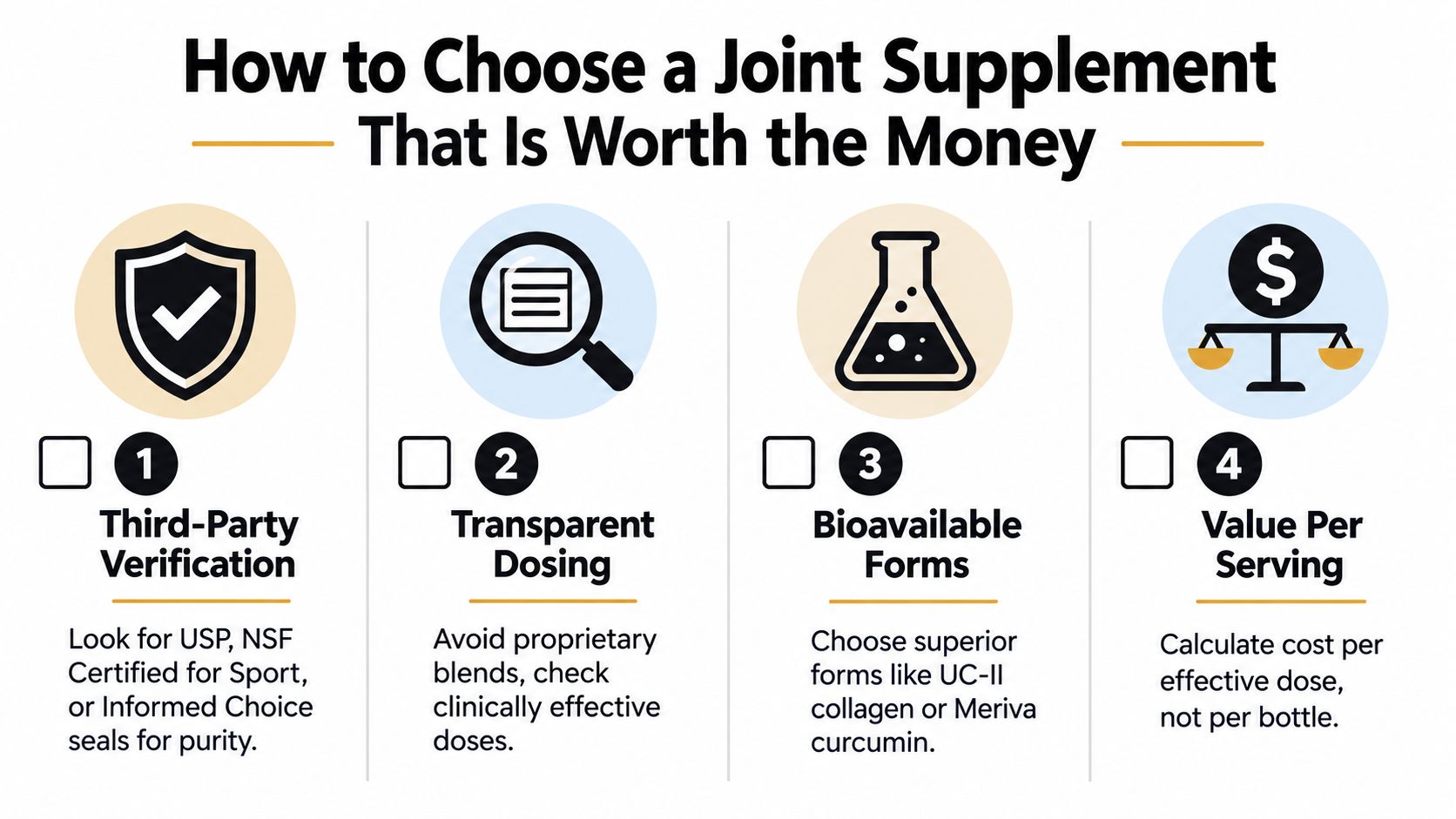
Filter one checks whether the label is trustworthy
Look for third-party verification such as USP, NSF Certified for Sport, Informed Choice, or ConsumerLab-style testing. The point isn't prestige. The point is simple: you want some outside confirmation that the bottle contains what it says it contains.
No seal doesn't automatically mean bad. But a verified product clears the first hurdle faster.
Filter two checks the ingredient form
A lot of men get tripped up. The front label says “turmeric” or “collagen,” but the practical question is what form you're getting.
- Glucosamine form matters: sulfate is usually the form most tied to the classic evidence base.
- Curcumin form matters: look for a formula built for absorption rather than plain powder with a flashy dose.
- Collagen form matters: hydrolyzed and undenatured versions aren't interchangeable marketing terms.
If labels confuse you, this guide on how to read supplement labels is useful because it walks through serving size, active ingredients, and the common places buyers misread a panel.
Filter three checks whether the dose is serious
A product can include the right ingredients and still underdose them badly.
For example, evidence-linked regimens commonly center around 1500 mg glucosamine and 1200 mg chondroitin daily, so a product that gives you far less per full serving may not match what the better-known trials even attempted. Compare the dose per serving, not the size of the bottle or the number of ingredients.
Filter four looks for red flags
Here's where I'd get cautious fast:
- Proprietary blends: they hide how much of each ingredient you're getting.
- Cure language: joint supplements are support tools, not miracle fixes.
- No lot number or expiration date: basic quality transparency matters.
- Long filler lists with vague actives: often a sign the formula is built for marketing, not clarity.
Buy on cost per effective dose, not cost per capsule.
A cheaper bottle with a clinically relevant serving is often the smarter buy than an expensive formula sprinkled with fashionable ingredients in tiny amounts.
Safety Interactions and Who Should Check With a Doctor First
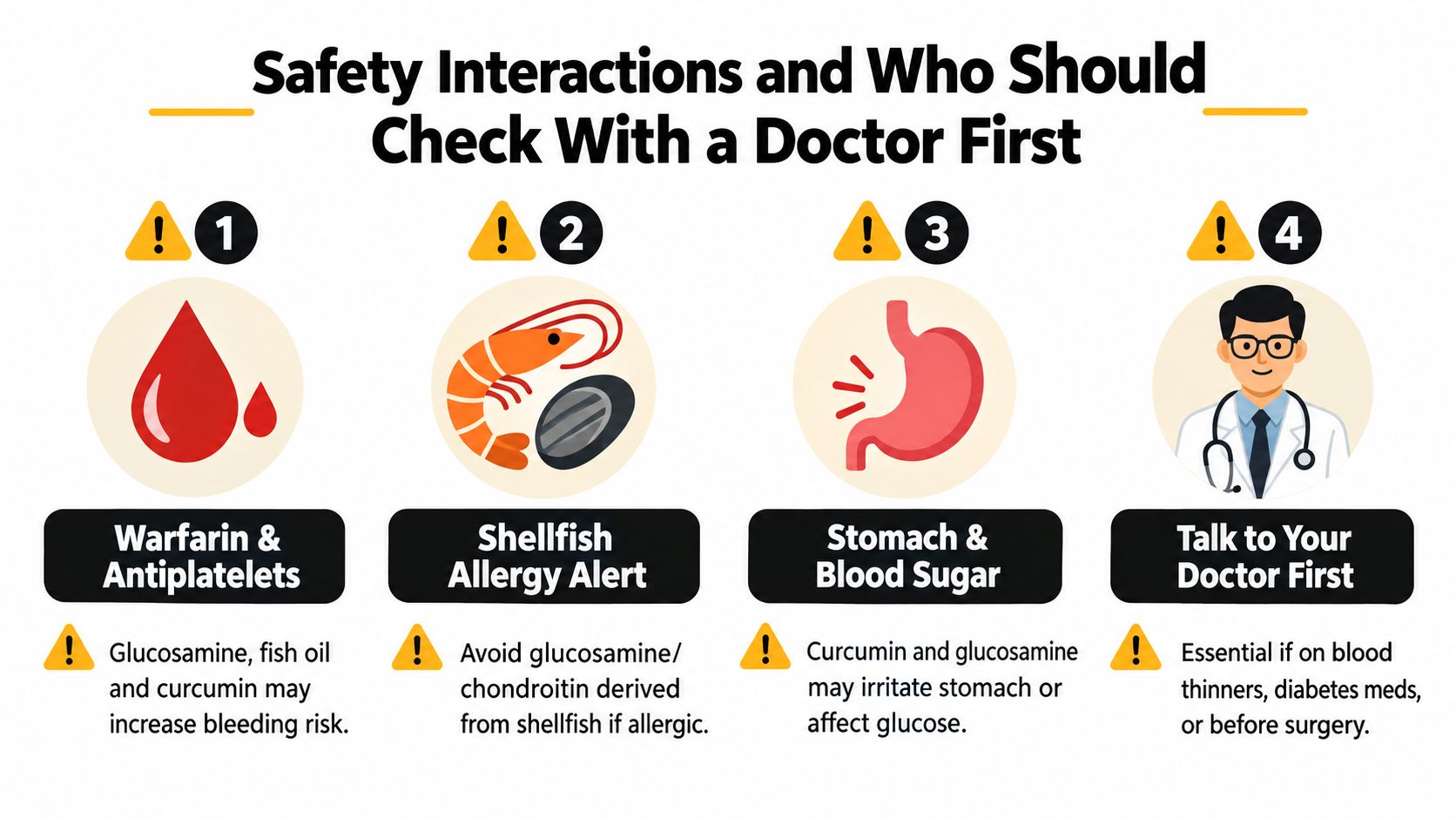
Most joint supplements are better described as conditionally safe than universally safe. The ingredient list matters, your medication list matters, and timing matters.
The interaction list that deserves respect
A few categories should trigger extra caution:
- Warfarin or antiplatelet use: omega-3s, glucosamine, and curcumin can complicate bleeding risk discussions.
- Diabetes medications: glucosamine raises enough questions about blood sugar handling that it's worth checking first.
- NSAID-heavy routines: curcumin and boswellia may sound “natural,” but they still belong in the bigger medication picture.
- Shellfish allergy: some glucosamine products are shellfish-derived, though not all are.
Men who should pause before starting
I'd want a medical green light first if you're in one of these groups:
- Men on immunosuppressants
- Anyone scheduled for surgery within two weeks
- Men with active peptic ulcer disease
- Anyone with liver disease considering curcumin
- Men with kidney impairment who are thinking about magnesium
Magnesium deserves a specific mention because form and kidney function both matter. A routine supplement for one person can be a poor choice for another.
The practical safety rule
Bring the bottle, or at least a clear photo of the Supplement Facts panel, to your clinician or pharmacist. That five-minute conversation is more useful than trying to reverse-engineer interaction risk from scattered internet advice.
Safe for many men doesn't mean safe for your medication list.
Setting Expectations and Measuring Real Results Over Time
A lot of supplement trials fail. Men either quit too early or stay on a dud forever.
Give it a fair trial
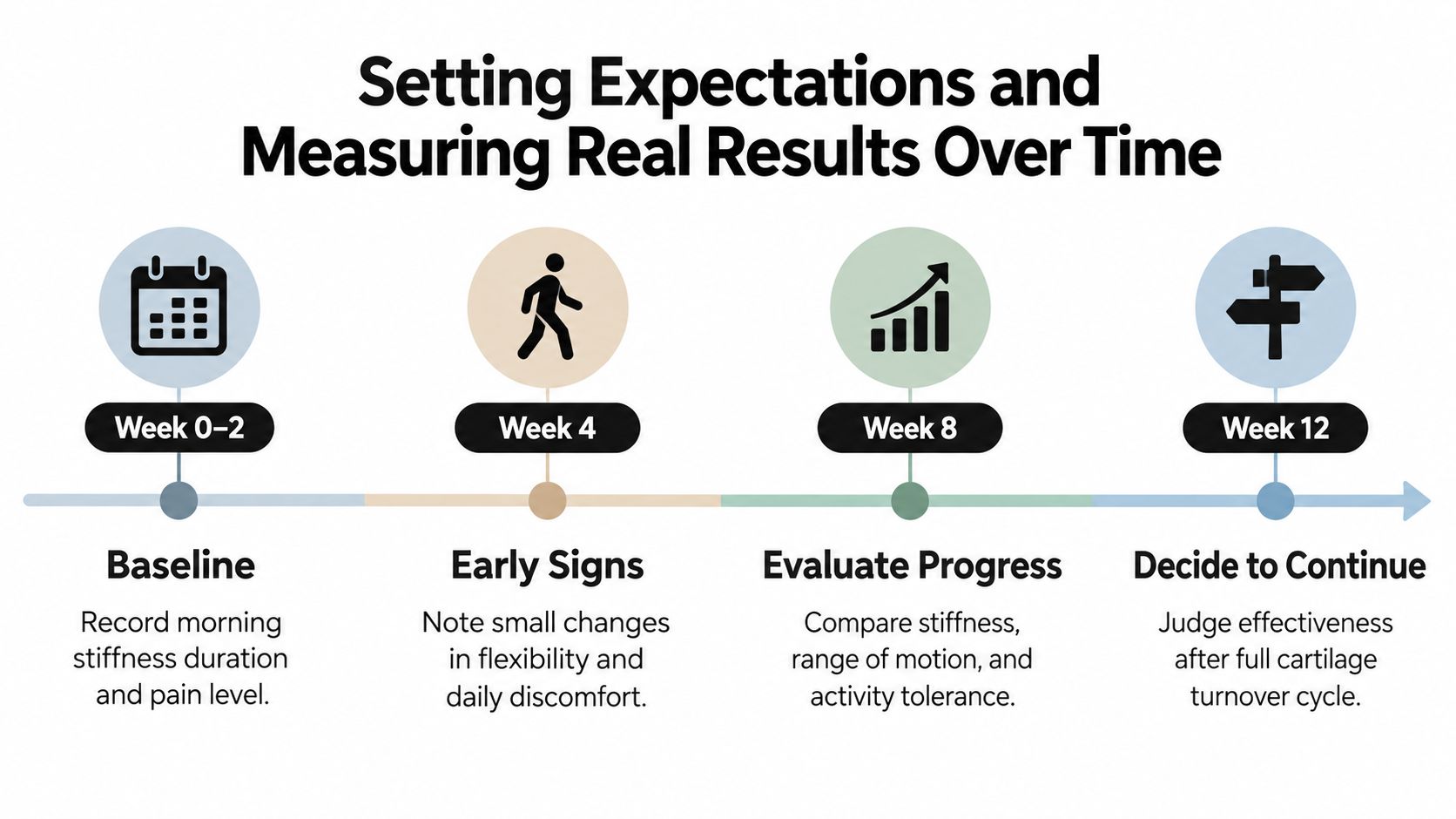
For most joint supplements, 8 to 12 weeks is a reasonable trial window. That's long enough to see whether a slow-acting ingredient is doing anything noticeable, but short enough to stop wasting money if it clearly isn't.
Don't change three other variables at the same time if you can help it. If you start a supplement, switch shoes, deload training, improve sleep, and lose weight in the same week, you won't know what produced the result.
Track four things every week
Use one note on your phone and keep it simple:
- Morning stiffness duration: write down how long it takes to feel normal.
- Pain during one standard movement: stairs, squats, lunges, or getting out of the car.
- Training tolerance: can you hold volume without a flare?
- Visible swelling or puffiness: especially around the same joint each time.
A supplement “working” often looks boring. You recover cleaner, warm up faster, and stop thinking about the joint as much. That still counts.
Use a simple decision rule
At the end of the trial, sort the result into one of three buckets:
-
Meaningful improvement
Keep it. Don't assume more is better. Just stay consistent. -
No improvement
Stop, or switch categories. If a structure-focused ingredient did nothing, an inflammation-focused one may be a better fit, or vice versa. -
Regression or worsening
Stop and reassess. At that point I'd look harder at training load, mechanics, body weight, and medical evaluation.
If you work with a clinician, objective markers such as range of motion or grip strength can make the decision cleaner.
Putting It All Together A Practical Daily Framework for Joint Health
Supplements help some men. They do not carry the whole job.
A better framework starts with daily movement, sane loading, enough protein, recovery, and body-weight management, then adds a supplement that matches the problem. If you skip those basics, even the best joint supplements for men tend to disappoint.
A simple daily setup
Morning is a good place to anchor the routine:
- Move first: a short mobility sequence for hips, ankles, thoracic spine, and shoulders
- Eat like recovery matters: protein plus an omega-3-rich food choice if it fits your diet
- Cover basics: vitamin D and magnesium may belong here for some men, depending on overall needs
Training needs the same honesty. Use progressive overload, keep full range of motion where you can control it, and avoid turning every week into a pounding contest. A joint that never gets a lower-stress week rarely rewards you for stubbornness.
Layer the supplement, don't build everything around it
If your pattern is load-related irritation, start with the anti-inflammatory side of the map. If your pattern is established wear, consider a slower structural-support option and judge it over a longer timeline.
Mobility still matters either way. If you want practical ideas beyond supplementation, this guide on how to improve mobility pairs well with the supplement conversation because it addresses the movement side men often ignore.
The long-game mindset
The smartest joint plan is usually boring. Good sleep. Reasonable body weight. Well-managed training volume. Strength through full ranges you own. Then a targeted supplement, used patiently, if it fits your symptom pattern.
That's the answer. Not “buy the strongest bottle,” but build a system your joints can live with for decades.
NexiHerb LLC offers science-inspired supplements and practical wellness education for adults who want straightforward options for daily support, including joint-related ingredients and broader recovery-focused nutrition. If you want to compare formulas, read label-focused guides, and build a supplement routine that fits training and everyday mobility, visit NexiHerb LLC.