

You're probably here because you saw arginine silicate inositol on a label, in a pre-workout discussion, or buried inside a “nitric oxide support” product and wondered whether it's just a fancier name for arginine. That's the right question to ask. A lot of supplement confusion starts when two things sound similar but don't behave the same way in the body.
The useful way to think about this ingredient is simple. Your body can make nitric oxide through the L-arginine pathway, and people also talk about a separate food-based route involving dietary nitrates. Arginine silicate inositol fits into the first bucket, but it isn't meant to be understood as plain arginine powder with a shiny label. It was developed as a formulated complex, and that matters when you look at absorption, timing, and what the research measured.
If your real goal is better training flow, sharper focus before a mentally demanding task, or a practical way to think about circulation support, the details matter more than the marketing copy. And if you're adjusting your routine more broadly, not just adding a supplement, even something as simple as smarter recovery habits can help. For example, these workout ideas for rest days are a useful reminder that circulation, energy, and readiness aren't only about what comes in a capsule.
Table of Contents
- Why This Ingredient Keeps Coming Up in Wellness Searches
- The Origin of Arginine Silicate Inositol as a Patented Complex
- How ASI Is Proposed to Work in the Body
- What the Human Evidence Actually Shows
- ASI Versus Other Nitric Oxide Pathways
- Practical Dosing, Timing, and Safety Considerations
- Setting Realistic Expectations and Choosing Whether to Try ASI
Why This Ingredient Keeps Coming Up in Wellness Searches
Arginine silicate inositol keeps showing up because it sits at the intersection of circulation, exercise prep, and mental performance. Those are all areas where people want something they can feel. A product label might hint at pumps, blood flow, focus, or nitric oxide support, and that naturally pulls attention.
Why people confuse it with plain arginine
The confusion starts with the first word. Arginine is a familiar amino acid, so many readers assume arginine silicate inositol must be the same thing with a longer name. It isn't that simple.
What matters is the practical question: are you looking at interchangeable arginine, or a distinct ingredient with its own absorption profile? That difference is why this ingredient deserves a slower, clearer explanation than most label summaries give it.
Here's the plain-language version:
- Plain arginine means you're mainly thinking about the amino acid itself.
- Arginine silicate inositol means you're looking at a built ingredient that includes arginine plus other components in a defined complex.
- Your decision isn't just “Does arginine help?” It's “Does this form have a meaningful reason to exist?”
Where it fits in the bigger nitric oxide picture
Nitric oxide support gets discussed as if there's only one route, but there are at least two broad ideas people run into. One is the enzymatic arginine route, where arginine serves as substrate for nitric-oxide-related physiology. The other is the dietary nitrate route, which people associate with foods like beet-based products.
That broader map matters because it stops you from treating every “blood flow” supplement as the same tool. Some are trying to influence nitric oxide support through arginine availability. Others lean on nitrate-rich ingredients. Arginine silicate inositol belongs in the first category, and the most important thing about it is that the human evidence focuses heavily on how fast and how long arginine shows up after dosing, not on sweeping real-world outcomes.
Most supplement labels sell outcomes. The more useful question is what the human studies actually measured.
That's why a careful adult should judge this ingredient on three things: what it is, how it appears to move through the body, and where the evidence stops short.
The Origin of Arginine Silicate Inositol as a Patented Complex
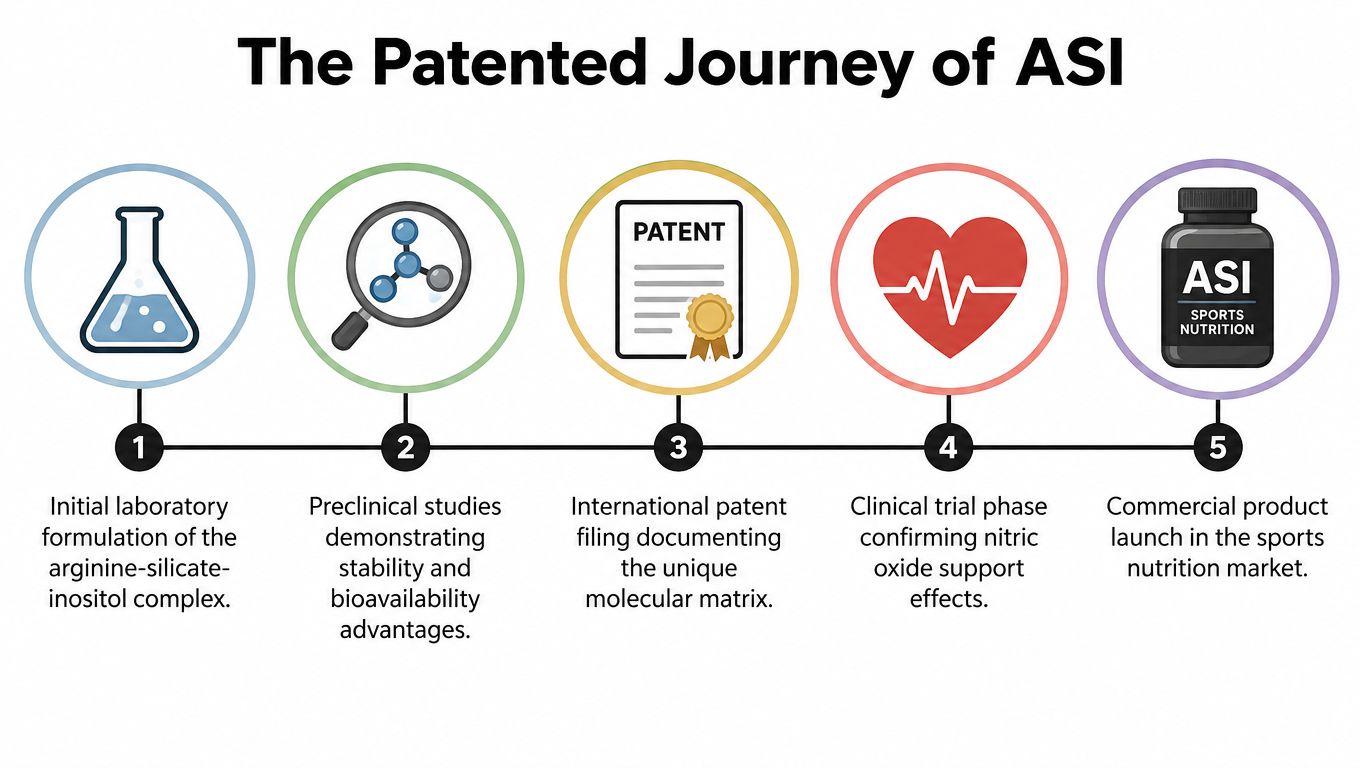
A curious ingredient often starts with a filing, not a shelf display. Arginine silicate inositol has that kind of origin story. Patent records trace the arginine-silicate concept back to a priority date of February 12, 1997, and the international patent application for the arginine silicate inositol complex was filed on February 11, 1998, which shows a defined ingredient identity rather than a loose mix of parts [patent record for the arginine silicate inositol complex].
Why the patent history matters
The patent trail matters because it tells you what kind of ingredient ASI is. The filings describe a stabilized complex involving arginine, a silicate source, and inositol, and later records describe production methods using those components under heated processing. That shows a formulated object, not just three ingredients sitting together in a jar.
This does not prove better real-world results by itself. It does show that arginine silicate inositol was built as its own ingredient identity.
A blend puts three ingredients in one capsule; a patented complex is engineered to behave as a single coordinated structure.
What it is not
ASI is not just ordinary arginine with a new label. The origin story points the other way, toward a specific composition that was intentionally developed and documented in the patent record.
That distinction helps when you compare it with other supplement formats. For example, Argi-Max NexiHerb L-Arginine, L-Citrulline-DL-Malate, and beet root powder is a dietary supplement formulated with amino acids and plant-based ingredients, including L-Arginine, L-Citrulline-DL-Malate, and beet root powder, in a capsule format for adults as part of a balanced lifestyle. That kind of formula is a blend of named ingredients. ASI is discussed in the literature as a specific complex with its own development and characterization.
How ASI Is Proposed to Work in the Body
A person reading about ASI can easily assume it works like plain arginine in a capsule. The proposed mechanism is narrower than that. ASI is described as a formulated complex, and the question is how that specific complex behaves once it is taken, especially compared with free arginine.
Arginine matters because the body uses it in the nitric-oxide pathway, which is one reason it appears so often in circulation-related supplements. The added silicate and inositol are there because ASI was developed as a coordinated composition, not just a loose mix of ingredients.
A review of ASI formulations describes inositol-stabilized arginine silicate as producing plasma arginine increases from the first measured time point, 30 minutes, with elevations lasting up to 6 hours. It also reports different timing by format, about 0.6 ± 0.2 hours for a beverage, 1.05 ± 0.50 hours for tablets, and 1.13 ± 0.52 hours for capsules [review of inositol-stabilized arginine silicate pharmacokinetics].
The step-by-step idea
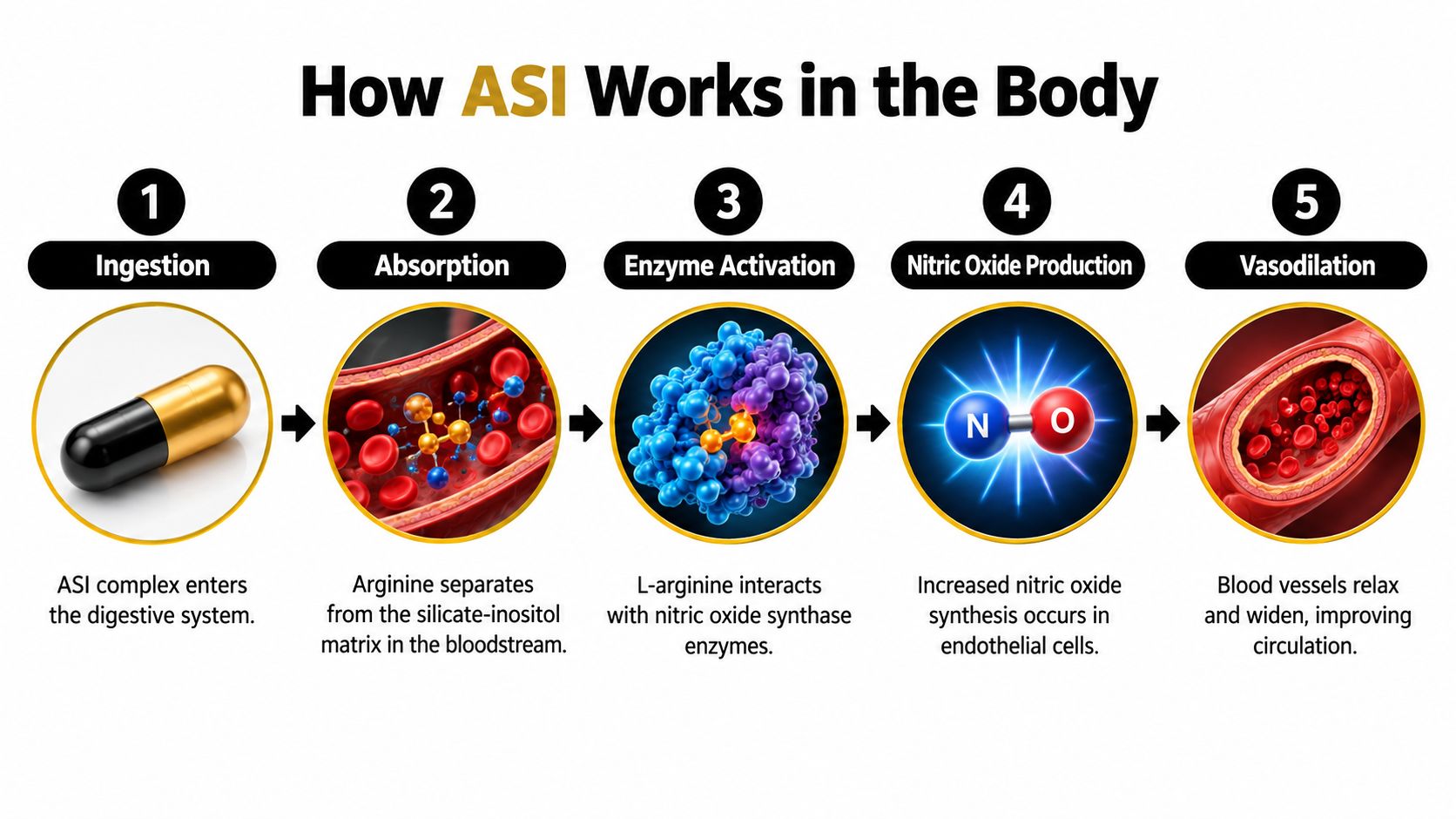
The proposed chain is straightforward:
- You take the ASI complex.
- The complex is processed in the gut and circulation in a way that may support arginine availability.
- Arginine then feeds into nitric-oxide-related physiology.
- That may support blood vessel relaxation and circulation-related effects.
The key phrase is may support. The timing data give a clear absorption pattern. They do not, by themselves, prove the broader claims often attached to nitric oxide supplements.
A useful analogy is a delivery package with a scheduled release, except this is a biochemical system, not a shipping service. The point is not that arginine disappears. The point is that the silicate-inositol structure may influence how arginine becomes available over time [review of inositol-stabilized arginine silicate pharmacokinetics].
For readers who want a plain-language refresher on the amino acid side of the story, L-arginine basics is a useful starting point. For a broader non-supplement perspective on habits linked to blood flow, you can browse circulation improvement advice.
A quick visual can help reinforce the process:
Where confidence is stronger, and where it isn't
The stronger point is the timed rise in plasma arginine after oral dosing of ASI formulations.
The weaker point is the jump from that pharmacokinetic pattern to broad claims about performance, energy, or daily cognition for everyone. The mechanism is plausible. The world outcome story is still limited.
What the Human Evidence Actually Shows
A person taking ASI before work or exercise may expect a noticeable boost. Human research supports a narrower conclusion: ASI has been studied mainly through pharmacokinetic measurements and a small number of acute, short-term studies. Those findings help explain what happens soon after a dose, but they do not establish lasting benefits for everyday users.
What the pharmacokinetic study found
A 2015 human pharmacokinetic study followed 10 healthy adult males with an average age of 26.7 ± 5.4 years. Participants took three 500 mg ASI capsules daily for 14 days. Researchers measured arginine, silicon, and nitric-oxide-related biomarkers [2015 human pharmacokinetic study of ASI].
The study found a measurable, time-linked rise in plasma arginine. Weight-adjusted plasma arginine reached a mean peak of 30.06 ± 7.80 micrograms per milliliter at 1.13 ± 0.52 hours, with statistically significant increases at the measured time points, P < 0.01. Arginine rose within 30 minutes, while arginine, silicon, and salivary nitrite remained high after 14 days in this small sample.
These results describe exposure in a controlled experiment. They do not show that every user will feel a clear daily effect, or that the same pattern produces durable changes in performance, energy, or cognition.
What the acute cognition findings mean
A later review examined the limited evidence for ASI and discussed a randomized crossover study in 19 young adults. After a single 1.5 g ASI dose, participants showed improved total neuropsychological and immediate-memory scores 60 minutes later. Other cognitive domains did not improve, and the authors called for longer studies in older populations [review discussing acute cognition findings and evidence limits].
A separate crossover trial involved 26 experienced gamers who used a 1,600 mg ASI-plus-inositol formulation. That sample may help identify a short-term signal, but its results apply less directly to adults with different ages, routines, or cognitive demands.
Short acute studies can show that an ingredient deserves further study. They cannot establish what routine use will do over months in a broad population.
Acute ASI outcomes by study
| Study | Dose | Sample | Key Finding |
|---|---|---|---|
| 2015 human pharmacokinetic study of ASI | Three 500 mg capsules daily for 14 days | 10 healthy adult males | Plasma arginine peaked at 30.06 ± 7.80 micrograms per milliliter at 1.13 ± 0.52 hours, with significant increases at measured time points |
| Review discussing acute cognition findings and evidence limits | Single 1.5 g dose | 19 young adults | Improved total neuropsychological and immediate-memory scores at 60 minutes, but not other domains |
| Same review, separate crossover trial | 1,600 mg ASI-plus-inositol formulation | 26 experienced gamers | Results came from a narrow group, limiting generalization to typical adult use |
The evidence supports two distinct conclusions. ASI produces measurable short-term arginine exposure, and some small studies report acute cognitive findings. Evidence remains insufficient to prove lasting improvements in exercise performance, workday energy, or general cognition across diverse groups.
ASI Versus Other Nitric Oxide Pathways
You have a pre-workout window in mind, but the label offers ASI, plain L-arginine, citrulline, and nitrate-rich foods. These options all relate to nitric oxide, yet they do not follow the same route or offer the same kind of timing. ASI is a formulated complex with its own pharmacokinetic profile, not another name for arginine.
Where ASI stands out
As covered in the pharmacokinetics discussion, ASI's plasma arginine curve has been documented by delivery format. That makes it a plausible timed-use option, although short-term exposure data do not establish better long-term results in exercise, energy, or general health. The key distinction is the formulation and its observed absorption pattern, rather than a claim that ASI produces more nitric oxide than every alternative [review of inositol-stabilized arginine silicate pharmacokinetics].
A simple comparison for real-world decisions
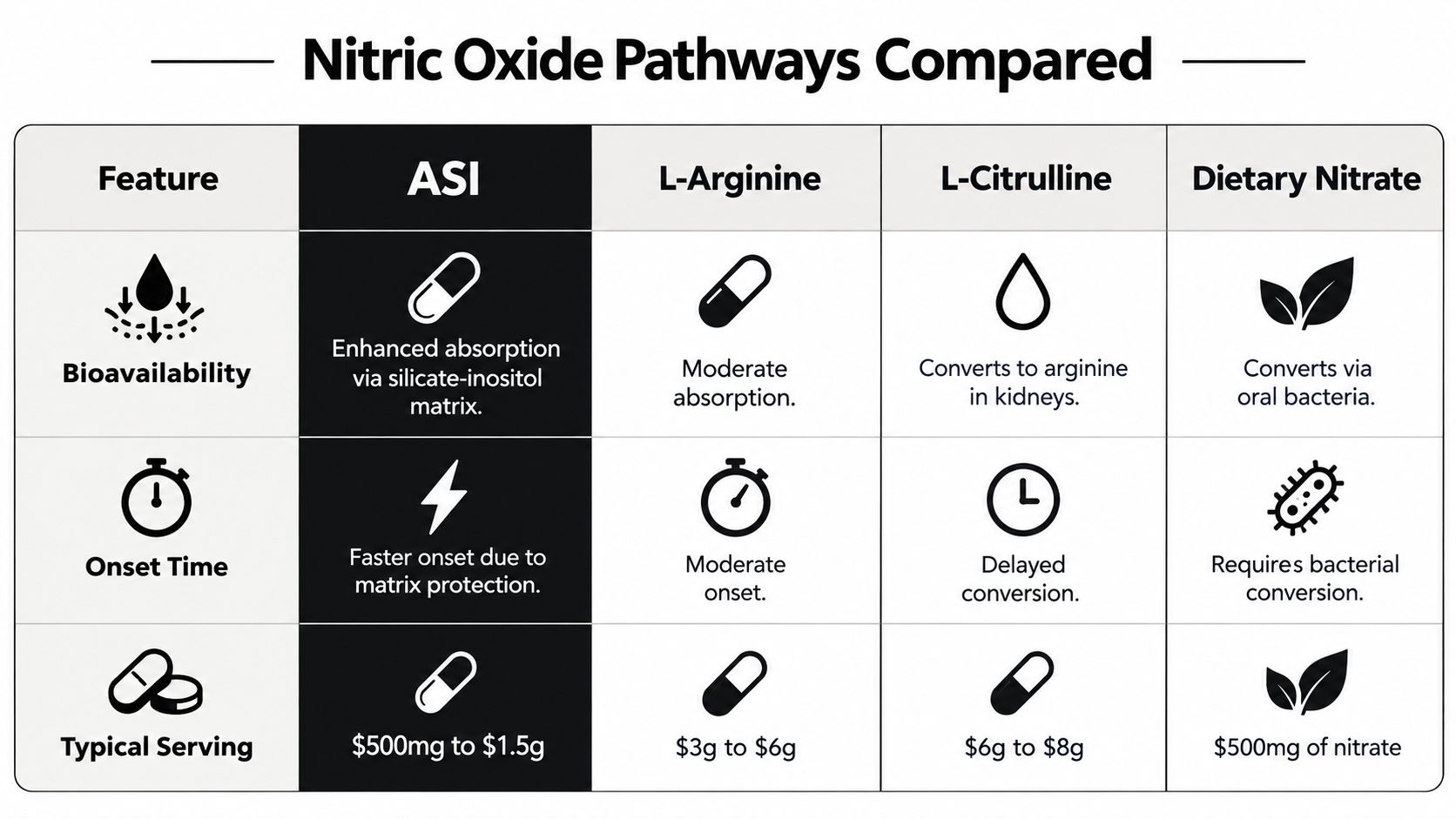
| Approach | Main idea | Best thought of as |
|---|---|---|
| ASI | A formulated arginine complex with a documented short-term absorption pattern | A timed option for a defined activity window |
| Plain L-arginine | Direct arginine intake without ASI's patented matrix | A basic arginine route that may be easier to find in bulk |
| L-citrulline | An amino-acid route that can support arginine availability indirectly | A different pathway, not an ASI substitute |
| Dietary nitrate | A food-led route associated with vegetables such as beetroot | A routine food approach rather than the same mechanism |
Price and availability can shape the practical choice. Bulk L-arginine is generally a simpler supplement format, while ASI depends on a branded formulation and may be less widely stocked. Citrulline sits between those options as a separate amino-acid strategy. Nitrate-rich foods can fit regular meals, but their use is less like selecting a defined ASI product. For food-focused context, see beet root powder for blood pressure. A further comparison of arginine and citrulline together can help clarify why combining or comparing these amino acids does not make them identical.
The part marketers often blur
Nitric oxide support is a broad label, not proof that every ingredient is interchangeable. ASI is a specific formulated pharmacokinetic approach. Citrulline follows a different metabolic route. Dietary nitrate uses another pathway, while plain L-arginine lacks ASI's matrix.
Match the option to the goal, the desired timing, cost, and availability. Acute absorption findings can support a defined short-term experiment. They cannot by themselves predict what routine use will do over months.
Practical Dosing, Timing, and Safety Considerations
ASI dosing makes most sense when you keep it tied to the product studied, not to a generic arginine habit. The question is not "how much amino acid support in general," but what amount of this formulated complex was tested.
Timing around a specific window
The ASI studies discussed earlier used 500 mg capsules taken several times daily, a single 1.5 g dose in a cognition study, and a 1,600 mg ASI-plus-inositol formulation in a gaming-focused trial. Those are the study-based reference points, not a public intake target.
For practical use, the key idea is timing around the task you care about. If someone is testing ASI before training or focused work, taking it before that window makes more sense than scattering it across the day. The cognition study measured effects about 60 minutes after 1.5 g, which is why people often look at a roughly 30 to 60 minute pre-activity window. That is a reasonable way to think about timing, but it is still an interpretation of acute study conditions, not a universal rule.
If you want a broader primer on supplement timing, best time to take aminos gives a useful starting point.
Who should be more cautious
ASI is still an arginine-based ingredient, so caution is sensible if you:
- Use blood-pressure-related medication, because an ingredient that raises plasma arginine for several hours may add to vascular effects.
- Use nitrate medications or similar agents, where overlapping circulation effects deserve clinician input.
- Combine it with other arginine-containing pre-workouts, since stacked arginine intake has not been studied well.
- Have stomach sensitivity to amino acid products, because the form, dose, and timing can affect tolerance.
If your interest in ASI is tied to circulation, energy, or performance, timing matters. If you take medication or stack supplements, safety comes first.
Study ranges are useful boundaries for thinking. They do not prove that more is better, and they do not show that the same routine suits every person.
Setting Realistic Expectations and Choosing Whether to Try ASI
At this point, the most useful view of arginine silicate inositol is neither skeptical dismissal nor blind enthusiasm. It's a defined complex with documented pharmacokinetics and limited human outcome data. That's more interesting than a generic arginine capsule, but it's also far short of a catch-all wellness claim.
What you can reasonably expect
A realistic expectation is that ASI has evidence for a short-term rise in plasma arginine after oral dosing and some acute findings in narrow settings. That supports the idea of a temporary window of physiological effect, especially when someone uses it with a specific purpose in mind.
What you should not assume is that this automatically becomes lasting improvement in stamina, workday energy, cognition, or sexual wellness over weeks or months. The current human evidence doesn't establish that across broad populations. It especially doesn't justify applying results from small samples of young adults, healthy men, or experienced gamers to everyone.
Three questions worth asking before you buy
-
What outcome do you care about?
If your goal is a timed pre-workout or pre-task ingredient, ASI is easier to evaluate. If your goal is vague “better health,” the fit is much less clear. -
Can you time it around that outcome?
This ingredient makes the most sense when timing matters. If your routine is inconsistent, the value proposition gets weaker. -
Do you have any reason to check with a clinician first?
If the answer might be yes, that question comes before label comparisons.
A short checklist helps:
- Know the category: ASI is a formulated complex, not just plain arginine under a different name.
- Match the use case: It makes more sense for specific timing than for broad promises.
- Read acute studies carefully: A short-term lab result isn't the same thing as long-term daily benefit.
- Stay conservative: If you try it, start with the mindset of observing response, not chasing hype.
The evidence supports interest. It doesn't support overconfidence.
That's the adult way to approach arginine silicate inositol. Respect the mechanism. Respect the limits. Then decide whether it fits a real purpose in your routine.
NexiHerb LLC offers science-inspired supplements and practical nutrition education for adults who want clear, grounded guidance on ingredients like arginine, citrulline, beet root, and nitric-oxide-support formulas. If you want to compare products, read straightforward wellness guides, or explore options that fit a balanced routine, visit NexiHerb LLC.