

You finish a familiar workout and notice that your legs feel heavy before they should. Or perhaps the afternoon slump arrives, and you wonder whether better circulation could improve your energy. That's where nitric oxide, often shortened to NO, enters the conversation.
Nitric oxide is a small signaling molecule your body makes naturally. It helps tell blood vessels when to relax, where blood should flow, and how strongly vessels should respond. Increasing NO availability can support normal circulation, but it isn't a magic switch for stamina, sexual function, or cardiovascular health.
The useful question isn't, "How can I get more nitric oxide?" It's, “What changes when NO signaling improves, and when does that change matter?” The answer depends on your vascular health, activity, diet, medication context, and the outcome you care about. Foundational cardiovascular research describes NO as a central regulator of vascular tone, blood flow, platelet activity, inflammation, and endothelial function.
Table of Contents
- Why a Simple Molecule Is Getting So Much Attention
- The Core Biology of Nitric Oxide
- How the Body Actually Makes Nitric Oxide
- What Increasing Nitric Oxide Changes in the Body
- When More Nitric Oxide Does Not Mean Better Results
- Safe Ways to Support Healthy Nitric Oxide Levels
- Who Should Be Cautious and Why Personalization Matters
- Practical Answers and a Clear Path Forward
Why a Simple Molecule Is Getting So Much Attention
You're halfway through a workout. Your breathing is controlled, but the effort feels harder than expected. A friend mentions beetroot, L-citrulline, or a “pump” supplement, and suddenly nitric oxide sounds like the missing piece.
There's a real physiological reason people discuss it. Blood vessels need to adjust constantly as your body moves from sitting to walking, from warm-up to hard effort, or from rest to stress. Nitric oxide helps coordinate that adjustment by signaling the smooth muscle around vessels to relax. The result can be a vessel that offers less resistance to moving blood.
That doesn't mean NO works like a fuel tank that you can fill until performance rises indefinitely. Think of it more like a traffic-control system. When signaling works properly, blood can be directed where it's needed. When the signal is weak, delayed, or overwhelmed by other problems, adding more of the signal may not solve the underlying issue.
A useful expectation: increasing NO may support normal blood flow and selected exercise outcomes, but it isn't a guaranteed treatment or a universal performance enhancer.
Three distinctions keep the topic clear. First, a biological marker can change without producing a noticeable benefit. Second, a modest improvement in endurance doesn't automatically mean better strength, maximal aerobic capacity, or daily energy. Third, an ingredient that raises NO-related availability may be inappropriate alongside certain medicines or health conditions.
The sections ahead follow that order. You'll first see how NO works, then how the body makes it, and finally what increased signaling can and can't do in exercise, circulation, recovery, and sexual function. The practical guidance comes with limits because appropriate signaling matters more than chasing maximum NO.
The Core Biology of Nitric Oxide
Nitric oxide is a gaseous signaling molecule made by cells lining the blood vessels. These endothelial cells sit between the blood and the vessel wall, positioning them to sense changes in blood flow, pressure, hormones, and nearby tissue needs.
A traffic-controller analogy helps explain the sequence:
- Endothelial cells detect a need for adjustment. Local conditions influence how much NO they produce.
- NO moves into nearby smooth-muscle cells. Because the cells are close together, NO diffuses across the small space between them.
- NO activates soluble guanylate cyclase. This enzyme receives the signal inside the smooth-muscle cell.
- Cyclic GMP rises. That chemical message instructs the muscle to relax.
- The vessel widens. A wider vessel can lower resistance and help regulate blood flow.
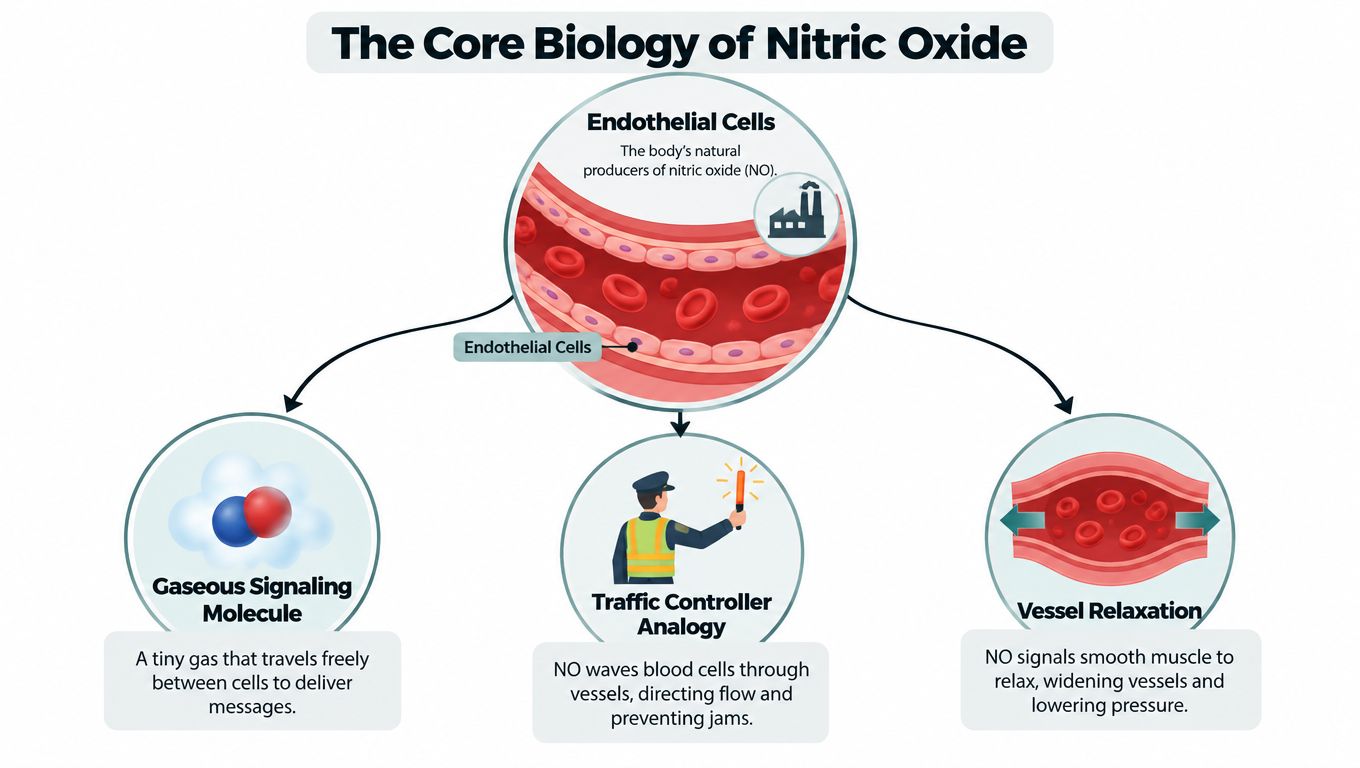
The pathway is often summarized as NO, soluble guanylate cyclase, cyclic GMP, smooth-muscle relaxation. Each step passes the message along, like a traffic signal coordinating movement at an intersection. The final result is a change in vessel diameter, not a general command for every vessel to remain permanently open.
NO also contributes to vascular tone, blood pressure regulation, platelet behavior, inflammation, and endothelial health. Inadequate signaling can impair how vessels respond, make platelet aggregation more likely, and contribute to vascular inflammation and atherosclerotic processes. These broader roles are discussed in this cardiovascular review of NO biology.
The physiological effect depends on where NO is produced, when it acts, how much is available, and how quickly oxidative processes break it down. Raising NO-related signaling may therefore support circulation when the system can respond appropriately. It may do little when another problem limits the response, and it may create risks when combined with medicines or conditions that already affect blood pressure.
NO is a regulator, not a trophy. Healthy circulation depends on a responsive signal at the right place and time, not the highest possible level.
How the Body Actually Makes Nitric Oxide
Your body uses more than one route to make or preserve NO-related signaling. The two main pathways work alongside each other, and neither is universally superior.
The enzymatic assembly line
The best-known route begins with the amino acid L-arginine. Nitric oxide synthase enzymes, including endothelial nitric oxide synthase, convert L-arginine into NO. You can picture this as an assembly line. L-arginine is the incoming material, the synthase enzyme is the machine, and the surrounding cellular environment supplies the conditions needed for production.
That environment matters. Enzymes need appropriate cofactors and a balanced oxidative state. If endothelial cells are damaged or oxidative breakdown is high, providing more raw material may not produce a proportional improvement in signaling. L-citrulline is also discussed because the body can recycle it into L-arginine, but the effect still depends on how well the whole system functions.
For readers comparing labels, L-arginine and related ingredients belong to this precursor-based conversation. A product such as Argi-Max NexiHerb L-Arginine, L-Citrulline-DL-Malate, and beet root powder combines those amino-acid ingredients with beet root powder in a capsule supplement intended for adults as part of a balanced lifestyle. Its listed serving is two capsules, with L-arginine forms, L-citrulline-DL-malate, and beet root powder included.
The dietary nitrate route
The second route starts with dietary nitrate. Nitrate-rich foods, including beets and leafy vegetables, can be converted by bacteria in the mouth into nitrite. Nitrite can then contribute to NO formation, particularly in conditions where oxygen availability is lower, such as active muscle during exercise.
This pathway means oral bacteria play a useful role. Antibacterial mouthwash, oral health, digestion, blood flow, and tissue conditions can all influence how much of the dietary signal ultimately becomes available as NO. That doesn't make vegetables a guaranteed performance product. It shows why food, oral biology, and exercise context can interact.
The enzymatic route and nitrate-nitrite route are complementary. One uses enzyme activity inside cells, while the other provides a dietary route through nitrate and nitrite. Both ultimately influence the same broad signaling network, and both can be limited by endothelial health, oxidative breakdown, dose, timing, and individual response.
What Increasing Nitric Oxide Changes in the Body
A brief rise in NO can change how readily blood vessels relax. More available NO activates soluble guanylyl cyclase, raises cyclic GMP, and signals vascular smooth muscle to loosen. The effect is similar to easing pressure on a valve: vascular tone, arterial compliance, and tissue perfusion can all be supported. In a human coronary-artery study00429-9), blocking NO synthesis narrowed coronary segments by approximately 8% and 11% and reduced coronary blood flow by about 33%. This shows that the body's own NO helps regulate coronary circulation at rest.
The everyday result is not a guaranteed, proportional increase in blood flow. Endothelial health, blood pressure, vessel condition, and oxidative inactivation all shape the response. Someone with reduced vascular responsiveness may have more room to benefit than someone whose circulation already adjusts efficiently.
Exercise effects are selective
During exercise, NO-related signaling can help direct blood toward active tissue and may affect how efficiently muscles use oxygen. A 2020 systematic review and meta-analysis found a statistically significant performance improvement with nitrate supplementation compared with placebo. The reported effect size was d = 0.174, with a 95% confidence interval of 0.120 to 0.229 and P < 0.001. Outcomes included faster time trials, greater distance, lower fatigue, and more repetitions.
The signal is real, yet modest. It does not establish a universal improvement in strength, maximal oxygen capacity, or every workout. NO may improve oxygen distribution or muscle efficiency without making the whole aerobic system more powerful.
Beet-derived ingredients are one dietary route. See this guide to beet juice powder for how the powdered form can fit into a routine.
A supplement such as Nitric-Ox NexiHerb, a dietary supplement contains beet root extract, grape seed extract, and coenzyme Q10 in capsule form for adult use. It is one product option in the category, not proof that every user will experience a measurable performance change.
| Outcome | Evidence strength | Realistic expectation |
|---|---|---|
| Blood-vessel relaxation | Strong physiological basis | Supports normal vascular tone and circulation |
| Endurance or repeated effort | Modest, variable evidence | May help some time trials, distances, or repeated efforts |
| Maximal aerobic capacity | Inconsistent | Do not assume VO₂max will rise |
| Strength and every gym metric | Limited and outcome-dependent | A stronger pump does not guarantee more strength |
| Recovery | Mechanistically plausible, individually variable | Better blood flow may support recovery, but results are not guaranteed |
| Sexual responsiveness | Depends on vascular signaling | NO is involved, but supplements are not a treatment for sexual conditions |
A visible muscle “pump” is a short-term sensation linked to local blood flow and pressure. It can feel noticeable without showing that long-term vascular health improved. Similarly, a higher blood nitrite marker can confirm that a pathway changed without proving that you will run faster, lift more, or feel more energetic.
When More Nitric Oxide Does Not Mean Better Results
Increasing nitric oxide can widen blood vessels, but performance has several bottlenecks. Training status, muscle strength, oxygen use, pacing, sleep, nutrition, and the task itself may matter just as much. Better circulation is one helpful adjustment, not a guarantee of a better result.
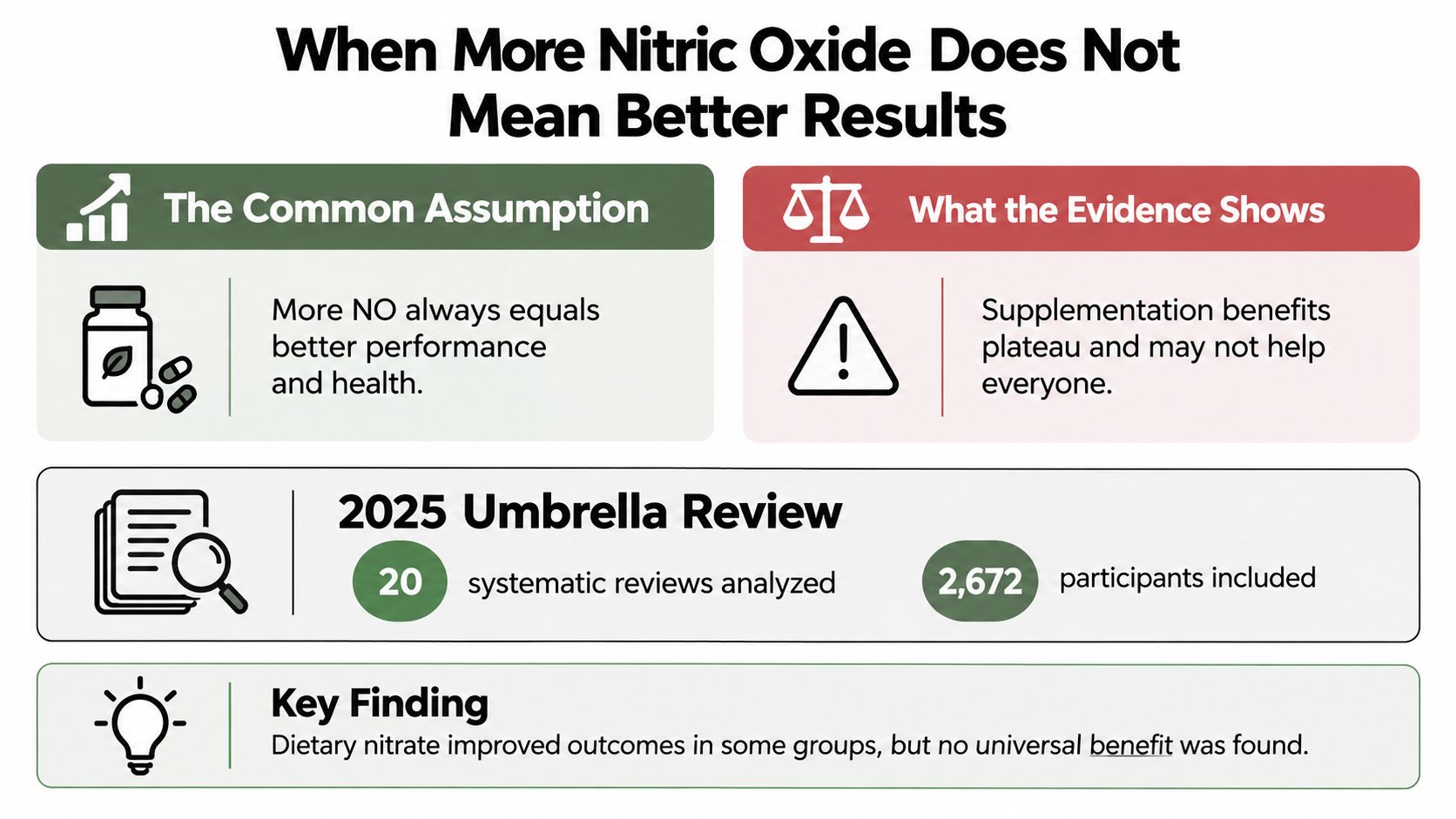
A 2025 umbrella review examined 20 systematic reviews, 180 primary studies, and 2,672 participants. Dietary nitrate improved time to exhaustion, total distance, muscular endurance, peak power, and time to peak power, while several other outcomes showed no ergogenic benefit. Effects were larger when intake reached at least 6 mmol nitrate per day, about 372 mg, and continued for more than three days, but those conditions do not make nitrate a universal performance enhancer.
Training status changes the response. Human nitrate reviews report more consistent benefits in less-trained people, while highly trained athletes often see smaller or absent effects. A separate 2025 meta-analysis found that nitrate substantially increased blood nitrite at high altitude but did not significantly improve VO₂max, heart rate, perceived exertion, or oxygen saturation.
The honest answer to “Will more NO make me faster?” Sometimes, for a specific endurance or repeated-effort task. Not reliably for every athlete, activity, or performance measure.
Dose, duration, baseline vascular function, and the outcome being tested all shape the result. A genuine physiological change may still produce little noticeable improvement in daily life or sport. It can also backfire when combined with blood-pressure medication or existing cardiovascular conditions, which makes individual context part of the answer.
Safe Ways to Support Healthy Nitric Oxide Levels
A brisk walk, a meal of leafy greens, and adequate sleep all support the systems that regulate blood flow. These habits may improve vascular function over time, but a physiological change does not guarantee a noticeable performance or health outcome.
Build the foundation before adding capsules
Start with ordinary food. Beets, leafy greens, arugula, and celery provide dietary nitrate, while a varied plant-based diet supplies other compounds that support vascular health. Food adds several nutrients to a routine rather than concentrating attention on one isolated ingredient.
Regular movement gives endothelial cells repeated opportunities to adjust blood flow. Walking, aerobic exercise, and resistance training can support circulation when matched to your fitness and health status. Exercise training has been associated with improved endothelial function and NO-related signaling, although findings vary between people and study designs. The response may be greater when baseline vascular function is limited, while someone with healthy function may notice little beyond the marker itself.
Sleep, stress management, hydration, and avoiding smoking also matter. During easy cardio, nasal breathing may feel comfortable for some people. It should not become a rigid rule during hard exercise or whenever breathing is restricted. Consistent movement and recovery are more useful targets than chasing a special NO surge.
- Eat plants regularly: Include nitrate-rich vegetables in meals instead of treating one food as a cure.
- Move consistently: Repeated activity can support endothelial responsiveness over time.
- Protect recovery: Sleep and stress habits affect how the body handles training and vascular demands.
- Limit vascular stressors: Smoking and excessive alcohol can work against healthy circulation.
For broader recovery habits, the MEDISTIK recovery supplement guide explains how supplements can fit into a training routine. Recovery products do not replace food, sleep, or appropriate medical care.
Consider ingredients only after the basics
Commonly studied NO-related categories include L-citrulline, L-arginine, beetroot extract, grape seed extract, and coenzyme Q10. They act through different routes, and findings vary with the ingredient, dose, formulation, and population studied. Read labels carefully, and avoid combining several products that may lower blood pressure without professional guidance.
A practical overview of food-first options appears in this guide to natural nitric oxide boosters. A supplement may complement a healthy routine, but it cannot compensate for inactivity, poor sleep, limited nutrition, or untreated symptoms.
Who Should Be Cautious and Why Personalization Matters
Raising nitric oxide is not automatically useful for everyone. The sensible choice depends on your baseline vascular health, goals, and medications, because a measurable signal does not guarantee a noticeable health outcome.
People with reduced vascular responsiveness may have more room to benefit from sustained dietary nitrate. A peer-reviewed review describes possible improvements in blood pressure and endothelial function mainly among some adults with hypertension, metabolic syndrome, obesity, or older age. Studied protocols have included up to 6 mmol daily for at least three weeks (review of nitrate and NO-related strategies). Someone with healthy vascular function may notice little, even when a blood marker changes.
Medication context matters more than a stronger “pump.” Nitric-oxide-supporting products may add to blood-pressure-lowering or vasodilatory effects. Ask a clinician before using them if you take blood-pressure medicines, nitrate medicines, erectile-dysfunction medicines, or another vasodilator regimen. Do not stop prescribed treatment or replace medical evaluation with a supplement.
Arginine is not a guaranteed answer
Oral arginine has mixed evidence. One review of 17 small clinical studies found improved endothelial or NO-dependent vasodilation in 12 studies, while five found no cardiovascular benefit (review of oral L-arginine and endothelial function). The mixed pattern supports individualized decisions rather than a blanket recommendation.
A stronger pump is a sensation, not proof of healthier arteries. Chest discomfort, unusual breathlessness, faintness, persistent erectile difficulty, or unexplained fatigue calls for medical attention instead of a stronger supplement routine.
Food choices can also reflect personal preferences, tolerances, and existing habits. This guide to customizing your meals can help you fit nitrate-rich vegetables into a routine you can maintain.
Practical Answers and a Clear Path Forward
Dietary changes and supplements don't produce one universal timeline. Some people notice an exercise sensation quickly, while meaningful vascular or training adaptations depend on repeated habits and individual response. Training status matters, and high-altitude results shouldn't be assumed from sea-level experiences, especially because nitrate research hasn't consistently improved VO₂max or oxygen saturation at altitude.
For a sensible starting point:
- Eat nitrate-rich vegetables regularly.
- Move consistently, with exercise appropriate to your condition.
- Use comfortable nasal breathing during easy cardio if it suits you.
- Prioritize sleep, hydration, and recovery.
- Consider a targeted supplement only after reviewing your goal, medicines, and health history.
Nitric oxide is supportive signaling, not a performance miracle. If you're curious about what increasing nitric oxide does, track a meaningful outcome such as workout tolerance or recovery rather than chasing a stronger pump or a higher laboratory marker.
NexiHerb LLC offers dietary supplements featuring ingredients such as amino acids, beet-derived components, botanical extracts, and coenzyme Q10 for adults who want to complement balanced wellness habits. Review the ingredient information and explore the NexiHerb LLC range before deciding whether a nitric-oxide-support product fits your routine.