

A supplement won't turn a tight hamstring into a dancer's split overnight. That popular promise confuses flexibility, mobility, and pain-free movement, three related but different outcomes. The best supplements for flexibility may help some people move more comfortably, recover from training, or support joint function, but they don't replace stretching, strength work, or an evaluation for persistent pain.
The useful question isn't “Which capsule makes everyone more flexible?” It's “What's limiting my movement, and which ingredient, if any, matches that limitation?” A person whose knee hurts during a squat needs a different strategy from someone whose hips lack active control or whose muscles just need gradual lengthening.
Table of Contents
- The Flexibility Supplement Reality Check
- Collagen Peptides and Joint Support Evidence
- Curcumin and Range of Motion Research
- Omega-3s, Vitamin C, and Supporting Nutrients
- How to Choose Supplements Based on Your Goals
- Building a Practical Supplementation Strategy
The Flexibility Supplement Reality Check

The ingredient matters less than the movement problem you want to solve. Passive range of motion is the distance a joint reaches when an external force, such as a stretch or therapist, moves it. Active mobility is the portion of that range you can control with your own strength and coordination. Pain-limited movement ends sooner because discomfort, irritation, or concern about aggravating a joint prompts protective tension.
These outcomes can overlap, but they require different solutions. Someone with knee discomfort may move more freely if a supplement helps them tolerate mobility practice. Someone recovering from demanding exercise may find that reduced soreness makes movement easier. Neither result means the product has lengthened every muscle or increased whole-body flexibility.
Practical rule: Match the supplement to the barrier. Discomfort points toward joint-support research, limited control points toward strength and coordination training, and restricted passive range points toward progressive mobility work.
The collagen evidence makes this distinction clear. It supports joint comfort and function more directly than a universal increase in flexibility, as covered in the collagen section below.
Curcumin has more relevant evidence for exercise-related range of motion, but its possible value also depends on recovery. If it reduces soreness or exercise-related muscle damage, movement may feel easier because protective muscle guarding is lower. That outcome differs from permanently changing tissue extensibility.
A supplement can improve the conditions for practice, not replace the practice itself. Controlled stretching, resistance training through usable ranges, warm-ups, adequate protein, and sleep remain the foundations for developing mobility. Persistent pain requires clinical assessment rather than a larger supplement stack.
The practical test is specific: identify whether discomfort, recovery, strength, coordination, or passive tissue tolerance is limiting movement, then judge an ingredient against that outcome. A product aimed at joint comfort should not be evaluated as though it were a direct tool for lengthening muscle.
Collagen Peptides and Joint Support Evidence
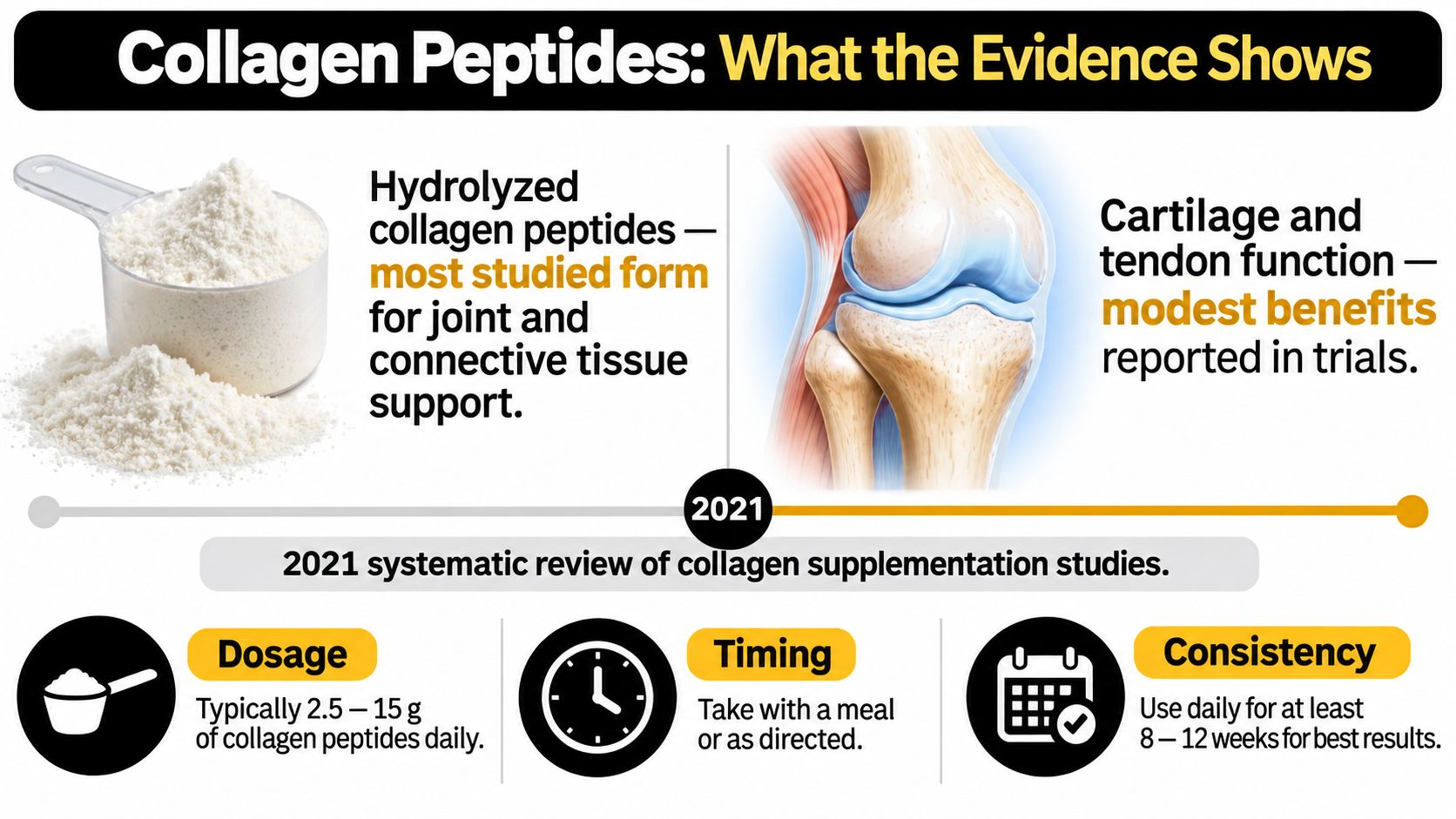
One trial enrolled 139 athletic participants, including 56 men and 83 women with an average age of approximately 24 years. Participants took 5 g of collagen peptides daily for 12 weeks while continuing regular exercise for at least three hours per week, according to the systematic review of collagen supplementation. The study therefore examined collagen as an addition to ongoing training, not as a replacement for mobility practice.
That context shapes the interpretation. Hydrolyzed collagen peptides supply small collagen-derived peptides and amino acids that may support connective-tissue maintenance. Relevant tissues include cartilage, tendons, ligaments, and other parts of the extracellular matrix involved in handling joint loads. The practical outcome may be better tolerance, comfort, or recovery during activity rather than a broad increase in passive flexibility.
Collagen type changes the interpretation
“Collagen” on a label does not identify one uniform intervention. Hydrolyzed collagen peptides and undenatured type II collagen differ in structure, biological behavior, dosing conventions, and the outcomes examined in research. Matching the product to the evidence requires checking the exact collagen form.
The same review reported that undenatured type II collagen was associated with improved knee-extension range of motion and longer pain-free exercise duration. The reported findings reached statistical significance at p = 0.011 and p = 0.019, respectively. These results may matter for someone whose movement is limited by knee discomfort, but they do not show that every collagen product produces the same effect.
The distinction is simple: collagen research is more relevant to pain-limited movement and joint function than to stretching a symptom-free muscle. A person with comfortable knees but restricted hamstring range still needs progressive mobility and strength work. A person who avoids movement because a joint hurts may reasonably consider collagen as an adjunct, while treating symptom relief as the outcome to evaluate.
For shopping, check the exact ingredient, serving size, testing information, allergen disclosure, and intended use. PepFlow collagen dosing tips discuss serving routines, while this joint-support supplement guide compares broader ingredient categories.
A daily multivitamin serves a different purpose. Vita Mix NexiHerb Multivitamin & Mineral Dietary Supplement is a once-daily vegetarian capsule formulated to complement overall nutritional intake, with vitamins, minerals, lutein, zeaxanthin, and other plant-derived compounds. It should not be evaluated as though it were a collagen intervention.
A sensible trial starts with a defined movement problem. If discomfort limits practice, collagen may support a broader plan, provided the evidence's variation is understood. Persistent or worsening pain warrants clinical assessment rather than a larger supplement stack.
Curcumin and Range of Motion Research
Curcumin has the clearest direct evidence for exercise-related range-of-motion outcomes among the commonly discussed ingredients. A systematic review and dose-response meta-analysis of 10 randomized controlled trials found that supplementation improved joint range of motion by a weighted mean difference of 6.49°, with a 95% confidence interval of 3.91° to 9.07°. The same analysis reported an improvement in maximal voluntary contraction of 3.10 units, with a 95% confidence interval of 1.45 to 4.75 (the curcumin dose-response meta-analysis).
Those findings don't mean curcumin creates a dramatic increase in baseline flexibility. The proposed pathway is more practical: exercise can produce soreness and muscle damage, and that discomfort may cause protective guarding. If recovery improves, a person may move through a greater range because movement feels less threatening and painful.
The formulation matters
Curcumin products vary widely in curcuminoid concentration, delivery system, dose, and timing. A standardized curcuminoid product with an absorption-enhancing technology may be more sensible than choosing a product based only on the word “turmeric” on the front label. For readers comparing formulations, this guide to turmeric with piperine explains why absorption is a practical consideration.
Curcumin is better matched to a person who trains consistently and notices post-exercise soreness or stiffness than to someone seeking a passive flexibility change without exercise. It may complement warm-ups, controlled resistance training, and progressive mobility work, but it can't replace them.
Curcumin may help you use the range you already have more comfortably. It isn't a substitute for teaching your body to control and gradually expand that range.
Safety deserves equal attention. Curcumin may interact with anticoagulant or antiplatelet medicines, so people taking those drugs should seek professional guidance before using it. The same caution applies to people managing medical conditions, preparing for a procedure, or combining several products with overlapping effects.
A reasonable decision framework is simple. Choose curcumin when recovery-related soreness appears to be restricting movement, review collagen research when joint discomfort is the main barrier, and prioritize training when the limitation is strength, coordination, or passive tissue tolerance. This approach avoids treating every movement problem as an inflammation problem.
Omega-3s, Vitamin C, and Supporting Nutrients
Flexibility depends on more than one ingredient. Muscles need adequate energy and protein, bones need structural support, and connective tissues need the nutrients involved in maintenance and repair. That makes nutrition a foundation rather than a shortcut.
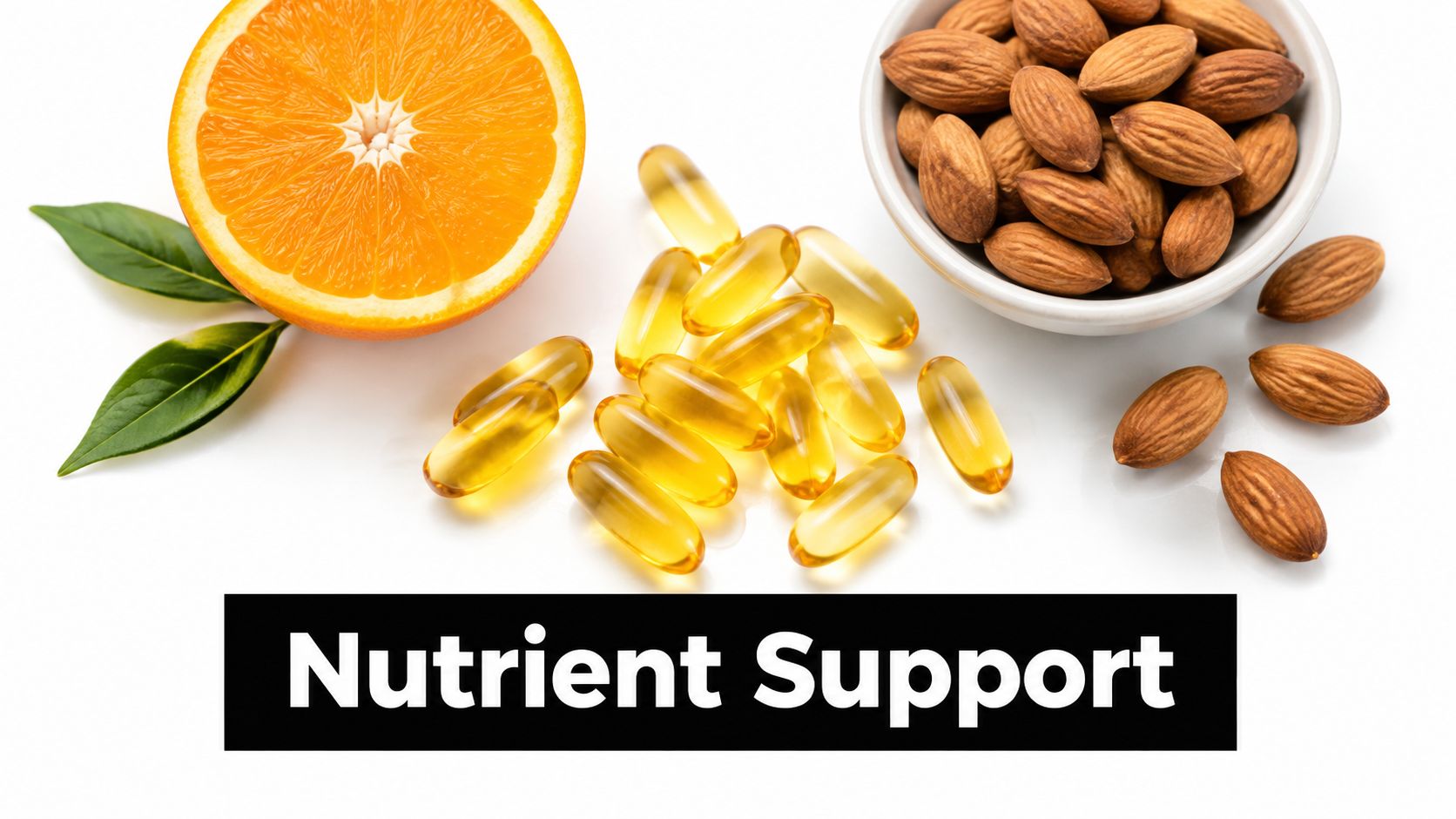
Vitamin C is a required cofactor for collagen synthesis. A person with inadequate vitamin C may struggle to support normal connective-tissue production, but taking extra vitamin C doesn't automatically create greater flexibility when intake is already sufficient. Food sources such as citrus, peppers, berries, and other fruits and vegetables can contribute to an adequate baseline.
Omega-3 fatty acids from fish or algae may fit a joint-support routine when the broader goal is managing everyday inflammatory load and supporting recovery. Their role is supportive, not equivalent to the direct range-of-motion evidence associated with curcumin. Readers comparing sources and product formats can review this guide to omega-3 fish oil.
Build the foundation before adding complexity
MSM supplies sulfur-containing compounds and appears in many joint formulas, but its evidence for flexibility is less solid than the evidence discussed for collagen and curcumin. That doesn't make it useless, but it does mean consumers should avoid treating it as a primary flexibility driver.
Vitamin D deserves careful interpretation. It supports muscle and bone physiology, yet supplementation hasn't been shown to universally improve flexibility or performance. A randomized trial cited by the NIH Office of Dietary Supplements assigned 78 frail or near-frail adults aged 65 and older to vitamin D3, 25-hydroxyvitamin D, or placebo for 6 months, and the groups showed no significant differences in muscle strength or performance (the NIH vitamin D fact sheet for health professionals). Correcting inadequate vitamin D may matter more than adding high doses when status is already adequate.
Magnesium is often added to flexibility discussions because it contributes to normal muscle and nerve function, but more isn't automatically better. People who are pregnant, taking medicines, or considering higher supplemental intake should review safety information such as this magnesium guide from Venus Health Co. and ask a qualified clinician about personal circumstances.
A strong baseline looks unglamorous: varied food, adequate protein, regular movement, resistance training, sleep, and hydration. Targeted supplements make more sense after those basics are consistent.
How to Choose Supplements Based on Your Goals
The phrase “best supplements for flexibility” hides the most important question: what exactly are you trying to improve? A supplement can be reasonable for one movement problem and poorly matched to another.
If knee discomfort prevents you from completing a squat or walking comfortably, collagen-derived products deserve consideration because their research centers on joint comfort and function. Hydrolyzed collagen peptides are commonly studied for connective-tissue support, while undenatured type II collagen has distinct research involving joint-related outcomes. Don't transfer the dose or expected effect of one form to the other.
If you train hard and soreness limits the range you can use during recovery, curcumin may be the more logical candidate. Its evidence concerns exercise-related range of motion and recovery, not a promise that an inactive person will gain broad flexibility. If your issue is poor control at end range, neither collagen nor curcumin replaces progressive strengthening.
| Goal Type | Primary Supplement | Supporting Nutrients | Expected Timeline |
|---|---|---|---|
| Pain-limited joint movement | Collagen-derived product matched to the studied ingredient | Adequate protein and overall nutrition | Several weeks of consistent use alongside exercise |
| Recovery-related stiffness | Standardized curcuminoid product | Adequate recovery, food, and hydration | Evaluate during a consistent training cycle |
| General connective-tissue support | Vitamin C and adequate dietary protein | Omega-3 sources when appropriate | Gradual support rather than an immediate flexibility change |
| Possible nutrient inadequacy | Nutrient identified through diet review or professional assessment | Food-first correction and monitoring | Depends on the underlying inadequacy |
The research on collagen often uses intervention periods of 8 to 12 weeks, so a short trial with a defined outcome is more informative than changing products every few days. Track one practical measure, such as knee range, squat depth, morning stiffness, or how comfortably you complete a mobility session.
Use a label-level checklist
- Name the ingredient: Confirm whether the product contains hydrolyzed collagen peptides or undenatured type II collagen.
- Match the study: Compare the product's serving information with research on that specific ingredient, without assuming all collagen products are equivalent.
- Check the curcumin format: Look for clearly stated curcuminoid content and an absorption approach rather than relying on a vague turmeric blend.
- Verify quality signals: Look for third-party testing, allergen disclosure, and transparent label information.
- Review interactions: Ask a pharmacist or clinician about anticoagulants, antiplatelet medicines, pregnancy, planned procedures, and other relevant conditions.
- Define success: Decide what measurable change would justify continuing the product.
Training also matters for body composition and movement capacity. Readers working on performance can pair this supplement framework with a guide to smarter muscle gains, while remembering that building strength and improving flexibility are related but separate goals.
Building a Practical Supplementation Strategy
A practical plan starts with a measurement, not a shopping cart. Choose one movement target, record how it feels and performs, and keep your mobility and training routine consistent. A useful target might be a comfortable squat depth, knee extension, shoulder reach, or the amount of morning stiffness you notice.
Add only one targeted supplement at a time when possible. That makes it easier to identify whether a change relates to the product, your training load, your sleep, or natural variation. Collagen and curcumin studies commonly use 8 to 12 week intervention periods, so reassessing after roughly that interval is more meaningful than expecting an immediate transformation (the collagen evidence review).
Keep the movement work central
Use supplements around a complete program:
- Progressive mobility: Practice controlled stretches and gradually expose the joint to usable ranges.
- Strength through range: Train the muscles that control the movement, not only the tissues you want to stretch.
- Recovery management: Adjust training stress when soreness prevents quality movement.
- Nutrition basics: Eat enough protein and a varied diet before stacking specialized products.
- Clinical judgment: Seek evaluation for persistent, worsening, or unexplained pain.
Dietary supplements also require careful product selection. In the United States, they aren't required to undergo FDA premarket approval in the same way medicines do, so label accuracy, allergen disclosure, third-party testing, and interaction screening deserve attention.
Decision rule: Use a supplement to support a defined limitation, test it consistently, and stop expecting it to perform the job of training.
The strongest strategy is therefore modest and conditional. Collagen may support joint-related mobility for some people, curcumin may support recovery-related range of motion, and foundational nutrients may help maintain normal tissue function when intake is inadequate. None establishes a blanket promise of greater flexibility for everyone.
NexiHerb LLC offers science-inspired dietary supplements covering multivitamins, omega-3s, antioxidants, herbal blends, and joint-care support for adults building practical wellness routines. Visit NexiHerb LLC to review clearly labeled options and choose nutrients that fit your mobility, recovery, and everyday nutrition goals.