

A single 500 mg capsule is often presented as the answer to every berberine question. That advice is convenient, but it's too narrow to reflect the human evidence. Berberine supplement dosage depends on total daily exposure, divided administration, product formulation, treatment goal, and personal tolerance, not on one universally correct capsule count.
Clinical studies have tested substantially different amounts, and gastrointestinal symptoms are often what determine whether someone can maintain a routine. A sensible approach is to understand the studied range, start conservatively with food, read the label precisely, and avoid treating disease-focused trial doses as an automatic wellness prescription.
Table of Contents
- Why Most Berberine Dosage Advice Misses the Point
- Understanding Clinical Dose Ranges and Evidence
- How to Take Berberine for Better Tolerance
- Choosing the Right Berberine Form and Product
- Berberine Safety Profile and Common Side Effects
- Medication Interactions and Important Contraindications
- Matching Dosage to Wellness Goals and Duration
- Starting a Berberine Routine Safely
-
Berberine Dosage FAQs for Everyday Users
- Is 500 mg the correct daily dose?
- Should berberine be taken with food?
- Is more berberine more effective?
- How long should I take it before reassessing?
- What should I do if I miss a serving?
- Can I use berberine with prescription medicines?
- Who should avoid berberine?
- What's the best way to compare products?
Why Most Berberine Dosage Advice Misses the Point
The familiar “500 mg once daily” recommendation is easy to print on a label, but it does not describe a complete routine. Berberine supplement dosage depends on total daily exposure, divided administration, product formulation, treatment goal, and personal tolerance, so capsule count alone can mislead. A single capsule may represent a modest or substantial share of the day's intake.
The label requires close reading. Two products can list different amounts per capsule, and some labels emphasize the weight of a botanical extract rather than the amount of berberine it provides. Check berberine content per serving separately from extract weight, especially when the product uses a ratio such as 15:1.
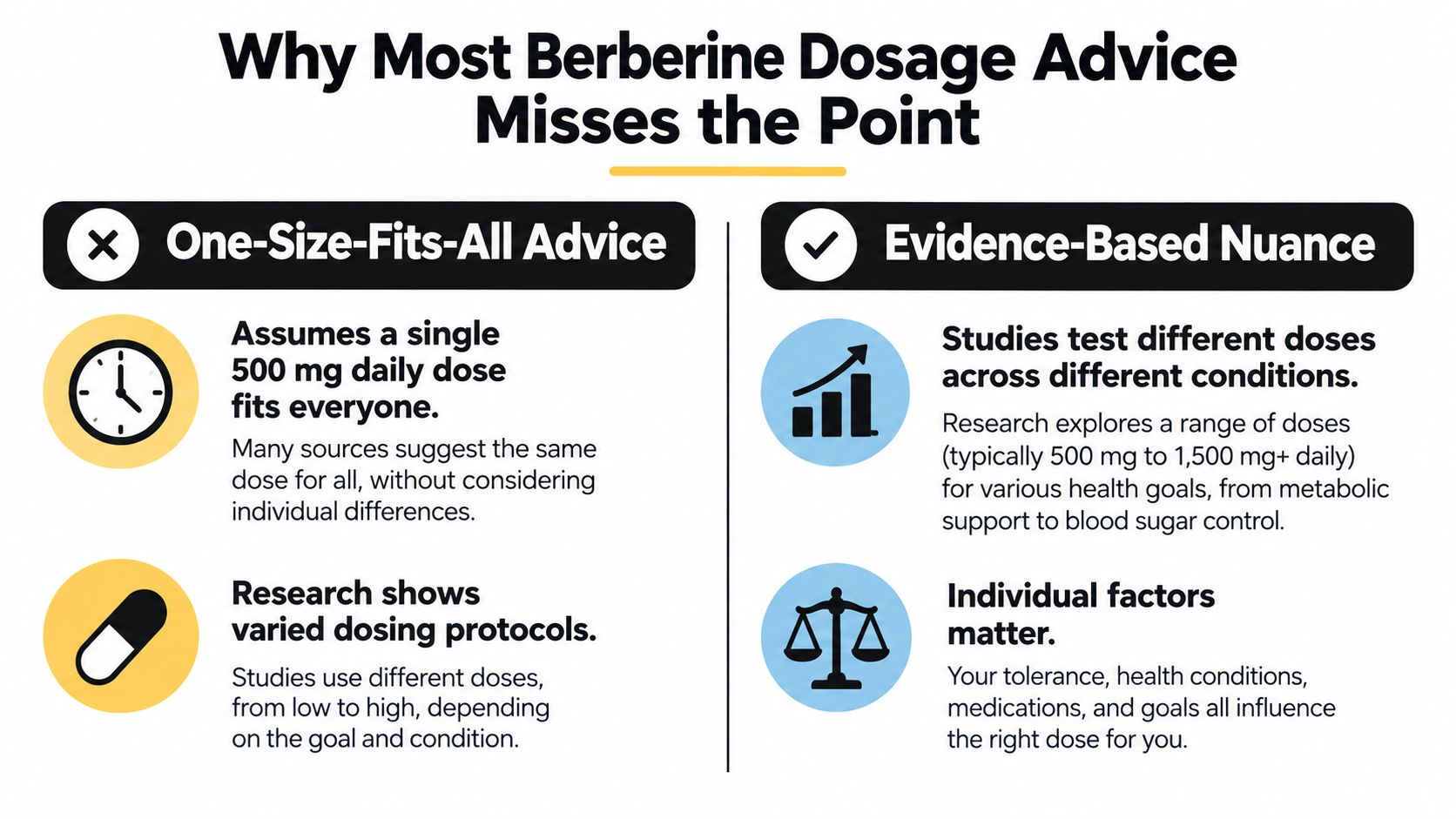
Practical rule: Judge a routine by its total daily amount and tolerability, not by the number printed on one capsule.
Dividing the daily amount can improve practical tolerance. Taking smaller servings with meals may reduce nausea, abdominal discomfort, constipation, or loose stools compared with placing the full amount in one serving. It does not mean every person needs multiple doses, but it explains why a schedule can matter as much as the capsule strength.
| Claim | What Research Suggests |
|---|---|
| 500 mg once daily is the standard dose | Research protocols use varied schedules, so one capsule is not a universal standard. |
| A higher dose is automatically better | Disease-focused protocols should not be copied as routine dosing for healthy adults. |
| Capsule weight equals berberine content | The label may describe extract weight, so check the stated berberine amount separately. |
| One study establishes the correct dose | Populations, formulations, goals, and schedules differ across studies. |
| Digestive symptoms mean berberine cannot be used | Symptoms can reflect an unsuitable starting amount, empty-stomach use, or an overly concentrated schedule. |
The U.S. National Library of Medicine's LiverTox reference describes a commonly recommended herbal-product regimen of 250 to 500 mg taken two or three times daily, equivalent to 500 to 3,000 mg per day (LiverTox berberine reference). That range is not a universal prescription. It shows why “standard dosage” is an incomplete label shortcut: the daily total, timing, formulation, and digestive response all affect how a routine works in practice.
Understanding Clinical Dose Ranges and Evidence
A 500 mg capsule does not define an effective berberine routine. Clinical research has tested different total daily exposures, schedules, populations, and formulations, so the useful comparison is the full daily amount rather than capsule strength alone.
Trials involving adults with type 2 diabetes tested total daily amounts from 0.3 to 3.0 g, with many using approximately 0.9 to 1.8 g per day divided into two or three administrations (clinical dosage review). These were disease-focused protocols. They should not be treated as a wellness target for someone without that diagnosis.
Some analyses found stronger effects on fasting glucose, post-meal glucose, and HbA1c in studies using approximately 1.5 to 2.0 g per day. Those findings describe differences among diabetes research protocols. They do not show that a healthy adult should take those amounts or that a higher dose will produce a predictable benefit.
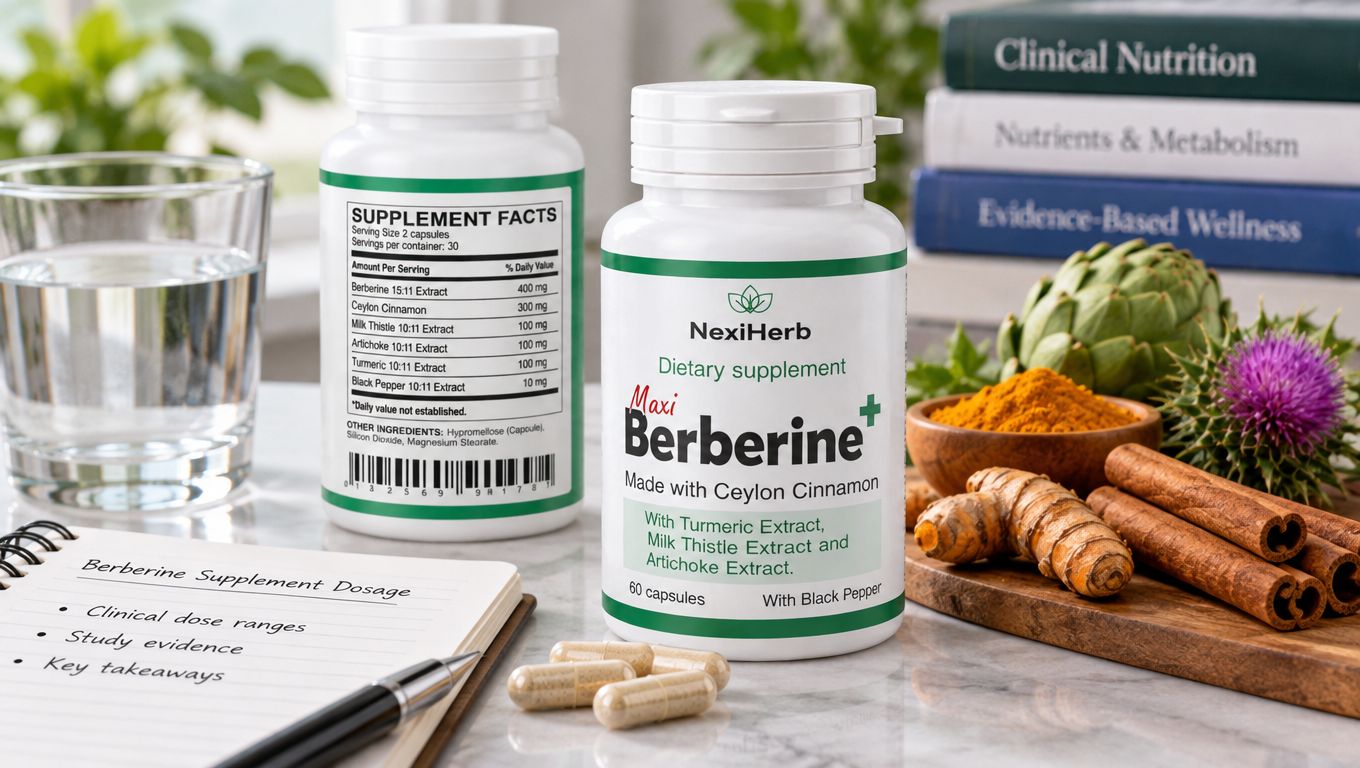
A broader review examined randomized trials using 300 to 1,500 mg daily for 84 to 140 days. Reported adverse effects were generally low, although nausea, constipation, abdominal discomfort, and occasional hypoglycemia occurred (2025 meta-analysis). The findings support judging both total exposure and how that exposure is divided, since two people can respond differently to the same daily amount.
| Total Daily Range | Typical Administration Pattern | Notes |
|---|---|---|
| 300–600 mg | One or more smaller servings | Appears in some clinical protocols and may represent a conservative exposure. |
| 900–1,800 mg | Divided into two or three administrations | Common in diabetes-focused studies, not a general self-care target. |
| 1,500–2,000 mg | Divided servings | Linked with stronger glycemic findings in some diabetes research, not a universal wellness dose. |
| Above 2,000 mg | Divided servings in some studies | Calls for particular caution and qualified guidance. |
For general wellness, a conservative example is 300 to 500 mg once daily with food, followed by an increase only when the product instructions and personal tolerance support it. The Maxi Berberine+ product page lists two capsules as a serving. Follow its stated serving instructions rather than converting a clinical trial dose directly into a product routine.
Readers seeking background on proposed uses can review these berberine supplement benefits. A researched range is not a guarantee and is not a personal prescription.
How to Take Berberine for Better Tolerance
Digestive tolerance usually determines whether a berberine routine survives beyond the first few days. Taking a large amount at once, especially without food, can make nausea or abdominal discomfort more likely for some people. Smaller servings paired with meals are often a more practical starting point.
A cautious routine can follow this sequence:
- Start with the label's lowest reasonable serving. A conservative example is 300 to 500 mg once daily with a meal, provided the product label allows it.
- Keep the schedule stable. Take it with the same meal or meals so you can identify whether symptoms relate to the supplement.
- Assess tolerance before increasing. Don't escalate just because a higher amount appeared in a study.
- Divide rather than concentrate. If a clinician or product label supports a higher daily amount, spreading it across meals may be gentler than taking it all together.
- Reduce or stop if symptoms persist. Ongoing nausea, constipation, abdominal discomfort, or other unusual effects deserve attention rather than endurance.
Modern human research commonly evaluates approximately 1,000 to 1,500 mg per day over several weeks to a few months, but those figures describe study exposure, not a universal recommendation (2025 human safety research). One randomized crossover study supplied 500 mg capsules and used two capsules daily for 30 days. That design can inform research interpretation, but it doesn't remove the need to account for medication use, health status, and individual response.
The National Center for Complementary and Integrative Health notes gastrointestinal symptoms and potential drug interactions, including with cyclosporine. It also reports that weight-related effects in research appeared mainly at amounts above 1 gram per day and treatment periods longer than eight weeks. Those findings support patience and monitoring, not automatic escalation.
If your stomach consistently objects, the right adjustment may be less berberine, a divided schedule, or stopping altogether.
Choosing the Right Berberine Form and Product
A supplement label should answer three questions quickly: How much berberine is present, how many capsules make a serving, and what is the maximum daily intake? If it only highlights the total weight of a plant extract, you may not have enough information to compare products accurately.
Extract ratios can create confusion. A 15:1 extract describes how a botanical extract was produced, but it doesn't automatically mean that the entire extract weight equals active berberine. Look for a Supplement Facts panel that separates berberine from other ingredients and states the amount per serving.
| Label Element | What It Means for Dosage |
|---|---|
| Serving size | Shows how many capsules or tablets supply the listed amounts. |
| Berberine amount | Identifies the stated berberine quantity you should use for daily calculations. |
| Extract ratio | Describes the extract specification and shouldn't be confused with active berberine weight. |
| Other botanicals | May add ingredients with their own tolerability or interaction considerations. |
| Suggested use | Provides the manufacturer's intended routine and daily limit. |
| Daily Value status | Shows whether an established Daily Value applies, which often isn't the case for botanical ingredients. |
A two-capsule serving can be convenient, but it also makes accidental duplication easier if you combine products. Before adding berberine to a broader stack, learn how to read supplement labels and write down the active amounts from every product you use.
The same comparison habit helps when evaluating unrelated wellness products. For readers reviewing broader options, a guide to compare longevity supplement options can provide a useful framework for checking serving sizes, ingredient lists, and intended use. The goal isn't to choose the longest ingredient list. It's to choose a product whose dose you can understand and whose routine you can follow without overlapping ingredients unnecessarily.
Berberine Safety Profile and Common Side Effects
Berberine is not automatically well tolerated just because a label recommends 500 mg. Tolerance depends on the total daily exposure, how that amount is divided, the product, and the person taking it. A single concentrated serving may cause more digestive trouble than the same daily amount split with meals.
The most common adverse effects are gastrointestinal: nausea, diarrhea, bloating, constipation, and abdominal discomfort. Symptoms are more likely when someone starts at a full serving, combines products, or has individual sensitivity. Reducing the serving, dividing doses, or stopping the supplement can help clarify whether berberine is the cause.
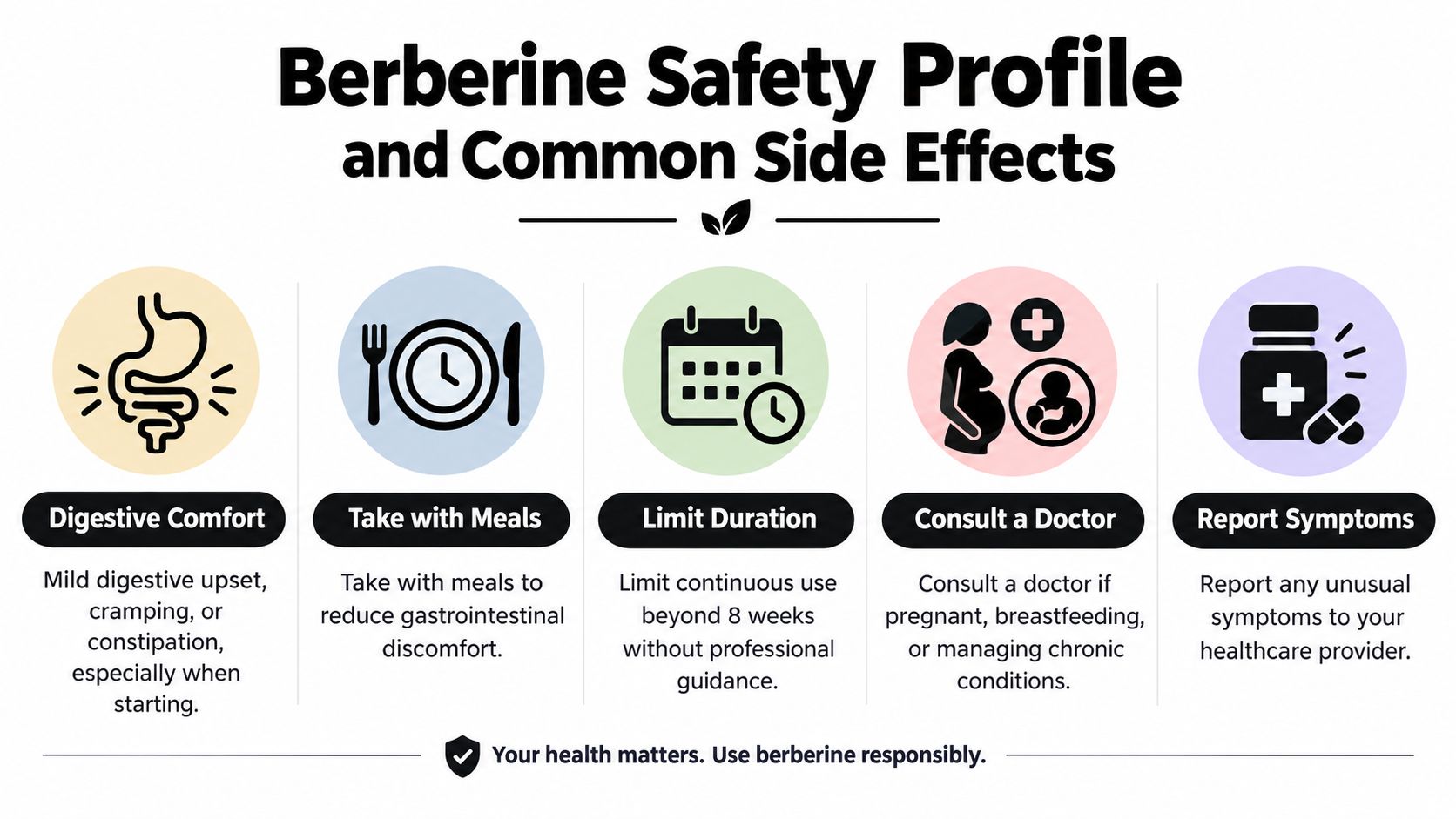
A 2025 safety review reported that oral exposure up to 2 g per day for periods as long as two years appeared generally tolerable in adult clinical investigations, while gastrointestinal symptoms remained the most common adverse effects. That finding describes study populations, not a personal dosing guarantee. The 2025 safety review should be read alongside individual health conditions, medicines, and product quality.
- Digestive symptoms: Persistent nausea, diarrhea, bloating, constipation, or abdominal discomfort means the amount or schedule should be reassessed.
- Low blood sugar: Hypoglycemia can matter for anyone using glucose-lowering treatment, especially when berberine is added without clinical supervision.
- Longer use: Use beyond the periods studied should be reviewed with a qualified professional, particularly for weight management or metabolic support.
- Pregnancy, breastfeeding, and infancy: Avoid berberine because of concerns about bilirubin accumulation in infants, as described in the National Center for Complementary and Integrative Health guidance.
- Medication users: Prescription medicines may alter the risk profile even when the supplement serving appears moderate.
Choose products with a clear maximum daily serving, meal-based directions, and warnings about persistent intolerance. A dose associated with an effect in a clinical trial is not automatically the safest dose for every consumer.
Medication Interactions and Important Contraindications
Berberine deserves a medication review before the first capsule, not after a symptom appears. It can interact with prescription drugs, and the relevant risk depends on the medicine, dose, health condition, and other supplements in the routine. Cyclosporine is one documented interaction concern, and people using medication for glucose control should be particularly cautious because berberine may contribute to low blood sugar.

Before starting, prepare a complete list of prescriptions, over-the-counter medicines, and supplements. A pharmacist or clinician can assess the combination more reliably than an online dosage chart. People who find travel or mobility difficult may also value home-based medication reviews as a way to discuss the full medication routine in context.
When professional review matters
Speak with a qualified healthcare professional before using berberine if you:
- Take prescription medication: Interactions can change drug exposure or amplify effects.
- Use treatment affecting blood sugar: The combination may increase the risk of glucose levels becoming too low.
- Have a chronic condition: Kidney, liver, cardiovascular, or other ongoing concerns can alter how a supplement should be approached.
- Are pregnant or breastfeeding: Berberine may pose risks to the fetus or infant and should be avoided.
- Are considering it for a child or infant: Berberine may be unsafe for infants because of bilirubin-related concerns.
The safest response to a possible interaction isn't to separate capsules by a few hours and assume the problem is solved. Timing may not prevent a pharmacological interaction. Pause the supplement and contact a healthcare professional if you develop unusual symptoms, persistent digestive problems, dizziness, or signs that your prescribed treatment is behaving differently.
For educational context on supplements used in metabolic routines, see blood sugar balance supplements, but don't use an online article as a substitute for an individualized medication review.
Matching Dosage to Wellness Goals and Duration
The familiar 500 mg serving is only one part of the decision. Total daily exposure, divided dosing, and the intended goal determine both the likely usefulness of a berberine routine and how well the digestive system handles it. General wellness usually calls for a more conservative approach than weight support or diabetes management, particularly without clinical monitoring.
Goal-specific exposure matters. Weight-related research has often examined daily amounts above 1 gram over more than eight weeks, but those findings do not guarantee a result or justify starting at the higher end. Diabetes management requires individualized supervision because berberine may sit alongside prescribed treatment and a broader monitoring plan. For general wellness, a lower label-directed exposure may be more appropriate. The meta-analysis of randomized trials provides broader evidence context without turning one study protocol into a universal recommendation.
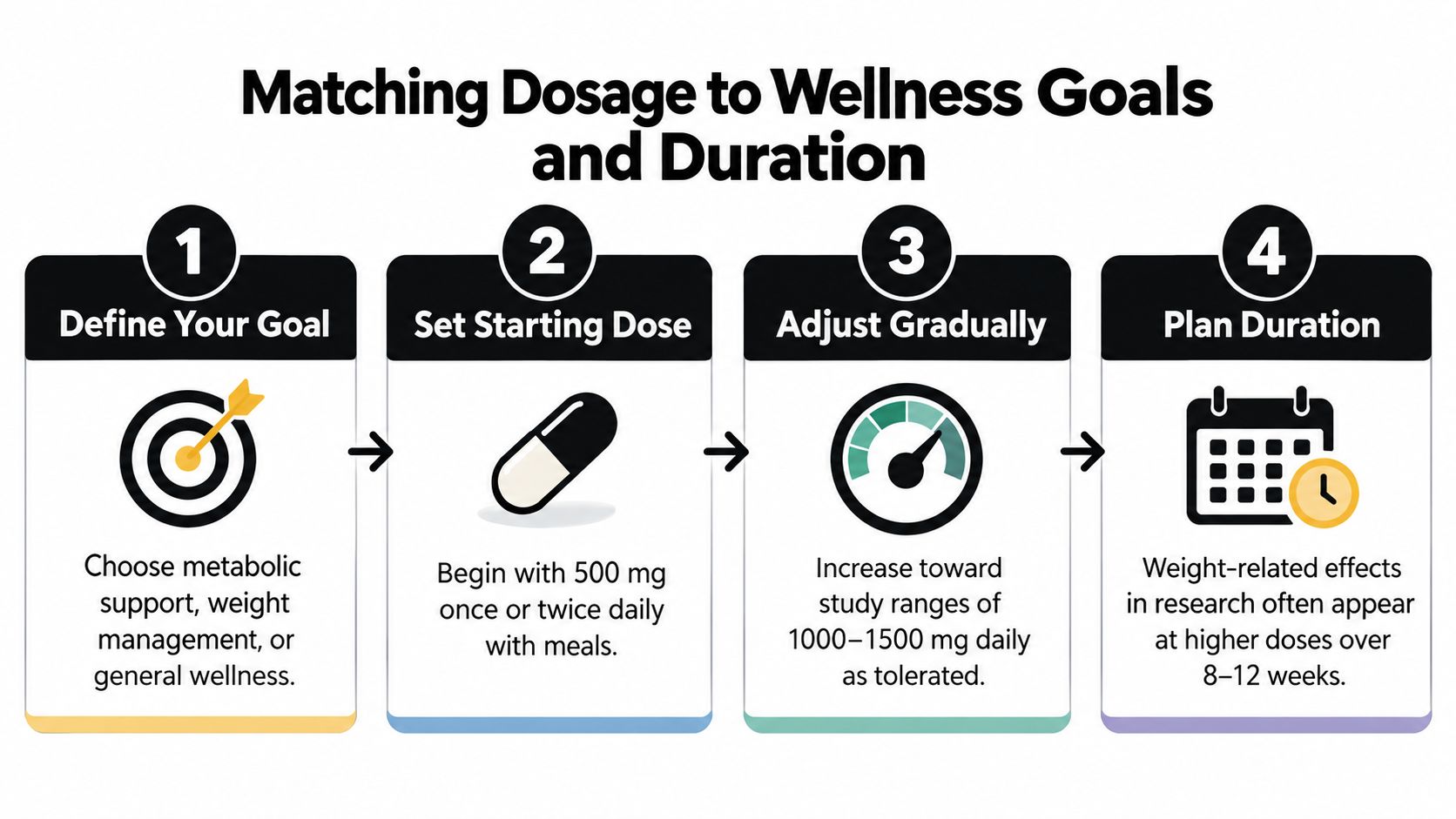
Use this decision model:
- Define the goal. General wellness, weight-related support, and diabetes management require different expectations.
- Set total daily exposure. Start at the lower amount allowed by the label, then divide it across meals when appropriate rather than concentrating the entire amount at once.
- Assess tolerance. Monitor digestive comfort and unexpected changes before increasing exposure.
- Choose a review point. Continue only if the routine remains tolerable, realistic, and suited to the goal.
Higher exposure is not automatically better. Duration and dose work together, so a longer routine does not compensate for an unsuitable amount, and a larger amount does not make an unclear goal more precise. A person managing a medical condition should set the dose and duration with a clinician.
Starting a Berberine Routine Safely
Start with the label, not with an internet protocol. Confirm the berberine amount per serving, identify how many capsules the serving contains, and check whether other botanical ingredients could complicate your existing routine.
Use this checklist:
- Review your health context: Ask a healthcare professional before use if you take medication, have a chronic condition, or are pregnant or breastfeeding.
- Pick a meal anchor: Attach the serving to breakfast, lunch, or dinner so consistency doesn't depend on memory.
- Begin conservatively: Use the lower end of the product's directions rather than copying a high clinical dose.
- Record the response: Note the amount, meal timing, nausea, bowel changes, abdominal discomfort, and any unusual symptoms.
- Adjust one variable: If tolerance is poor, lower the amount or change the meal pairing. Don't add several new supplements at the same time.
- Don't double a missed serving: Resume the next scheduled serving instead of trying to compensate.
- Reassess the purpose: If the goal changes, the routine may need professional review.
Taking berberine with food may improve comfort, while dividing a daily amount can avoid an unnecessarily concentrated serving. If symptoms persist, stop and seek advice rather than treating discomfort as evidence that the supplement is “working.”
For broader habits that support a sustainable routine, readers may also find these everyday health tips for midlife useful. Berberine should complement sensible nutrition, movement, sleep, and medical care, not replace them.
Berberine Dosage FAQs for Everyday Users
Is 500 mg the correct daily dose?
Not for everyone. Clinical studies have used a wide range of total daily amounts, and many protocols divide the amount across two or three administrations. Treat 500 mg as a possible starting reference only when it fits the product label and your health context, not as a universal target.
Should berberine be taken with food?
Taking it with a meal is a practical way to improve tolerance for some people. It may be especially sensible when starting, because nausea and abdominal discomfort are among the commonly reported adverse effects.
Is more berberine more effective?
Not automatically. Higher amounts have been associated with stronger findings in some diabetes-focused studies, but those results don't establish a routine wellness dose. A larger serving can also increase the likelihood of intolerance or medication-related problems.
How long should I take it before reassessing?
Research has evaluated courses lasting several weeks to a few months, and weight-related findings were mainly seen after more than eight weeks at amounts above 1 gram daily (NCCIH weight-related evidence). That isn't a promise of results. Reassess sooner if symptoms occur, and seek professional guidance before extending use.
What should I do if I miss a serving?
Don't double the next serving. Continue with the next planned amount and return to your normal meal-based schedule.
Can I use berberine with prescription medicines?
Ask a pharmacist or clinician first. Berberine can interact with medicines, including cyclosporine, and the risk depends on your complete medication and health profile.
Who should avoid berberine?
It should be avoided during pregnancy, breastfeeding, and infancy because of concerns about bilirubin effects. People taking prescriptions or managing medical conditions should obtain professional advice before starting.
What's the best way to compare products?
Check the actual berberine amount, serving size, extract description, other ingredients, suggested use, and maximum daily intake. Don't assume that a larger capsule or a higher extract ratio means a higher or better dose.
NexiHerb LLC offers dietary supplements such as Maxi Berberine+ in clearly defined capsule formats for adults seeking to complement a balanced wellness routine. Visit NexiHerb LLC to review its botanical formulas and nutrition resources, then compare each label with your health goals and professional guidance before choosing a routine.