

If you search “copper supplement dosage,” are you really asking how much copper your body needs, or how much you can take before the dose becomes unsafe? Those are different questions. A maintenance dose helps cover ordinary nutritional needs, while a repletion dose temporarily corrects a confirmed deficiency and may require laboratory monitoring.
For most adults, the foundational benchmark is 900 micrograms, or 0.9 milligrams, per day from food and supplements combined. The adult tolerable upper intake level is 10,000 micrograms, or 10 milligrams, per day, a ceiling intended to reduce the risk of liver damage. The distance between those figures is 9,100 micrograms, which is why a supplement stack deserves more attention than the copper amount on one bottle alone. The NIH Office of Dietary Supplements explains the adult copper intake target and upper limit.
Table of Contents
- How Much Copper Should You Actually Take
- Copper RDAs and Safe Upper Limits by Life Stage
- Common Copper Supplement Forms and What the Label Dose Means
- Copper and Zinc How Doses Stack Across Your Routine
- Maintenance Dosing Versus Repletion Protocols
- Signs of Copper Deficiency and Toxicity to Watch For
- Building a Daily Routine With a Copper Supplement
- Smart Takeaways Before You Start Supplementing
How Much Copper Should You Actually Take
The practical answer depends on which of two jobs you want copper to perform.
Routine maintenance
Routine maintenance means supporting adequate intake when your diet or a general multivitamin may not provide enough. For an adult, the central reference point is 0.9 mg per day, not the upper limit. A low-dose supplement or a multivitamin may be reasonable for some people, but the label has to be assessed alongside food, fortified products, and other mineral formulas.
A person eating a varied diet may need little or no standalone copper. Someone whose routine contains very little copper-rich food, or who takes substantial zinc over time, may have a different situation. The product label can tell you how much elemental copper is present, but it can't determine whether you personally need more.
Short-term repletion
Repletion is a different category. It usually follows a suspected or confirmed deficiency, a risk factor such as high zinc exposure or malabsorption, and a clinician's decision about dose and duration. Expert nutrition references describe 3 to 8 mg per day of oral copper for mild to moderate deficiency, while severe cases may involve 2 to 4 mg per day of intravenous copper for about 6 days, or until blood levels recover, under medical supervision. The Linus Pauling Institute summarizes these deficiency-management ranges.
Practical rule: Don't treat the adult upper limit as a target. It's a boundary for total intake, not a routine dosage recommendation.
Typical consumer products may contain 1 to 4 mg of copper, but that doesn't make every product appropriate for daily use. Your age, diet, supplement stack, laboratory results, medical history, and reason for taking copper all matter. A maintenance formula shouldn't be confused with a medical repletion protocol.
Copper RDAs and Safe Upper Limits by Life Stage
Copper needs change with growth, pregnancy, and lactation. The numbers also use different terms. For infants and children, authorities often use an adequate intake, or AI, because there isn't enough evidence to establish a formal recommended dietary allowance for every early life stage. Adults generally use an RDA.
The following figures come from the NIH copper fact sheet and the CDC trace-elements summary.
| Life Stage | RDA / AI (mg/day) | Tolerable UL (mg/day) |
|---|---|---|
| Infants 0 to 12 months | AI 0.2 to 0.3 | 1 |
| Children 1 to 3 years | 0.34 | 1 |
| Children 4 to 8 years | 0.44 | 3 |
| Children 9 to 13 years | 0.7 | 5 |
| Adolescents 14 to 18 years | 0.89 to 1.3 | 8 |
| Adults 19 years and older | 0.9 to 1.3 | 10 |
| Pregnancy | 1.0 | 10 |
| Lactation | 1.3 | 10 |
How to read the table
For adults, 0.9 mg per day is the standard nutritional reference point. Pregnancy raises the listed target to 1.0 mg, while lactation uses 1.3 mg. Those figures describe total daily intake, not necessarily the amount that should come from a capsule.
The upper limit follows a different logic. It represents the highest daily intake from food and supplements that is considered tolerable for the relevant life stage, not the amount a person should pursue. For adults, the ceiling is 10 mg per day, including pregnancy and lactation.
Children need particular caution because their upper limits are lower. A dose that falls within an adult framework may be inappropriate for a child. Pediatric supplementation should be guided by a qualified clinician, especially because the AI and UL are not interchangeable.
A safe supplement decision starts with the correct life-stage reference, then adds up every source of copper.
For a healthy adult, the useful mental window runs from roughly 0.9 mg toward, but not routinely up to, 10 mg per day. Food, fortified products, multivitamins, and standalone minerals all count toward the same total.
Common Copper Supplement Forms and What the Label Dose Means
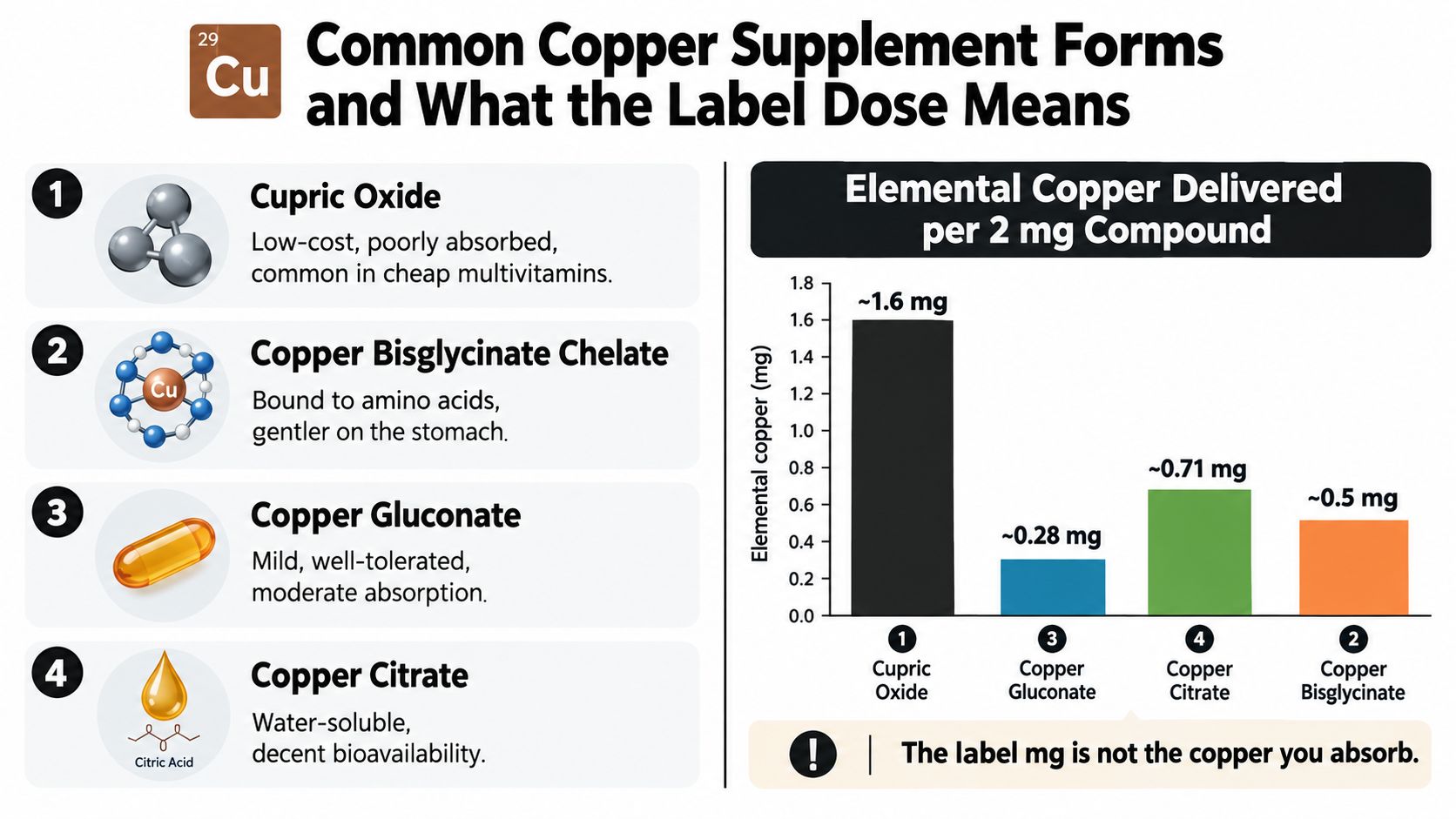
A copper label can be confusing because the compound name and the elemental copper amount aren't always the same thing. Elemental copper is the amount that matters when you compare products and calculate total intake. A compound may weigh more than the copper it contains.
Common forms include cupric oxide, cupric sulfate, copper gluconate, copper citrate, copper picolinate, and copper bisglycinate. Cupric oxide is inexpensive and appears in some multivitamins, but it's often described as less absorbable. Chelated forms, such as bisglycinate, bind copper to amino acids and may be easier for some people to tolerate. Gluconate and citrate are also common standalone forms.
The chemical form can influence how much elemental copper a compound supplies, but the label's Supplement Facts panel should be the deciding reference. Don't calculate your intake from the compound weight unless the manufacturer explicitly gives the elemental amount.
What to check on the bottle
Look for the line that states Copper, followed by a quantity and a chemical form. That number is more useful than the larger compound name elsewhere on the label. A product listing copper gluconate and another listing copper bisglycinate may use different compound weights while providing a similar elemental amount.
Standalone products commonly sit above the amount found in a general multivitamin, but formulas vary. A multivitamin may include copper alongside zinc, iron, and other minerals, so adding a copper-only capsule without reviewing the full panel can produce an unintended overlap.
For a practical lesson in reading Supplement Facts panels, use this guide to reading supplement labels. If you're comparing copper compounds with topical or peptide-related products, the Peptide Warehouse USA GHK-Cu guide provides useful context about why a copper-containing compound isn't automatically the same as an oral copper supplement.
The key distinction is simple: a multivitamin can serve as a maintenance source, while a higher-dose standalone product should have a clear reason behind it. Neither the form name nor a bigger milligram figure proves that more copper is appropriate.
Copper and Zinc How Doses Stack Across Your Routine
Copper and zinc interact in the gut. High-dose, long-term zinc can reduce copper absorption, which is why some clinicians recommend 2 to 3 mg of copper with 50 mg of supplemental zinc when deficiency prevention is clinically appropriate. This isn't a universal prescription. It's a signal to review the balance rather than taking zinc and copper independently.
A supplement stack can hide the total. A multivitamin may supply copper, a fortified breakfast product may add more, and a copper-only capsule can push the daily amount higher even when each individual label looks reasonable.
| Source | Typical Copper Contribution | Notes |
|---|---|---|
| Multivitamin-mineral product | 0.5 to 2 mg | Check the Supplement Facts panel |
| Fortified food | Varies | Include the serving you actually eat |
| Standalone copper product | 1 to 4 mg | Compare elemental copper |
| Zinc-focused routine | May require review | High-dose zinc can affect copper balance |
| Multiple mineral formulas | Varies | Add overlapping products together |
A worked example
Consider a 35-year-old taking 50 mg of zinc picolinate for skin concerns, a multivitamin containing 1 mg of copper, and a copper-fortified oatmeal product. The multivitamin already contributes 1 mg, the food adds another amount, and a separate copper tablet would sit on top of both. The resulting total could reach the 3 to 4 mg range even without deliberately choosing a high copper dose, depending on the food label and the standalone product.
That total remains below the adult UL, but “below the ceiling” doesn't mean “necessary.” The better question is whether the person needs extra copper, whether zinc use is appropriate for the intended duration, and whether laboratory testing supports repletion.
Iron deserves the same kind of review. Mineral supplements can compete for absorption, so a routine containing zinc, copper, and iron may need timing adjustments. For broader context on zinc products and their role in a supplement routine, see this zinc supplement guide.
Count copper from the whole routine, not just from the bottle named copper.
Maintenance Dosing Versus Repletion Protocols
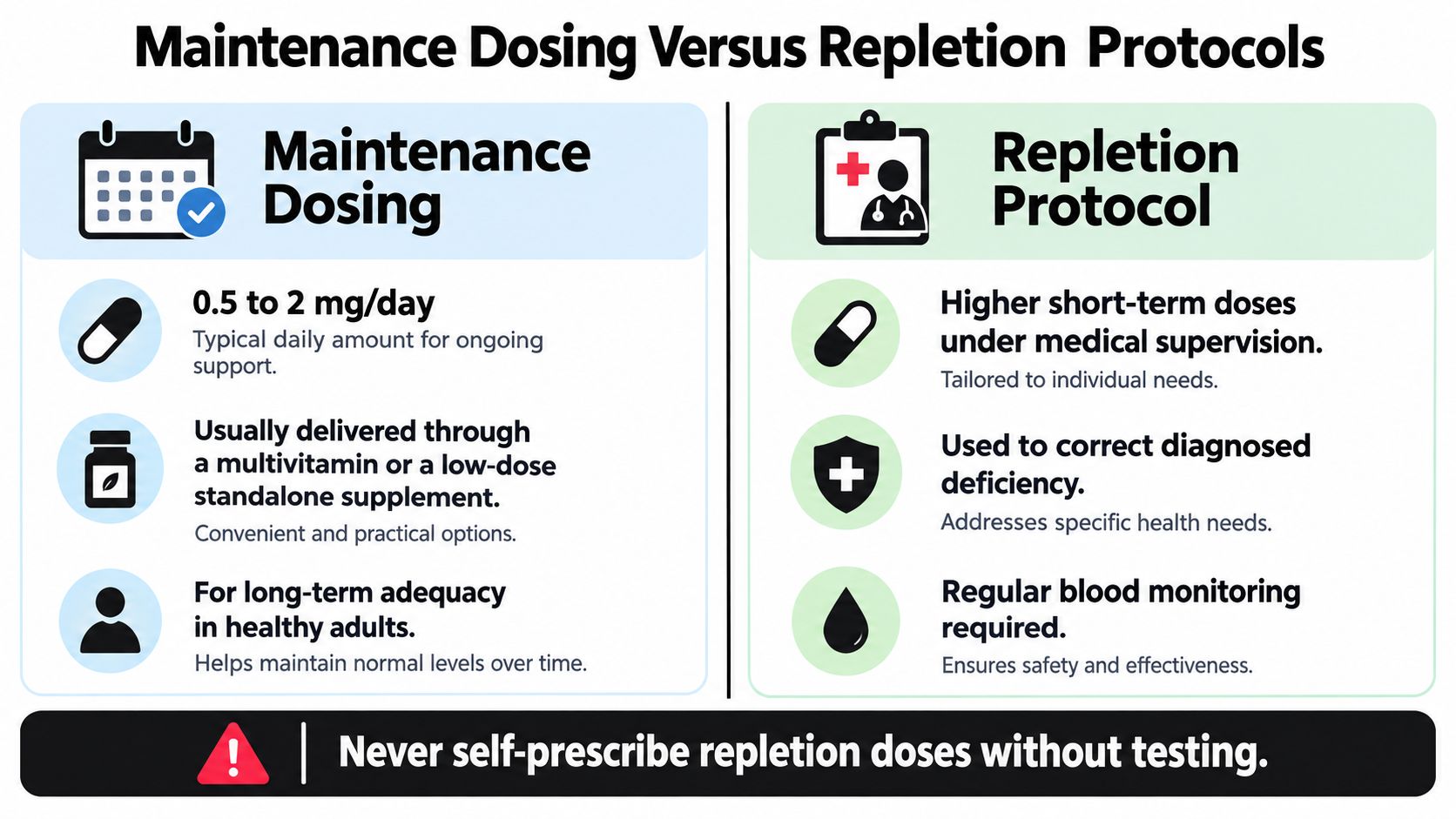
The most important dosing distinction is between maintenance and repletion. Maintenance supports ordinary nutritional adequacy. Repletion corrects a documented or strongly suspected deficiency and should be treated as a temporary medical plan.
Maintenance is the lower tier
A maintenance routine often falls around 0.5 to 2 mg per day, commonly through a multivitamin or low-dose standalone supplement. That amount may complement dietary intake, but it isn't automatically needed by every adult. The final calculation should include food and every product that lists copper.
A person using maintenance dosing should be able to explain the purpose clearly. Perhaps a clinician identified a dietary gap, or a multivitamin is being used as general nutritional coverage. If the only reason is that a larger number appears more powerful, the dose deserves reconsideration.
Repletion needs a defined endpoint
For mild to moderate deficiency, expert guidance commonly uses 3 to 8 mg per day of oral copper, often as copper sulfate or gluconate, until blood markers improve. Severe deficiency may require intravenous copper, including 2 to 4 mg per day for about 6 days in some clinical references. These are not ordinary wellness doses.
The cause also matters. Malabsorption, gastrointestinal surgery, prolonged high-dose zinc, and other medical conditions can change how a person responds. A clinician may use plasma copper, ceruloplasmin, blood counts, and the clinical history to decide whether oral treatment is enough.
For readers preparing for evaluation, this resource on testing copper levels explains the role of plasma copper testing. High-dose treatment should have a start point, a monitoring plan, and a reason to stop or reduce the dose.
Don't turn a repletion protocol into a permanent habit. Copper can accumulate in the liver, and the safe choice depends on follow-up rather than on repeating the original dose indefinitely.
Signs of Copper Deficiency and Toxicity to Watch For
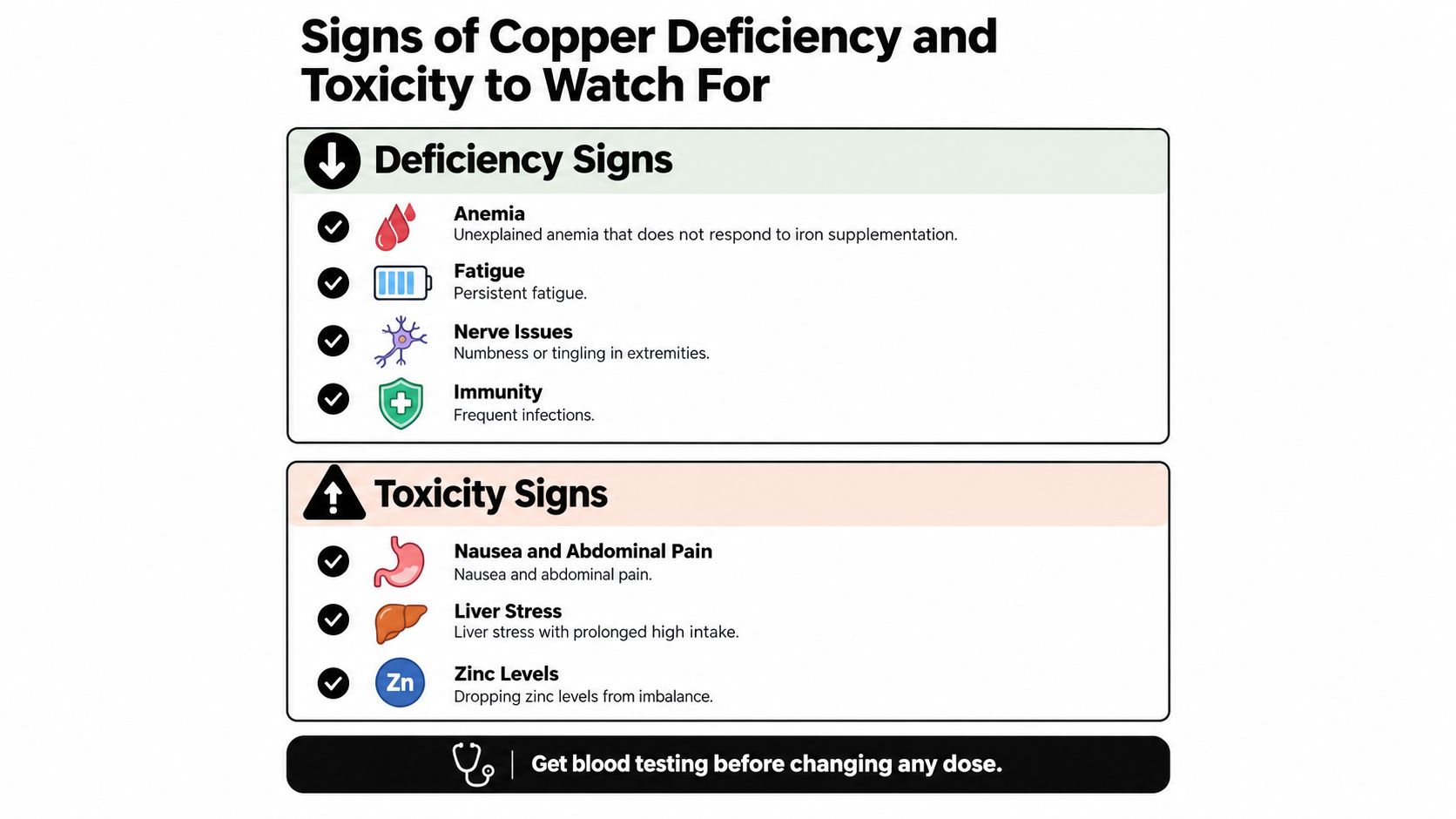
Symptoms can suggest that testing is worth discussing, but they can't establish a copper diagnosis by themselves. Deficiency may appear alongside unexplained anemia, especially when iron treatment hasn't corrected it, persistent fatigue, low neutrophil counts, reduced bone strength, or neurological symptoms such as numbness, tingling, and gait instability.
Risk rises when the clinical context makes copper depletion more plausible. Long-term high-dose zinc, malabsorption, and gastrointestinal surgery deserve attention because they can change mineral absorption and balance. A person with symptoms shouldn't respond by automatically increasing copper.
Symptoms that call for caution
Toxicity can produce nausea, abdominal pain, a metallic taste, and diarrhea. With chronic excess, liver stress may appear through abnormal liver enzymes. Wilson disease, a genetic disorder involving copper accumulation, requires specialist care and isn't something a supplement adjustment can safely manage.
Seek medical guidance promptly if symptoms are persistent, severe, or accompanied by abnormal blood results. Don't use symptom lists as a self-prescribing tool.
Tests provide the missing context
Clinicians may consider serum ceruloplasmin, plasma copper, and 24-hour urinary copper alongside a complete blood count, liver tests, diet history, and supplement review. The results need interpretation in context because one marker doesn't explain every copper-related problem.
Normal results often make additional high-dose copper less defensible, particularly when dietary intake is adequate. If the results suggest deficiency, the treatment plan should address both the copper dose and the underlying cause, such as excess zinc or impaired absorption.
Building a Daily Routine With a Copper Supplement
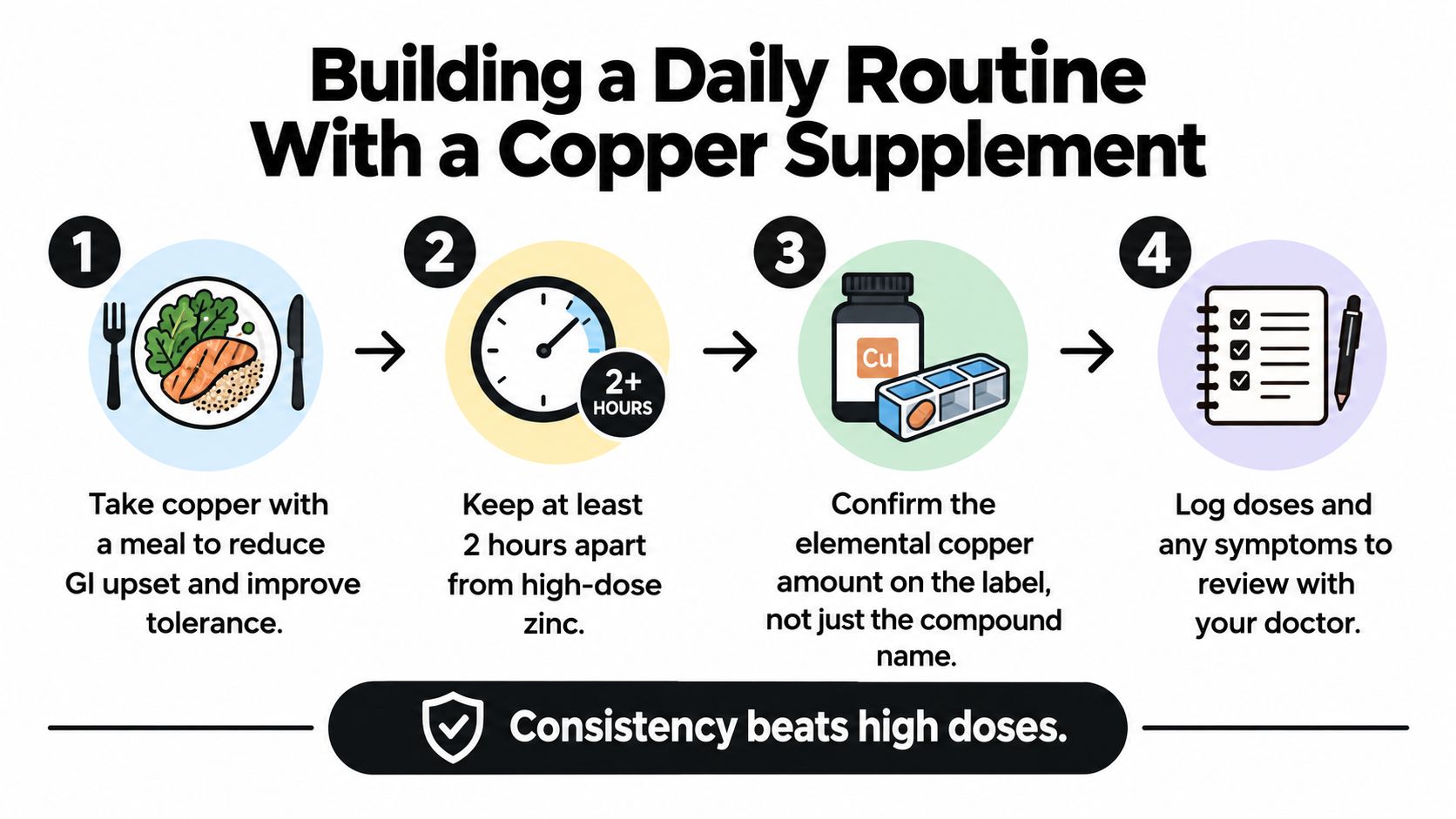
A practical routine starts with the label, not the capsule. Confirm the elemental copper amount, list every product and fortified food that contributes copper, and choose a meal that makes the supplement easy to tolerate. Taking copper with food may reduce stomach upset for some people.
Spacing can help when the routine includes other minerals. Keep copper separate from high-dose zinc, commonly by at least 2 hours when a clinician or pharmacist recommends spacing, and review iron timing as well. The exact schedule should account for prescription medicines and the reason each mineral is being used.
A simple example
Suppose a daily routine contains 0.9 mg from a multivitamin, 0.2 mg from fortified cereal, and 2 mg from a standalone copper capsule. The total is 3.1 mg, before counting any additional dietary sources. That figure is below the adult UL, but it may still exceed what a person needs for maintenance, so the reason for adding the standalone product matters.
Morning or evening can both work. Consistency is more important than choosing a special hour, provided the supplement fits safely around zinc, iron, medicines, and meals.
A once-daily product such as Vita Mix NexiHerb Multivitamin & Mineral Dietary Supplement can be assessed as one part of a broader routine. Its product information describes a vegetarian, one-capsule daily multivitamin and mineral formula for adults, with instructions to take it with water, preferably with a meal. Check its current Supplement Facts panel for copper before adding another mineral product.
For practical routine planning, this daily wellness supplements guide can help organize products without losing track of overlaps.
Bring these details to a provider visit:
- Current products: Photograph every front label and Supplement Facts panel.
- Daily amounts: Record how many capsules, servings, and fortified foods you use.
- Recent results: Include blood counts, copper-related tests, and liver results when available.
- Symptoms: Note when fatigue, digestive symptoms, numbness, or other changes began.
Smart Takeaways Before You Start Supplementing
Copper dosing becomes clearer when you separate the nutritional target from the medical correction dose. For adults, the anchor is 900 micrograms, or 0.9 mg, per day, while the total adult ceiling is 10 mg per day from food and supplements. Those figures frame the decision, but they don't replace an assessment of diet, medications, medical conditions, and laboratory findings.
High-dose zinc is the most important stacking issue for many supplement users. Guidance cited in public health and clinical nutrition materials commonly discusses 2 to 3 mg of copper with 50 mg of supplemental zinc when prevention is clinically considered, but that isn't a universal instruction to pair the products. Zinc exposure, duration, diet, and test results still matter.
Keep the decision proportional
A low-dose maintenance product and a short repletion course have different purposes. Repletion may involve 3 to 8 mg per day of oral copper or supervised intravenous treatment in severe cases, while maintenance generally stays much lower. More copper isn't automatically better, and a product that stays below the UL may still be unnecessary.
Copper also interacts with the broader mineral routine. Review zinc and iron timing, check fortified foods, and look for copper in multivitamins, prenatal products, and combination formulas. If you take prescription medicines or have liver, gastrointestinal, or genetic conditions, ask a clinician or pharmacist to review the plan.
Long-term safety data for sustained higher-dose use remain limited, individual responses can differ, and upper-limit reviews may evolve. That uncertainty is a reason to use testing and follow-up, not a reason to experiment with escalating doses.
Before changing your copper supplement dosage, confirm the suspected need, total your current intake, and agree on a monitoring plan with a qualified provider.
NexiHerb LLC offers multivitamins, minerals, and other dietary supplements designed to complement everyday wellness routines and a varied diet. Visit NexiHerb LLC to review product information and choose a routine that fits your nutritional goals.