

Do you need a complete amino acid supplement, or are you paying for nutrients your meals and protein powder already provide? That question matters because “complete” sounds automatically superior, yet the right choice depends on your protein intake, training schedule, digestion, dietary pattern, and health status.
Amino acids are the individual components your body uses to build and repair proteins. Free-form supplements can be convenient, but convenience isn't the same as necessity. The useful comparison is practical: does an EAA formula solve a real problem that food or a standard protein powder can't solve as easily?
Table of Contents
- What Makes an Amino Acid Supplement Complete
- Comparing EAAs, BCAAs, and Whole Protein Powders
- The Science of Muscle Protein Synthesis and Recovery
- Dosing Strategies and Timing for Optimal Results
- Evaluating Ingredient Matrices and Formula Quality
- Who Actually Needs Complete Amino Acid Supplements
- Building a Supplement Routine for Your Specific Goals
What Makes an Amino Acid Supplement Complete
What qualifies an amino acid supplement as complete, and does that label make it a better choice than food or protein powder? A complete profile contains all nine essential amino acids, or EAAs: histidine, isoleucine, leucine, lysine, methionine, phenylalanine, threonine, tryptophan, and valine. The body cannot produce enough of these compounds, so they must come from food or supplements, as explained in this NIH-hosted review of essential amino acid supplementation.
Amino acids support more than muscle building. They provide the raw materials for tissue maintenance, enzymes, hormones, immune activity, and everyday repair. Protein is the finished structure, while amino acids are its building pieces. If one required piece is scarce, protein construction becomes less efficient.
Complete does not always mean supplemental
A varied diet can already supply a complete amino acid pattern. Animal proteins such as eggs, dairy, fish, poultry, and meat provide all nine EAAs, while soy, quinoa, and suitable plant combinations can do the same. These practical tips for complete protein offer meal ideas for meeting protein needs through food.
A free-form EAA supplement delivers individual amino acids rather than the larger protein structure found in a meal or powder. That format can suit someone who wants a small, rapidly consumed option before or around training. It does not, however, provide the fiber, vitamins, minerals, fats, or other nutrients found in whole foods. Its role is targeted convenience, not a replacement for varied meals.
The question of dietary need
Cleveland Clinic guidance notes that balanced diets generally provide essential amino acids, while supplements may have narrower uses related to athletic performance, sleep, or mood support. Read the Cleveland Clinic's amino acid guidance for that broader medical context. Someone already eating sufficient complete protein at regular meals may notice little benefit from adding free-form EAAs.
The practical case is stronger for a person who cannot tolerate food before training, follows a low-protein or restrictive diet, trains fasted, or finds a shake too heavy. In those circumstances, the supplement solves a timing, appetite, or portability problem. A complete label describes the amino acid profile, not automatic superiority. Compare the formula with your current meals and protein powder before paying for the lighter format.
Comparing EAAs, BCAAs, and Whole Protein Powders
The simplest distinction is coverage. EAAs provide the nine amino acids your body must obtain from food. BCAAs contain only leucine, isoleucine, and valine. Whole protein powders, such as whey or a blended plant protein, provide a broader protein matrix that your digestive system breaks down into amino acids.
| Format | Profile Completeness | Digestion Speed | Best Use Case |
|---|---|---|---|
| EAAs | Complete essential profile when all nine are included | Rapid and light | Fasted training, low appetite, or a small pre-workout option |
| BCAAs | Incomplete, only leucine, isoleucine, and valine | Rapid | A narrow supplement role when a person specifically prefers BCAAs |
| Whole protein powder | Complete when the source or blend supplies all essential amino acids | Slower than free-form amino acids | Daily protein intake, post-workout nutrition, or meal support |
Why BCAAs aren't equivalent to EAAs
Leucine can help signal muscle protein synthesis, but signaling isn't the same as construction. The body also needs the other essential amino acids as raw material. BCAAs may therefore be a limited tool, while a complete EAA formula covers the full essential set. This comparison of essential amino acids and branched-chain amino acids offers a useful label-level distinction.
A whole protein powder usually wins when your main challenge is meeting total protein needs. It supplies a more substantial nutritional package and can work well in a smoothie or meal. Its drawbacks are practical, not necessarily biological. Some people find shakes filling, heavy, inconvenient, or difficult to tolerate around exercise.
EAAs occupy the middle ground. They offer more complete coverage than BCAAs and less digestive volume than a protein shake. That makes them attractive for someone training early, exercising soon after waking, or trying to keep a session comfortable while dieting.
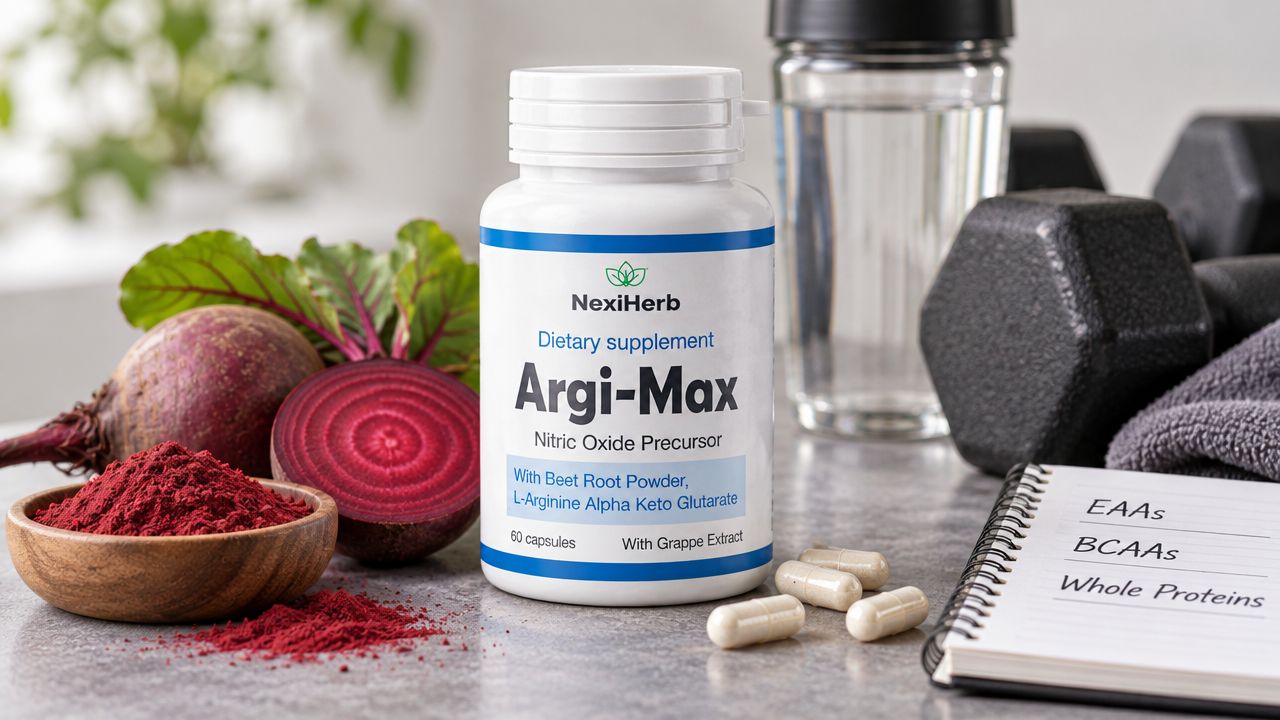
A separate amino acid product isn't automatically a muscle-building formula. For example, Argi-Max NexiHerb L-Arginine, L-Citrulline-DL-Malate, and beet root powder is a capsule supplement containing L-arginine HCL, L-arginine alpha keto glutarate, L-citrulline-DL-malate, and beet root powder. Its listed ingredients don't represent a complete EAA profile, so it should be evaluated as a different type of amino acid and botanical formula, not as a substitute for an EAA product.
Decision rule: Choose whole protein to cover a food gap, EAAs to solve a timing or digestion problem, and BCAAs only when their narrower profile fits a specific preference.
The Science of Muscle Protein Synthesis and Recovery
Could a free-form EAA supplement improve recovery more than food or protein powder for your routine? The answer depends on what your muscles receive, when they receive it, and whether convenience solves a real nutritional gap.
Muscle protein synthesis, or MPS, is the process of assembling new muscle proteins. Resistance training provides the adaptation signal, while essential amino acids supply the building materials. Leucine acts like an on-switch for part of that response by helping activate cellular machinery associated with the mTOR pathway.
The ceiling effect
Dose-response research found that about 10 grams of EAAs containing roughly 2.1 grams of leucine maximally stimulated myofibrillar protein synthesis in young adults. Lower amounts still produced smaller measurable responses, and a resistance-exercise study found 6 grams of EAAs improved net muscle protein balance. For label reading, check the total EAA amount and leucine content, rather than choosing the product with the largest overall gram figure.
That ceiling helps explain why a free-form supplement does not automatically outperform a meal or protein shake. Once a serving provides enough of the relevant amino acids for the acute response, adding more powder may offer little extra benefit at that feeding. A complete protein serving can still be the better choice when your priority is meeting total daily protein and receiving a broader nutritional package.
A recovery study also found that a leucine-supplemented suboptimal protein dose performed similarly to 25 grams of whey during the early recovery window, according to a clinical review. This result supports a narrower use case. EAAs may help when the available protein dose is limited, but the comparison does not make them a universal replacement for meals or protein powder.
Age can change the response. An review of leucine-rich EAA formulations describes evidence that approximately 1.8 to 2.1 grams of leucine within an 8 to 10 gram EAA serving often supports the acute response in healthy young adults. Older adults may respond better to a more leucine-rich or higher-dose formula because anabolic resistance can reduce muscle sensitivity to the usual signal. One study found 3.6 grams of a leucine-rich EAA composition increased muscle fractional synthetic rate in older adults.
The practical takeaway is simple: EAAs can fit a specific nutritional moment, especially when a full meal or shake is inconvenient. Training quality, adequate total protein, sleep, and regular meals still shape broader recovery.
All Night NexiHerb, Advanced Herbal Formula for Male Vitality & Daily Wellness belongs to a separate category. Its listed formula combines botanical ingredients with L-arginine for adult men, so it should not be treated as a complete EAA product or evidence of an MPS-focused formula.
Dosing Strategies and Timing for Optimal Results
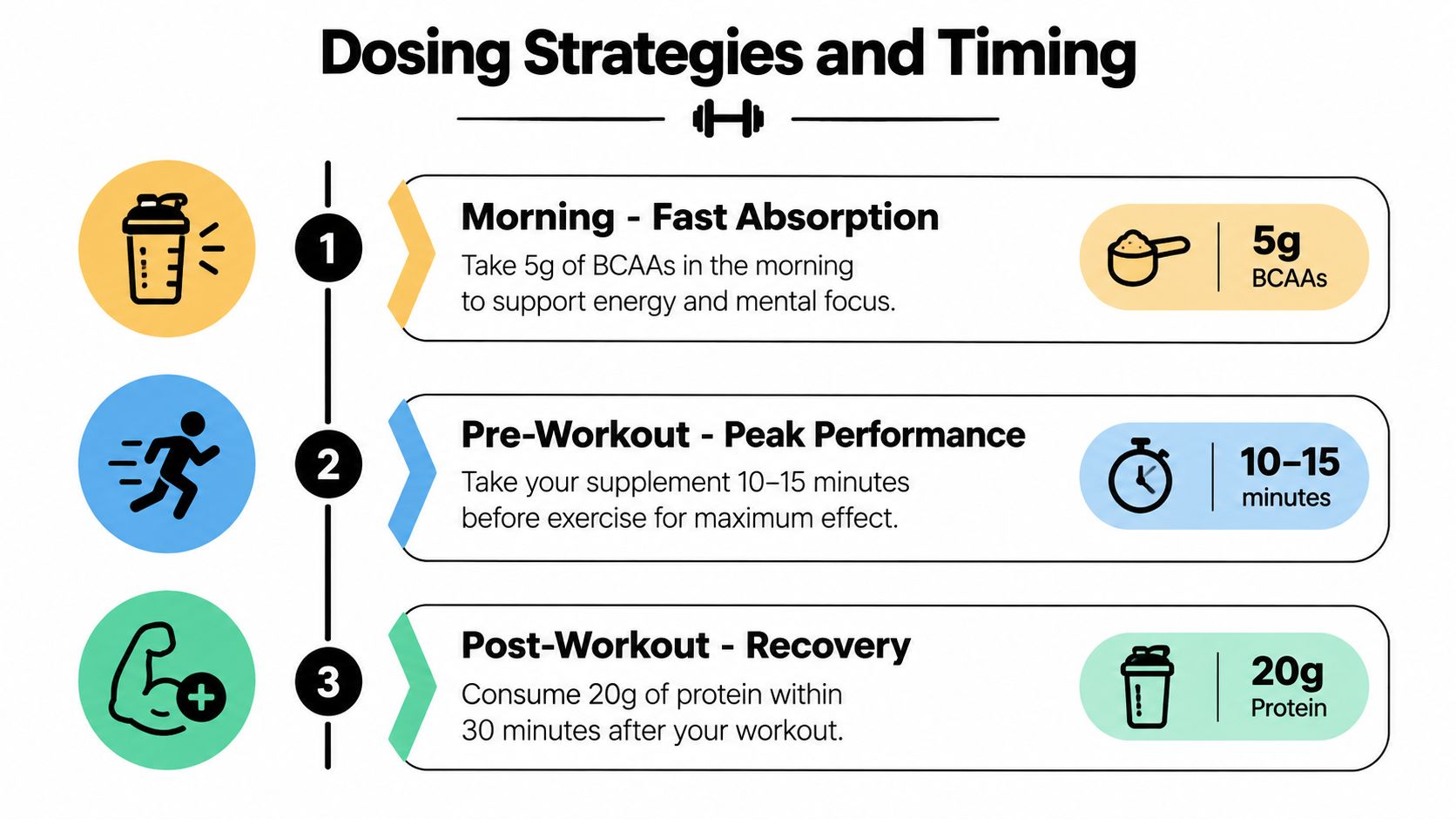
Could an EAA supplement improve your routine, or would a meal or protein shake do the same job? The answer depends less on the clock than on whether your schedule leaves a meaningful protein gap. After a protein-containing meal, free-form EAAs may add little. Before an early workout, during calorie restriction, or when appetite is low, they can provide a lighter option than solid food or a full shake.
Match the serving to the situation
Start with the label's total EAA amount and leucine content. Use the threshold described above as a practical reference, rather than repeating the dose-response findings here. A scoop marked “amino acids” may contain mostly BCAAs, nonessential amino acids, or a partially disclosed blend, so the product name alone cannot confirm that it is complete.
For a fasted morning session, a complete EAA serving shortly before or during training may suit people who want amino acids without a heavy shake. It is a bridge across a scheduling gap, not a special requirement created by the workout clock.
Training later in the day calls for a different first question: what did the previous meal provide? If it included enough complete protein, adding EAAs before, during, or after exercise is optional. A guide to the best time to take amino acids can help compare these placements, while keeping the priority on the day's overall diet.
Calorie restriction and rest days
During a calorie deficit, spread protein-containing meals through the day instead of using one supplement serving to compensate for an inconsistent intake. EAAs can help between meals when food volume, hunger, or convenience makes that pattern difficult. They do not provide the wider nutrients found in a meal.
Rest days rarely require a timing ritual. Ask whether the product helps you maintain an appropriate eating pattern. If meals already contain complete proteins, free-form EAAs may not improve the plan. If appetite is low or food choices are restricted, a clinician or qualified sports dietitian can help assess whether they fit.
Practical rule: Use timing to solve a real nutritional gap, not to add a costly routine when food or protein powder already meets the need.
Evaluating Ingredient Matrices and Formula Quality
A reliable label should let you answer three questions quickly. Which essential amino acids are included? How much of each is present? Does the serving provide meaningful leucine rather than hiding the formula behind a large total number?
Look for a fully disclosed Supplement Facts panel. A proprietary blend prevents you from judging the ratio, while a transparent panel lets you compare the product with the evidence on EAA composition. The label should also separate EAAs from other ingredients such as glutamine, arginine, citrulline, flavoring agents, or botanicals.
Spotting amino spiking
“Amino spiking” refers to adding cheaper amino acids to inflate the apparent amino acid or protein total without providing an equivalent complete EAA profile. The practical defense is simple: inspect the individual quantities instead of relying on the front-panel headline.
Check for:
- All nine EAAs: A complete formula should identify histidine, isoleucine, leucine, lysine, methionine, phenylalanine, threonine, tryptophan, and valine.
- Leucine visibility: The label should show how much leucine the serving contains, because leucine is central to the acute anabolic signal.
- No hidden matrix: Avoid relying on a proprietary blend when you can't see the amount of each active ingredient.
- Quality controls: Look for testing information, allergen clarity, and screening appropriate for your sport or personal needs.
- Formula purpose: A nitric oxide or botanical product may have a legitimate role, but it isn't automatically a complete amino acid supplement.
Read beyond the headline
The presence of added botanicals doesn't make a formula better or worse. It changes what the product is designed to do. For example, a capsule containing arginine, citrulline, and beet root powder should be assessed for its stated ingredient amounts and intended role, not compared directly with an EAA powder designed around MPS.
The same reading habit applies to products for adjacent goals. A resource such as Sleep All Nite's supplement comparison can be useful when separating sleep-support products from amino acid formulas. For a broader label-reading framework, use this supplement label guide.
Label test: If you can't tell what the serving contains, you can't tell whether it matches your goal.
Who Actually Needs Complete Amino Acid Supplements
Most adults don't need a complete amino acid supplement because amino acids are important. Importance and supplementation are different questions. A balanced diet can usually supply essential amino acids through foods such as eggs, dairy, soy, quinoa, fish, poultry, and combinations of plant proteins.
The clearest use cases are practical or clinical. An athlete who trains fasted may want a light option that doesn't sit heavily in the stomach. Someone following a low-protein or highly restrictive diet may need help identifying and closing a genuine intake gap. An older adult dealing with reduced appetite or difficulty maintaining lean mass may benefit from a carefully selected, leucine-rich formula, but that decision should involve individual nutrition and medical context.
When food comes first
Whole foods remain the default because they deliver more than amino acids. A meal can provide protein alongside fiber, minerals, vitamins, fats, and carbohydrates that support training and general health. A protein powder can also be more useful than EAAs if your central problem is consistently failing to consume enough total protein.
Vegan athletes don't automatically need EAAs. A varied plant-based diet can provide the required amino acids, particularly when meals include soy, legumes, grains, nuts, seeds, or other complementary sources. The supplement becomes more relevant when schedule, appetite, travel, or training conditions make that pattern difficult to maintain.
Who should pause before using them
People with kidney or liver conditions should get individualized advice before adding amino acid or protein supplements. Protein metabolism creates waste products that the body must process and remove, and people with kidney disease may need carefully managed protein intake. The American Kidney Fund's guidance on protein supplements and kidney health emphasizes that needs vary by disease stage, nutritional status, and treatment.
Pregnant or breastfeeding adults, people with metabolic disorders, those taking prescription medicines, and younger users should also speak with a healthcare professional before use. Supplements marketed for adults aren't automatically suitable for children or adolescents.
Safety first: If you have a diagnosed condition, unexplained symptoms, or a medically managed diet, choose professional guidance over a generic serving suggestion.
Building a Supplement Routine for Your Specific Goals
What should your supplement routine solve? Start with the obstacle, not the label on the tub. Keep regular meals, adequate hydration, suitable resistance training, and a sleep schedule you can maintain. Add a complete amino acid supplement only when it makes one of those habits easier to follow.

For the performance-focused athlete
Use a complete EAA formula when training fasted, managing a low appetite, or unable to carry a meal or shake. On ordinary days, complete meals or protein powder can provide the foundation. Check that the label lists all nine EAAs and identifies the leucine content. A clear formula makes it easier to compare products than flavor claims or broad marketing language.
The practical test is simple: does the supplement help you train consistently without displacing a more nourishing meal?
For the busy professional
Build the routine around predictable gaps. Eat food at regular meals, then reserve an EAA serving for travel, long meetings, or training after work when a meal is impractical. Keep the product ready where the problem occurs, such as in a work bag or gym kit.
An amino acid formula supplies selected building blocks, not broad daily nutrition. A multivitamin, omega-3, or botanical formula has a different role and should not be counted as a protein replacement.
For healthy aging
Choose easy-to-prepare meals with complete protein first. If appetite, chewing difficulty, dietary restrictions, or recovery from illness limits intake, discuss an EAA option with a clinician or dietitian. As noted earlier, older adults may respond better to a leucine-focused approach, so professional guidance can help match the routine to the person.
The video below provides a visual introduction to amino acids and their place in a broader wellness routine.
NexiHerb LLC offers amino acid, botanical, omega-3, multivitamin, and wellness formulas. Review the ingredient panel and intended use, then visit NexiHerb LLC to compare options that fit your routine, rather than choosing a product solely because it says “complete.”