

You're standing in a supplement aisle with a small dropper bottle in your hand. The label mentions 2,000 IU of vitamin D3, but it doesn't immediately tell you whether that means one drop, half a dropper, or several drops. A second bottle nearby uses a different serving size, so comparing them feels less like shopping and more like solving a dosing puzzle.
That confusion is understandable. Liquid vitamin D3 drops aren't standardized by drop count across brands. One product may provide 100 IU per drop, another may recommend one or two drops for 1,000 IU, and another may require four or five drops for an adult serving, as illustrated by current product labeling from NOW Foods. The bottle's serving size, dropper design, oil thickness, and instructions all matter.
Liquid drops remain useful because they're easy to swallow, simple to mix into food or drinks, and more adjustable than a fixed-dose capsule. Those advantages also create the main risk: a small assumption about drop size can change your daily intake. The practical answer is to read the label as a dosing tool, not just as a list of ingredients.
Table of Contents
- Why Liquid Drops Are Worth Understanding
- What Vitamin D3 Actually Is and Why an Oil Matrix Matters
- How Drops Compare to Capsules, Tablets, and Sprays
- Reading the Dropper and Finding Your Real Dose
- Safety, Upper Limits, and Common Interactions
- Storage, Stability, and Absorption Habits
- Choosing a Quality Liquid D3 Formulation
- A Quick Pre-Purchase Checklist
Why Liquid Drops Are Worth Understanding
You pick up a small vitamin D3 bottle and see a high IU number on the label. The difficult question is often smaller: does that amount describe one drop, a full dropper, or several drops? That distinction matters because liquid products do not use a universal drop size, and a dose that looks modest can vary sharply between brands.
Vitamin D deficiency remains a widespread nutrition concern. A 2023 pooled analysis of 7.9 million participants from studies conducted between 2000 and 2022 found that 15.7% had serum 25-hydroxyvitamin D below 30 nmol/L, 47.9% were below 50 nmol/L, and 76.6% were below 75 nmol/L. Low levels were more common in high-latitude regions and during winter and spring than during summer and autumn.
That context helps explain the appeal of concentrated formats. In the United States, vitamin D intake was about three times higher when supplements were included, increasing from 4.8 mcg, or 192 IU, from foods and beverages to 19.9 mcg, or 796 IU, with supplements, according to the NIH intake data summarized in that reference. A small bottle can deliver a measurable amount without requiring someone to swallow a large tablet.
Flexibility comes with a measurement task
A capsule provides one predetermined serving. Drops allow adjustments, which may help when a healthcare professional recommends a specific intake or when adults and children in one household use different amounts. MedlinePlus also notes that liquid vitamin D drops may be added to food or drink for children, making administration easier.
The trade-off is that a drop isn't a universal unit. One label may list IU per serving rather than per drop, while another dropper may release a different volume because of its design or the liquid's thickness. Before taking the first dose, check three details: the IU per serving, the stated serving volume or drop count, and whether the instructions refer to one drop or a full dropper.
Liquid vitamin D supplements are a relatively modern format. One product history account places the invention of drop-form liquid vitamin D supplements in Toronto in 2006, with commercial availability in Canada in 2007. The same account reports that daily vitamin D use of 1,000 IU or more in the United States rose from 0.3% in 1999-2000 to 18.2% in 2013-2014, while daily intake of 4,000 IU or more reached 3.2% in 2013-2014, based on cited JAMA and NIH summaries.
Practical rule: Never convert “one dropper” into an IU dose until the label states exactly how much that dropper contains.
What Vitamin D3 Actually Is and Why an Oil Matrix Matters
If you are comparing liquid vitamin D3 drops with tablets, the key difference starts with the nutrient itself. Vitamin D3, or cholecalciferol, is produced in the skin after sunlight exposure and is also widely used in supplements. After ingestion, it crosses the intestinal lining. The liver converts it into 25-hydroxyvitamin D, the form commonly measured in blood tests, and the kidneys convert that compound into the active hormone calcitriol.
Because vitamin D3 is fat-soluble, dietary fat can support its absorption. An oil-based liquid already places the cholecalciferol in a fatty carrier, while a dry tablet must first disintegrate during digestion. The oil is not a guarantee of better results, but it can remove one physical step before absorption.
Why pre-dissolved oil can help
Common carrier oils include MCT, olive, and sunflower oil. In an oil matrix, the active ingredient is dispersed before you take it, rather than compressed into a tablet that must break apart. A review summary associated oil-based liquid preparations with peak serum levels about 2 hours earlier and approximately 12–15% higher overall bioavailability than equivalent tablets. It also reported mean serum 25(OH)D rises 10–25% higher than with dry-powder products at equivalent doses (comparison of supplement forms).
Those findings describe comparisons between formulations, not a promise that every liquid will outperform every capsule. Dose accuracy, ingredient quality, storage, digestion, and the meal taken with the supplement can all influence the result. The practical point is narrower: pre-dissolved D3 may make absorption less dependent on tablet breakdown.
The harder issue is dosing. A liquid can contain very different amounts of IU per drop, so the oil format does not make a high-potency product automatically safer. Read the label's serving size and IU amount before measuring, especially when a product combines D3 with another nutrient.
Some formulas pair D3 with vitamin K2, often the MK-7 form. Vitamin K2 participates in proteins involved in calcium movement, but research on combined supplementation is still developing. The combination should not be treated as a guaranteed health outcome. For comparison, D3+K2 NexiHerb 10,000 IU of vitamin D3 + 120 mcg of Vitamin K2 is a capsule providing 10,000 IU of vitamin D3 and 120 mcg of vitamin K2 as MK-7 per capsule for adult use.
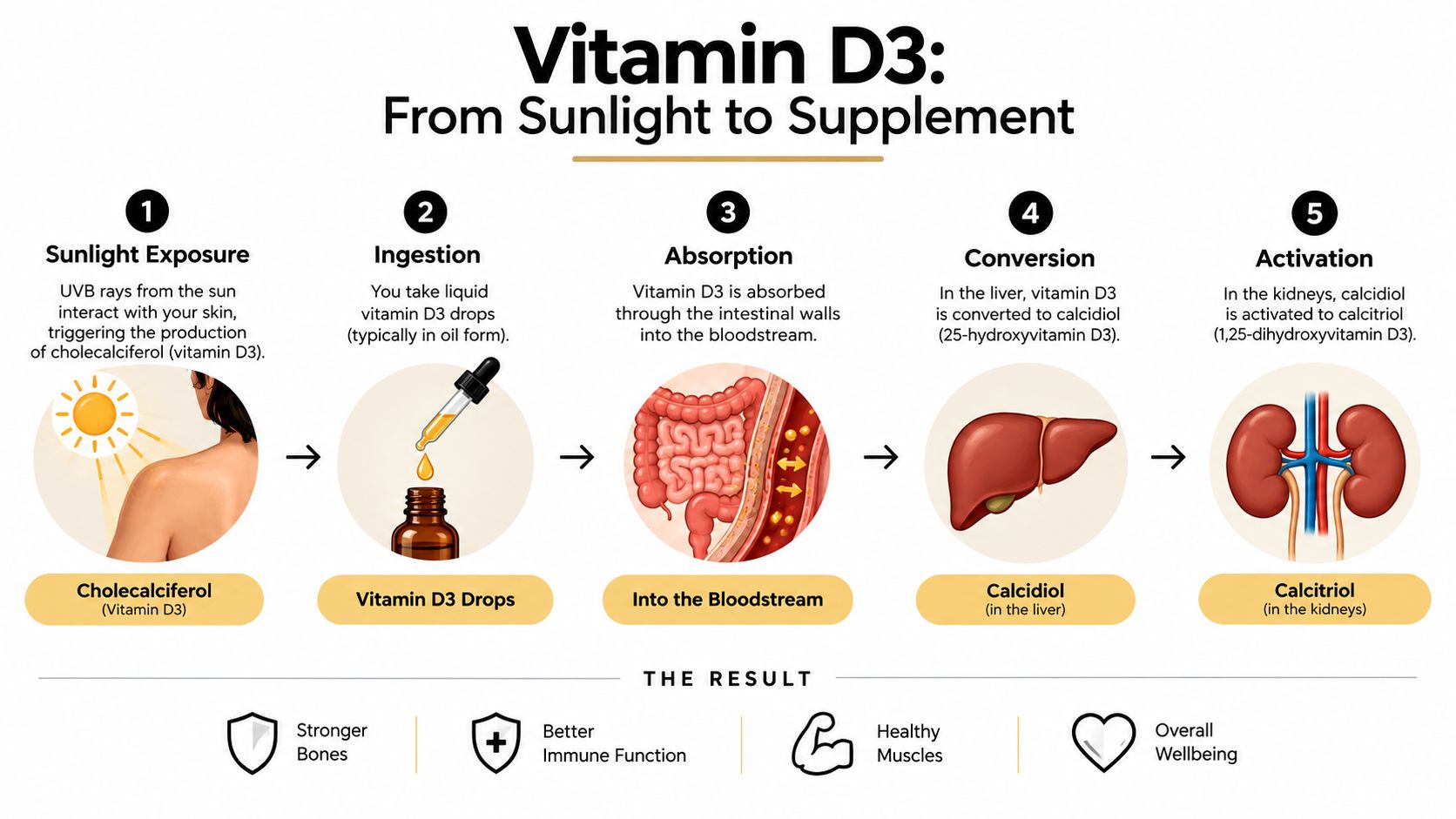
This visual connects sunlight, ingestion, absorption, liver conversion, and kidney activation:
For context on vitamin D's relationship with other nutrients, see vitamin D and B.
How Drops Compare to Capsules, Tablets, and Sprays
A person who struggles with pills may find drops easier to use, while someone who travels often may prefer a pre-measured capsule. The practical choice depends on how precisely you need to adjust the dose, how you take supplements, and how much measuring your routine can support. Drops emphasize flexible dosing and oil-based delivery.
Softgels also contain vitamin D in oil, but they usually provide one fixed serving. Tablets and dry powder capsules must disintegrate and dissolve before the vitamin enters the digestive process. Sublingual sprays provide another pre-dissolved format, although direct comparisons with oil-based drops remain limited.
| Format | Bioavailability | Dose Flexibility | Convenience | Stability |
|---|---|---|---|---|
| Oil-based liquid drops | Pre-dissolved in oil, with review summary associating this format with earlier peak levels and higher bioavailability than equivalent tablets | High, if IU per drop is clearly stated | Easy to swallow and mix into food or drinks | Sensitive to light, heat, air, and carrier-oil oxidation |
| Softgels | Oil-filled and similar in design to liquid delivery | Low, usually one fixed serving | Simple, pre-measured, and easy to carry | Often less exposed to air after opening |
| Tablets | Must disintegrate before absorption | Low | Familiar and portable | Generally convenient to store |
| Dry powder capsules | Require capsule breakdown and dissolution | Low to moderate, depending on the product | Useful for people who prefer capsules | Depends on packaging and formulation |
| Sublingual sprays | Pre-dissolved and directed toward the mouth | Moderate | Useful for people who dislike pills | Follow the product's storage instructions carefully |
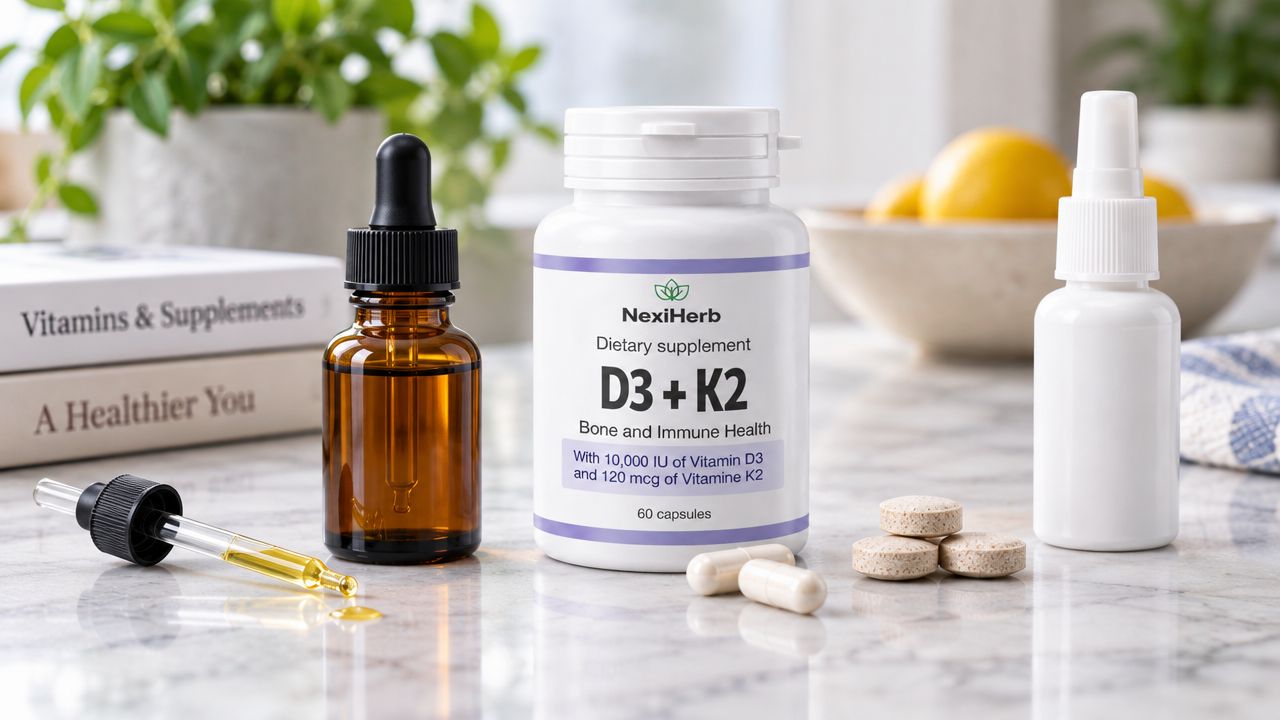
Format differences matter most when the label appears similar. A drop, capsule, or spray may show a comparable IU amount per serving, yet the serving itself can mean one drop, several drops, a full dropper, or one complete capsule. Treat each label as its own dosing system rather than assuming that products can be exchanged by container size or serving count.
The carrier also matters. An oil-based liquid, a water-based product, and a spray may behave differently in the body even when their listed IU amounts look alike. The word “liquid” does not identify the delivery system by itself. Check the carrier, serving definition, and directions before comparing products.
A capsule can carry a substantial fixed amount. The NexiHerb D3 and K2 capsule described earlier provides 10,000 IU per capsule and should therefore be evaluated as a high-potency, pre-measured format, not as the capsule equivalent of a low-dose drop. The useful comparison is IU per serving, the intended frequency, and whether that amount fits your personal plan.
Reading the Dropper and Finding Your Real Dose
The most important number on a liquid D3 bottle is not always printed beside the word “drop.” Many labels show IU per serving, followed by a volume such as a fraction of a milliliter or a full milliliter. Others specify the number of drops. Those details aren't interchangeable unless the manufacturer tells you how the included dropper is calibrated.
Start with the label and answer these questions:
- What is the serving size? Is it one drop, several drops, a marked volume, or a full dropper?
- How many IU are in that serving? Look for IU and, if listed, the equivalent amount in micrograms.
- Does the label state IU per drop? If it doesn't, don't assume the answer from another bottle.
- Is the dropper marked? A marked oral syringe or calibrated dropper is easier to use consistently than an unmarked pipette.
- Does the product distinguish children's and adult directions? Keep those instructions separate.
The calculation that prevents guesswork
If the label provides total IU and total drops, use this formula:
IU per drop = total IU in the bottle ÷ total drops in the bottle
Then calculate:
Drops for your target dose = target IU ÷ IU per drop
The arithmetic only works when the bottle's total drop count is known or reliably measured. A label that says “2,000 IU per serving” but doesn't define whether the serving is one drop or a full dropper doesn't provide enough information for accurate conversion.
The following table uses configurations as illustrative arithmetic examples, not typical product specifications:
| Total IU per Bottle | Approx. Drops per Bottle | IU per Single Drop | Drops Needed for 1,000 IU |
|---|---|---|---|
| 12,000 IU | 60 | 200 IU | 5 |
| 24,000 IU | 120 | 200 IU | 5 |
| 30,000 IU | 100 | 300 IU | About 3.3 |
| 40,000 IU | 100 | 400 IU | 2.5 |
The worked example often causes confusion. If a bottle contains 2,000 IU across 60 drops, the calculation is about 33 IU per drop, so a 1,000 IU target would require about 30 drops. That configuration may be impractical, which is a signal to recheck whether the label means 2,000 IU per bottle, per milliliter, or per serving. Don't use the example as a dosing recommendation.
Why the physical drop changes
Drop size can shift when you hold the bottle at an angle, squeeze the bulb too hard, or let oil cling to the dropper walls. Oil viscosity and the shape of the tip also affect how much liquid leaves at once. A marked syringe can be more reliable when the label gives a volume-based instruction.
Count drops against the printed target instead of estimating from the bottle's appearance. For the first week, a simple dosing log can help you record the date, stated IU, number of drops, and any other vitamin D products you took. If you want to connect supplement use with a laboratory result, track your vitamin D through a 25-hydroxyvitamin D test discussion with a qualified healthcare professional.
For unrelated general wellness products, Maca Power+ NexiHerb Herbal Dietary Supplement is a separate adult capsule formula containing maca, botanical extracts, and black pepper. It shouldn't be treated as part of a vitamin D dosing calculation.
Safety, Upper Limits, and Common Interactions
Vitamin D safety has three practical layers: how much you take, what else you take, and whether a medical condition changes your risk. The Institute of Medicine adult tolerable upper intake level is 4,000 IU per day, as summarized by the NIH Office of Dietary Supplements (vitamin D safety information). That figure includes total intake from supplements and other sources, not just the drops.
A clinician may sometimes recommend a higher amount for a defined period, based on laboratory results and follow-up. That doesn't make a high-potency bottle appropriate for self-directed daily use. With drops, a counting error repeats every day, so the margin for casual estimation is small.
Medicines that deserve a review
Ask a pharmacist or clinician to review your plan if you use medicines that can alter vitamin D absorption, breakdown, or calcium balance.
- Corticosteroids: These can reduce vitamin D absorption or affect vitamin D metabolism.
- Certain anticonvulsants: Phenytoin and phenobarbital can accelerate vitamin D breakdown.
- Orlistat: This weight-loss medicine can reduce absorption of fat-soluble vitamins.
- Thiazide diuretics: Combined with vitamin D, these may increase the risk of high calcium.
- Cholestyramine and similar bile-acid sequestrants: These can bind fat-soluble vitamins and reduce absorption.
People with hypercalcemia, kidney stones, sarcoidosis, or granulomatous disorders should speak with a clinician before using supplemental vitamin D. These conditions can change how the body handles vitamin D and calcium.
Safety checkpoint: If you use more than one vitamin D-containing product, add the IU from every source before taking another dose.
Persistent nausea, frequent urination, constipation, and confusion can signal excessive vitamin D intake and related calcium problems. Stop treating the bottle as a casual wellness product if you suspect an accidental overdose. Contact a healthcare professional or poison information service promptly, especially if a child may have received the wrong number of drops.
A separate herbal product, All Night NexiHerb, contains a botanical blend for adult male wellness and doesn't replace a medication review for vitamin D or calcium interactions.
Storage, Stability, and Absorption Habits
A bottle may carry the correct label amount yet become less reliable after repeated heat, light, or air exposure. A peer-reviewed stability study found that oil-based vitamin D3 formulations showed less than 10% degradation after 6 months under ambient storage conditions. This supports sensible storage, while the product's expiration date and directions still take priority. The same research review reported about a 25% increase in vitamin D3 content from gastric to intestinal stages in vitro for liquid supplement samples. That laboratory result suggests some liquid preparations can remain usable through simulated digestion, but it does not predict an individual's blood level.
Store the bottle tightly closed in a cool, dark cupboard. Keep it away from windowsills, stovetops, heated cabinets, and humid bathrooms. Amber glass or opaque plastic usually limits light exposure better than clear packaging. The carrier oil can also oxidize after repeated contact with air, so a rancid or unusually stale smell means the product should not be used, even if its printed date has not passed.
Match the dose to a meal
Vitamin D3 is fat-soluble. Taking oil-based drops with a meal that contains fat can support absorption. Eggs, nuts, avocado, olive oil, and full-fat dairy are practical options when they fit your dietary needs. A very low-fat meal may provide less favorable conditions for absorption.
You do not need to hold oil-based drops under your tongue. The liquid already carries vitamin D3 in oil, so follow the label's instructions for swallowing or mixing it with food or a drink.
Keep the bottle upright when possible. This limits oil collecting around the dropper tip and reduces unnecessary air contact between doses. For guidance on fitting supplements around meals and daily routines, see the best time to take vitamins.
Choosing a Quality Liquid D3 Formulation
A trustworthy liquid D3 product should make dosing easy to verify. Brand familiarity can be useful, but the label and packaging answer the questions that matter most.
Five filters for a closer look
Carrier oil: MCT, olive, sunflower, or avocado oil can change the product's texture, flavor, and allergen considerations. Choose an oil that fits your diet and sensitivities. If the label hides the carrier, comparison becomes harder.
Preservatives and antioxidants: Some narrow-neck bottles avoid conventional preservatives. Others use vitamin E or mixed tocopherols to help protect the oil. Neither approach automatically makes a product superior, but the ingredients should be clearly listed.
Independent testing: Look for recognizable third-party programs such as USP, NSF, or Informed Choice, when applicable. An accessible Certificate of Analysis can provide more useful information than a vague purity statement because it may show what was tested and when.
Dose transparency: The label should state IU per drop or clearly define the volume and drop count for a serving. Ideally, you should also see total IU per bottle and enough information to calculate the cost per 1,000 IU without guessing.
Packaging: Dark amber glass or opaque plastic can reduce light exposure. A well-designed package also includes an expiration date, storage directions, and a dropper that matches the stated serving method.
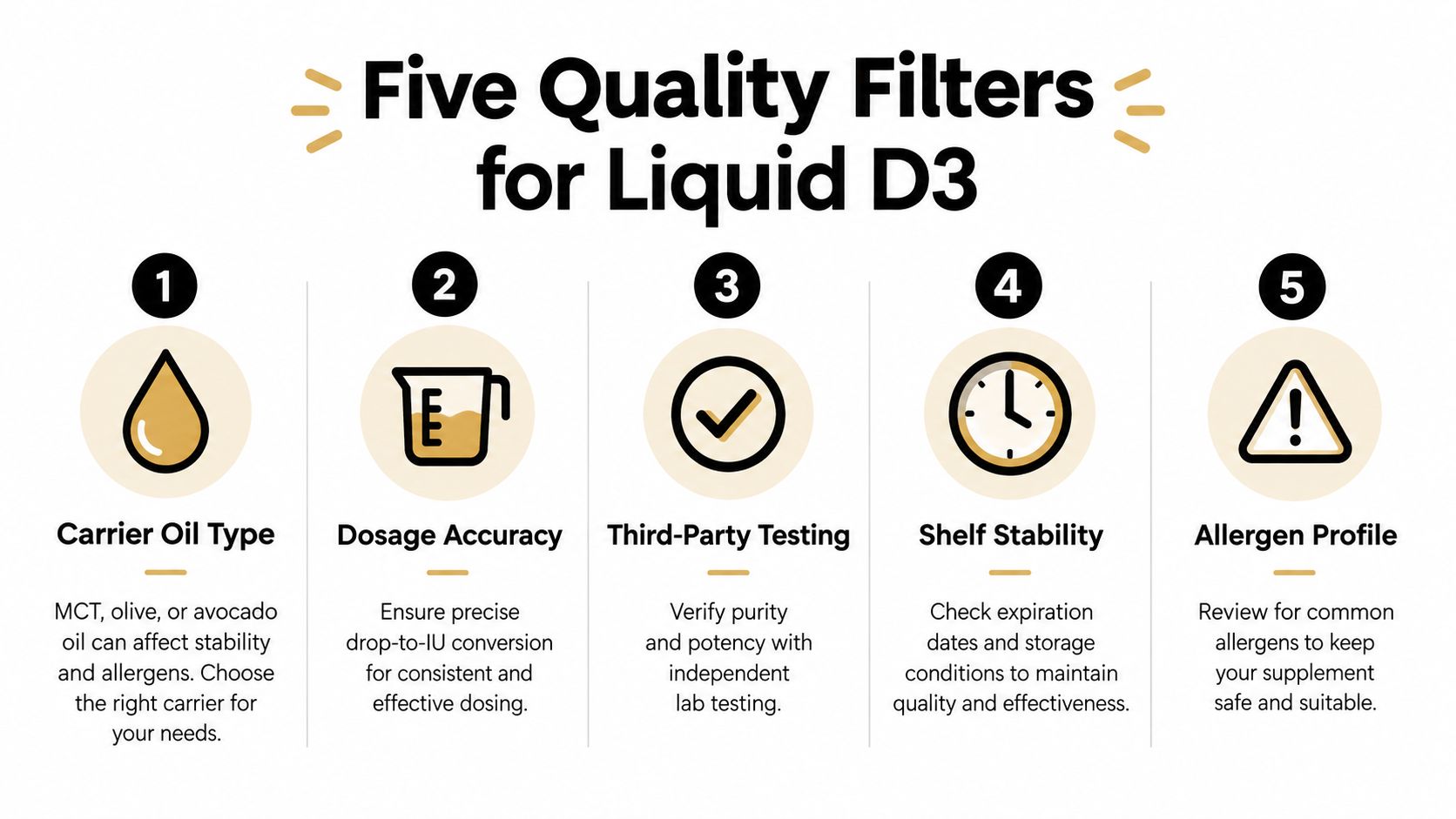
Inspect the dropper, not just the bottle
A 1 mL dropper and a 0.5 mL dropper don't necessarily produce the same number of drops. Tip opening, pressure, oil viscosity, and the angle of use all influence the physical drop. Some manufacturers reduce that ambiguity with marked droppers, oral syringes, or pre-measured sachets.
For a real-world comparison point, Supplemynts Inc D3 K2 drops can be reviewed for its listed format and directions, but the same verification process still applies: identify the carrier, serving definition, IU amount, and storage instructions rather than relying on the product category alone.
Red flags include a proprietary blend that conceals individual amounts, a missing expiration date, unclear child directions, and claims that drops cure a specific disease. Use this guide to reading supplement labels to check serving size, active ingredients, and warnings before you buy.
A Quick Pre-Purchase Checklist
You should be able to evaluate a bottle of liquid vitamin D3 drops in under a minute if you use the same sequence each time.
- Confirm the dose: Find IU per drop, or confirm exactly how the stated volume converts to drops.
- Check the tool: Make sure the bottle includes the marked dropper or syringe described on the label.
- Review the carrier: Look for MCT, olive, sunflower, avocado, or another named oil that fits your allergies and preferences.
- Verify testing: Look for third-party certification or an accessible batch Certificate of Analysis.
- Compare value correctly: Calculate cost per 1,000 IU, not merely cost per bottle. A larger bottle isn't automatically better value if the dose is difficult to measure.
- Inspect storage details: Note the expiration date and whether the manufacturer requires special storage.
- Plan the routine: Take the drops with a meal containing fat if that matches the product directions and your dietary needs.
- Screen for conflicts: Add the IU from other supplements and review medications with a pharmacist or clinician.
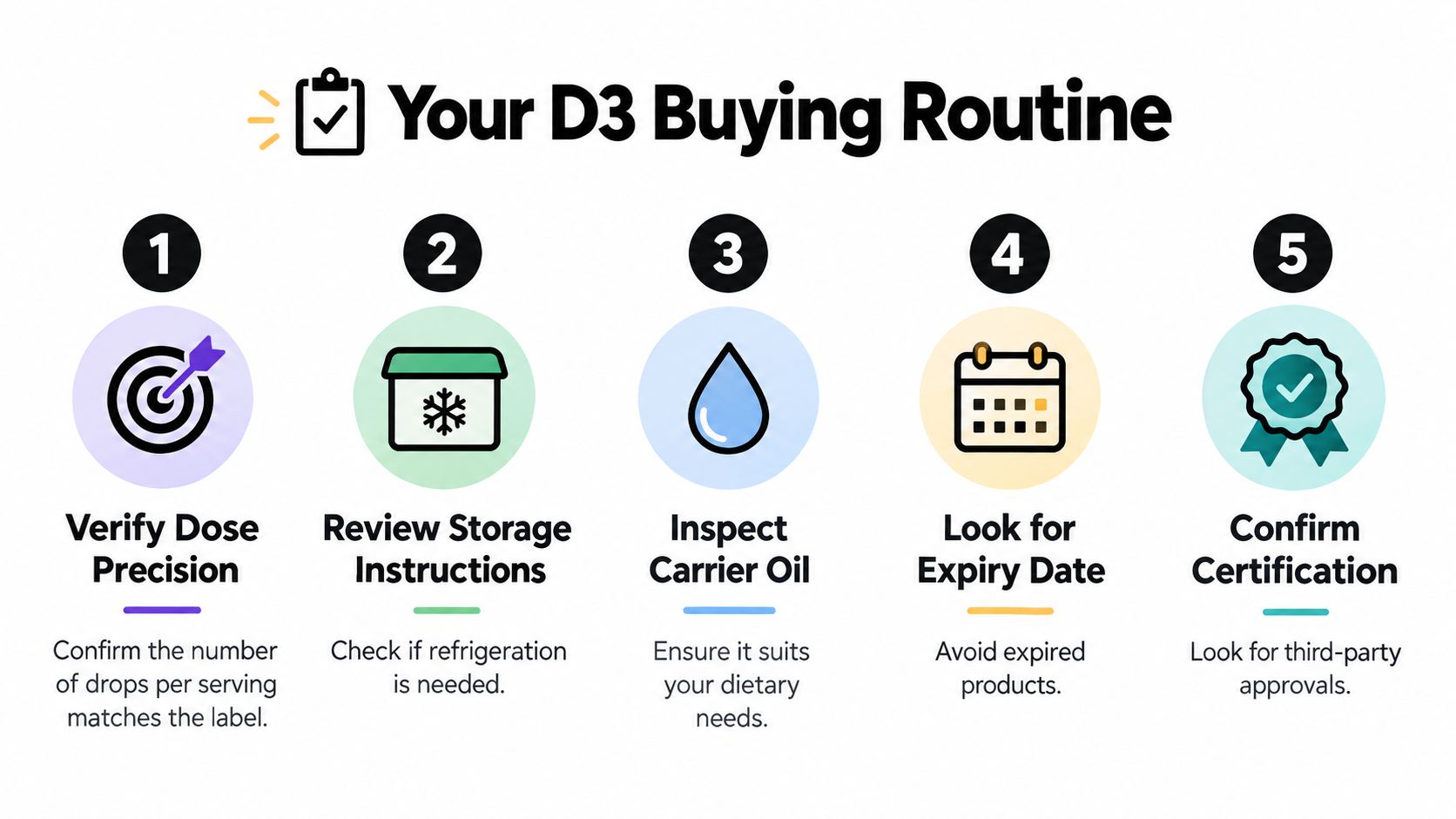
The central question isn't whether drops sound convenient. It's whether you can identify the actual IU in your intended number of drops, repeat that amount consistently, store the oil properly, and keep your total intake within a plan appropriate for you. If a label doesn't let you answer those questions, choose a clearer product or ask a qualified professional before starting.
NexiHerb LLC offers science-inspired dietary supplements for everyday wellness, including formulas with vitamins, minerals, botanicals, and other familiar ingredients. Visit NexiHerb LLC to review clearly presented options and nutrition guidance, then compare any vitamin D product with your dosing, medication, and storage needs.