

A familiar search often starts with a small annoyance. Your knee feels stiff after sitting, your hip complains on stairs, or your first few steps in the morning take longer to loosen up. You search for joint support and find an entire shelf of products labeled HA joint formula, while some pages discuss injections and others talk about facial serums. The shared ingredient name makes these products sound more interchangeable than they are.
An oral HA joint formula is a dietary supplement, not a clinic procedure. To judge one sensibly, you need to separate the route of delivery, understand what hyaluronic acid does in joint tissue, examine the oral evidence independently from injection research, and read the label for dose and molecular information. You'll also need realistic expectations about comfort, function, safety, and the role of supplements alongside movement and other ways to improve joint health naturally.
Table of Contents
- What an HA Joint Formula Is and Who It Is For
- How Hyaluronic Acid Works Inside a Joint
- A Short History of HA in Joint Care
- What the Clinical Evidence Actually Shows
- Reading an HA Supplement Label Like a Pro
- Typical Doses, Safety, and Who Should Be Cautious
- Comparing an HA-Only Formula with a Joint-Stack Formula
- Realistic Expectations and a Smart Buying Checklist
What an HA Joint Formula Is and Who It Is For
Hyaluronic acid, often shortened to HA, is a substance the body naturally uses in synovial fluid, cartilage, skin, and other connective tissues. An oral HA joint formula delivers HA in a capsule, tablet, powder, or liquid intended to complement the HA already involved in normal joint lubrication and tissue structure.
That description matters because a capsule on a shop shelf isn't the same thing as an injection. A clinician places injected HA directly into the joint space. A topical HA serum is applied to the skin and serves a cosmetic or skin-care purpose. An oral product must pass through digestion, and researchers are still studying how swallowed HA or its breakdown products could influence joint-related pathways.
Who tends to consider one
Adults commonly look at oral HA after noticing mild, activity-related stiffness, reduced ease of movement, or discomfort that appears after walking, exercising, or remaining in one position. Older adults may also be interested because joint tissues and synovial fluid change over time, although a supplement shouldn't be treated as a way to restore damaged cartilage.
Some shoppers choose HA because they want a non-drug option or can't tolerate certain anti-inflammatory medicines. Others add it to a broader routine that includes collagen, glucosamine, chondroitin, exercise, or physical therapy. Those are different goals, so the right product depends on whether you want a focused HA trial or a formula with several joint-support ingredients.
Practical rule: The words “hyaluronic acid” tell you what an ingredient is, not whether the product is oral, injected, topical, appropriate for your symptoms, or supported by the same evidence.
This article focuses on oral supplementation. It covers the molecule's role in a joint, the history behind its reputation, what oral and injected research says, how to interpret a label, and how to plan a careful trial. If pain is persistent, severe, swollen, associated with an injury, or limiting ordinary activity, a qualified healthcare professional should help identify the cause before you shop for supplements.
How Hyaluronic Acid Works Inside a Joint
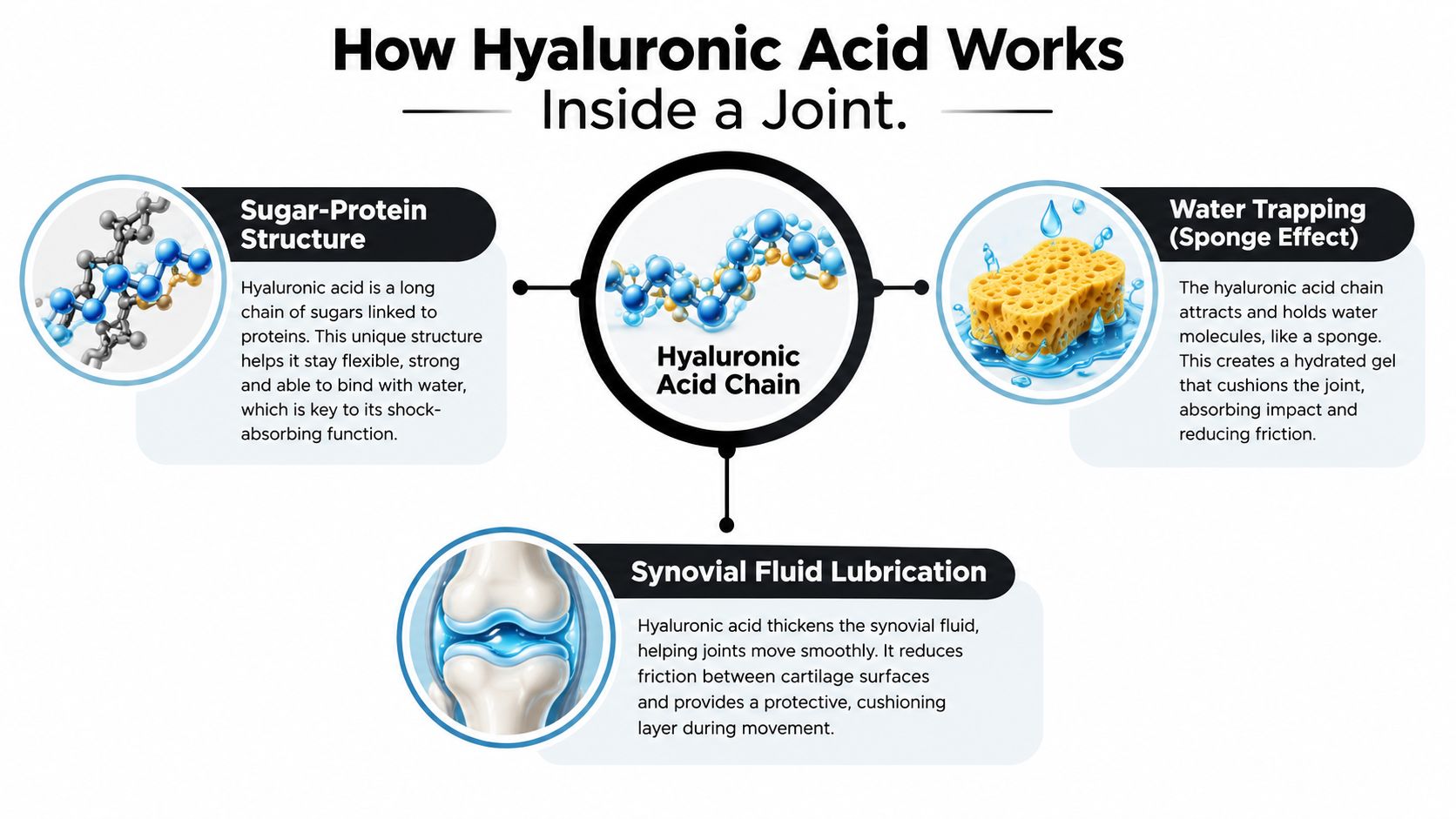
Think of HA as part of a water-holding cushion. Its long sugar-based chains can attract and retain water, much like a sponge. That hydrated structure contributes to the slippery quality of synovial fluid, helping joint surfaces move with less friction while also supporting the fluid's shock-absorbing behavior.
HA isn't floating in one isolated compartment. It is dissolved in synovial fluid, participates in the matrix around cartilage cells, and is produced by cells called synoviocytes that line the joint capsule. This arrangement helps explain why HA appears in joint formulas. The ingredient is connected to a real biological system involved in movement and cushioning, rather than being an arbitrary addition to a capsule.
The unresolved question after swallowing HA
A large molecule in a capsule doesn't easily travel intact from the stomach to the knee. Researchers have proposed several possible explanations for oral HA's effects:
- Intestinal handling: Some HA may be absorbed through intestinal routes, potentially as intact molecules or smaller fragments.
- Gut immune signaling: HA fragments may interact with receptors in gut-associated lymphoid tissue, which could influence broader biological signaling.
- Indirect support: Oral HA may provide building blocks or signals that affect the body's own production of HA in connective tissues.
These are mechanistic hypotheses, not proof that every oral product reaches a painful joint or rebuilds cartilage. Molecular weight, formulation, dose, and duration may all affect what happens after ingestion. The technical literature has linked low-molecular-weight oral HA in the 50 to 500 kDa range with better pain and physical-function outcomes in an eight-week randomized, double-blind, placebo-controlled trial, but that finding shouldn't be generalized to every HA ingredient on the market. The details are discussed in the research on molecular weight and oral HA.
Injected HA follows a different route and therefore raises different clinical questions. Readers comparing oral supplements with procedures may find an overview of coping with knee pain at Midwest Pain useful, provided they keep the distinction between a medical injection and an oral supplement clear.
One other product category illustrates why labels need careful reading. Argi-Max NexiHerb L-Arginine, L-Citrulline-DL-Malate, and beet root powder is a capsule dietary supplement containing amino acids and beet root powder, not an HA formula. Its ingredients and intended wellness use shouldn't be confused with a product designed to supply hyaluronic acid.
A Short History of HA in Joint Care
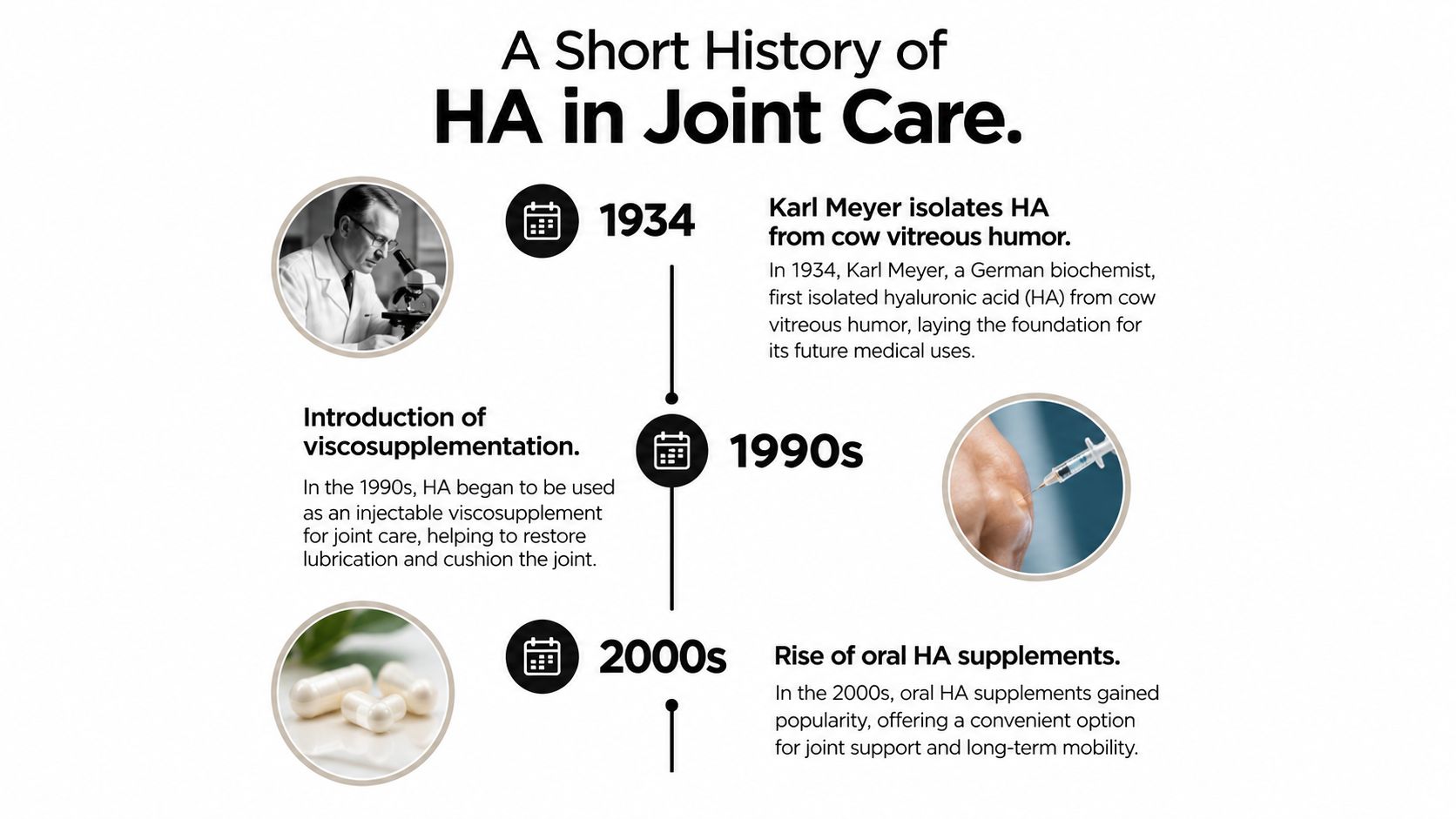
HA's credibility in joint care developed gradually. Karl Meyer and John Palmer first isolated it in 1934, establishing the substance as a subject of basic biochemical research. It was first used commercially in 1942, showing that the molecule could move beyond the laboratory into practical applications. The American Journal of Roentgenology review of HA's joint-care history documents this progression.
The next important step involved the joint itself. Researchers first tested HA in arthritic animal joints in 1970, and the first reported human intra-articular use followed in 1974. These milestones helped connect HA's chemistry with synovial fluid, cartilage, and the mechanical experience of joint movement.
From laboratory substance to medical market
The major commercial turning point arrived in 1997, when the U.S. Food and Drug Administration approved Hyalgan, the first FDA-approved viscosupplement. That approval marked the beginning of the modern joint-injection market and gave HA a recognized role in a medical intervention for knee osteoarthritis.
The timeline doesn't prove that every later HA product works equally well. It does show why consumers recognize the ingredient today. HA moved from isolation and commercial use, through animal and human joint testing, to a regulated injection category over roughly six decades. The 1970s and 1990s were especially important because they connected biological plausibility with clinical use and commercial availability.
Oral HA developed along a parallel path. Supplement makers later used different molecular weights and delivery formats, while researchers tested whether swallowed HA could support comfort or function without placing the substance directly inside the joint. That question remains separate from the history of injections, even though both products use the same broad ingredient name.
What the Clinical Evidence Actually Shows
The most important evidence lesson is simple: injected HA and oral HA shouldn't be treated as one intervention. An injection places HA inside the joint. An oral formula depends on digestion, absorption, molecular handling, and downstream biological effects. Negative findings about one route don't automatically answer whether a capsule helps.
The injection debate
A 2026 Australian Prescriber review summarized a main analysis of 24 placebo-controlled trials involving 8,702 participants. It found that intra-articular HA produced a 2.0 mm reduction in pain on a 100 mm visual analogue scale at three months, a difference the review characterized as clinically irrelevant. The review also discussed potential harms. Those results explain why headlines about HA injections can sound discouraging.
They don't mean every clinician reaches the same conclusion for every patient. The verified evidence also describes recent expert consensus supporting injected HA for selected people with knee osteoarthritis. The practical interpretation is that injection decisions require diagnosis, symptom severity, previous treatment response, and a clinician's assessment. An oral capsule shouldn't inherit either the promise or the criticism of an injection automatically.
The oral evidence
The oral literature is mixed, but the direction is more favorable than the injection headlines suggest. A 2024 review found improvements in pain, stiffness, function, or quality of life in 9 of 11 studies, and concluded that about 80% of the analyzed studies showed symptom benefits with minor side effects. The review covered oral HA products across differing doses and study designs, so the result supports interest in oral HA without establishing a universal formula or guaranteed response. See the review of oral and injected HA evidence for the route-specific comparison.
| Factor | Injected HA, knee OA | Oral HA |
|---|---|---|
| Delivery route | Placed directly inside the joint by a clinician | Taken by mouth as a supplement |
| Main evidence signal | Large placebo-controlled evidence base with a small average pain difference in the cited analysis | Several studies report improvements, but protocols and outcomes vary |
| What the evidence doesn't establish | A predictable, clinically important benefit for every patient | That every capsule reaches the joint intact or changes disease progression |
| Shopper's takeaway | Discuss as a medical treatment option | Evaluate dose, molecular weight, ingredients, and a measured trial |
The plain-language conclusion is neither “HA works” nor “HA is useless.” Oral HA may offer a modest improvement in comfort or function for some adults, while the evidence doesn't show that it repairs advanced joint damage or guarantees relief. Readers who want broader context on supplements can also consult this guide to joint support supplements, then return to the label and route of delivery rather than relying on the ingredient name alone.
Reading an HA Supplement Label Like a Pro
A label can answer more useful questions than the front of a bottle. Start with the ingredient panel, then work through four checkpoints: molecular weight, daily amount, delivery format, and formula design.
Check the molecular information
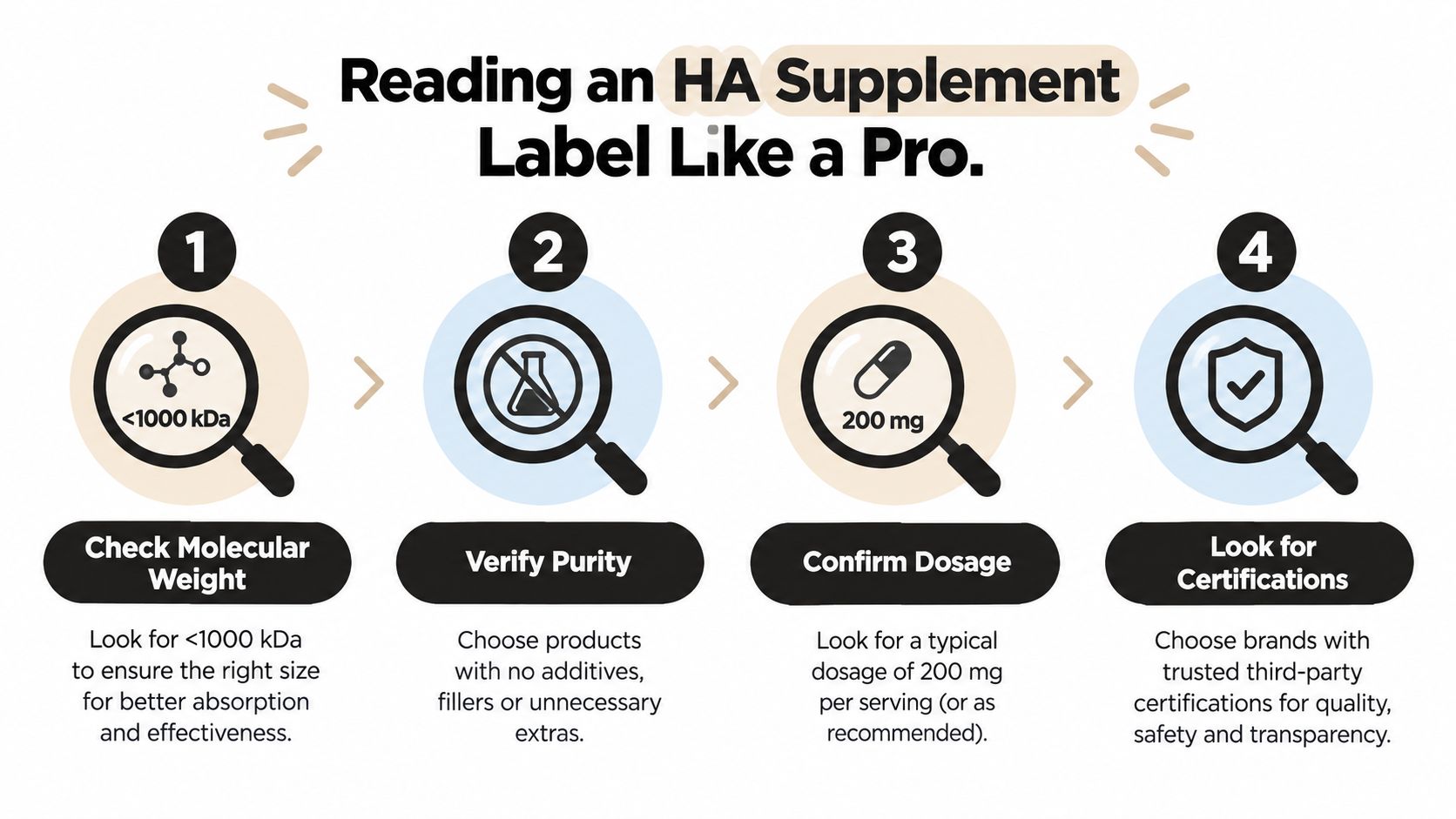
Molecular weight is often expressed in kilodaltons, or kDa. The oral research includes low-molecular-weight HA, including a cited range of 50 to 500 kDa, while the market also contains products that don't disclose molecular weight at all. A disclosed specification gives you more information than a vague claim such as “advanced HA.”
Don't assume that a higher number is automatically better. HA's behavior depends on structure and context, and the evidence doesn't justify treating one molecular-weight band as a guarantee of absorption or results. If a label gives no molecular-weight information, record that as an uncertainty rather than filling in the gap with marketing language.
Confirm the daily HA amount
Look for the actual HA amount per serving and calculate how much you would take per day. Oral studies reviewed in the literature have used doses ranging from 30 to 300 mg per day, while other studies used 48 to 60 mg daily for periods ranging from two weeks to two months. Those figures describe research protocols, not a prescription for every shopper.
Next, identify whether the serving requires one capsule, multiple capsules, a tablet, powder, or liquid. A convenient format may improve consistency, but convenience alone doesn't prove better clinical performance. Read the suggested use and compare it with the amount listed in the Supplement Facts panel.
Separate HA from the rest of the stack
Some formulas combine HA with collagen peptides, glucosamine, chondroitin, MSM, curcumin, or boswellia. That may suit someone who wants a broad routine, but it makes it harder to identify which ingredient relates to a change in symptoms. A product that lists a long blend without individual amounts also limits your ability to compare it with the research.
For a deeper lesson in serving sizes, proprietary blends, and inactive ingredients, use this guide on how to read supplement labels. A transparent label won't remove uncertainty, but it lets you make a more informed comparison between products.
Typical Doses, Safety, and Who Should Be Cautious
The oral HA studies described in the evidence base used a broad range, from 30 to 300 mg daily. That range is a reference point for label comparison, not a reason to take more than the product directs. Follow the serving instructions, take the product consistently, and avoid treating a larger dose as a shortcut to better results.
The oral review discussed earlier described side effects as minor. Even so, supplements can cause individual reactions, and a new product can make it difficult to identify which ingredient is responsible if the formula contains several compounds. Stop and seek medical advice if you experience a concerning reaction rather than trying to push through it.
Questions to ask before starting
A pharmacist or clinician should review the product with you if you:
- Use anticoagulants: Ask whether the full ingredient list fits with your medicines, especially if the formula includes botanicals or other joint-support compounds.
- Have a known allergy: Check whether the HA source is disclosed and ask about avian-derived materials or other relevant sources.
- Are pregnant or breastfeeding: Professional guidance is appropriate because supplement research may not cover your situation adequately.
- Have an upcoming joint procedure: Tell the clinician who is managing the procedure about every supplement you take.
- Take diuretics or manage fluid balance: HA is sometimes discussed in relation to fluid retention, but evidence for meaningful interactions is limited. A clinician can assess your individual medicines and health history.
These precautions don't mean oral HA is dangerous. They reflect the difference between a generally healthy adult trying a labeled supplement and someone whose medication, allergy, pregnancy, procedure, or medical condition changes the risk calculation.
Keep the trial measurable
Choose one or two outcomes before you begin. You might track how stiff you feel after sitting, how comfortable a regular walk feels, or whether stairs are easier. Don't change several supplements at the same time if you want to learn whether HA made a difference.
A careful trial asks, “What changed in my daily function?” rather than “Does this bottle promise joint repair?”
Persistent swelling, pronounced warmth, sudden loss of movement, or pain after an injury deserves medical evaluation. An HA supplement shouldn't delay a diagnosis.
Comparing an HA-Only Formula with a Joint-Stack Formula
The choice between a focused HA product and a broader joint stack depends on the question you want the supplement to answer. An HA-only formula makes it easier to evaluate HA on its own. A stack may be more convenient when you already want several ingredients, but a change in comfort won't tell you which component helped.
The distinction is practical, not ideological. Someone seeking a simple experiment may prefer a clearly disclosed HA amount and minimal extras. Someone who wants to combine cartilage-oriented ingredients and botanical compounds may accept a more complex formula, provided the label lists meaningful amounts rather than hiding everything inside a proprietary blend.
| Factor | HA-only formula | Joint-stack formula |
|---|---|---|
| Main purpose | Focused trial of oral hyaluronic acid | Combined approach using HA with other joint-support ingredients |
| Ingredient clarity | Easier to connect a change with HA | Harder to identify which ingredient influenced the result |
| Best fit | Shoppers prioritizing a simple label | Shoppers who already want several complementary ingredients |
| Main limitation | Doesn't cover every ingredient category | Individual amounts may be smaller or less clearly disclosed |
| Buying question | Is the HA amount and molecular information transparent? | Are all active ingredients listed with useful serving details? |
A joint stack can include collagen peptides, glucosamine, chondroitin, MSM, curcumin, or boswellia. Before combining products, check for duplicated ingredients and ask a professional about medicine interactions. This comparison of glucosamine, HA, chondroitin, and MSM can help clarify why multi-ingredient labels require closer inspection.
For example, Joint Care Complex NexiHerb Glucosamine & Chondroitin Complex is an adult capsule product containing glucosamine sulfate potassium, chondroitin sulfate, botanical extracts, and MSM. Its listed serving is three capsules, with glucosamine sulfate potassium, boswellia extract, chondroitin sulfate, turmeric extract, quercetin, L-methionine, MSM, and bromelain. It is not an HA-only product, so it belongs in a different comparison category.
Supplements also aren't the only non-procedural option. Some people explore supportive equipment, activity changes, or gentle compression for joint pain as part of a wider comfort routine. Match the intervention to your goal, and don't expect a capsule to replace assessment, strength work, or treatment for a diagnosed condition.
Realistic Expectations and a Smart Buying Checklist
Oral HA is best approached as a trial for symptom support, not as a promise of cartilage restoration. The oral evidence includes favorable findings, but it also varies by product, molecular weight, dose, joint, and outcome. A person may notice easier movement or less stiffness, while another may notice no meaningful change.
Build the trial around daily life. Gentle movement, progressive strength work suited to your ability, weight management where relevant, adequate hydration, and appropriate clinical care may matter more than any single bottle. If symptoms are worsening, identify the cause instead of repeatedly changing supplements.
What to verify before buying
- Disclosed HA amount: Find the amount per serving and calculate the daily intake.
- Molecular-weight information: Prefer a product that tells you what type of HA it uses rather than leaving the specification unclear.
- Complete formula: Check whether the product is HA-only or combines HA with collagen, glucosamine, chondroitin, MSM, curcumin, or botanicals.
- Testing and transparency: Look for clear manufacturing information, batch or quality documentation where available, and contact details for the brand.
- Serving practicality: Confirm how many capsules, tablets, or spoonfuls the daily serving requires.
- Value per day: Compare the cost of the instructed daily serving, not just the bottle size.
- Personal fit: Review allergies, medicines, pregnancy or breastfeeding status, and planned procedures with a healthcare professional when relevant.

Give the product enough time for a fair assessment based on its labeled directions and the study designs behind oral HA. Keep a baseline note before starting, record your selected symptom or function measures, and reassess after a sustained period rather than judging the first capsule. If the result isn't meaningful, don't renew automatically. Discuss alternatives with a clinician, especially when pain affects sleep, walking, work, or ordinary activities.
The most useful buying decision is therefore not “Which HA claim sounds strongest?” It's “Which route am I evaluating, what does the label disclose, what outcome will I track, and when will I stop if it doesn't help?” That approach keeps oral HA in its proper place, as one possible tool for joint comfort rather than a substitute for diagnosis or care.
NexiHerb LLC offers science-inspired dietary supplements across areas that include joint care, amino acids, herbal blends, omega-3s, and everyday wellness. Visit NexiHerb LLC to review clearly labeled options and choose a formula that fits your joint-support routine and broader health habits.