

You turn off the lights, put your phone down, and discover that your body is tired while your brain is still running tomorrow's meeting, unfinished tasks, and every unresolved worry. That experience can feel like a failure to relax, but it often reflects stress-driven arousal, not a lack of willpower.
Cortisol is part of that picture. When evening stress keeps the hypothalamic-pituitary-adrenal, or HPA, axis active, the body may stay alert when it should be preparing for sleep. Phosphatidylserine, often shortened to PS, is interesting because it may help regulate that stress response rather than act like a conventional sedative.
This distinction matters. The evidence for phosphatidylserine for sleep is developing, and it includes both potential benefits and reports of insomnia. The practical question isn't just whether PS "works." It's whether your sleep difficulty appears to be driven by stress hormones, or by a different problem such as delayed circadian timing or difficulty initiating sleep. This guide explains the mechanism, the human evidence, cautious timing, safety questions, and a decision process you can use before adding it to your routine. For broader context, compare PS with other stress support supplements, but keep the central principle in mind: a stress modulator isn't automatically a sleep drug.
Table of Contents
- When Your Mind Won't Power Down
- What Phosphatidylserine Actually Does
- What the Research on Sleep Really Shows
- Who Is Most Likely to Benefit
- How to Dose and Time It for Sleep
- Safety, Side Effects, and Interactions
- How to Choose a Quality Supplement
- Putting It All Together Tonight
When Your Mind Won't Power Down
At bedtime, your muscles may feel loose, your eyes may grow heavy, and your mind still keeps running through a conversation, tomorrow's presentation, an unpaid bill, or the sound of your own heartbeat. That extra layer of worry can keep the body from settling.
Hyperarousal describes that state well. The HPA axis, which links the hypothalamus, pituitary gland, and adrenal glands, helps manage the stress response. Cortisol helps during the day because it supports alertness and energy mobilization. At night, when stress signaling stays active, the body can act as if it is still on call instead of preparing for sleep.
A better model is an over-sensitive alarm system. It should warn you during a real emergency, then quiet down once the danger passes. If it keeps reacting after the situation is over, the house never feels still. Evening cortisol can behave in a similar way, keeping the body prepared for action when it should be easing into rest.
That does not make cortisol the only explanation for insomnia, and it does not mean PS acts like melatonin or a direct sedative. A 2025 review on dietary protocols for restful sleep noted that direct dietary intervention studies on PS and sleep were still lacking. The review discussed a possible role in cortisol regulation and neurochemical balance, which is a plausible mechanism, not proof that PS helps every sleep problem.
The practical question: Is the main issue an overactive stress response, or is sleep simply arriving at the wrong biological time?
That distinction matters because the next step depends on the cause. If you feel wired, ruminate at night, or wake with stress still humming in the background, PS may be worth considering. If your difficulty is more about a delayed sleep schedule, restless legs, medication effects, or another medical issue, lowering cortisol is unlikely to solve the whole problem. For a broader overview of stress support supplements, see stress support supplements.
What Phosphatidylserine Actually Does
Phosphatidylserine is a phospholipid, a fat-like component of cell membranes, including those in the nervous system. These membranes do more than contain cells. They help organize communication and shape how receptors respond to incoming signals.
At the membrane level, phosphatidylserine helps organize receptor signaling and may modulate how strongly cells respond to cortisol feedback within the HPA axis. Cortisol carries information about the body's stress state. PS does not erase that message. Its proposed role is to help the system register the feedback that tells the stress response when to ease.
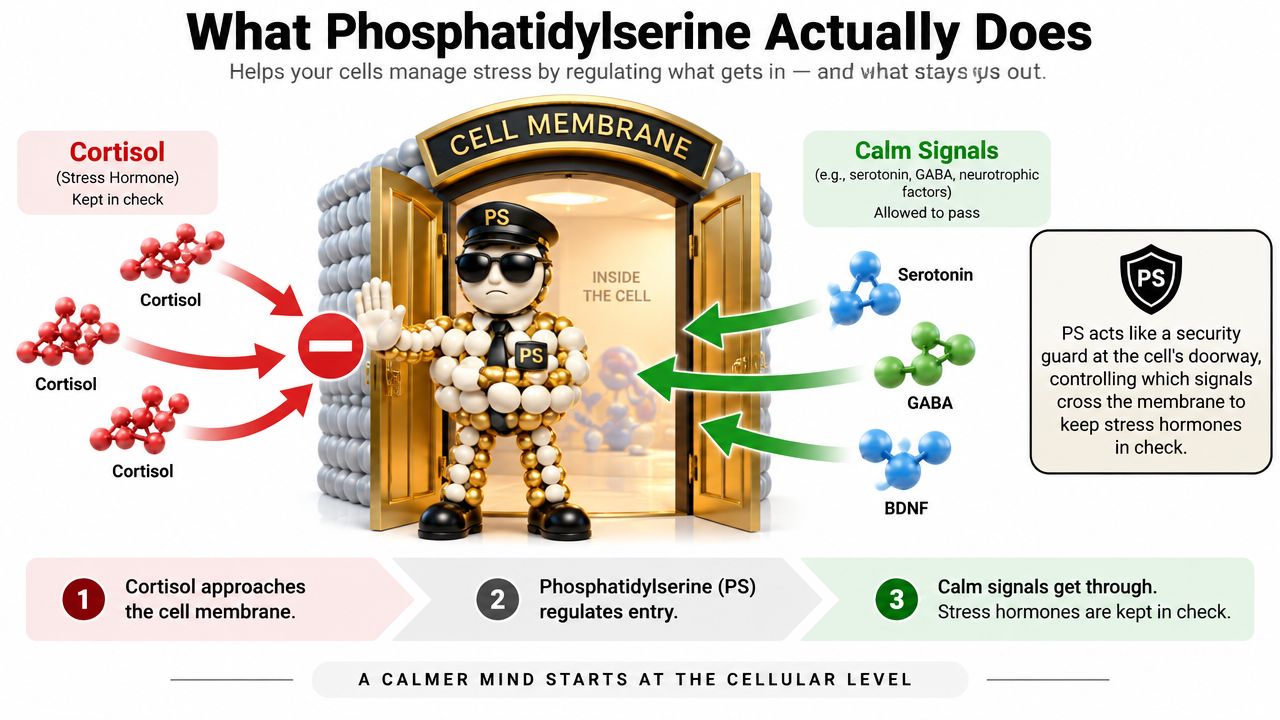
The cortisol feedback loop
Cortisol normally follows a daily rhythm. Levels are generally higher earlier in the day, supporting alertness, and taper as evening approaches. Psychological stress, demanding training, illness, or inadequate recovery can disturb that pattern. For sleep, the concern is not just “high cortisol.” It is cortisol arriving at the wrong time, when the brain and body should be reducing alerting signals.
PS may influence this process by helping the HPA axis respond to cortisol's negative feedback. In plain language, the brain may receive a clearer signal that the stress response has completed its task and can begin to settle. A peer-reviewed review of PS and cortisol regulation summarized research in older adults with major depression who took PS with omega-3 polyunsaturated fatty acids three times daily for twelve weeks. The combination reduced basal cortisol and regulated the daily rhythm of salivary cortisol. The authors connected lower HPA-axis activation with better sleep quality, but the specific population and combined formula do not establish a universal effect from PS alone.
PS also contributes to membrane structure and may affect signaling involving acetylcholine and dopamine. These neurotransmitters support attention, movement, motivation, and sleep-wake regulation. That role does not make PS equivalent to a GABA agonist or hypnotic medication.
Why PS isn't a conventional sedative
Melatonin mainly provides timing information to the circadian system. GABA-acting sedatives increase inhibitory signaling and can create a direct calming or drowsy effect. PS works further upstream. Its proposed function is to help regulate the stress command system that may be keeping the brain alert.
The practical distinction is straightforward. Someone whose mind races after a stressful day may feel more settled if excessive stress signaling is moderated. Someone whose sleep onset is delayed by bright evening light may notice little, because the main problem is timing rather than cortisol regulation. The Maxi Vir NexiHerb Herbal Dietary Supplement – Botanical Blend for Male Wellness & Vitality Support is a separate adult men's wellness formula containing traditional botanical extracts, not a phosphatidylserine sleep product, so it should not be treated as interchangeable with PS.
What the Research on Sleep Really Shows
The research points in a useful direction, but it does not make phosphatidylserine a sure-fire sleep aid. The clearest pattern is that PS may help when sleep loss is tied to stress physiology, especially when the body stays too “switched on” at night.
The 2025 dietary review discussed earlier set an important boundary. The authors did not find direct dietary intervention studies on PS and sleep in their review, even though they considered cortisol regulation and neurochemical balance plausible routes. That matters because a plausible mechanism is not the same thing as a sleep trial with direct outcomes.
A separate review summarized work in older adults with major depression who took PS with omega-3 PUFAs three times daily for twelve weeks. In that study, basal cortisol fell and the salivary cortisol rhythm became more regulated, which the authors associated with better sleep quality. The catch is simple. That was a combined intervention in a specific clinical group, so it cannot be read as proof that PS alone will help a healthy adult fall asleep.
The most direct sleep signal comes from a clinical thesis in adults aged 20 to 69 years with insomnia. PS alone improved sleep quality versus placebo by day 8, with p = 0.016, and the effect was stronger by day 15, with p < 0.001 (Cleveland Clinic drug monograph and related clinical evidence). The same study found no extra sleep-quality benefit when PS was combined with another sleep-aid supplement compared with the sleep aid alone. That pattern suggests PS may matter most when it matches the problem, not when it is stacked onto a formula without a clear reason.
| Study | Population | Daily dose | Duration | Sleep-related finding |
|---|---|---|---|---|
| Dietary protocol review | Review of dietary strategies and mechanisms | Not established for a direct PS sleep intervention | Not applicable | PS may support sleep indirectly through cortisol regulation and neurochemical balance |
| Cortisol-rhythm study summarized in a peer-reviewed review | Older adults with major depression | PS with omega-3 PUFAs, taken three times daily | 12 weeks | Lower basal cortisol and regulated salivary cortisol rhythm, linked by authors to better sleep quality |
| Randomized clinical thesis | Adults aged 20 to 69 years with insomnia | PS alone, dose not specified in the verified summary | Results reported by day 8 and day 15 | Sleep quality improved versus placebo, while adding PS to another sleep aid produced no additional difference |
There is one caution that keeps the picture honest. The Cleveland Clinic monograph also lists insomnia as a possible side effect of PS. That is why PS should be viewed as a stress-cortisol modulator, not a blanket sedative. For a broader comparison with another sleep supplement approach, see ZMA for sleep.
Who Is Most Likely to Benefit
PS makes the most sense when the sleep problem resembles a stress-response problem. Start by observing what happens during the hour before bed, rather than judging your sleep only by the time it takes to fall asleep.
You may be a reasonable candidate if your evening includes mental replay, physical tension, sudden alertness, or repeated thoughts about responsibilities. Another clue is that sleep worsens during demanding work periods, emotionally difficult weeks, or intense training, then improves when the pressure eases. These patterns fit PS's proposed role because the supplement is aimed at stress signaling, not at forcing the brain into unconsciousness.
Older adults may also have a relevant profile when age-related changes in cortisol rhythm contribute to nighttime alertness. The available review evidence involving older adults and major depression concerns a combined PS and omega-3 intervention, so it shouldn't be generalized to every older sleeper. Still, it illustrates why researchers focus on cortisol timing when studying sleep and later life.
Athletes and high-volume trainees should be cautious about assuming that a physically stressful day guarantees a PS response. Training load, energy intake, pain, room temperature, and schedule can all affect sleep. PS may be worth discussing when recovery stress and post-training alertness are central features, but performance-related evidence doesn't automatically prove better sleep.
| Sleep profile | Cortisol-driven? | PS suitability |
|---|---|---|
| Rumination and “wired but tired” evenings | Plausible | Potentially suitable, with cautious monitoring |
| Stress-related night waking | Plausible | Worth discussing with a clinician |
| Delayed sleep schedule or late-night light exposure | Not necessarily | Less likely to be the first choice |
| Restless legs or uncomfortable limb sensations | Not necessarily | Needs a different evaluation |
| Sleep disruption after a new medication | Unclear | Review the medication first |
| Expectation of immediate sedation | Usually not the right match | Likely to disappoint |
Ask yourself: Does stress keep me alert, or do I remain awake because my biological sleep window has not arrived? If the second description fits better, work on light exposure, schedule consistency, and clinical evaluation before treating PS as the answer.
How to Dose and Time It for Sleep
If your evenings feel keyed up, phosphatidylserine is usually approached as a stress-related sleep aid, not as a sedative. Cleveland Clinic guidance places it around 100 to 200 mg at bedtime (Cleveland Clinic guidance on phosphatidylserine timing and sleep). That range is useful because PS is meant to help quiet stress signals, not force sleep the way a sleeping pill might.
The logic is simple. Cortisol should taper as night approaches, but when stress keeps that signal high, the brain can stay in “daytime alert” mode. PS is studied more as a way to soften that stress response than as a direct sleep inducer, so more product does not automatically mean better sleep.
Start low and keep the timing steady. Take it in the evening and notice whether you feel calmer, unchanged, or oddly more alert. The Cleveland Clinic monograph lists insomnia as a possible side effect, and a clinical-style summary suggests sleep trouble may be more likely above 300 mg, so a higher dose is not a safer bet for sleep.
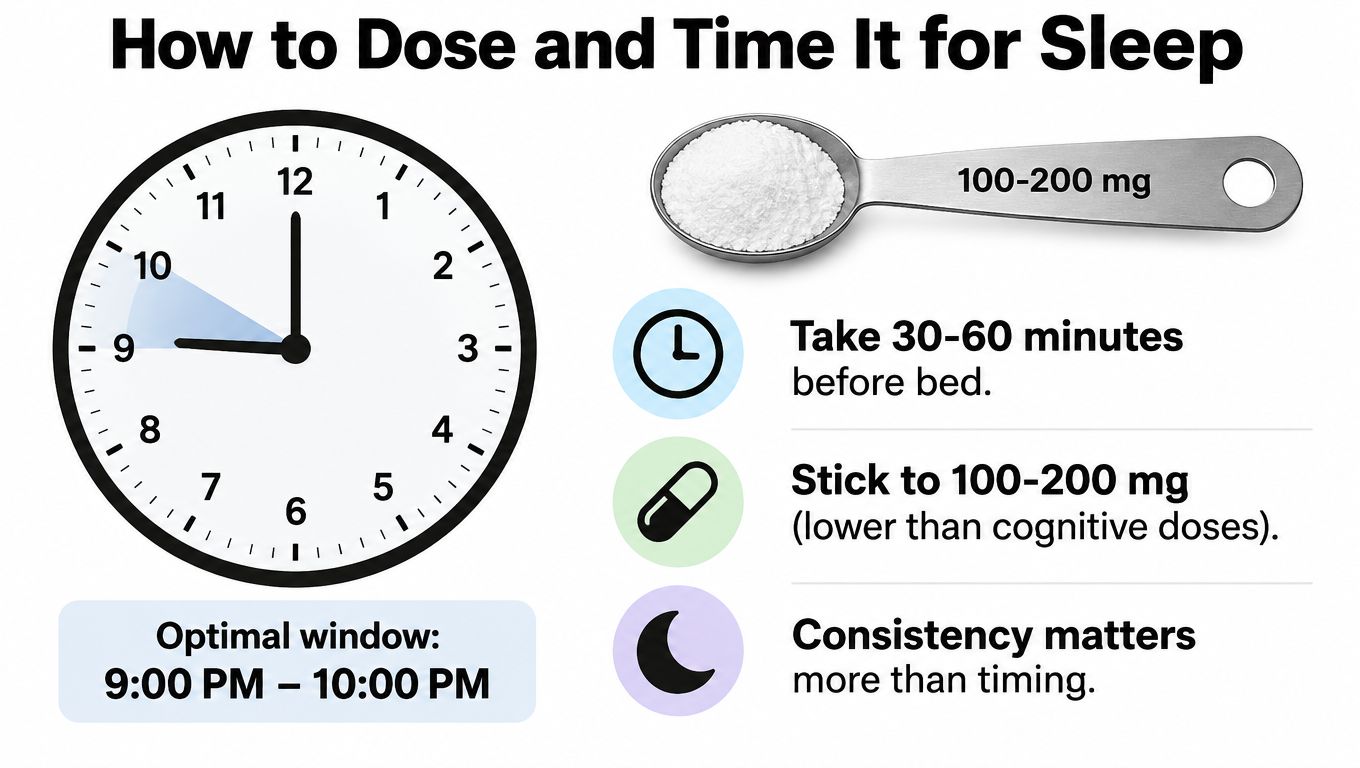
Build a testable evening routine
Keep the trial consistent. Changing the dose every night makes it harder to tell whether PS is helping, doing nothing, or making you feel more activated. A short log helps, especially if you track when you took it, how long it took to fall asleep, any night waking, and how you felt in the morning.
Pair the trial with habits that reduce competing signals:
- Reduce stimulation: Set a caffeine cutoff in the early afternoon and avoid turning bedtime into a second work session.
- Lower light exposure: Dim overhead lighting in the evening so your environment supports the body's normal transition toward sleep.
- Create a short landing routine: Use a brief wind-down such as light reading, slow breathing, or gentle stretching.
- Protect the bedroom: Keep the room cool, dark, and quiet when possible.
- Review the wider plan: For more non-drug approaches, these natural insomnia treatment options provide useful context.
PS can be taken with or without food. If it upsets your stomach, a meal may help. Judge it by your actual sleep pattern, not by one unusual night. If your problem is stress-driven, PS may fit. If your sleep onset problem is mostly about schedule, light, or a delayed body clock, it is less likely to be the right first move.
Safety, Side Effects, and Interactions
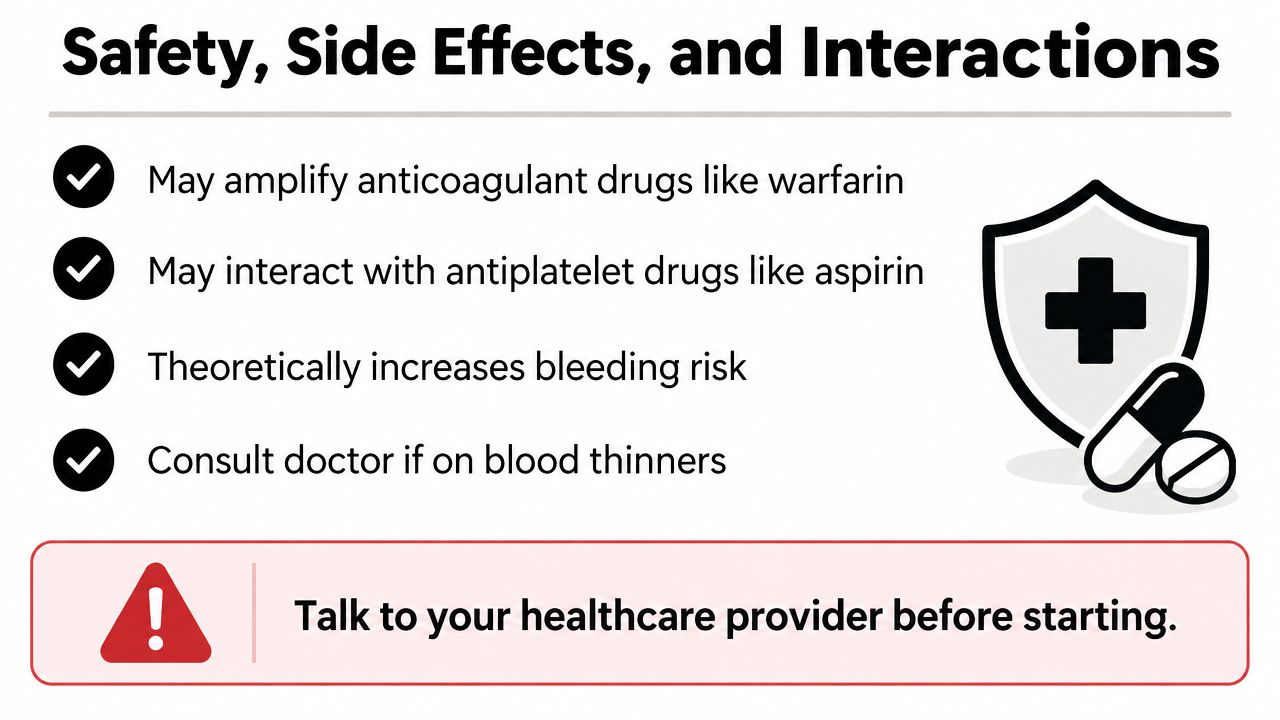
PS deserves the same medication review as any supplement that may influence physiology. Cleveland Clinic lists insomnia among its possible side effects, which means a sleep-focused user should watch for the opposite of the intended result. Mild digestive upset and headaches may also occur, and sensitivity can vary with formulation, timing, and dose.
The most important medication question concerns bleeding risk. PS may amplify the effects of anticoagulant or antiplatelet medicines such as warfarin and aspirin, at least theoretically. If you use blood thinners, don't begin PS without discussing the product and dose with your prescriber.
Medication check: Bring the exact supplement label to a pharmacist or clinician. “It's only a supplement” isn't enough information for an interaction review.
Potential interactions also deserve attention if you take anticholinergic medicines for overactive bladder, or medicines that affect acetylcholine signaling, including some antidepressants and Parkinson's drugs. The concern is not that every combination will cause harm. The concern is that the medication context may change how you respond, and a professional can assess that context more accurately than a generic label.
Stop and reassess if your sleep worsens
Reduce the dose or stop the trial and seek guidance if you notice:
- Bedtime activation: You feel wired, restless, or mentally sharper after taking PS.
- Unusual dreams: Vivid dreams appear consistently after starting or increasing it.
- Morning sluggishness: You wake feeling unusually heavy or impaired.
- Digestive symptoms: Stomach discomfort persists rather than settling.
- Bleeding concerns: You notice unusual bruising or bleeding, especially while taking anticoagulant or antiplatelet medication.
Pregnancy, breastfeeding, and childhood use lack sufficient safety data. Those groups shouldn't use PS without individualized medical guidance. Anyone with persistent insomnia, severe anxiety, loud snoring, breathing interruptions, or major daytime impairment should also look beyond supplements and arrange an appropriate evaluation.
How to Choose a Quality Supplement
The front of a PS bottle tells you less than the Supplement Facts panel. Start by identifying the actual phosphatidylserine amount per serving, not just the total weight of a phospholipid blend. A product that hides PS inside a proprietary blend makes it difficult to compare with the bedtime range used in medical guidance.
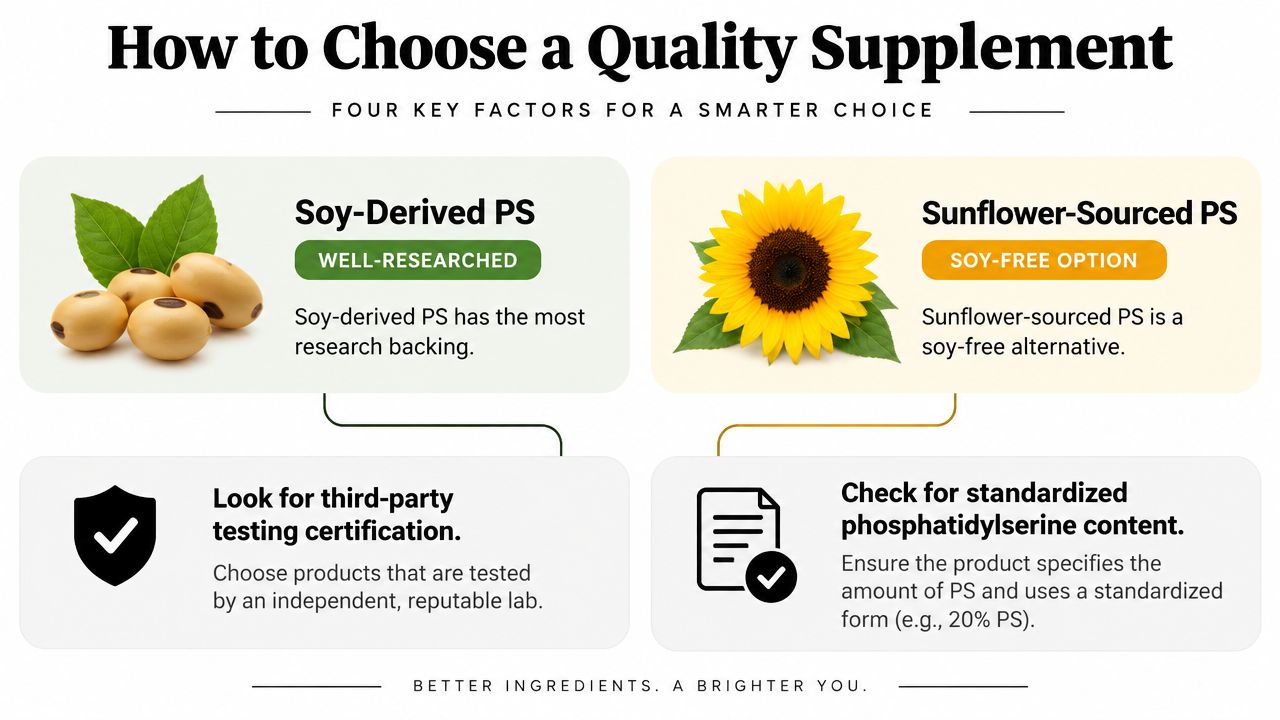
Sourcing is another practical consideration. Soy-derived PS appears frequently in the research literature, while sunflower-derived PS provides a soy-free alternative for people who avoid soy or have a relevant allergy. Neither source should be treated as automatically superior. What matters is clear labeling, a meaningful active amount, and manufacturing controls.
A label-reading checklist
- Confirm the active ingredient: Look for phosphatidylserine stated separately from total phospholipids.
- Check concentration: A higher percentage of active PS makes the label easier to interpret than a diluted lecithin formula.
- Reject opaque blends: You should be able to see how much PS you receive in each capsule or serving.
- Review the source: Note whether the product uses soy or sunflower and check for allergen information.
- Look for independent testing: Certifications from organizations such as USP, NSF, or Informed Choice can provide additional quality information when applicable to the product.
- Inspect added ingredients: Avoid unnecessary stimulants, artificial colors, or ingredients that could work against evening use.
- Compare effective servings: Compare the cost of a clearly labeled 100 mg serving, not merely the cost per capsule.
A transparent label doesn't prove that PS will improve your sleep, but it lets you run a fairer personal trial. If the capsule contains several stimulating botanicals, you won't know whether the response came from PS or from the rest of the formula. For more help decoding serving sizes, blends, and ingredient order, use this guide on how to read supplement labels.
Also check storage instructions, allergen statements, lot information, and the manufacturer's contact details. A quality decision is less about a flashy promise and more about whether you can identify what you're taking and reproduce the same routine from one evening to the next.
Putting It All Together Tonight
Treat PS as a stress-regulation experiment, not a sleep switch. A simple plan helps you see whether the problem is a mind that stays “on” after a stressful day, or sleep that is hard to start for other reasons.
If stress seems to be the driver, start by naming the pattern. Is it rumination, a wired body, waking up in the middle of a tense week, or delayed sleep timing? That matters because PS is better framed as a cortisol modulator than as a sedative. Cortisol is the body's alertness signal. When that signal stays high at night, sleep can feel like a phone that never fully enters sleep mode.
If a clinician says PS is appropriate, begin conservatively with 100 mg in the evening. Cleveland Clinic guidance supports a bedtime range of 100 to 200 mg for stress-related sleep difficulty as cited earlier. Keep the rest of the evening steady, dim lights, reduce caffeine earlier in the day, and keep the bedroom cool and dark. Consistency makes the trial easier to read.
Track sleep onset, night waking, morning energy, and how stressful the day felt. If sleep improves during stressful weeks without a groggy, sedated feeling, that is a useful sign of fit. If the pattern worsens, stop or lower the dose instead of increasing it automatically.
If your main issue is falling asleep for reasons that do not look stress-driven, PS may not be the best first tool. In that case, behavior, schedule, light exposure, or another cause may matter more. If symptoms persist, worsen, or bring daytime impairment, get evaluated for anxiety, circadian disruption, medication effects, sleep apnea, restless legs, or other causes.
A broader resource on 7 ways to biohack sleep can help support the behavioral side of the plan. NexiHerb LLC offers science-inspired dietary supplements and nutrition guides for adults building practical wellness routines, including products across vitamins, amino acids, botanical blends, omega-3s, and recovery support. Visit NexiHerb LLC to review clearly presented wellness options and choose products that fit, rather than replace, consistent sleep habits and professional guidance.