

The most popular advice about ZMA for sleep is also the least reliable: take zinc, magnesium, and vitamin B6 before bed, and you'll sleep more soundly. That sounds plausible because magnesium is associated with relaxation, and all three nutrients matter to normal body functions. But a plausible mechanism isn't the same as a proven sleep effect.
The controlled human evidence is much less impressive. Recent trials in healthy, recreationally active men who already met their micronutrient needs found that ZMA didn't improve sleep, cognition, or next-morning exercise performance. The more useful question, therefore, isn't just whether ZMA works. It's who might benefit from correcting a deficiency, and who is unlikely to gain anything from adding a fixed-dose sports supplement.
This distinction matters before you spend money or combine ZMA with other products. A person with inadequate magnesium intake may respond to magnesium replacement, while a nutrient-replete adult may experience no meaningful change, or may just add unnecessary zinc and vitamin B6. Your sleep environment also deserves attention. For practical ideas about how changing bed position may support comfort and routine, see DME Superstore's adjustable bed insights.
Table of Contents
- What ZMA Really Is and Why People Take It for Sleep
- The Three Ingredients in ZMA and Their Sleep Roles
- What the 2024 Clinical Trials Found
- Who Is Most Likely to Notice a Sleep Benefit
- How to Dose and Time ZMA Safely
- ZMA Versus Magnesium-Only for Sleep
- Side Effects, Interactions, and When to Skip ZMA
- Common Questions About ZMA for Sleep
What ZMA Really Is and Why People Take It for Sleep
ZMA is a fixed-dose combination of zinc, magnesium, and vitamin B6. It was developed and marketed primarily in sports nutrition, where people used it for recovery, muscle function, cramps, and hormonal support. Sleep became part of the sales story because magnesium has a reasonable biological connection to nervous-system regulation and because athletes often take the product at night.
That history is important. The formula's familiar ratio wasn't created because researchers had established an ideal sleep combination. It came from the sports-supplement world, where the product was positioned around training and recovery. The fact that a capsule contains three nutrients doesn't prove that the nutrients work better together than separately.
The key distinction is nutrient status
Think of ZMA as a possible deficiency-correction tool, not a universal sleep aid. If someone has low magnesium intake or an unrecognized deficiency, restoring an adequate level could plausibly help sleep-related symptoms. If someone already eats a varied diet and meets their nutritional needs, adding more may have little effect.
The same logic applies to zinc and vitamin B6. These nutrients perform important jobs, but that doesn't mean extra intake improves sleep in people who already have enough. Current human research hasn't shown a dependable sleep benefit from the combined ZMA formula in healthy adults.
Practical rule: Ask what problem you're trying to solve. If the problem is suspected magnesium inadequacy, a targeted magnesium product and clinical guidance may make more sense than automatically choosing a three-ingredient blend.
The rest of the decision is practical. You need to understand what each ingredient contributes, what the clinical trials measured, how deficiency changes the picture, and which safety limits matter. Once you separate those questions, ZMA becomes easier to evaluate without relying on fitness marketing.
The Three Ingredients in ZMA and Their Sleep Roles
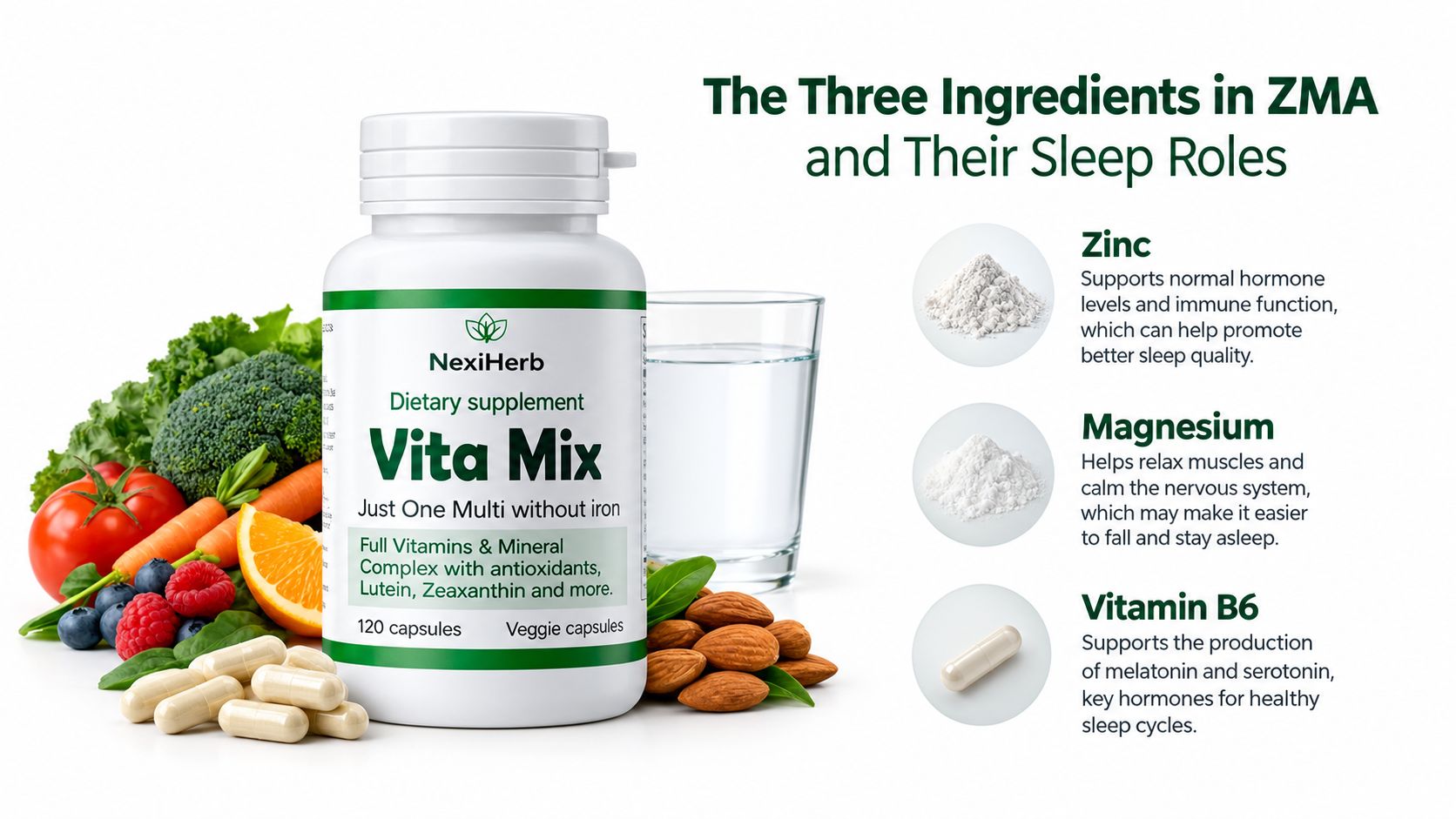
ZMA contains three nutrients with legitimate biological roles, yet the blend itself is not a proven sleep formula. A 2024 trial tested 30 mg of zinc, 450 mg of magnesium, and 10.5 mg of vitamin B6 after partial sleep restriction. That dose profile also shows why the product name is not enough: commercial formulas differ, so read the Supplement Facts panel.
Zinc
Zinc supports normal cellular function and neurotransmitter activity. Sleep articles often connect it with melatonin production and serotonin pathways, but those mechanisms do not show that extra zinc improves sleep for people who already get enough. High intake can cause nausea and, with prolonged use, interfere with copper balance.
This zinc education guide explains zinc's general nutritional role. Its presence in ZMA does not automatically make zinc a sleep ingredient.
Magnesium
Magnesium carries most of ZMA's sleep rationale. Proposed mechanisms include effects on GABA-related calming signals, cortisol regulation, and NMDA activity. These pathways make magnesium plausible for some people, particularly when intake is low, but a plausible mechanism is not the same as a demonstrated effect from the full blend.
The form and amount also matter. A label may list magnesium by its compound rather than clearly emphasizing elemental magnesium, so compare products carefully.
Vitamin B6
Vitamin B6 helps with neurotransmitter synthesis. That role explains why marketers associate it with serotonin, melatonin, and vivid dreams. It does not establish that adding B6 to zinc and magnesium produces a special sleep response. In ZMA, B6 largely reflects the formula's sports-nutrition origins rather than a combination proven by sleep research.
| Ingredient | Typical Dose | Proposed Sleep Mechanism |
|---|---|---|
| Zinc | Varies by brand, with 30 mg in the 2024 study | May support normal neurotransmitter and melatonin-related pathways |
| Magnesium | Varies by brand, with 450 mg in the 2024 study | May influence relaxation, GABA-related signaling, cortisol, and NMDA activity |
| Vitamin B6 | Varies by brand, with 10.5 mg in the 2024 study | Supports neurotransmitter synthesis and is sometimes linked with dream vividness |
A broad daily formula such as Vita Mix NexiHerb Multivitamin & Mineral Dietary Supplement belongs to a different category. Its listed ingredients include vitamins, minerals, lutein, zeaxanthin, and other plant-derived compounds. It is designed to complement overall nutrition, not to serve as a sleep-specific treatment or a direct equivalent of ZMA.
What the 2024 Clinical Trials Found
The recent controlled evidence does not support broad claims that ZMA improves sleep in healthy adults. In a 2024 randomized crossover study involving 21 recreationally active males, participants took ZMA after two nights of partial sleep restriction. Researchers compared the supplement with placebo and no-pill conditions, finding no improvement in sleep quality, cognitive function, or next-morning submaximal weightlifting performance (study details).
The dose was not trivial. Each serving contained 30 mg zinc, 450 mg magnesium, and 10.5 mg vitamin B6. Researchers assessed sleep with wrist-based actigraphy and questionnaires, then tested cognition and physical performance the following morning. That combination of objective and self-reported measures gives the result more context than a study based only on how participants felt.
Why actigraphy strengthens the interpretation
Actigraphy uses a wrist-worn movement sensor to estimate sleep and wake patterns. It cannot measure brain waves like a sleep-laboratory test, yet it records movement-based information about sleep timing and continuity in a person's usual environment. Questionnaires added participants' subjective experience, allowing researchers to examine both observable sleep patterns and perceived sleep quality.
Under those conditions, ZMA did not improve actigraphy-based or questionnaire-based sleep markers. The finding does not establish that no individual could ever respond. It shows that the standard blend produced no measurable advantage in a relevant group, even after restricted sleep.
A second 2024 study tested healthy males given either 4 hours or 8 hours of sleep opportunity over two nights. ZMA again failed to improve objective or subjective sleep outcomes. Compared with placebo or no-pill controls, it reduced total sleep time by about 0.46 hours overall and about 0.94 hours in the 8-hour sleep condition (the second controlled study).
The fairest conclusion is cautious: controlled trials have not shown a reliable sleep benefit, and ZMA should not be marketed as a guaranteed recovery solution. For nutrient-replete adults, the full blend currently has a weaker case than correcting a genuine magnesium shortfall.
Who Is Most Likely to Notice a Sleep Benefit
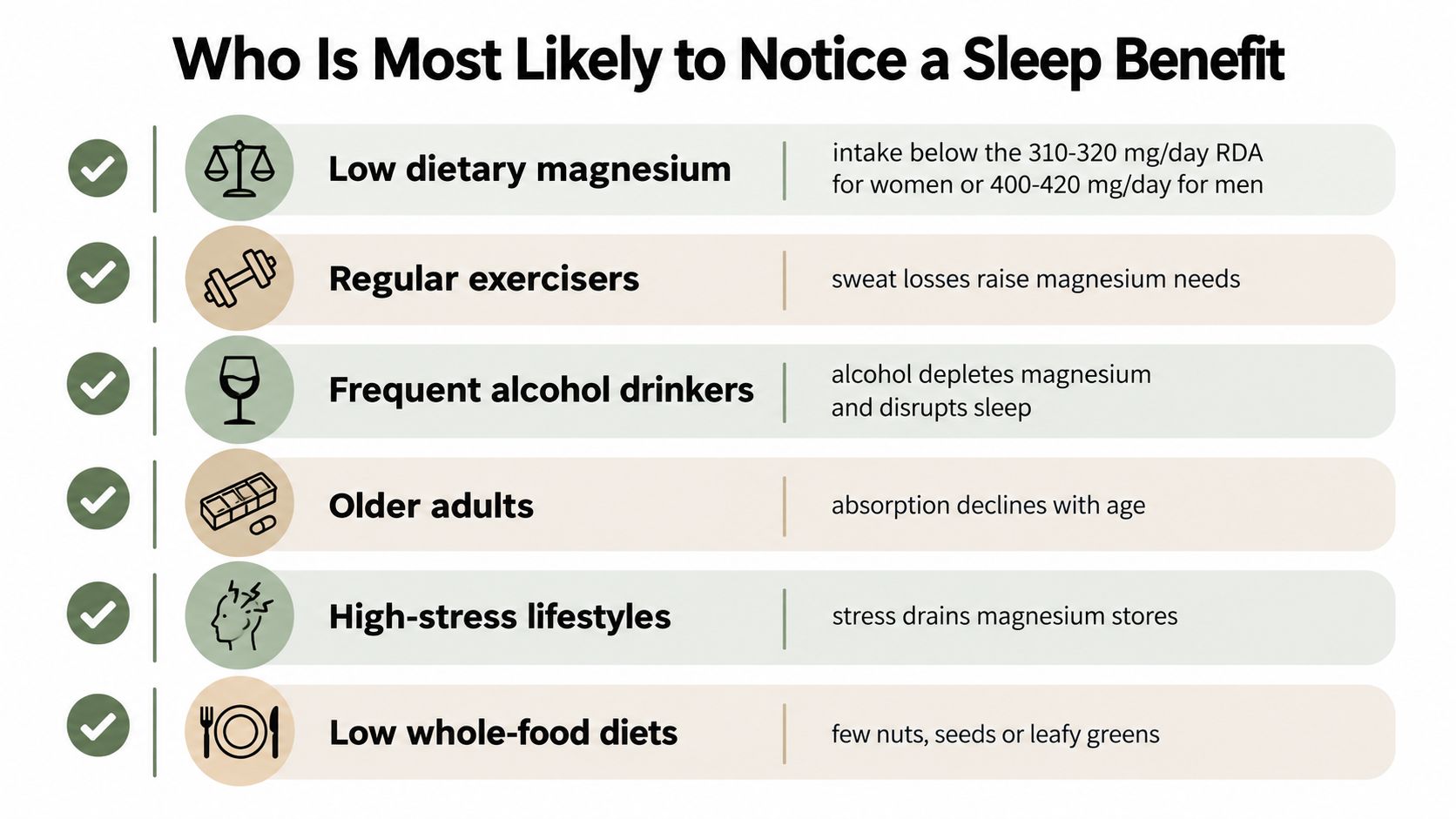
The people most likely to respond aren't necessarily the people most attracted to ZMA marketing. They're people whose magnesium status or intake may be inadequate, including some older adults and people with conditions or medication patterns that affect absorption or mineral balance. A recent review describes the sleep signal as more plausible in people with low magnesium status, older adults, or insomnia, while noting that healthy, nutrient-sufficient participants may see no improvement (review of magnesium and sleep evidence).
A useful risk-based screen
Magnesium inadequacy is more plausible in people with reduced absorption, gastrointestinal conditions, type 2 diabetes, chronic alcohol use, or long-term use of medicines such as proton pump inhibitors or diuretics. Older adults may also face greater risk because absorption and dietary patterns can change with age.
That doesn't automatically make ZMA the right answer. Any benefit is more likely to come from correcting magnesium inadequacy than from a special zinc-magnesium-B6 synergy. Zinc or B6 deficiency can matter, but isolated deficiencies aren't a strong reason for most adults to use a high-dose combination without a clinical reason.
Healthy adults eating varied diets should be more skeptical of universal claims. If your diet already supplies enough magnesium and zinc, you have less room for a noticeable improvement. The recent controlled study in healthy recreationally active males who met micronutrient needs found no meaningful improvement in sleep latency, sleep efficiency, or total sleep time after two nights of ZMA, which directly challenges the idea that everyone benefits.
Testing needs context
A standard serum magnesium test can be useful when deficiency is suspected, but it doesn't capture every aspect of magnesium stored inside cells. Results should therefore be interpreted with symptoms, diet, medications, medical history, and clinical judgment rather than treated as a perfect yes-or-no answer.
Don't diagnose yourself from a sleep advertisement. If you have persistent insomnia, a gastrointestinal condition, kidney problems, or long-term medication use, ask a clinician whether testing and a targeted supplement make sense.
How to Dose and Time ZMA Safely
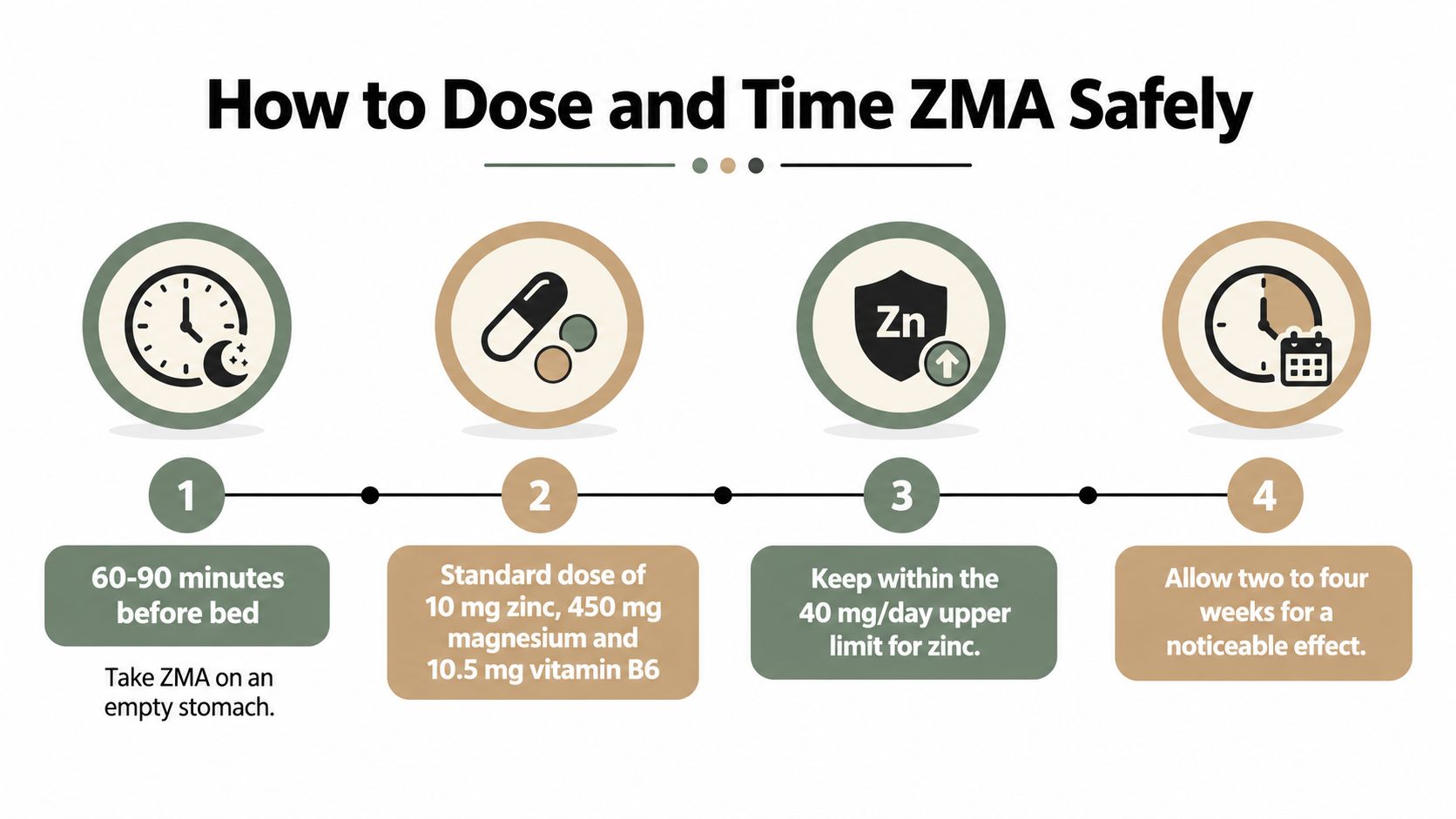
ZMA has no universal dose, and copying a study formula can create unnecessary risk. The 2024 study used 30 mg zinc, 450 mg magnesium, and 10.5 mg vitamin B6, but you should not assume every label provides those amounts or that the study dose suits you, as detailed in the trial summarized above. Check the amount of elemental magnesium, rather than only the total weight of the magnesium compound.
Taking ZMA in the evening is a practical choice, but bedtime timing is not a magic switch. Mineral-rich meals may affect absorption, while an empty stomach can make zinc cause nausea. If that happens, take the product with a small snack instead.
A safer routine
- Read the full label. Check the zinc, magnesium, and B6 supplied by ZMA, then add amounts from multivitamins and other supplements. This supplement-label reading guide can help you distinguish elemental minerals from the weight of their compounds.
- Start with the stated serving. Do not combine multiple ZMA products or raise the dose because you notice no immediate effect. A lack of early change is not evidence that more will help.
- Use food if your stomach needs it. A small snack may reduce zinc-related nausea, even though some labels recommend taking ZMA away from food.
- Track a short trial. Note how long falling asleep seems to take, how often you wake, and how you feel the next morning. If no clear improvement appears, indefinite use has little evidence behind it.
The U.S. tolerable upper intake level for supplemental magnesium is 350 mg per day. The upper limits for zinc and vitamin B6 are 40 mg per day and 100 mg per day, respectively. These limits do not show that higher amounts improve sleep. A product listing 450 mg of magnesium may exceed the supplemental magnesium limit, depending on whether the label reports elemental magnesium or the full compound weight.
Magnesium form affects both absorption and comfort. Magnesium oxide is generally less bioavailable than citrate or glycinate, and larger supplemental amounts can loosen stools. Magnesium and zinc can also interfere with absorption of tetracycline or quinolone antibiotics and bisphosphonates, so ask a pharmacist about suitable spacing. This matters more than taking ZMA at an exact minute.
ZMA Versus Magnesium-Only for Sleep
For most adults choosing a supplement specifically for sleep, magnesium-only is the more evidence-aligned starting point. A recent consumer medical review noted that there isn't enough solid evidence to say ZMA works for sleep, while the broader magnesium literature offers a more plausible, though still context-dependent, signal (consumer medical review of ZMA).
The choice becomes clearer when you separate the blend from its ingredients.
| Criterion | ZMA | Magnesium-Only |
|---|---|---|
| Evidence strength | Direct controlled trials of the combined formula have produced null sleep findings in healthy adults | More direct sleep research exists for magnesium, especially in selected populations |
| Dose flexibility | Fixed zinc, magnesium, and B6 amounts can add nutrients you don't need | Easier to select and adjust the magnesium amount |
| Tolerability | Zinc may cause nausea, while unnecessary long-term zinc or B6 can create avoidable concerns | Mainly limited by gastrointestinal effects and individual medical factors |
| Form selection | Often uses a fixed mineral form chosen by the brand | Available in forms such as citrate, glycinate, and oxide, with different tolerability profiles |
A magnesium-only product also lets you test the ingredient most closely connected with the sleep hypothesis without automatically adding zinc and B6. Readers comparing forms may find this magnesium citrate review guide useful when deciding what to discuss with a clinician or pharmacist.
Magnesium glycinate or citrate may be reasonable options for some adults, but a universal dose recommendation would be misleading. Your diet, kidney function, medications, bowel tolerance, and the product's elemental magnesium amount all matter.
Topical products are often marketed as another route. A soothing magnesium spray guide can help you understand how that category is presented, but marketing language shouldn't be confused with proof that transdermal magnesium improves sleep.
Choose ZMA when there is a specific reason to supplement zinc and B6 alongside magnesium, such as a confirmed deficiency or clinician-directed plan. Otherwise, the simpler formula makes it easier to control exposure and judge whether magnesium itself changes anything.
Side Effects, Interactions, and When to Skip ZMA
ZMA isn't automatically unsafe, but its three ingredients create more considerations than magnesium alone. Magnesium salts can cause loose stools, while zinc commonly causes nausea when taken without enough food. Chronic high zinc intake can interfere with copper balance, and excessive vitamin B6 over time can contribute to neurological symptoms.
Medication timing matters
Minerals can bind to some medicines in the digestive tract and reduce absorption. Pay particular attention to:
- Tetracycline and quinolone antibiotics: Separate them from mineral supplements according to a pharmacist's instructions.
- Bisphosphonates: These also require careful spacing from minerals.
- Levothyroxine: Ask about timing because minerals may interfere with absorption.
- Diuretics: Thiazide and loop diuretics can affect mineral status and may change how supplementation should be managed.
- Proton pump inhibitors: Long-term use can affect magnesium absorption, so unexplained symptoms deserve medical review rather than automatic self-treatment.
Situations that need professional guidance
Don't start ZMA casually if you have kidney disease, an active duodenal ulcer, or a known disorder of zinc or copper metabolism. Kidney impairment is especially important because the body may handle magnesium differently, increasing the risk of accumulation.
| Category | Specific Item | What Happens / What to Do |
|---|---|---|
| Gastrointestinal effects | Nausea or loose stools | Reduce exposure or stop, and discuss a better-tolerated form with a clinician |
| Mineral imbalance | Long-term high zinc | May interfere with copper balance; review total intake |
| Neurological symptoms | Tingling, numbness, or new weakness | Stop the supplement and seek medical advice |
| Drug interaction | Antibiotics, bisphosphonates, or levothyroxine | Get individualized spacing instructions |
| Medical condition | Kidney disease or mineral-metabolism disorder | Avoid self-prescribing ZMA and ask a clinician first |
| Red flags | Persistent diarrhea, palpitations, or new neurological symptoms | Stop and contact a healthcare professional |
Stop signal: Persistent diarrhea, palpitations, paresthesia, or new neurological symptoms aren't signs that the supplement is “working.” They warrant a pause and medical advice.
Common Questions About ZMA for Sleep
Should you use ZMA only after a blood test?
Not necessarily, but testing is sensible when deficiency is plausible, symptoms persist, or medication and medical history raise risk. Serum magnesium is useful but imperfect because much of the body's magnesium is inside cells. A clinician can interpret the result alongside diet, symptoms, kidney function, and medicines. Don't assume a normal result proves that ZMA will help, or that a borderline result proves the blend is required.
How long should you wait to notice an effect?
There is no guaranteed timeline for better sleep. If supplementation corrects an actual deficiency, changes may develop as nutritional status improves, but a fixed promise of rapid sleep improvement isn't supported by the controlled ZMA trials. If you can't identify a clear benefit during a cautious trial, continuing indefinitely turns an experiment into a habit without a measurable reason.
Can ZMA be combined with melatonin or sleep medication?
Ask a clinician or pharmacist before combining them. The issue isn't that every combination is automatically dangerous. It's that multiple sleep products can make it difficult to identify side effects, increase next-day grogginess, or interact with prescription medicines. Avoid adding magnesium glycinate to ZMA without checking the total magnesium amount, and don't stack products just because each one is marketed for nighttime use.
What should you do before buying ZMA?
Start with the basics that directly affect sleep:
- Protect a consistent schedule: Keep sleep and wake times as regular as your routine allows.
- Manage caffeine timing: Move caffeine earlier if it appears to delay sleep.
- Use light strategically: Get bright daytime light and reduce stimulating light exposure near bedtime.
- Lower evening arousal: Try a repeatable wind-down routine, relaxation practice, or stress-management habit.
- Investigate persistent insomnia: Ongoing sleep problems deserve clinical assessment rather than indefinite supplement stacking.
ZMA can be reasonable in a targeted deficiency-correction plan, but it isn't a proven universal sleep aid. For most nutrient-replete adults, a simpler approach, careful tracking, and professional guidance are more defensible than buying the most aggressively marketed formula.
NexiHerb LLC offers science-inspired dietary supplements, including multivitamins and targeted nutrition products designed to complement a balanced lifestyle. Visit NexiHerb LLC to review clearly labeled options and nutrition guides before deciding whether a targeted supplement fits your routine.