

Most human studies of maca root used 1.5 to 3.5 grams per day, but no single dose has been proven best. The amount that makes sense depends on the product's form, what you're taking it for, and whether its label lists maca root or a concentrated extract.
That difference matters at the supplement shelf. A capsule may contain a few hundred milligrams of maca alongside other herbs, while clinical studies often tested maca in gram amounts on its own. Grams and milligrams are easy to confuse: 1 gram equals 1,000 milligrams, so a 300 mg capsule provides 0.3 grams of maca, not 3 grams. And a blend can't be compared directly with a study of single-ingredient maca.
Table of Contents
- Maca Root Dosage Ranges by Form
- Why Studied Doses Vary So Much
- Dosage for Energy, Stamina and Libido
- Common Side Effects and Safety Limits
- Factors That Shape Your Personal Dose
- Who Should Get Clinician Advice First
- Starting Dose, Timeline and Review Date
Maca Root Dosage Ranges by Form
Most human studies used 1.5 to 3.5 grams of maca daily, and no single dose has been established as optimal. The table translates studied amounts into common product forms, but treat the capsule counts as arithmetic, not as advice to exceed a product's label.
| Form | Studied daily amount | Typical intake | Practical note |
|---|---|---|---|
| Dried root powder | 1.5–3 g per day | 1.5–3 g stirred into food or drink | 3 g was used in a 12-week safety trial involving 175 participants (trial details) |
| Concentrated red or black extract | About 3 g per day in a studied trial | Follow the label's stated ratio and serving size | Extract weight isn't equivalent to the same weight of whole root |
| Capsules, 500 mg each | 1.5–3.5 g per day | 3–7 capsules | Count capsules, not scoops |
| Capsules, 1,000 mg each | 1.5–3.5 g per day | 2–3 capsules, or 2–3 g | Confirm whether the label lists root or extract |
A milligram figure alone doesn't tell you whether a product matches a study. The label should identify the maca amount per serving and clarify whether it's root powder or extract. If a product contains a blend, the total weight of all ingredients isn't the maca dose.
The often-cited male libido study used 1,500 mg or 3,000 mg daily for 12 weeks, according to an EBSCO research summary of maca. Those are study amounts, not proof that either one is right for everyone.
To calculate a capsule or powder amount:
- Convert the target dose to milligrams. For example, 1.5 g is 1,500 mg.
- Divide that amount by the milligrams of maca in each capsule or scoop.
- Check the label's serving size and confirm the calculated amount falls within the 1.5–3.5 g research range.
For powder, check how many grams the scoop really holds rather than assuming all scoops are the same. For more practical ideas on adding a powder to food or drinks, see this guide to taking herbal powders.
Why Studied Doses Vary So Much
A maca dose is a little like a baking instruction that says “bake for 20 to 30 minutes.” You still need to know the oven, pan, and loaf size before that range tells you much. With maca, the dose only makes sense when you know what preparation researchers used, who took it, which outcome they measured, and how long the trial lasted.
A dose only means something in context. The same number of grams doesn't make two products or two study results interchangeable.
A 2010 systematic review of four randomized trials found that studies tested 1.5–3.5 grams daily over 2–12 weeks. The review concluded that researchers hadn't identified an optimal dose. The evidence was limited by the small number of trials, modest sample sizes, and generally limited study methods.
Four details help explain why the results can't be boiled down to one number:
- Preparation: A study of root powder isn't automatically comparable with a concentrated extract. Red and black maca preparations may differ, too.
- Population: Researchers have studied healthy men, men with mild erectile dysfunction, and adults with sexual dysfunction associated with SSRI medicines. Findings in one group don't automatically apply to another.
- Outcome: Libido, erectile function, semen quality, and exercise performance are different measures. A result for one isn't evidence of an effect on all the others.
- Duration: Trials have used different time frames, so a dose tested over a short period doesn't establish what to take indefinitely.
For example, one trial involving 57 healthy men tested 1.5 or 3 grams daily for 12 weeks. A separate trial involving 50 men with mild erectile dysfunction tested 2.4 grams daily for 12 weeks and reported a significant improvement in erectile-function scores compared with placebo. Those findings apply to their particular groups, preparations, and outcomes. They don't prove that more maca is necessarily better.
Use the research range as a reference, not a reason to push the dose upward. A studied amount isn't a guaranteed effective amount or a universal recommendation.
Dosage for Energy, Stamina and Libido
Match the goal you have in mind to the closest row, then look at what the human evidence really tested. Some goals have more directly relevant information than others.
| Goal | Studied daily dose | Duration studied | What the trials showed |
|---|---|---|---|
| Energy and daily vitality | No dedicated dose established | Not established | Little direct human evidence |
| Stamina and exercise performance | Not specified for the cycling study | Not specified | A cycling study found no benefit at the dose tested |
| Libido and sexual desire | 1.5 g or 3 g per day | 12 weeks | Desire rose at both doses; about half of 175 participants in a separate 3 g trial reported increased desire (trial summary) |
| Erectile function in men with mild erectile dysfunction | 2.4 g per day | 12 weeks | Significant improvement versus placebo in 50 men |
| Semen quality | 1–5 g per day | 12–16 weeks | Evidence wasn't overwhelming in infertile or healthy men (systematic review) |
For energy and daily vitality, the evidence doesn't establish a dedicated dose. If this is your reason for considering maca, be cautious about treating a general wellness claim as a dose supported by a specific human trial.
For stamina and exercise performance, a cycling study found no benefit at the dose tested. That result is a useful reminder: studies about libido don't establish that maca will improve sports performance. Active adults looking at maca for exercise can also read this overview of maca root for men, while keeping the limits of the evidence in mind.
The libido findings don't establish a reliable dose-response pattern. In healthy men, both 1.5 g and 3 g daily increased sexual desire, with no demonstrated difference between doses. A small pilot involving 20 adults with SSRI-associated sexual dysfunction reported improved scores at 3 g daily, but not at 1.5 g. That pilot was small and specific to a particular condition, so it shouldn't be used as a rule for everyone (NIH LiverTox maca overview).
Practical rule: Choose the goal row closest to your reason for using maca, and don't assume a higher dose will work better.
Common Side Effects and Safety Limits
In a randomized trial, 175 participants took 3 grams daily for 12 weeks as placebo, red maca extract, or black maca extract, and investigators reported no serious adverse effects in any group (trial safety details). That's reassuring for short-term use under controlled study conditions, but it doesn't establish that every person can take the same amount safely or that longer use is risk-free.
Another randomized trial tested about 5 grams daily for 12 weeks. Two participants in the maca group reported mild gastrointestinal complaints, and both continued in the study. Researchers reported no treatment-related severe side effects and no clinically significant changes in laboratory tests or vital signs. These results describe the participants and conditions studied, not a general guarantee.
NIH LiverTox describes small clinical trials as generally well tolerated, without convincing evidence of maca-related liver injury. But the available safety studies are mostly short-term, and they don't settle questions about prolonged use or higher amounts.
Possible concerns to watch for include:
- Digestive discomfort: Mild gastrointestinal complaints are the side effect reported in the trial information. If your stomach is sensitive, start cautiously and take maca with food if the label allows.
- Individual sensitivity: A person may find that a supplement doesn't agree with them even when a study group tolerated it. Don't treat higher amounts tested in a trial as a target.
- Uncertain long-term safety: Short, controlled trials can't show that ongoing use is risk-free.
If digestive symptoms persist, reduce the amount or stop taking the product and speak with a clinician. Don't increase a dose to “get through” uncomfortable effects.
Factors That Shape Your Personal Dose
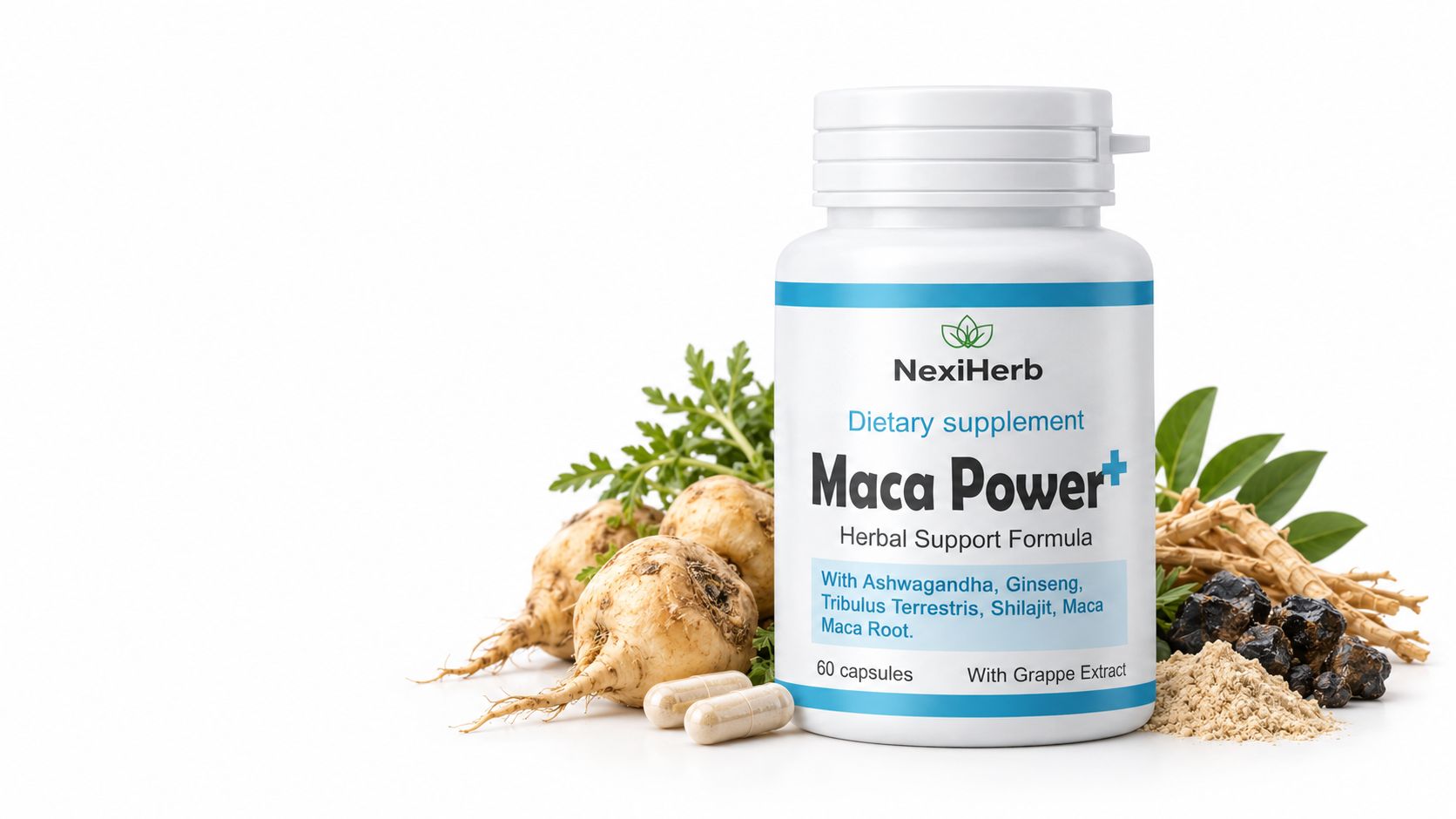
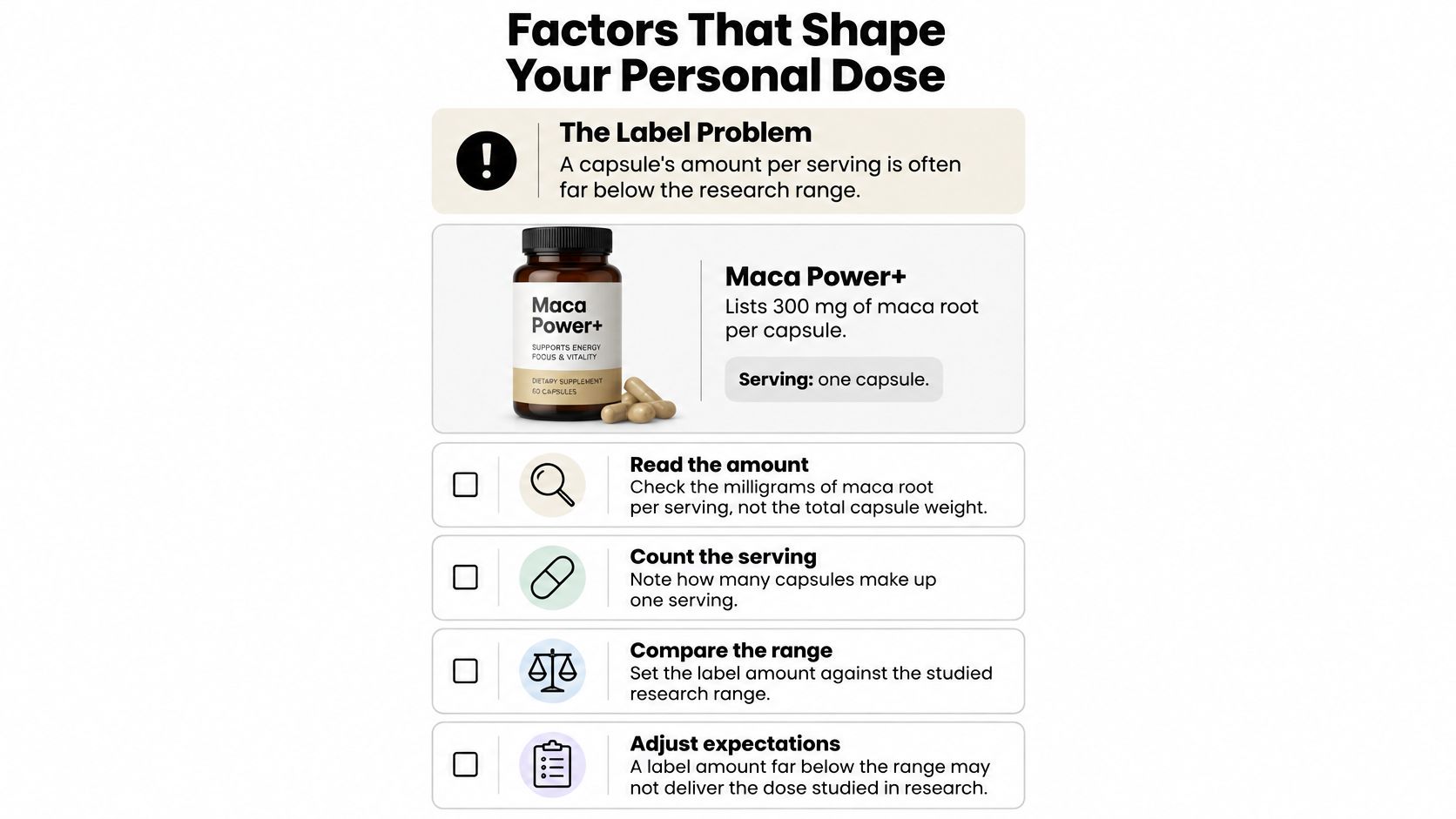
A label can show a maca amount far below the amounts used in many maca studies. For example, Maca Power+ NexiHerb Herbal Dietary Supplement lists 300 mg of maca root per capsule and a serving of one capsule daily. Compared with the 1.5–3.5 g research range, that's about 9–20% of the range. The comparison is only about the maca amount, not about the overall product's effect.
Maca Power+ combines maca root with ashwagandha, ginseng, tribulus, shilajit, shatavari, and black pepper. Because it's a blend, it can't be compared directly with trials that tested maca as a single ingredient. Follow the product's serving instructions rather than multiplying capsules to imitate a research dose.
Use this checklist before choosing an amount:
- Read the form and amount: Check how many milligrams of maca are in each serving, not just the total weight of the capsule.
- Check the extract ratio: If the product is an extract, look for the stated ratio. The extract's weight isn't automatically equal to the weight of whole root.
- Match your goal: Compare your reason for taking maca with the evidence in the goal table.
- Track your timeline: Note how long you've used the product and whether you've reached a point to reassess.
- Review medicines and supplements: Ask about prescription medicines and other products containing herbs that may overlap with a blend.
- Consider your own tolerance: Digestive sensitivity may affect whether you tolerate a product.
- Check pregnancy or breastfeeding status: Seek professional advice before use if either applies.
If you want a broader framework for checking supplement labels and evaluating products, Lila's guide to choosing supplements can help you review what a label says and what questions to ask.
Follow the label and don't exceed its recommended serving. If you're considering more than the label directs to approximate a study dose, discuss that decision with a clinician first.
Who Should Get Clinician Advice First
For some people, maca safety and interaction evidence is incomplete. The safer default is to ask a clinician before starting rather than trying to infer a personal dose from studies in other groups.
| Situation | Why the evidence is thin | What to do |
|---|---|---|
| Pregnancy or breastfeeding | Safety data are incomplete | Ask a clinician before starting |
| Hormone-sensitive condition | Interaction and safety evidence are incomplete | Get clinician review first |
| Prescription medicines, including SSRIs | Interactions are poorly documented; the SSRI pilot included only 20 adults | Check with the prescriber before taking any dose |
| Fertility treatment or trying to conceive | Semen-quality evidence isn't overwhelming | Discuss timing with a fertility specialist |
| Existing liver condition | Liver data come from small trials | Ask a clinician; seek prompt care for unusual symptoms |
The pilot involving people with SSRI-associated sexual dysfunction doesn't establish that maca is safe with every prescription medicine. Likewise, findings about semen quality don't show that maca will support fertility treatment or replace guidance from a fertility specialist. A clinician can review the specific product and judge whether its ingredients and dose fit your health history.
Starting Dose, Timeline and Review Date
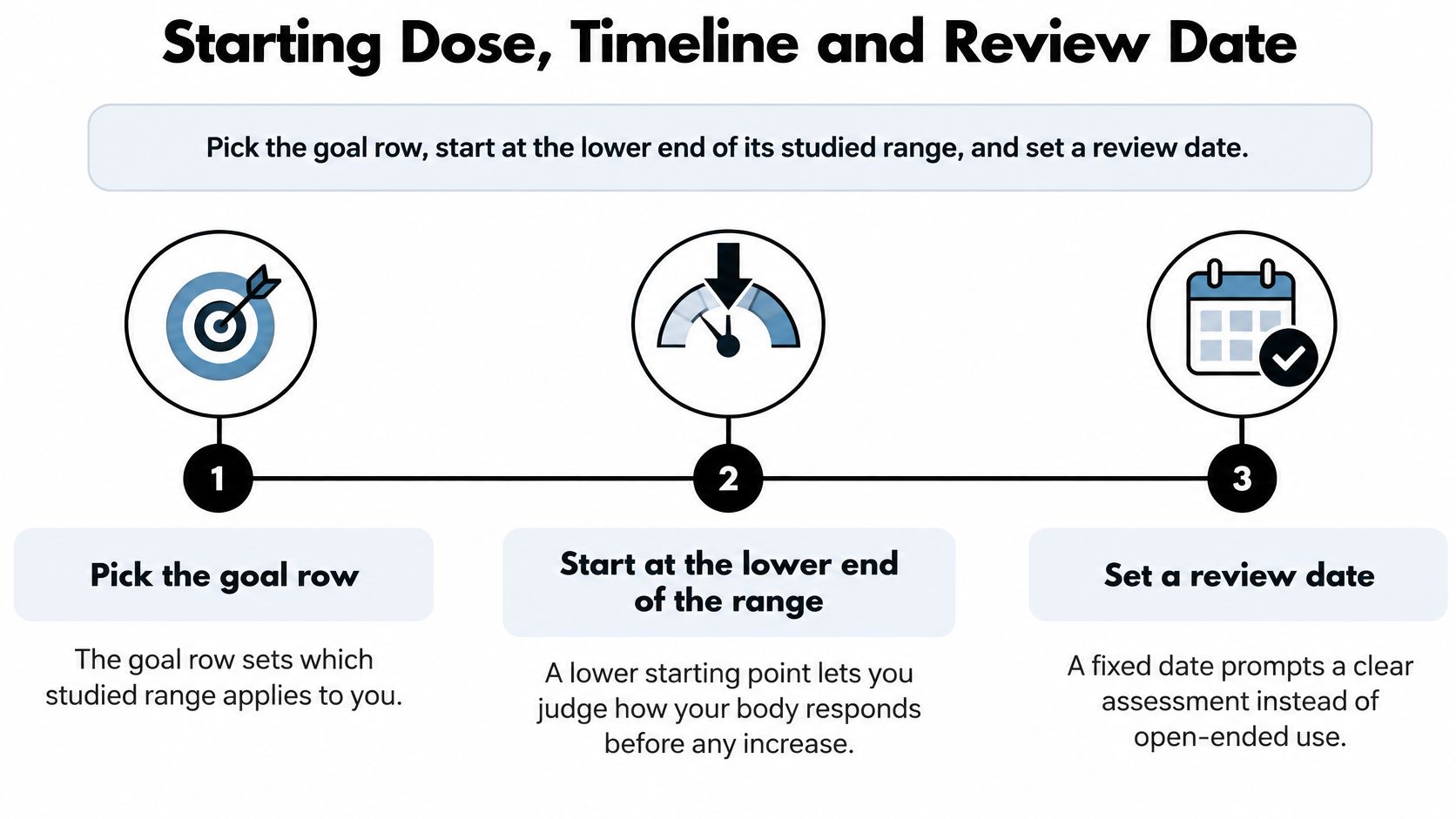
Choose the goal that most closely matches your reason for taking maca, start at the lower end of the relevant studied range, and set a date to reassess. That approach helps prevent open-ended use based on the assumption that more time or a larger amount must produce a better result.
- Identify the form and amount per serving. Use the form table to distinguish root powder from extract and find the maca amount on the label. Total blend weight isn't the same as the maca dose, so check the maca figure specifically.
- Find your goal in the evidence table. Note the dose and outcome studied for the closest matching goal. This keeps you from using libido research to assume an exercise effect.
- Convert the dose to servings or capsules. Divide the target amount in milligrams by the maca amount in each serving. Then compare your calculation with the product label.
- Begin at the lower end and follow the label. Taking it with food may be a practical choice if that fits the directions and your digestion. Don't exceed the recommended daily intake.
- Check the personal factors and clinician table. Review your medicines, other supplements, health conditions, and whether you should ask a clinician before use.
The timeline below is a way to keep track of your experience, not a schedule proven to guarantee a result. Studies have used different durations, and individual responses can vary.
| Checkpoint | What to do |
|---|---|
| Week 0 | Record the product, the maca amount per serving, your goal, and any symptoms you already have. |
| Week 4 | Note digestion, sleep, and mood in a simple log. Pay attention to whether the product feels tolerable, not only whether you notice a change. |
| Week 8 | Review whether the outcome you're tracking has shifted. If there's no meaningful improvement, don't assume that raising the dose is the answer. |
| Week 12 | Make a clear choice to continue, pause, or stop. This is the end of a commonly studied window, not proof that longer use is safe or useful. |
| Weeks 12–16 | If you're considering continuing, reassess with a clinician. Evidence for longer use is limited. |
No trial has established an on-off cycling schedule for maca. The often-mentioned approach of using it for about 12 weeks, then taking 2–4 weeks off, is a convention, not a proven protocol. Don't treat it as a way to guarantee safety or make maca work better.
The evidence also doesn't support assuming that active adults will gain stamina from studies about libido. If exercise performance is your main goal, judge maca against the evidence for that outcome, not a result measured in a different context. For background on how response timing varies across the research, see this guide to how long maca root may take to work.
Maca can complement a varied diet and healthy routine, but it doesn't replace medical care. Put your review date on your calendar before you start, ideally before the end of the studied window, so you have a specific moment to decide whether continuing makes sense.
NexiHerb LLC offers dietary supplements, including botanical blends, alongside nutrition guides designed to help adults make informed choices about everyday wellness. Review the product label against the maca evidence, then visit NexiHerb LLC to explore its catalog and educational resources.