

About one-third of U.S. adults take a multivitamin or multimineral supplement, according to the National Institutes of Health overview of multivitamin use, which also places use among children and adolescents at about one-quarter and traces the broader category's U.S. history to the early 1940s. A whole food multivitamin belongs to that established category, but its food-based positioning raises a separate question: what does the formula provide?
A label covered in fruit and vegetable names can look reassuring. Choosing well requires a less colorful comparison: disclosed nutrient forms, appropriate amounts, and a realistic understanding of what a capsule can't replace.
Table of Contents
- Why Whole Food Multivitamins Stay Mainstream
- What Whole Food Really Means on a Label
- Benefits and Limits Backed by Evidence
- Who a Daily Multivitamin May Help
- How to Choose a Quality Formula
- Safety Interactions and Smart Timing
- A Practical Routine and Fresh Questions
Why Whole Food Multivitamins Stay Mainstream
Multivitamins aren't a new wellness invention. Their long history helps explain why shoppers view them as a familiar addition to breakfast rather than an unusual intervention.
The category is also broad. The NIH overview cited above describes products containing multiple vitamins and often minerals, and notes that the CDC has used a minimum of three vitamins in its classification. That definition doesn't distinguish a formula built around food concentrates from one containing isolated nutrients or a combination.
Popularity describes use, not superiority. Population surveys can tell us how many people take multivitamins. They can't establish that a whole food multivitamin works better because its label names plants.
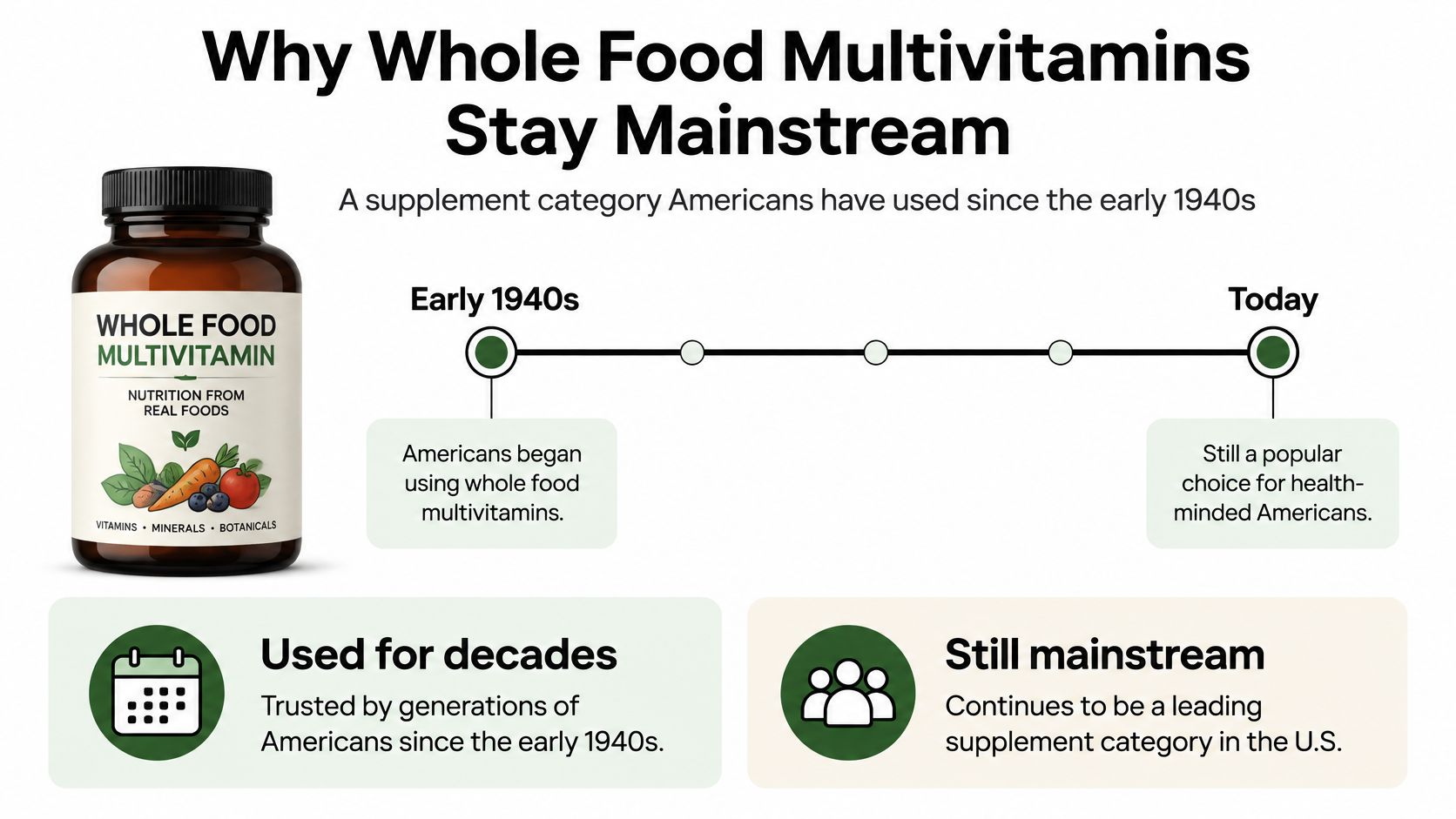
This timeline illustrates the category's continuity, rather than evidence that any particular sourcing method is better.
Familiar products alongside changing habits
Survey findings show sustained interest alongside changing choices. A review of U.S. supplement-use trends describes multivitamin/multimineral use rising from 30% in 1988–1994 to 39% in 2003–2006; later research covering 2007–2018 found any-supplement use increasing from 50% to 56% and micronutrient-containing supplement use from 46% to 49%, while multivitamin-mineral use fell from 70% to 56% within the study's supplement-user classification.
Those figures use different populations and categories. In particular, the percentage among supplement users shouldn't be read as a percentage of all adults. The useful interpretation is narrower: shoppers still use broad formulas, but they also choose more targeted products.
For your own decision, separate these questions:
- Category familiarity: Does a broad multivitamin fit the way you approach everyday nutrition?
- Formula suitability: Are its disclosed ingredients and amounts appropriate for you?
- Diet fit: What will you continue to obtain from meals rather than the bottle?
Meal planning deserves attention alongside supplement shopping. If you use a Thermomix and want a food-first planning resource, you can browse the Thermomix diet guides from IT'S A CHEF! without treating any diet guide as evidence for supplement effectiveness.
The practical takeaway isn't that everyone needs a multivitamin. It's that a familiar product still deserves an individual assessment.
What Whole Food Really Means on a Label
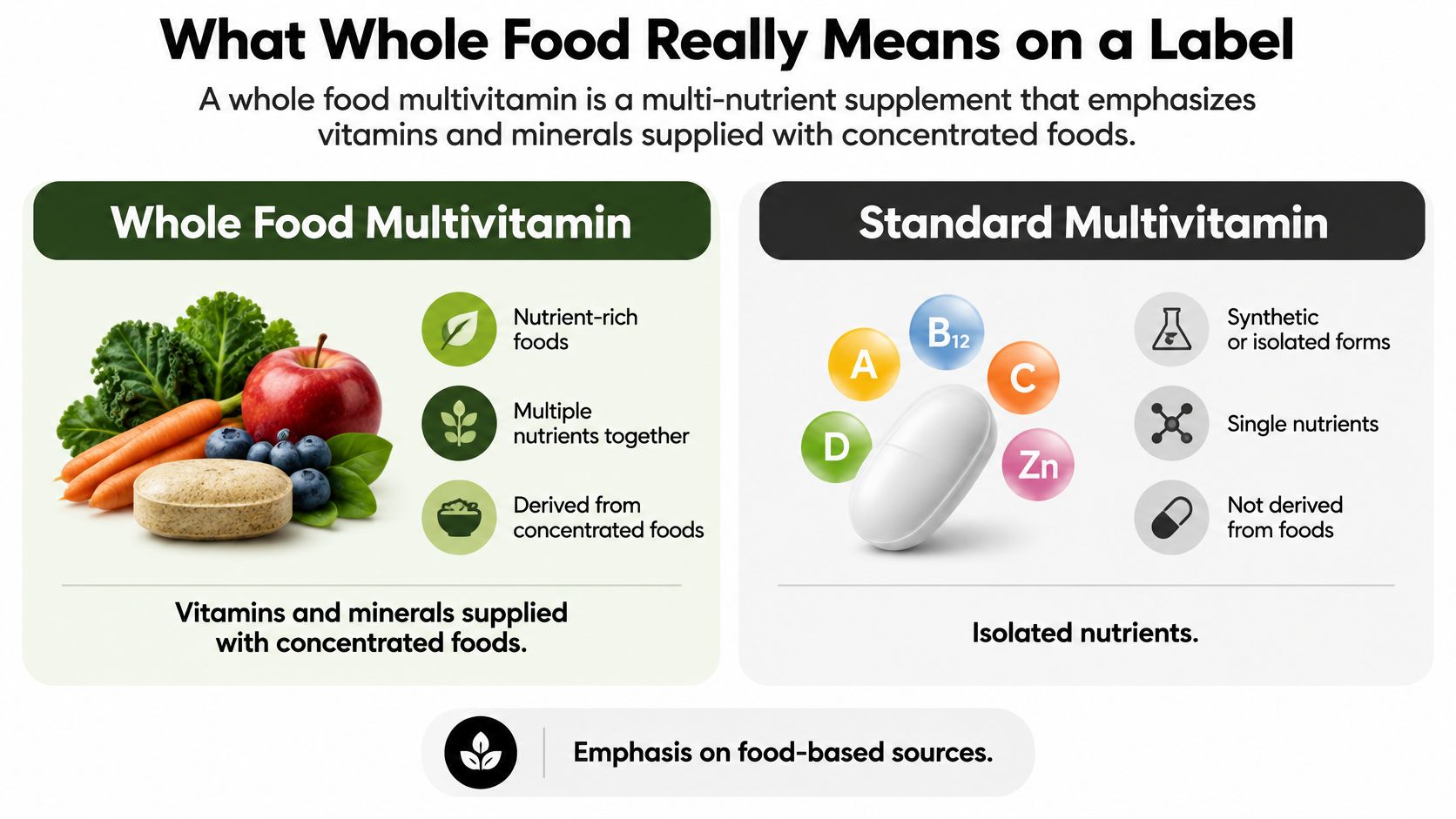
A whole food multivitamin generally emphasizes nutrients supplied with concentrated foods, powders, or extracts. An isolated-nutrient formula identifies vitamins and minerals as specific compounds, while some products combine both approaches.
Think of a concentrated pantry beside measured recipe ingredients. The pantry analogy describes the food-based presentation; the measured ingredients describe the precision of named compounds. Neither tells you, by itself, whether the finished formula suits your needs.
The comparison below highlights sourcing language, not a ranking of effectiveness.
Food ingredients aren't an absorption guarantee
Bioavailability means how available a nutrient is for absorption and use. It depends on the nutrient's chemical form and the surrounding food matrix, meaning the other components present with it.
A peer-reviewed review of nutrient interactions in dairy, vegetables, and fruits describes both helpful and opposing interactions affecting vitamin A, folate, vitamins C and K, calcium, magnesium, zinc, iodine, and iron. In plain language, food components can help some nutrients become available while making others less available.
That doesn't make food concentrates undesirable. It means food-derived isn't a universal shortcut to better absorption, and incomplete human data for some matrices leave questions that a marketing phrase can't answer.
A plant name tells you an ingredient is present. It doesn't tell you how much of a particular vitamin you'll receive.
Separate the nutrient panel from the food blend
Consider a hypothetical label listing a vegetable blend alongside folate. The blend may sound appealing, but you still need the folate amount and form. A combined blend weight doesn't disclose the contribution of each ingredient or establish the dose of each nutrient.
Use these distinctions when comparing bottles:
- Nutrient amount: Look for the quantity of each vitamin and mineral per serving.
- Nutrient form: Look for the named compound or clearly identified source, not just a front-label description.
- Food blend: Read it as additional ingredient information, not a replacement for nutrient disclosure.
For a focused walkthrough, use this guide to reading supplement labels. If you'd also like to practice separating food-label details from front-of-package language, explore label reading with Learn Olive Oil.
The shopping question becomes straightforward: Can you identify what you're taking without guessing? A shorter, transparent label can be more useful than a longer list that leaves the important details unclear.
Benefits and Limits Backed by Evidence
A useful supplement claim should be narrower than a promise of better health. A multivitamin can contribute disclosed vitamins and minerals to your overall intake. Whether that contribution addresses a meaningful gap depends on what you already eat and take.
That distinction matters because providing a nutrient isn't the same as demonstrating a noticeable benefit for every user. A formula may add nutritional coverage without producing an obvious change in how you feel. Conversely, feeling tired or unwell isn't enough to identify which nutrient, if any, you need.
Judge the contribution, not the promise
The most defensible role is helping close dietary micronutrient gaps. This is a practical purpose, not a claim that a whole food multivitamin treats symptoms or outperforms every alternative.
When evaluating benefit language, ask what the manufacturer is promising:
| Claim style | A useful response |
|---|---|
| Broad nutritional coverage | Check which nutrients and amounts are provided |
| Better because it contains plants | Ask for evidence specific to the finished formula |
| Guaranteed absorption | Look for qualification rather than certainty |
| A solution for a medical problem | Seek clinical advice instead of relying on marketing |
The supplement-use patterns discussed earlier describe consumer behavior. They aren't clinical evidence that broad formulas or targeted products produce better outcomes.
Keep the limits visible
A multivitamin shouldn't become permission to stop improving meals. Treating a bottle as a substitute for dietary variety asks it to perform a job it wasn't designed to do.
Likewise, a higher amount isn't automatically a stronger benefit. The appropriate comparison is your likely need, not another product's largest number.
Evidence check: An ingredient's nutritional role and a finished supplement's demonstrated benefit are different claims.
Be cautious with language that turns general wellness into certainty. Statements about extraordinary energy, complete nutritional protection, or universal suitability deserve more scrutiny than a clear description of nutrient content.
Supplements aren't intended to diagnose, treat, cure, or prevent disease. If you're choosing a product because of persistent symptoms, a suspected deficiency, or a diagnosed condition, the decision needs more than a retail label.
A modest expectation is appropriate: a suitable formula may complement an otherwise thoughtful eating pattern. It doesn't have to promise a dramatic result to serve that limited purpose.
Who a Daily Multivitamin May Help
Consider a busy professional who repeats the same lunch because it's convenient. The useful question isn't whether that person is busy enough to need supplements. It's whether the repeated meals leave identifiable nutritional gaps.
An active adult faces a similar distinction. Wanting a simple routine alongside training doesn't establish a need for a particular formula, and a multivitamin shouldn't be treated as a substitute for meals or an individualized recovery plan.
Everyday routines, different decisions
These examples are decision scenarios, not evidence that everyone in these groups needs supplementation:
- The repetitive eater: Review the foods regularly missing from meals before choosing broad coverage.
- The active adult: Consider the full eating pattern and existing sports-nutrition products, not exercise alone.
- The generally varied eater: Decide whether a supplement adds something useful rather than buying it because imperfect weeks feel uncomfortable.
A person comparing targeted vitamins with a multivitamin can use the guide to vitamin D and B vitamins to organize questions. The choice should still depend on individual intake and advice where needed, not on which bottle sounds more complete.
When an adult formula needs closer review
Iron is a concrete example of why the same bottle won't suit everyone. Adult needs differ by sex and life stage, and unnecessary supplemental iron can be inappropriate for many adult men and postmenopausal women. The reference-intake framework used in the label table below makes that difference visible.
Someone already using fortified drinks or separate nutrient pills also needs a different assessment from someone taking no supplements. A broad formula might duplicate an existing plan rather than improve it.
Bring the decision to a clinician or pharmacist when your goal involves a medical condition, a suspected deficiency, pregnancy, or medicine use. Ask a specific question: Does this formula fit my meals, life stage, medicines, and existing supplements?
You don't need to prove that your diet is perfect before considering a multivitamin. You do need a reason more useful than the impression that food-based ingredients must be right for everyone.
How to Choose a Quality Formula
Start with the Supplement Facts panel, not the plant illustrations. Compare the labeled serving with age- and sex-appropriate Dietary Reference Intakes, then consider what your meals already contribute.
The adult nutrient-reference framework and formulation discussion provides the benchmarks below, including iron at 8–18 mg daily, and explains why calcium, magnesium, and potassium are difficult to supply fully in capsule-based multivitamins because of their relatively large daily requirements.
Adult Label Checkpoints for a Multivitamin
The values in this table come from that linked framework. They're daily-intake checkpoints for healthy adults, not amounts every supplement must provide.
| Nutrient | Adult daily benchmark | What to notice |
|---|---|---|
| Vitamin A | 700–900 mcg RAE | Check the form and reporting unit |
| Vitamin C | 75–90 mg | Compare with your overall intake |
| Vitamin D | 15–20 mcg | Account for separate vitamin D products |
| Folate | 400 mcg DFE | Read both the amount and named form |
| Vitamin B12 | 2.4 mcg | Don't assume a larger number is necessary |
| Zinc | 8–11 mg | Check overlapping products |
| Selenium | 55 mcg | Consider total intake |
| Iron | 8–18 mg | Match the decision to sex and life stage |
A daily target isn't a capsule target. Food contributes toward these amounts, and individual recommendations may differ. A formula doesn't need megadoses to be useful.
Inspect forms and acknowledge capsule limits
Prefer labels that identify forms, such as folate as L-5-MTHF, without assuming a named form proves superiority. Keep listed nutrient quantities separate from blend weights.
A compact capsule also can't reasonably replace mineral-rich foods. If calcium, magnesium, or potassium is a priority, investigate your overall intake rather than assuming a multivitamin covers it.
For a concrete adult-format example, Vita Mix NexiHerb Multivitamin & Mineral Dietary Supplement uses a vegetarian capsule and lists vitamins A, C, D, E, B-complex vitamins, folate as L-5-MTHF, biotin, pantothenic acid, zinc, selenium, manganese, chromium, molybdenum, and boron. It also lists lutein, zeaxanthin, astaxanthin, citrus bioflavonoids, and mixed tocopherols; its suggested use is one capsule daily with water, preferably with a meal, according to the linked product information.
The product image identifies the example, but the label details remain the basis for comparison.
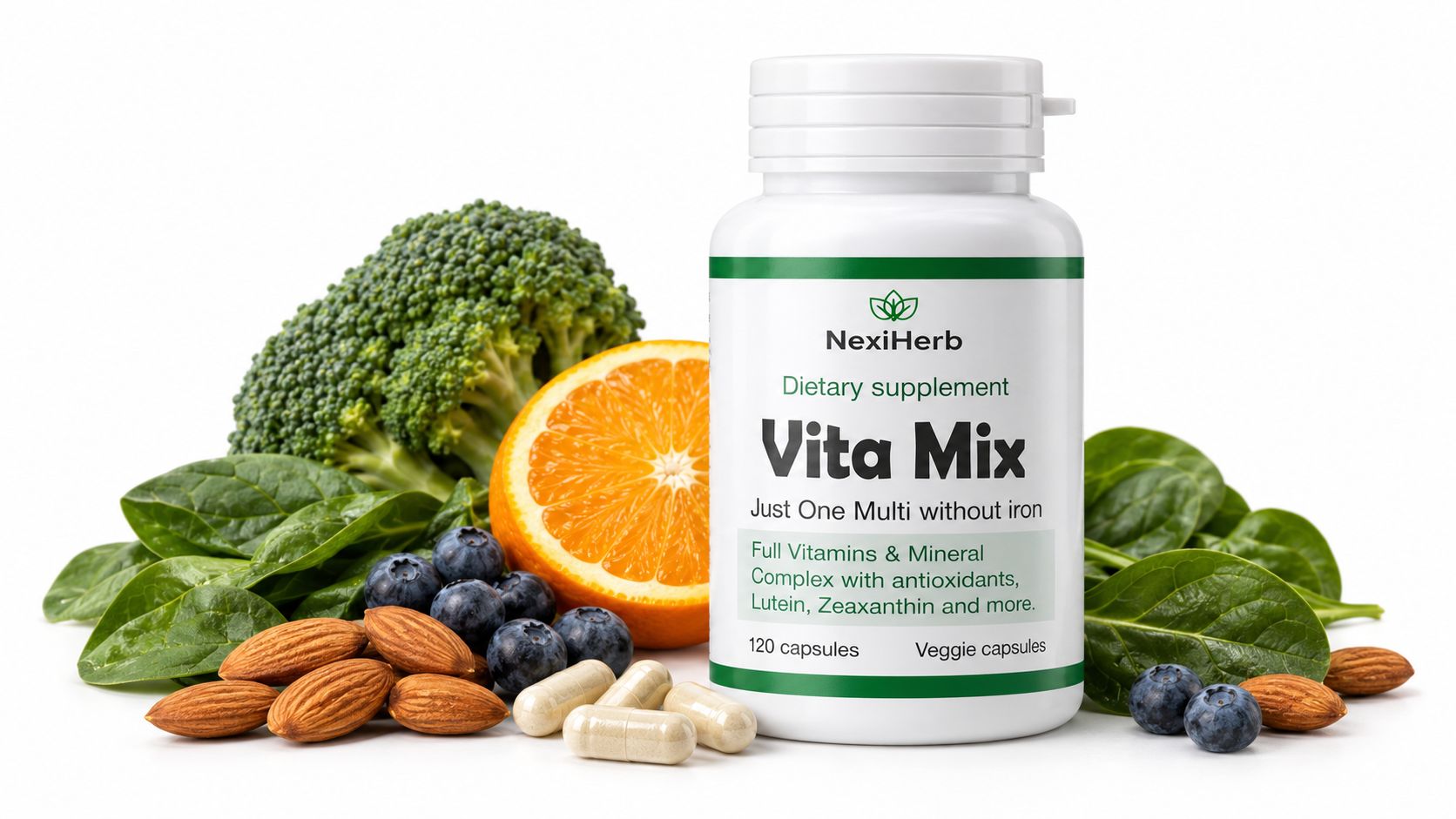
That ingredient list alone doesn't establish whole-food sourcing, dose suitability, or superior absorption. Apply the same audit to it as to any alternative.
For testing questions, consult GutRx's discussion of what third-party supplement testing guarantees, then ask the manufacturer what testing applies to the specific product.
Your final checklist is short:
- Transparent forms: Can you identify the nutrients?
- Sensible amounts: Do they fit your overall intake?
- Restrained claims: Does the product avoid disease promises?
- Realistic coverage: Are you still planning meals for what the capsule doesn't supply?
Safety Interactions and Smart Timing
Before adding another supplement, put every relevant label on the table. Include multivitamins, individual vitamins and minerals, fortified drinks, and protein products with added micronutrients.
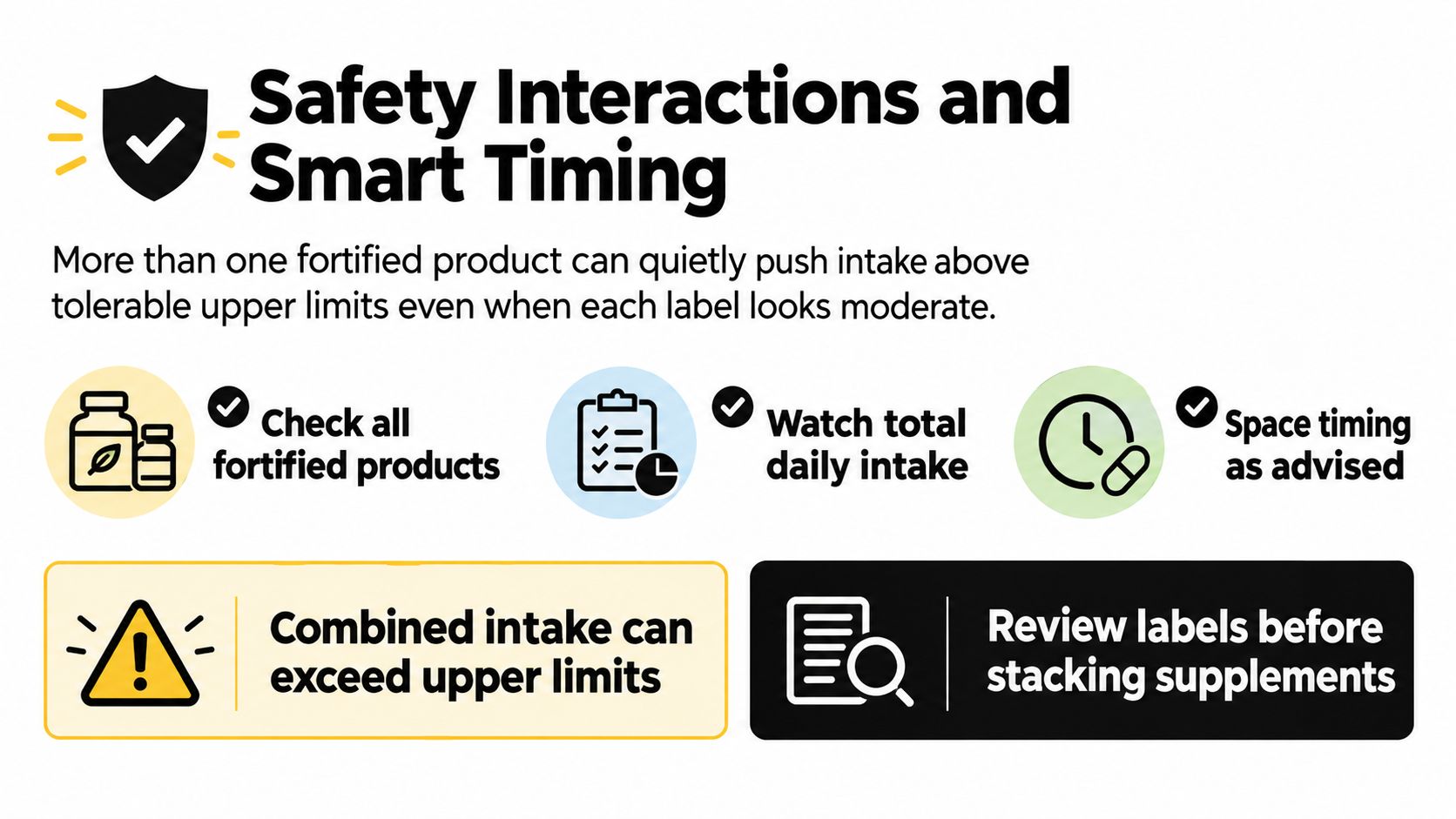
The purpose is to see combined intake. As the nutrient-interaction review discussed earlier notes, stacking fortified products can push intake above tolerable upper limits even when each product looks reasonable on its own.
Use this checklist as a reminder to review the whole routine rather than a single bottle.
Plan intake before adjusting timing
Write down the serving you use, not just the amount printed beside a nutrient. Then note when you take each product and whether it was recommended for a specific reason.
- Identify overlap: Highlight repeated nutrients across labels.
- Follow the serving: Don't increase the dose because a meal was less varied than usual.
- Get personalized advice: Ask a clinician or pharmacist about combinations involving medicines, pregnancy, or a medical condition.
More convenient doesn't necessarily mean more appropriate. Taking every bottle together may simplify the habit, but minerals can interact or compete. Don't invent a spacing schedule without advice relevant to the ingredients you use.
Use meals deliberately
Fat-soluble vitamins A, D, E, and K are suited to intake with a meal containing dietary fat because their absorption depends on that context. Iron requires separate attention: both its chemical form and meal composition influence absorption.
These mechanisms don't mean you need to engineer every bite. Follow the product directions and ask for specific timing advice when your routine includes iron, multiple mineral products, or medicines.
For help organizing that conversation, consult the guide to the best time to take vitamins. Timing should support a suitable plan, not compensate for an unsuitable combination.
This video can accompany your review, but your label and individualized advice should determine what you take.
Routine safeguard: Keep a written supplement list and update it whenever you add, remove, or change a product.
If you develop concerns after starting a supplement, don't respond by rotating through more bottles. Review the product and your situation with a qualified professional instead.
A Practical Routine and Fresh Questions
Build the routine around a meal you already eat regularly. Keep the product where you'll remember it, while following its storage directions and keeping it out of children's reach.
Take the labeled serving with water and food when directed. Keep your supplement list nearby so a new purchase doesn't become an unrecorded addition.
Make consistency observable
Use a short note or checklist to record whether you followed the directions and whether the routine was practical. This is a habit check, not a test of whether the supplement is treating anything.
If remembering the product is difficult, reconsider the setup before changing the dose. A simpler routine is more useful than an ambitious collection of bottles you use unpredictably.
You can consider the adult capsule example above if that format suits you, but compare the full nutrient panel with your needs before buying. Convenience is a selection criterion, not evidence of completeness.
Questions that deserve their own answers
Can a child use an adult whole food multivitamin?
Don't assume an adult formula is suitable. Ask a pediatric clinician or pharmacist about age-appropriate products and whether supplementation is needed.
Should the bottle be refrigerated?
Follow that product's storage instructions. The presence of food-derived ingredients isn't enough to decide how the finished supplement should be stored.
Does a longer ingredient list mean broader coverage?
Not necessarily. Coverage depends on the nutrients and amounts provided, not the number of botanicals or food powders named.
Where should unclear shopping questions go?
Use the product page and retailer support to clarify serving directions, ingredient details, or missing label information. Take questions about personal suitability to a clinician or pharmacist rather than asking customer support to make a medical judgment.
The lasting routine is a decision you can explain: you know what the formula supplies, why you chose it, and what you still obtain from meals. Revisit that choice when your diet, life stage, medicines, or other supplements change.
NexiHerb LLC offers adult multivitamin and mineral supplements alongside other everyday wellness products. Visit NexiHerb LLC to review product information, compare disclosed ingredients with the label checkpoints above, and ask support about details you need before choosing.