

Eleven of 16 people given maca in a small double-blind dose-finding study reported at least one adverse event, according to a 2024 comprehensive review of maca safety. The next part of that finding matters more than the number itself: every event was described as transient, and not one participant stopped taking it.
Coverage of maca root side effects tends to land at one of two extremes, either a harmless traditional food or a hormone-wrecking hazard, and both skip the detail that decides the answer. What counts is the weight of evidence behind each symptom, how long the research lasted, and what was inside the product someone swallowed.
Three questions sort the noise from useful caution. How strong is the evidence for this symptom? How long did the study run? And what exactly was in the bottle? Keep those in view and most alarming claims shrink into something you can act on.
Table of Contents
- Reported Maca Side Effects at a Glance
- Short-Term Trials Versus Long-Term Safety
- Blood Pressure and Liver Enzyme Signals
- Maca, Thyroid Disease and Levothyroxine
- Product Type and Quality Risks
- Who Should Avoid Maca and What to Do Next
Reported Maca Side Effects at a Glance
The quickest way to read maca safety is to separate what happened under observation from what someone reported afterward. The table below sorts the common and rare effects by body system, the setting where each was reported, and the weight you should give it.
Reported maca side effects by body system
| Symptom or Effect | Body System | Where Reported | Evidence Strength | What to Do |
|---|---|---|---|---|
| Gastrointestinal upset | Digestive | Dose-finding study; larger randomized trial | Most consistently reported in trials | Reduce the dose or take it with a meal; seek advice if it persists |
| Headache | Nervous system | Dose-finding study | Limited trial data | Monitor; stop and ask a clinician if it recurs |
| Irritability, sleep disruption, increased dreaming | Mood and sleep | Dose-finding study, isolated reports | Very limited | Note timing relative to doses; discuss with a clinician |
| Panic attack or manic episode | Mental health | Case reports, including a manic episode in a man with no prior psychiatric history | Case-level only | Stop and seek urgent care if it occurs |
| Increased sweating, urinary frequency, blurry vision | Various | Dose-finding study, isolated reports | Very limited | Seek medical advice promptly if vision changes |
| Vaginal bleeding or thicker menstrual discharge | Reproductive | Case reports and one trial report | Case-level only | Medical review, especially for unexpected bleeding |
| Diastolic blood pressure rise and raised AST | Cardiovascular and liver | Small study in adults with metabolic syndrome | Moderate but inconsistent across trials | Tell a clinician; monitor blood pressure if you take medicine |
| Probable liver injury | Liver | Case report after a concentrated alcoholic maca preparation | Case-level; concentrated preparation | Stop and seek medical assessment for jaundice or dark urine |
Read the evidence column before the symptom column. Trial data works like a scheduled check-in: people are dosed on a schedule and asked about symptoms at set intervals, so it hints at how often something turns up among a few dozen or a few hundred users. Case-level evidence works like a single voice in a hallway: it proves a symptom is possible, not that it is common.
The digestive row carries the most weight because it rests on scheduled follow-up rather than spontaneous complaints. In the dose-finding study, gastrointestinal upset was the most frequent complaint, followed by headache and irritability. The same study logged isolated reports of panic attack, urinary frequency, blurry vision, sleep disruption, increased sweating, increased dreaming, thicker menstrual discharge, and worsening fibromyalgia symptoms.
Case reports add the rare and serious end of the list. They describe vaginal bleeding in a young woman and a manic episode in a man with no prior psychiatric history. A separate case report describes probable liver injury after a concentrated alcoholic maca preparation, not ordinary powder. Those reports matter because they flag what to watch for, but they cannot tell you the rate.
A trial counts people who were asked. A case report counts a person who told someone. Both matter, and they answer different questions.
Which rows warrant which response follows from that split. Trial-backed symptoms call for a dose change, a meal, or a conversation. Case-level symptoms, particularly a mental health change, unexpected bleeding, or jaundice, call for stopping and seeking medical advice rather than watching and waiting.
Short-Term Trials Versus Long-Term Safety
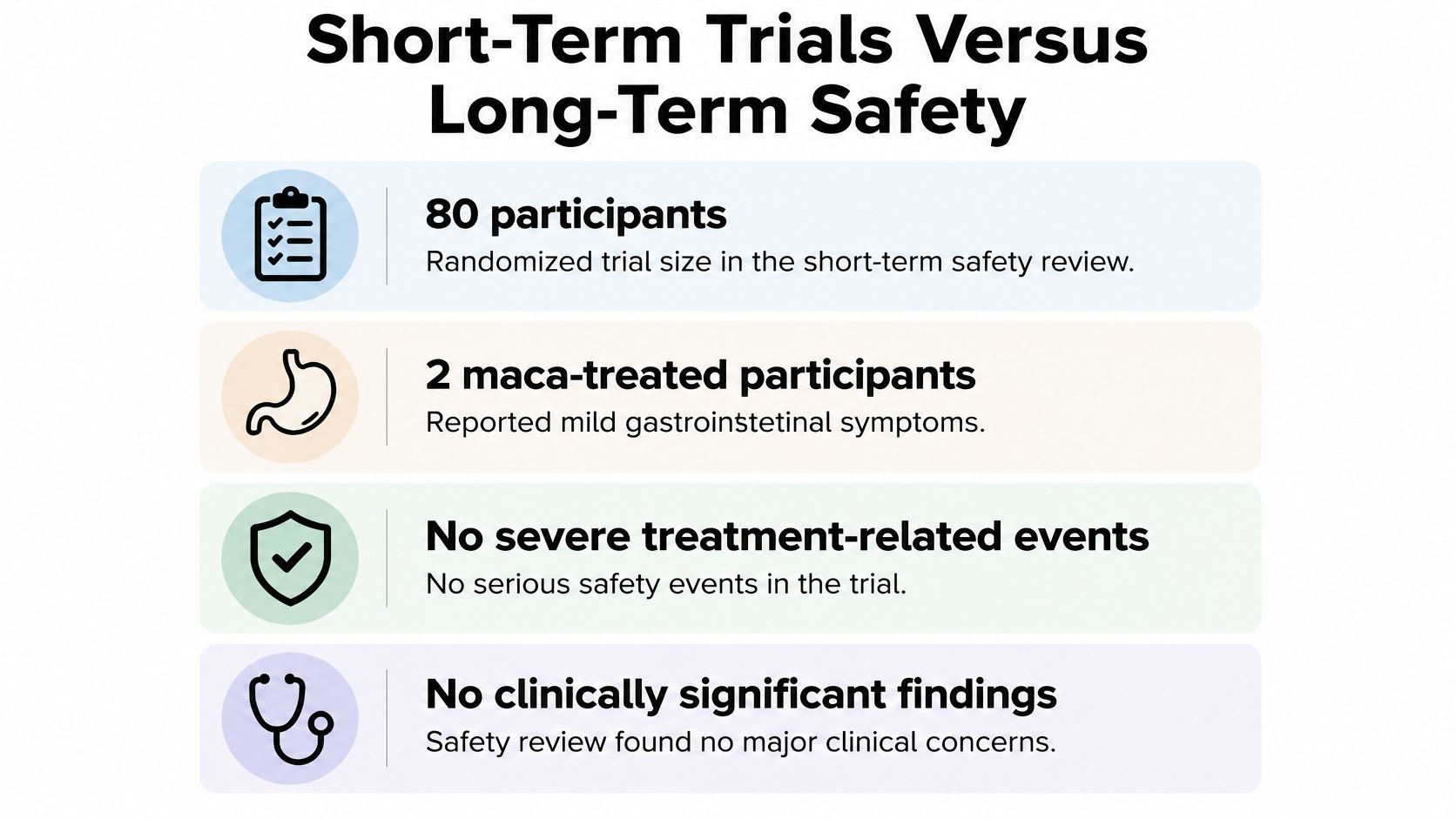
The most reassuring maca data comes from trials that actively hunted for harm rather than waiting for complaints. In an 80-person randomized trial, two maca-treated participants reported mild gastrointestinal symptoms, investigators found no severe treatment-related events, and blood tests, vital signs and safety markers showed no clinically significant changes. The 2025 University of Malta review of the evidence that summarized these results also noted that most maca research has focused on short-term use, which sets the limit on how far those reassuring numbers can stretch.
Here's how those numbers look side by side.
The largest single study points the same way. In a 2016 randomized, double-blind, placebo-controlled study, 175 adults took 3 grams per day of black maca extract, red maca extract, or placebo for 12 weeks, and researchers reported no severe or serious adverse effects attributable to maca, with no participant discontinuing treatment because of a reaction, per the published trial report in Pharmaceuticals.
Together, those results support short-term tolerability at doses around 2 to 3 grams daily. That is the range you can point to when someone asks whether maca is safe to try.
A good snapshot is still a snapshot.
What twelve weeks can and can't tell you
A twelve-week trial works like a test drive rather than years of ownership. Fifteen minutes behind the wheel confirms the car starts, steers and brakes. It says nothing about a year of daily commuting, winter mornings, or how the transmission behaves at 90,000 miles.
The same limit applies here, and it's the piece most write-ups skip. Human safety studies have mostly lasted about 12 weeks, so the evidence answers one question well: tolerability over a few months. The decade-long question stays open.
The honest conclusion: serious reactions look uncommon in short clinical trials. The absence of reported harm is not proof of universal safety.
For anyone taking maca daily, reasonable monitoring means watching for new digestive symptoms, shifts in sleep or mood, blood pressure concerns, or unexplained laboratory abnormalities, without assuming the supplement routinely damages organs. It also means separating a bad reaction to maca itself from contamination or adulteration in a poorly made product.
Evidence is thinnest where people ask most often. The 2024 safety review found that data remain limited for children, pregnant or breastfeeding people, and individuals with serious liver or kidney disease, which is why those groups get their own caution level later rather than a casual green light.
Blood Pressure and Liver Enzyme Signals
One finding in the maca safety record works like a smoke alarm. A sounding alarm means somebody should walk over and check; it does not mean the house is on fire.
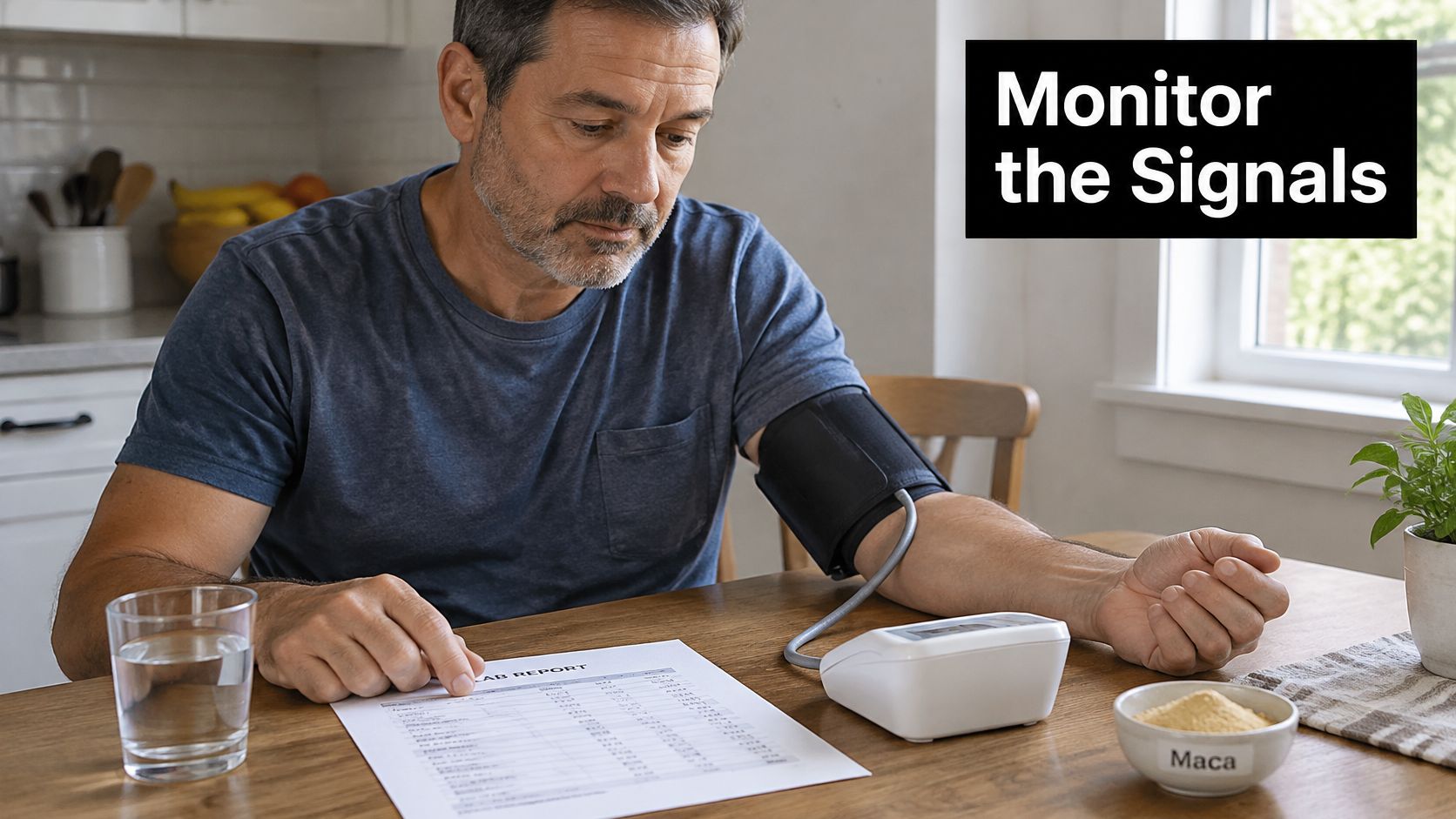
The signal comes from a 90-day study using 0.6 g/day in adults with metabolic syndrome, which reported a moderate increase in diastolic blood pressure and AST, an enzyme used as a marker of possible liver-cell stress, according to a review of maca's clinical safety profile.
Two details keep that result in proportion. The same review describes generally good tolerance across the other human trials it examined, with no clinically meaningful changes in laboratory markers or vital signs. And the study population already carried cardiovascular risk, so a moderate diastolic rise there does not automatically transfer to healthy adults taking maca at food-level doses.
One moderate reading in one population is a prompt to check.
Who needs a monitoring plan
- On blood pressure medicine: a supplement that shifts diastolic pressure changes the picture your prescriber is working from.
- Managing cardiovascular risk: a sustained rise deserves investigation rather than attribution to stress.
- Using other liver-active products: alcohol, certain pain relievers and some prescription medicines all affect liver enzymes, and stacking unknowns makes an abnormal result hard to interpret.
Tell your clinician you take maca before they interpret an unexplained blood pressure change or an abnormal AST result. That single sentence can save a round of repeat tests and guesswork, because clinicians read an isolated AST value differently when they know the full list of what you take. If you want a baseline before you start, it helps to track liver enzymes with Lola so a later result has something to sit beside.
Stop the supplement and seek medical assessment if you develop jaundice, dark urine, unusual fatigue, severe abdominal pain, or persistently high blood pressure. Those are not watch-and-wait symptoms.
Maca, Thyroid Disease and Levothyroxine
Search "is maca safe with thyroid disease" and you'll find plenty of flat warnings. The evidence supports something less tidy than a yes or no, and it's worth understanding why the question keeps getting answered badly.
Maca is a cruciferous plant, in the same family as broccoli and cabbage, and it contains glucosinolates. Some glucosinolate breakdown products can interfere with iodine utilization, which creates a plausible concern for people with hypothyroidism, iodine deficiency, or high-dose use over a long period, as a clinical review of maca and thyroid hormone explains.
What the interaction record actually shows
A clinical interaction database identified no published study directly evaluating maca with levothyroxine and no established interaction. Reports where maca use appears alongside thyroid problems in an adverse-event database don't prove that maca caused them, since co-occurrence is not causation.
That gap is the whole story. A theoretical mechanism plus an evidence vacuum is not the same as a confirmed drug interaction, and it doesn't justify telling thyroid patients they must quit maca altogether.
What it does justify is separating five questions that usually get mashed into one:
- Product quality. A tested powder and an unlabeled import are different exposures.
- Dose. Food-level maca and a concentrated extract deliver very different amounts per serving.
- Iodine status. Low iodine intake is the condition under which glucosinolates matter most.
- Thyroid diagnosis. Hashimoto's, post-surgical hypothyroidism and a mildly high TSH are not the same situation.
- Medication timing. Levothyroxine absorption has its own rules, and none of them were tested against maca in a trial.
If you're building a routine around thyroid health, an overview of what a thyroid support complex typically contains helps you see which ingredients carry real evidence and which are there for tradition.
The practical guidance is short. Never adjust levothyroxine on your own, and run concentrated maca past a clinician or pharmacist before starting. Uncertainty and individual risk assessment are the accurate answer here, not a blanket prohibition.
Product Type and Quality Risks
Two bottles labeled maca can contain very different things, which is why the risk picture shifts with what you're holding rather than with the plant's reputation.
Maca eaten as a food is a different exposure from a concentrated powder or extract, because the concentrated form delivers far more per dose. Composition varies across products too, so the same product name on two labels can mean two different dose levels and two different sets of other ingredients.
The liver-injury case covered earlier turns on this same distinction. The product involved was a concentrated alcoholic maca liquor, a preparation type far removed from the powders and capsules used in trials. A case report tied to one extreme preparation tells you little about the safety of a labeled capsule taken at a normal dose.
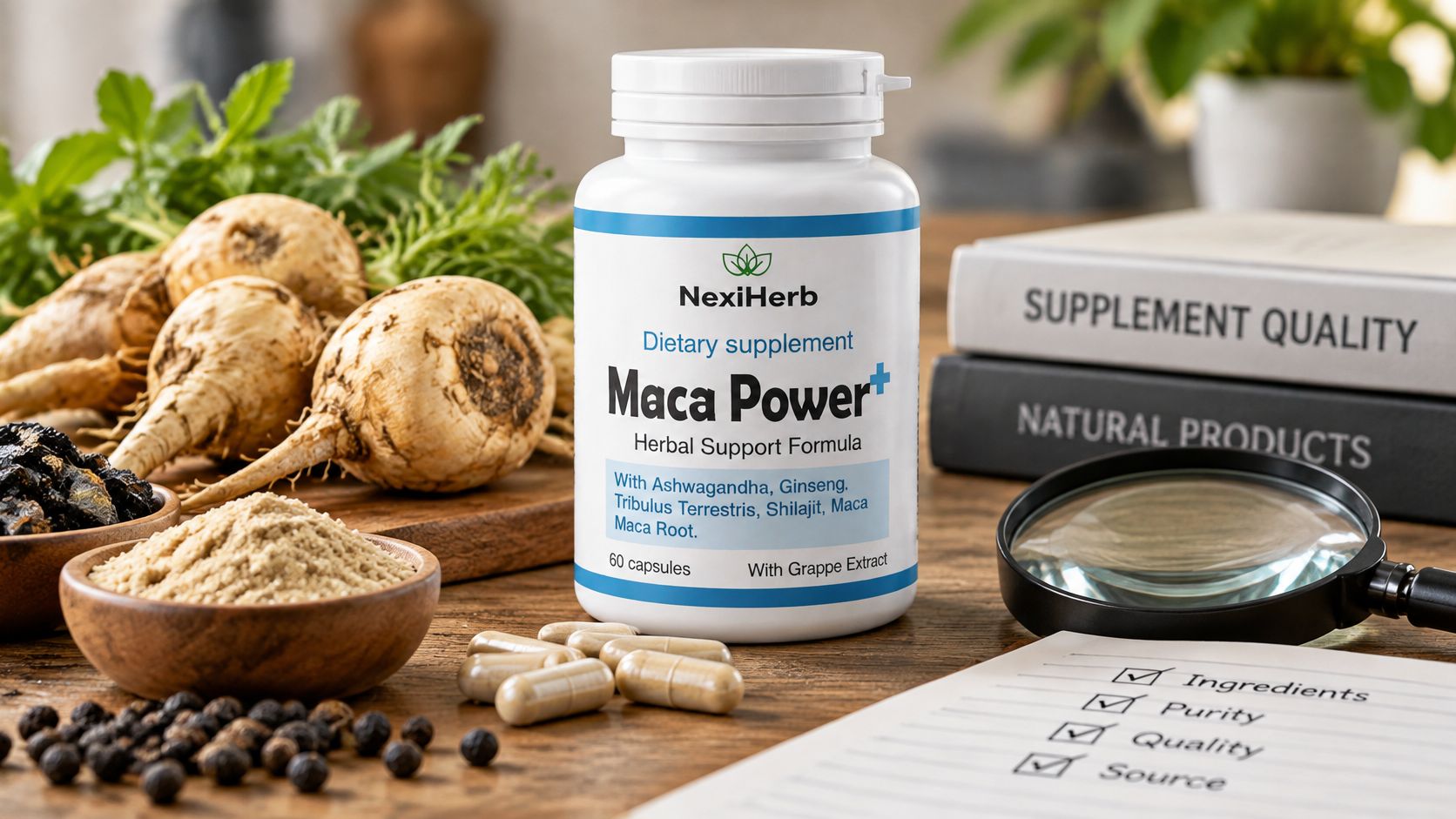
Contamination and adulteration sit in a separate category from anything intrinsic to the root. A product with a stated dose and a clear ingredient list is a different proposition from an unlabeled powder of unknown origin, and a surprising reaction is more likely to come from what else is in the capsule than from the maca itself.
A four-point check before you open the bottle
- Read the dose and the extract type. The label should state how much maca is in a serving and whether it's root powder, gelatinized root, or an extract with a ratio.
- Skip concentrated alcoholic preparations. A tincture at 50% alcohol is not comparable to a capsule, and there's no reason to use one for general wellness.
- Look for evidence of independent batch testing. This explainer on how to read a certificate of analysis shows which documents are worth asking a seller for.
- Keep the bottle if symptoms appear. A symptom you can't trace back to a specific product is a symptom nobody can investigate.
Labels are where this starts, and some are more useful than others. Maca Power+ NexiHerb Herbal Dietary Supplement shows the level of detail worth expecting from any product: a stated amount per serving and a complete ingredient list, so you can compare it with anything else on the shelf before you buy.
One more calibration point. The 0.6 g/day metabolic-syndrome study and the 2 to 3 gram trial doses are research doses, and nothing guarantees a commercial product matches them once you account for extract ratios. Trials tell you maca was well tolerated at those doses for those durations. What the label tells you is whether the bottle in your hand resembles what was tested.
Who Should Avoid Maca and What to Do Next
Sorting readers by how well the evidence covers them is the most honest way to decide who should pause before starting. The groups below are ranked on that basis.
Caution level by reader group
| Reader Group | Caution Level | Why It Matters | Suggested Step |
|---|---|---|---|
| Pregnant or breastfeeding | High | Evidence limited and safety data sparse | Ask a healthcare professional before use |
| Children | High | Human safety studies do not cover children | Avoid unless a clinician advises |
| Thyroid disease or iodine deficiency | High | A theoretical concern that remains unconfirmed in human data | Clinician or pharmacist review before use |
| Taking antihypertensive medicine | High | An open question remains in the trial data | Review with your prescriber and monitor blood pressure |
| Liver or kidney disease | High | Safety data in this group are thin | Medical review; avoid concentrated extracts unless advised |
| Hormone-sensitive conditions | Moderate to high | Limited data on hormonal effects | Professional review before use |
| Past psychiatric condition | Moderate | Single manic-episode report | Discuss with a clinician before starting |
| Healthy adult, labeled dose, short term | Lower | Mild symptoms only; no serious events in trials | Follow the label and track how you feel |
Caution tracks missing evidence; it does not track proven harm. Pregnancy and childhood sit at the top because nobody studied them, not because maca was shown to hurt anyone there.
- Find your row. If you appear more than once, use the highest caution level, since the strictest constraint governs.
- Get sign-off first if you're pregnant, breastfeeding, taking medication, or managing a thyroid, liver, kidney or psychiatric history. Bring the actual label to that conversation, because a pharmacist can read a supplement facts panel faster than you can explain it.
- Start at the labeled dose and don't exceed it. More is not a shortcut, and the studied range is narrower than commonly assumed.
- For the first weeks, track digestion, headaches, sleep, mood, unusual bleeding, and blood pressure if it's relevant to you. A two-line note on your phone beats trying to recall how you felt three weeks ago.
- Stop and seek care for fainting or any change in your mental state, and follow the warning signs covered in the earlier section. These are the events where waiting costs more than stopping.
- Reassess after a few months. Ask whether the reason you started still holds, and check the maca root dosage guidance if you're unsure how your product compares with the doses used in research.
NexiHerb LLC asks customers who are pregnant, breastfeeding, take medication or other supplements, or manage a medical condition to consult a physician or other medical practitioner before using its products.
Short-term use with sensible monitoring is a reasonable choice for many healthy adults. Higher-risk readers should get professional sign-off before the first capsule, and the product label should go to that appointment.
Maca root sits in a crowded category where bold claims are cheap and long-term data are scarce, which is why NexiHerb LLC builds its catalog around clearly labeled, plant-based formulas rather than promises. If you're weighing whether maca belongs in your routine, Maca Power+ is one option to compare against the doses and evidence described here, with every ingredient and amount printed on the label. Visit NexiHerb LLC to read the full formula details, check current pricing, and see the rest of the supplement range before you decide.