

What does a quality seal verify: the factory, one batch, or the result you hope for? In the U.S., cGMP certified means the supplement maker follows FDA's current Good Manufacturing Practice rules under 21 CFR Part 111, which govern how the product is made and controlled, not whether it is approved or proven effective.
Keep three claims separate: legal compliance with manufacturing rules, a third-party certificate or seal, and batch testing for a specific lot. Each answers a different question, and none proves the formula works. A manufacturing claim cannot do the work of clinical evidence.
Table of Contents
- What cGMP Certified Means in Plain English
- Three Quality Claims That Get Confused
- How cGMP Controls Work From Raw Material to Shelf
- What a cGMP Label Does Not Prove
- Warning Letters That Show What Gaps Look Like
- How to Verify a cGMP Claim Yourself
- Confirm the Label Before You Buy a Supplement
What cGMP Certified Means in Plain English
cGMP stands for current Good Manufacturing Practice. For supplements, it describes a documented system for controlling production, rather than a special ingredient standard or a medical endorsement.
Think of a restaurant's recipe cards, refrigerator-temperature logs, and cleaning records. Those documents help staff prepare food consistently and prevent avoidable mistakes. They don't establish that you'll enjoy the dish. Similarly, supplement manufacturing controls address how a product is produced, not whether it delivers the health result you want.
The FDA's explanation of current Good Manufacturing Practices describes mandatory controls for companies that manufacture, package, label, or hold dietary supplements, with requirements taking effect in stages beginning in 2008, first for larger companies and later for smaller businesses. The framework followed authority granted under the Dietary Supplement Health and Education Act.
What manufacturers must control
The purpose is practical: establish procedures so the product has the identity, purity, strength, and composition represented on its label. That means controlling ingredients, equipment, production instructions, testing, packaging, storage, and records.
Say a company makes a botanical capsule. Its staff need to establish that the incoming ingredient is the intended botanical, use the correct manufacturing instructions, evaluate relevant contamination limits, and apply the right label. A finished capsule that looks normal doesn't establish that those steps happened correctly.
The central distinction: cGMP addresses the reliability of manufacturing, not the therapeutic value of the finished supplement.
There's also an important wording issue. FDA generally enforces compliance through inspections and regulatory action; it doesn't issue a universal cGMP certificate. When a brand says certified, the useful follow-up is whether it means a private facility audit, a statement of legal compliance, or something else supported by documentation.
Three Quality Claims That Get Confused
Legal compliance, third-party certification, and independent product testing are related, but they aren't interchangeable. Each answers a different quality question.
Legal compliance is the baseline obligation. A manufacturer must follow the applicable rules whether or not it displays a seal. An FDA inspection is regulatory oversight, not an award that permanently establishes a facility's status.
Third-party certification adds an outside assessment. A private auditor or certification organization evaluates a facility against a defined standard and scope. To interpret that certificate, you need to know which location and activities it covers, along with its dates.
Independent product testing focuses more narrowly on material submitted to a laboratory. The relevant question becomes what was tested, which specifications were used, and whether the report matches the product batch you're considering.
Three quality claims compared
| Claim | Who issues it | What it confirms | What it does not confirm |
|---|---|---|---|
| Legal cGMP compliance | FDA inspection and enforcement; no universal certificate | Manufacturing controls, specifications, records, and labeling meet applicable requirements when compliance is established | Efficacy, FDA approval, or potency of every bottle |
| Third-party cGMP certificate | Private auditor or certification body | A facility passed an audit within a stated scope and date | Batch-level quality or health results |
| Independent product testing | Laboratory hired by the brand or a third party | The tested sample from a batch meets the listed identity, strength, or contamination limits | Effectiveness, safety for every user, or the facility's overall controls |
The FDA's questions and answers about dietary supplements explains that manufacturing safeguards are intended to support product quality, rather than establish a supplement's effectiveness.
Outside certification and independent testing are voluntary additions to the legal baseline. That doesn't mean a manufacturer's required testing is optional. It means an independently issued consumer-facing report or certification is a separate claim from meeting manufacturing obligations.
For example, a laboratory might confirm an ingredient's measured strength in a submitted sample. That result doesn't tell you whether researchers have studied the finished formula for your intended use. Our guide to a clinically tested formula helps distinguish that separate evidence question.
A logo can therefore be useful without being complete. Before treating it as reassurance, identify what was assessed, by whom, and at what level: facility, production system, or batch.
How cGMP Controls Work From Raw Material to Shelf
Manufacturers can't build a dependable quality system around a final laboratory result alone. They need controls before ingredients enter production, while employees make the supplement, and after the finished product leaves the line.
The dietary-supplement cGMP regulation sets out requirements for specifications, dietary-ingredient identity testing, production records, equipment controls, quality review, and finished-product verification. These requirements work together to prevent mistakes rather than merely detect them afterward.
The process diagram groups the major activities into a continuous production flow.
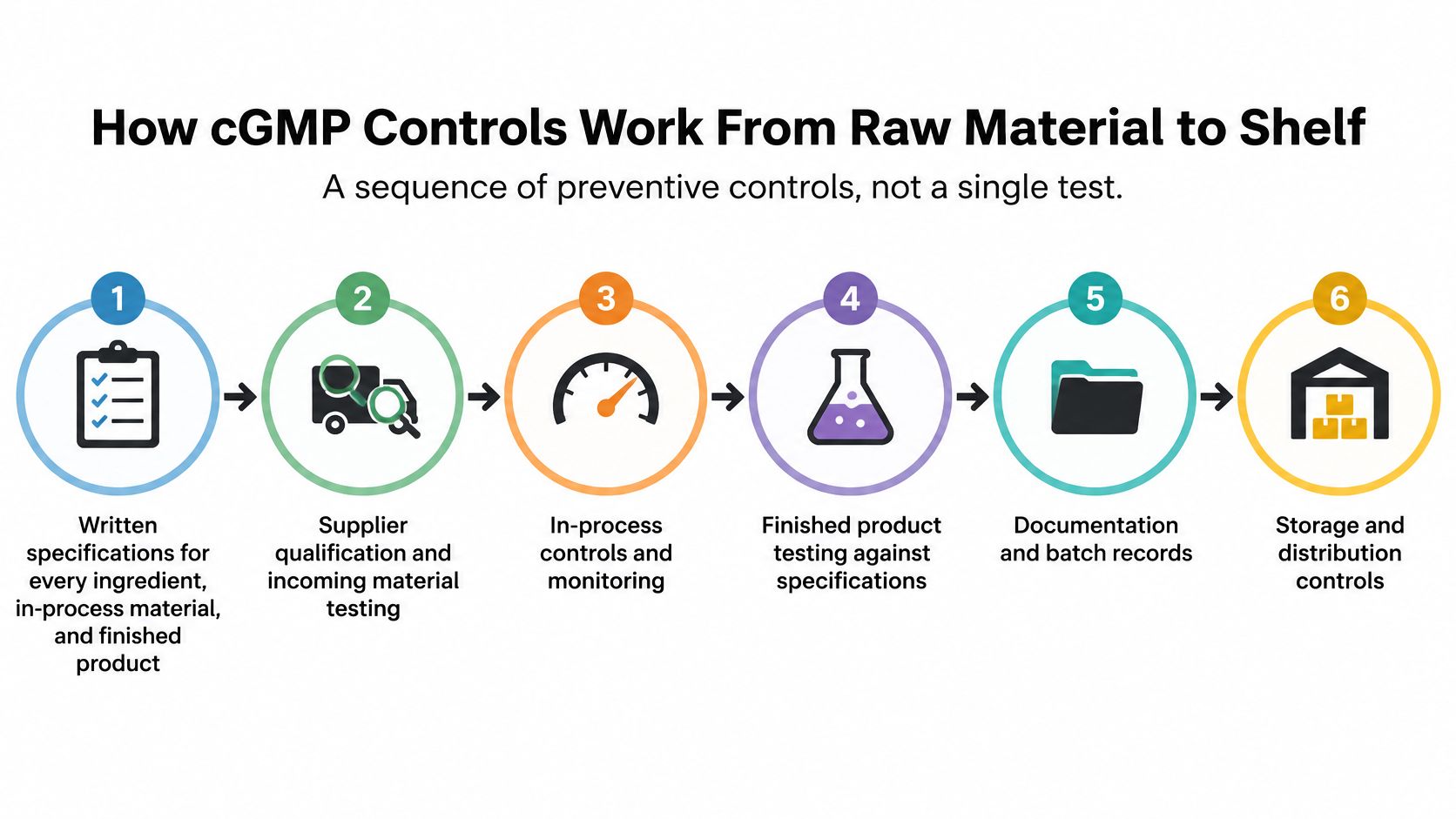
The preventive controls in practice
- Define acceptable materials and products. Written specifications for ingredients, in-process materials, finished products, packaging, and labels prevent staff from accepting materials without clear quality criteria.
- Confirm dietary-ingredient identity. Appropriate identity testing before use, unless FDA grants an exemption, helps prevent a mislabeled or substituted ingredient from entering the formula.
- Follow the master manufacturing record. A controlled set of instructions keeps ingredient quantities and production steps from changing informally between runs.
- Monitor production and equipment. Representative in-process samples where control is necessary, together with routine equipment calibration or inspection, help catch problems such as a drifting fill weight.
- Verify finished-product specifications. Verification using every batch or a statistically sound sampling plan evaluates identity, purity, strength, composition, and contamination limits, helping identify unacceptable finished material.
- Document the work and review it. Production and laboratory records give quality-control personnel evidence to evaluate deviations instead of relying on staff recollection.
- Investigate relevant complaints and returns. Reviewing a reported problem helps determine whether the cause could affect other batches, rather than treating each returned bottle as an isolated event.
- Control packaging, labeling, holding, and distribution. Organized handling helps prevent the correct capsules from receiving the wrong label or deteriorating under unsuitable storage conditions.
Why records matter after shipment
Suppose a manufacturer discovers a problem with an incoming botanical ingredient after using it in production. Staff need to connect that ingredient to affected batches and distribution records. A passing test on an unrelated batch won't answer that traceability question.
For an operational perspective, SIX ERP on recall readiness offers a useful way to think about finding affected products through connected records. It's a traceability resource, not evidence that any particular supplement complies with cGMP.
The accompanying video provides another format for reviewing the manufacturing topic.
The system runs from raw-material receipt through distribution. Testing matters, but so do the instructions, equipment, staff decisions, and records surrounding it.
What a cGMP Label Does Not Prove
The most consequential overreach is treating a manufacturing statement as proof that a supplement works. A well-controlled process can consistently produce a formula whose health benefits remain unproven. Manufacturing quality and clinical usefulness require different evidence.
FDA warning letters, including the Penn Herb Company compliance document, illustrate why actual specifications and quality procedures deserve scrutiny rather than assumptions based on marketing language.
A cGMP claim doesn't establish superior absorption, a beneficial dose, or suitability for every person. It also isn't a promise that every bottle has been individually analyzed.
The distinction is easier to see when manufacturing coverage and health claims are placed side by side.
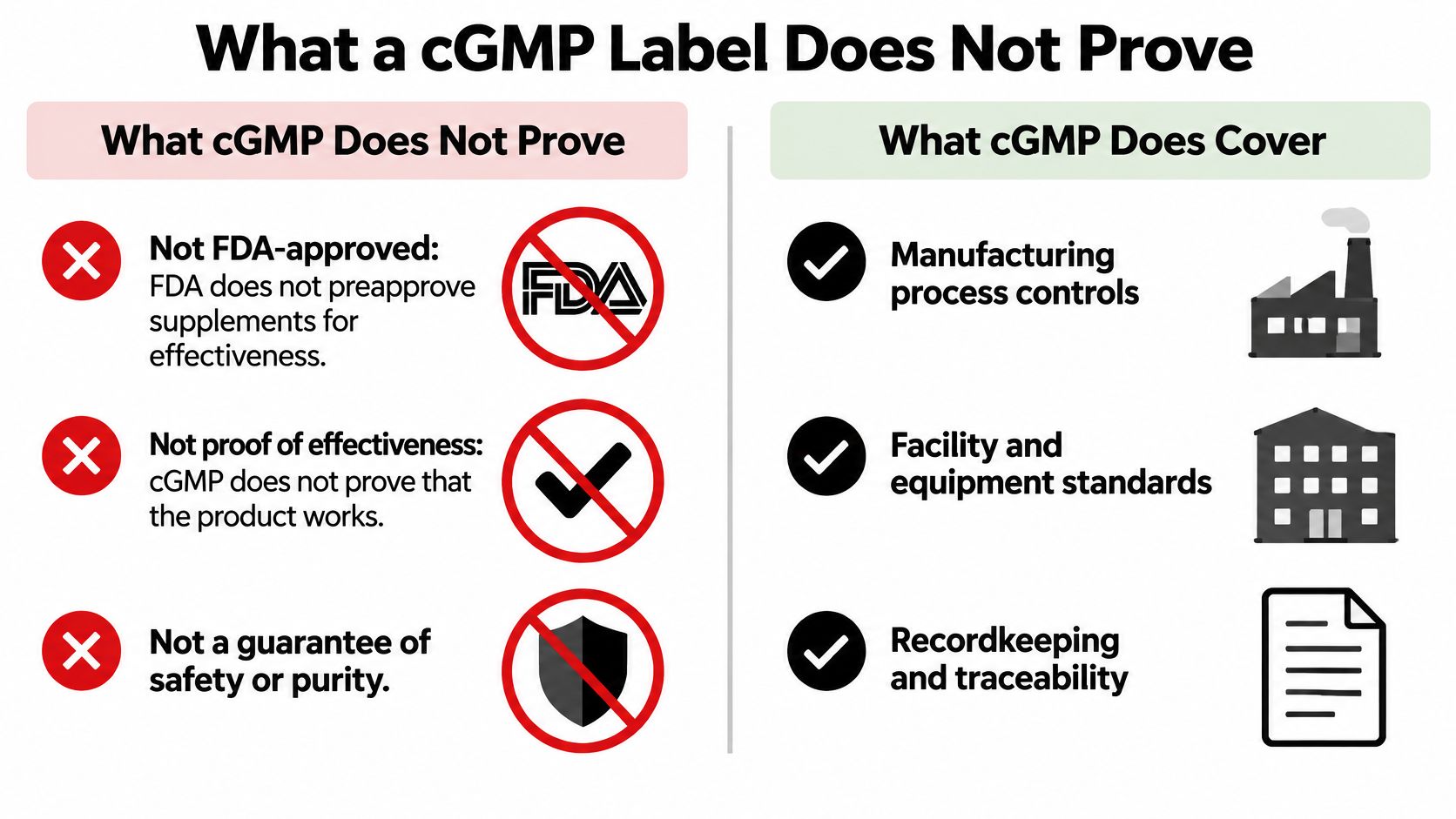
What a supported claim signals
- Controlled production: The manufacturer follows defined procedures rather than improvising the process.
- Documented decisions: Production and quality records support review of what happened.
- Quality checks: Specifications and relevant testing address ingredient identity and contamination risks.
- An identifiable operation: Supporting documentation should connect the claim to a manufacturing site and its covered activities.
What remains unanswered
- Efficacy: Does credible research support the intended benefit?
- Individual response: Do the study population and circumstances resemble yours?
- Dose suitability: Does the product provide an amount relevant to the evidence and appropriate for you?
- Medication compatibility: Could the ingredients present concerns alongside your medicines or health conditions?
For a concrete example, our dietary supplements are not approved by the FDA, but they're manufactured in facilities that follow quality standards. That statement describes manufacturing context; it doesn't claim that FDA has evaluated our products' effectiveness.
For botanicals, amino acids, mushrooms, and multivitamins, avoid replacing ingredient-specific questions with broad quality language. Our discussion of scientifically backed ingredients addresses the separate task of interpreting evidence.
A cGMP label is a process signal, not a medical endorsement or a performance guarantee.
A useful purchasing decision therefore needs both manufacturing documentation and a reasoned assessment of the particular ingredient, formulation, and dose.
Warning Letters That Show What Gaps Look Like
The following FDA warning letters show how inspections can identify deficiencies in supplement manufacturing controls.
FDA warning letter inspections of supplement manufacturers
| Firm | Inspection dates | Reported finding |
|---|---|---|
| Western Innovations | January 29 to February 21, 2024 | The FDA warning letter for Western Innovations reported serious violations of dietary-supplement cGMP requirements under 21 CFR Part 111 following this inspection. |
| Formulation Technology | October 24 to November 9, 2023 | The FDA warning letter for Formulation Technology reported significant violations of dietary-supplement cGMP requirements under 21 CFR Part 111 following this inspection. |
| Restorative Botanicals | November 27 to December 12, 2023 | The FDA warning letter for Restorative Botanicals reported serious violations of dietary-supplement cGMP requirements under 21 CFR Part 111 following this inspection. |
| Txsyn International | October 25 to November 14, 2023 | The FDA warning letter for Txsyn International reported serious violations of dietary-supplement cGMP requirements under 21 CFR Part 111 following this inspection. |
| West Coast Laboratories | October 3 to October 24, 2023 | The FDA warning letter for West Coast Laboratories reported serious violations of dietary-supplement cGMP requirements under 21 CFR Part 111 following this inspection. |
Inspection dates aren't the same as warning-letter dates. The inspection is the period when FDA examines operations and records; the letter communicates the agency's findings afterward. Keep those events separate when evaluating a manufacturer's history.
A warning letter documents regulatory concerns. It doesn't, by itself, establish that a particular customer was harmed or that every product made at the facility had the same defect.
Read findings precisely: Identify the deficient control, the affected operation, and any documented corrective response before drawing conclusions about a product.
The practical lesson isn't that all supplements are unreliable. It's that selling supplements and demonstrating adequate quality controls are different things. A broad claim on a bottle should prompt a search for meaningful supporting documents, not end it.
How to Verify a cGMP Claim Yourself
Start with the bottle and the product page, then compare their wording with supporting documents. Save the product name, lot identifier, and screenshots of the quality claims so you can check whether the documentation matches.
Our guide to how to read supplement labels can help you locate the product information you'll need. Treat a missing detail as an unanswered question rather than filling the gap with an assumption.
Run these checks
- Identify the kind of claim. Decide whether you're reading a statement of compliance, a third-party facility certificate, or a laboratory report; don't treat those documents as substitutes.
- Name the assessor. Find the auditor, certification organization, or testing laboratory, and establish whether it's separate from the brand.
- Match the scope. Compare the facility name and address, covered activities, product description, and lot identifier where applicable; a document for another site or batch doesn't resolve your question.
- Check document dates. Read the audit date, issue date, expiration date if listed, and current status rather than relying on an undated logo.
- Request the available documentation. For some specific products, we may provide additional quality information or certificates upon request if available; specify the product and the claim you want clarified.
- Match evidence to your decision. Use a facility audit to assess manufacturing oversight, a relevant batch report to assess listed test results, and ingredient research to consider potential benefit.
For an example of how a supplier presents certification information in another ingredient category, review Allive's hemp quality certifications. Use it to practice reading scope and documentation, not as an endorsement of an unrelated supplement.
Red flags worth investigating
- Unnamed authority: Pharmaceutical-grade wording without a defined standard or named assessor.
- Unverifiable seal: A certification logo without supporting certificate details.
- Mismatched documents: A report for a different product, location, or lot.
- Disease promises: Statements that a supplement treats or cures a disease.
- Unsupported certainty: Claims that manufacturing certification guarantees results.
FDA warning letters are public, so search the manufacturer's name in FDA's records too. A refusal to clarify documentation is worth noting, although unavailable public documents alone don't establish noncompliance.
Confirm the Label Before You Buy a Supplement
Before buying, apply the checklist to the exact product in front of you. A brand's reputation can set expectations, but the bottle, lot, and claim decide what is supported.
When you ask, “What does cGMP certified mean?”, sort the answer into three decisions: whether the facility is controlled, whether this batch was tested, and whether the ingredient evidence fits your goal. A supplement can clear one question and still leave the other two open.
Is the manufacturing process controlled?
Look for explicit compliance language and documentation that identifies the manufacturing facility. If a private certificate is displayed, compare its scope with the activities behind that product: receiving, blending, encapsulation, packaging, testing, or only part of that chain.
Scope matters outside supplements too. Requirements such as child-resistant THCA packaging rules show that compliance language belongs to a defined product and context. Treat every seal the same way: ask what it covers, who issued it, and whether it reaches the item you plan to buy.
What evidence describes the batch?
Ask for a laboratory report that matches the product and lot, with named tests, results, and acceptance limits. Read the coverage line by line rather than assuming that “tested” means screened for every possible problem.
If the document covers only selected contaminants, it does not answer every ingredient-strength question. If it lists ingredient strength alone, it does not settle contamination questions. The test list defines the report's reach.
Is there evidence for the intended benefit?
Check research on the specific ingredient, preparation, dose, and intended use. A study of a different botanical extract or formula may describe a related idea without answering the question raised by the bottle in your hand.
A label can identify ingredients and summarize quality claims. It cannot show that a product will change your energy, recovery, circulation, or mood. If you have a health condition or take medication, consult a healthcare professional before starting any supplement.
Write down what you know about the facility, the batch, and the evidence for your goal. Mark unanswered questions instead of treating them as confirmed facts.
Keep that short record beside your shopping comparison. Decide only after each question that matters to you has a clear answer, and postpone the purchase when an important claim remains unsupported.
NexiHerb LLC offers science-inspired dietary supplements and practical nutrition guides to help adults make informed everyday wellness choices. NexiHerb dietary supplements are not approved by the FDA, but they are manufactured in facilities that follow quality standards. Visit NexiHerb LLC to review product labels, compare ingredients with your goals, and request additional quality information for specific products where available.