

Have you ever turned a men's multivitamin bottle over and looked for the word energy in the Supplement Facts panel? It isn't there. What's there is a list of vitamins and minerals with milligram amounts and percentage Daily Values, because that's what a supplement physically contains. Energy isn't an ingredient you can put in a capsule.
That gap between the front label and the back panel is where most of the confusion about a men's multivitamin for energy begins. The front promises a lift. The back lists nutrients your cells use to extract energy from food. Those two things are related, but they aren't the same, and treating them as the same is how men end up buying a stimulant-heavy product when what they needed was a three-day food diary and a blood test.
The order below matters. First, what a multivitamin does and doesn't do for energy. Then the mechanism, explained without biochemistry jargon. Then which men are most likely to notice a difference, how to separate deficiency-driven tiredness from tiredness with another cause, and how to read a label without overshooting the upper limits.
Table of Contents
- Does a Men's Multivitamin Really Boost Energy?
- How Micronutrients Keep Energy Metabolism Running
- Which Men Are Most Likely to Benefit
- Fatigue Linked to Deficiency and Other Causes
- Label Checks and Upper Limits
- Choosing a Formula and Checking Your Labs First
Does a Men's Multivitamin Really Boost Energy?
No, not in the way the front label implies. A men's multivitamin doesn't act like a stimulant, and it won't reliably produce a same-day lift in a man whose diet already covers his needs. It works by filling nutrient gaps, so whether you feel anything depends almost entirely on your starting nutritional status.
A stimulant and a nutrient do different jobs. Caffeine blocks the receptors that make you feel drowsy, and the effect arrives within the hour and fades by evening. A vitamin or mineral is a raw material your cells use to run the reactions that convert food into usable energy. When the raw material is already stocked, adding more doesn't speed the reaction up.
The table below sets out what each energy-related nutrient does.
| Nutrient | Role in Energy Metabolism | What It Means for Energy |
|---|---|---|
| Iron | Carries oxygen via hemoglobin | Low iron can cause weakness and reduced exercise performance |
| Vitamin B12 | Supports red blood cell formation and nerve function | Deficiency can cause fatigue, and symptoms can take years to appear |
| B-complex vitamins (B1, B2, B3, B5, B6, biotin) | Act as coenzymes in carbohydrate, fat and protein metabolism | Provide no calories; effect depends on existing status |
| Zinc | Cofactor for many enzymes | Adds no energy by itself; excess intake can cause harm |
| Vitamin D | Supports bone and muscle function | No consistent link to fatigue in population data |
The distinction matters because supplement use is now mainstream. The CDC's National Center for Health Statistics reported that 50.8% of men aged 20 and older had used at least one dietary supplement in the previous 30 days, with use climbing from 35.9% among men aged 20 to 39 to 67.3% among men aged 60 and older. Most adult men are already taking something. Volume of use is not evidence of effect.
CDC materials also list increasing energy among the reasons people give for taking supplements. That tells you what buyers hope for. It doesn't tell you what a tablet does inside a well-fed body.
Why the honest claim is the modest one
"Supports normal energy metabolism" is defensible wording because it describes a nutrient's role in a pathway. A promise of immediate energy is not, because it describes a stimulant effect that vitamins and minerals don't produce. When a men's multivitamin for energy leans hard on the second kind of language, that's a signal about the marketing rather than the formula.
A multivitamin supplies building blocks. It isn't fuel, and it isn't a stimulant.
Two checks are worth running before you buy anything. Ask whether your diet covers iron, B12, the B group, zinc and vitamin D on most days, since a gap in one of those is the only realistic route to a noticeable difference. Then ask whether your tiredness has an obvious cause, such as short sleep, a training ramp or a new medication, because a capsule can't fix a cause it never reaches.
How Micronutrients Keep Energy Metabolism Running
Think of cellular energy production as an assembly line. Food arrives as raw material, and each station on the line needs a specific helper to keep moving. B vitamins act as coenzymes that shuttle fuel molecules through their reactions. Zinc sits inside enzymes at several stations along that line. Iron is the cargo handler delivering oxygen so the whole operation can run at all.
The concept map below shows where each helper sits and what happens when one goes missing.
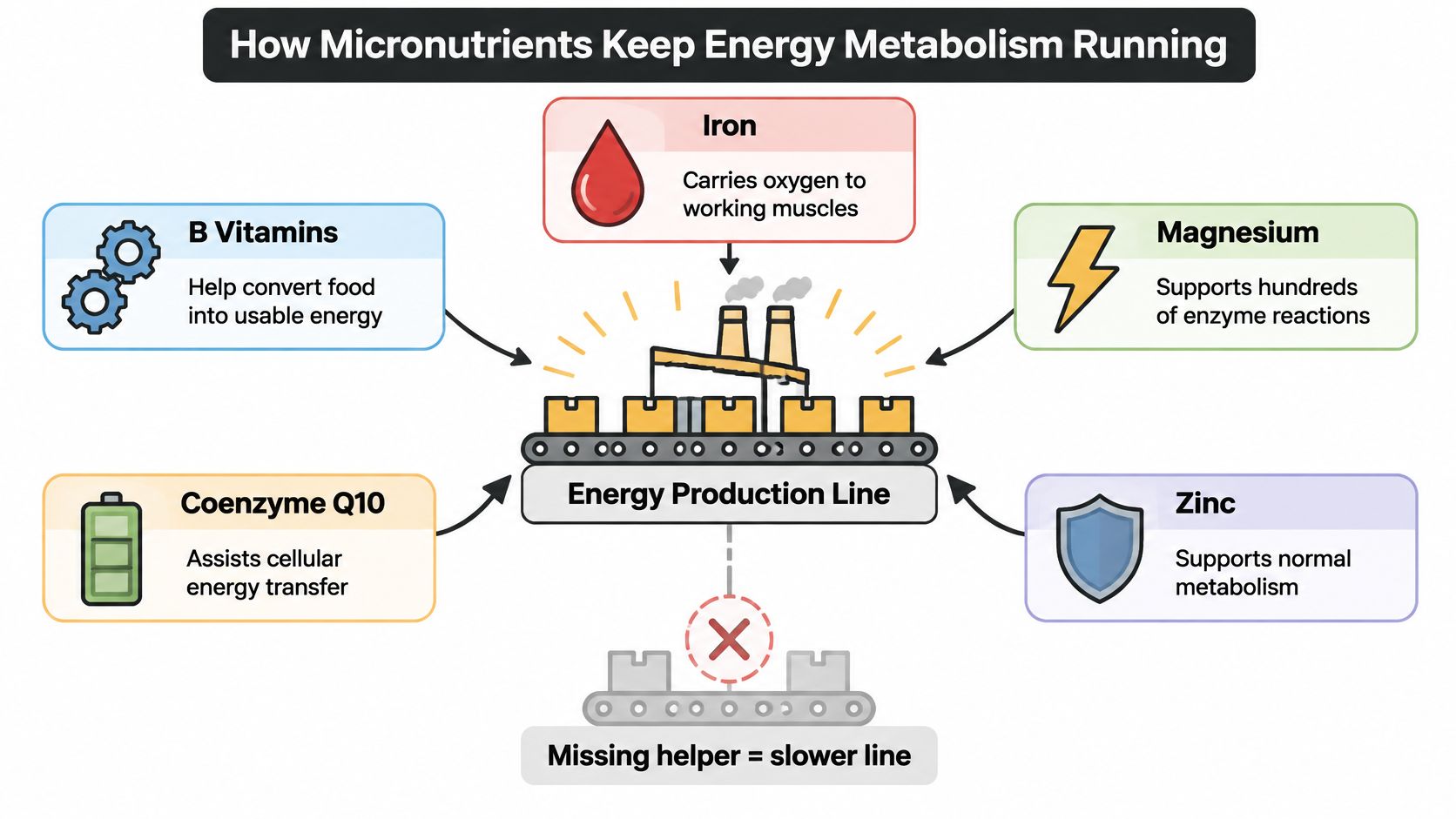
A missing helper slows the line, a surplus doesn't speed it up
This is the part that separates nutrient correction from stimulant marketing. An assembly line running at design capacity doesn't go faster because you add a second worker to a station that already has one. The line speeds up only when a station was short. Micronutrients behave the same way. Your body uses what it needs, clears the surplus through normal routes, and doesn't convert the extra into additional energy.
Iron shows the mechanism most clearly. The NIH Office of Dietary Supplements iron fact sheet describes the sequence:
- Iron availability falls. Stores deplete and hemoglobin production drops.
- Oxygen-carrying capacity falls. Fewer red blood cells carry less oxygen to working muscle.
- Exertional strain rises. The same workload feels harder, concentration slips, and perceived fatigue follows.
That chain only runs in one direction when a deficiency already exists, which is also why iron isn't a supplement every man should reach for. Excess iron can be harmful, and tiredness with a non-nutritional cause won't respond to it at all.
Practical rule: more iron doesn't mean more energy. Read the Supplement Facts panel, count how often you actually eat red meat, beans or fortified cereal, and get a clinician's view before starting a high-iron product for persistent tiredness.
Fuel is the other half of the equation. A line with every helper in place still stalls on an empty tank. If you don't know roughly how much you eat in a day, start there, and this guide to working out your daily calorie needs gives you a number to build meals around before you spend anything on capsules.
Vitamin D sits further upstream, in muscle and bone function, and its relationship with tiredness is muddier than most product pages admit. The connections between vitamin D and the B group are worth understanding in their own right, and this guide to vitamin D and B vitamins covers how they interact.
For a walk-through of the same process at the cellular level, the video below is a useful companion.
Now name your own weakest station. A man training hard four or more days a week sweats out more minerals and turns over more iron than a sedentary man, so his line runs at higher throughput and higher demand. A man who eats little meat or restricts overall intake has less raw material arriving each day. A man in his sixties may absorb B12 from food less efficiently than he did at thirty. Same line, different bottleneck, and the fix depends on which one is yours.
Which Men Are Most Likely to Benefit
Multivitamin use rises steadily with age. NHANES data covering 2017 to 2018, summarized by the NIH Office of Dietary Supplements found that 24.0% of adults aged 20 to 39, 29.8% of adults aged 40 to 59 and 39.4% of adults aged 60 and older had used a multivitamin or mineral supplement in the previous 30 days.

The more useful figure is the size of the effect. The same NIH review of NHANES findings reported that approximately 74% to 76% of men already had adequate average intakes of the 17 nutrients examined from food alone, and that adding a multivitamin lifted the share with adequate intake to 84%. That is a real gain of roughly eight to ten percentage points, and every point of it lands with the men who had gaps. A multivitamin corrects a shortage; it does not produce a lift the way a stimulant does. For a man whose diet already covers those nutrients, the capsule changes very little.
Four men who may notice a difference
The narrow eater. If most of your meals come from a short list, or you avoid animal foods altogether, B12, iron and zinc are the nutrients most likely to run short. A three-day food log answers this faster than any quiz: write down what you eat, then mark which of the five nutrients from the opening table show up. The answer usually appears before the list is finished.
The heavy trainer. High-volume endurance work and frequent heavy lifting raise what your body asks of your diet, week after week. The tell is timing. If the tiredness arrived in the same month your training volume jumped, and your rest days shrank at the same time, the gap is more likely demand than diet.
The man over 60. Appetite tends to fall with age, and the plate often gets smaller along with it. Start with the plate, not the bottle: look at protein and total calories first, since a multivitamin does not fix undereating or make up for meals that have shrunk.
The man with a confirmed deficiency. A blood test showing low ferritin, low B12 or low vitamin D gives you a target rather than a guess. Bring the result back to the clinician who ordered it before choosing a dose, because correcting a diagnosed deficiency is a clinical decision.
There is a ceiling to this logic. In the same review's figures for supplement users, 10% to 15% had excessive intakes of vitamin A, iron or zinc, while 48% to 61% had excessive niacin intake. Stacking a second product or a high-dose B complex on top of a multivitamin is exactly how that happens. And fatigue with no clear cause should be evaluated properly before another supplement joins the pile.
Fatigue Linked to Deficiency and Other Causes
Vitamin B12 supports normal red blood cell formation and neurological function, so low status affects energy through megaloblastic anemia and reduced oxygen delivery. NIH data from NHANES 2007 to 2018 estimated vitamin B12 deficiency, defined as serum B12 below 200 pg/mL (148 pmol/L), in approximately 3.6% of U.S. adults aged 19 and older.
That's a small share of the population, but the symptom pattern matters more than the prevalence. B12 deficiency can cause fatigue, palpitations, neurological changes and megaloblastic anemia, and symptoms can take years to appear. A man can feel steadily worse for a long stretch without ever connecting it to what's on his plate.
Why a normal diet can still leave a gap
Absorption is the usual culprit rather than intake. B12 depends on a sequence of steps through the stomach and small intestine, and a break anywhere along that chain lowers how much you absorb from food no matter how good your diet looks on paper. Men who eat little or no animal food are the obvious group, and they're also the group where a supplement is most clearly useful.
The harder question is whether tiredness comes from a nutrient at all. Use the table to match what you're feeling against the most likely cause before you change anything.
| Possible Cause | Signs to Notice | Next Step |
|---|---|---|
| Low vitamin B12 or iron | Tiredness with pale skin, palpitations or numbness (B12); breathlessness on exertion (iron) | Ask for blood tests before raising supplement doses |
| Poor sleep or heavy training load | Fatigue after short sleep or a recent rise in training volume | Adjust sleep and training, then reassess over several weeks |
| Low mood or depression | Low interest, low mood or poor sleep lasting weeks | Talk with a clinician; a multivitamin is not a treatment |
| Medication side effects | Fatigue beginning after a new prescription or dose change | Review the medication with the prescriber or pharmacist |
| Medical condition | Persistent fatigue alongside other unexplained symptoms | Clinical evaluation; do not escalate supplement doses |
Three actions that beat another bottle
- Write down the timeline. Note when the fatigue started, what else changed that month, and whether it's steady or comes in waves. Patterns point at causes faster than a symptom checklist does.
- Ask about blood tests. A clinician can order B12, iron studies and vitamin D, which is the only way to know whether a deficiency is present rather than suspected.
- Review medications with a pharmacist. Fatigue that began after a new prescription or a dose change has an obvious first suspect, and a pharmacist can spot interactions no label will flag.
Hormonal causes sit outside the nutrient list entirely. Tiredness that arrives alongside shifts in mood, body composition or libido deserves a different conversation, and this overview of treatments for hormone-related fatigue explains what those evaluations typically involve.
If you plan to look at supplements anyway, do it informed. This comparison of supplements used for fatigue is worth reading beside the table above, so you can see which options carry evidence and which are pure marketing.
Persistent fatigue, weakness, paleness or neurological symptoms call for clinical assessment, not a bigger dose.
None of this makes a multivitamin useless. It makes it a small, low-risk step that belongs after the obvious causes have been considered, not before.
Label Checks and Upper Limits
The most informative column on a supplement panel is the %DV, the percentage of a nutrient's daily requirement that one serving covers. It works like a fuel gauge: two formulas can promise the same things on the front of the bottle while one fills each nutrient to half a tank and the other overshoots several times over. Reading that column first is also how you spot where stimulant-style claims end and actual nutrient correction begins, because a vitamin percentage describes a gap being filled, not a feeling being produced.
Everything else on the panel, including the safety limits below, is measured against those percentages. Run the checklist in the aisle, before anything goes in the basket.
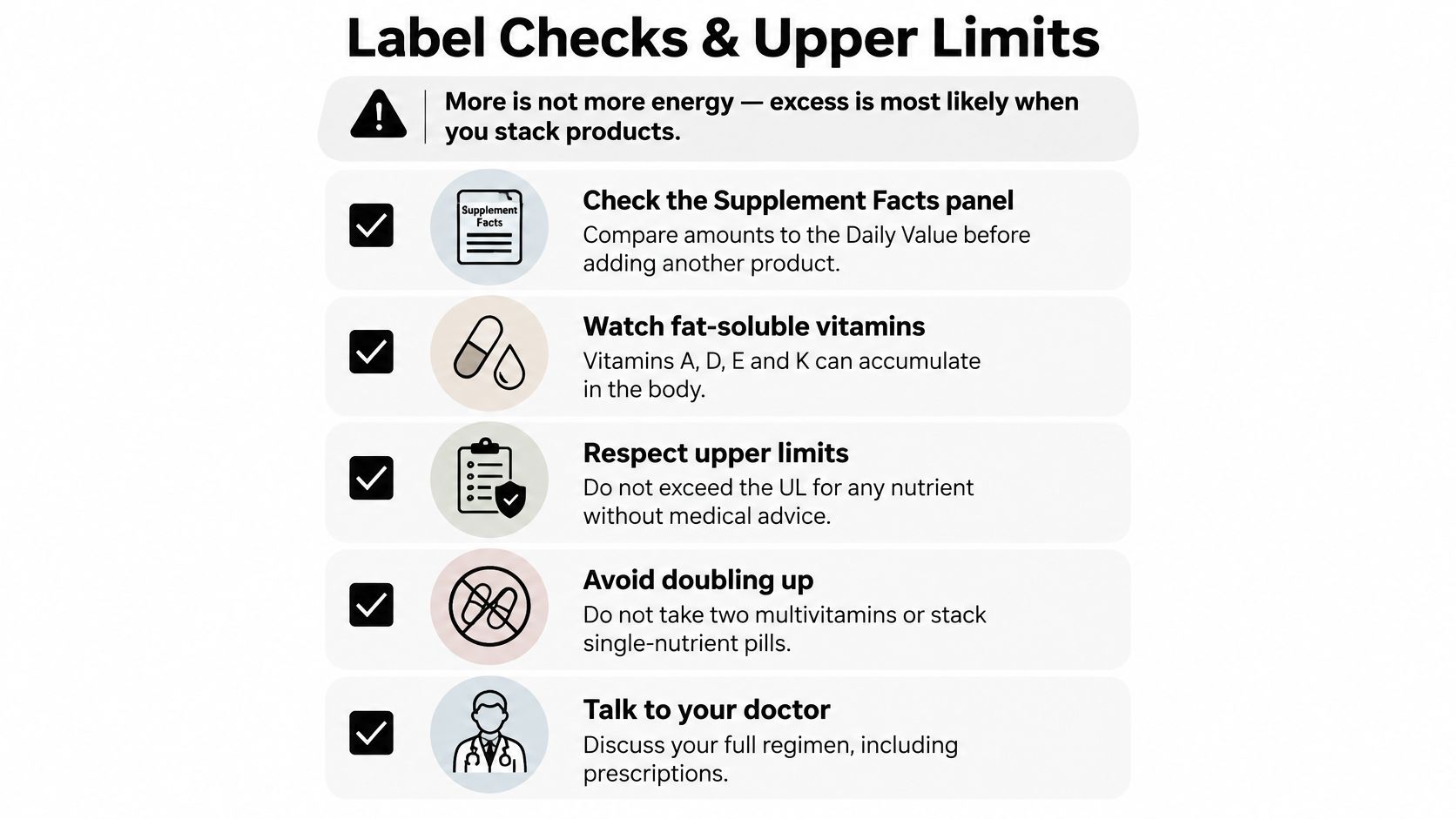
The five checks that catch most problems
- Compare each amount with its Daily Value. Reaching 100% of several nutrients isn't automatically better than reaching 50%, and a formula printing four-digit percentages is telling you about its marketing rather than its usefulness.
- Look for clear numbers on iron, B12 and folate. If those three sit inside a proprietary "energy blend" with no amounts listed, you can't compare the product to anything, including the other supplements already in your cabinet.
- Separate stimulants from vitamins. Caffeine, guarana and green tea extract are their own category. If a formula contains them, judge it as a caffeinated product, because that's the part you'll feel within the hour.
- Confirm the serving size. Most men's formulas are one capsule or tablet daily, and a label listing two or three per serving changes every number on that panel.
- Read the claim and the disclaimer together. "Supports normal energy metabolism" is a nutrient statement. A promise of immediate energy is a stimulant claim. The not-intended-to-diagnose, treat, cure or prevent any disease statement should also be present.
What the upper limits actually say
Tolerable upper intake levels exist for the nutrients most likely to be overdone, and they're set for daily intake over time rather than for a single dose. The adult figures below are drawn from the NIH Office of Dietary Supplements nutrient recommendations, which publish the tolerable upper intake level for each vitamin and mineral.
| Nutrient | Upper Limit for Adults | Practical Risk at High Intake |
|---|---|---|
| Niacin (vitamin B3) | 35 mg per day from supplements and fortified foods | Flushing and liver effects at high doses |
| Iron | 45 mg per day | Harm in men who do not need extra iron |
| Zinc | 40 mg per day | Can reduce copper absorption |
| Preformed vitamin A | Applies to preformed retinol only, not beta-carotene | Toxicity from excess retinol |
Iron is the nutrient most likely to arrive from several directions at once, since a multivitamin, a standalone iron tablet and a fortified breakfast cereal all feed the same daily total. Zinc has a similar overlap problem, because sustained intake near its ceiling interferes with copper absorption over time. The men who benefit from a multivitamin differ from the men who don't: someone correcting a genuine shortfall stays well under these numbers, while someone adding a full-dose formula on top of an adequate diet drifts toward them.
Add up a week before you add a product
Do the arithmetic once. List every product you swallow in a week with each nutrient's daily amount, then add them together. Include the standalone B complex, the iron tablet, the pre-workout powder and the multivitamin, because men rarely count the powder as a supplement even though it belongs in the total. Compare the sum against the limits above, and treat any nutrient running over as a reason to simplify rather than to add.
Before you buy a second bottle: if two products list the same nutrients, you're stacking, not covering.
Anyone already taking higher doses, or taking a formula alongside a prescription, should ask a clinician before continuing. A pharmacist can review the whole list in a single appointment, and this guide to how to read supplement labels walks the panel line by line if you want to check your own bottles tonight.
Choosing a Formula and Checking Your Labs First
Picking the bottle is the last step, not the first. Three steps in sequence resolve most of the confusion around a men's multivitamin for energy.
- Audit your diet first. Return to the nutrient list near the top of this guide and mark which of those five you eat on most days. If the answer is all five, a multivitamin is insurance rather than a fix.
- Get tests before a high-dose product. If fatigue has lasted more than a few weeks, work through the causes table and ask a clinician about B12, iron studies and vitamin D. A blood test answers the question that raising a dose cannot.
- Then run the label checklist. Clear amounts, no hidden blends, and no nutrient pushed past its upper limit once everything else you take is added in.
The evidence supports that restraint. The NIH multivitamin review notes that multivitamins can improve nutrient adequacy while most studies haven't found broad effects on measured health outcomes. Population research has also failed to find a consistent link between vitamin and mineral supplement use and whether fatigue appears or resolves. A supplement works best as targeted correction of a real gap, not as a universal lift for every tired man.
If you do choose a formula, test it against the checks rather than against the advertising.
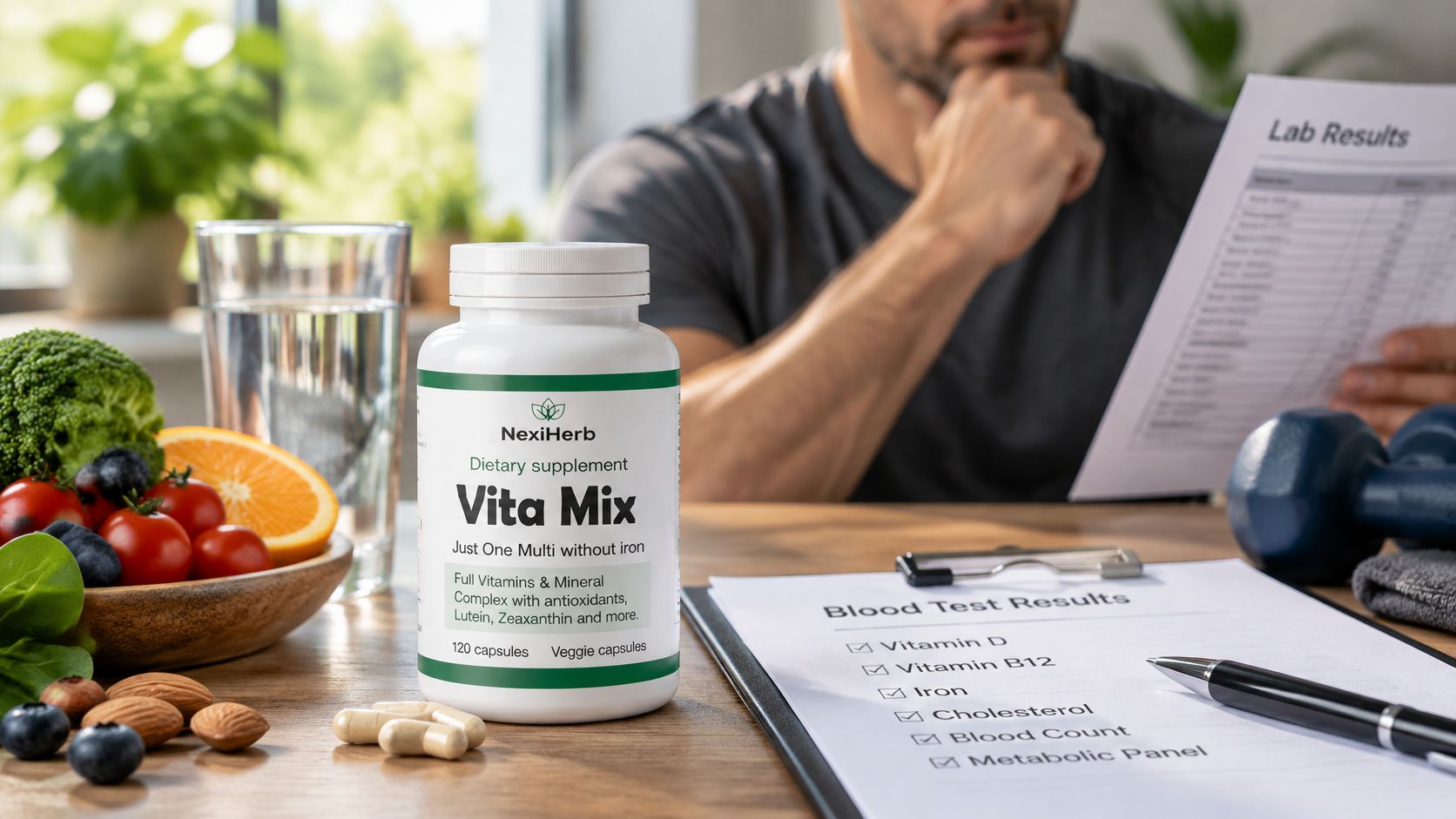
Vita Mix NexiHerb Multivitamin & Mineral Dietary Supplement is one product you can run through the checklist as an exercise. It's a multivitamin and mineral supplement currently priced at $21.99, and NexiHerb presents its male vitality collection supplements without making medical or therapeutic claims. That framing is the right one for any multivitamin: it fills documented gaps rather than promising stimulant-style energy.
Judge whatever you choose over a few months, with your clinician's input if you started because of fatigue. A same-day feeling isn't a realistic measure, and slow improvement isn't proof either, since sleep, training and diet shift on the same timeline. What you can measure is coverage: fewer gaps in your diet, and a clearer picture from a repeat blood test if the first one was abnormal.
NexiHerb LLC stocks daily multivitamins, minerals and targeted formulas for adults who want one sensible base instead of a cabinet full of half-used bottles, and every product is positioned as a complement to a varied diet and a steady routine rather than a treatment. If the label checks and diet audit above pointed to gaps you can name, browse the full catalog at NexiHerb LLC and compare nutrient panels side by side. Start with a single product, give it a few months, and let your food intake and your lab results tell you whether it's earning its place.