

Two bottles sit side by side on the same shelf, and both advertise 1,000 mg of fish oil in large type. One delivers 300 mg of EPA and 200 mg of DHA per softgel. The other delivers 180 mg of EPA and 120 mg of DHA. Which one is the better buy?
Neither, until you know what you're buying it for. That's the gap in most omega 3 EPA vs DHA advice: shoppers get taught to choose "fish oil" as if it were a single ingredient, when the two fatty acids doing the work have different structures, different jobs and different research records.
Get the distinction right and the shelf stops being confusing. You'll know whether your goal is served by EPA, by DHA, or by both, and you'll know how to check whether a capsule delivers the amount.
Table of Contents
- EPA and DHA Side by Side and What Each Does
- How Each Fatty Acid Affects Triglycerides and LDL
- Food Sources and How Much Each Gives You
- Which Ratio Fits Your Situation
- Safety, Interactions and Quality Concerns
- Read the Label and Decide Before You Buy
EPA and DHA Side by Side and What Each Does
The two names usually appear on the back panel in small type, printed as one combined number, as though they were the same substance counted twice. They aren't. The NIH Office of Dietary Supplements consumer fact sheet treats them as distinct long-chain omega-3 fatty acids rather than interchangeable nutrients, and the chemistry explains why: EPA carries 20 carbon atoms and 5 double bonds, while DHA carries 22 carbons and 6 double bonds.
Here's the reference version, worth keeping in mind the next time a label starts throwing around words like "concentrated" or "high potency."
| Attribute | EPA | DHA |
|---|---|---|
| Full name | Eicosapentaenoic acid | Docosahexaenoic acid |
| Carbon atoms and double bonds | 20 carbons, 5 double bonds | 22 carbons, 6 double bonds |
| Main biological role | Precursor to signaling molecules in inflammatory and vascular regulation | Structural component of cell membranes, especially in the brain and retina |
| Conversion from plant ALA | Limited and variable | Limited and variable |
| Recommended daily intake | No separate established intake; seafood emphasized | No separate established intake; seafood emphasized |
What the extra carbons buy you
DHA's longer, more unsaturated chain is what makes it useful as a building block. It sits in cell membranes throughout the body, with its heaviest concentration in the brain and retina, where its highly unsaturated structure supports membrane fluidity. That's a structural job, and you can't swap in a different fatty acid to do it.
EPA works through a different route. It's the starting material for signaling molecules involved in inflammatory and vascular regulation, which is why so much of the clinical literature on EPA sits in cardiovascular and lipid research rather than in neurodevelopment.
Where plant omega-3s fall short
Flaxseed, chia, walnuts and hemp supply alpha-linolenic acid (ALA), and the body can convert some of it into EPA and DHA. The word "some" is carrying a lot of weight there. The same NIH fact sheet describes that conversion as limited and variable, which makes preformed EPA and DHA from fish, seafood or algae the principal way people raise their intake of either.
A practical test before you compare bottles: if your goal is membrane and tissue support, DHA is the fatty acid to look at first. If your goal is inflammatory and vascular regulation, EPA is.
What official guidance does and doesn't say
The NIH states plainly that no universally established recommended daily intake exists specifically for EPA or DHA. Official guidance tends to emphasize seafood consumption rather than a single supplement target, which is why you'll see "eat fish twice a week" far more often than a milligram figure on a government page.
That absence isn't an oversight. The evidence base is organized around food patterns and around specific clinical populations, not around one universal capsule dose. So a formula with more DHA isn't automatically equivalent to one with more EPA, because the two molecules land in different tissues and have been studied for different things. Compare the actual milligrams of EPA and DHA separately, never the total fish oil weight.
How Each Fatty Acid Affects Triglycerides and LDL
Start with the effect both fatty acids share. EPA and DHA each lower triglycerides, the most consistent lipid finding in the omega-3 literature. The split appears in LDL cholesterol, where the same dose can nudge two related measures in different directions.
In a systematic review of randomized trials, DHA raised LDL cholesterol by an average of 7.23 mg/dL versus placebo, while EPA's LDL change was not statistically significant, and in direct EPA-versus-DHA comparisons DHA raised LDL by 4.63 mg/dL more. DHA also tended to produce the larger triglyceride reduction across pooled results, with a greater tendency to push LDL cholesterol upward as the trade-off.
The head-to-head numbers are the part worth slowing down on. In the head-to-head trial data, EPA-rich and DHA-rich fish oils both reduced plasma triglycerides by about 14.1% from baseline, with no statistically significant difference between them on the primary triglyceride outcome; the DHA-rich oil produced a slightly higher on-treatment LDL-particle number, while the EPA-rich oil more strongly reduced HDL proteins associated with inflammation and increased apolipoprotein M relative to DHA.
| Outcome | EPA | DHA |
|---|---|---|
| Triglycerides | Lowers; about 14.1% in a head-to-head trial with no significant gap from DHA | Lowers; about 14.1% in the same trial and generally the larger reduction across pooled reviews |
| LDL cholesterol | No significant change in the systematic review | Raises by an average of 7.23 mg/dL versus placebo |
| LDL particles | Lower on-treatment LDL-particle number than the DHA-rich oil in that trial | Slightly higher on-treatment LDL-particle number in that trial; LDL increases may involve larger particles |
| Inflammation-linked HDL proteins | Stronger reduction and increased apolipoprotein M in the head-to-head trial | Smaller effect than EPA in the same trial |
Why the LDL signal looks worse than it is
An LDL rise on DHA is a different signal from an LDL rise driven by a diet heavy in saturated fat. When DHA pushes LDL cholesterol up, the increase may involve larger LDL particles, and larger particles are generally considered less atherogenic than small, dense ones. LDL cholesterol is reported in mg/dL, while LDL-particle number counts particles, so a single LDL-cholesterol figure still matters yet tells you less than particle number, triglycerides and baseline risk together.
What this means when you choose a formula
An EPA-dominant formula fits a goal of triglyceride support without an emphasis on LDL. A DHA-containing formula fits a broader triglyceride goal, or a goal built around DHA's structural role. Actual effects depend on dose, baseline lipids, formulation and whatever else you are taking, so a lipid panel is far more actionable than a guess.
Judge with a blood test. Pick a dose, hold it steady for the full trial period, then recheck fasting triglycerides and LDL before you decide whether the product worked.
If you are weighing other products aimed at the same system, the guide to heart health supplements explains where omega-3s fit alongside them. The main mistake is assuming every fish oil behaves identically.
Food Sources and How Much Each Gives You
A 100-gram portion of oily fish and a 100-gram measure of capsule oil are far apart as doses. A 2025 peer-reviewed comparison of fish and supplements reported that fish species contained 9–14 mg of EPA and 9–25 mg of DHA per gram, while fish-oil capsules contained 142–176 mg of EPA per gram.
Scaled to the way people eat and dose, capsule oil carries roughly 10 to 20 times more EPA per gram of material than fish flesh does.
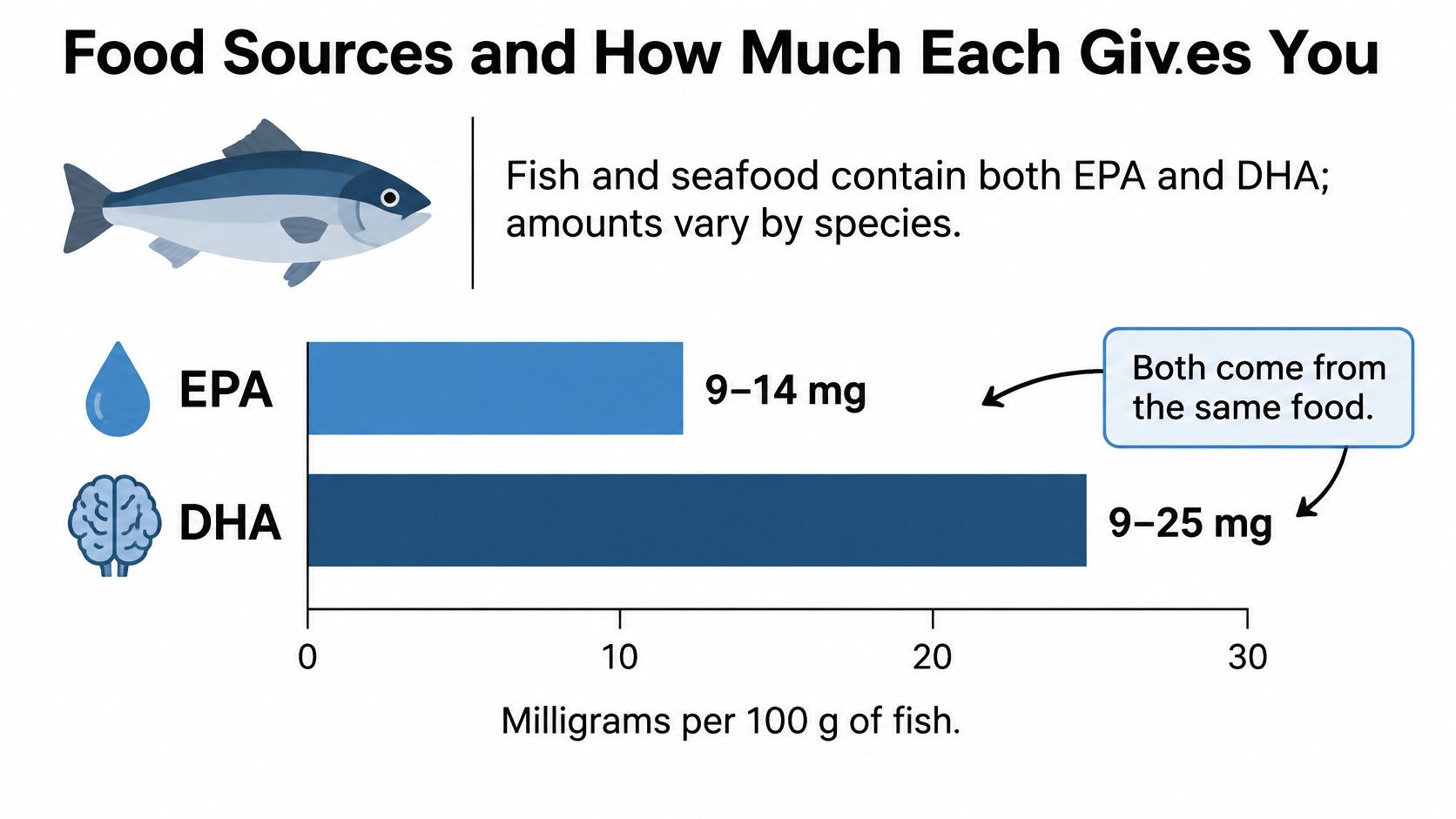
Read those figures with the denominator in mind, because that is where most of the confusion starts. They are per gram of material rather than per serving, and a fillet and a softgel sit on different scales. Convert both to a real portion before you compare them: at 9–14 mg per gram, a 100-gram fillet works out to roughly 900–1,400 mg of EPA, while a single gram of capsule oil supplies 142–176 mg.
| Source | EPA per gram | DHA per gram |
|---|---|---|
| Fish species | 9–14 mg | 9–25 mg |
| Fish-oil capsules | 142–176 mg | Varies by product; listed on the supplement facts panel |
Why so many people still fall short
A 2025 review summarized by the Global Seafood Alliance found that 76% of people worldwide fell below recommended EPA and DHA intake levels, with 250 mg/day of combined EPA and DHA identified as the most common adult target. That target is low enough that two oily fish meals a week cover it comfortably, and high enough that a diet without fish rarely reaches it.
A short exercise worth ten minutes
- Count your fish week. Write down how many meals in the past seven days included oily fish such as salmon, mackerel, sardines or herring. Be honest about the breaded fish sandwich.
- Do the arithmetic on the target. If you eat fish once a week or less, the gap between your intake and the common adult target of 250 mg/day is real, and it is the number that justifies a capsule.
- Treat the supplement as a gap-filler. Its job is to close what your plate leaves open, with a varied diet doing the rest of the work.
Fish is one protein among several on the plate, and the rest of your diet still matters. If you are reworking breakfast while you rebalance fats, this overview of the benefits of farm fresh eggs explains what eggs contribute and where they fall short on the omega-3 front.
Which Ratio Fits Your Situation
A healthy adult, a pregnant reader and someone with very high triglycerides should not be choosing the same bottle. The right ratio follows the goal, not a generic omega-3 claim on the front of the box.

Start with what the 2024 review of EPA and DHA evidence says. Both fatty acids lower triglycerides, DHA may have a slightly stronger triglyceride effect and may reduce heart rate and blood pressure more effectively, and DHA-rich intake is particularly relevant to maintaining tissue DHA, which makes it more relevant during pregnancy. A 2025 meta-analysis of randomized trials reported in the same review found that purified EPA was associated with a larger reduction in cardiovascular-attributable mortality than combined EPA/DHA formulations, with a hazard ratio of 0.79 for EPA versus 0.92 for EPA/DHA.
That hazard ratio is not a shopping instruction. The trials behind it used purified prescription EPA in defined patient groups, and those results can't be transferred automatically to over-the-counter mixed oils. The Alpha Omega Trial shows why dose and population matter so much: 4,837 older adults who had already had a myocardial infarction took 226 mg EPA plus 150 mg DHA daily for 40 months, and the regimen did not significantly reduce major cardiovascular events compared with placebo. Same fatty acids, different dose, different population, different answer.
| Situation | Main Question | Ratio to Check | Clinician Role |
|---|---|---|---|
| Healthy adult who eats little fish | Closing the seafood gap toward the common adult target | Balanced EPA and DHA, totaled against the daily target | Not usually needed |
| Pregnancy or breastfeeding | Supporting tissue DHA | DHA-containing product with listed milligrams | Discuss with the prescriber before starting |
| Elevated triglycerides | Lowering triglycerides without raising LDL | EPA-dominant formula, checked against a lipid panel | Required for very high levels; monitor results |
| Established heart disease | Evidence from clinical outcome trials | Purified EPA only under medical guidance | Required; supplements never replace prescribed therapy |
| Vegetarian or vegan | A non-fish source of EPA and DHA | Algae-based product with EPA and DHA listed separately | Consider with a dietitian or prescriber |
Anyone with established heart disease or very high triglycerides should use omega-3s only under medical supervision, and never as a substitute for prescribed therapy. For everyone else, match the product to the goal in that table and read the panel before the price tag.
Safety, Interactions and Quality Concerns
Fish oil is well tolerated by many, and the complaints are predictable: a fishy aftertaste, burping and loose stools. They tend to worsen as the dose climbs. Taking the capsule with a meal that contains fat, splitting a large dose across two meals and keeping the bottle somewhere cool all reduce the odds that you'll abandon a product over the aftertaste.
Two checks matter more than the side effects. The first is medication. Omega-3 supplements can add to the effect of blood-thinning medication, so anyone taking an anticoagulant, an antiplatelet drug or a prescribed triglyceride therapy should put the bottle in front of a prescriber before the first capsule. If you take several products, our guide to supplements not to take together is a sensible starting point for that conversation.
The second is source. A fish or shellfish allergy means reading the source line rather than the front label, and algae-based products cover readers who avoid fish entirely.
Quality checks worth two minutes
- Contaminants. Favor manufacturers that publish independent testing for heavy metals and other contaminants, not just a "pure" claim on the label.
- Oxidation. Oxidized oil has lost quality and smells sour or sharp. If a capsule smells rancid when you open the bottle, return it rather than finish it.
- Storage. Heat and light speed up oxidation, so keep softgels out of the kitchen windowsill and away from the stove.
Higher intakes show diminishing cardiovascular returns, which is the practical argument against doubling your dose when the first one doesn't feel like enough. Anything above a clinician-directed dose is a decision to make with that clinician.
The honest limit of this guide: it explains the evidence and how to read a label. It doesn't diagnose, treat or replace a conversation with your doctor.
Read the Label and Decide Before You Buy
The front of the bottle is the storefront; the supplement facts panel is the receipt. One quiet pass with the bottle in your hand tells you whether the oil inside matches the goal you named earlier.
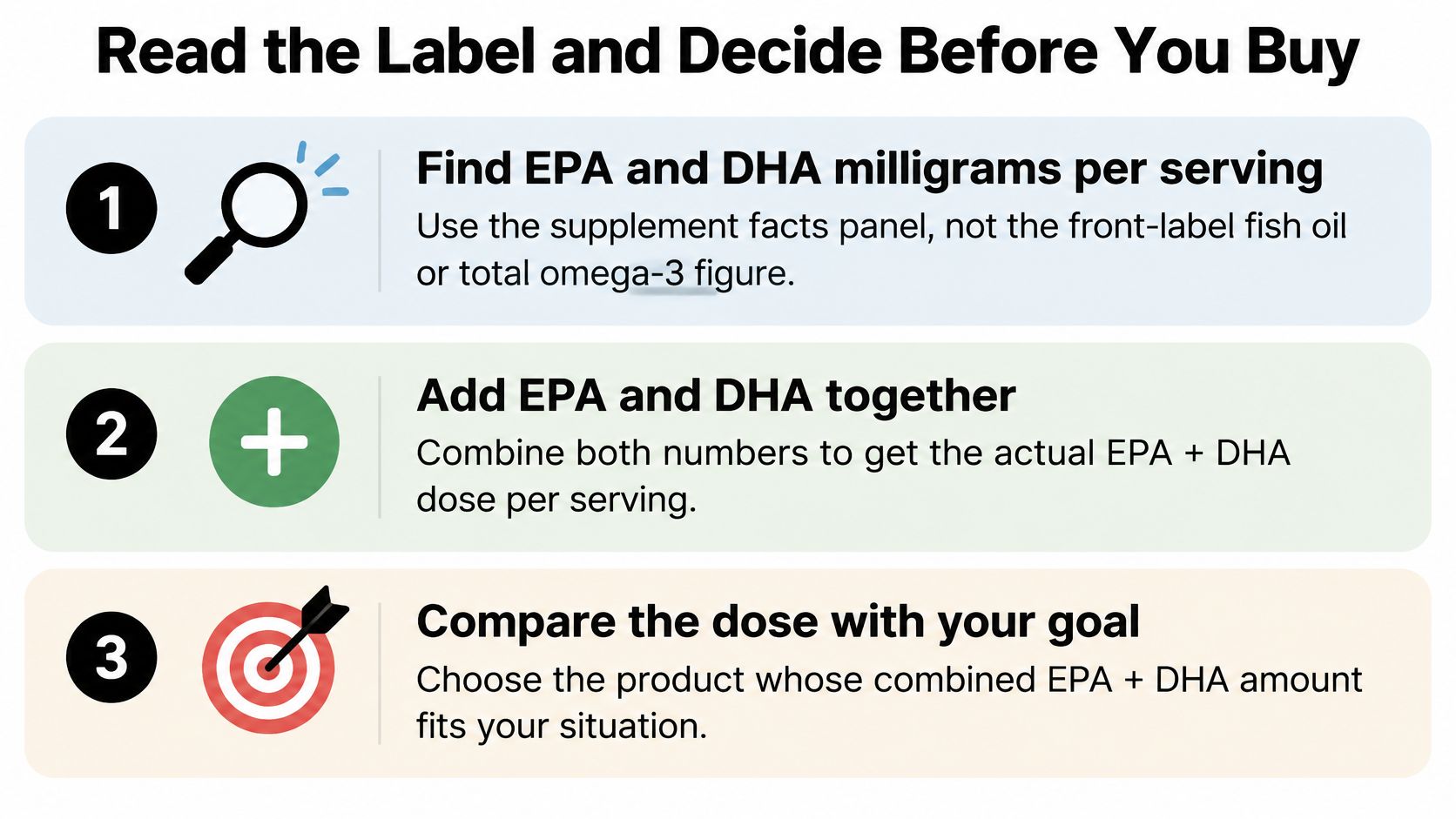
- Find the EPA and DHA milligrams per serving. The supplement facts panel carries the numbers that matter. The front-label "fish oil" figure is the weight of the oil, not the active content, and a 1,000 mg softgel can hold less than a third of that in EPA plus DHA.
- Read each number separately, then add them. You need both figures to apply the ratio logic above, and you need the total to compare against any daily target you're working toward.
- Check the chemical form. The NIH health professional fact sheet notes that re-esterified triglyceride, natural triglyceride and free-fatty-acid forms generally have somewhat higher bioavailability than ethyl esters, although all forms can significantly raise blood EPA and DHA.
- Take it with a meal that contains fat. Absorption improves and the fishy repeat tends to fade, which matters for whether you stick with the product long enough to see an effect.
- Check how many capsules make one serving. If the label defines a serving as two softgels, every EPA, DHA and cost number belongs to two softgels, and halving the serving halves the active omega-3 you get.
- Calculate cost per 1,000 mg of combined EPA and DHA. Multiply the combined EPA and DHA per serving by the number of servings in the bottle, divide the bottle price by that total, then compare the result between products. A cheaper bottle often delivers substantially less active omega-3 per serving, and bottle price hides that.
- Stay inside the printed serving or a clinician's target. Higher supplemental doses of EPA and DHA carry safety considerations, so keep to the amount on the label or the amount set for you, and do not exceed a prescriber's recommendation. A clinician-directed target for established coronary heart disease belongs to that care plan.
Then decide in three moves. Name your goal out loud. Pick the ratio that matches it from the situation table. If the goal involves triglycerides or cardiovascular risk, take a lipid panel to a clinician rather than self-managing.
If you'd rather watch the walkthrough than read it, this covers the same arithmetic step by step.
NexiHerb LLC offers dietary supplements that include omega-3s, amino acids, vitamins, minerals and antioxidants, and every criterion above applies to any brand on the market, ours included. Our own guide to reading supplement labels walks through the panel line by line if you want a second pass.
Write your goal on your phone, find the EPA and DHA milligrams per serving on the panel, and divide the bottle price by the combined EPA and DHA total before anything reaches your cart.
The omega 3 EPA vs DHA decision gets a lot simpler once you shop for a milligram figure that matches a goal. NexiHerb LLC stocks omega-3s alongside the rest of its catalog of vitamins, minerals, amino acids and antioxidants, all with the label detail you need to do the arithmetic yourself, and orders over $49 ship free within the U.S. Bring the checklist to NexiHerb LLC and compare the actual EPA and DHA content.