

56.6% of 650 retired British Olympians reported at least one significant Olympic-career injury, according to a study published in the British Journal of Sports Medicine. That reframes joint support for athletes: the important question isn't which capsule to buy, but how to train, recover, and respond to symptoms so you can keep moving well beyond your competitive years.
A useful strategy separates injury prevention, symptom management, and nutritional support. Those aren't interchangeable goals. An ingredient that helps someone with an existing joint condition hasn't necessarily been shown to prevent a healthy athlete from getting injured.
Table of Contents
- Which Joint Strategies Have Real Evidence
- Where Athletes' Joints Get Injured Most
- Load Management and Recovery Habits That Protect Joints
- How to Build a Neuromuscular Routine That Lowers Risk
- What Supplements Can and Cannot Do for Joints
- How to Read a Supplement Label for Tested Athletes
- Decide Between Self-Management and a Clinic Visit
Which Joint Strategies Have Real Evidence
Training choices come before capsules. The most useful joint-protection strategies address the forces athletes repeatedly produce, absorb, and control. Supplements sit further down the list because they don't teach landing mechanics, restore strength after injury, or correct an overloaded training schedule.
The retired-Olympian findings establish the importance of long-term joint care, but they don't prove that sport always damages joints. Injury history, sport exposure, rehabilitation, and individual health all matter. Nor can an observational study identify a single habit that would have prevented those athletes' symptoms.
Joint Protection Strategies Ranked by Strength of Evidence
This is a practical hierarchy, not a head-to-head comparison of every strategy. Direct injury-prevention evidence deserves more weight than a plausible recovery benefit.
| Strategy | Strength of evidence | What it does for joints | Where to start |
|---|---|---|---|
| Neuromuscular training | Strongest direct support, including systematic reviews | Improves coordination during landing and changes of direction | Integrate regular sessions into warm-ups or strength work |
| Progressive load management | Established practice; no universal protective progression rule | Matches training demands to current tolerance | Increase demands gradually and track symptoms |
| Strength training for muscles around joints | Moderate to strong within exercise-based programs | Builds the capacity to absorb and control force | Use progressive lower-limb and trunk exercises |
| Mobility and flexibility work | Mixed for injury prevention; more useful for range of motion | Addresses restrictions relevant to the sport | Use brief, targeted practice rather than stretching everything |
| Sleep and recovery | Supportive and indirect for joint protection | Creates opportunities to recover between demanding sessions | Keep a consistent sleep schedule and plan easier days |
| Adequate energy and protein | Foundational nutritional support, not a stand-alone prevention intervention | Supplies energy and building materials for repair | Meet needs through a varied diet before adding products |
An important distinction sits inside that table: a useful habit isn't automatically a proven injury-prevention treatment. Sleep and adequate food belong in an athlete's routine, but that doesn't justify assigning them a precise reduction in joint injuries.
For example, a basketball player with poor landing control needs more than stronger quadriceps. They need to practice absorbing force, maintaining balance, and responding to an opponent while moving. A recreational runner who abruptly adds hills may instead need to reorganize training demands.
Judge Products Against a Specific Goal
Before buying anything, finish this sentence: “I'm considering this because I want to improve…” If the answer is joint health, narrow it down. Comfort during daily activity, tendon rehabilitation, and injury prevention require different decisions.
Our explanation of whether joint-support supplements work can help frame those questions. For readers comparing cannabinoid-based options, HempWell USA's a guide to THC-free joint care provides another resource to evaluate critically, not evidence of sports-injury prevention or a guarantee of anti-doping safety.
Foundation first: Choose the training or recovery problem you're trying to solve before choosing a product.
Where Athletes' Joints Get Injured Most
Share of Reported Musculoskeletal Injuries by Category
The scoping review of Olympic sports published in Medicina reported the following injury-category shares, with joint sprains forming the largest category:
| Injury category | Share of reported musculoskeletal injuries |
|---|---|
| Joint sprains | 25.2% |
| Muscle injuries | 16.7% |
| Tendon injuries | 12.1% |
| Cartilage injuries or impingement | 9.3% |
| Joint dislocation or instability | 5.5% |
These are shares of reported injuries, not an individual athlete's probability of injury. They also describe tissue or injury categories rather than a ranking of specific joints.
The visual below illustrates common athletic injury themes. Use the source-based table above for the category percentages, since the visual mixes anatomical locations with injury types and doesn't reproduce that breakdown.
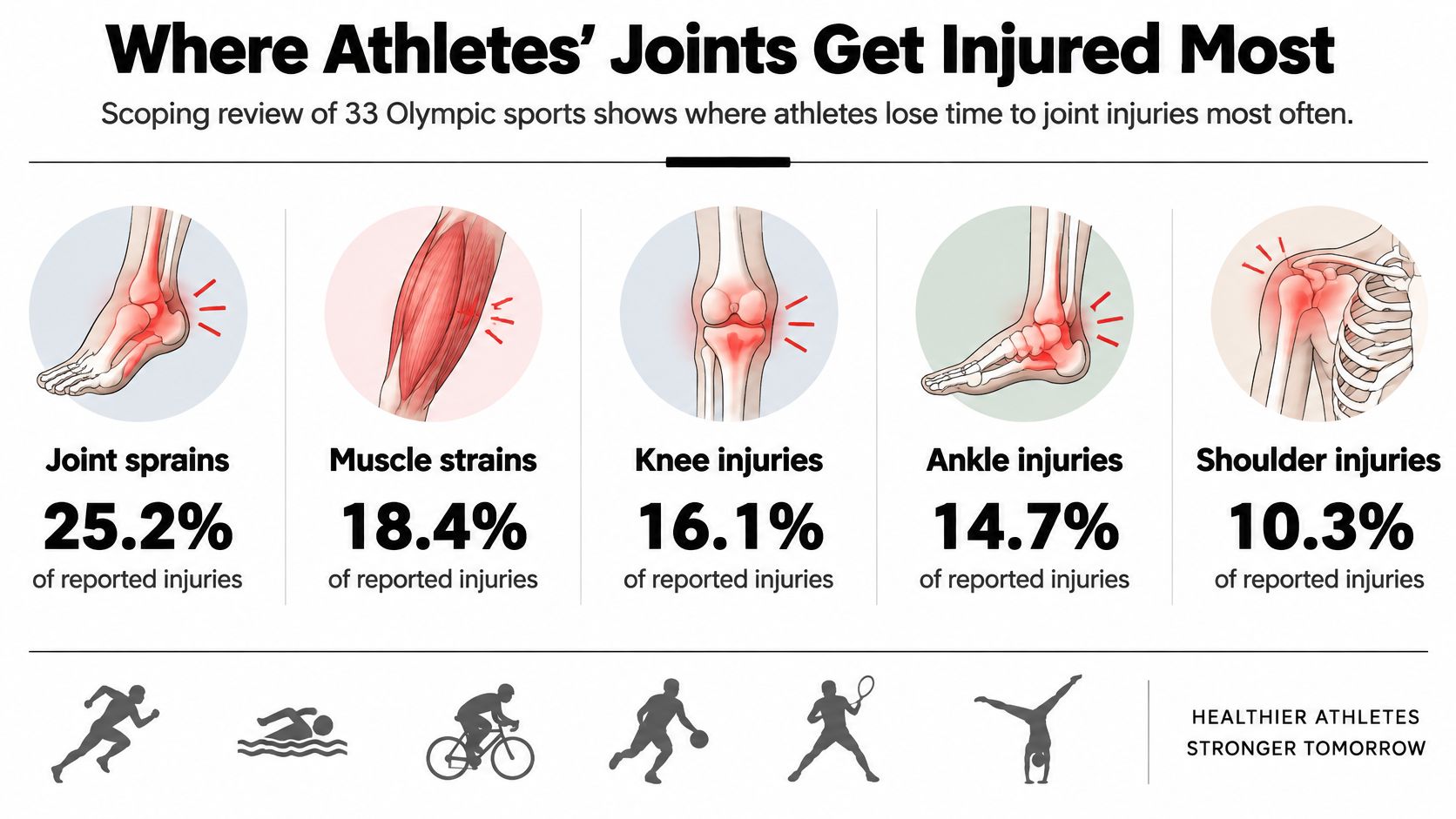
Ligaments act as passive restraints around joints. Muscles provide active control, helping an athlete manage position and force before a ligament reaches its limits. That helps explain why joint protection includes movement skills rather than just flexibility or the feeling of external support.
A sprain and a tendon problem aren't the same thing, either. A ligament connects bone to bone, while a tendon transfers force from muscle to bone. Rehabilitation needs to reflect the injured tissue and the demands placed on it.
Match Preparation to Sport Exposure
The review identified different regional patterns across sports: archery stood out for upper-extremity injuries, marathons for lower-extremity injuries, and triathlon and weightlifting for trunk-related injuries. That doesn't make one universal joint routine appropriate for everyone.
An archer might prioritize shoulder control and tolerance for repeated drawing. A runner needs to manage repeated lower-limb loading, while a weightlifter needs sufficient mobility and trunk control for loaded positions. Start with the movement demand, not the supplement category.
Interpret comparisons cautiously. The review's authors noted that studies often combined musculoskeletal injuries with broader injury groups, limiting clean comparisons between sports.
If you've already injured an ACL, treatment decisions belong with a qualified clinician. Dream Body Clinic's page on stem cell treatment for ACL injuries is something you may encounter while comparing options, but a clinic's treatment description doesn't establish effectiveness or replace an individualized rehabilitation assessment.
Load Management and Recovery Habits That Protect Joints
Pain that starts earlier in each session deserves attention. So do symptoms that build across the training week, swelling that's still present the next morning, and stiffness that lingers into daily activity. Don't wait until you can't complete a workout before adjusting it.
Track the trend, not just the hardest session. Record the exercise, effort, symptoms during activity, and how the joint feels afterward. A short note such as “stairs uncomfortable the next morning” can be more useful than trying to remember how your knee felt last week.
Change the Demand Before Adding a Recovery Tool
Say a runner develops knee discomfort after adding both hill repeats and a longer weekend run. Buying a massage device doesn't address the obvious programming change. First reduce the provoking demand and avoid increasing duration, speed, and terrain difficulty together.
Fixed weekly percentage increases can serve as reminders to progress cautiously, but they aren't guarantees of protection. Your starting fitness, previous injury, session intensity, and recovery opportunities all influence what you can tolerate.
Use these checks when adjusting training:
- Symptoms during activity: Does discomfort settle, stay stable, or steadily increase?
- Movement quality: Are you limping, shortening a stride, or shifting away from one side?
- Later response: Does the joint return to its usual baseline before the next demanding session?
- Competing demands: Have work stress, travel, or poor sleep reduced your recovery opportunities?
Target mobility where you lack useful range. Controlled ankle movements, hip rotations, and thoracic-spine rotations can help you explore sport-relevant positions. Don't force a painful joint into a deeper stretch or mistake extra range for extra control.
Recovery Tools Aren't Injury Insurance
Sleep and planned easier days deserve priority over elaborate recovery routines. Locals Jiu Jitsu Alexandria's guidance on how to improve recovery with better rest offers a practical starting point for organizing that habit.
Easy walking, gentle cycling, or relaxed swimming may help you feel ready to move again. Massage and cold exposure can be comfort tools, but feeling less sore doesn't demonstrate that a joint is ready for unrestricted loading.
Recovery should help you make better training decisions, not make an excessive workload easier to ignore.
Our guide to improving workout recovery can help you organize the basics. Judge a recovery routine by whether you can train consistently with stable symptoms and sound technique, not by how many tools it includes.
How to Build a Neuromuscular Routine That Lowers Risk
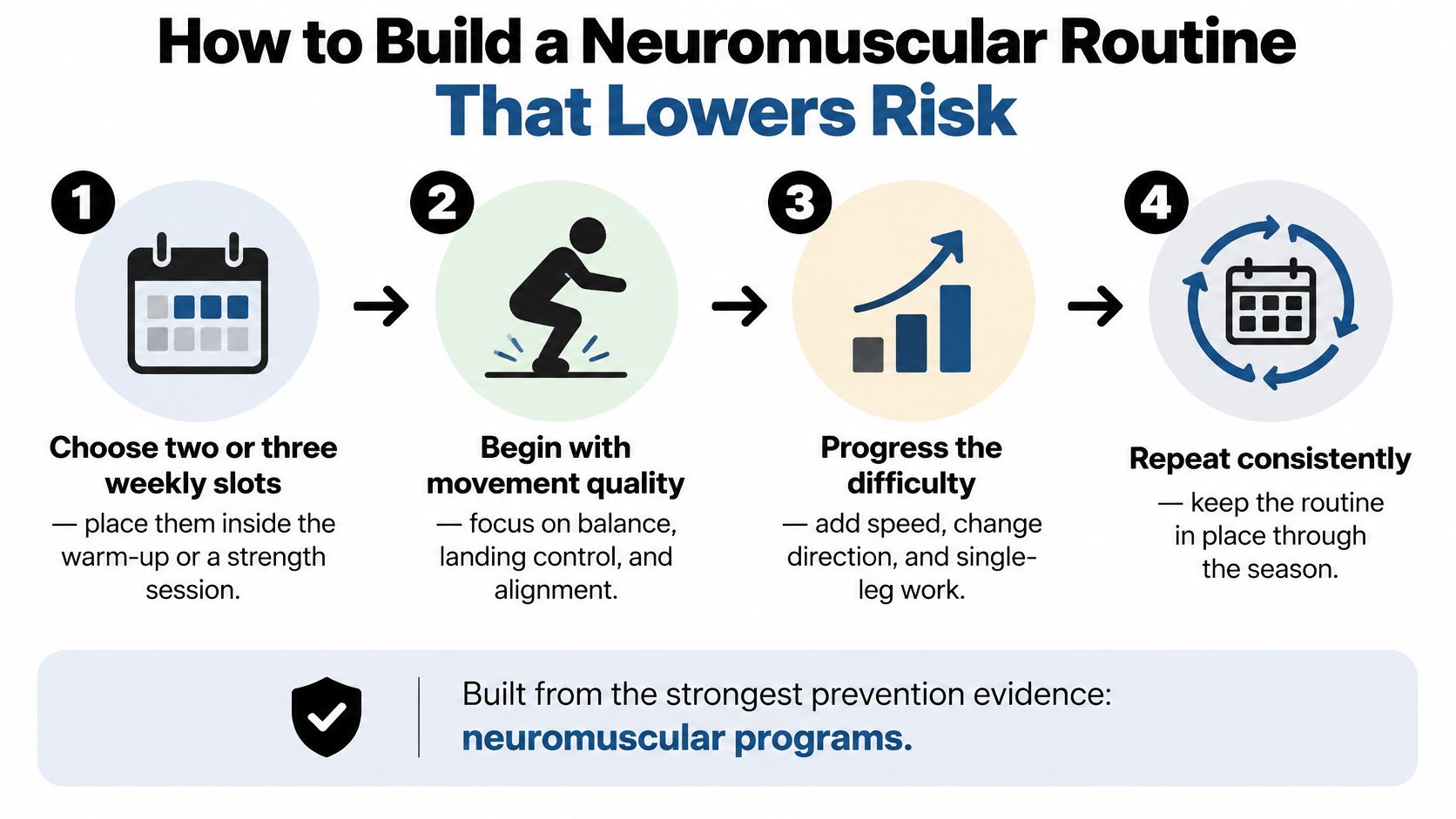
Neuromuscular training combines strength, balance, landing practice, and sport-specific movement. The aim is coordinated control of the hip, knee, and ankle, so muscles and connective tissues share external loads rather than leaving vulnerable structures to absorb them.
A systematic review of sports-injury prevention reported approximately 27% fewer knee injuries with neuromuscular training and describes integrating it two to three times weekly. The evidence summarized also included 7.63 fewer injuries per 1,000 hours with exercise-based interventions in track-and-field athletes, although substantial differences between studies mean that estimate shouldn't be treated as universal.
The visual provides a simple progression from scheduling to consistent practice.
Build Control Before Speed
- Choose repeatable training slots. Attach the routine to existing warm-ups or strength sessions rather than creating another demanding workout. Consistency is easier when you don't need a separate trip to the gym.
- Start with controlled two-leg movements and single-leg balance. Stand near a support if needed, keep your foot comfortably planted, and hold a steady position before adding reaching or movement.
- Introduce single-leg strength. Split squats and step-downs let you practice controlling the pelvis, knee, and foot together. Increase resistance only when you can repeat the movement without twisting or dropping abruptly.
- Add low hops and deliberate landings when basic strength tasks are comfortable. Land softly, absorb force through the hips and knees, and aim for the knee to follow the direction of the foot rather than collapsing inward.
- Practice slowing down before cutting faster. Progress from stopping after an easy approach to planned direction changes. A field-sport athlete can then add a coach's cue or ball movement to make the task more representative.
- Check familiar movements when you're mildly fatigued. Don't introduce difficult jumps at exhaustion; reduce the challenge if alignment, balance, or landing control deteriorates.
- Progress according to demonstrated control. Change one feature at a time, such as load, speed, direction, or unpredictability. After an injury, reassess the starting level with your rehabilitation professional instead of resuming the hardest version.
Make Technique Repeatable
These are building blocks, not a universal rehabilitation prescription. A novice, an experienced court athlete, and someone returning after ligament surgery need different entry points.
Film a front and side view of a familiar drill if you struggle to notice changes. Look for repeatability rather than trying to force every athlete into an identical posture.
Use the following video as a movement reference, then adapt exercise selection to your current capacity.
What Supplements Can and Cannot Do for Joints
Collagen with vitamin C has a loading-related rationale; glucosamine and chondroitin have evidence concentrated in symptomatic joint populations; vitamin D is primarily a baseline-status question. None deserves a blanket promise of injury prevention.
Joint Supplement Ingredients Compared on Athlete Evidence
| Ingredient | Evidence in athletes | Best-fit situation | Main limit |
|---|---|---|---|
| Collagen with vitamin C | Limited controlled evidence for tendon mechanical adaptations during training | An athlete already following progressive tendon loading | Doesn't establish pain relief, cartilage regeneration, or added strength |
| Glucosamine and chondroitin | Evidence mainly concerns osteoarthritis and joint-pain populations | Diagnosed joint symptoms, with clinician input | Doesn't establish injury prevention in healthy athletes |
| Vitamin D | Direct performance benefit is inconclusive | Confirmed low status assessed clinically | No established performance advantage from adding more when status is adequate |
A controlled study in professional female soccer players found greater patellar-tendon stiffness and Young's modulus after 10 weeks of training with 30 g collagen plus 500 mg vitamin C before sessions than with an energy-matched placebo. Earlier findings discussed in the same publication used 15 g hydrolyzed collagen with 50 mg vitamin C approximately one hour before loading.
Those are study protocols, not universal dosing instructions. Tendon stiffness describes a mechanical property; it doesn't mean athletes should try to make every joint feel stiffer. Nor does a favorable tendon measurement automatically mean fewer injuries.
Collagen supplies amino acids used in connective tissue, while vitamin C supports collagen formation. The defensible application is an adjunct to an appropriate loading program, not a replacement for rehabilitation.
Match the Ingredient to the Clinical Question
A systematic review of glucosamine and chondroitin reported positive outcomes in more than 90% of efficacy studies, but the evidence was concentrated mainly in osteoarthritis and joint-pain populations. A positive result in those groups doesn't establish improved performance or fewer injuries in athletes without joint disease.
For vitamin D, testing and clinical context matter more than a joint-health marketing claim. Correcting a deficiency addresses a nutritional problem; taking extra isn't equivalent to strengthening a ligament.
Keep the intended outcome explicit:
- Symptom support: Does the athlete experience a meaningful improvement in comfort or function?
- Cartilage disease management: Has a clinician identified a condition requiring a broader care plan?
- Bone health: Is there a nutritional or medical issue that needs assessment?
- Injury prevention: Has the intervention reduced injuries in a relevant athletic population?
The pictured product is an example of the combination-supplement format, not evidence of an athletic outcome.
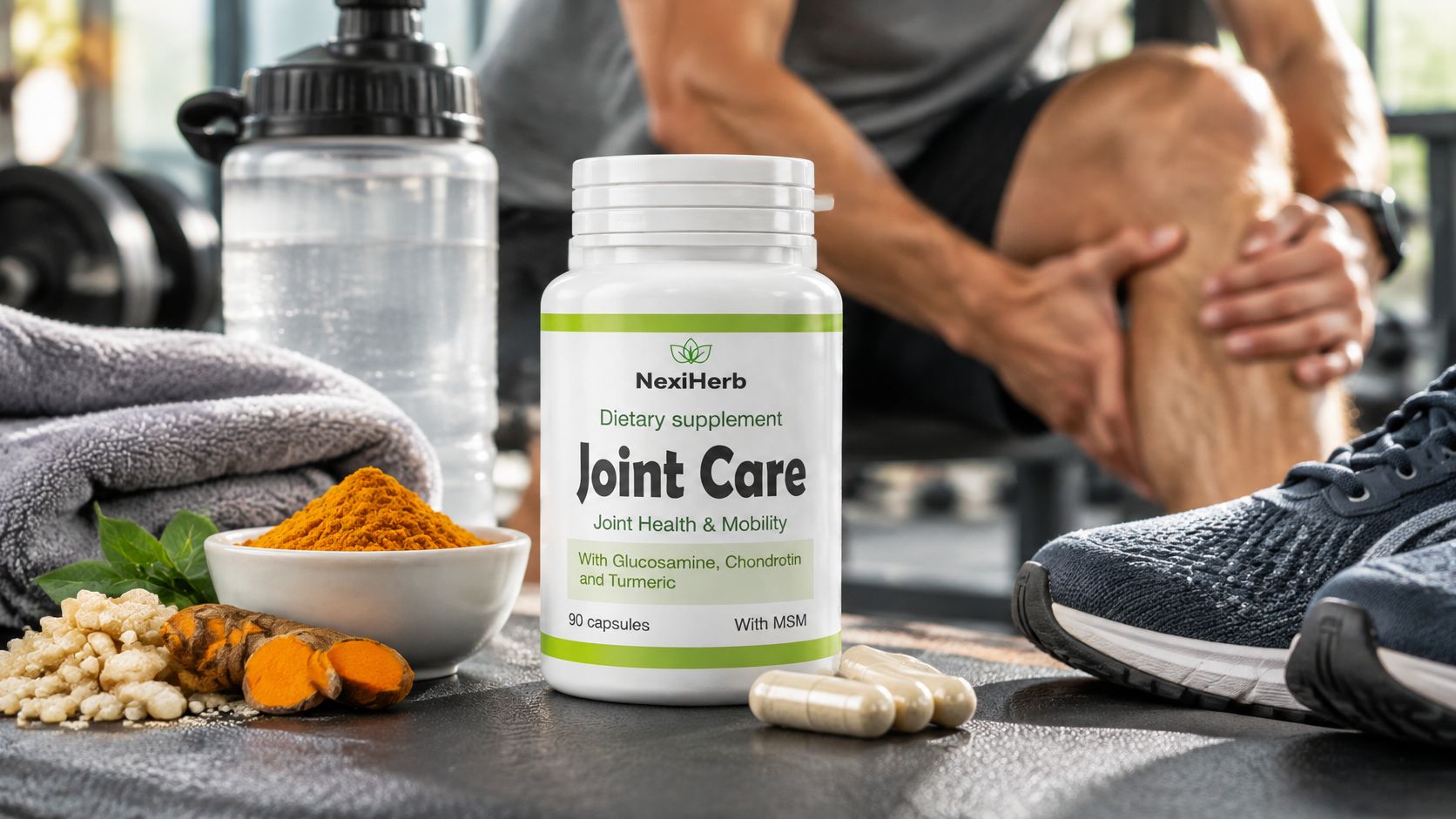
Joint Care Complex NexiHerb Glucosamine & Chondroitin Complex contains glucosamine sulfate potassium, chondroitin sulfate, botanical extracts, and MSM in adult-use capsules. Its ingredient list doesn't establish injury prevention, and it isn't intended to diagnose, treat, cure, or prevent disease.
Our supplements are meant to complement a varied diet and healthy lifestyle, not replace a balanced diet.
How to Read a Supplement Label for Tested Athletes
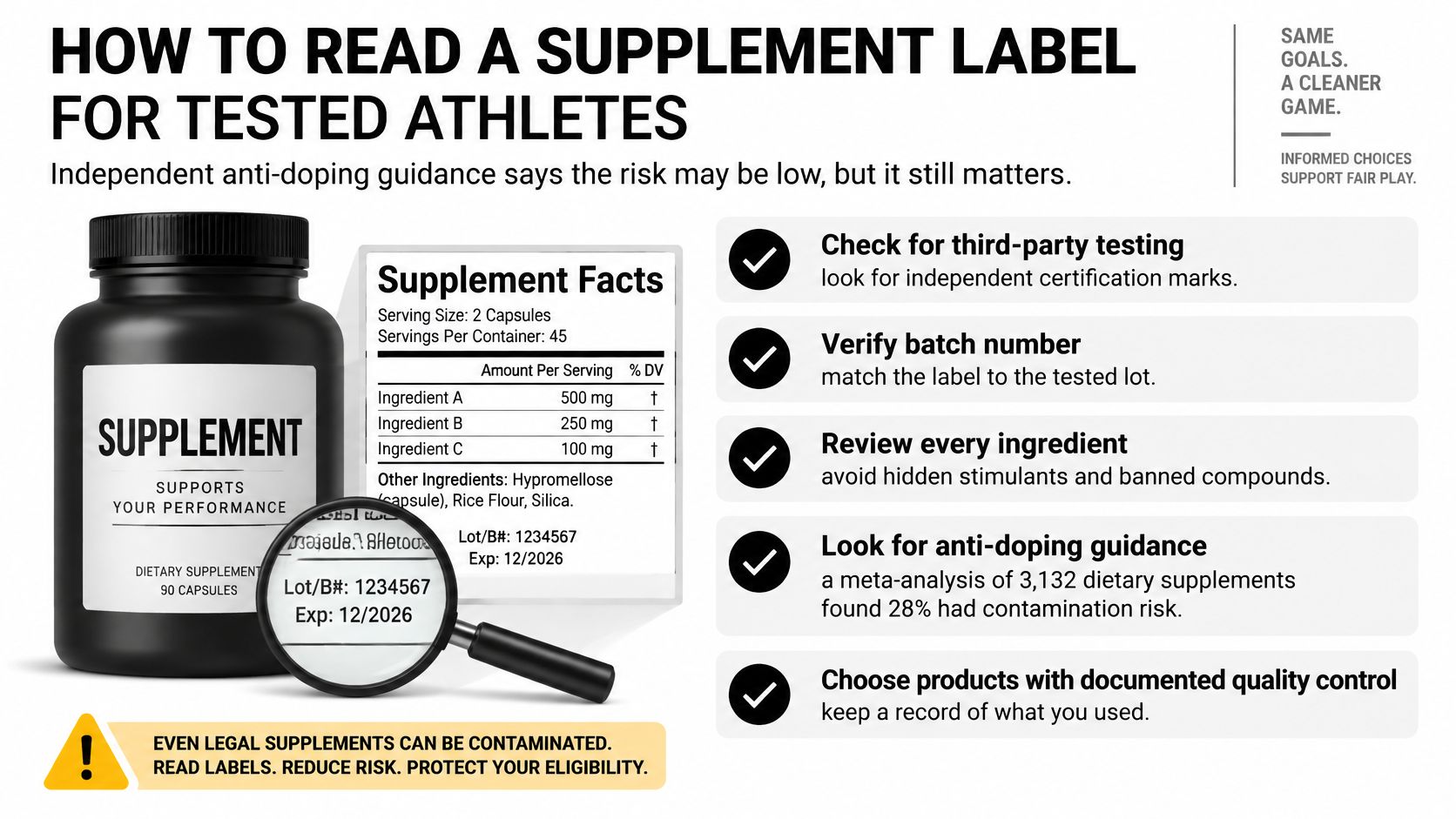
A wellness label doesn't eliminate eligibility risk. Independent anti-doping guidance from BSCG reports that a meta-analysis of 3,132 dietary supplements found 28% contained undeclared substances, while a 2025 survey found prohibited substances in 35% of uncertified sports supplements, with joint-health products among higher-risk categories.
Those findings aren't a contamination probability for every bottle. They are a reason to investigate manufacturing controls before taking a product, even when its purpose sounds conservative.
Use the visual checklist to organize the review, then verify the documentation yourself.
Supplement Label Signals and What They Mean for Athletes
| Label signal | What it tells you | Red flag |
|---|---|---|
| Third-party certification, such as NSF Certified for Sport or Informed Sport | Indicates independent assessment within the named program's scope | Tested claim without a named certifying body |
| Lot-specific test results | Lets you establish whether your bottle matches a tested batch | Documentation describes only the generic formula |
| Full ingredient amounts | Allows dose comparisons with relevant studies | Total blend weight without individual amounts |
| Proprietary blend | May conceal individual ingredient doses | You can't determine how much of each ingredient you're taking |
| Disease or treatment wording | Raises concern about inappropriate medical marketing | Promises to cure arthritis or repair joint disease |
Verify certification in the certifier's records, rather than relying only on a logo in a product image. Check the exact product name and any batch details the program provides. Certification reduces uncertainty within its scope; it doesn't make a supplement risk-free.
Run These Checks Before Purchase
- Confirm your sport's rules: Review the governing body's current prohibited-substance guidance and consult your team's qualified support staff if you're unsure.
- Compare the actual formula: Match ingredient form and amount to the evidence, not just the ingredient name on the front.
- Check capsule materials: Some supplements contain gelatin or other animal-derived ingredients, even when the featured ingredient is plant-derived.
- Keep a record: Save the lot number, label photograph, receipt, and available testing documentation.
- Review combinations: Include other supplements and medicines when discussing suitability with a clinician or sports dietitian.
Our guide to reading supplement labels provides additional help interpreting ingredient panels.
Safety and efficacy are separate checks. A clean test result doesn't prove a product works, and a promising ingredient doesn't prove the bottle is free of prohibited substances.
Even a clear label alone doesn't demonstrate contamination controls. That requires credible, verifiable testing and manufacturing documentation.
Decide Between Self-Management and a Clinic Visit
Mild, short-lived symptoms may respond to a sensible training adjustment. Mechanical symptoms, persistent swelling, or signs of serious illness need assessment instead. Don't use a supplement trial to postpone finding out what's wrong.
Arrange clinical assessment for any of these warning signs:
- Giving way: The joint feels unstable or unexpectedly buckles.
- Locking or catching: You can't move the joint normally.
- Persistent swelling: Swelling doesn't settle or repeatedly returns.
- Sudden severe injury: There's deformity or you can't bear weight.
- Altered sensation: You develop numbness or tingling.
- Disrupted sleep: Unexplained night pain wakes you.
- Heat with fever: A joint is hot and swollen while you feel unwell.
- Changed movement: Pain keeps making you limp or compensate.
A hot, swollen joint with fever, major deformity, or significant loss of function warrants urgent medical evaluation, not a routine appointment weeks away.
A Conservative Path for Mild Symptoms
- Reduce the provoking load. Temporarily modify the movement, resistance, surface, or training duration while keeping comfortable activity.
- Maintain tolerable mobility and strength work. Don't force painful repetitions or turn complete rest into the default when pain-free movement is available.
- Reassess the direction of change. If symptoms aren't improving over the following weeks, or worsen sooner, book a clinician visit.
A symptom score alone isn't enough. Notice whether you're regaining normal movement, tolerating everyday tasks, and returning toward your usual training capacity without a rebound in symptoms.
For symptom-driven supplementation, establish the reason first. A blood-tested nutrient deficiency and diagnosed joint disease present different decisions from unexplained exercise pain. Your clinician can help determine whether an ingredient has a relevant role and whether it conflicts with medicines or competition requirements.
Bring your training log, symptom notes, and every product you already take to the appointment. Include what changed before symptoms began and which activities now provoke them, so the clinician can assess the likely driver rather than guessing from a supplement label.
NexiHerb LLC offers adult dietary supplements, including joint-care products, alongside practical nutrition and wellness guides. Visit NexiHerb LLC to review ingredient information and educational resources, then use those details to discuss whether a supplement fits your training, diet, and clinical needs.