

You're standing in front of a supplement shelf with two nearly identical bottles in your hands. One lists iron prominently, while the other says “without iron.” You eat reasonably well, you're not sure whether you're at risk of deficiency, and the label gives you no obvious answer. The choice feels more medical than nutritional.
That hesitation is useful. Iron isn't automatically beneficial in a multivitamin, and removing it doesn't automatically make a product incomplete. The better question is whether your diet, life stage, health history, and laboratory results support additional iron. For many men and postmenopausal women, an iron-free formula can be a sensible way to avoid a nutrient they already obtain sufficiently. For people with iron deficiency or pregnancy-related needs, skipping iron without professional guidance can be the wrong move.
Table of Contents
- Why You Might Choose Multivitamins Without Iron
- Who Really Needs Iron-Free Formulas
- Is Iron-Free Lower Quality or Smarter Design
- Standard Multivitamins vs Iron-Free Options
- How to Read Labels and Spot Hidden Iron
- Making the Right Choice by Age, Sex, and Lab Results
- Next Steps for Choosing a Safe Daily Multivitamin
Why You Might Choose Multivitamins Without Iron
A shopper often reaches for an iron-free multivitamin after noticing that the iron-containing option causes stomach discomfort or seems mismatched to their needs. Another person may already take a separate iron product, eat iron-fortified foods regularly, or have been told that their iron stores are high. These aren't trend-driven reasons. They're formulation questions.
In major markets, standard multivitamins are often built around 18 mg of iron, or 100% of the Daily Value, while “without iron” products intentionally leave that mineral out. The difference reflects life-stage needs. Adult men need 8 mg of iron per day, women aged 19 to 50 need 18 mg, and women aged 51 and older return to 8 mg according to the nutrition guidance summarized by National Jewish Health. A product with no iron can therefore be a deliberate match for someone whose daily requirement is lower, not evidence that the manufacturer forgot an essential nutrient.
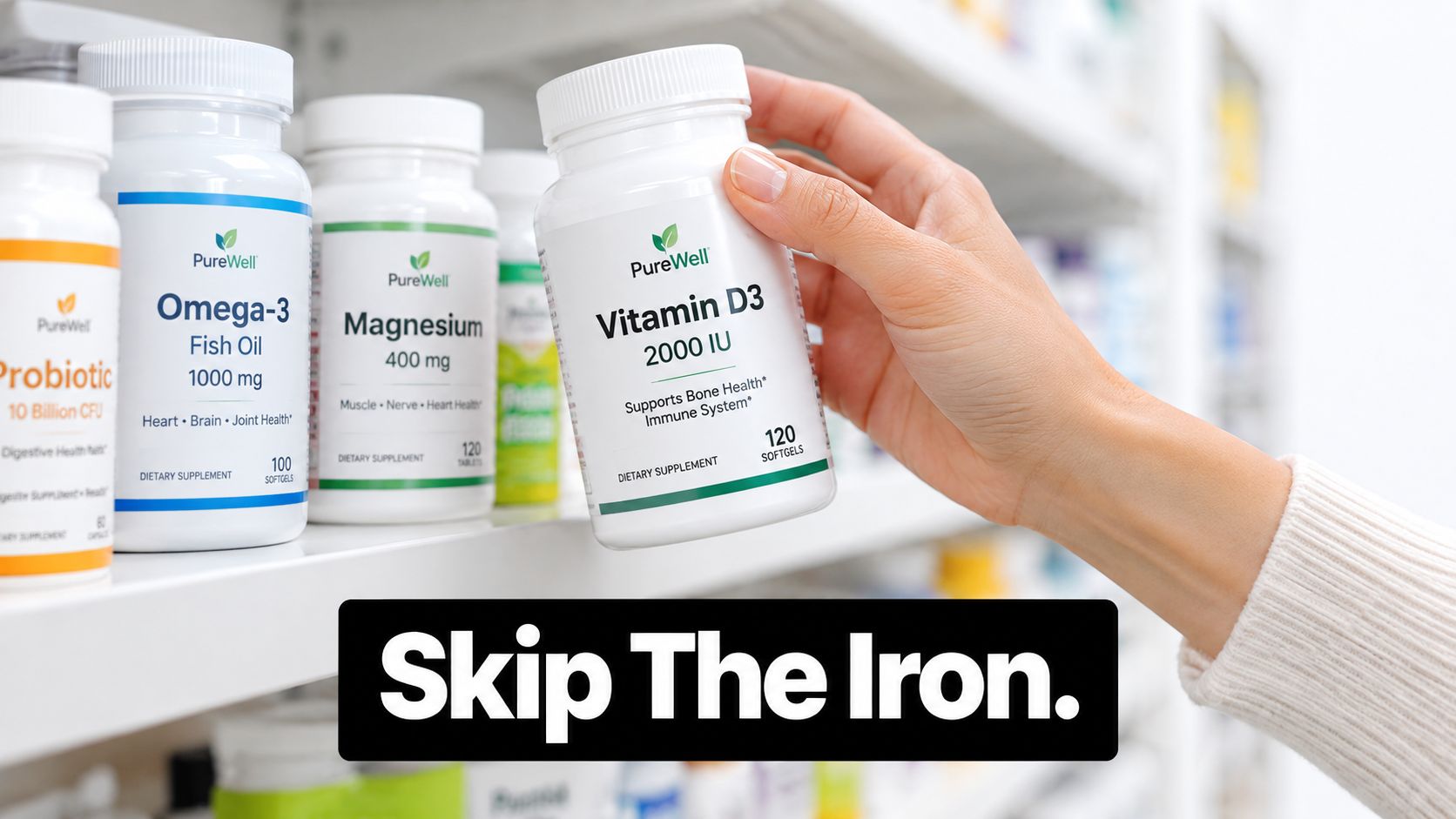
Start with your total intake
The practical issue is total iron exposure, not just the amount in one capsule. A multivitamin may sit alongside fortified cereals, meal replacements, a separate mineral supplement, or a diet that already supplies iron-rich foods. People who want to improve their overall diet should first review vitamins found in food and then decide whether a supplement is filling a genuine gap.
An iron-free formula can also simplify daily use. It removes one ingredient that may be unnecessary for a particular adult, while leaving room to assess the remaining nutrients on their own merits. That's the right way to think about the benefits of a daily multivitamin, as a possible nutritional complement rather than a universal requirement.
Practical rule: Choose the iron level that fits your physiology and lab results, not the label designed for a broad demographic.
Who Really Needs Iron-Free Formulas
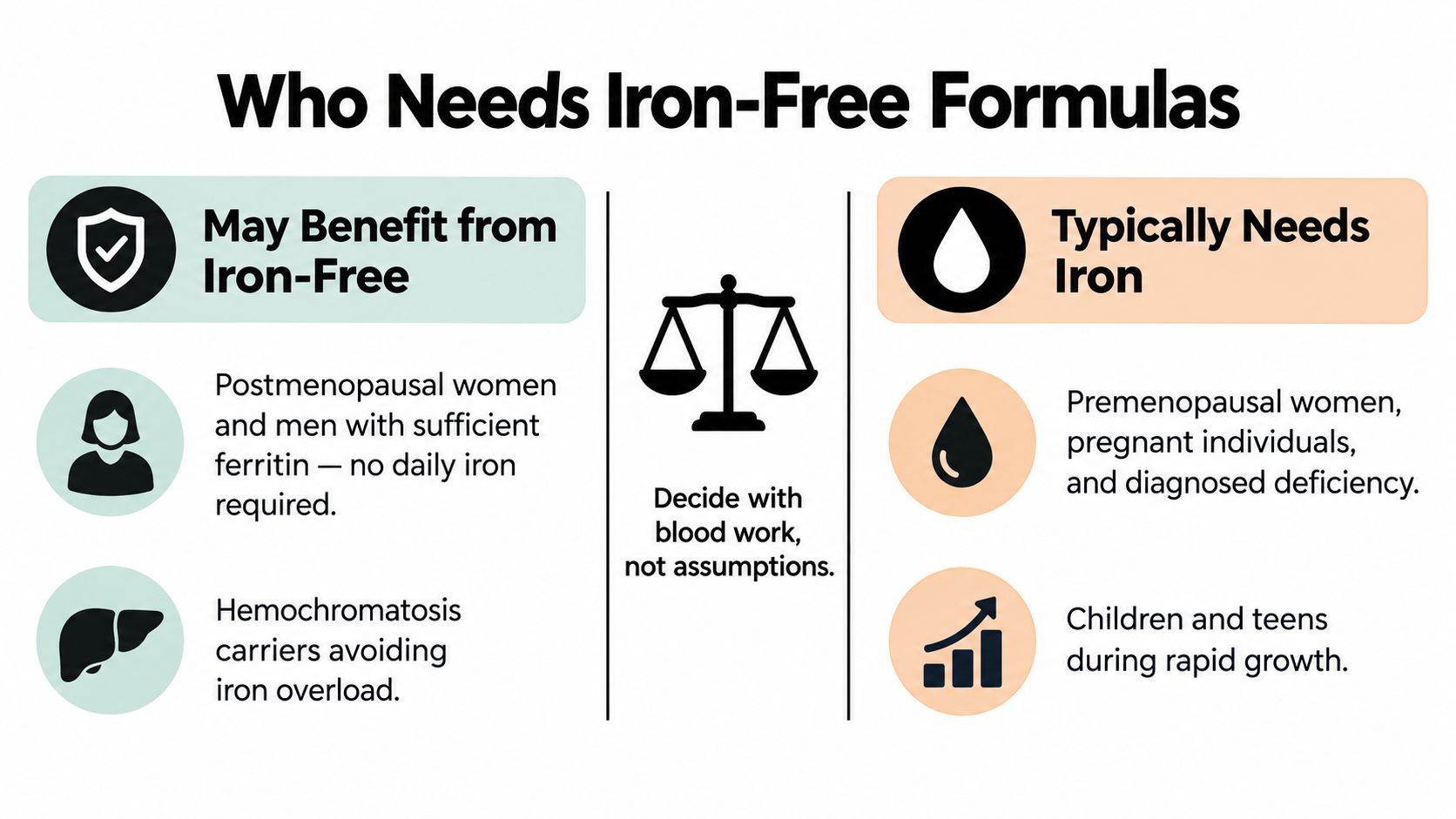
A man with a varied diet, normal iron markers, and no history of blood loss may gain little from adding iron to a daily multivitamin. The same can apply to a postmenopausal woman, but age or sex alone should not decide the formula. Ferritin, transferrin saturation, and a complete blood count (CBC) provide a more useful starting point than a broad label category.
Postmenopausal women generally need 8 mg of iron per day rather than the 18 mg commonly built into women's formulas. A zero-iron product may therefore fit a woman whose diet supplies enough iron and whose laboratory results show adequate stores. Menstruating women, people with diagnosed deficiency, and adults with ongoing blood loss may need an iron-containing product or a separate treatment plan instead.
Both the NIH Office of Dietary Supplements and the NIH professional fact sheet on iron note that men's and seniors' multivitamins frequently contain little or no iron, while women's products more often provide about 18 mg. Those formulations reflect common needs, not a personal prescription.
Why the upper limit matters
The NIH identifies 45 mg of iron per day as the upper limit for adults from food, supplements, and fortified products. That figure is a ceiling, not a target, and remaining below it does not show that supplemental iron is appropriate. Review the full daily intake when a multivitamin is combined with fortified cereal, a meal replacement, a mineral product, or an iron supplement.
An iron-free formula deserves discussion with a clinician for:
- Men with sufficient iron status: Normal ferritin, transferrin saturation, and CBC results, together with an iron-adequate diet, may support skipping routine supplemental iron.
- Postmenopausal women without deficiency: Their lower routine requirement can make a zero-iron formula a sensible option.
- People managing high iron stores: Conditions associated with iron accumulation require individualized medical advice, not self-directed iron use.
- Adults already using iron elsewhere: Removing iron from the multivitamin can reduce accidental duplication.
- People with deficiency or continuing blood loss: These adults should not select an iron-free formula just because it is easier to tolerate. They may require clinician-directed iron and follow-up testing.
A once-daily adult formula from Vita Mix NexiHerb Multivitamin & Mineral Dietary Supplement is described as containing vitamins, minerals, lutein, zeaxanthin, and other selected compounds. Its product information does not establish whether an individual needs iron. Check the Supplement Facts panel against diet, medications, lab results, and clinical advice before choosing it.
Is Iron-Free Lower Quality or Smarter Design
A client may arrive with a normal-looking supplement routine, yet the right formula depends on more than the product's mineral count. Quality depends on whether the formula is appropriate for the person taking it, whether the label is clear, and whether its nutrients match the person's diet, lab results, and health context.
Iron remains useful when testing, diet, or clinical circumstances indicate a need. It can also be difficult to tolerate for some people, especially when taken on an empty stomach or duplicated across several products. Removing iron may make daily use more comfortable for an adult whose iron status is adequate, but tolerability still varies.
What changes when iron is removed
The formulation trade-off is straightforward. Omitting iron can simplify the mineral profile and reduce accidental duplication with a separate iron supplement, fortified food, or another multivitamin. It does not guarantee smaller capsules, fewer stomach symptoms, or improved absorption. Those outcomes depend on the dose, other ingredients, capsule design, and the individual.
Lab results help distinguish a purposeful design choice from an unnecessary omission. Ferritin gives information about stored iron, transferrin saturation helps assess circulating iron availability, and a CBC can identify blood-count patterns that deserve follow-up. Interpret these markers together with diet and clinical history rather than treating one result as a complete answer. A diet with little meat, frequent blood donation, heavy menstrual loss, or restricted food choices may change the decision even when a multivitamin label appears suitable.
The formula's remaining nutrients deserve equal attention. Confirm that it covers the nutrients you intend to supplement, uses doses appropriate for your situation, and does not duplicate another vitamin or mineral product. A long ingredient list does not prove completeness, and iron's presence does not prove quality.
An iron-free multivitamin is not a premium version of a standard multivitamin. It is a targeted design choice for people who do not need routine supplemental iron.
Large evidence reviews report little or no benefit from multivitamins for preventing cancer, cardiovascular disease, or death in generally well-nourished adults. That finding shifts the decision away from “more minerals must be better” and toward nutritional fit, safety, and purpose.
Choose an iron-free formula when it addresses a clear need, such as avoiding duplication or matching adequate iron status. Skip it when deficiency, suspected blood loss, or clinician-directed iron treatment remains unresolved.
Standard Multivitamins vs Iron-Free Options
The shelf comparison becomes easier when you judge both products against the same practical criteria. A standard iron multivitamin usually aims to provide iron alongside its broader vitamin and mineral blend. An iron-free option removes that mineral, which can be useful for one adult and inappropriate for another.
| Feature | Standard Iron Multivitamin | Iron-Free Multivitamin |
|---|---|---|
| Iron content | Includes a stated amount of iron, often built around the full Daily Value | Contains no intentionally added iron, subject to the complete label |
| Typical fit | May suit people with higher needs, diagnosed deficiency, or clinician-directed supplementation | May suit men, postmenopausal women, or adults with adequate iron status |
| Main advantage | Covers iron as part of one daily formula | Avoids routine supplemental iron when it isn't needed |
| Main concern | Can duplicate iron from other products or exceed personal needs | Can leave a genuine deficiency unaddressed |
| Best decision method | Confirm the reason you need iron and the dose you're taking | Confirm that iron status is adequate and review the full formula |
When a standard formula is more appropriate
People with diagnosed iron deficiency shouldn't switch to iron-free products just because they are marketed as gentler. The same caution applies to individuals with pregnancy-related nutrient needs, people with ongoing blood loss, and anyone whose clinician has prescribed iron. In these situations, the appropriate product may not be an ordinary multivitamin at all. It may be a targeted supplement with a dose and follow-up plan selected for the underlying problem.
Women who are menstruating may also have a different baseline need from postmenopausal women. That doesn't prove that every woman needs a full-dose iron multivitamin, but it does make an automatic zero-iron choice less defensible without considering diet and laboratory results.
When iron-free is the cleaner match
An iron-free option is more logical when your iron status is sufficient, you're already meeting needs through food, or you're taking another product that supplies iron. It may also be preferable when a clinician has advised you to reduce supplemental iron. Read the entire stack, not only the multivitamin, because duplicate ingredients can come from products aimed at energy, minerals, or general wellness.
The most useful comparison isn't “strong versus weak.” It's appropriate versus unnecessary. A standard formula covers more situations on paper, while an iron-free formula can be more precise for an adult whose physiology doesn't call for added iron.
How to Read Labels and Spot Hidden Iron
Start with the Supplement Facts panel, not the front of the bottle. Find the line for iron and note both the amount per serving and the percentage of the Daily Value. A product marketed for men, seniors, or general wellness may still contain iron, so the phrase “iron-free” should be verified against the actual panel.
Next, confirm the serving size. One capsule may be the serving, but some products define a serving as multiple capsules. Compare the iron amount with every other supplement you take, including stand-alone iron, prenatal products, mineral combinations, and fortified meal products. The objective is to understand your daily total, not to judge one bottle in isolation.
A label-reading sequence that works
- Find the iron line: Don't infer the content from the product name or the audience on the front label.
- Check the serving definition: Calculate the amount you take, especially if you use more than the suggested serving.
- Scan the other products: Look for repeated iron across a multivitamin, mineral supplement, prenatal formula, or fortified nutrition product.
- Review the complete blend: Confirm that removing iron hasn't left you without another nutrient you specifically need.
- Check directions and warnings: Follow the stated intake and ask a pharmacist or clinician about interactions with medicines or diagnosed conditions.
Iron may also appear within a broader proprietary or mineral blend, where the front label gives little useful detail. If the amount isn't clear, contact the manufacturer or choose a product with transparent Supplement Facts rather than guessing. The same disciplined approach applies when comparing forms of other nutrients. For example, readers reviewing vitamin C may benefit from a practical explanation of how to compare buffered C vs ascorbic acid, because ingredient form and tolerance can matter as much as the headline nutrient.
The guide to reading supplement labels can help you build a repeatable review habit. Take a photo of each panel, list overlapping ingredients, and bring that list to an appointment if you're discussing fatigue, anemia, high iron results, or a new supplement routine.
A clear label still can't answer whether your body needs iron. It can only tell you what the product supplies. That distinction prevents a common mistake, choosing a formula because its packaging sounds personalized while skipping the information that determines need.
Making the Right Choice by Age, Sex, and Lab Results
A low ferritin result can change the decision more than the word “men's” or “women's” on a bottle. A man may be iron deficient, while a postmenopausal woman may have high iron stores. Someone following a plant-based diet may need a closer review of iron intake and absorption, whereas frequent blood loss can create a different clinical need. Age and sex provide context. They do not replace laboratory results, diet history, or medical assessment.
Use laboratory results as the decision point
Four findings can clarify whether an iron-free formula is appropriate:
- Ferritin: This estimates stored iron, but inflammation and other health conditions can raise the result without reflecting adequate iron reserves.
- Transferrin saturation: This indicates how much of the iron-binding capacity is occupied and adds context to ferritin.
- CBC: Hemoglobin and other blood-cell measures can reveal patterns consistent with anemia, although a CBC does not identify every cause.
- Inflammation markers: These help a clinician judge whether inflammation may be affecting ferritin interpretation.
A single result should not determine your supplement choice. Ask a healthcare professional whether ferritin, transferrin saturation, a CBC, and relevant inflammation markers fit your symptoms, medical history, and dietary pattern. The NCBI review of multivitamin evidence supports caution about treating one general multivitamin formula as superior for everyone. Testing and clinical context make the decision more specific.
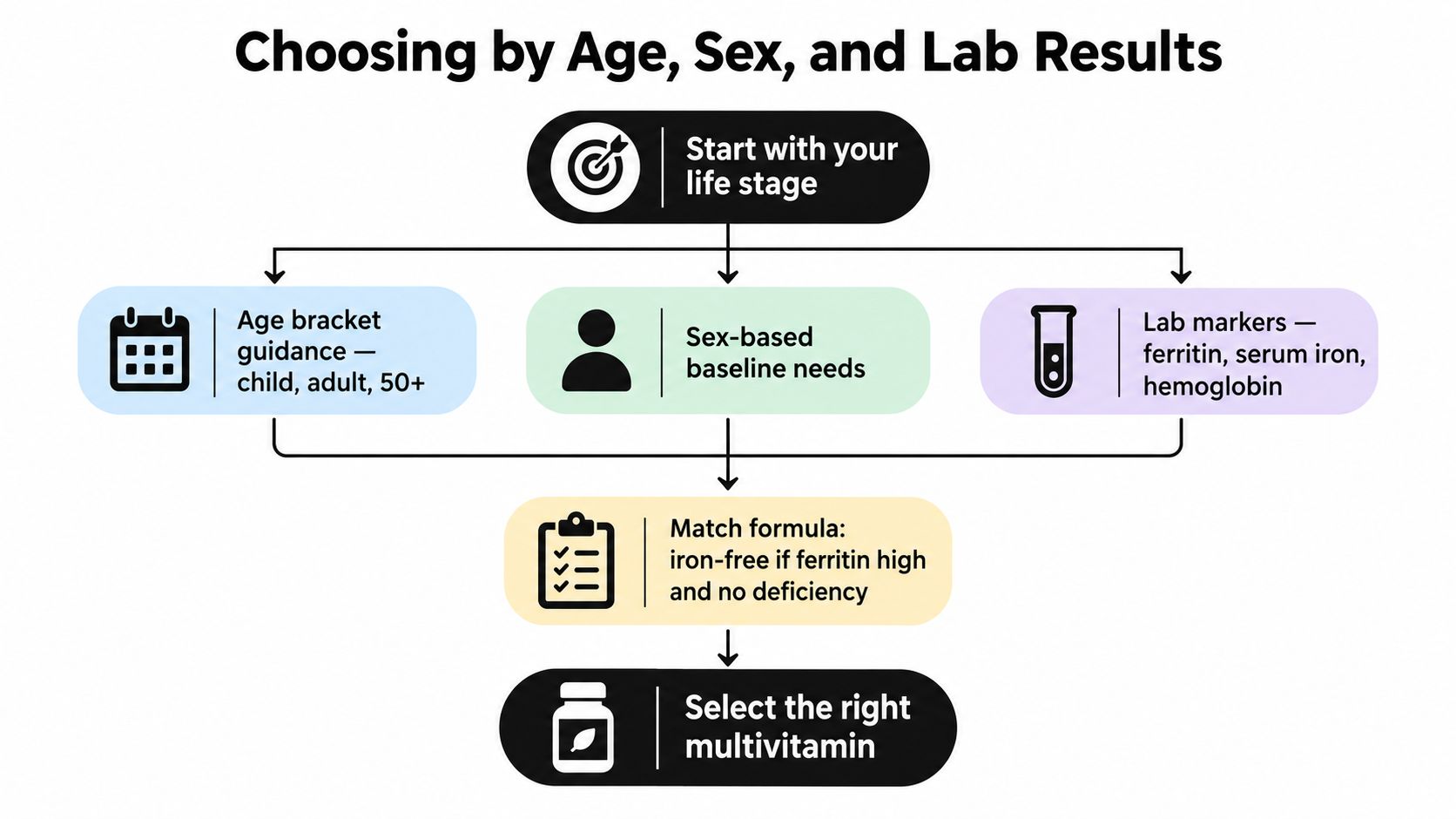
Add diet and life stage
Review how often you eat iron-containing foods, rely on fortified products, avoid animal foods, or take other supplements. Also consider menstruation, pregnancy, recent blood loss, digestive conditions, and any diagnosed disorder involving iron metabolism. These factors can explain why a label designed for a demographic group may not suit your physiology.
Use the results to guide the choice:
- Adequate markers and no special need: An iron-free multivitamin may be reasonable.
- Low or uncertain markers: Wait for clinical interpretation before choosing a zero-iron formula.
- Pregnancy or trying to conceive: Follow pregnancy-specific guidance rather than adapting a general formula.
- Diagnosed deficiency: Follow the prescribed iron plan and monitoring schedule.
- High stores or an iron-related condition: Avoid added iron unless your healthcare professional recommends it.
A guide to choosing a multivitamin can help you compare broader formula criteria, but it cannot interpret laboratory results. Choose according to current physiology, diet, and medical need, not the demographic printed on the bottle.
Next Steps for Choosing a Safe Daily Multivitamin
Start with the problem you're trying to solve. If your goal is to cover dietary gaps, write down what you eat across a typical week and list every supplement, fortified drink, and medication you use. If the goal is to address fatigue or an abnormal blood result, get the cause evaluated rather than using a multivitamin as a diagnostic experiment.
Then compare products in a consistent order:
- Confirm iron first: Check the Supplement Facts panel and serving size. Don't rely on “men's,” “senior,” or “gentle” wording.
- Review the complete formula: Look at the vitamins, minerals, botanical compounds, and overlapping products.
- Match the product to your life stage: Pregnancy, menstruation, postmenopause, dietary restriction, and diagnosed deficiency can change the decision.
- Ask about testing: Discuss ferritin, transferrin saturation, CBC, and inflammation markers when symptoms or history justify it.
- Follow the label: More capsules won't necessarily provide better nutrition, and exceeding the recommended intake can create unnecessary exposure.
A client who has adequate iron status, eats a varied diet, and wants a simple daily formula may reasonably choose an iron-free multivitamin. A client with documented deficiency, pregnancy-related needs, or unexplained anemia should pause and seek individualized advice instead. Those two decisions can look opposite on a store shelf while both being sensible.
Other nutrients deserve the same care. If you're building a broader routine around vitamin D, vitamin K, and magnesium, a practical UK guide to D3 K2 magnesium can help you identify questions to raise with a qualified professional. It shouldn't encourage stacking products without checking for duplicate ingredients or personal contraindications.
Before buying, take a picture of the label and write down why you chose the formula. That small record makes it easier to reassess after blood work, a dietary change, or a new diagnosis. An iron-free multivitamin can be a thoughtful choice, but only when the missing iron is an intentional match for your needs rather than an assumption.
NexiHerb LLC offers clearly described dietary supplements, including multivitamin options for adults building a practical daily wellness routine. Review the formula and iron content against your diet and lab results, then visit NexiHerb LLC to explore products and nutrition guidance that fit your approach.