

EPA and DHA are the two active, long-chain omega-3 fatty acids in fish oil, with EPA containing 20 carbon atoms and DHA containing 22. Their specific milligram amounts on a label matter more than the total weight of the fish oil carrying them.
That point challenges the most popular advice in the supplement aisle. A bottle may advertise “1,000 mg fish oil,” but that number describes the oil mixture, not necessarily the amount of omega-3 your body receives. To understand what you're buying, you need to look past the front of the bottle and read the separate EPA and DHA amounts in the Supplement Facts panel.
Table of Contents
- Beyond the Bottle Label - The EPA and DHA Reality
- EPA vs DHA - Two Distinct Molecules With Different Jobs
- Regulatory Status and Safety Guidelines
- Dosing for Different Health Goals
- How to Choose a High-Quality Supplement
- Conclusion - Making an Informed Choice
Beyond the Bottle Label - The EPA and DHA Reality
A capsule labeled 1,000 mg of fish oil doesn't automatically provide 1,000 mg of EPA and DHA. Fish oil contains a mixture of fats, and EPA and DHA are only the most relevant long-chain omega-3 components for comparing products. The meaningful calculation is the combined amount of EPA plus DHA per serving, not the larger number printed in bold on the front label.
The National Institutes of Health explanation of omega-3 fatty acids makes this distinction clear. Fish oil is a delivery vehicle, while EPA and DHA are the specific fatty acids you're evaluating. A product with a large total-oil number can provide a modest active omega-3 dose, while another product with a similar capsule size may provide a different EPA and DHA profile.
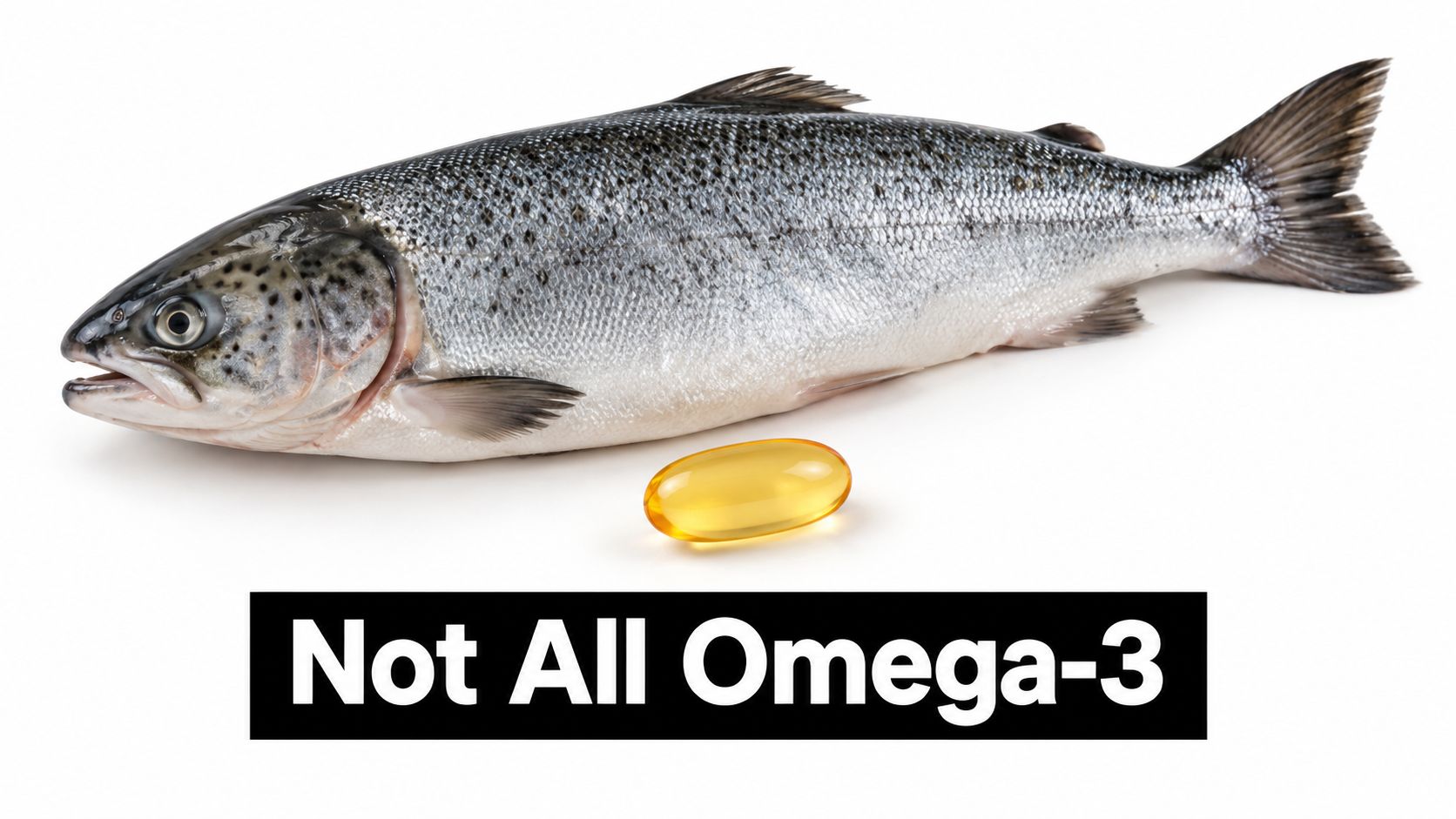
The label-reading habit that prevents confusion
Find the Supplement Facts panel and identify three separate lines:
- Total fish oil: This describes the complete oil mixture in the serving.
- EPA: This shows the amount of eicosapentaenoic acid.
- DHA: This shows the amount of docosahexaenoic acid.
Add the EPA and DHA figures together. That total gives you the product's combined long-chain omega-3 amount for the stated serving. If the serving is more than one capsule, check whether the listed values apply to the full serving or to each capsule.
Practical rule: Never compare fish-oil products using total oil weight alone. Compare EPA, DHA, and their combined amount per serving.
This simple habit also helps you avoid treating every omega-3 product as interchangeable. Fish oil, krill oil, cod-liver oil, and algal oil can have different compositions and different reasons for being chosen. If you're exploring the broader question of why take omega-3 fish oil, keep the same standard in mind: ask which fatty acids the product supplies and how much of each it provides.
The front label is marketing shorthand. The Supplement Facts panel is the purchasing evidence.
EPA vs DHA - Two Distinct Molecules With Different Jobs
EPA and DHA belong to the same omega-3 family, but they aren't identical ingredients with identical tasks. A useful analogy is a building project: EPA and DHA are two types of structural material, and the body places them in different settings according to their shape and function.
EPA, or eicosapentaenoic acid, contains 20 carbon atoms. It participates prominently in cell-signaling pathways and helps provide the raw material for biologically active lipid mediators. DHA, or docosahexaenoic acid, contains 22 carbon atoms and serves as a major structural component of neural and retinal membranes. The research review on omega-3 fatty acids and inflammation describes how both can enter cell-membrane phospholipids and partially replace arachidonic acid.
That doesn't mean EPA belongs only in the bloodstream or DHA belongs only in the brain. Both fatty acids can be incorporated into cell membranes, and both participate in broader physiological processes. The practical distinction is one of emphasis. EPA is especially relevant to signaling and lipid mediator production, while DHA contributes heavily to the physical structure of brain and retinal tissue.
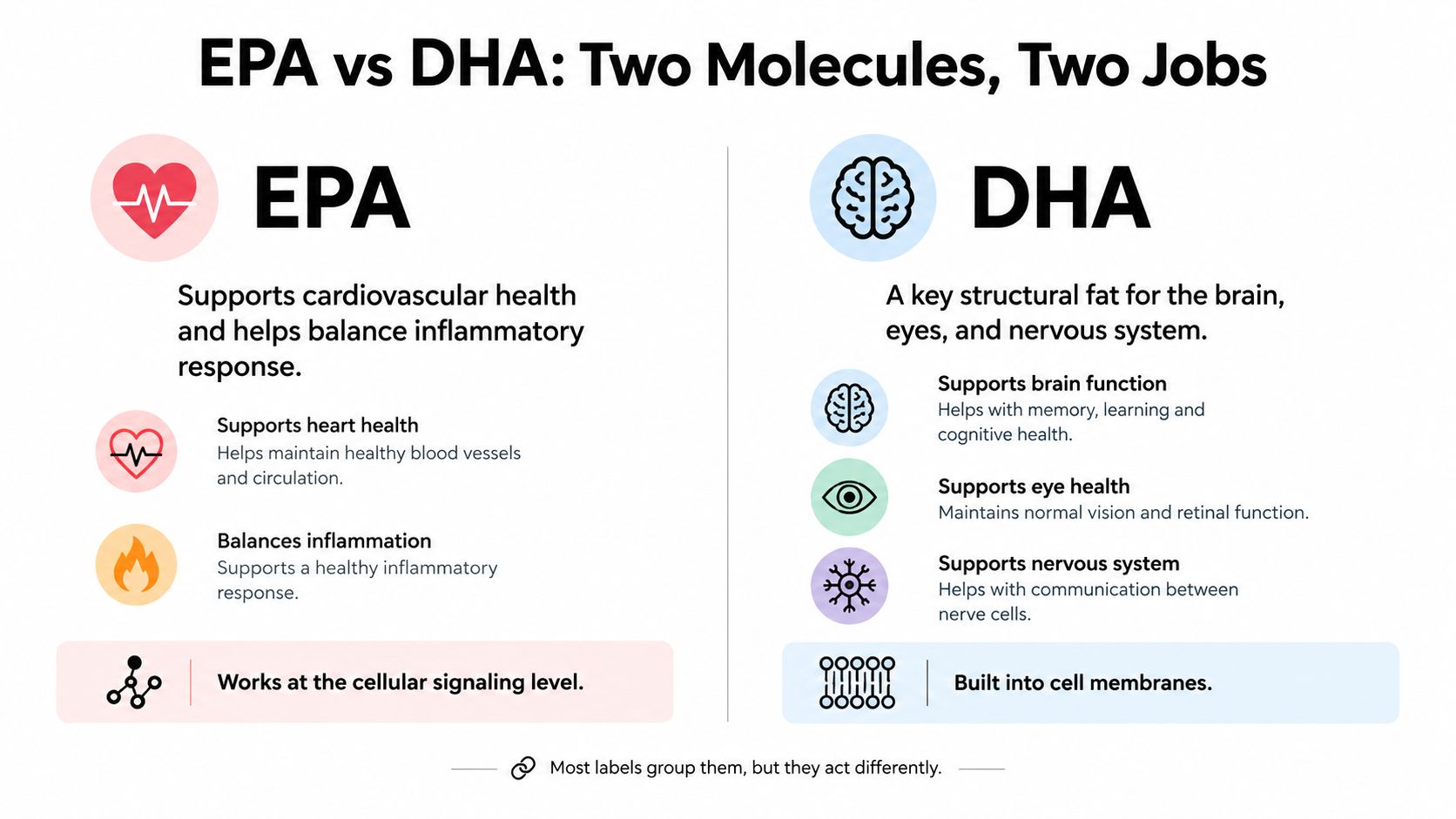
EPA and DHA at a glance
| Feature | EPA | DHA |
|---|---|---|
| Full name | Eicosapentaenoic acid | Docosahexaenoic acid |
| Carbon structure | 20 carbon atoms | 22 carbon atoms |
| Main emphasis | Cell-membrane signaling and lipid mediator production | Structural support for neural and retinal membranes |
| Label question | How much EPA does the serving provide? | How much DHA does the serving provide? |
| Practical interpretation | Often considered when the goal involves a signaling-focused formula | Often considered when structural brain and eye support is relevant |
Your choice shouldn't rely on a simplistic “EPA is good, DHA is good” slogan. The better question is whether the product's ratio and total amounts suit your dietary pattern, intended use, and professional guidance. Someone comparing fish oil with krill oil should also inspect the actual EPA and DHA quantities rather than assuming the source name tells the whole story. The fish oil versus krill oil comparison can help frame that comparison, but the Supplement Facts panel still makes the final distinction.
The same label discipline applies to unrelated supplements. For example, All Night NexiHerb is a botanical dietary supplement for adult men, not an EPA or DHA product, so its listed herbal ingredients shouldn't be compared with fish-oil amounts. Different ingredients require different label questions.
Regulatory Status and Safety Guidelines
EPA and DHA are well-studied nutrients, but that doesn't make fish oil a guaranteed treatment or a universal answer to disease prevention. The U.S. Food and Drug Administration's position illustrates the difference between scientific interest and a medical promise.
In 2004, the FDA approved a qualified health claim for conventional foods and dietary supplements containing EPA and DHA. The wording is deliberately cautious. Supportive but inconclusive research indicates that consuming EPA and DHA may reduce the risk of coronary heart disease. In 2024, the FDA also announced that it wouldn't object to certain qualified claims involving possible reductions in hypertension and coronary-heart-disease risk, while emphasizing that the evidence was credible but inconclusive and highly inconsistent. These regulatory details are summarized by the NIH overview for health professionals.
What the safety guidance actually means
The same guidance says the FDA has concluded that up to 5 grams per day of combined EPA and DHA from supplements is safe when used as recommended. It also notes that supplement labels shouldn't recommend more than 2 grams per day of EPA plus DHA.
Those figures aren't an invitation to self-prescribe a high dose. They help define the difference between a general supplement label and a clinician-directed intervention. A person taking an anticoagulant, managing a bleeding disorder, preparing for surgery, or using other lipid-lowering treatment should discuss omega-3 supplementation with a healthcare professional.
Safety comes from context, not from the phrase “natural supplement.” The relevant questions include the combined EPA and DHA dose, the product's source, other medicines, and the reason for taking it.
A qualified claim isn't the same as a disease-treatment claim. It tells you that regulators recognize some supportive evidence while also acknowledging uncertainty. That is a more useful interpretation than treating a fish-oil bottle as either a miracle product or a risky one.
Read the directions, calculate the active dose, and don't increase the serving just because the front label advertises a large total fish-oil number. If a product's directions conflict with advice from your clinician, follow the clinician's guidance.
Dosing for Different Health Goals
There isn't one universal fish-oil dose because the intended use changes the question. Someone adding omega-3-rich foods to an ordinary diet isn't in the same situation as someone receiving prescription treatment for high triglycerides. Pregnancy and breastfeeding introduce another set of dietary and safety considerations.
| Goal or situation | What the evidence supports | How to interpret the label |
|---|---|---|
| General dietary intake | Focus on obtaining EPA and DHA from seafood or a suitable supplement | Add the EPA and DHA amounts rather than relying on total fish oil |
| Clinician-supervised triglyceride management | Prescription omega-3 preparations providing approximately 4 grams per day, generally more than 3 grams per day of combined EPA and DHA, can reduce triglycerides, according to the American Heart Association's scientific statement | Don't reproduce this dose with guesswork or treat it as routine wellness guidance |
| Pregnancy or breastfeeding | U.S. guidance recommends 8 to 12 ounces of lower-mercury seafood weekly, as reported in the same AHA source | Consider species, preparation, dietary intake, and clinician advice together |
General wellness is not prescription therapy
Over-the-counter capsules may contain substantially less EPA plus DHA than their total fish-oil weight suggests. That difference explains why a person can take a product marketed as “high strength” without knowing whether the actual active dose is appropriate for the goal.
For triglyceride management, the AHA benchmark applies to prescription preparations and clinical supervision. It isn't a recommendation to select several retail capsules and imitate a prescription regimen. A clinician may consider laboratory results, current medicines, cardiovascular risk, and the specific formulation before recommending a high dose.
Pregnancy requires the same careful distinction. Seafood can provide EPA and DHA, but the lower-mercury choice matters. A supplement may be appropriate in some circumstances, yet the product's source, purification, vitamin-A content, and individual medical history deserve attention.
A botanical product such as Maca Power+ NexiHerb is a plant-based general-wellness supplement, not a source of EPA or DHA and not a substitute for omega-3 dosing. Keeping product categories separate prevents a common mistake: assuming that every supplement serving can be evaluated with the same dosage framework.
The safest decision is to match the dose to the goal. For ordinary nutrition, start with food and the label. For an abnormal lipid result, ask a healthcare professional to direct the treatment.
How to Choose a High-Quality Supplement
A good fish-oil purchase starts with the back panel, not the product name. The front may emphasize total oil, “omega-3,” or a source such as fish, krill, cod liver, or algae. Those details matter, but they don't replace the EPA and DHA figures.
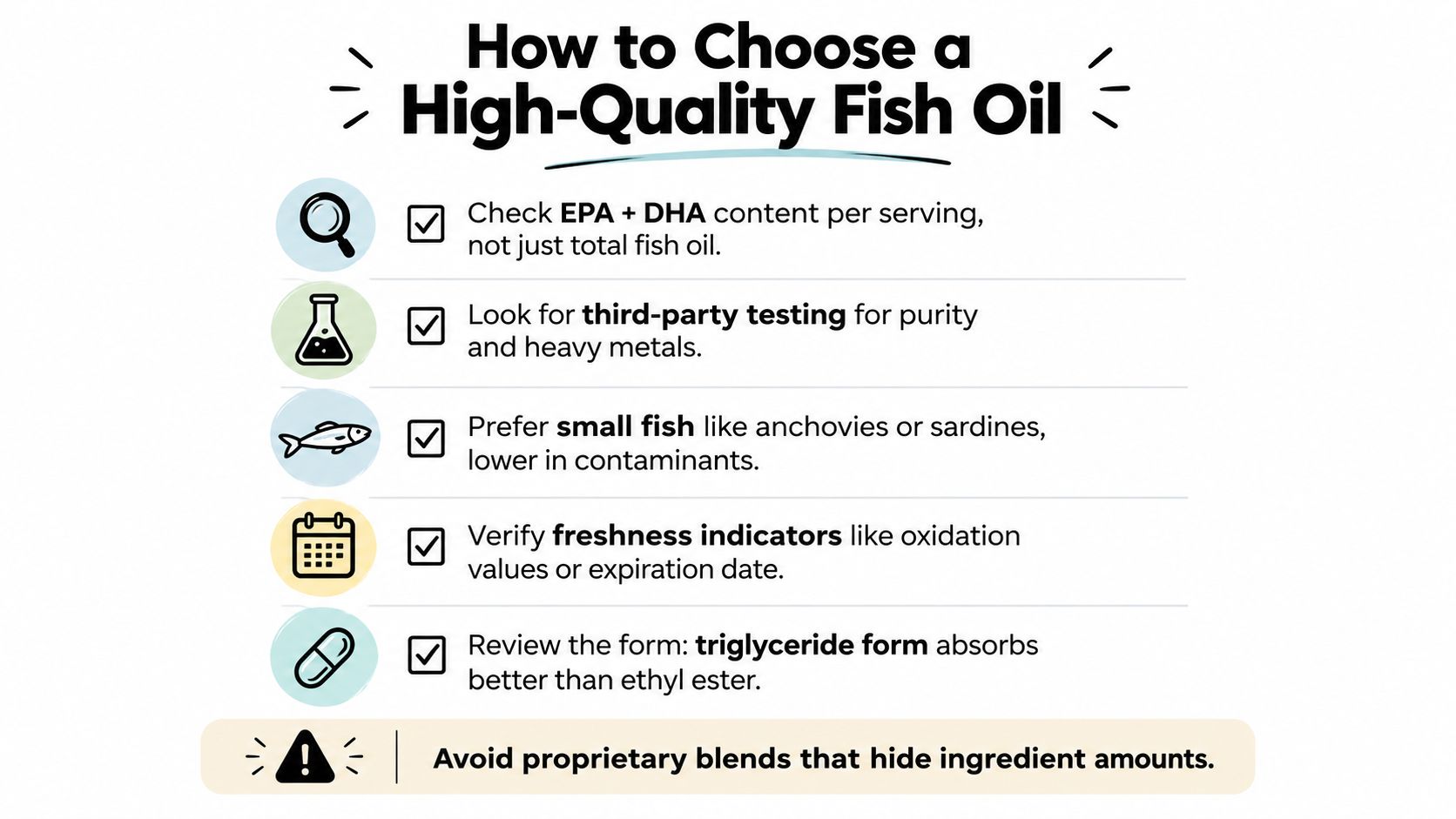
Audit the Supplement Facts panel
Use this quick inspection before buying:
- Calculate the active amount. Add the listed EPA and DHA values for the stated serving. Don't treat total fish oil as the active omega-3 dose.
- Check the serving definition. Confirm whether the panel describes one capsule or several. A number attached to a multi-capsule serving can look more impressive than the amount in each capsule.
- Identify the source. Fish-body oil, cod-liver oil, and algal oil aren't interchangeable. Algal oil is the principal vegetarian source of EPA and DHA, while cod-liver oil raises a separate vitamin-A question.
- Look for purity information. Prefer products that provide credible information about contaminant testing, purification, and manufacturing controls.
- Review freshness details. An expiration date and clear storage instructions help you judge whether the product has been handled as a perishable oil.
- Compare formulas by purpose. An EPA-dominant product, a DHA-dominant product, and a balanced formula may suit different needs. Choose based on the actual quantities, not a vague “omega-3” claim.
Mercury and PCBs can harm fetal development, and unrefined fish-oil preparations may retain pesticide or PCB residues. The World Health Organization's guidance on fish oil during pregnancy notes that purification removes PCBs and dioxins from purified fish oil, while cod-liver oil should be avoided because its vitamin-A content can become excessive.
Source and formulation deserve attention
“Fish oil” doesn't describe a single manufacturing standard. Ask whether the product is purified and whether the manufacturer explains contaminant controls. If you avoid animal-derived ingredients, a resource such as veganicity omega 3 DHA EPA capsules may help you compare a plant-based option, but you should still inspect its individual EPA and DHA amounts.
You can also use the NexiHerb guide to omega-3 fish oil supplements as a starting point for label questions. The goal isn't to find the loudest claim. It's to verify active content, source, purity information, and suitability for your situation.
Conclusion - Making an Informed Choice
A shopper sees a bottle labeled “fish oil,” but the body receives specific fatty acids. EPA and DHA are the two principal long-chain omega-3s supplied by fish oil, and they perform overlapping but distinct jobs. EPA is associated with cell signaling and lipid mediator production, while DHA has a major structural role in neural and retinal membranes.
Consider two hypothetical labels. The first advertises a large amount of total fish oil but lists a relatively modest combined EPA and DHA amount. The second uses a similar total-oil claim but provides a different EPA and DHA profile. The front labels may appear comparable, yet the Supplement Facts panels tell you that they aren't the same product nutritionally.
The buying decision in plain language
- Start with the purpose. General dietary intake, pregnancy, and triglyceride treatment aren't the same situation.
- Read the active ingredients. Add EPA and DHA, then compare the result per serving.
- Keep EPA and DHA distinct. Don't assume a high total omega-3 number tells you how much of each fatty acid you're getting.
- Respect clinical boundaries. High-dose triglyceride therapy belongs with professional supervision.
- Inspect quality signals. Source, purification, contaminant controls, freshness, and the difference between body oil and liver oil all matter.
- Use food intelligently. Lower-mercury seafood can be part of a balanced diet, while a supplement may be considered when dietary intake doesn't meet personal needs.
The answer to “what is EPA and DHA in fish oil” is therefore more useful than a vocabulary definition. EPA and DHA are distinct nutrients carried by fish oil, and their separate milligram amounts are the practical truth behind the label. Once you learn to find those numbers, you can compare products calmly, ask better questions, and choose a formula that matches your actual goal instead of the largest number on the bottle.
NexiHerb LLC offers dietary supplements across categories including omega-3 formulas, herbal blends, amino acids, antioxidants, and everyday wellness products. Visit NexiHerb LLC to review clearly labeled options and choose supplements that fit your nutrition routine.