

You've got two supplement bottles on your desk and a calculator open on your phone. One looks cheaper, until you turn it around and notice that a serving means two capsules, not one. Suddenly, the capsule count on the front doesn't tell you how long the bottle will last, or what your daily routine will cost.
The useful comparison starts with the Supplement Facts panel and ends with what you'll pay and finish. That means checking the serving size, using the checkout price, and resisting the temptation to divide by whichever number makes the bottle look cheapest.
Table of Contents
- What a Supplement Serving Actually Costs
- Label Cost per Serving You Can Copy
- How to Calculate Cost per Serving
- Shipping and Servings You Do Not Finish
- Compare Bottles With Unlike Servings
- Choose the Bottle You Will Actually Finish
What a Supplement Serving Actually Costs
Cost per serving is the price paid divided by the servings per container on the Supplement Facts panel. It isn't automatically the price divided by every capsule in the bottle.
The baseline calculation is straightforward:
Package price ÷ servings per container = listed cost per serving.
A daily vitamin that calls for one capsule uses the bottle differently from an amino formula that calls for two. Even when the containers hold the same number of capsules, they won't necessarily provide the same number of days of use.
Separate the capsule from the serving
Think of a capsule as the physical unit and a serving as the label's defined portion. When a serving requires more than one capsule, counting capsules as servings understates the cost of taking the complete labeled portion.
Keep these figures separate as you compare:
- Listed cost per serving: The product price divided by labeled servings.
- Checkout-adjusted cost: The calculation after shipping and other applicable checkout charges.
- Cost per finished serving: Your spending divided by the servings you take.
Our NexiHerb USA prices are in US dollars, and we calculate shipping at checkout rather than including it in the shelf price. A product-page calculation is therefore a starting point, not necessarily your final cost.
Before adjusting anything, copy the product price, serving size, and servings per container. Those entries give you a consistent baseline without confusing bottle size with usable supply.
Label Cost per Serving You Can Copy
Two bottles can have similar capsule counts yet different serving costs. Use the label's servings per container as the divisor, then use the sale price available at checkout.
Label cost per serving from sale prices
| Method | What you divide | Example | Result |
|---|---|---|---|
| Listed cost per serving | Sale price ÷ servings per container | D3+K2, $14.99 ÷ 60 servings | $0.25 per serving |
| Two-capsule serving done correctly | Sale price ÷ servings, not capsules | Argi-Max, $22.99 ÷ 30 servings | $0.77 per serving |
| Capsule-count mistake | Sale price ÷ every capsule in the bottle | Argi-Max, $22.99 ÷ 60 capsules | $0.38 per capsule |
| Thirty-day label cost | Cost per serving × 30 days | D3+K2, $0.25 × 30 | $7.50 estimated label cost |
The capsule-count mistake produces a valid per-capsule figure, but it does not describe the cost of a complete two-capsule serving. Taking one capsule means taking half the labeled serving, so the comparison should use the cost of the full portion.
The Argi-Max label defines a serving as two capsules and lists 30 servings per container. Its sale price of $22.99 gives a listed cost of about $0.77 per serving. At the regular price of $24.99, the same division gives about $0.83 per serving. A daily serving at the sale price works out to about $23.00 over 30 days.
Read the panel before trusting the calculation
A label's serving size and serving count determine the division. The guide to reading supplement labels explains how to find those entries. For mushroom products, supplement label insights for mushroom shoppers offers another resource for comparing label information.
For a different label format, Vita Mix NexiHerb Multivitamin & Mineral Dietary Supplement lists a per-serving entry on its panel. Use the same division with its own current checkout price. Keep the panel's serving information alongside the price so the result stays tied to the portion the label defines.
The table gives a label-only estimate. Shipping is calculated at checkout, so it can change the amount paid. And if you do not finish all the servings, the cost of the servings you take will be higher than this baseline.
How to Calculate Cost per Serving
A label can show a capsule count that looks generous, yet the serving size may call for more than one capsule. Keep a short note beside your calculator as you compare products, and label each figure so capsules, servings, and ingredient amounts do not get mixed up.
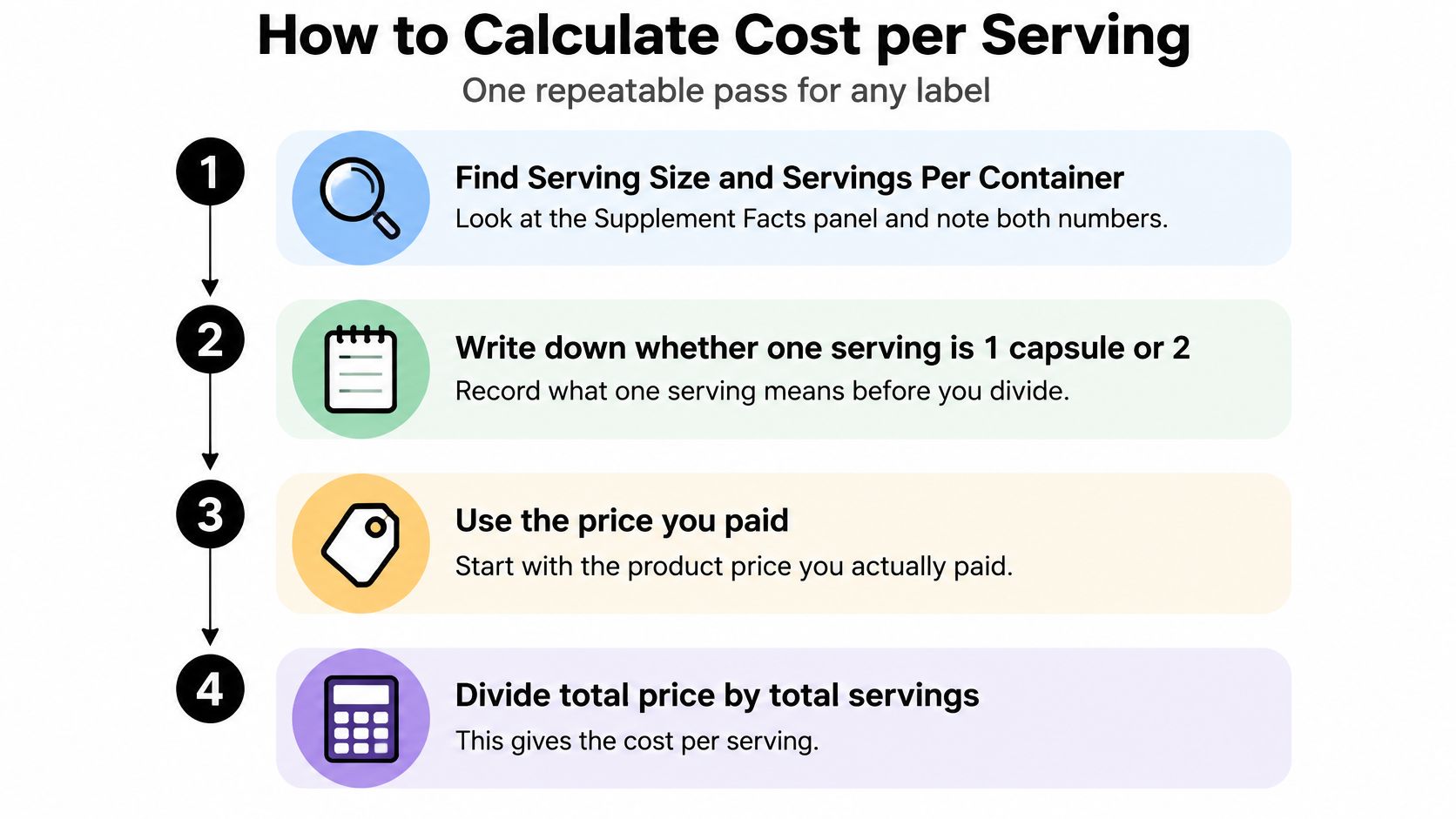
Make one repeatable pass
- Record the serving size and servings per container. Find both on the Supplement Facts panel. Write down how many capsules make one serving. The large capsule count on the front of the bottle is not the serving count.
- Copy the price for your purchase. Use the active sale price if it applies. A subscription offer, expired promotion, or crossed-out price may not be what you pay.
- Divide price by labeled servings. Use the price you copied as the numerator and the container's labeled servings as the denominator. Keep the calculator result unrounded until the final step. This gives you a repeatable way to compare bottles without relying on a price-per-capsule shortcut.
- Estimate your routine. Multiply the unrounded cost per serving by the servings you expect to take each day, then by 30 for a consistent monthly planning window. Follow the product directions or your healthcare professional's guidance when deciding how many servings to take.
- Check capsule arithmetic separately. For a product with two capsules per serving, multiply the capsule count per serving by the number of servings. This checks whether the total matches the container, but the serving count remains the denominator in the cost calculation.
Keep ingredient amount on its own line
The amino formula provides 400 mg of L-arginine hydrochloride per serving. Record that amount separately from the serving's cost. The milligrams describe an ingredient; the price describes the complete serving.
Cost per milligram requires an additional conversion. A larger milligram figure by itself does not show whether a formula suits your needs.
Quick check: Your note should include price, servings per container, capsules per serving, and the final rounded cost per serving. Add units as you go, so each figure stays clear when you compare another bottle.
For adjacent products such as tea powders, check origin and packaging before ordering to keep attention on what you are buying as well as its price.
Treat the monthly number as a consumption estimate, not a payment schedule. A bottle bought today can outlast the planning window.
Shipping and Servings You Do Not Finish
The label calculation leaves out delivery. For a more realistic figure, add the shipping shown at checkout to the product price before dividing. Include applicable taxes or unavoidable purchasing charges when you want an all-in comparison.
We calculate shipping at checkout, and orders over $49 qualify for free shipping. A single $14.99 vitamin bottle doesn't reach that threshold. Include whatever shipping checkout quotes rather than guessing a delivery fee.
Compare the cart you intend to buy
Combining bottles only removes shipping when the merchandise total qualifies. Don't assume a pair of bottles clears the threshold, and don't add an unwanted product solely to make delivery free.
- Single-product order: Assign the shipping charge to that purchase.
- Mixed cart: Allocate delivery consistently, such as in proportion to each item's merchandise price.
- Qualifying cart: Use the free-shipping result shown at checkout, without adding a fictional delivery cost.
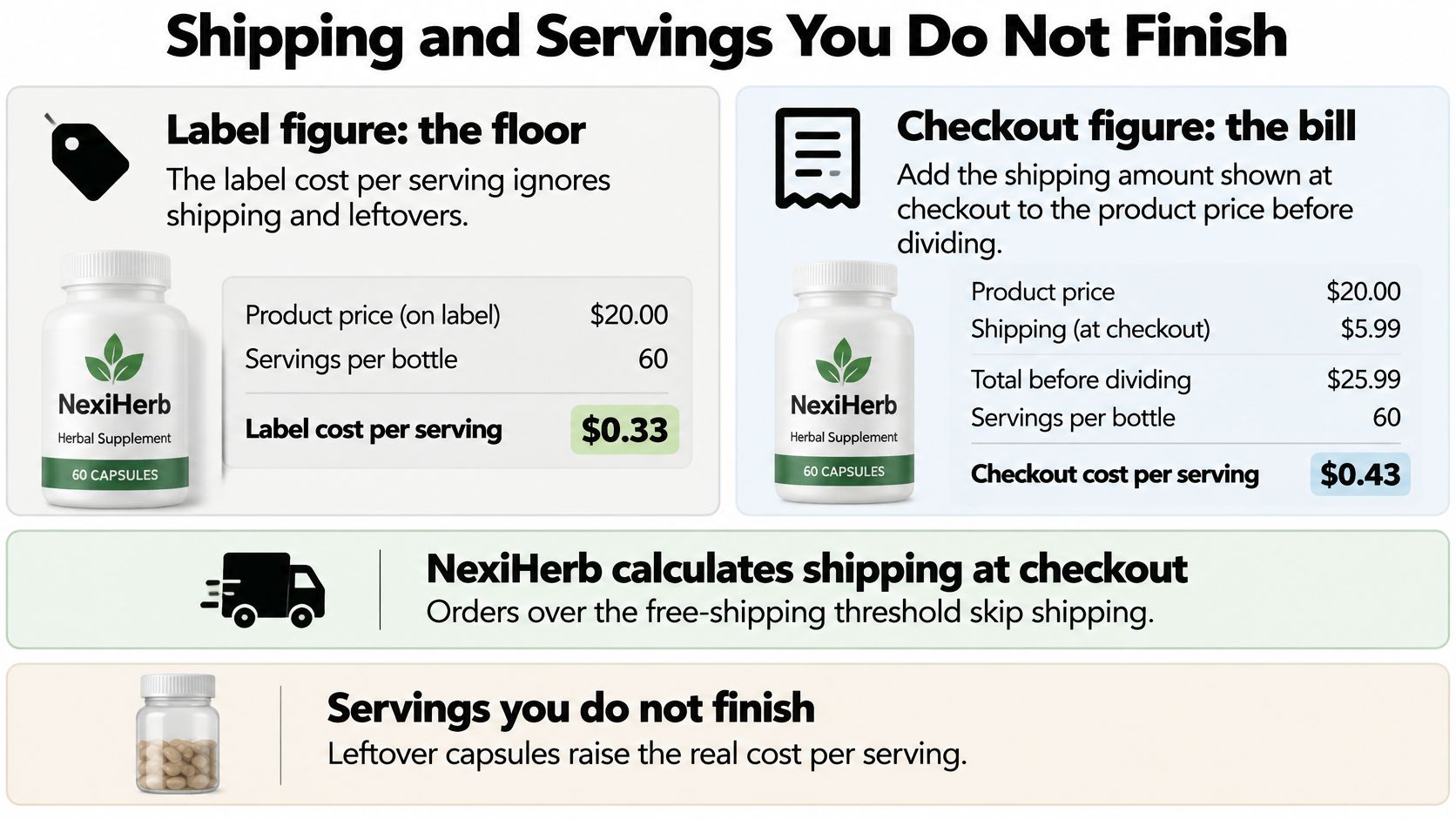
Count the servings you finish
Food budgeting illustrates why the denominator matters: the U.S. Environmental Protection Agency estimates that consumers lose $728 per person annually on food they purchase but don't eat. That's a food-waste estimate, not a supplement-waste estimate, but the purchasing lesson applies to a half-used bottle.
Say you take only 24 servings from the $22.99 amino bottle and abandon the rest. In that hypothetical scenario, $22.99 ÷ 24 = approximately $0.96 per consumed serving, before shipping.
For supplements, a clean formula is:
Effective cost per consumed serving = total purchase cost, including unavoidable extras, ÷ servings taken.
The full bottle price already includes what you paid for unused capsules. Don't add the value of those capsules again as a separate waste charge, or you'll double-count the loss.
Skipped days alone don't necessarily increase the cost per finished serving. If you eventually finish the bottle, you've delayed consumption rather than wasted it. The denominator shrinks when servings remain unused permanently.
With powders, consistent measurement matters too. Our guide to taking herbal powders offers practical context for building a repeatable routine.
Divide by the servings you reasonably expect to finish, not the number that makes the container look cheapest.
Compare Bottles With Unlike Servings
A capsule count alone does not tell you what a serving costs. Compare products only after checking what each labeled portion contains and whether the products serve a similar purpose. A daily multivitamin and an amino-acid blend, for example, are different routines even if both come in capsules.
Keep listed cost, standardized cost, and cost per consumed serving distinct. Listed cost uses the label's serving size. Standardized cost adjusts for a named ingredient amount, while cost per consumed serving reflects the servings you expect to take.
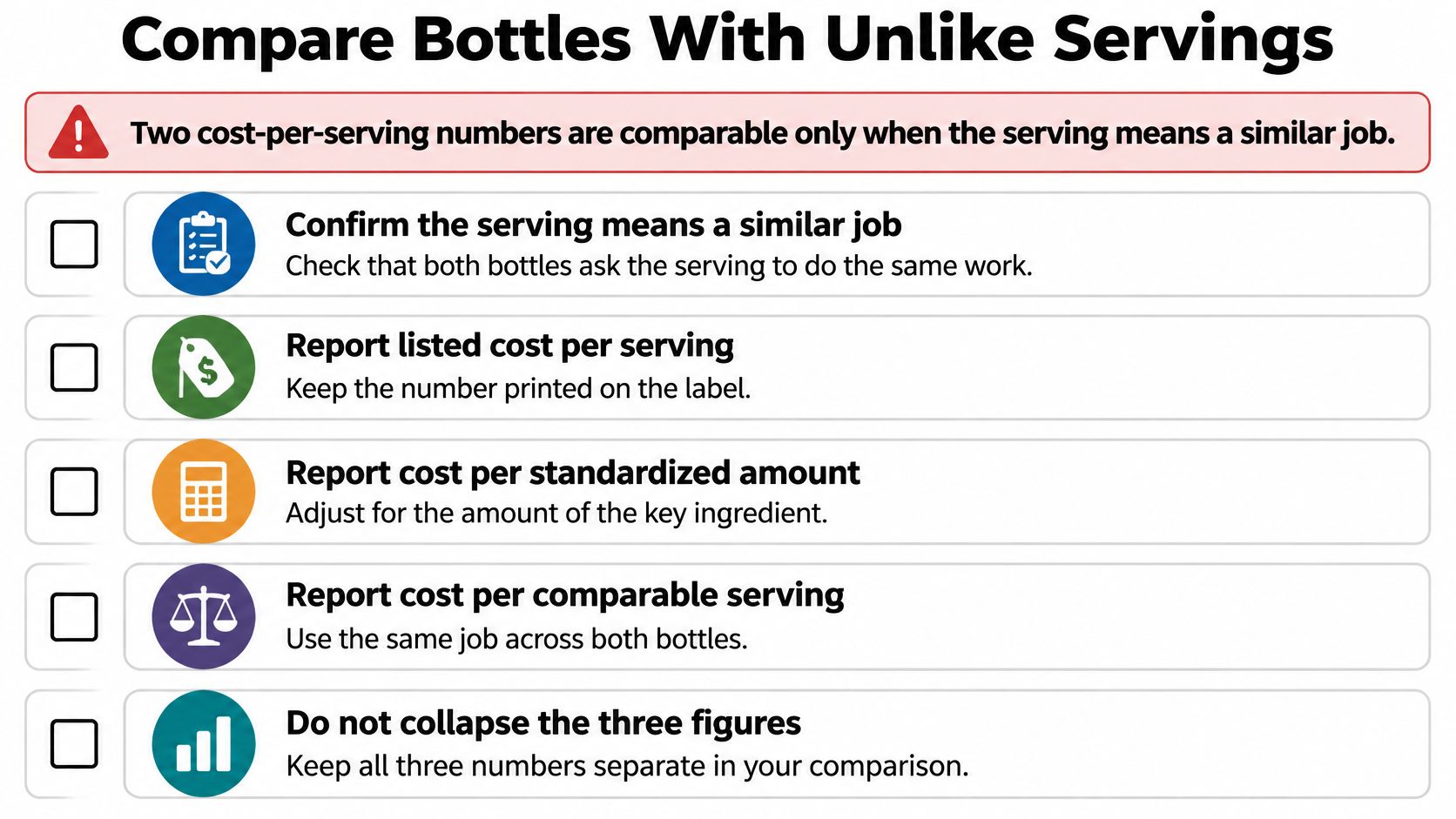
Standardize only what you can meaningfully compare
For the amino example, divide its unrounded sale-price serving cost by 400 mg, then multiply by 1,000 mg. The result is approximately $1.92 per 1,000 mg of L-arginine hydrochloride. This assigns part of the whole formula's cost to that named ingredient; it does not reveal the ingredient's standalone price or recommend taking that amount.
A once-daily herbal product offers a different reference point. Maca Power+ NexiHerb Herbal Dietary Supplement has a $17.99 sale price and 100 capsules. With one capsule per serving, that is about $0.18 per serving, or about $5.40 over 30 days. The daily outlay is lower, yet a different purpose and ingredient profile means this number cannot stand in for the amino formula's cost.
Capsules and gummies can also use different serving definitions. Consult this daily multivitamin gummy guide when comparing formats, and check the label before treating their servings as equivalent.
Match the purchase as well as the portion
For a multi-product bundle, don't divide the total price by the servings in only one bottle. Compare the combined routine over the same period, or clearly allocate the bundle cost across its components.
Budget context can help explain why careful comparisons matter. The USDA Economic Research Service reports that U.S. food-at-home prices rose 2.3% in 2025, while food absorbed 9.7% of disposable personal income in 2025. These figures describe food budgets, not supplement-price trends.
Before comparing, check:
- Same goal: Choose products intended for a comparable routine.
- Same serving definition: Match portions and relevant ingredient forms.
- Sale price confirmed: Use the offer available to you.
- Shipping included: Compare the complete checkout cost.
- Unfinished servings removed: Base the comparison on servings you expect to take.
Choose the Bottle You Will Actually Finish
Choose the bottle with the lower cost per serving you'll finish for the goal you have. The cheapest front-label price can be a poor purchase if the portion doesn't match your needs or the routine doesn't suit you.
Consider the practical friction before buying. Can you comfortably follow the capsule directions? Does the routine fit your meals and schedule? A bottle that looks economical on paper isn't useful value if you're likely to leave it untouched.
Use a keep-or-skip rule
Keep a candidate when its serving information is clear, its current price fits your budget, and you can reasonably follow the labeled routine. Skip it for now when servings per container are missing or you can't establish what the advertised portion means. Missing information is a reason to pause, not a reason to guess.
That distinction between affordability and suitability applies outside nutrition too. Buy Me Japan's affordable Japanese skincare picks offers a separate shopping reference for readers reviewing another everyday-care category. A budget shortlist still needs to fit the person using it.
Buying decision: Prefer a routine you can sustain over a larger supply you're unlikely to use.
Run the same label-and-checkout process on the next NexiHerb bottle you're considering. Keep the daily planning cost beside the actual purchase price so you don't mistake a manageable consumption cost for a smaller bill today.
Before adding the bottle, make one note: price, servings per container, capsules per serving, and whether your intended cart qualifies for free shipping. If any entry is unclear, leave the purchase undecided until you can complete it.
NexiHerb LLC offers multivitamins, amino-acid formulas, and herbal supplements for everyday wellness routines. Visit NexiHerb LLC to review the Supplement Facts and current prices for the products you're considering, then calculate your cost per serving with the checkout shipping included.